GROUP MEMBERS:
SHIEKH ARSHAD ZAMAN BSCE-13-099
WAQAR KHAN BSCE-13-133
SUPERVISED BY:
FINAL YEAR PROJECT PROPOSAL
Analysis of RCC Beams using
ABAQUS
ABSTRACT
 Reinforced concrete (RC) has become one of
the most important building materials and is
widely used in many types of engineering
structures. For the efficient use of RCC it is
necessary to know the properties and the
behavior of RCC elements under various
constrains.
 The development of reliable analytical models
can reduce the number of required test
specimens for the solution of a given problem,
recognizing that tests are time-consuming and
costly and often do not simulate exactly the
loading and support conditions of the actual
ABSRACT(CONT)
 The aim of the present study is to compare
experimental results with the ABAQUS results.
Initially Laboratory tests are carried out on a
beam of 1200 x 200 x100 mm of M30 grade
concrete for plain, under, balanced, over
reinforced sections
 Finite Element Analysis (FEA) have also been
performed using ABAQUS for the model
geometry considered in the experimental study.
The numerical results from the FEA are compared
with the experimental results which showed good
agreement between the results.
INTRODUCTION
 A concrete beam is a structural element that
carries load primarily in bending. The loads
carried by a beam are transferred to columns,
walls, which is then transferred to foundations.
The compression section must be designed to
resist buckling and crushing, while the tension
section must be able to adequately resist to the
tension. Experimental based testing has been
widely used as a means to analyze individual
elements and the effects of concrete strength
under loading
DESIGN CRITERIA
 Concrete structure must satisfy the following
conditions:
 The structure must be strong and safe.
 The structure must be stiff and appear
unblemished.
 The structure must be economical. Advanced
analytical tools can be an indispensable aid in the
assessment of the safety and the serviceability of
a proposed design. Intimately related to the
increase in scale of modern structures is the
extent and impact of disaster in terms of human
and economic loss in the event of structural
failure. As a result, careful and detailed structural
safety analysis becomes more and more
EXPERIMENTAL PROCEDURE
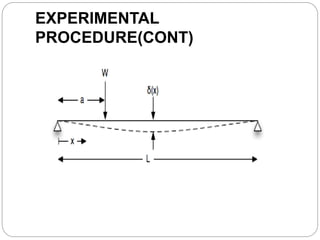
 After completion of 28 days curing the beams
were subjected to three point loading by using
UTM. Dial gauges were arranged to the bottom of
beam. And hydraulic load is applied linearly we
measure the deflection of beam at each interval
of 5KN load , and also observe the first crack at
which load and corresponding deflection this
process is continue for all beams and also note
the ultimate load with corresponding deflection for
all beam sections.
EXPERIMENTAL
PROCEDURE(CONT)
ABAQUS MODELLING
 On the basis of the central objectives of this
research, three dimensional Finite Element
models of reinforced concrete beam were
developed, and the various items concerned with
modeling is addressed as follows.
 Elements type x Material property
 Assigning sections
 Defining step
ABAQUS MODELLING (CONT)
 Interaction between elements
 Specify boundary conditions and load
 Meshing
 Assigning job
 Evaluating the results
ABACUS MODELING
CONCLUSION
 Deflections and stresses at the centerline along
with initial and progressive cracking of the finite
element model compare well to experimental data
obtained from a reinforced concrete beam.
 The ultimate load carrying capacity of Plane
concrete beam is 0.14 times under reinforced
beam
 . The failure mechanism of a reinforced concrete
beam is modeled quite well using FEA and the
failure load predicted is very close to the failure
load measured during experimental testing
CONCLUSION(CONT)
 From the analytical investigation it was observed
that under reinforced ratio is the best type of
reinforcement ratio among the others since it
shows greatest warning zone before failure
 In under reinforced beam maximum elements
reach ultimate stress compare to over reinforced
concrete beam.
 RCC design using Abaqus software

RCC design using Abaqus software

  • 2.
    GROUP MEMBERS: SHIEKH ARSHADZAMAN BSCE-13-099 WAQAR KHAN BSCE-13-133 SUPERVISED BY:
  • 3.
    FINAL YEAR PROJECTPROPOSAL Analysis of RCC Beams using ABAQUS
  • 4.
    ABSTRACT  Reinforced concrete(RC) has become one of the most important building materials and is widely used in many types of engineering structures. For the efficient use of RCC it is necessary to know the properties and the behavior of RCC elements under various constrains.  The development of reliable analytical models can reduce the number of required test specimens for the solution of a given problem, recognizing that tests are time-consuming and costly and often do not simulate exactly the loading and support conditions of the actual
  • 5.
    ABSRACT(CONT)  The aimof the present study is to compare experimental results with the ABAQUS results. Initially Laboratory tests are carried out on a beam of 1200 x 200 x100 mm of M30 grade concrete for plain, under, balanced, over reinforced sections  Finite Element Analysis (FEA) have also been performed using ABAQUS for the model geometry considered in the experimental study. The numerical results from the FEA are compared with the experimental results which showed good agreement between the results.
  • 6.
    INTRODUCTION  A concretebeam is a structural element that carries load primarily in bending. The loads carried by a beam are transferred to columns, walls, which is then transferred to foundations. The compression section must be designed to resist buckling and crushing, while the tension section must be able to adequately resist to the tension. Experimental based testing has been widely used as a means to analyze individual elements and the effects of concrete strength under loading
  • 7.
    DESIGN CRITERIA  Concretestructure must satisfy the following conditions:  The structure must be strong and safe.  The structure must be stiff and appear unblemished.  The structure must be economical. Advanced analytical tools can be an indispensable aid in the assessment of the safety and the serviceability of a proposed design. Intimately related to the increase in scale of modern structures is the extent and impact of disaster in terms of human and economic loss in the event of structural failure. As a result, careful and detailed structural safety analysis becomes more and more
  • 8.
    EXPERIMENTAL PROCEDURE  Aftercompletion of 28 days curing the beams were subjected to three point loading by using UTM. Dial gauges were arranged to the bottom of beam. And hydraulic load is applied linearly we measure the deflection of beam at each interval of 5KN load , and also observe the first crack at which load and corresponding deflection this process is continue for all beams and also note the ultimate load with corresponding deflection for all beam sections.
  • 9.
  • 10.
    ABAQUS MODELLING  Onthe basis of the central objectives of this research, three dimensional Finite Element models of reinforced concrete beam were developed, and the various items concerned with modeling is addressed as follows.  Elements type x Material property  Assigning sections  Defining step
  • 11.
    ABAQUS MODELLING (CONT) Interaction between elements  Specify boundary conditions and load  Meshing  Assigning job  Evaluating the results
  • 12.
  • 13.
    CONCLUSION  Deflections andstresses at the centerline along with initial and progressive cracking of the finite element model compare well to experimental data obtained from a reinforced concrete beam.  The ultimate load carrying capacity of Plane concrete beam is 0.14 times under reinforced beam  . The failure mechanism of a reinforced concrete beam is modeled quite well using FEA and the failure load predicted is very close to the failure load measured during experimental testing
  • 14.
    CONCLUSION(CONT)  From theanalytical investigation it was observed that under reinforced ratio is the best type of reinforcement ratio among the others since it shows greatest warning zone before failure  In under reinforced beam maximum elements reach ultimate stress compare to over reinforced concrete beam.