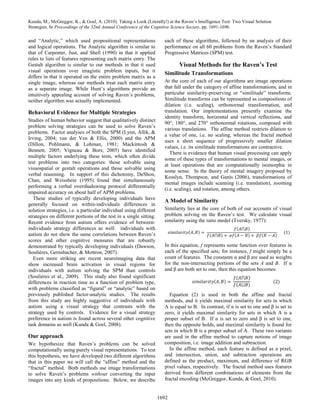
Kunda, M., McGreggor, K., & Goel, A. (2010). Taking a Look (Literally!) at the Raven’s Intelligence Test: Two Visual Solution
Strategies. In Proceedings of the 32nd Annual Conference of the Cognitive Science Society, pp. 1691-1696.


                    Taking a Look (Literally!) at the Raven’s Intelligence Test:
                                 Two Visual Solution Strategies
                                        Maithilee Kunda (mkunda@gatech.edu)
                                    Keith McGreggor (keith.mcgreggor@gatech.edu)
                                           Ashok Goel (goel@cc.gatech.edu)
             Design & Intelligence Laboratory, School of Interactive Computing, Georgia Institute of Technology
                                       85 Fifth Street NW, Atlanta, GA 30332 USA


                           Abstract                                   over which various kinds of reasoning then take place. In
                                                                      this paper, we provide evidence from two different methods
  The Raven’s Progressive Matrices intelligence test is widely
  used as a measure of Spearman’s general intelligence factor g.      that Raven’s problems can be solved visually, without first
  Although Raven’s problems resemble geometric analogies,             converting problem inputs into propositional descriptions.
  prior computational accounts of solving the test have been
  propositional. Studies of both typical and atypical human           Existing Computational Accounts
  behavior suggest the possible existence of visual strategies;
  for example, neuroimaging data indicates that individuals
                                                                      Carpenter, Just, and Shell (1990) used a production system
  with autism may preferentially recruit visual processing brain      that took hand-coded symbolic descriptions of problems
  regions when solving the test. We present two different             from the Advanced Progressive Matrices (APM) test and
  algorithms that use visual representations to solve Raven’s         then selected an appropriate rule to solve each problem. The
  problems. These algorithms yield performances on the                rules were generated by the authors from a priori inspection
  Standard Progressive Matrices test at levels equivalent to          of the APM and were validated in experimental studies of
  typically developing 9.5- and 10.5- year-olds. We find that         subjects taking the test with verbal reporting protocols.
  these algorithms perform most strongly on problems
  identified from factor-analytic human studies as requiring          Bringsjord and Schimanski (2003) used a theorem-prover to
  gestalt or visuospatial operations, and less so on problems         solve selected Raven's problems stated in first-order logic.
  requiring verbal reasoning. We discuss implications of this            Lovett, Forbus, and Usher (2007) combined automated
  work for understanding the computational nature of Raven’s          sketch understanding with the structure-mapping analogy
  and visual analogy in problem solving.                              technique to solve problems from the Standard Progressive
  Keywords: Analogy; intelligence tests;            knowledge         Matrices (SPM) test. Their system took as inputs problem
  representations; mental imagery; Raven’s          Progressive       entries sketched in Powerpoint as segmented shape objects
  Matrices; visual reasoning.                                         and then automatically translated these shapes into
                                                                      propositional descriptions. A two-stage structure-mapping
                       Introduction                                   process was then used to select the answer that most closely
The Raven’s Progressive Matrices tests (Raven, Raven, &               fulfilled inferred analogical relations from the matrix.
Court, 1998) are a collection of standardized intelligence               In contrast to these propositional approaches, Hunt (1974)
tests that consist of geometric analogy problems in which a           proposed the existence of two qualitatively different
matrix of geometric figures is presented with one entry               strategies: “Gestalt,” which used visual representations and
missing, and the correct missing entry must be selected from          perceptual operations like continuation and superposition,
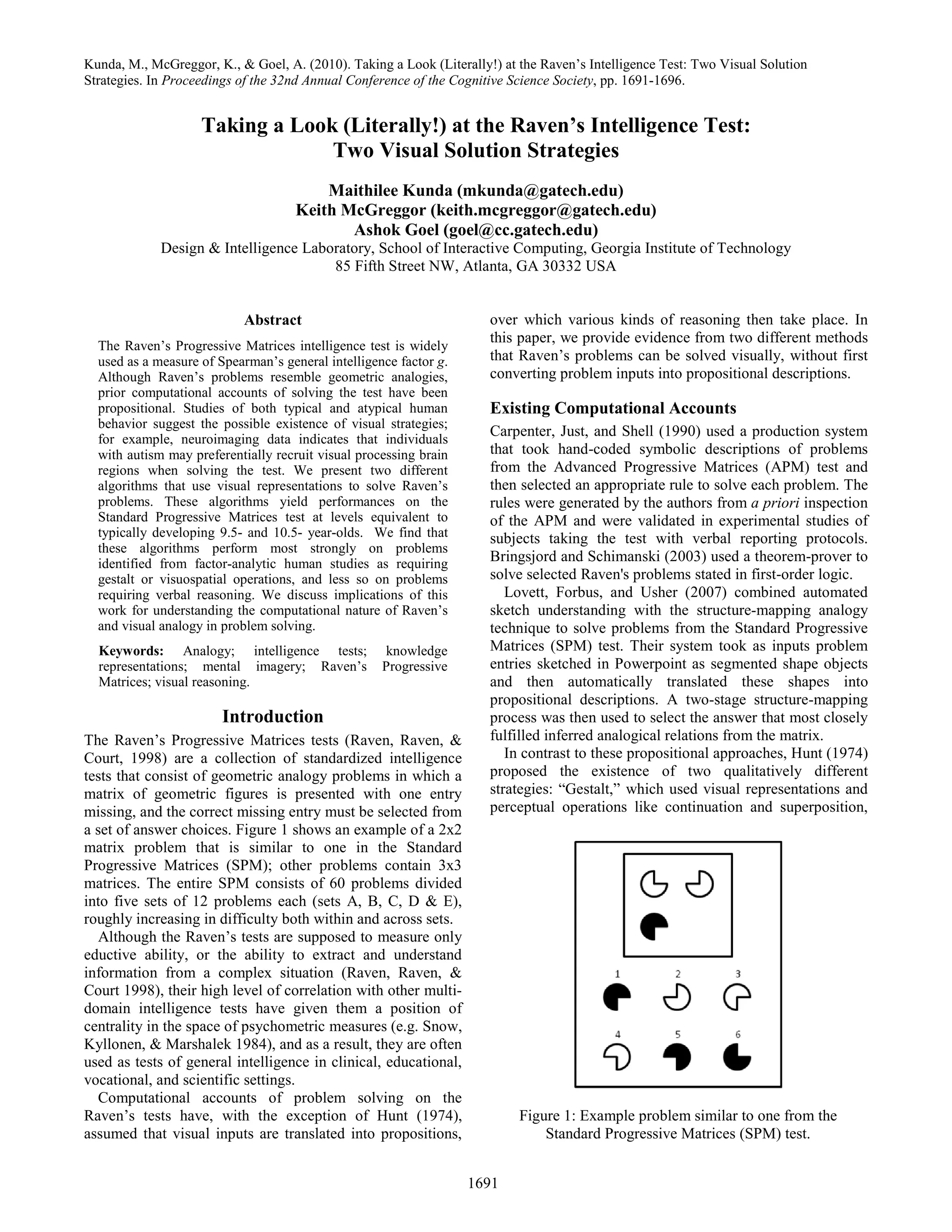
a set of answer choices. Figure 1 shows an example of a 2x2
matrix problem that is similar to one in the Standard
Progressive Matrices (SPM); other problems contain 3x3
matrices. The entire SPM consists of 60 problems divided
into five sets of 12 problems each (sets A, B, C, D & E),
roughly increasing in difficulty both within and across sets.
  Although the Raven’s tests are supposed to measure only
eductive ability, or the ability to extract and understand
information from a complex situation (Raven, Raven, &
Court 1998), their high level of correlation with other multi-
domain intelligence tests have given them a position of
centrality in the space of psychometric measures (e.g. Snow,
Kyllonen, & Marshalek 1984), and as a result, they are often
used as tests of general intelligence in clinical, educational,
vocational, and scientific settings.
  Computational accounts of problem solving on the
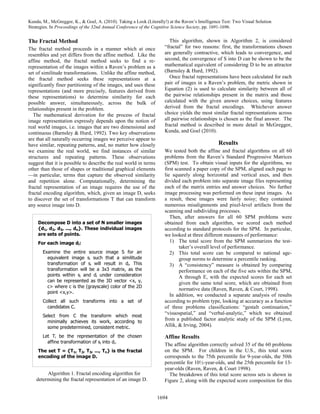
Raven’s tests have, with the exception of Hunt (1974),                     Figure 1: Example problem similar to one from the
assumed that visual inputs are translated into propositions,                   Standard Progressive Matrices (SPM) test.


                                                                   1691
Kunda, M., McGreggor, K., & Goel, A. (2010). Taking a Look (Literally!) at the Raven’s Intelligence Test: Two Visual Solution
Strategies. In Proceedings of the 32nd Annual Conference of the Cognitive Science Society, pp. 1691-1696.

and “Analytic,” which used propositional representations              each of these algorithms, followed by an analysis of their
and logical operations. The Analytic algorithm is similar to          performance on all 60 problems from the Raven’s Standard
that of Carpenter, Just, and Shell (1990) in that it applied          Progressive Matrices (SPM) test.
rules to lists of features representing each matrix entry. The
Gestalt algorithm is similar to our methods in that it used                  Visual Methods for the Raven’s Test
visual operations over imagistic problem inputs, but it
                                                                      Similitude Transformations
differs in that it operated on the entire problem matrix as a
single image, whereas our methods treat each matrix entry             At the core of each of our algorithms are image operations
as a separate image. While Hunt’s algorithms provide an               that fall under the category of affine transformations, and in
intuitively appealing account of solving Raven’s problems,            particular similarity-preserving or “similitude” transforms.
neither algorithm was actually implemented.                           Similitude transforms can be represented as compositions of
                                                                      dilation (i.e. scaling), orthonormal transformation, and
Behavioral Evidence for Multiple Strategies                           translation. Our implementations presently examine the
                                                                      identity transform, horizontal and vertical reflections, and
Studies of human behavior suggest that qualitatively distinct
                                                                      90°, 180°, and 270° orthonormal rotations, composed with
problem solving strategies can be used to solve Raven’s
                                                                      various translations. The affine method restricts dilation to
problems. Factor analyses of both the SPM (Lynn, Allik, &
                                                                      a value of one, i.e. no scaling, whereas the fractal method
Irving, 2004; van der Ven & Ellis, 2000) and the APM
                                                                      uses a short sequence of progressively smaller dilation
(Dillon, Pohlmann, & Lohman, 1981; Mackintosh &
                                                                      values, i.e. its similitude transformations are contractive.
Bennett, 2005; Vigneau & Bors, 2005) have identified
                                                                         There is evidence that human visual processing can apply
multiple factors underlying these tests, which often divide
                                                                      some of these types of transformations to mental images, or
test problems into two categories: those solvable using
                                                                      at least operations that are computationally isomorphic in
visuospatial or gestalt operations and those solvable using
                                                                      some sense. In the theory of mental imagery proposed by
verbal reasoning. In support of this dichotomy, DeShon,
                                                                      Kosslyn, Thompson, and Ganis (2006), transformations of
Chan, and Weissbein (1995) found that simultaneously
                                                                      mental images include scanning (i.e. translation), zooming
performing a verbal overshadowing protocol differentially
                                                                      (i.e. scaling), and rotation, among others.
impaired accuracy on about half of APM problems.
   These studies of typically developing individuals have             A Model of Similarity
generally focused on within-individuals differences in
solution strategies, i.e. a particular individual using different     Similarity lies at the core of both of our accounts of visual
strategies on different portions of the test in a single sitting.     problem solving on the Raven’s test. We calculate visual
Recent evidence from autism offers evidence of between-               similarity using the ratio model (Tversky, 1977):
individuals strategy differences as well: individuals with                                                     ⋂
autism do not show the same correlations between Raven’s                            ,   =                                           1
                                                                                               ⋂       +       −   +       −
scores and other cognitive measures that are robustly
demonstrated by typically developing individuals (Dawson,             In this equation, f represents some function over features in
Soulières, Gernsbacher, & Mottron, 2007).                             each of the specified sets; for instance, f might simply be a
   Even more striking are recent neuroimaging data that               count of features. The constants α and β are used as weights
show increased brain activation in visual regions for                 for the non-intersecting portions of the sets A and B. If α
individuals with autism solving the SPM than controls                 and β are both set to one, then this equation becomes:
(Soulières et al., 2009). This study also found significant                                                    ⋂
differences in reaction time as a function of problem type,                                        ,       =                    2
                                                                                                               ⋃
with problems classified as “figural” or “analytic” based on
previously published factor-analytic studies. The results                Equation (2) is used in both the affine and fractal
from this study are highly suggestive of individuals with             methods, and it yields maximal similarity for sets in which
autism using a visual strategy that contrasts with the                A is equal to B. In contrast, if α is set to one and β is set to
strategy used by controls. Evidence for a visual strategy             zero, it yields maximal similarity for sets in which A is a
preference in autism is found across several other cognitive          proper subset of B. If α is set to zero and β is set to one,
task domains as well (Kunda & Goel, 2008).                            then the opposite holds, and maximal similarity is found for
                                                                      sets in which B is a proper subset of A. These two variants
Our approach                                                          are used in the affine method to capture notions of image
We hypothesize that Raven’s problems can be solved                    composition, i.e. image addition and subtraction.
computationally using purely visual representations. To test             In the affine method, each feature is defined as a pixel,
this hypothesis, we have developed two different algorithms           and intersection, union, and subtraction operations are
that in this paper we will call the “affine” method and the           defined as the product, maximum, and difference of RGB
“fractal” method. Both methods use image transformations              pixel values, respectively. The fractal method uses features
to solve Raven’s problems without converting the input                derived from different combinations of elements from the
images into any kinds of propositions. Below, we describe             fractal encoding (McGreggor, Kunda, & Goel, 2010).


                                                                    1692
Kunda, M., McGreggor, K., & Goel, A. (2010). Taking a Look (Literally!) at the Raven’s Intelligence Test: Two Visual Solution
Strategies. In Proceedings of the 32nd Annual Conference of the Cognitive Science Society, pp. 1691-1696.


The Affine Method                                                          Table 1: Base transforms and matrix relationships used
The affine method assumes that elements within a row or                                  by the affine algorithm.
column in a Raven’s problem matrix are related by
similitude transformations. It tries to discover which                                                     2x2:             3x3:
similitude transformation best fits any of the complete rows
or columns in the matrix, and then applies this transform to                            Transforms
                                                                                                           A B            A B C
the last row/column to generate a guess for the answer.                                                    C ?            D E F
Then, it compares this guess to each of the answer choices,                                                               G H ?
and chooses the answer that is most similar.
   Each similitude transformation is represented as the                                   Identity
                                                                                                                     BC→H?      DG→F?
combination of three image operations: a base transform, a                     Two-        Mirror
                                                                                                                     AC→G?      AG→C?
translation, and a composition. Algorithm 1 shows how, for                  element         Flip         AB→C?
                                                                                                                     EF→H?      EH→F?
                                                                         transforms      Rotate90        AC→ B?
a pair of images A and B, these three components of the                                                              DF→G?      BH→C?
                                                                         & relations     Rotate180
“best-fit” similitude transformation are found. Given a                                                              GH→H?      CF→F?
                                                                                         Rotate270
Raven’s problem, then, the affine method seeks to discover
                                                                              Three-                                     ABC→GH?
the best-fit similitude transform over various combinations                 element
                                                                                           Union
                                                                                                                         DEF→GH?
of the matrix entries. In particular, the algorithm assumes                             Intersection        n/a
                                                                         transforms                                      ADG→CF?
that certain analogical relationships exist based on the                                    XOR
                                                                         & relations                                     BEH→CF?
spatial arrangement of the entries. Similitude transforms are
calculated for those combinations of entries that would yield
                                                                         For example, take the problem given in Figure 1. The
an analogical mapping to solve for the missing entry. The
specific base transforms and analogical relationships used            similarity scores calculated for the various transforms and
by the affine algorithm are shown in Table 1, divided into            relationships are shown in Table 2. The best-fit similitude
those used for 2x2 and for 3x3 matrix problems.                       transformation is found to be a mirror (or reflection about
                                                                      the vertical axis) for the relationship AB, using an addition
   Once the relationship and transformation are found that
maximize similarity, the transformation is applied to the             image composition (i.e. maximal similarity found using α =
first entry or entries in the last row or column, as listed in        1, β = 0). Therefore, the answer image “?” is obtained using
Table 1. The resulting image represents the algorithm’s best          the analogous relationship of A:B :: C?. C is mirrored,
                                                                      translated by the (tx, ty) that was found in the search, and
guess as to the missing entry. This image is compared to
the answer choices, using Equation (2), and the best match            the composition operand of B – A (which in this case is
is chosen as the final answer.                                        mostly a blank image) is added on to the result. Finally, this
                                                                      “guess” image is compared to each of the six answer
                                                                      choices using Equation (2), and the best match is chosen as
                                                                      the final answer, which in this case is answer #5.
     For each base transform T:
       Apply T to Image A.
       Find translation (tx, ty) which yields best                         Table 2: Calculation of best-fit similitude transform and
          match between T(A) and B, using Eq. (2).                       resulting answer guess for the problem shown in Figure 1.
       Find image composition operand X as follows:
          Calculate similarity using Eq. (1) with:                                                       α=1        α=1         α=0
              1) α = 1, β = 1                                            Relation       Transform
                                                                                                         β=1        β=0         β=1
              2) α = 1, β = 0                                                              Identity      0.475      0.644       0.644
              3) α = 0, β = 1
                                                                                             Mirror      0.963      0.981       0.981
          Choose maximum similarity value.
                                                                                               Flip      0.337      0.504       0.504
              If maximum is (1), then X = 0.                               AB
                                                                                          Rotate90       0.341      0.508       0.508
              If maximum is (2), then X = B – A,
                                                                                         Rotate180       0.453      0.624       0.624
                 and ⊕ refers to image addition.
              If maximum is (3), then X = A – B,                                         Rotate270       0.947      0.973       0.973
                 and ⊕ refers to image subtraction.                                        Identity      0.256      0.764       0.277
                                                                                             Mirror      0.252      0.759       0.274
     The best-fit similitude transformation can                                                Flip      0.335      0.951       0.341
     then be specified as:                                                  AC
                                                                                          Rotate90       0.331      0.941       0.338
                [Tmax+(tx, ty)](A) ⊕ X = B                                               Rotate180       0.257      0.771       0.279
                                                                                         Rotate270       0.250      0.752       0.273

      Algorithm 1. Affine method for calculating best-fit
                                                                                         Generated
  similitude transformation for a pair of images A and B.                                   guess:
   For three-element transforms, T is applied to images A
  and B, and the result is compared, as above, to image C.


                                                                  1693
Kunda, M., McGreggor, K., & Goel, A. (2010). Taking a Look (Literally!) at the Raven’s Intelligence Test: Two Visual Solution
Strategies. In Proceedings of the 32nd Annual Conference of the Cognitive Science Society, pp. 1691-1696.


The Fractal Method                                                       This algorithm, shown in Algorithm 2, is considered
The fractal method proceeds in a manner which at once                 “fractal” for two reasons: first, the transformations chosen
resembles and yet differs from the affine method. Like the            are generally contractive, which leads to convergence, and
affine method, the fractal method seeks to find a re-                 second, the convergence of S into D can be shown to be the
representation of the images within a Raven’s problem as a            mathematical equivalent of considering D to be an attractor
set of similitude transformations. Unlike the affine method,          (Barnsley & Hurd, 1992).
the fractal method seeks these representations at a                      Once fractal representations have been calculated for each
significantly finer partitioning of the images, and uses these        pair of images in a Raven’s problem, the metric shown in
representations (and more precisely, features derived from            Equation (2) is used to calculate similarity between all of
these representations) to determine similarity for each               the pairwise relationships present in the matrix and those
possible answer, simultaneously, across the bulk of                   calculated with the given answer choices, using features
relationships present in the problem.                                 derived from the fractal encodings. Whichever answer
   The mathematical derivation for the process of fractal             choice yields the most similar fractal representations across
image representation expressly depends upon the notion of             all pairwise relationships is chosen as the final answer. The
real world images, i.e. images that are two dimensional and           fractal method is described in more detail in McGreggor,
continuous (Barnsley & Hurd, 1992). Two key observations              Kunda, and Goel (2010).
are that all naturally occurring images we perceive appear to
have similar, repeating patterns, and, no matter how closely                                     Results
we examine the real world, we find instances of similar               We tested both the affine and fractal algorithms on all 60
structures and repeating patterns. These observations                 problems from the Raven’s Standard Progressive Matrices
suggest that it is possible to describe the real world in terms       (SPM) test. To obtain visual inputs for the algorithms, we
other than those of shapes or traditional graphical elements          first scanned a paper copy of the SPM, aligned each page to
—in particular, terms that capture the observed similarity            lie squarely along horizontal and vertical axes, and then
and repetition alone. Computationally, determining the                divided each problem into separate image files representing
fractal representation of an image requires the use of the            each of the matrix entries and answer choices. No further
fractal encoding algorithm, which, given an image D, seeks            image processing was performed on these input images. As
to discover the set of transformations T that can transform           a result, these images were fairly noisy; they contained
any source image into D.                                              numerous misalignments and pixel-level artifacts from the
                                                                      scanning and subdividing processes.
                                                                         Then, after answers for all 60 SPM problems were
     Decompose D into a set of N smaller images                       obtained from each algorithm, we scored each method
     {d1, d2, d3, ..., dn}. These individual images                   according to standard protocols for the SPM. In particular,
     are sets of points.                                              we looked at three different measures of performance:
     For each image di:                                                  1) The total score from the SPM summarizes the test-
                                                                              taker’s overall level of performance.
       Examine the entire source image S for an                          2) This total score can be compared to national age-
         equivalent image si such that a similitude                           group norms to determine a percentile ranking.
         transformation of si will result in di. This                    3) A “consistency” measure is obtained by comparing
         transformation will be a 3x3 matrix, as the                          performance on each of the five sets within the SPM,
         points within si and di under consideration                          A through E, with the expected scores for each set
         can be represented as the 3D vector <x, y,                           given the same total score, which are obtained from
         c> where c is the (grayscale) color of the 2D
                                                                              normative data (Raven, Raven, & Court, 1998).
         point <x,y>.
                                                                         In addition, we conducted a separate analysis of results
       Collect all such transforms into a set of                      according to problem type, looking at accuracy as a function
         candidates C.                                                of three problems classifications: “gestalt continuation,”
                                                                      “visuospatial,” and “verbal-analytic,” which we obtained
       Select from C the transform which most
         minimally achieves its work, according to
                                                                      from a published factor analytic study of the SPM (Lynn,
         some predetermined, consistent metric.                       Allik, & Irving, 2004).

       Let Ti be the representation of the chosen                     Affine Results
         affine transformation of si into di.
                                                                      The affine algorithm correctly solved 35 of the 60 problems
     The set T = {T1, T2, T3, ..., Tn} is the fractal                 on the SPM. For children in the U.S., this total score
     encoding of the image D.                                         corresponds to the 75th percentile for 9-year-olds, the 50th
                                                                      percentile for 10½-year-olds, and the 25th percentile for 13-
                                                                      year-olds (Raven, Raven, & Court 1998).
         Algorithm 1. Fractal encoding algorithm for                    The breakdown of this total score across sets is shown in
    determining the fractal representation of an image D.             Figure 2, along with the expected score composition for this


                                                                  1694
Kunda, M., McGreggor, K., & Goel, A. (2010). Taking a Look (Literally!) at the Raven’s Intelligence Test: Two Visual Solution
Strategies. In Proceedings of the 32nd Annual Conference of the Cognitive Science Society, pp. 1691-1696.


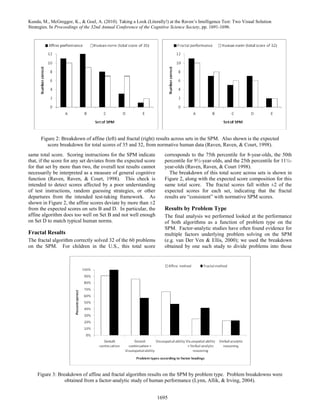
      Figure 2: Breakdown of affine (left) and fractal (right) results across sets in the SPM. Also shown is the expected
         score breakdown for total scores of 35 and 32, from normative human data (Raven, Raven, & Court, 1998).
same total score. Scoring instructions for the SPM indicate           corresponds to the 75th percentile for 8-year-olds, the 50th
that, if the score for any set deviates from the expected score       percentile for 9½-year-olds, and the 25th percentile for 11½-
for that set by more than two, the overall test results cannot        year-olds (Raven, Raven, & Court 1998).
necessarily be interpreted as a measure of general cognitive            The breakdown of this total score across sets is shown in
function (Raven, Raven, & Court, 1998). This check is                 Figure 2, along with the expected score composition for this
intended to detect scores affected by a poor understanding            same total score. The fractal scores fall within ±2 of the
of test instructions, random guessing strategies, or other            expected scores for each set, indicating that the fractal
departures from the intended test-taking framework. As                results are “consistent” with normative SPM scores.
shown in Figure 2, the affine scores deviate by more than ±2
from the expected scores on sets B and D. In particular, the          Results by Problem Type
affine algorithm does too well on Set B and not well enough           The final analysis we performed looked at the performance
on Set D to match typical human norms.                                of both algorithms as a function of problem type on the
                                                                      SPM. Factor-analytic studies have often found evidence for
Fractal Results                                                       multiple factors underlying problem solving on the SPM
The fractal algorithm correctly solved 32 of the 60 problems          (e.g. van Der Ven & Ellis, 2000); we used the breakdown
on the SPM. For children in the U.S., this total score                obtained by one such study to divide problems into those


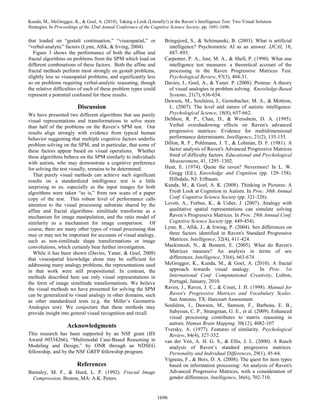
    Figure 3: Breakdown of affine and fractal algorithm results on the SPM by problem type. Problem breakdowns were
                 obtained from a factor-analytic study of human performance (Lynn, Allik, & Irving, 2004).


                                                                  1695
Kunda, M., McGreggor, K., & Goel, A. (2010). Taking a Look (Literally!) at the Raven’s Intelligence Test: Two Visual Solution
Strategies. In Proceedings of the 32nd Annual Conference of the Cognitive Science Society, pp. 1691-1696.

that loaded on “gestalt continuation,” “visuospatial,” or             Bringsjord, S., & Schimanski, B. (2003). What is artificial
“verbal-analytic” factors (Lynn, Allik, & Irving, 2004).                intelligence? Psychometric AI as an answer. IJCAI, 18,
   Figure 3 shows the performance of both the affine and                887–893.
fractal algorithms on problems from the SPM which load on             Carpenter, P. A., Just, M. A., & Shell, P. (1990). What one
different combinations of these factors. Both the affine and            intelligence test measures: a theoretical account of the
fractal methods perform most strongly on gestalt problems,              processing in the Raven Progressive Matrices Test.
slightly less so visuospatial problems, and significantly less          Psychological Review, 97(3), 404-31.
so on problems requiring verbal-analytic reasoning, though            Davies, J., Goel, A., & Yaner. P. (2008). Proteus: A theory
the relative difficulties of each of these problem types could          of visual analogies in problem solving. Knowledge-Based
represent a potential confound for these results.                       Systems, 21(7), 636-654.
                                                                      Dawson, M., Soulières, I., Gernsbacher, M. A., & Mottron,
                         Discussion                                     L. (2007). The level and nature of autistic intelligence.
We have presented two different algorithms that use purely              Psychological Science, 18(8), 657-662.
visual representations and transformations to solve more              DeShon, R. P., Chan, D., & Weissbein, D. A. (1995).
than half of the problems on the Raven’s SPM test. Our                  Verbal overshadowing effects on Raven's advanced
results align strongly with evidence from typical human                 progressive matrices: Evidence for multidimensional
behavior suggesting that multiple cognitive factors underlie            performance determinants. Intelligence, 21(2), 135-155.
problem solving on the SPM, and in particular, that some of           Dillon, R. F., Pohlmann, J. T., & Lohman, D. F. (1981). A
these factors appear based on visual operations. Whether                factor analysis of Raven's Advanced Progressive Matrices
these algorithms behave on the SPM similarly to individuals             freed of difficulty factors. Educational and Psychological
with autism, who may demonstrate a cognitive preference                 Measurement, 41, 1295–1302.
for solving the test visually, remains to be determined.              Hunt, E. (1974). Quote the raven? Nevermore! In L. W.
   That purely visual methods can achieve such significant              Gregg (Ed.), Knowledge and Cognition (pp. 129–158).
results on a standardized intelligence test is a little                 Hillsdale, NJ: Erlbaum.
surprising to us, especially as the input images for both             Kunda, M., & Goel, A. K. (2008). Thinking in Pictures: A
algorithms were taken “as is,” from raw scans of a paper                Fresh Look at Cognition in Autism. In Proc. 30th Annual
copy of the test. This robust level of performance calls                Conf. Cognitive Science Society (pp. 321-326).
attention to the visual processing substrate shared by the            Lovett, A., Forbus, K., & Usher, J. (2007). Analogy with
affine and fractal algorithms: similitude transforms as a               qualitative spatial representations can simulate solving
mechanism for image manipulation, and the ratio model of                Raven’s Progressive Matrices. In Proc. 29th Annual Conf.
similarity as a mechanism for image comparison. Of                      Cognitive Science Society (pp. 449-454).
course, there are many other types of visual processing that          Lynn, R., Allik, J., & Irwing, P. (2004). Sex differences on
may or may not be important for accounts of visual analogy,             three factors identified in Raven's Standard Progressive
such as non-similitude shape transformations or image                   Matrices. Intelligence, 32(4), 411-424.
convolutions, which certainly bear further investigation.             Mackintosh, N., & Bennett, E. (2005). What do Raven's
   While it has been shown (Davies, Yaner, & Goel, 2008)                Matrices measure? An analysis in terms of sex
that visuospatial knowledge alone may be sufficient for                 differences. Intelligence, 33(6), 663-674.
addressing many analogy problems, the representations used            McGreggor, K., Kunda, M., & Goel, A. (2010). A fractal
in that work were still propositional. In contrast, the                 approach towards visual analogy.            In Proc. 1st
methods described here use only visual representations in               International Conf. Computational Creativity, Lisbon,
the form of image similitude transformations. We believe                Portugal, January, 2010.
the visual methods we have presented for solving the SPM              Raven, J., Raven, J. C., & Court, J. H. (1998). Manual for
can be generalized to visual analogy in other domains, such             Raven's Progressive Matrices and Vocabulary Scales.
as other standardized tests (e.g. the Miller’s Geometric                San Antonio, TX: Harcourt Assessment.
Analogies test). We conjecture that these methods may                 Soulières, I., Dawson, M., Samson, F., Barbeau, E. B.,
provide insight into general visual recognition and recall.             Sahyoun, C. P., Strangman, G. E., et al. (2009). Enhanced
                                                                        visual processing contributes to matrix reasoning in
                                                                        autism. Human Brain Mapping. 30(12), 4082-107
                    Acknowledgments
                                                                      Tversky, A. (1977). Features of similarity. Psychological
This research has been supported by an NSF grant (IIS                   Review, 84(4), 327-352.
Award #0534266), “Multimodal Case-Based Reasoning in                  van der Ven, A. H. G. S., & Ellis, J. L. (2000). A Rasch
Modeling and Design,” by ONR through an NDSEG                           analysis of Raven’s standard progressive matrices.
fellowship, and by the NSF GRFP fellowship program.                     Personality and Individual Differences, 29(1), 45-64.
                                                                      Vigneau, F., & Bors, D. A. (2008). The quest for item types
                         References                                     based on information processing: An analysis of Raven's
Barnsley, M. F., & Hurd, L. P. (1992). Fractal Image                    Advanced Progressive Matrices, with a consideration of
  Compression. Boston, MA: A.K. Peters.                                 gender differences. Intelligence, 36(6), 702-710.


                                                                  1696

Ravens intelligence test

  • 1.
    Kunda, M., McGreggor,K., & Goel, A. (2010). Taking a Look (Literally!) at the Raven’s Intelligence Test: Two Visual Solution Strategies. In Proceedings of the 32nd Annual Conference of the Cognitive Science Society, pp. 1691-1696. Taking a Look (Literally!) at the Raven’s Intelligence Test: Two Visual Solution Strategies Maithilee Kunda (mkunda@gatech.edu) Keith McGreggor (keith.mcgreggor@gatech.edu) Ashok Goel (goel@cc.gatech.edu) Design & Intelligence Laboratory, School of Interactive Computing, Georgia Institute of Technology 85 Fifth Street NW, Atlanta, GA 30332 USA Abstract over which various kinds of reasoning then take place. In this paper, we provide evidence from two different methods The Raven’s Progressive Matrices intelligence test is widely used as a measure of Spearman’s general intelligence factor g. that Raven’s problems can be solved visually, without first Although Raven’s problems resemble geometric analogies, converting problem inputs into propositional descriptions. prior computational accounts of solving the test have been propositional. Studies of both typical and atypical human Existing Computational Accounts behavior suggest the possible existence of visual strategies; for example, neuroimaging data indicates that individuals Carpenter, Just, and Shell (1990) used a production system with autism may preferentially recruit visual processing brain that took hand-coded symbolic descriptions of problems regions when solving the test. We present two different from the Advanced Progressive Matrices (APM) test and algorithms that use visual representations to solve Raven’s then selected an appropriate rule to solve each problem. The problems. These algorithms yield performances on the rules were generated by the authors from a priori inspection Standard Progressive Matrices test at levels equivalent to of the APM and were validated in experimental studies of typically developing 9.5- and 10.5- year-olds. We find that subjects taking the test with verbal reporting protocols. these algorithms perform most strongly on problems identified from factor-analytic human studies as requiring Bringsjord and Schimanski (2003) used a theorem-prover to gestalt or visuospatial operations, and less so on problems solve selected Raven's problems stated in first-order logic. requiring verbal reasoning. We discuss implications of this Lovett, Forbus, and Usher (2007) combined automated work for understanding the computational nature of Raven’s sketch understanding with the structure-mapping analogy and visual analogy in problem solving. technique to solve problems from the Standard Progressive Keywords: Analogy; intelligence tests; knowledge Matrices (SPM) test. Their system took as inputs problem representations; mental imagery; Raven’s Progressive entries sketched in Powerpoint as segmented shape objects Matrices; visual reasoning. and then automatically translated these shapes into propositional descriptions. A two-stage structure-mapping Introduction process was then used to select the answer that most closely The Raven’s Progressive Matrices tests (Raven, Raven, & fulfilled inferred analogical relations from the matrix. Court, 1998) are a collection of standardized intelligence In contrast to these propositional approaches, Hunt (1974) tests that consist of geometric analogy problems in which a proposed the existence of two qualitatively different matrix of geometric figures is presented with one entry strategies: “Gestalt,” which used visual representations and missing, and the correct missing entry must be selected from perceptual operations like continuation and superposition, a set of answer choices. Figure 1 shows an example of a 2x2 matrix problem that is similar to one in the Standard Progressive Matrices (SPM); other problems contain 3x3 matrices. The entire SPM consists of 60 problems divided into five sets of 12 problems each (sets A, B, C, D & E), roughly increasing in difficulty both within and across sets. Although the Raven’s tests are supposed to measure only eductive ability, or the ability to extract and understand information from a complex situation (Raven, Raven, & Court 1998), their high level of correlation with other multi- domain intelligence tests have given them a position of centrality in the space of psychometric measures (e.g. Snow, Kyllonen, & Marshalek 1984), and as a result, they are often used as tests of general intelligence in clinical, educational, vocational, and scientific settings. Computational accounts of problem solving on the Raven’s tests have, with the exception of Hunt (1974), Figure 1: Example problem similar to one from the assumed that visual inputs are translated into propositions, Standard Progressive Matrices (SPM) test. 1691
  • 2.
    Kunda, M., McGreggor,K., & Goel, A. (2010). Taking a Look (Literally!) at the Raven’s Intelligence Test: Two Visual Solution Strategies. In Proceedings of the 32nd Annual Conference of the Cognitive Science Society, pp. 1691-1696. and “Analytic,” which used propositional representations each of these algorithms, followed by an analysis of their and logical operations. The Analytic algorithm is similar to performance on all 60 problems from the Raven’s Standard that of Carpenter, Just, and Shell (1990) in that it applied Progressive Matrices (SPM) test. rules to lists of features representing each matrix entry. The Gestalt algorithm is similar to our methods in that it used Visual Methods for the Raven’s Test visual operations over imagistic problem inputs, but it Similitude Transformations differs in that it operated on the entire problem matrix as a single image, whereas our methods treat each matrix entry At the core of each of our algorithms are image operations as a separate image. While Hunt’s algorithms provide an that fall under the category of affine transformations, and in intuitively appealing account of solving Raven’s problems, particular similarity-preserving or “similitude” transforms. neither algorithm was actually implemented. Similitude transforms can be represented as compositions of dilation (i.e. scaling), orthonormal transformation, and Behavioral Evidence for Multiple Strategies translation. Our implementations presently examine the identity transform, horizontal and vertical reflections, and Studies of human behavior suggest that qualitatively distinct 90°, 180°, and 270° orthonormal rotations, composed with problem solving strategies can be used to solve Raven’s various translations. The affine method restricts dilation to problems. Factor analyses of both the SPM (Lynn, Allik, & a value of one, i.e. no scaling, whereas the fractal method Irving, 2004; van der Ven & Ellis, 2000) and the APM uses a short sequence of progressively smaller dilation (Dillon, Pohlmann, & Lohman, 1981; Mackintosh & values, i.e. its similitude transformations are contractive. Bennett, 2005; Vigneau & Bors, 2005) have identified There is evidence that human visual processing can apply multiple factors underlying these tests, which often divide some of these types of transformations to mental images, or test problems into two categories: those solvable using at least operations that are computationally isomorphic in visuospatial or gestalt operations and those solvable using some sense. In the theory of mental imagery proposed by verbal reasoning. In support of this dichotomy, DeShon, Kosslyn, Thompson, and Ganis (2006), transformations of Chan, and Weissbein (1995) found that simultaneously mental images include scanning (i.e. translation), zooming performing a verbal overshadowing protocol differentially (i.e. scaling), and rotation, among others. impaired accuracy on about half of APM problems. These studies of typically developing individuals have A Model of Similarity generally focused on within-individuals differences in solution strategies, i.e. a particular individual using different Similarity lies at the core of both of our accounts of visual strategies on different portions of the test in a single sitting. problem solving on the Raven’s test. We calculate visual Recent evidence from autism offers evidence of between- similarity using the ratio model (Tversky, 1977): individuals strategy differences as well: individuals with ⋂ autism do not show the same correlations between Raven’s , = 1 ⋂ + − + − scores and other cognitive measures that are robustly demonstrated by typically developing individuals (Dawson, In this equation, f represents some function over features in Soulières, Gernsbacher, & Mottron, 2007). each of the specified sets; for instance, f might simply be a Even more striking are recent neuroimaging data that count of features. The constants α and β are used as weights show increased brain activation in visual regions for for the non-intersecting portions of the sets A and B. If α individuals with autism solving the SPM than controls and β are both set to one, then this equation becomes: (Soulières et al., 2009). This study also found significant ⋂ differences in reaction time as a function of problem type, , = 2 ⋃ with problems classified as “figural” or “analytic” based on previously published factor-analytic studies. The results Equation (2) is used in both the affine and fractal from this study are highly suggestive of individuals with methods, and it yields maximal similarity for sets in which autism using a visual strategy that contrasts with the A is equal to B. In contrast, if α is set to one and β is set to strategy used by controls. Evidence for a visual strategy zero, it yields maximal similarity for sets in which A is a preference in autism is found across several other cognitive proper subset of B. If α is set to zero and β is set to one, task domains as well (Kunda & Goel, 2008). then the opposite holds, and maximal similarity is found for sets in which B is a proper subset of A. These two variants Our approach are used in the affine method to capture notions of image We hypothesize that Raven’s problems can be solved composition, i.e. image addition and subtraction. computationally using purely visual representations. To test In the affine method, each feature is defined as a pixel, this hypothesis, we have developed two different algorithms and intersection, union, and subtraction operations are that in this paper we will call the “affine” method and the defined as the product, maximum, and difference of RGB “fractal” method. Both methods use image transformations pixel values, respectively. The fractal method uses features to solve Raven’s problems without converting the input derived from different combinations of elements from the images into any kinds of propositions. Below, we describe fractal encoding (McGreggor, Kunda, & Goel, 2010). 1692
  • 3.
    Kunda, M., McGreggor,K., & Goel, A. (2010). Taking a Look (Literally!) at the Raven’s Intelligence Test: Two Visual Solution Strategies. In Proceedings of the 32nd Annual Conference of the Cognitive Science Society, pp. 1691-1696. The Affine Method Table 1: Base transforms and matrix relationships used The affine method assumes that elements within a row or by the affine algorithm. column in a Raven’s problem matrix are related by similitude transformations. It tries to discover which 2x2: 3x3: similitude transformation best fits any of the complete rows or columns in the matrix, and then applies this transform to Transforms A B A B C the last row/column to generate a guess for the answer. C ? D E F Then, it compares this guess to each of the answer choices, G H ? and chooses the answer that is most similar. Each similitude transformation is represented as the Identity BC→H? DG→F? combination of three image operations: a base transform, a Two- Mirror AC→G? AG→C? translation, and a composition. Algorithm 1 shows how, for element Flip AB→C? EF→H? EH→F? transforms Rotate90 AC→ B? a pair of images A and B, these three components of the DF→G? BH→C? & relations Rotate180 “best-fit” similitude transformation are found. Given a GH→H? CF→F? Rotate270 Raven’s problem, then, the affine method seeks to discover Three- ABC→GH? the best-fit similitude transform over various combinations element Union DEF→GH? of the matrix entries. In particular, the algorithm assumes Intersection n/a transforms ADG→CF? that certain analogical relationships exist based on the XOR & relations BEH→CF? spatial arrangement of the entries. Similitude transforms are calculated for those combinations of entries that would yield For example, take the problem given in Figure 1. The an analogical mapping to solve for the missing entry. The specific base transforms and analogical relationships used similarity scores calculated for the various transforms and by the affine algorithm are shown in Table 1, divided into relationships are shown in Table 2. The best-fit similitude those used for 2x2 and for 3x3 matrix problems. transformation is found to be a mirror (or reflection about the vertical axis) for the relationship AB, using an addition Once the relationship and transformation are found that maximize similarity, the transformation is applied to the image composition (i.e. maximal similarity found using α = first entry or entries in the last row or column, as listed in 1, β = 0). Therefore, the answer image “?” is obtained using Table 1. The resulting image represents the algorithm’s best the analogous relationship of A:B :: C?. C is mirrored, translated by the (tx, ty) that was found in the search, and guess as to the missing entry. This image is compared to the answer choices, using Equation (2), and the best match the composition operand of B – A (which in this case is is chosen as the final answer. mostly a blank image) is added on to the result. Finally, this “guess” image is compared to each of the six answer choices using Equation (2), and the best match is chosen as the final answer, which in this case is answer #5. For each base transform T: Apply T to Image A. Find translation (tx, ty) which yields best Table 2: Calculation of best-fit similitude transform and match between T(A) and B, using Eq. (2). resulting answer guess for the problem shown in Figure 1. Find image composition operand X as follows: Calculate similarity using Eq. (1) with: α=1 α=1 α=0 1) α = 1, β = 1 Relation Transform β=1 β=0 β=1 2) α = 1, β = 0 Identity 0.475 0.644 0.644 3) α = 0, β = 1 Mirror 0.963 0.981 0.981 Choose maximum similarity value. Flip 0.337 0.504 0.504 If maximum is (1), then X = 0. AB Rotate90 0.341 0.508 0.508 If maximum is (2), then X = B – A, Rotate180 0.453 0.624 0.624 and ⊕ refers to image addition. If maximum is (3), then X = A – B, Rotate270 0.947 0.973 0.973 and ⊕ refers to image subtraction. Identity 0.256 0.764 0.277 Mirror 0.252 0.759 0.274 The best-fit similitude transformation can Flip 0.335 0.951 0.341 then be specified as: AC Rotate90 0.331 0.941 0.338 [Tmax+(tx, ty)](A) ⊕ X = B Rotate180 0.257 0.771 0.279 Rotate270 0.250 0.752 0.273 Algorithm 1. Affine method for calculating best-fit Generated similitude transformation for a pair of images A and B. guess: For three-element transforms, T is applied to images A and B, and the result is compared, as above, to image C. 1693
  • 4.
    Kunda, M., McGreggor,K., & Goel, A. (2010). Taking a Look (Literally!) at the Raven’s Intelligence Test: Two Visual Solution Strategies. In Proceedings of the 32nd Annual Conference of the Cognitive Science Society, pp. 1691-1696. The Fractal Method This algorithm, shown in Algorithm 2, is considered The fractal method proceeds in a manner which at once “fractal” for two reasons: first, the transformations chosen resembles and yet differs from the affine method. Like the are generally contractive, which leads to convergence, and affine method, the fractal method seeks to find a re- second, the convergence of S into D can be shown to be the representation of the images within a Raven’s problem as a mathematical equivalent of considering D to be an attractor set of similitude transformations. Unlike the affine method, (Barnsley & Hurd, 1992). the fractal method seeks these representations at a Once fractal representations have been calculated for each significantly finer partitioning of the images, and uses these pair of images in a Raven’s problem, the metric shown in representations (and more precisely, features derived from Equation (2) is used to calculate similarity between all of these representations) to determine similarity for each the pairwise relationships present in the matrix and those possible answer, simultaneously, across the bulk of calculated with the given answer choices, using features relationships present in the problem. derived from the fractal encodings. Whichever answer The mathematical derivation for the process of fractal choice yields the most similar fractal representations across image representation expressly depends upon the notion of all pairwise relationships is chosen as the final answer. The real world images, i.e. images that are two dimensional and fractal method is described in more detail in McGreggor, continuous (Barnsley & Hurd, 1992). Two key observations Kunda, and Goel (2010). are that all naturally occurring images we perceive appear to have similar, repeating patterns, and, no matter how closely Results we examine the real world, we find instances of similar We tested both the affine and fractal algorithms on all 60 structures and repeating patterns. These observations problems from the Raven’s Standard Progressive Matrices suggest that it is possible to describe the real world in terms (SPM) test. To obtain visual inputs for the algorithms, we other than those of shapes or traditional graphical elements first scanned a paper copy of the SPM, aligned each page to —in particular, terms that capture the observed similarity lie squarely along horizontal and vertical axes, and then and repetition alone. Computationally, determining the divided each problem into separate image files representing fractal representation of an image requires the use of the each of the matrix entries and answer choices. No further fractal encoding algorithm, which, given an image D, seeks image processing was performed on these input images. As to discover the set of transformations T that can transform a result, these images were fairly noisy; they contained any source image into D. numerous misalignments and pixel-level artifacts from the scanning and subdividing processes. Then, after answers for all 60 SPM problems were Decompose D into a set of N smaller images obtained from each algorithm, we scored each method {d1, d2, d3, ..., dn}. These individual images according to standard protocols for the SPM. In particular, are sets of points. we looked at three different measures of performance: For each image di: 1) The total score from the SPM summarizes the test- taker’s overall level of performance. Examine the entire source image S for an 2) This total score can be compared to national age- equivalent image si such that a similitude group norms to determine a percentile ranking. transformation of si will result in di. This 3) A “consistency” measure is obtained by comparing transformation will be a 3x3 matrix, as the performance on each of the five sets within the SPM, points within si and di under consideration A through E, with the expected scores for each set can be represented as the 3D vector <x, y, given the same total score, which are obtained from c> where c is the (grayscale) color of the 2D normative data (Raven, Raven, & Court, 1998). point <x,y>. In addition, we conducted a separate analysis of results Collect all such transforms into a set of according to problem type, looking at accuracy as a function candidates C. of three problems classifications: “gestalt continuation,” “visuospatial,” and “verbal-analytic,” which we obtained Select from C the transform which most minimally achieves its work, according to from a published factor analytic study of the SPM (Lynn, some predetermined, consistent metric. Allik, & Irving, 2004). Let Ti be the representation of the chosen Affine Results affine transformation of si into di. The affine algorithm correctly solved 35 of the 60 problems The set T = {T1, T2, T3, ..., Tn} is the fractal on the SPM. For children in the U.S., this total score encoding of the image D. corresponds to the 75th percentile for 9-year-olds, the 50th percentile for 10½-year-olds, and the 25th percentile for 13- year-olds (Raven, Raven, & Court 1998). Algorithm 1. Fractal encoding algorithm for The breakdown of this total score across sets is shown in determining the fractal representation of an image D. Figure 2, along with the expected score composition for this 1694
  • 5.
    Kunda, M., McGreggor,K., & Goel, A. (2010). Taking a Look (Literally!) at the Raven’s Intelligence Test: Two Visual Solution Strategies. In Proceedings of the 32nd Annual Conference of the Cognitive Science Society, pp. 1691-1696. Figure 2: Breakdown of affine (left) and fractal (right) results across sets in the SPM. Also shown is the expected score breakdown for total scores of 35 and 32, from normative human data (Raven, Raven, & Court, 1998). same total score. Scoring instructions for the SPM indicate corresponds to the 75th percentile for 8-year-olds, the 50th that, if the score for any set deviates from the expected score percentile for 9½-year-olds, and the 25th percentile for 11½- for that set by more than two, the overall test results cannot year-olds (Raven, Raven, & Court 1998). necessarily be interpreted as a measure of general cognitive The breakdown of this total score across sets is shown in function (Raven, Raven, & Court, 1998). This check is Figure 2, along with the expected score composition for this intended to detect scores affected by a poor understanding same total score. The fractal scores fall within ±2 of the of test instructions, random guessing strategies, or other expected scores for each set, indicating that the fractal departures from the intended test-taking framework. As results are “consistent” with normative SPM scores. shown in Figure 2, the affine scores deviate by more than ±2 from the expected scores on sets B and D. In particular, the Results by Problem Type affine algorithm does too well on Set B and not well enough The final analysis we performed looked at the performance on Set D to match typical human norms. of both algorithms as a function of problem type on the SPM. Factor-analytic studies have often found evidence for Fractal Results multiple factors underlying problem solving on the SPM The fractal algorithm correctly solved 32 of the 60 problems (e.g. van Der Ven & Ellis, 2000); we used the breakdown on the SPM. For children in the U.S., this total score obtained by one such study to divide problems into those Figure 3: Breakdown of affine and fractal algorithm results on the SPM by problem type. Problem breakdowns were obtained from a factor-analytic study of human performance (Lynn, Allik, & Irving, 2004). 1695
  • 6.
    Kunda, M., McGreggor,K., & Goel, A. (2010). Taking a Look (Literally!) at the Raven’s Intelligence Test: Two Visual Solution Strategies. In Proceedings of the 32nd Annual Conference of the Cognitive Science Society, pp. 1691-1696. that loaded on “gestalt continuation,” “visuospatial,” or Bringsjord, S., & Schimanski, B. (2003). What is artificial “verbal-analytic” factors (Lynn, Allik, & Irving, 2004). intelligence? Psychometric AI as an answer. IJCAI, 18, Figure 3 shows the performance of both the affine and 887–893. fractal algorithms on problems from the SPM which load on Carpenter, P. A., Just, M. A., & Shell, P. (1990). What one different combinations of these factors. Both the affine and intelligence test measures: a theoretical account of the fractal methods perform most strongly on gestalt problems, processing in the Raven Progressive Matrices Test. slightly less so visuospatial problems, and significantly less Psychological Review, 97(3), 404-31. so on problems requiring verbal-analytic reasoning, though Davies, J., Goel, A., & Yaner. P. (2008). Proteus: A theory the relative difficulties of each of these problem types could of visual analogies in problem solving. Knowledge-Based represent a potential confound for these results. Systems, 21(7), 636-654. Dawson, M., Soulières, I., Gernsbacher, M. A., & Mottron, Discussion L. (2007). The level and nature of autistic intelligence. We have presented two different algorithms that use purely Psychological Science, 18(8), 657-662. visual representations and transformations to solve more DeShon, R. P., Chan, D., & Weissbein, D. A. (1995). than half of the problems on the Raven’s SPM test. Our Verbal overshadowing effects on Raven's advanced results align strongly with evidence from typical human progressive matrices: Evidence for multidimensional behavior suggesting that multiple cognitive factors underlie performance determinants. Intelligence, 21(2), 135-155. problem solving on the SPM, and in particular, that some of Dillon, R. F., Pohlmann, J. T., & Lohman, D. F. (1981). A these factors appear based on visual operations. Whether factor analysis of Raven's Advanced Progressive Matrices these algorithms behave on the SPM similarly to individuals freed of difficulty factors. Educational and Psychological with autism, who may demonstrate a cognitive preference Measurement, 41, 1295–1302. for solving the test visually, remains to be determined. Hunt, E. (1974). Quote the raven? Nevermore! In L. W. That purely visual methods can achieve such significant Gregg (Ed.), Knowledge and Cognition (pp. 129–158). results on a standardized intelligence test is a little Hillsdale, NJ: Erlbaum. surprising to us, especially as the input images for both Kunda, M., & Goel, A. K. (2008). Thinking in Pictures: A algorithms were taken “as is,” from raw scans of a paper Fresh Look at Cognition in Autism. In Proc. 30th Annual copy of the test. This robust level of performance calls Conf. Cognitive Science Society (pp. 321-326). attention to the visual processing substrate shared by the Lovett, A., Forbus, K., & Usher, J. (2007). Analogy with affine and fractal algorithms: similitude transforms as a qualitative spatial representations can simulate solving mechanism for image manipulation, and the ratio model of Raven’s Progressive Matrices. In Proc. 29th Annual Conf. similarity as a mechanism for image comparison. Of Cognitive Science Society (pp. 449-454). course, there are many other types of visual processing that Lynn, R., Allik, J., & Irwing, P. (2004). Sex differences on may or may not be important for accounts of visual analogy, three factors identified in Raven's Standard Progressive such as non-similitude shape transformations or image Matrices. Intelligence, 32(4), 411-424. convolutions, which certainly bear further investigation. Mackintosh, N., & Bennett, E. (2005). What do Raven's While it has been shown (Davies, Yaner, & Goel, 2008) Matrices measure? An analysis in terms of sex that visuospatial knowledge alone may be sufficient for differences. Intelligence, 33(6), 663-674. addressing many analogy problems, the representations used McGreggor, K., Kunda, M., & Goel, A. (2010). A fractal in that work were still propositional. In contrast, the approach towards visual analogy. In Proc. 1st methods described here use only visual representations in International Conf. Computational Creativity, Lisbon, the form of image similitude transformations. We believe Portugal, January, 2010. the visual methods we have presented for solving the SPM Raven, J., Raven, J. C., & Court, J. H. (1998). Manual for can be generalized to visual analogy in other domains, such Raven's Progressive Matrices and Vocabulary Scales. as other standardized tests (e.g. the Miller’s Geometric San Antonio, TX: Harcourt Assessment. Analogies test). We conjecture that these methods may Soulières, I., Dawson, M., Samson, F., Barbeau, E. B., provide insight into general visual recognition and recall. Sahyoun, C. P., Strangman, G. E., et al. (2009). Enhanced visual processing contributes to matrix reasoning in autism. Human Brain Mapping. 30(12), 4082-107 Acknowledgments Tversky, A. (1977). Features of similarity. Psychological This research has been supported by an NSF grant (IIS Review, 84(4), 327-352. Award #0534266), “Multimodal Case-Based Reasoning in van der Ven, A. H. G. S., & Ellis, J. L. (2000). A Rasch Modeling and Design,” by ONR through an NDSEG analysis of Raven’s standard progressive matrices. fellowship, and by the NSF GRFP fellowship program. Personality and Individual Differences, 29(1), 45-64. Vigneau, F., & Bors, D. A. (2008). The quest for item types References based on information processing: An analysis of Raven's Barnsley, M. F., & Hurd, L. P. (1992). Fractal Image Advanced Progressive Matrices, with a consideration of Compression. Boston, MA: A.K. Peters. gender differences. Intelligence, 36(6), 702-710. 1696