RPM
• Raven's ProgressiveMatrices or RPM is a nonverbal test typically used to
measure general human intelligence and abstract reasoning and is regarded as a
non-verbal estimate of fluid intelligence.
• It measures eductive ability- the ability to make sense and meaning out of
complex or confusing data. The ability to percieve new patterns and
relationships, and to forge constructs which make it easy to handle complexity.
• It is one of the most common tests administered to both groups and individuals
ranging from 5-year-olds to the elderly.
• It comprises 60 multiple choice questions, listed in order of increasing difficulty.
• The tests were originally developed by John C. Raven in 1936.
• In each test item, the subject is asked to identify the missing element that
completes a pattern.
• The Matrices are available in three different forms for participants of different
ability:
3.
RPM
• Standard ProgressiveMatrices: These were the original form of the matrices, first
published in 1938. The booklet comprises five sets (A to E) of 12 items each (e.g.,
A1 through A12), with items within a set becoming increasingly complex, requiring
ever greater cognitive capacity to encode and analyze information. All items are
presented in black ink on a white background. For age range 20-65 years of age.
• Colored Progressive Matrices: Designed for children aged 5 through 11 years-of-
age, the elderly, and mentally and physically impaired individuals. This test contains
sets A and B from the standard matrices, with a further set of 12 items inserted
between the two, as set Ab. Most items are presented on a coloured background to
make the test visually stimulating for participants.
• Advanced Progressive Matrices: The advanced form of the matrices contains 48
items, presented as one set of 12 (set I), and another of 36 (set II). Items are again
presented in black ink on a white background, and become increasingly complex as
progress is made through each set. These items are appropriate for adults and
adolescents of above-average intelligence. For age range 5 and above.
4.
Method
AIM:
• To determinethe level of intelligence or capacity for perceptual accuracy
analytical reasoning of the subject.
PLAN:
• To administer Raven’s Progressive Matrices. Score responses and determine
the percentile rank and grade of the subject.
MATERIALS:
• RPM test booklet
• Answer sheets
• Writing materials
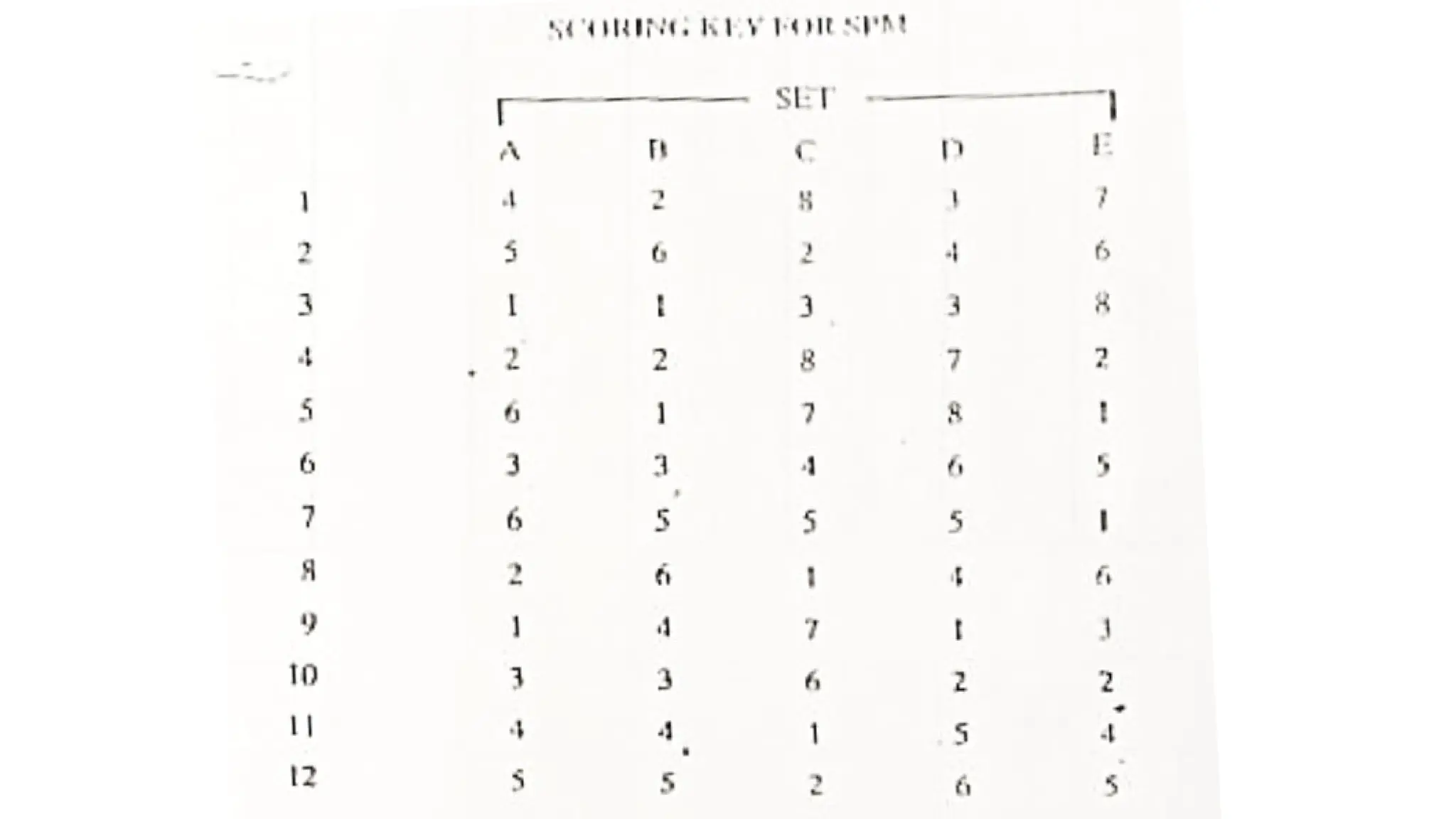
• Scoring key
• Norms
• Stop clock
5.
PROCEDURE:
• The subjectis seated comfortably in a well-ventilated and bright room. The booklet along with
the answer sheet is placed in front of the subject and instructions are given, with the example of
the first pattern, it is ensured that the subject has understood the instructions before starting the
test. With the signal ‘start’ allow the subject to work.
INSTRUCTIONS:
• “On every page of the booklet there is a pattern with a piece of missing(the experimenter points
them). You have to choose which of the pieces below is the right one to complete the pattern.
When you think you found the right piece, write its corresponding number next to the problem
number in the answer sheet. If you make a mistake, or want to change your answer, put a cross
through the incorrect answer, and then write the corresponding number of the correct answer
on your answer sheet. Go on like this by yourself until you get to the end of the booklet.
• They are quite simple in the beginning and get difficult progressively. If you attend to the pattern
with concentration, they get less difficult work at your own pace. do not miss any item. Do not
turn back. Begin when I give the ‘start’ sign. There are 60 problems. 12 in each set.
6.
ANALYSIS OF RESULTS:
•Score the answers with reference to the key
• Total number of problems solved correctly constitutes the subject’s raw score.
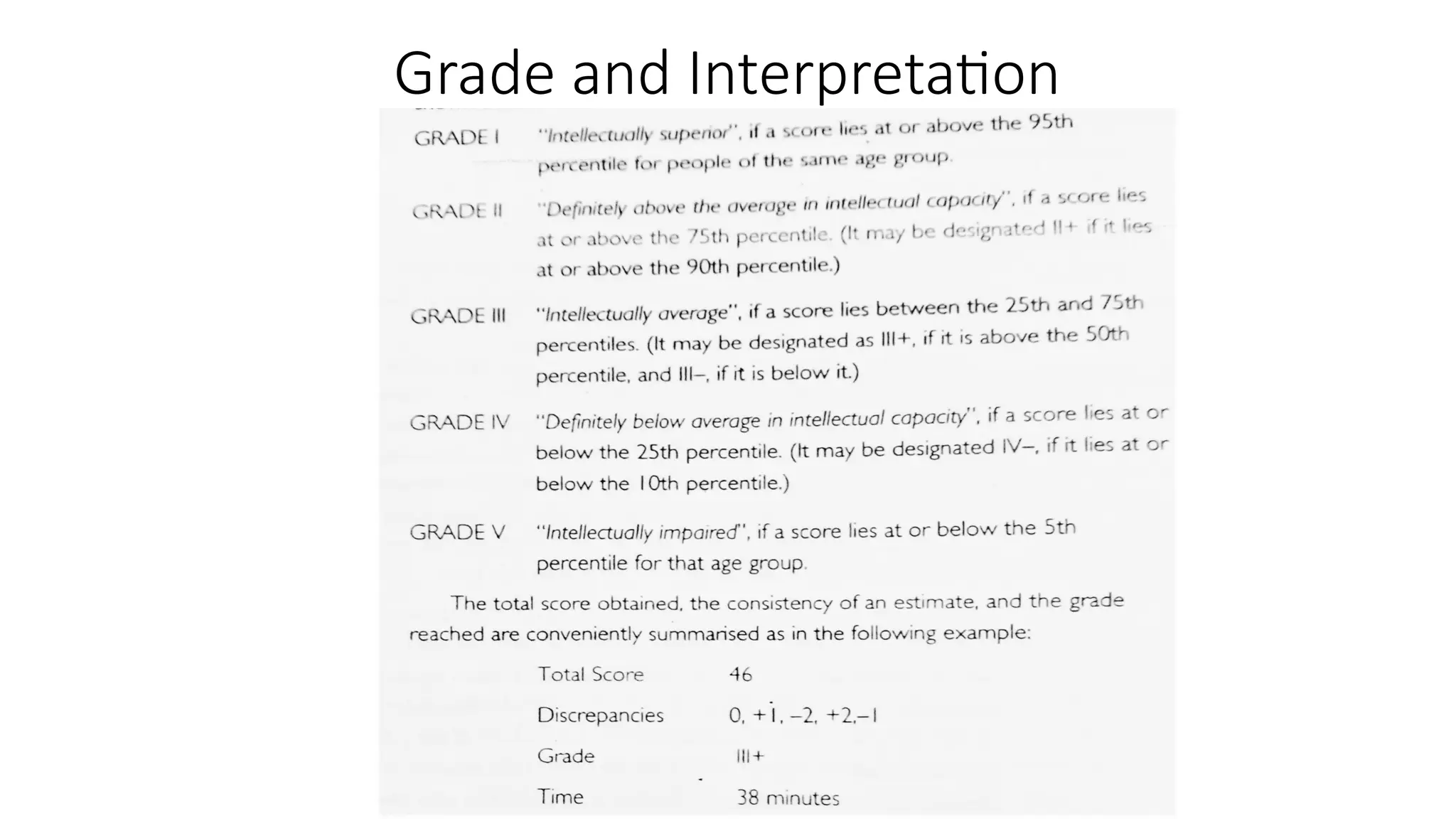
• Convert the raw score into percentile point. Interpolation if applicable.
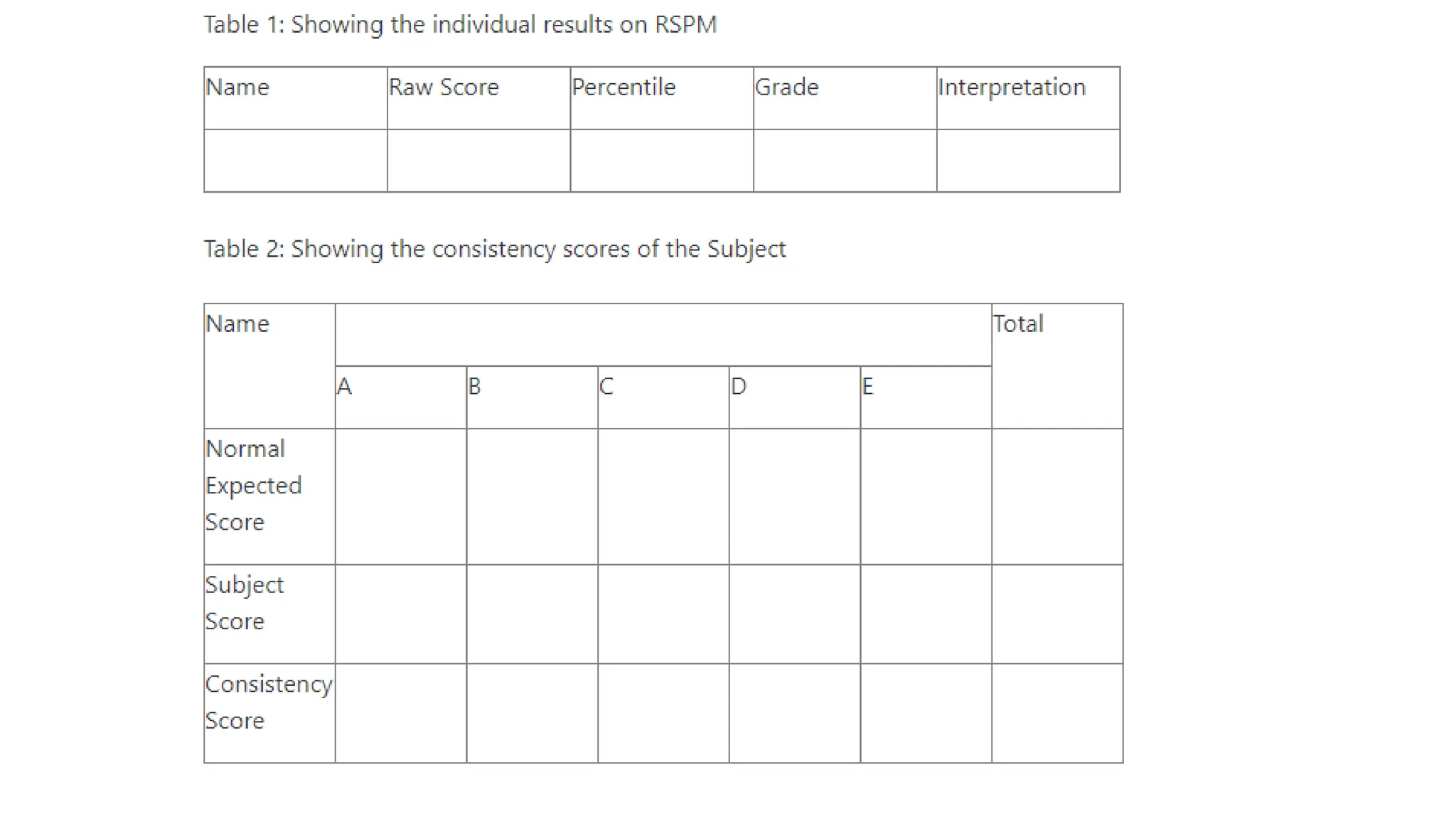
• Consistency score is found by calculating the difference subject’s score on each set
from that of the normal expected score.
• Consistency score= Subject’s score - Normal Expected score.
• If the subject’s score on any of the sets deviates by more than 2 from the normal
expected score, his/her total score on the scale cannot be accepted at its face value,
as a consistent estimate of his general capacity for intellectual activity.
• [for normal expected score refer-SPM II normal(expected) score composition (1979)
standardization]
• Compute total and mean for the total raw score for the group.
• Subjects are graded according to the norms.

![ANALYSIS OF RESULTS:
• Score the answers with reference to the key
• Total number of problems solved correctly constitutes the subject’s raw score.
• Convert the raw score into percentile point. Interpolation if applicable.
• Consistency score is found by calculating the difference subject’s score on each set
from that of the normal expected score.
• Consistency score= Subject’s score - Normal Expected score.
• If the subject’s score on any of the sets deviates by more than 2 from the normal
expected score, his/her total score on the scale cannot be accepted at its face value,
as a consistent estimate of his general capacity for intellectual activity.
• [for normal expected score refer-SPM II normal(expected) score composition (1979)
standardization]
• Compute total and mean for the total raw score for the group.
• Subjects are graded according to the norms.](https://image.slidesharecdn.com/2-250620065415-247f36f0/75/standard-progressive-matrices-test-conduction-6-2048.jpg)