RAVEN’S PROGRESSIVE
MATRICES
Development of the Test
The title was first introduce in 1938
For 30 years Raven continued to develop his
test
It is based on Spearman’s two factor
intelligence theory.
(Cohen,swerdlik& Sturmumn,2013)
Spearman tested how well people performed on various
tasks relating to intelligence. Such tasks include:
distinguishing pitch, perceiving weight and colors,
directions, and mathematics. When analyzing the data
he collected, Spearman noted that those that did well in
one area also scored higher in other areas.
(Spearman, 1904).
With this data, Spearman concluded that there must be
one central factor that influences our cognitive abilities.
Spearman termed this general intelligence g.
“Mental ability is something that is general in nature”
(Spearman, 1904).
The purpose of Raven’s Progressive
Matrices is to assess reasoning and
cognitive abilities in the visual modality.
(Raven's General Overview,1985)
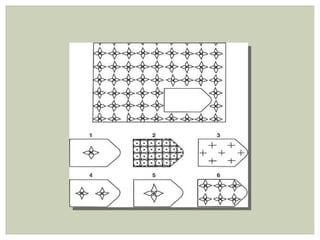
It is a test of inductive reasoning.
Test items requires the examinee to infer a rule
relating to a collection of elements and then to
use the rule to generate the next item in the
series or to verify that the presented element is
relative to the rule.
(Raven's General Overview,1985)
It’s a popular measure of conceptual ability as
responses require neither verbalization, skilled
manipulative ability, or subtle differentiation
In addition verbal instruction is kept to a
minimal.
(Raven's General Overview,1985)
Three series of Raven’s are:
Colored Progressive Matrices (CPM)
Standard Progressive Matrices (SPM)
Advanced Progressive Matrices (APM)
the initial series of SPM was followed by the CPM
thereby extending the range of the usefulness down to
include young children, old people and mentally
challenged people
(Raven's General Overview,1985)
A need to extend the standard series of the test led to
the development of the Advanced progressive Matrices
Colored Progressive Matrices (CPM)
Age range:
According to CPM guide the age range is 5 – 11
years of age, to make the test more suitable for
use with persons who are for any reason
mentally sub normal or impaired.
According to manual it can be used with
children under age 11 years
(Nicholas,2008)
 The Colored Progressive Matrices is designed for use with
young children and old people, for anthropological studies & for
clinical work.
 It can be satisfactorily used with people who for any reason,
cannot understand or speak the English language, with people
suffering from physical disabilities, aphasias, cerebral palsy or
deafness, as well as with people who are intellectually
subnormal or have deteriorated.
(Raven's General Overview,1985
CPM is designed to assess as accurately as
possible a person’s clarity of observation and
level of intellectual development.
 The three sets of 12 problems are arranged to assess the chief
cognitive processes of which children under 11 are usually
capable.
 The 3 sets together provide 3 opportunities for a person to
develop a consistent theme of thought & the scale of 36
problems as a whole is designed to assess as accurately as
possible mental development up to intellectual maturity
(Gregory,1996)
Standard Progressive Matrices (SPM)
The Standard Progressive Matrices (SPM) is a
nonverbal assessment tool
designed to measure an individual’s ability to
perceive and think clearly,
 make meaning out of confusion, and formulate
new concepts when faced with novel
information.
(Nicholas,2008)
The scale consists of 60 problems into 5 sets of
12
In each test item, the subject is asked to identify
the missing element that completes a pattern.
OBJECTIVE AND RATIONALE
SPM has the basic rationale of assessing an
individual’s intellectual functioning. It can be applied
in various contexts on several populations.
The Matrices test can provide a valid means of
assessing a person’s present capacity for clear thinking
and accurate intellectual work.
Advanced Progressive Matrices (APM)
(Foulds & Forbes, 1965)
It consists of two sets.(set I &II)
It contains total 48 items,
presented as one set of 12 (set I), and another of 36 (set
II).
Set A covers/measure all the intellectual processes
set 2 asses all the analytical and integral operations
involved in the higher thought process and
differentiates clearly between people of even superior
intellectual ability.
(Raven's General Overview,1985)
PSYCHOMETRIC PROPERTIES
The test cannot be use satisfactorily before age 11
years.
 It has high test re-test reliability of 0.91.
(Gregory,1996)
Raven's standard progressive matrices ppt

  • 1.
  • 2.
  • 3.
    The title wasfirst introduce in 1938 For 30 years Raven continued to develop his test It is based on Spearman’s two factor intelligence theory. (Cohen,swerdlik& Sturmumn,2013)
  • 4.
    Spearman tested howwell people performed on various tasks relating to intelligence. Such tasks include: distinguishing pitch, perceiving weight and colors, directions, and mathematics. When analyzing the data he collected, Spearman noted that those that did well in one area also scored higher in other areas. (Spearman, 1904).
  • 5.
    With this data,Spearman concluded that there must be one central factor that influences our cognitive abilities. Spearman termed this general intelligence g. “Mental ability is something that is general in nature” (Spearman, 1904).
  • 6.
    The purpose ofRaven’s Progressive Matrices is to assess reasoning and cognitive abilities in the visual modality. (Raven's General Overview,1985)
  • 7.
    It is atest of inductive reasoning. Test items requires the examinee to infer a rule relating to a collection of elements and then to use the rule to generate the next item in the series or to verify that the presented element is relative to the rule. (Raven's General Overview,1985)
  • 9.
    It’s a popularmeasure of conceptual ability as responses require neither verbalization, skilled manipulative ability, or subtle differentiation In addition verbal instruction is kept to a minimal. (Raven's General Overview,1985)
  • 10.
    Three series ofRaven’s are: Colored Progressive Matrices (CPM) Standard Progressive Matrices (SPM) Advanced Progressive Matrices (APM)
  • 11.
    the initial seriesof SPM was followed by the CPM thereby extending the range of the usefulness down to include young children, old people and mentally challenged people (Raven's General Overview,1985)
  • 12.
    A need toextend the standard series of the test led to the development of the Advanced progressive Matrices
  • 13.
  • 14.
    Age range: According toCPM guide the age range is 5 – 11 years of age, to make the test more suitable for use with persons who are for any reason mentally sub normal or impaired. According to manual it can be used with children under age 11 years (Nicholas,2008)
  • 15.
     The ColoredProgressive Matrices is designed for use with young children and old people, for anthropological studies & for clinical work.  It can be satisfactorily used with people who for any reason, cannot understand or speak the English language, with people suffering from physical disabilities, aphasias, cerebral palsy or deafness, as well as with people who are intellectually subnormal or have deteriorated. (Raven's General Overview,1985
  • 16.
    CPM is designedto assess as accurately as possible a person’s clarity of observation and level of intellectual development.
  • 17.
     The threesets of 12 problems are arranged to assess the chief cognitive processes of which children under 11 are usually capable.  The 3 sets together provide 3 opportunities for a person to develop a consistent theme of thought & the scale of 36 problems as a whole is designed to assess as accurately as possible mental development up to intellectual maturity (Gregory,1996)
  • 18.
  • 19.
    The Standard ProgressiveMatrices (SPM) is a nonverbal assessment tool designed to measure an individual’s ability to perceive and think clearly,  make meaning out of confusion, and formulate new concepts when faced with novel information. (Nicholas,2008)
  • 20.
    The scale consistsof 60 problems into 5 sets of 12 In each test item, the subject is asked to identify the missing element that completes a pattern.
  • 21.
    OBJECTIVE AND RATIONALE SPMhas the basic rationale of assessing an individual’s intellectual functioning. It can be applied in various contexts on several populations. The Matrices test can provide a valid means of assessing a person’s present capacity for clear thinking and accurate intellectual work.
  • 22.
    Advanced Progressive Matrices(APM) (Foulds & Forbes, 1965)
  • 23.
    It consists oftwo sets.(set I &II) It contains total 48 items, presented as one set of 12 (set I), and another of 36 (set II).
  • 24.
    Set A covers/measureall the intellectual processes set 2 asses all the analytical and integral operations involved in the higher thought process and differentiates clearly between people of even superior intellectual ability. (Raven's General Overview,1985)
  • 25.
    PSYCHOMETRIC PROPERTIES The testcannot be use satisfactorily before age 11 years.  It has high test re-test reliability of 0.91. (Gregory,1996)