UPRATN
A
Presented By:
Dr. Pritika
M.D. RAS SHASTRA &
B.K.
ASSIST. PROF.
B.K.A.M.C.H., DAUDHAR
, MOGA PUNJAB
Reason For Classification Of
Upratna
 In the process of geological transformation,
due to some reasons they interrupted and
remain in complete or dead. These can also
be taken as second rated gem stones. The
semi precious stones or minor gems also
have some metaphysical and therapeutic
efficacy which is also explored by geologists
and physicians.
Ras Tarangini
 Vaikramta
 Suryakanta
 Chandrakanta
 Rajavarta
 Perojaka
 Saphtika
Also known as kshudhra ratna.
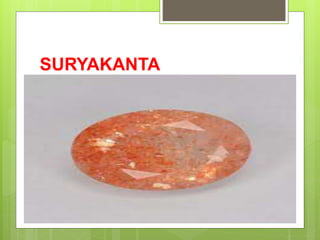
SURYAKANTA
Criteria for good stone:
 Clear, smoothness, evenness, not flaky, becoming
clearer on rubbing and producing fire when kept in
sun are considered as the qualities of good
sunstone.
 This might be a stone having the shape of convex
lens or magnifying lens which by keeping in sun,
concentrates the rays and produces fire .(Convex
Lens. This is a lens in which both surfaces are
curved so that a beam of light passing through it is
brought to a point or focus. )
Hardness 5.5
 Marana : manhashilla, gandhaka, nimbu
sawrasa- 7 puta
 Properties: ushna , rasayana, vaat-
kaphanashak
 Dose : 25mg to 100mg
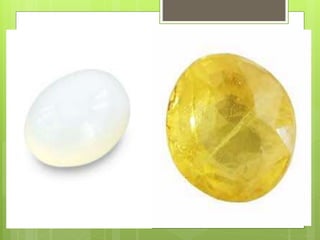
Chandrakanta
 Moon-stone
 Chnadrakanta, chandramani, chandropala
 this as available as colourless to white, grey-
reddish brown, yellowish grey or greenish
grey stone.
 Hardness-6
 Chemical composition: KAlSi3O8
Criteria of good Chandrakanta
 It should be snigdha, sheet, peet, trasamanta( no
partial opacity), swachta,
srava (which oozes when exposed to moon-light,
is to be called as a good moon-stone)
 Marana :equal quantity of hingula, manhashilla,
with kumari sawrasa.
 Properties : sheeta, snigdha, jwarahar,
dahanashak, raktapittnashak, wearing this stone
is satisfying to Lord shiva (shivpritikar),
grahalakshmivinashna.
 Dose : 1/2ratti-1ratti
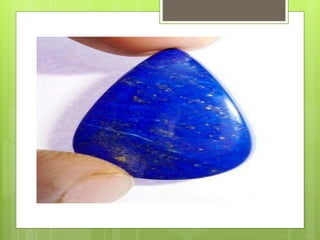
Rajavarta
 English name: Lapis lazuli
 Sanskrit name: nripavarta, avartaka mani,
nripopala, avarta,
 Hardness : 5.5-6
 Criteria of good stone : nirmal, msirna,
garshunya(having no adhesive matter)
snigdha, sharadnirabha, , suneela , krishna,
gurushikhikanthasamprakasha.
Purification
 Swedana – Nimbu sawrasa mixed with
gomutra, kshara
 Marana – gomutra , gandhaka, - 7 puta
 Properties– katu, tikta, sheeta, pittanashana,
prameha, pandukaphavaatnashak, deepan,
pachana, vrishya.
 Dose 1/2 – 1 ratti
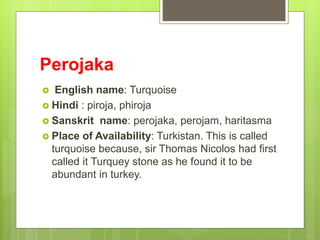
Perojaka
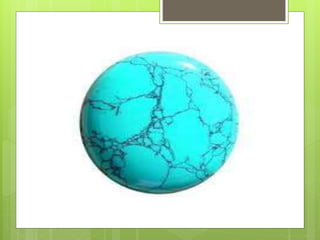
 English name: Turquoise
 Hindi : piroja, phiroja
 Sanskrit name: perojaka, perojam, haritasma
 Place of Availability: Turkistan. This is called
turquoise because, sir Thomas Nicolos had first
called it Turquey stone as he found it to be
abundant in turkey.
Varieties:
 Bhasmnga (greyish blue)
 Harita (greenish blue)
 Purification and incineration of Perojaka are done as
in case of Rajavarta,
 Marana : gandhaka, Nimbu sawrasa- 7 times
 Properties: kshaya, madhura, sheeta, sara, deepan,
vishgna, shulagana, hridya, rechaka.
 Dose : ½-1ratti
Sphatikamani (Rock crystal/
Quartz)
 Hindi : sphatik, billor, garpathar
 This is a colourless transparent stone.
 Hardness : 7
 SiO2
 Properties : Madhur, balya, raktpitta shaman
, jawardahnashan.
 Gangtoybinduchavi, vimlam, netrahridyam,
snigdham,
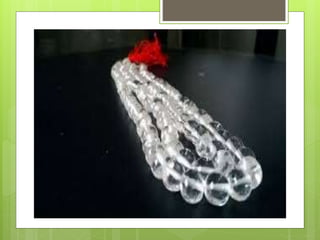
• Sphatik are semi-precious stones and is
considered excellent for
japa. Sphatik (Quartz Crystal) is comprised
of quartz and silica, which are also a major
component of the human body.
 Sphatik removes excess heat from the body and can
also reduce fever. Sphatik Mala helps focus the mind. It
also helps relieve headaches and reduces stress and
tension by promoting overall healing of the body. Sphatik
Mala is mainly used by followers of Lord Shiva to
appease him.
 It enhances energy by absorbing, storing, amplifying,
balancing, focusing and transmitting. Sphatik is a power
stone. Sphatik is a stone of clarity and dispels negativity.
While it can be used to purify and clarify on the spiritual,
mental, and physical planes, it is also a stone of
harmony.
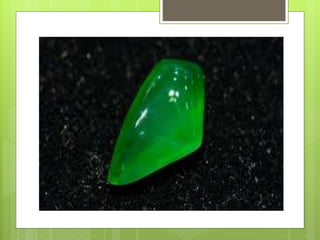
Vyomasma (Jade)
 Hardness 7
 because of its extreme hardness, it was used in making
of stone weapons. The pestle and mortar units made up
of jade are fondly used in Ras shastra lab.
 Yellow green coloured hard jade is considered good for
therapeutic use.
 Shodhana : it is made into small pieces kept in earthen
plate heated and decoction of Arjuna is poured in it.
Heating is continued till the material becomes hot. The
process is done for 21 times
Marana
 Bhavana dravya: arjuna kwath, gojiva kwath,
ghrita kumari, - 10 gajputa- bhasma is white in
color
 Properties:
it is used in unani paddti, considered as cardio
tonic, heart palpitations, hypertensions,
insomnia, burning micturition, abdominal
discomfort.
Dose : 2-4 ratti

Upratna

  • 1.
    UPRATN A Presented By: Dr. Pritika M.D.RAS SHASTRA & B.K. ASSIST. PROF. B.K.A.M.C.H., DAUDHAR , MOGA PUNJAB
  • 2.
    Reason For ClassificationOf Upratna  In the process of geological transformation, due to some reasons they interrupted and remain in complete or dead. These can also be taken as second rated gem stones. The semi precious stones or minor gems also have some metaphysical and therapeutic efficacy which is also explored by geologists and physicians.
  • 3.
    Ras Tarangini  Vaikramta Suryakanta  Chandrakanta  Rajavarta  Perojaka  Saphtika Also known as kshudhra ratna.
  • 4.
  • 5.
    Criteria for goodstone:  Clear, smoothness, evenness, not flaky, becoming clearer on rubbing and producing fire when kept in sun are considered as the qualities of good sunstone.  This might be a stone having the shape of convex lens or magnifying lens which by keeping in sun, concentrates the rays and produces fire .(Convex Lens. This is a lens in which both surfaces are curved so that a beam of light passing through it is brought to a point or focus. )
  • 6.
    Hardness 5.5  Marana: manhashilla, gandhaka, nimbu sawrasa- 7 puta  Properties: ushna , rasayana, vaat- kaphanashak  Dose : 25mg to 100mg
  • 7.
    Chandrakanta  Moon-stone  Chnadrakanta,chandramani, chandropala  this as available as colourless to white, grey- reddish brown, yellowish grey or greenish grey stone.  Hardness-6  Chemical composition: KAlSi3O8
  • 9.
    Criteria of goodChandrakanta  It should be snigdha, sheet, peet, trasamanta( no partial opacity), swachta, srava (which oozes when exposed to moon-light, is to be called as a good moon-stone)  Marana :equal quantity of hingula, manhashilla, with kumari sawrasa.  Properties : sheeta, snigdha, jwarahar, dahanashak, raktapittnashak, wearing this stone is satisfying to Lord shiva (shivpritikar), grahalakshmivinashna.  Dose : 1/2ratti-1ratti
  • 10.
    Rajavarta  English name:Lapis lazuli  Sanskrit name: nripavarta, avartaka mani, nripopala, avarta,  Hardness : 5.5-6  Criteria of good stone : nirmal, msirna, garshunya(having no adhesive matter) snigdha, sharadnirabha, , suneela , krishna, gurushikhikanthasamprakasha.
  • 12.
    Purification  Swedana –Nimbu sawrasa mixed with gomutra, kshara  Marana – gomutra , gandhaka, - 7 puta  Properties– katu, tikta, sheeta, pittanashana, prameha, pandukaphavaatnashak, deepan, pachana, vrishya.  Dose 1/2 – 1 ratti
  • 13.
    Perojaka  English name:Turquoise  Hindi : piroja, phiroja  Sanskrit name: perojaka, perojam, haritasma  Place of Availability: Turkistan. This is called turquoise because, sir Thomas Nicolos had first called it Turquey stone as he found it to be abundant in turkey.
  • 15.
    Varieties:  Bhasmnga (greyishblue)  Harita (greenish blue)  Purification and incineration of Perojaka are done as in case of Rajavarta,  Marana : gandhaka, Nimbu sawrasa- 7 times  Properties: kshaya, madhura, sheeta, sara, deepan, vishgna, shulagana, hridya, rechaka.  Dose : ½-1ratti
  • 16.
    Sphatikamani (Rock crystal/ Quartz) Hindi : sphatik, billor, garpathar  This is a colourless transparent stone.  Hardness : 7  SiO2  Properties : Madhur, balya, raktpitta shaman , jawardahnashan.  Gangtoybinduchavi, vimlam, netrahridyam, snigdham,
  • 17.
    • Sphatik aresemi-precious stones and is considered excellent for japa. Sphatik (Quartz Crystal) is comprised of quartz and silica, which are also a major component of the human body.  Sphatik removes excess heat from the body and can also reduce fever. Sphatik Mala helps focus the mind. It also helps relieve headaches and reduces stress and tension by promoting overall healing of the body. Sphatik Mala is mainly used by followers of Lord Shiva to appease him.  It enhances energy by absorbing, storing, amplifying, balancing, focusing and transmitting. Sphatik is a power stone. Sphatik is a stone of clarity and dispels negativity. While it can be used to purify and clarify on the spiritual, mental, and physical planes, it is also a stone of harmony.
  • 19.
    Vyomasma (Jade)  Hardness7  because of its extreme hardness, it was used in making of stone weapons. The pestle and mortar units made up of jade are fondly used in Ras shastra lab.  Yellow green coloured hard jade is considered good for therapeutic use.  Shodhana : it is made into small pieces kept in earthen plate heated and decoction of Arjuna is poured in it. Heating is continued till the material becomes hot. The process is done for 21 times
  • 21.
    Marana  Bhavana dravya:arjuna kwath, gojiva kwath, ghrita kumari, - 10 gajputa- bhasma is white in color  Properties: it is used in unani paddti, considered as cardio tonic, heart palpitations, hypertensions, insomnia, burning micturition, abdominal discomfort. Dose : 2-4 ratti