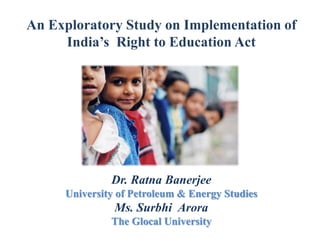
An Exploratory Study on Implementation of
India’s Right to Education Act

Dr. Ratna Banerjee
University of Petroleum & Energy Studies

Ms. Surbhi Arora
The Glocal University
An Exploratory Study on Implementation of
India’s Right to Education Act
Introduction
Initiatives under RTE
Cases

Findings
Conclusion
An Exploratory Study on Implementation of
India’s Right to Education Act
Introduction
The Right to Education is explicitly stated in the United Nations‘
Universal Declaration of Human Rights (UDHR), adopted in 1948:
"Everyone has the right to education. Education shall be free, at
least in the elementary and fundamental stages. Elementary
education shall be compulsory. Technical and professional
education shall be made generally available and higher education
shall be equally accessible to all on the basis of merit. …"
(Article 26)
An Exploratory Study on Implementation of
India’s Right to Education Act
Introduction
Access to education should be complemented with the quality of
education. As stated, in the UDHR:
"... Education shall be directed to the full development of the
human personality and to the strengthening of respect for
human rights and fundamental freedoms. It shall promote
understanding, tolerance and friendship among ... racial or
religious groups. ..." (Article 26)
An Exploratory Study on Implementation of
India’s Right to Education Act
Introduction
Katerina Tomasevski, former United Nations Special Rapporteur on
the right to education, points out: "There are a large number of
human rights problems, which cannot be solved unless the right to
education is addressed as the key to unlock other human rights.
Education operates as multiplier, enhancing the enjoyment of all
individual rights, freedoms where the right to education is
effectively guaranteed, while depriving people of the enjoyment of
many rights and freedoms where the right to education is denied
or violated" (Tomasevski, 2006 Global Report).
An Exploratory Study on Implementation of
India’s Right to Education Act
Initiatives under RTE
Both the Central and the State governments have expanded the
provisions of formal and non-formal primary education to realize
the objective of Universalization of Elementary Education (UEE).

Sarva Shiksha Abhiyan (SSA) is a flagship programme for
achieving UEE
Mid-Day meal initiative was aimed to enhance enrollment,
retention, attendance and to improve the nutritional levels among
the children. It is one of the world’s largest school feeding
programme reaching to around 12 crore children in over 9.5 lacs
schools/EGS centres all across India.
An Exploratory Study on Implementation of
India’s Right to Education Act
Cases

Neelam’s Case:
We need to look into the reasons as to why the
school could not provide her the required
platform to continue her studies.
An Exploratory Study on Implementation of
India’s Right to Education Act
Poonam’s Case:
This gives us an insight on the sufficiency of
mid-day meals being provided at the schools.
An Exploratory Study on Implementation of
India’s Right to Education Act
Prem’s Case:
We need to find whether these schools are
connected properly with proper roads and
infrastructure.
An Exploratory Study on Implementation of
India’s Right to Education Act
Rani’s Case:
Can our education system provide a vocation
which can help such children to learn and earn
at the same time?
An Exploratory Study on Implementation of
India’s Right to Education Act
Anita’s Case:
Considering the Indian mindset, till how long will
we suppress our daughters?
An Exploratory Study on Implementation of
India’s Right to Education Act

Binod’s Case:

How will the government ensure fairness in the
education system?
An Exploratory Study on Implementation of
India’s Right to Education Act
Findings
Gap Analysis was done using Chi Square Test with a sample
(convenience sampling) size of 256 students in the age group of
10-12 years.
These students were asked various questions from different
subjects to test their knowledge
It was found that observed frequency is significantly different
from the expected frequency at 5% los. (expected frequency was
calculated using Binomial Distribution Mass Function)
How will the government ensure that expected
knowledge is imparted?
An Exploratory Study on Implementation of
India’s Right to Education Act
Conclusion:
Energy of children and teenagers has to be channelized in positive
direction with a blend of sensitivity and patience in an interesting manner.

If the parents are assured about their child’s overall development then only
they would feel secure to send them for education willingly and they have a
valid reason to think that their child has a right to be educated.
There should be some counseling sessions to change the mindsets of people
which are a major constraint in meeting the objectives of RTE.
Education to be linked with vocational training so that it can help provide
livelihood too.
An Exploratory Study on Implementation of
India’s Right to Education Act
Conclusion:
Education implementation pattern should be innovative, creative and
focused on carrier building.
Real life projects should be inculcated in pedagogy of education to have

real time learning.
There should associations of research scholars with these for mutual
benefits.
While appointing the teachers and people who are directly in contact with
these children they should have strong ethics and this should be aligned with
objective of RTE.
Ratna & surbhi exploratory study on rte implementation

Ratna & surbhi exploratory study on rte implementation

  • 1.
    An Exploratory Studyon Implementation of India’s Right to Education Act Dr. Ratna Banerjee University of Petroleum & Energy Studies Ms. Surbhi Arora The Glocal University
  • 2.
    An Exploratory Studyon Implementation of India’s Right to Education Act Introduction Initiatives under RTE Cases Findings Conclusion
  • 3.
    An Exploratory Studyon Implementation of India’s Right to Education Act Introduction The Right to Education is explicitly stated in the United Nations‘ Universal Declaration of Human Rights (UDHR), adopted in 1948: "Everyone has the right to education. Education shall be free, at least in the elementary and fundamental stages. Elementary education shall be compulsory. Technical and professional education shall be made generally available and higher education shall be equally accessible to all on the basis of merit. …" (Article 26)
  • 4.
    An Exploratory Studyon Implementation of India’s Right to Education Act Introduction Access to education should be complemented with the quality of education. As stated, in the UDHR: "... Education shall be directed to the full development of the human personality and to the strengthening of respect for human rights and fundamental freedoms. It shall promote understanding, tolerance and friendship among ... racial or religious groups. ..." (Article 26)
  • 5.
    An Exploratory Studyon Implementation of India’s Right to Education Act Introduction Katerina Tomasevski, former United Nations Special Rapporteur on the right to education, points out: "There are a large number of human rights problems, which cannot be solved unless the right to education is addressed as the key to unlock other human rights. Education operates as multiplier, enhancing the enjoyment of all individual rights, freedoms where the right to education is effectively guaranteed, while depriving people of the enjoyment of many rights and freedoms where the right to education is denied or violated" (Tomasevski, 2006 Global Report).
  • 6.
    An Exploratory Studyon Implementation of India’s Right to Education Act Initiatives under RTE Both the Central and the State governments have expanded the provisions of formal and non-formal primary education to realize the objective of Universalization of Elementary Education (UEE). Sarva Shiksha Abhiyan (SSA) is a flagship programme for achieving UEE Mid-Day meal initiative was aimed to enhance enrollment, retention, attendance and to improve the nutritional levels among the children. It is one of the world’s largest school feeding programme reaching to around 12 crore children in over 9.5 lacs schools/EGS centres all across India.
  • 7.
    An Exploratory Studyon Implementation of India’s Right to Education Act Cases Neelam’s Case: We need to look into the reasons as to why the school could not provide her the required platform to continue her studies.
  • 8.
    An Exploratory Studyon Implementation of India’s Right to Education Act Poonam’s Case: This gives us an insight on the sufficiency of mid-day meals being provided at the schools.
  • 9.
    An Exploratory Studyon Implementation of India’s Right to Education Act Prem’s Case: We need to find whether these schools are connected properly with proper roads and infrastructure.
  • 10.
    An Exploratory Studyon Implementation of India’s Right to Education Act Rani’s Case: Can our education system provide a vocation which can help such children to learn and earn at the same time?
  • 11.
    An Exploratory Studyon Implementation of India’s Right to Education Act Anita’s Case: Considering the Indian mindset, till how long will we suppress our daughters?
  • 12.
    An Exploratory Studyon Implementation of India’s Right to Education Act Binod’s Case: How will the government ensure fairness in the education system?
  • 13.
    An Exploratory Studyon Implementation of India’s Right to Education Act Findings Gap Analysis was done using Chi Square Test with a sample (convenience sampling) size of 256 students in the age group of 10-12 years. These students were asked various questions from different subjects to test their knowledge It was found that observed frequency is significantly different from the expected frequency at 5% los. (expected frequency was calculated using Binomial Distribution Mass Function) How will the government ensure that expected knowledge is imparted?
  • 14.
    An Exploratory Studyon Implementation of India’s Right to Education Act Conclusion: Energy of children and teenagers has to be channelized in positive direction with a blend of sensitivity and patience in an interesting manner. If the parents are assured about their child’s overall development then only they would feel secure to send them for education willingly and they have a valid reason to think that their child has a right to be educated. There should be some counseling sessions to change the mindsets of people which are a major constraint in meeting the objectives of RTE. Education to be linked with vocational training so that it can help provide livelihood too.
  • 15.
    An Exploratory Studyon Implementation of India’s Right to Education Act Conclusion: Education implementation pattern should be innovative, creative and focused on carrier building. Real life projects should be inculcated in pedagogy of education to have real time learning. There should associations of research scholars with these for mutual benefits. While appointing the teachers and people who are directly in contact with these children they should have strong ethics and this should be aligned with objective of RTE.