Debarshi Mukherjee
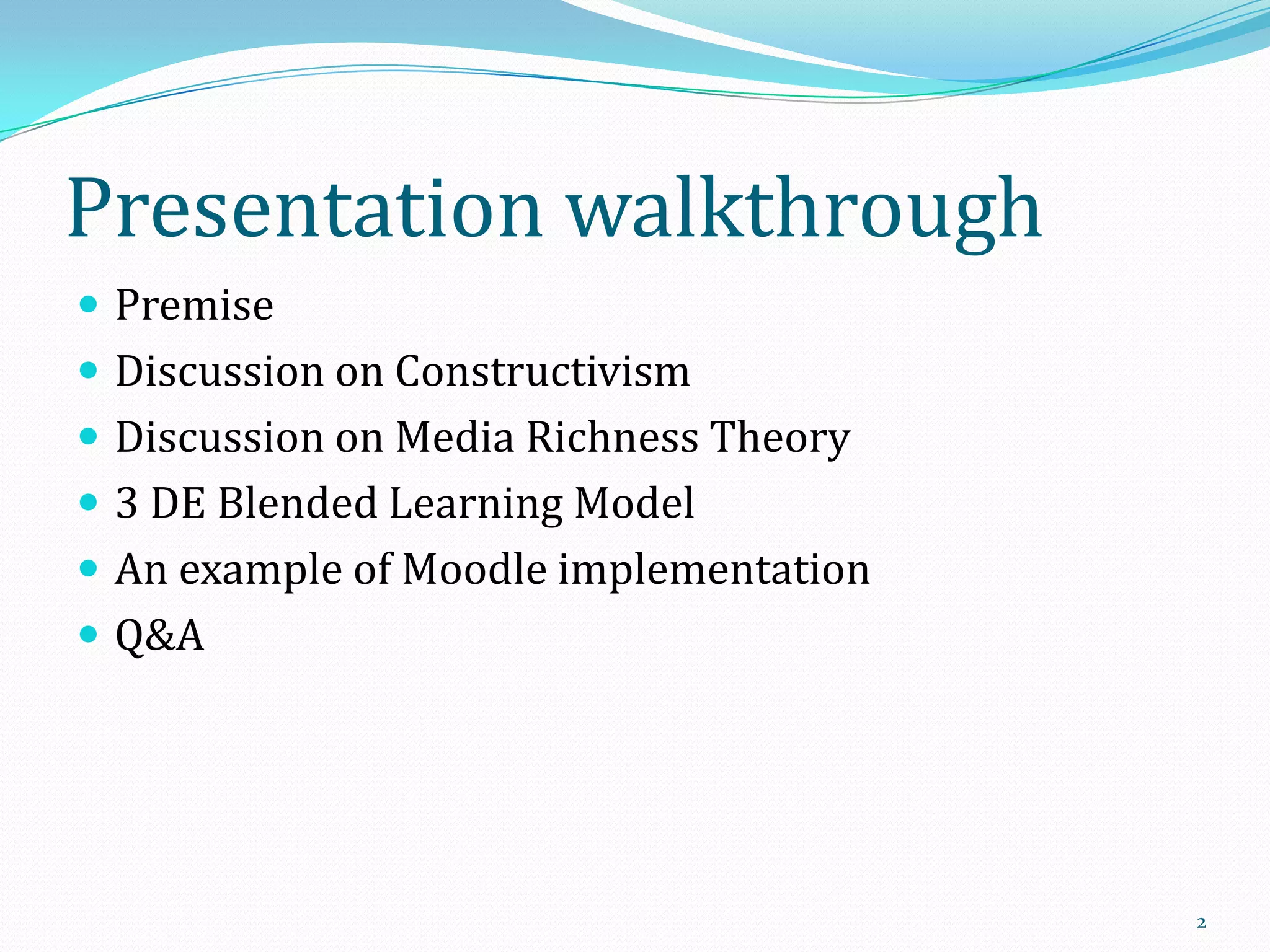
Presentation walkthrough
 Premise
 Discussion on Constructivism
 Discussion on Media Richness Theory
 3 DE Blended Learning Model

 An example of Moodle implementation
 Q&A

2
Premise
 Finding a better solution
 between learners centric and learning centric pedagogy
 or the one between knowledge construction and
knowledge communication

3
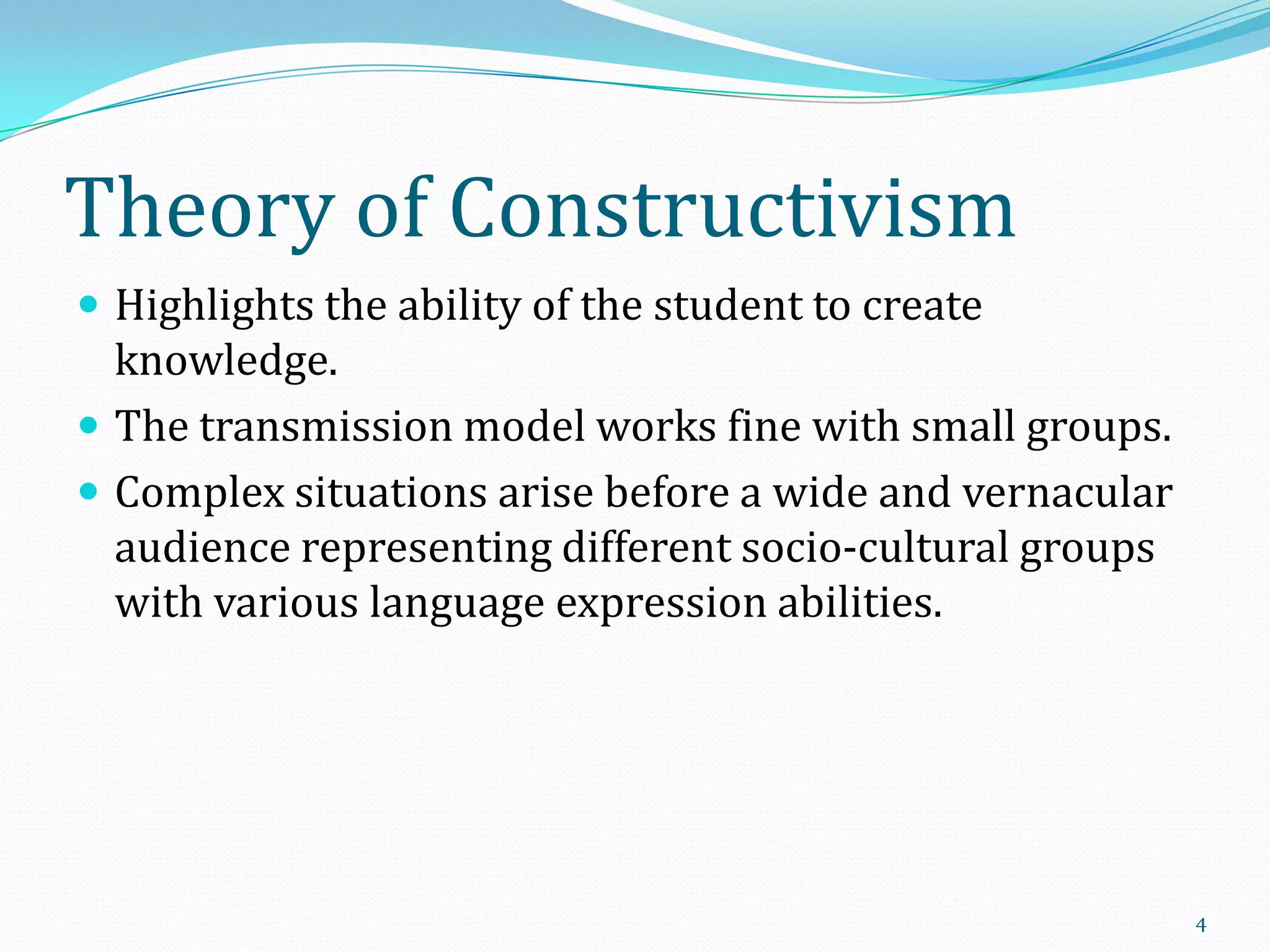
Theory of Constructivism
 Highlights the ability of the student to create

knowledge.
 The transmission model works fine with small groups.
 Complex situations arise before a wide and vernacular
audience representing different socio-cultural groups
with various language expression abilities.

4
Theory of Constructivism
 A student learns to put together pieces of knowledge

collected from different sources as transmitted to him
on various occasions and add his/her inner value and
own application to create knowledge.
 Minimal guidance to the students forces the students
to develop indigenous problem solving and cognitive
thinking ability leading to knowledge creation.

5
Theory of Constructivism
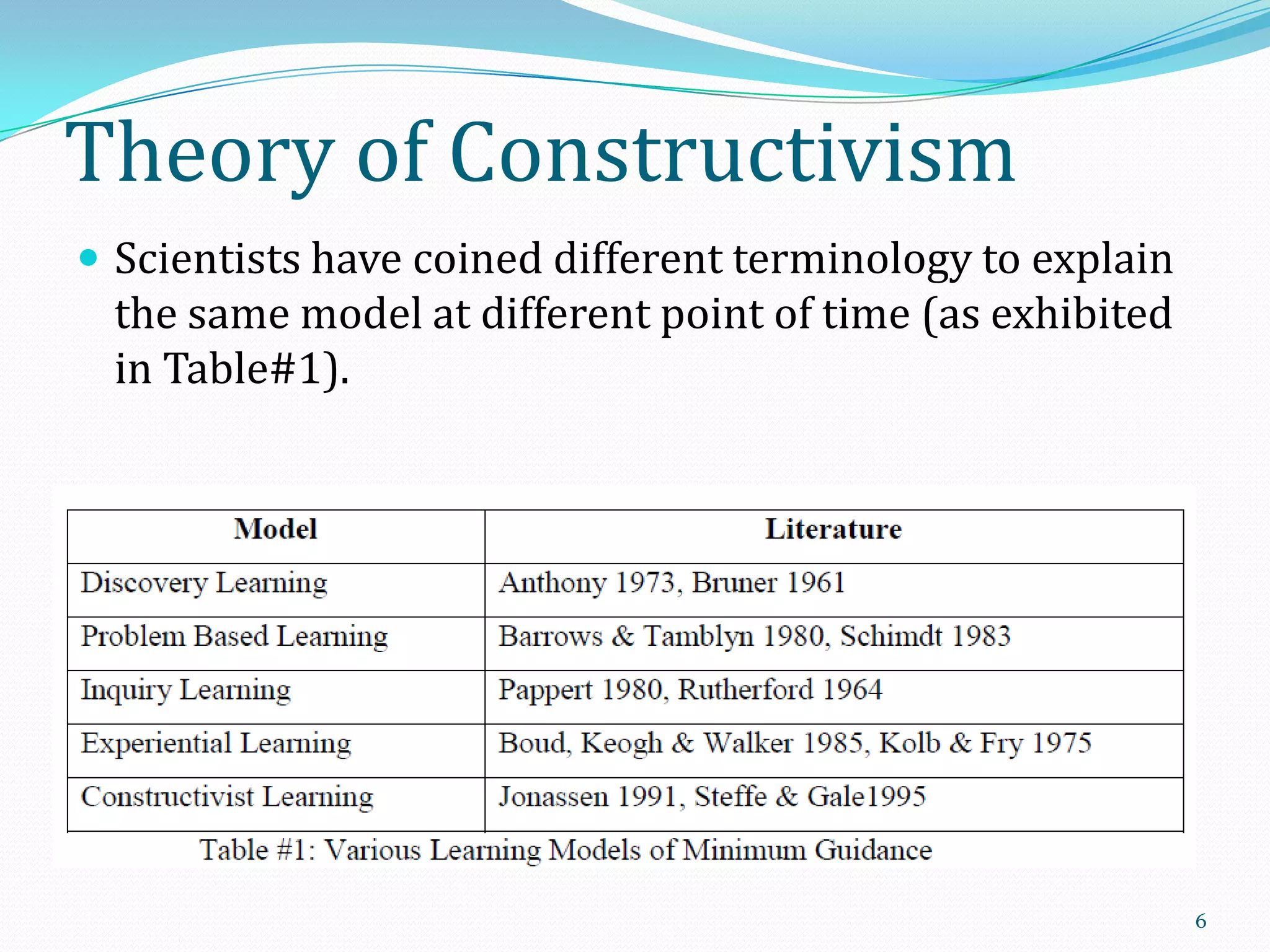
 Scientists have coined different terminology to explain

the same model at different point of time (as exhibited
in Table#1).

6
Major Gap in Constructivism
 Doesn’t work on intermediate or primary learners as

the requirement of strong instructional guidance
cannot overlooked.

7
Media Richness Theory
 Arrived in late eighties which owes its origin to social

learning and selection of media to foster effective
communication.
 Media, preferably a computing device can send
information over a network while maintain the
richness of a face-to-face interaction.

8
Media Richness Theory
 Argues that selection of media could enhance the task

being done consuming the media hence it can be
concluded that using networked learning mode can not
only reproduce the effectiveness of a face-to-face
conversation but increases many folds.
 The two theories advocate a blended model of
education could be meaningful.

9
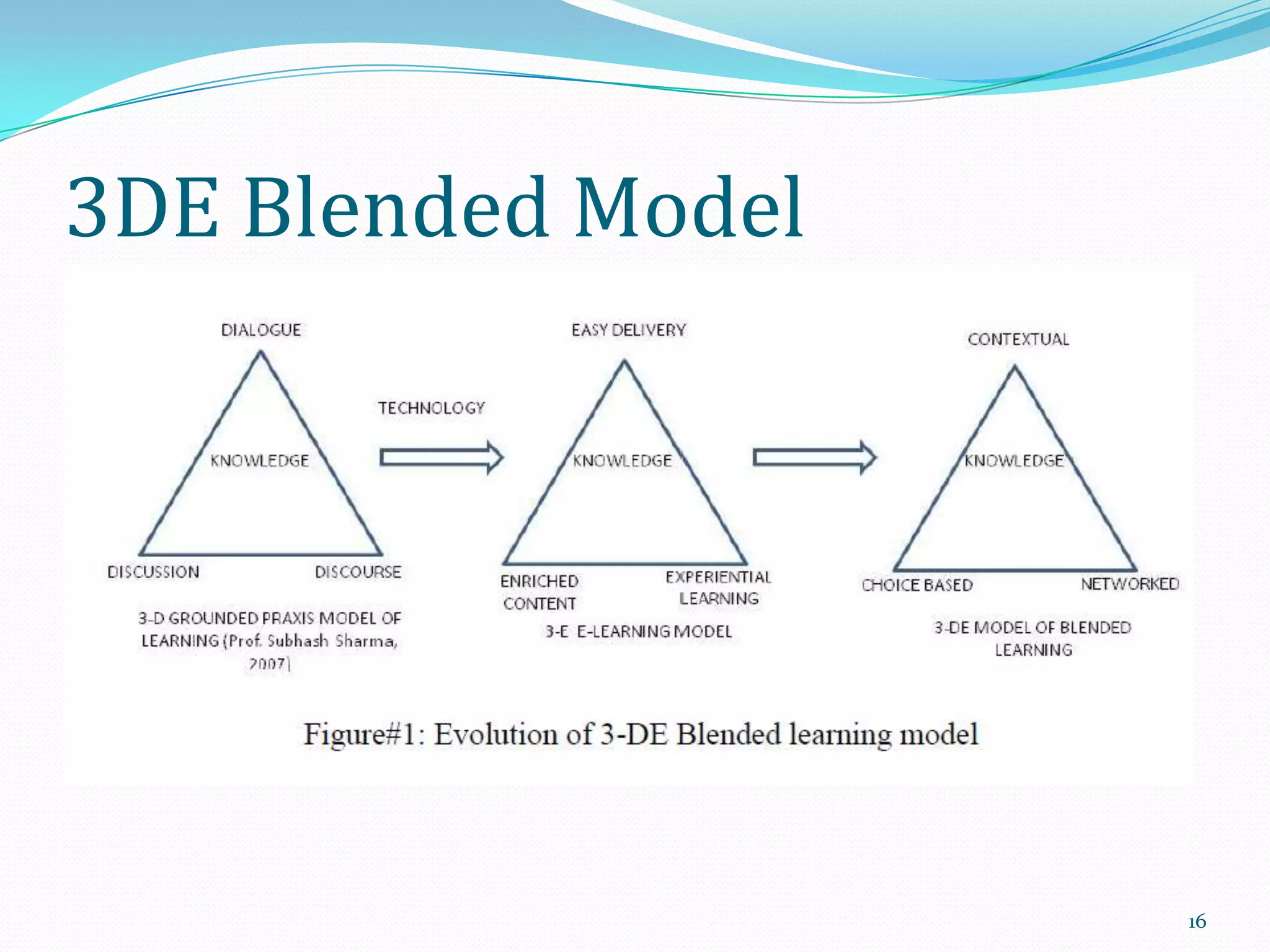
3-D Grounded Praxis Model
 Discussion, Dialogue and Discourse: This model seems

befitting in its traditional classroom environment
addressing a relatively smaller group.
 Asynchronous learning mode wasn’t a part of 3D
model.
 To address a global audience using a technology
platform becomes imperative and offering online
course in virtual learning environment causes a
paradigm shift in education sector.

10
Pure e-learning (3-E)
 Pure e-learning (3-E) format promises enriched

content, easy delivery mode and experiential learning
which is an extension to 3-D model.
 3-E model realizes both synchronous and
asynchronous learning modes.
 It offers to break the geographic barrier of traditional
classroom setting and imbibes the concept of
collaborative learning over a network.

11
The Blend
 A blend of the two previous models seems evident as it

aims to bring effectiveness in the pedagogy to meet
learner’s expectations.
 The blended learning model appreciates the shift from
the legacy of enriched content, easy delivery and
experiential learning to the advanced dimension of
contextual, choice based, networked learning.

12
The Blend
 All three dimensions of blended model function in

unison with the understanding of student’s expectation
designed in accordance with the interaction between a
student and a teacher as argued by constructivist
theorists (Laurillard, 2002).

13
The Blend
 Sharing knowledge over a network reduces geographic

dispersion gap of a face – to – face classroom meeting
while bringing in the aroma of collaborative learning
which is exactly in line with the arguments of media
richness theory.
 Besides virtual interaction this model promises face –
to – face interaction as well under managed learning
environment as in India purely technology mediated
learning environment may work as an impediment to
the evolution of e-learning.
14
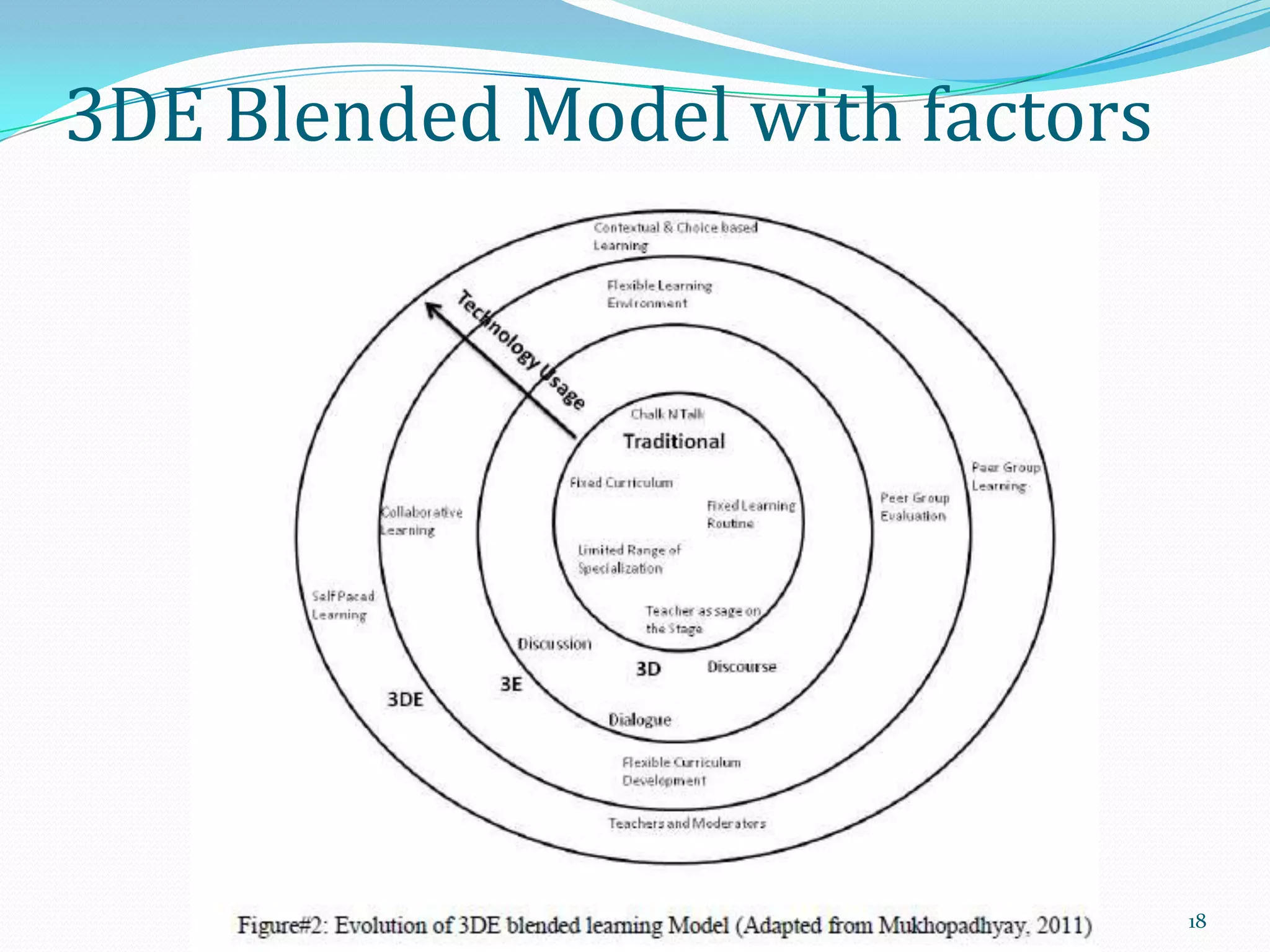
The Blend (3-DE)
 Contextual learning does not only talk about enriched

content and its navigational dimensions but at the
same time situation specific across – the – table
interactions involving Dialogue – Discussion –
Discourse which helps meeting student’s expectations
with higher learning gain.

15
3DE Blended Model

16
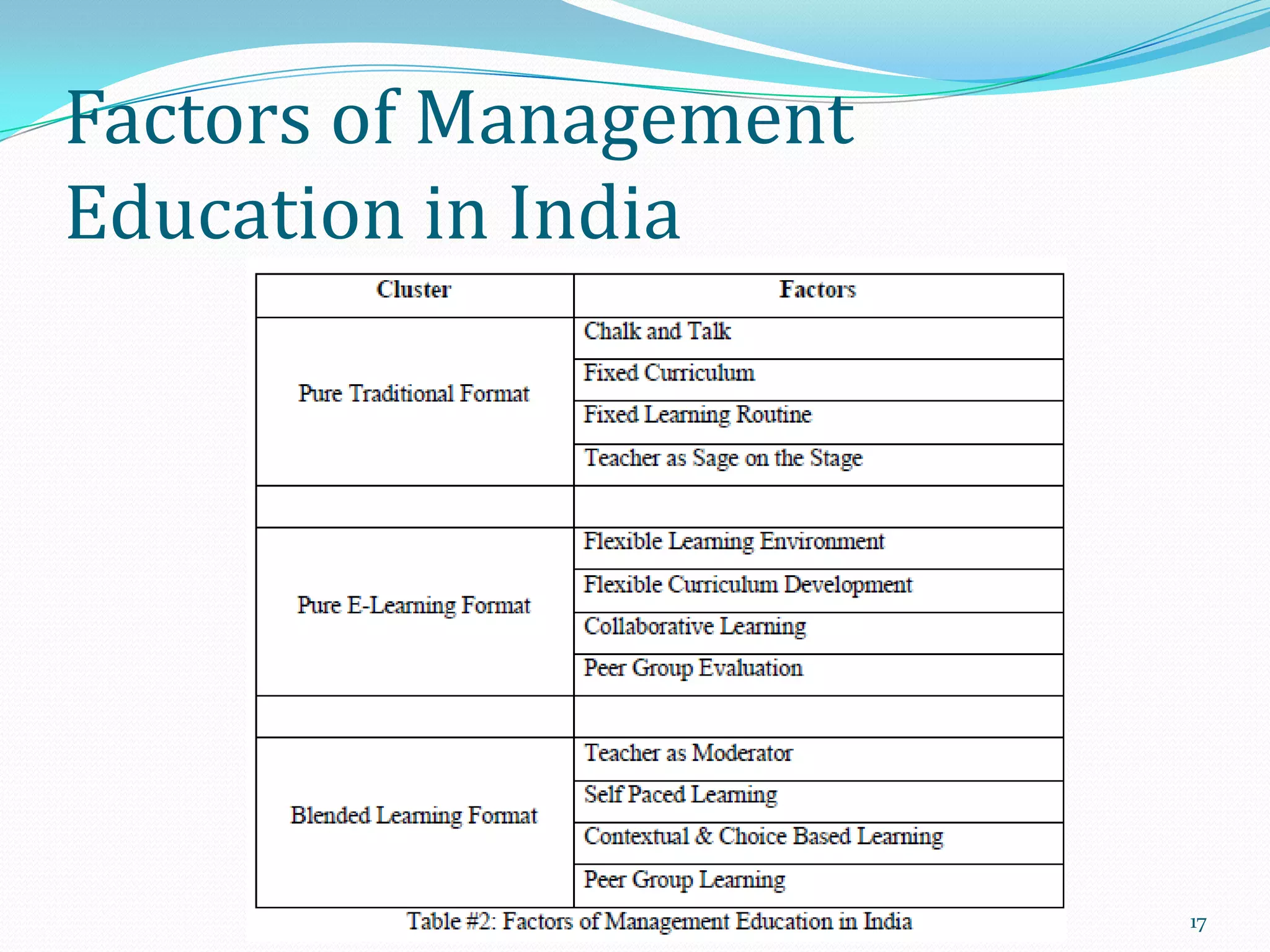
Factors of Management
Education in India

17
3DE Blended Model with factors

18
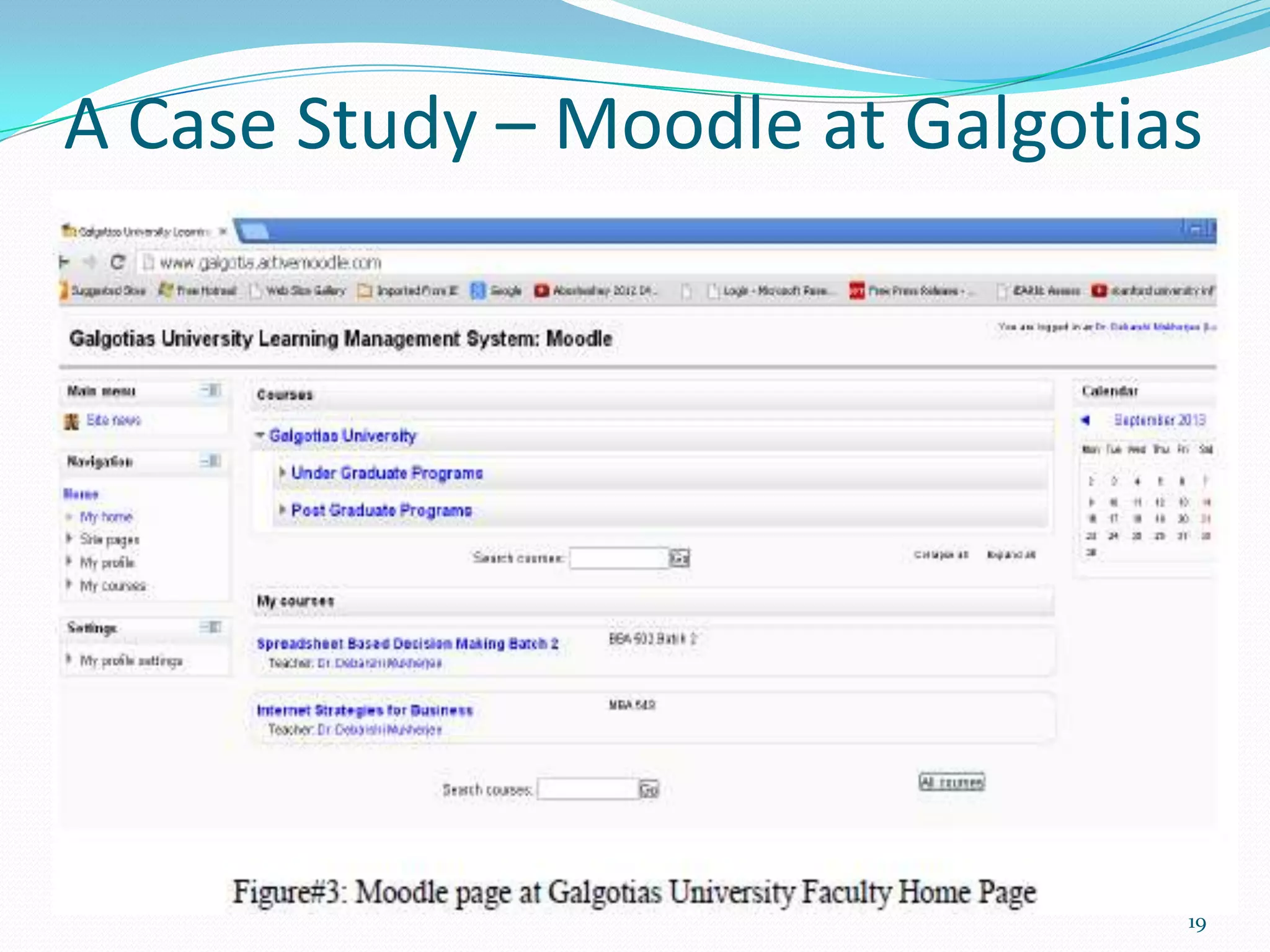
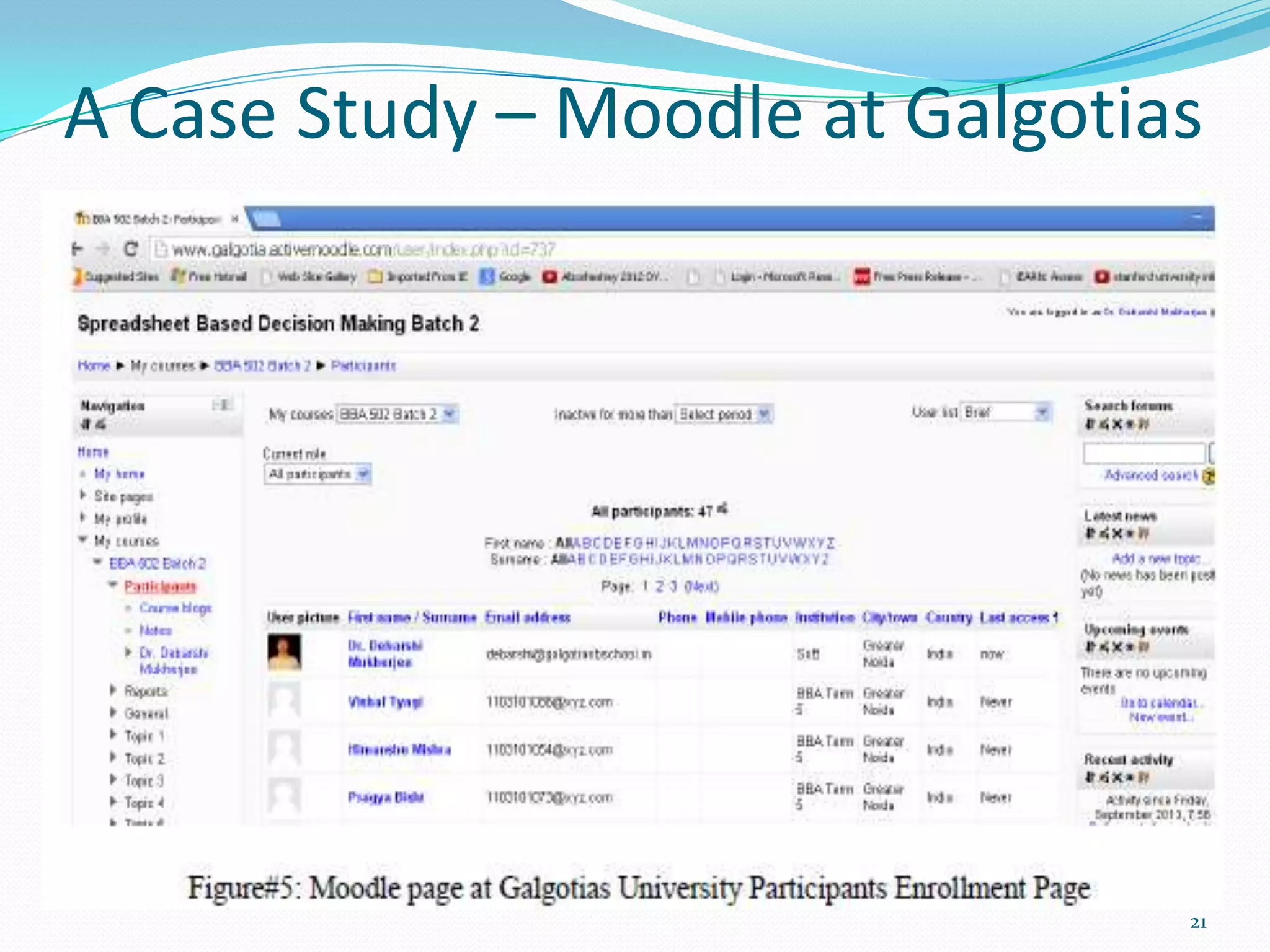
A Case Study – Moodle at Galgotias

19
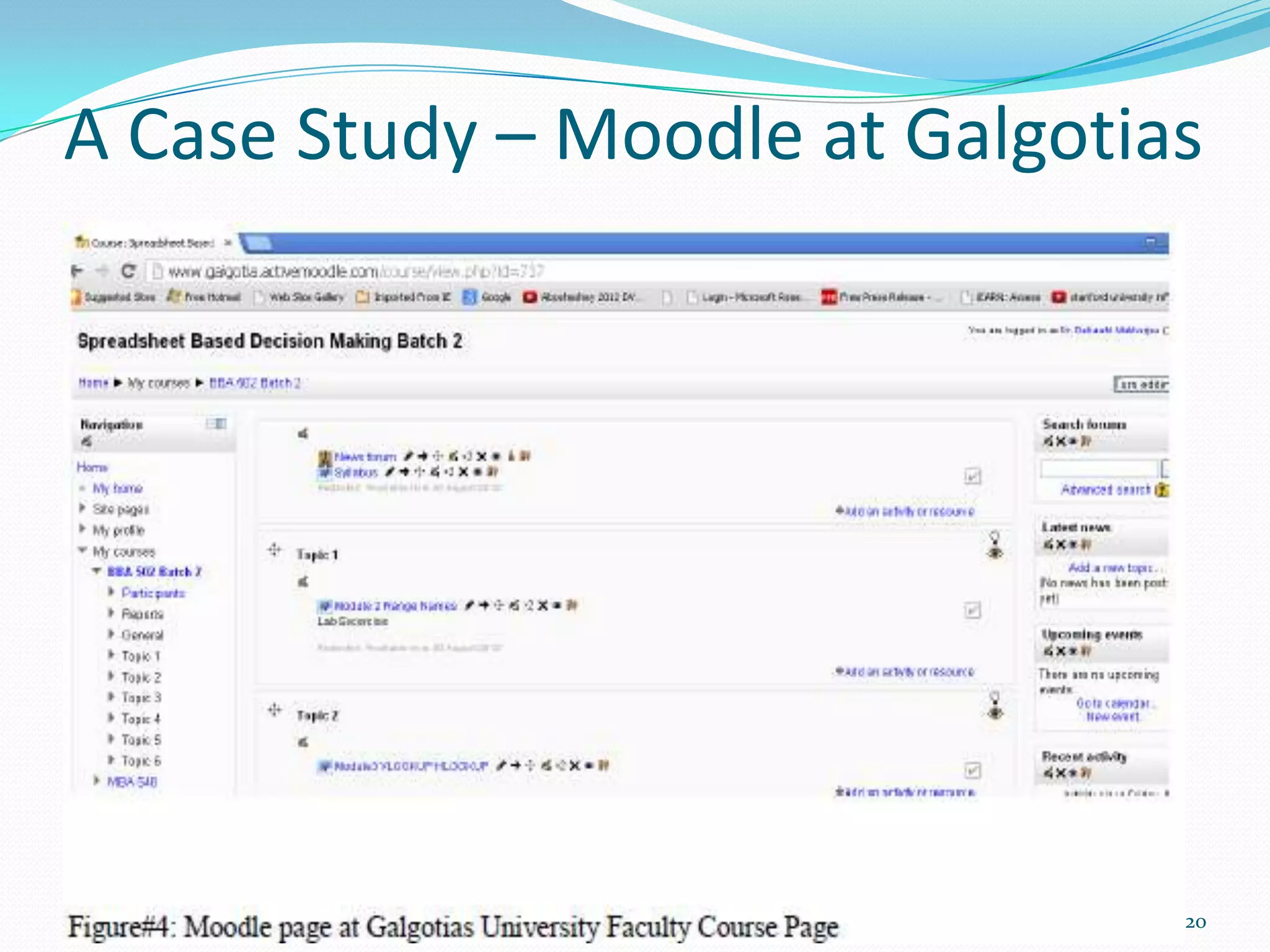
A Case Study – Moodle at Galgotias

20
A Case Study – Moodle at Galgotias

21
Conclusion
 In the spectrum of educational system in India which is

split into different clusters starting from pre-primary
to tertiary education it is difficult to postulate a onesize-fits-all model of programme delivery and
knowledge dissemination.
 the theory of constructivism might not hold true for
young learners but can have an impeccable advantage
on matured learners for skill development.

22
Conclusion
 given the infrastructural constraints across the country

pure e-learning format might not realize the learning
objective.
 Since we have moved on from traditional chalk and
model of learning a model bridging these two extremes
could possibly meet the student’s expectation by
developing a blended learning model.

23
Conclusion
 Empirical evidences have suggested that experiential

and peer group learning under collaborative learning
environment foster application knowledge where
technology plays a pivotal role.

24
Questions Please….

Dr. Debarshi Mukherjee
Associate Professor
School of Business
Galgotias University
debarshi.mukherjee@galgotiasuniversity.edu.in
+91.9899882497
25

Debarshi education using technology

  • 1.
  • 2.
    Presentation walkthrough  Premise Discussion on Constructivism  Discussion on Media Richness Theory  3 DE Blended Learning Model  An example of Moodle implementation  Q&A 2
  • 3.
    Premise  Finding abetter solution  between learners centric and learning centric pedagogy  or the one between knowledge construction and knowledge communication 3
  • 4.
    Theory of Constructivism Highlights the ability of the student to create knowledge.  The transmission model works fine with small groups.  Complex situations arise before a wide and vernacular audience representing different socio-cultural groups with various language expression abilities. 4
  • 5.
    Theory of Constructivism A student learns to put together pieces of knowledge collected from different sources as transmitted to him on various occasions and add his/her inner value and own application to create knowledge.  Minimal guidance to the students forces the students to develop indigenous problem solving and cognitive thinking ability leading to knowledge creation. 5
  • 6.
    Theory of Constructivism Scientists have coined different terminology to explain the same model at different point of time (as exhibited in Table#1). 6
  • 7.
    Major Gap inConstructivism  Doesn’t work on intermediate or primary learners as the requirement of strong instructional guidance cannot overlooked. 7
  • 8.
    Media Richness Theory Arrived in late eighties which owes its origin to social learning and selection of media to foster effective communication.  Media, preferably a computing device can send information over a network while maintain the richness of a face-to-face interaction. 8
  • 9.
    Media Richness Theory Argues that selection of media could enhance the task being done consuming the media hence it can be concluded that using networked learning mode can not only reproduce the effectiveness of a face-to-face conversation but increases many folds.  The two theories advocate a blended model of education could be meaningful. 9
  • 10.
    3-D Grounded PraxisModel  Discussion, Dialogue and Discourse: This model seems befitting in its traditional classroom environment addressing a relatively smaller group.  Asynchronous learning mode wasn’t a part of 3D model.  To address a global audience using a technology platform becomes imperative and offering online course in virtual learning environment causes a paradigm shift in education sector. 10
  • 11.
    Pure e-learning (3-E) Pure e-learning (3-E) format promises enriched content, easy delivery mode and experiential learning which is an extension to 3-D model.  3-E model realizes both synchronous and asynchronous learning modes.  It offers to break the geographic barrier of traditional classroom setting and imbibes the concept of collaborative learning over a network. 11
  • 12.
    The Blend  Ablend of the two previous models seems evident as it aims to bring effectiveness in the pedagogy to meet learner’s expectations.  The blended learning model appreciates the shift from the legacy of enriched content, easy delivery and experiential learning to the advanced dimension of contextual, choice based, networked learning. 12
  • 13.
    The Blend  Allthree dimensions of blended model function in unison with the understanding of student’s expectation designed in accordance with the interaction between a student and a teacher as argued by constructivist theorists (Laurillard, 2002). 13
  • 14.
    The Blend  Sharingknowledge over a network reduces geographic dispersion gap of a face – to – face classroom meeting while bringing in the aroma of collaborative learning which is exactly in line with the arguments of media richness theory.  Besides virtual interaction this model promises face – to – face interaction as well under managed learning environment as in India purely technology mediated learning environment may work as an impediment to the evolution of e-learning. 14
  • 15.
    The Blend (3-DE) Contextual learning does not only talk about enriched content and its navigational dimensions but at the same time situation specific across – the – table interactions involving Dialogue – Discussion – Discourse which helps meeting student’s expectations with higher learning gain. 15
  • 16.
  • 17.
  • 18.
    3DE Blended Modelwith factors 18
  • 19.
    A Case Study– Moodle at Galgotias 19
  • 20.
    A Case Study– Moodle at Galgotias 20
  • 21.
    A Case Study– Moodle at Galgotias 21
  • 22.
    Conclusion  In thespectrum of educational system in India which is split into different clusters starting from pre-primary to tertiary education it is difficult to postulate a onesize-fits-all model of programme delivery and knowledge dissemination.  the theory of constructivism might not hold true for young learners but can have an impeccable advantage on matured learners for skill development. 22
  • 23.
    Conclusion  given theinfrastructural constraints across the country pure e-learning format might not realize the learning objective.  Since we have moved on from traditional chalk and model of learning a model bridging these two extremes could possibly meet the student’s expectation by developing a blended learning model. 23
  • 24.
    Conclusion  Empirical evidenceshave suggested that experiential and peer group learning under collaborative learning environment foster application knowledge where technology plays a pivotal role. 24
  • 25.
    Questions Please…. Dr. DebarshiMukherjee Associate Professor School of Business Galgotias University debarshi.mukherjee@galgotiasuniversity.edu.in +91.9899882497 25