Ratios
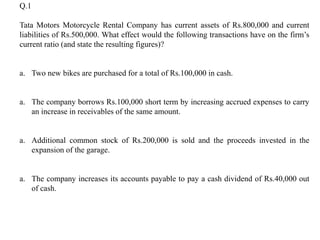
Q.1
Tata Motors Motorcycle Rental Company has current assets of Rs.800,000 and current
liabilities of Rs.500,000. What effect would the following transactions have on the firm’s
current ratio (and state the resulting figures)?
a. Two new bikes are purchased for a total of Rs.100,000 in cash.
a. The company borrows Rs.100,000 short term by increasing accrued expenses to carry
an increase in receivables of the same amount.
a. Additional common stock of Rs.200,000 is sold and the proceeds invested in the
expansion of the garage.
a. The company increases its accounts payable to pay a cash dividend of Rs.40,000 out
of cash.
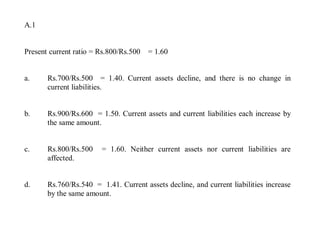
A.1
Present current ratio = Rs.800/Rs.500 = 1.60
a. Rs.700/Rs.500 = 1.40. Current assets decline, and there is no change in
current liabilities.
b. Rs.900/Rs.600 = 1.50. Current assets and current liabilities each increase by
the same amount.
c. Rs.800/Rs.500 = 1.60. Neither current assets nor current liabilities are
affected.
d. Rs.760/Rs.540 = 1.41. Current assets decline, and current liabilities increase
by the same amount.
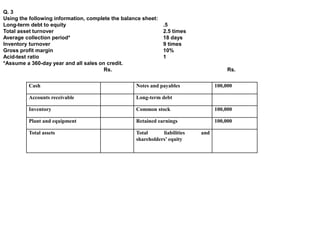
Cash Notes and payables 100,000
Accounts receivable Long-term debt
Inventory Common stock 100,000
Plant and equipment Retained earnings 100,000
Total assets Total liabilities and
shareholders’ equity
Q. 3
Using the following information, complete the balance sheet:
Long-term debt to equity .5
Total asset turnover 2.5 times
Average collection period* 18 days
Inventory turnover 9 times
Gross profit margin 10%
Acid-test ratio 1
*Assume a 360-day year and all sales on credit.
Rs. Rs.
A. 3
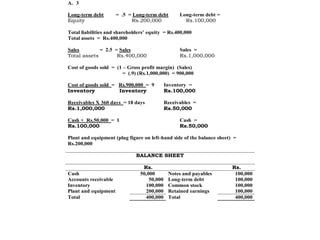
Long-term debt = .5 = Long-term debt Long-term debt =
Equity Rs.200,000 Rs.100,000
Total liabilities and shareholders’ equity = Rs.400,000
Total assets = Rs.400,000
Sales = 2.5 = Sales Sales =
Total assets Rs.400,000 Rs.1,000,000
Cost of goods sold = (1 – Gross profit margin) (Sales)
= (.9) (Rs.1,000,000) = 900,000
Cost of goods sold = Rs.900,000 = 9 Inventory =
Inventory Inventory Rs.100,000
Receivables X 360 days = 18 days Receivables =
Rs.1,000,000 Rs.50,000
Cash + Rs.50,000 = 1 Cash =
Rs.100,000 Rs.50,000
Plant and equipment (plug figure on left-hand side of the balance sheet) =
Rs.200,000
BALANCE SHEET
Rs. Rs.
Cash 50,000 Notes and payables 100,000
Accounts receivable 50,000 Long-term debt 100,000
Inventory 100,000 Common stock 100,000
Plant and equipment 200,000 Retained earnings 100,000
Total 400,000 Total 400,000
Ratios
Ratios
Ratios

Ratios

  • 1.
  • 2.
    Q.1 Tata Motors MotorcycleRental Company has current assets of Rs.800,000 and current liabilities of Rs.500,000. What effect would the following transactions have on the firm’s current ratio (and state the resulting figures)? a. Two new bikes are purchased for a total of Rs.100,000 in cash. a. The company borrows Rs.100,000 short term by increasing accrued expenses to carry an increase in receivables of the same amount. a. Additional common stock of Rs.200,000 is sold and the proceeds invested in the expansion of the garage. a. The company increases its accounts payable to pay a cash dividend of Rs.40,000 out of cash.
  • 3.
    A.1 Present current ratio= Rs.800/Rs.500 = 1.60 a. Rs.700/Rs.500 = 1.40. Current assets decline, and there is no change in current liabilities. b. Rs.900/Rs.600 = 1.50. Current assets and current liabilities each increase by the same amount. c. Rs.800/Rs.500 = 1.60. Neither current assets nor current liabilities are affected. d. Rs.760/Rs.540 = 1.41. Current assets decline, and current liabilities increase by the same amount.
  • 4.
    Cash Notes andpayables 100,000 Accounts receivable Long-term debt Inventory Common stock 100,000 Plant and equipment Retained earnings 100,000 Total assets Total liabilities and shareholders’ equity Q. 3 Using the following information, complete the balance sheet: Long-term debt to equity .5 Total asset turnover 2.5 times Average collection period* 18 days Inventory turnover 9 times Gross profit margin 10% Acid-test ratio 1 *Assume a 360-day year and all sales on credit. Rs. Rs.
  • 5.
    A. 3 Long-term debt= .5 = Long-term debt Long-term debt = Equity Rs.200,000 Rs.100,000 Total liabilities and shareholders’ equity = Rs.400,000 Total assets = Rs.400,000 Sales = 2.5 = Sales Sales = Total assets Rs.400,000 Rs.1,000,000 Cost of goods sold = (1 – Gross profit margin) (Sales) = (.9) (Rs.1,000,000) = 900,000 Cost of goods sold = Rs.900,000 = 9 Inventory = Inventory Inventory Rs.100,000 Receivables X 360 days = 18 days Receivables = Rs.1,000,000 Rs.50,000 Cash + Rs.50,000 = 1 Cash = Rs.100,000 Rs.50,000 Plant and equipment (plug figure on left-hand side of the balance sheet) = Rs.200,000 BALANCE SHEET Rs. Rs. Cash 50,000 Notes and payables 100,000 Accounts receivable 50,000 Long-term debt 100,000 Inventory 100,000 Common stock 100,000 Plant and equipment 200,000 Retained earnings 100,000 Total 400,000 Total 400,000