This document consists of 13 printed pages and 3 blank pages.
IB08 11_9706_02/3RP
© UCLES 2008 [Turn over
*0480602393*
For Examiner's Use
1
2
3
Total
UNIVERSITY OF CAMBRIDGE INTERNATIONAL EXAMINATIONS
General Certificate of Education
Advanced Subsidiary Level and Advanced Level
ACCOUNTING 9706/02
Paper 2 Structured Questions October/November 2008
1 hour 30 minutes
Candidates answer on the Question Paper
No Additional Materials are required.
READ THESE INSTRUCTIONS FIRST
Write your Centre number, candidate number and name on all the work you hand in.
Write in dark blue or black pen.
You may use a soft pencil for rough working.
Do not use staples, paper clips, highlighters, glue or correction fluid.
DO NOT WRITE IN ANY BARCODES.
Answer all questions.
You may use a calculator.
At the end of the examination, fasten all your work securely together.
The number of marks is given in brackets [ ] at the end of each question or part question.
2
© UCLES 2008 9706/02/O/N/08
For
Examiner's
Use
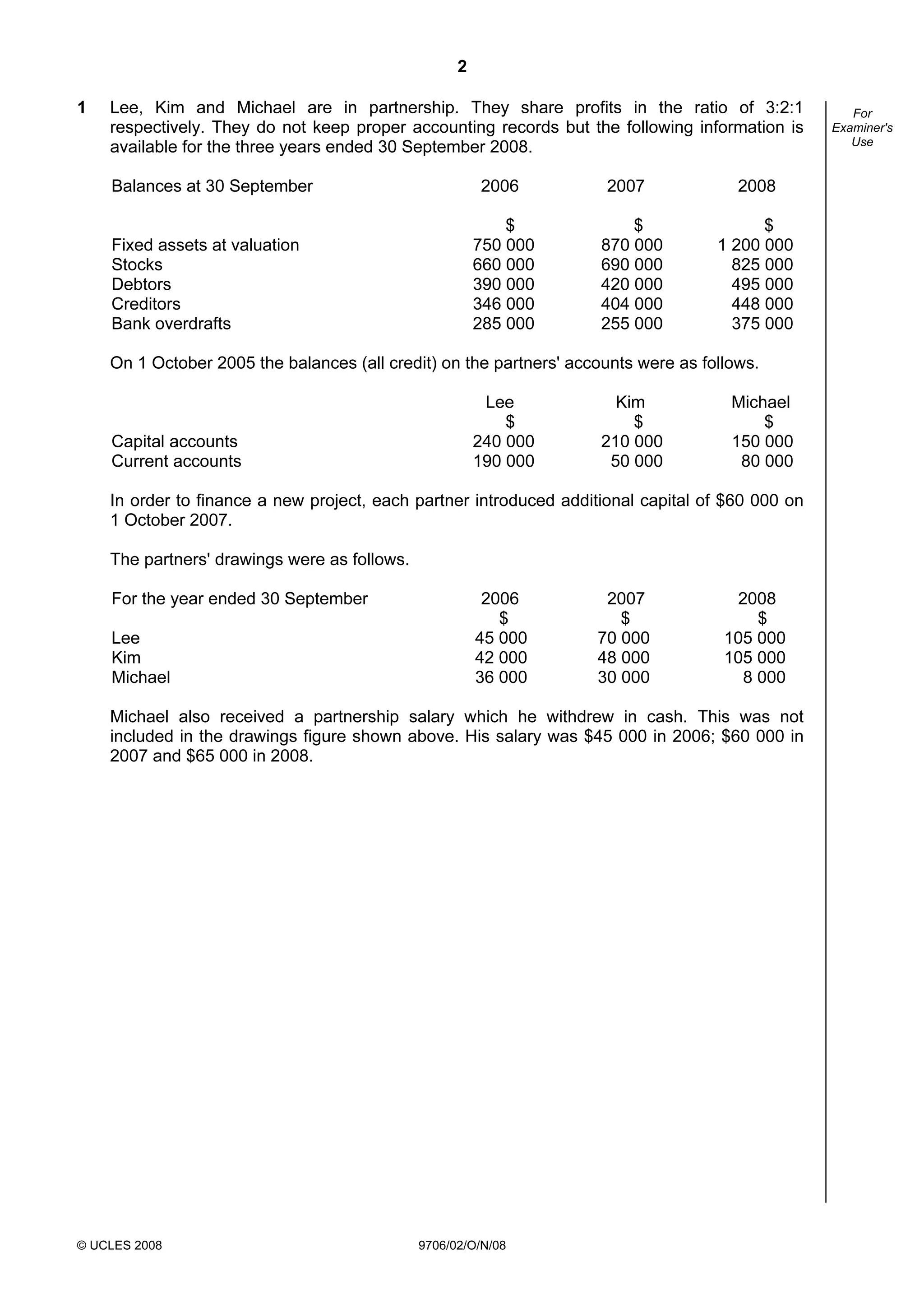
1 Lee, Kim and Michael are in partnership. They share profits in the ratio of 3:2:1
respectively. They do not keep proper accounting records but the following information is
available for the three years ended 30 September 2008.
Balances at 30 September 2006 2007 2008
$ $ $
Fixed assets at valuation 750 000 870 000 1 200 000
Stocks 660 000 690 000 825 000
Debtors 390 000 420 000 495 000
Creditors 346 000 404 000 448 000
Bank overdrafts 285 000 255 000 375 000
On 1 October 2005 the balances (all credit) on the partners' accounts were as follows.
Lee Kim Michael
$ $ $
Capital accounts 240 000 210 000 150 000
Current accounts 190 000 50 000 80 000
In order to finance a new project, each partner introduced additional capital of $60 000 on
1 October 2007.
The partners' drawings were as follows.
For the year ended 30 September 2006 2007 2008
$ $ $
Lee 45 000 70 000 105 000
Kim 42 000 48 000 105 000
Michael 36 000 30 000 8 000
Michael also received a partnership salary which he withdrew in cash. This was not
included in the drawings figure shown above. His salary was $45 000 in 2006; $60 000 in
2007 and $65 000 in 2008.
3
© UCLES 2008 9706/02/O/N/08 [Turn over
For
Examiner's
Use
REQUIRED
(a) Calculate the total net profit available to the partners for each of the three years ended
30 September 2006, 2007, 2008.
[12]
4
© UCLES 2008 9706/02/O/N/08
For
Examiner's
Use
(b) Prepare Michael's capital and current accounts for each of the three years ended
30 September 2006, 2007 and 2008.
Capital account – Michael
Current account - Michael
[14]
5
© UCLES 2008 9706/02/O/N/08 [Turn over
For
Examiner's
Use
(c) Explain, briefly, why partnerships may keep both capital accounts and current
accounts.
[4]
[Total: 30]
6
© UCLES 2008 9706/02/O/N/08
For
Examiner's
Use
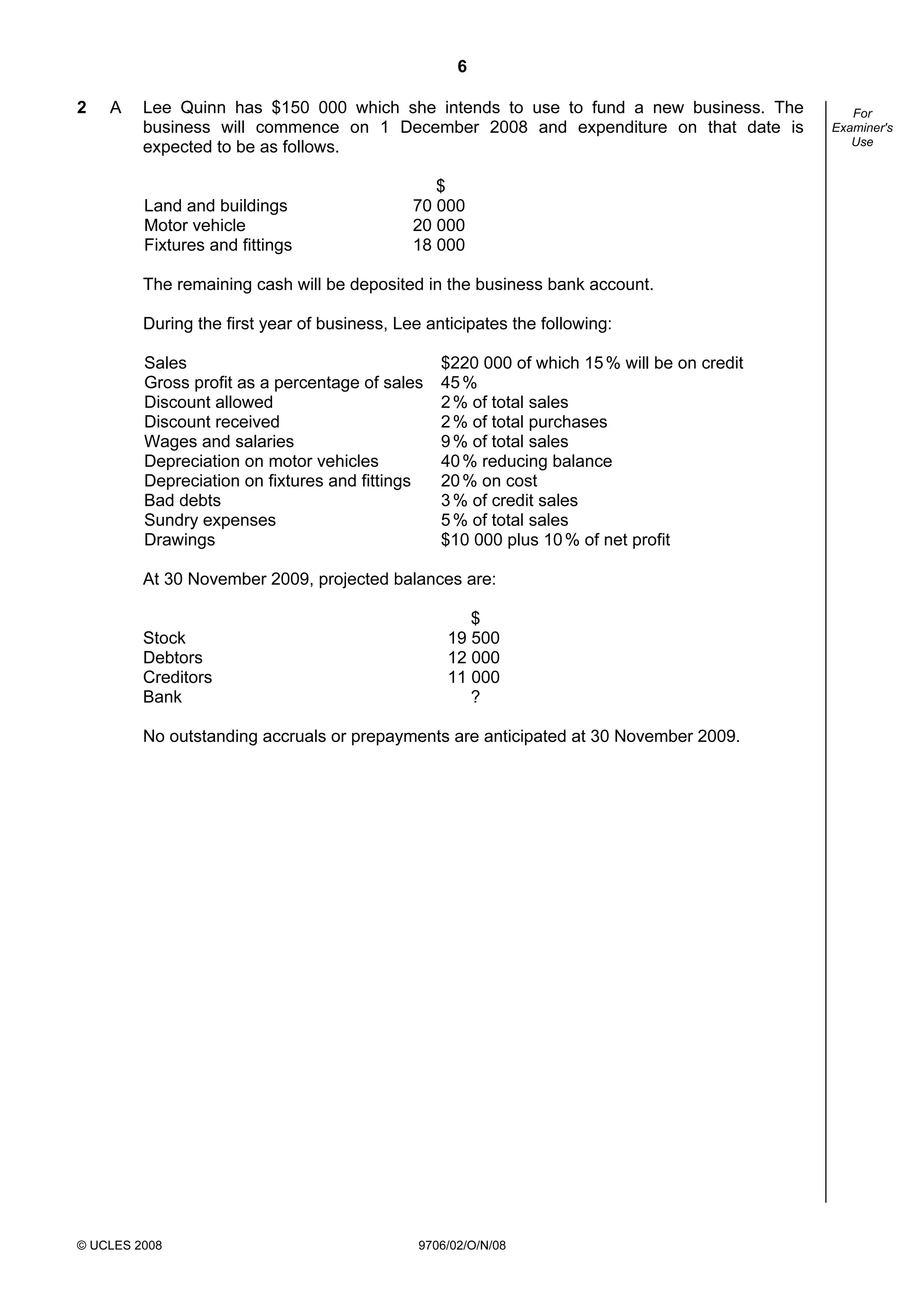
2 A Lee Quinn has $150 000 which she intends to use to fund a new business. The
business will commence on 1 December 2008 and expenditure on that date is
expected to be as follows.
$
Land and buildings 70 000
Motor vehicle 20 000
Fixtures and fittings 18 000
The remaining cash will be deposited in the business bank account.
During the first year of business, Lee anticipates the following:
Sales $220 000 of which 15% will be on credit
Gross profit as a percentage of sales 45%
Discount allowed 2% of total sales
Discount received 2% of total purchases
Wages and salaries 9% of total sales
Depreciation on motor vehicles 40% reducing balance
Depreciation on fixtures and fittings 20% on cost
Bad debts 3% of credit sales
Sundry expenses 5% of total sales
Drawings $10 000 plus 10% of net profit
At 30 November 2009, projected balances are:
$
Stock 19 500
Debtors 12 000
Creditors 11 000
Bank ?
No outstanding accruals or prepayments are anticipated at 30 November 2009.
7
© UCLES 2008 9706/02/O/N/08 [Turn over
For
Examiner's
Use
REQUIRED
(a) For the year ending 30 November 2009, calculate:
(i) total receipts from debtors;
[4]
(ii) total purchases, all of which will be on credit;
[3]
(iii) total payments to creditors.
[3]
8
© UCLES 2008 9706/02/O/N/08
For
Examiner's
Use
(b) (i) Prepare a projected trading and profit and loss account for the year ending
30 November 2009.
[8]
9
© UCLES 2008 9706/02/O/N/08 [Turn over
For
Examiner's
Use
(ii) Prepare a projected balance sheet at 30 November 2009.
[6]
10
© UCLES 2008 9706/02/O/N/08
For
Examiner's
Use
B Ahmed Khan is a sole trader. During the year ended 30 September 2007, his
percentage of net profit to sales was 22 %. The following year, this dropped to 18 %,
despite the year's net profit having increased from $60 000 to $70 000.
REQUIRED
State six possible reasons for the decrease in the ratio of net profit to sales.
[6]
[Total: 30]
11
BLANK PAGE
9706/02/O/N/08 [Turn over
Question 3 is on the next page
12
© UCLES 2008 9706/02/O/N/08
For
Examiner's
Use
3 Ken owns a manufacturing business which makes a single product. The following figures
apply for all relevant periods.
Per unit $
Selling price 35
Direct material 9
Direct labour 11
Fixed manufacturing overheads 5
Fixed manufacturing overheads are absorbed into product costs at pre-determined rates
per unit of output. Under- or over-absorbed manufacturing overheads are transferred to
profit and loss in the period in which they occur.
Normal production is 80 000 units per accounting period.
REQUIRED
(a) Calculate the break-even point in both units and dollars, based on the information
above.
[4]
The following information has been acquired for the last three accounting periods.
Three months ended 28 February 31 May 31 August
Units Units Units
Sales 60 000 80 000 45 000
Stock at start of period 15 000 0 35 000
Stock at end of period 0 35 000 20 000
13
© UCLES 2008 9706/02/O/N/08 [Turn over
For
Examiner's
Use
(b) Calculate the profit or loss in each period using marginal costing.
[13]
14
© UCLES 2008 9706/02/O/N/08
For
Examiner's
Use
(c) Calculate the profit or loss in each period using absorption costing.
[7]
(d) Prepare a financial statement that reconciles your profit using marginal costing with your
profit using absorption costing.
For three months ended 28 February 31 May 31 August
$ $ $
Profit using marginal costing
Profit using absorption costing
[6]
[Total: 30]
15
BLANK PAGE
9706/02/O/N/08
16
BLANK PAGE
Permission to reproduce items where third-party owned material protected by copyright is included has been sought and cleared where possible. Every
reasonable effort has been made by the publisher (UCLES) to trace copyright holders, but if any items requiring clearance have unwittingly been included, the
publisher will be pleased to make amends at the earliest possible opportunity.
University of Cambridge International Examinations is part of the Cambridge Assessment Group. Cambridge Assessment is the brand name of University of
Cambridge Local Examinations Syndicate (UCLES), which is itself a department of the University of Cambridge.
9706/02/O/N/08

Accounting 970602 paper 2 structured questions october november 2008

  • 1.
    This document consistsof 13 printed pages and 3 blank pages. IB08 11_9706_02/3RP © UCLES 2008 [Turn over *0480602393* For Examiner's Use 1 2 3 Total UNIVERSITY OF CAMBRIDGE INTERNATIONAL EXAMINATIONS General Certificate of Education Advanced Subsidiary Level and Advanced Level ACCOUNTING 9706/02 Paper 2 Structured Questions October/November 2008 1 hour 30 minutes Candidates answer on the Question Paper No Additional Materials are required. READ THESE INSTRUCTIONS FIRST Write your Centre number, candidate number and name on all the work you hand in. Write in dark blue or black pen. You may use a soft pencil for rough working. Do not use staples, paper clips, highlighters, glue or correction fluid. DO NOT WRITE IN ANY BARCODES. Answer all questions. You may use a calculator. At the end of the examination, fasten all your work securely together. The number of marks is given in brackets [ ] at the end of each question or part question.
  • 2.
    2 © UCLES 20089706/02/O/N/08 For Examiner's Use 1 Lee, Kim and Michael are in partnership. They share profits in the ratio of 3:2:1 respectively. They do not keep proper accounting records but the following information is available for the three years ended 30 September 2008. Balances at 30 September 2006 2007 2008 $ $ $ Fixed assets at valuation 750 000 870 000 1 200 000 Stocks 660 000 690 000 825 000 Debtors 390 000 420 000 495 000 Creditors 346 000 404 000 448 000 Bank overdrafts 285 000 255 000 375 000 On 1 October 2005 the balances (all credit) on the partners' accounts were as follows. Lee Kim Michael $ $ $ Capital accounts 240 000 210 000 150 000 Current accounts 190 000 50 000 80 000 In order to finance a new project, each partner introduced additional capital of $60 000 on 1 October 2007. The partners' drawings were as follows. For the year ended 30 September 2006 2007 2008 $ $ $ Lee 45 000 70 000 105 000 Kim 42 000 48 000 105 000 Michael 36 000 30 000 8 000 Michael also received a partnership salary which he withdrew in cash. This was not included in the drawings figure shown above. His salary was $45 000 in 2006; $60 000 in 2007 and $65 000 in 2008.
  • 3.
    3 © UCLES 20089706/02/O/N/08 [Turn over For Examiner's Use REQUIRED (a) Calculate the total net profit available to the partners for each of the three years ended 30 September 2006, 2007, 2008. [12]
  • 4.
    4 © UCLES 20089706/02/O/N/08 For Examiner's Use (b) Prepare Michael's capital and current accounts for each of the three years ended 30 September 2006, 2007 and 2008. Capital account – Michael Current account - Michael [14]
  • 5.
    5 © UCLES 20089706/02/O/N/08 [Turn over For Examiner's Use (c) Explain, briefly, why partnerships may keep both capital accounts and current accounts. [4] [Total: 30]
  • 6.
    6 © UCLES 20089706/02/O/N/08 For Examiner's Use 2 A Lee Quinn has $150 000 which she intends to use to fund a new business. The business will commence on 1 December 2008 and expenditure on that date is expected to be as follows. $ Land and buildings 70 000 Motor vehicle 20 000 Fixtures and fittings 18 000 The remaining cash will be deposited in the business bank account. During the first year of business, Lee anticipates the following: Sales $220 000 of which 15% will be on credit Gross profit as a percentage of sales 45% Discount allowed 2% of total sales Discount received 2% of total purchases Wages and salaries 9% of total sales Depreciation on motor vehicles 40% reducing balance Depreciation on fixtures and fittings 20% on cost Bad debts 3% of credit sales Sundry expenses 5% of total sales Drawings $10 000 plus 10% of net profit At 30 November 2009, projected balances are: $ Stock 19 500 Debtors 12 000 Creditors 11 000 Bank ? No outstanding accruals or prepayments are anticipated at 30 November 2009.
  • 7.
    7 © UCLES 20089706/02/O/N/08 [Turn over For Examiner's Use REQUIRED (a) For the year ending 30 November 2009, calculate: (i) total receipts from debtors; [4] (ii) total purchases, all of which will be on credit; [3] (iii) total payments to creditors. [3]
  • 8.
    8 © UCLES 20089706/02/O/N/08 For Examiner's Use (b) (i) Prepare a projected trading and profit and loss account for the year ending 30 November 2009. [8]
  • 9.
    9 © UCLES 20089706/02/O/N/08 [Turn over For Examiner's Use (ii) Prepare a projected balance sheet at 30 November 2009. [6]
  • 10.
    10 © UCLES 20089706/02/O/N/08 For Examiner's Use B Ahmed Khan is a sole trader. During the year ended 30 September 2007, his percentage of net profit to sales was 22 %. The following year, this dropped to 18 %, despite the year's net profit having increased from $60 000 to $70 000. REQUIRED State six possible reasons for the decrease in the ratio of net profit to sales. [6] [Total: 30]
  • 11.
    11 BLANK PAGE 9706/02/O/N/08 [Turnover Question 3 is on the next page
  • 12.
    12 © UCLES 20089706/02/O/N/08 For Examiner's Use 3 Ken owns a manufacturing business which makes a single product. The following figures apply for all relevant periods. Per unit $ Selling price 35 Direct material 9 Direct labour 11 Fixed manufacturing overheads 5 Fixed manufacturing overheads are absorbed into product costs at pre-determined rates per unit of output. Under- or over-absorbed manufacturing overheads are transferred to profit and loss in the period in which they occur. Normal production is 80 000 units per accounting period. REQUIRED (a) Calculate the break-even point in both units and dollars, based on the information above. [4] The following information has been acquired for the last three accounting periods. Three months ended 28 February 31 May 31 August Units Units Units Sales 60 000 80 000 45 000 Stock at start of period 15 000 0 35 000 Stock at end of period 0 35 000 20 000
  • 13.
    13 © UCLES 20089706/02/O/N/08 [Turn over For Examiner's Use (b) Calculate the profit or loss in each period using marginal costing. [13]
  • 14.
    14 © UCLES 20089706/02/O/N/08 For Examiner's Use (c) Calculate the profit or loss in each period using absorption costing. [7] (d) Prepare a financial statement that reconciles your profit using marginal costing with your profit using absorption costing. For three months ended 28 February 31 May 31 August $ $ $ Profit using marginal costing Profit using absorption costing [6] [Total: 30]
  • 15.
  • 16.
    16 BLANK PAGE Permission toreproduce items where third-party owned material protected by copyright is included has been sought and cleared where possible. Every reasonable effort has been made by the publisher (UCLES) to trace copyright holders, but if any items requiring clearance have unwittingly been included, the publisher will be pleased to make amends at the earliest possible opportunity. University of Cambridge International Examinations is part of the Cambridge Assessment Group. Cambridge Assessment is the brand name of University of Cambridge Local Examinations Syndicate (UCLES), which is itself a department of the University of Cambridge. 9706/02/O/N/08