Ratio-analysis is applied to
financial statements to analyze
the success, failure and progress
of a business.
RATIO ANALYSIS
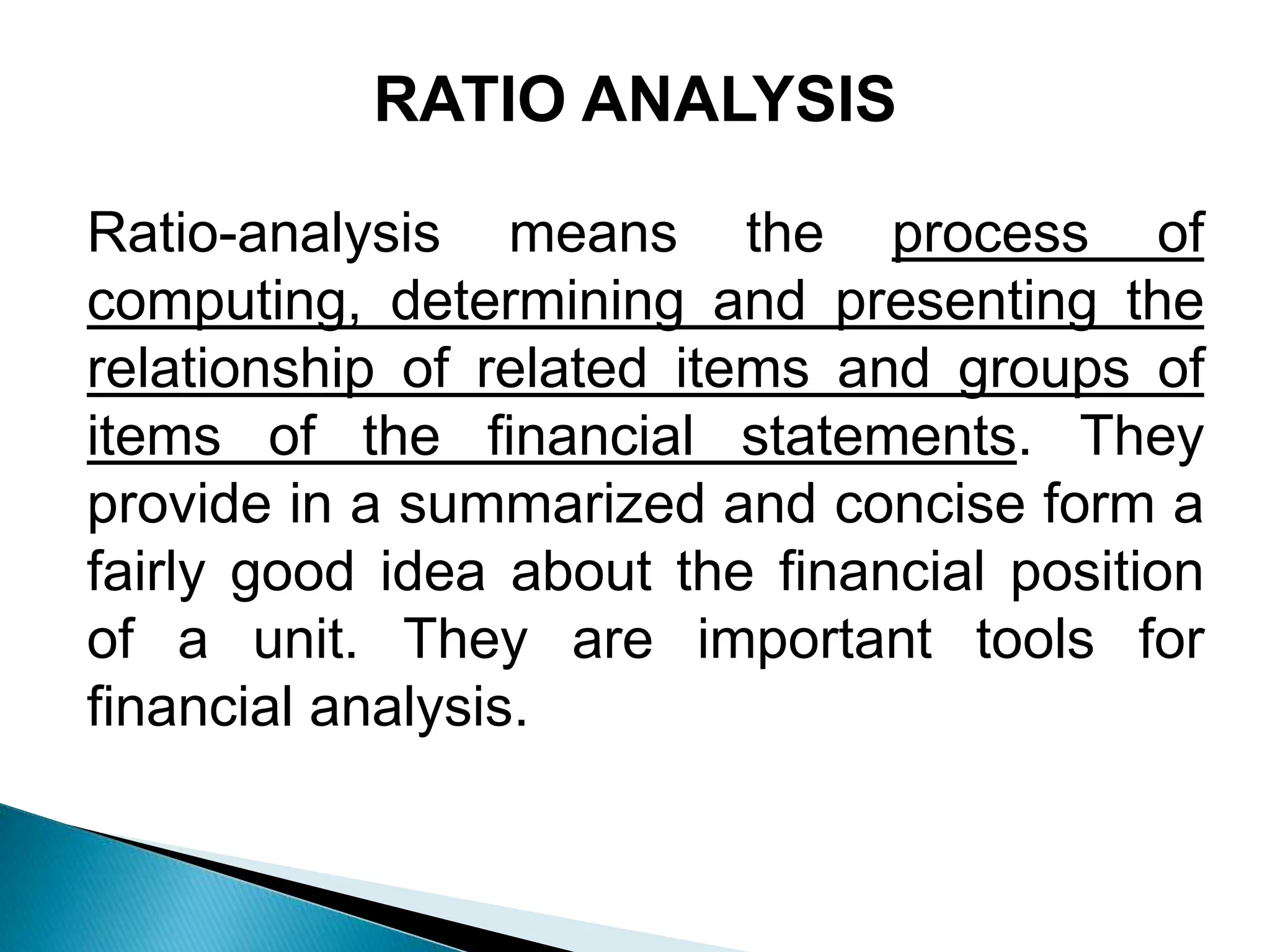
Ratio-analysis means the process of
computing, determining and presenting the
relationship of related items and groups of
items of the financial statements. They
provide in a summarized and concise form a
fairly good idea about the financial position
of a unit. They are important tools for
financial analysis.
RATIO ANALYSIS
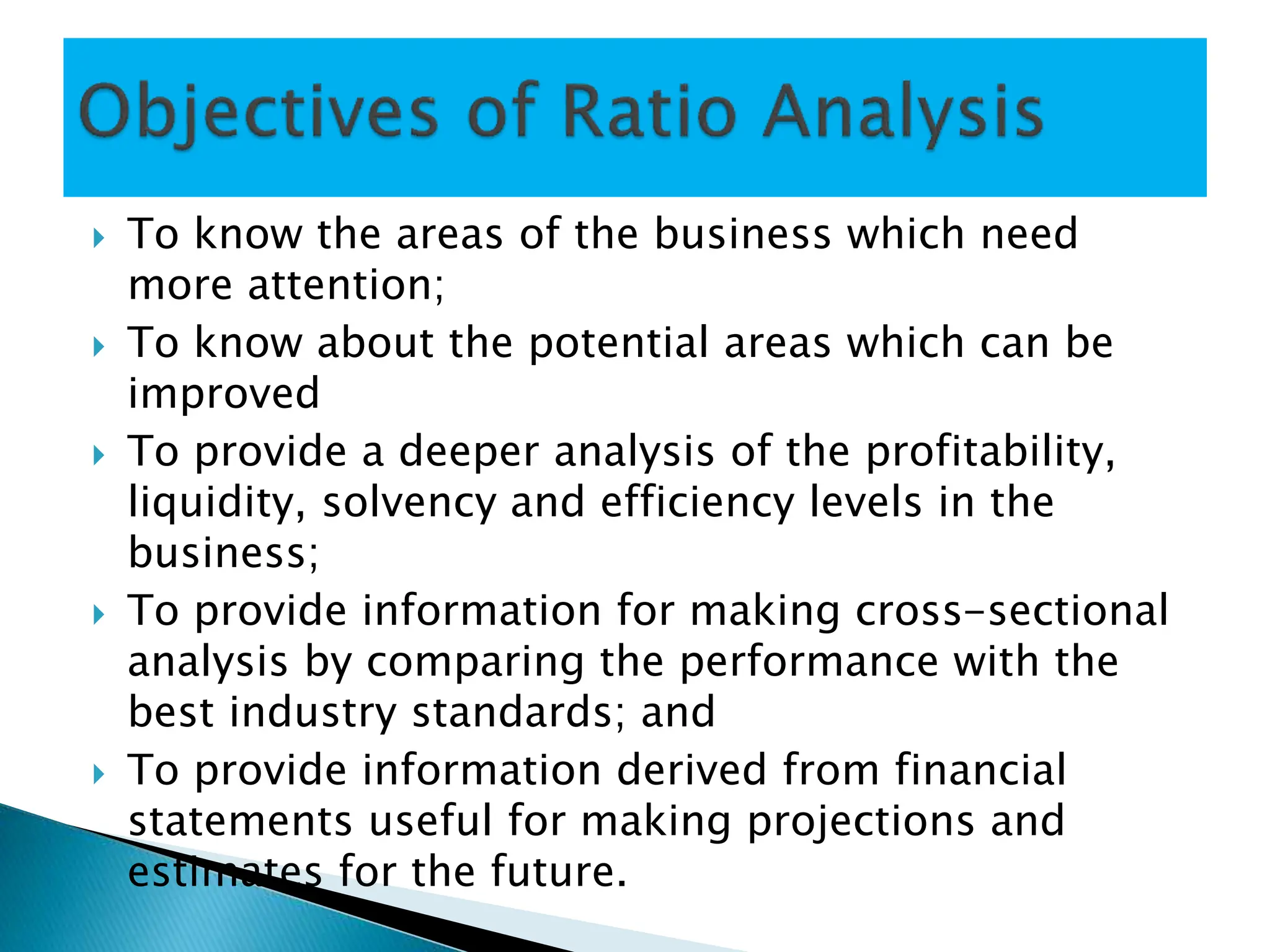
 To know the areas of the business which need
more attention;
 To know about the potential areas which can be
improved
 To provide a deeper analysis of the profitability,
liquidity, solvency and efficiency levels in the
business;
 To provide information for making cross-sectional
analysis by comparing the performance with the
best industry standards; and
 To provide information derived from financial
statements useful for making projections and
estimates for the future.
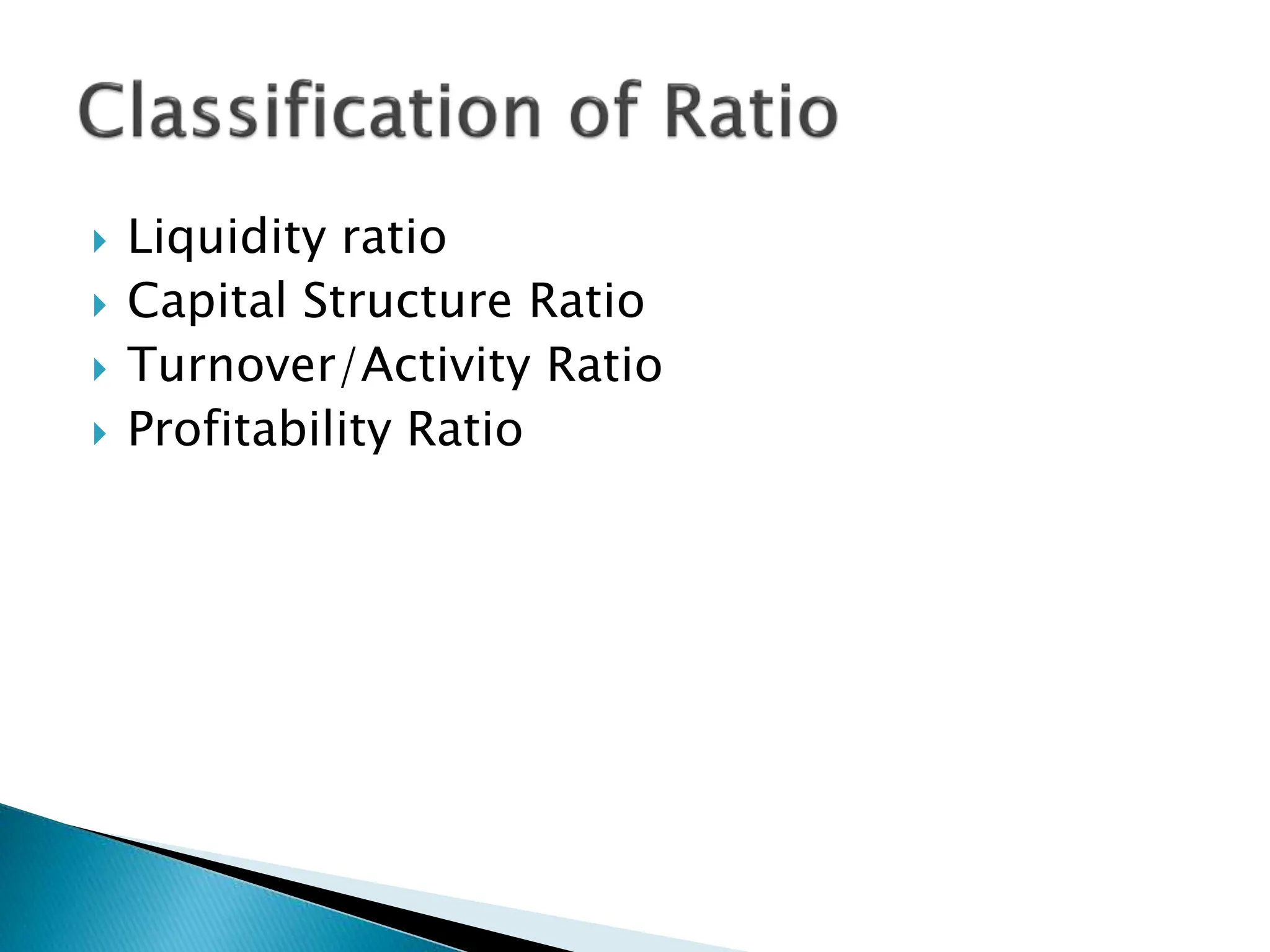
 Liquidity ratio
 Capital Structure Ratio
 Turnover/Activity Ratio
 Profitability Ratio
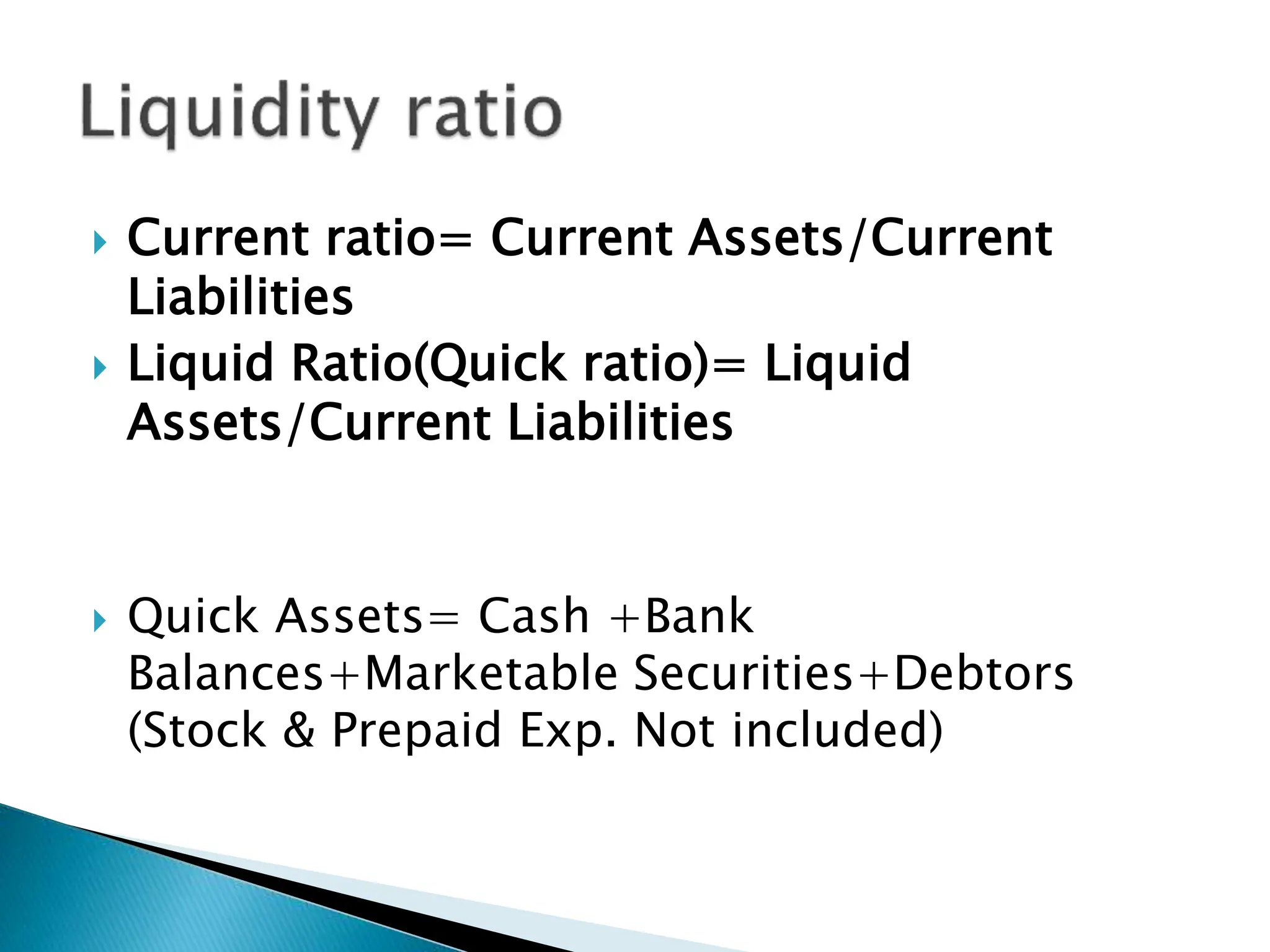
 Current ratio= Current Assets/Current
Liabilities
 Liquid Ratio(Quick ratio)= Liquid
Assets/Current Liabilities
 Quick Assets= Cash +Bank
Balances+Marketable Securities+Debtors
(Stock & Prepaid Exp. Not included)
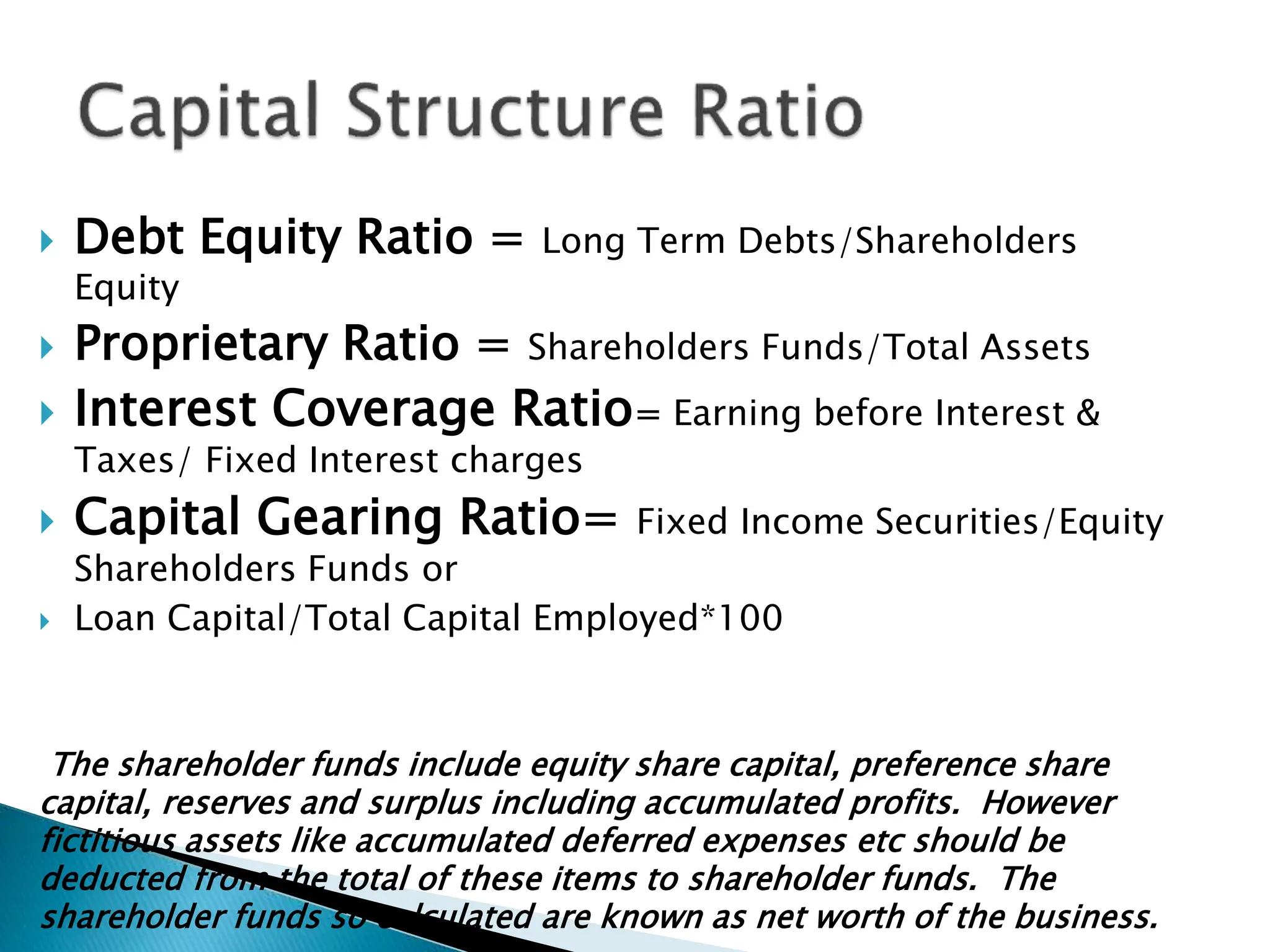
 Debt Equity Ratio = Long Term Debts/Shareholders
Equity
 Proprietary Ratio = Shareholders Funds/Total Assets
 Interest Coverage Ratio= Earning before Interest &
Taxes/ Fixed Interest charges
 Capital Gearing Ratio= Fixed Income Securities/Equity
Shareholders Funds or
 Loan Capital/Total Capital Employed*100
The shareholder funds include equity share capital, preference share
capital, reserves and surplus including accumulated profits. However
fictitious assets like accumulated deferred expenses etc should be
deducted from the total of these items to shareholder funds. The
shareholder funds so calculated are known as net worth of the business.
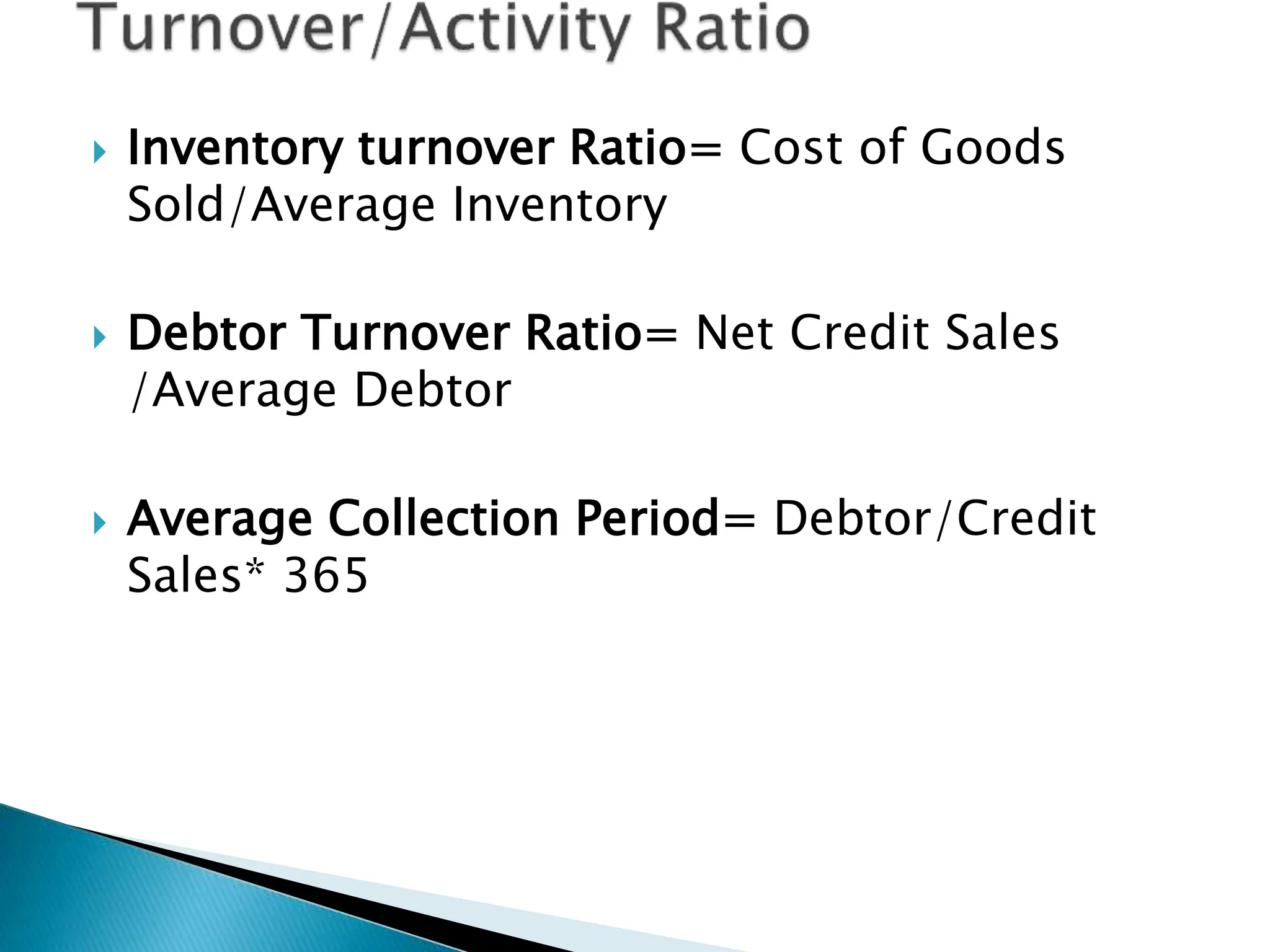
 Inventory turnover Ratio= Cost of Goods
Sold/Average Inventory
 Debtor Turnover Ratio= Net Credit Sales
/Average Debtor
 Average Collection Period= Debtor/Credit
Sales* 365
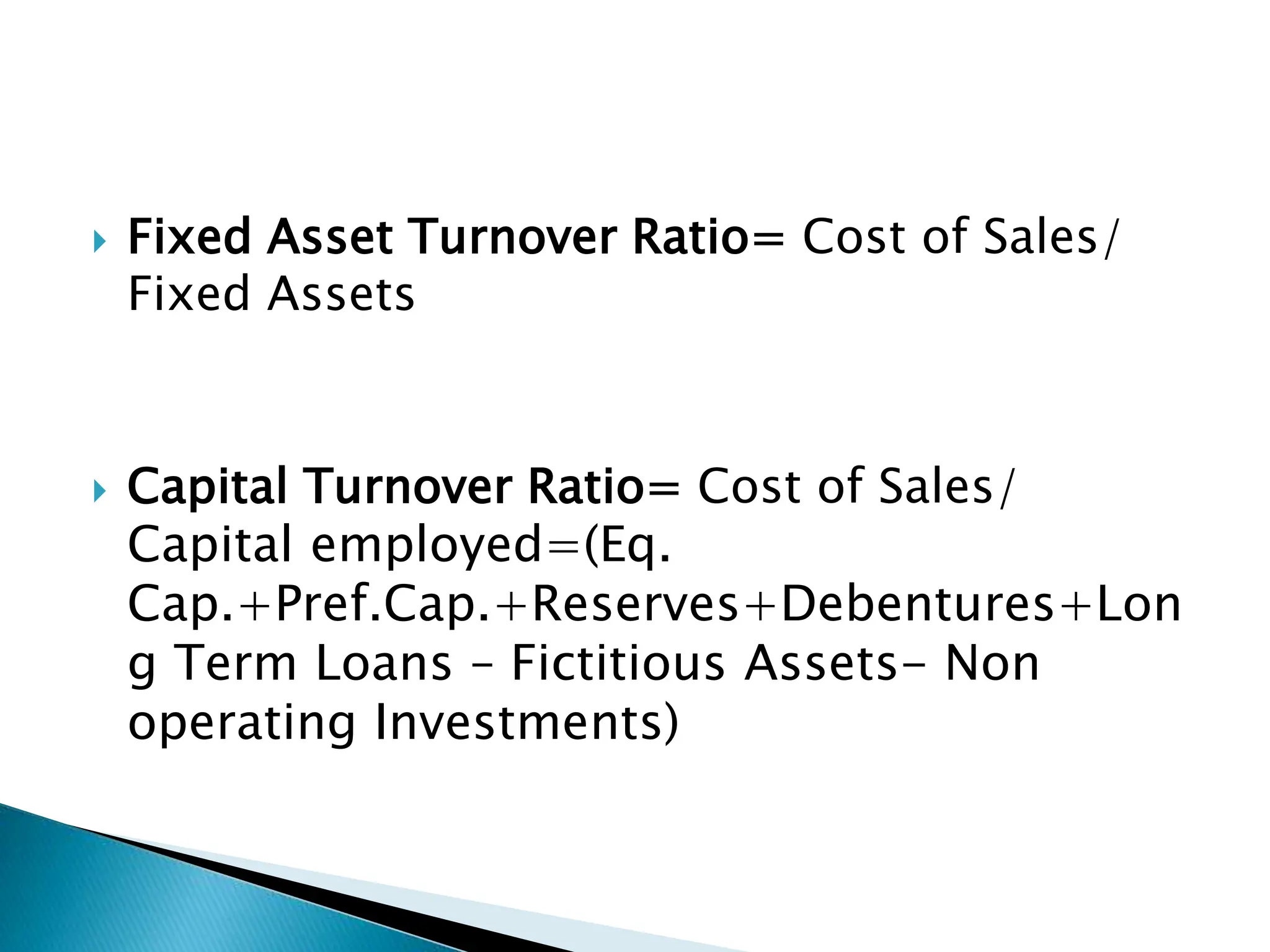
 Fixed Asset Turnover Ratio= Cost of Sales/
Fixed Assets
 Capital Turnover Ratio= Cost of Sales/
Capital employed=(Eq.
Cap.+Pref.Cap.+Reserves+Debentures+Lon
g Term Loans – Fictitious Assets- Non
operating Investments)
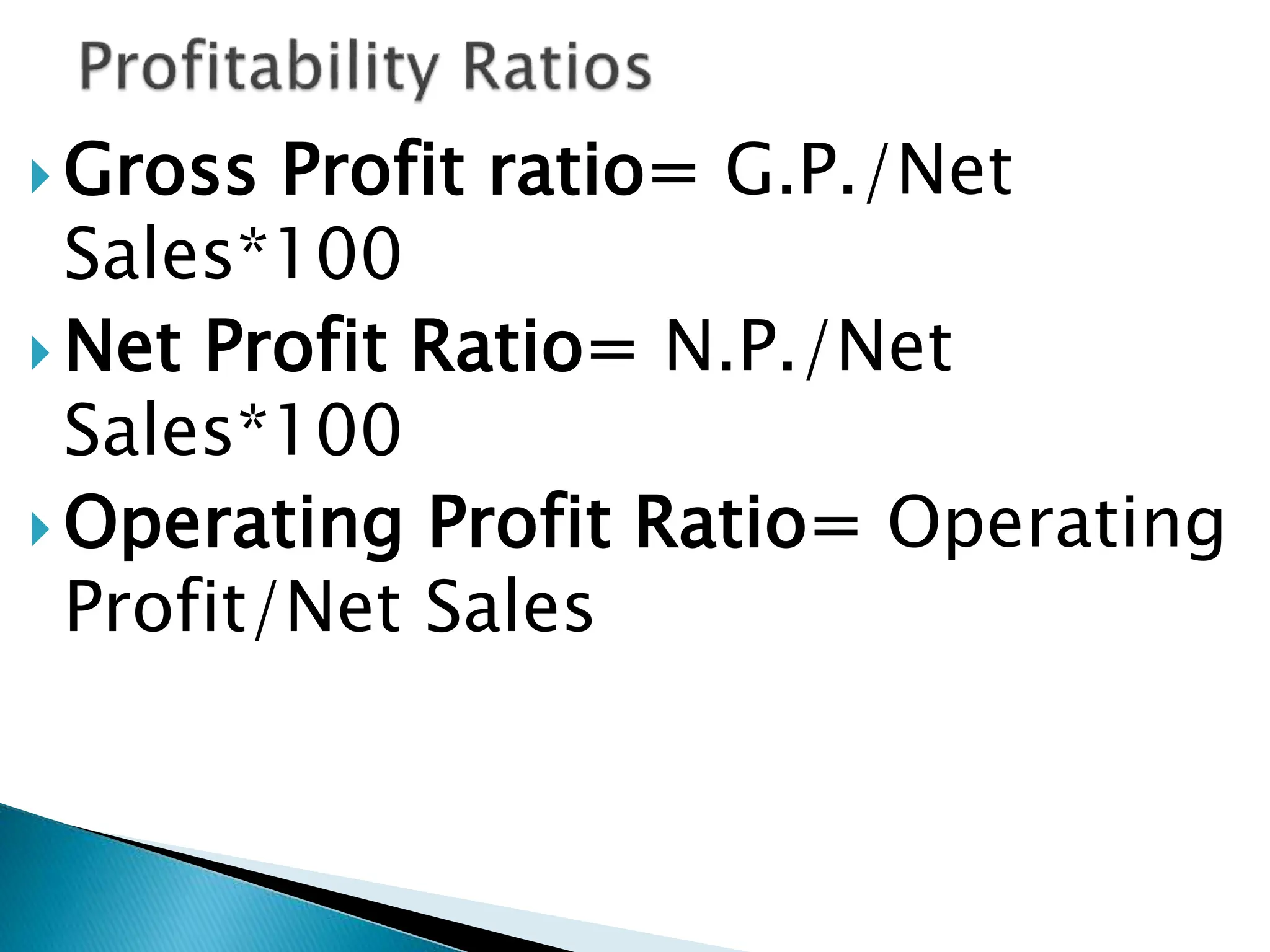
 Gross Profit ratio= G.P./Net
Sales*100
 Net Profit Ratio= N.P./Net
Sales*100
 Operating Profit Ratio= Operating
Profit/Net Sales
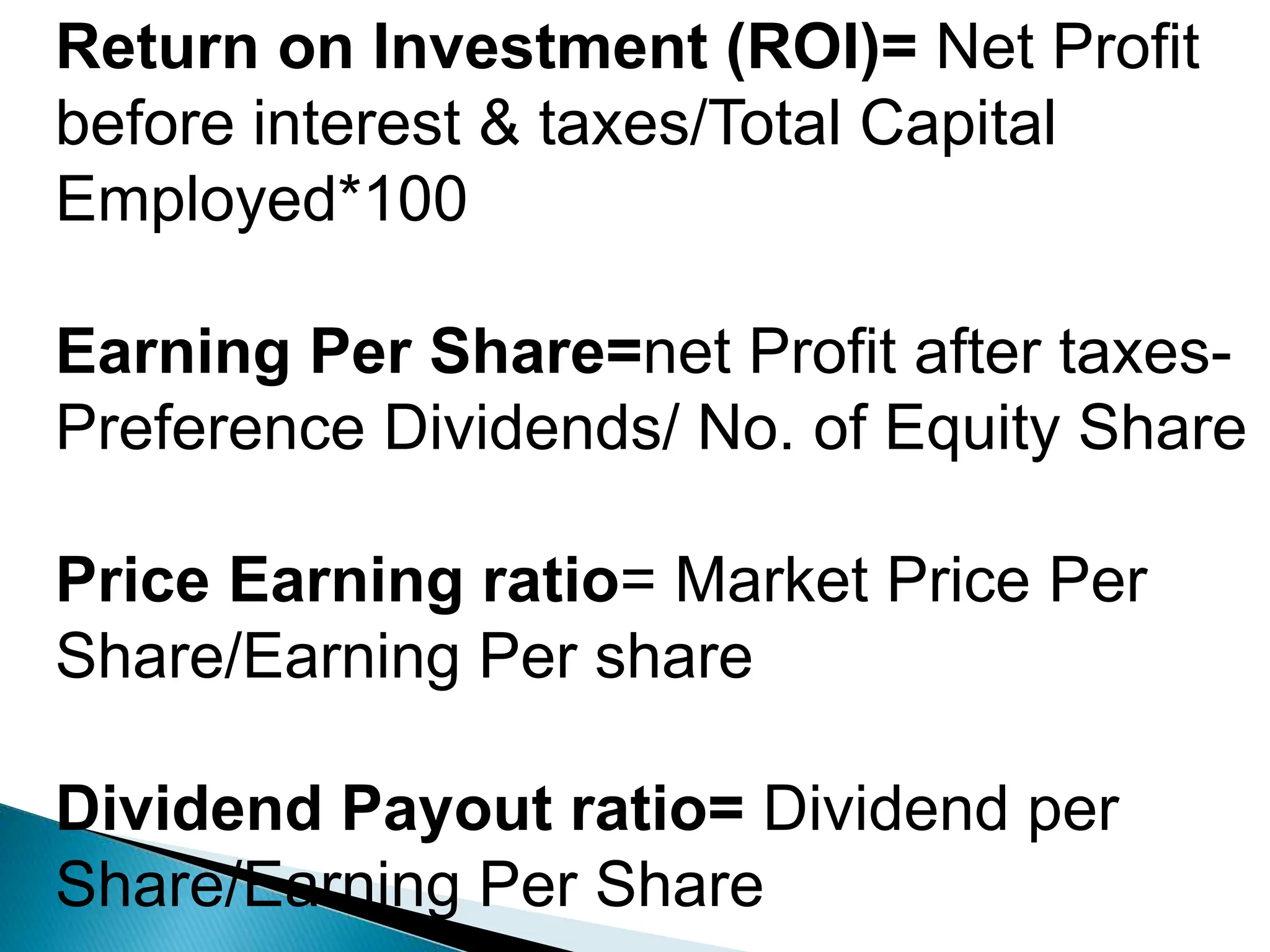
Return on Investment (ROI)= Net Profit
before interest & taxes/Total Capital
Employed*100
Earning Per Share=net Profit after taxes-
Preference Dividends/ No. of Equity Share
Price Earning ratio= Market Price Per
Share/Earning Per share
Dividend Payout ratio= Dividend per
Share/Earning Per Share
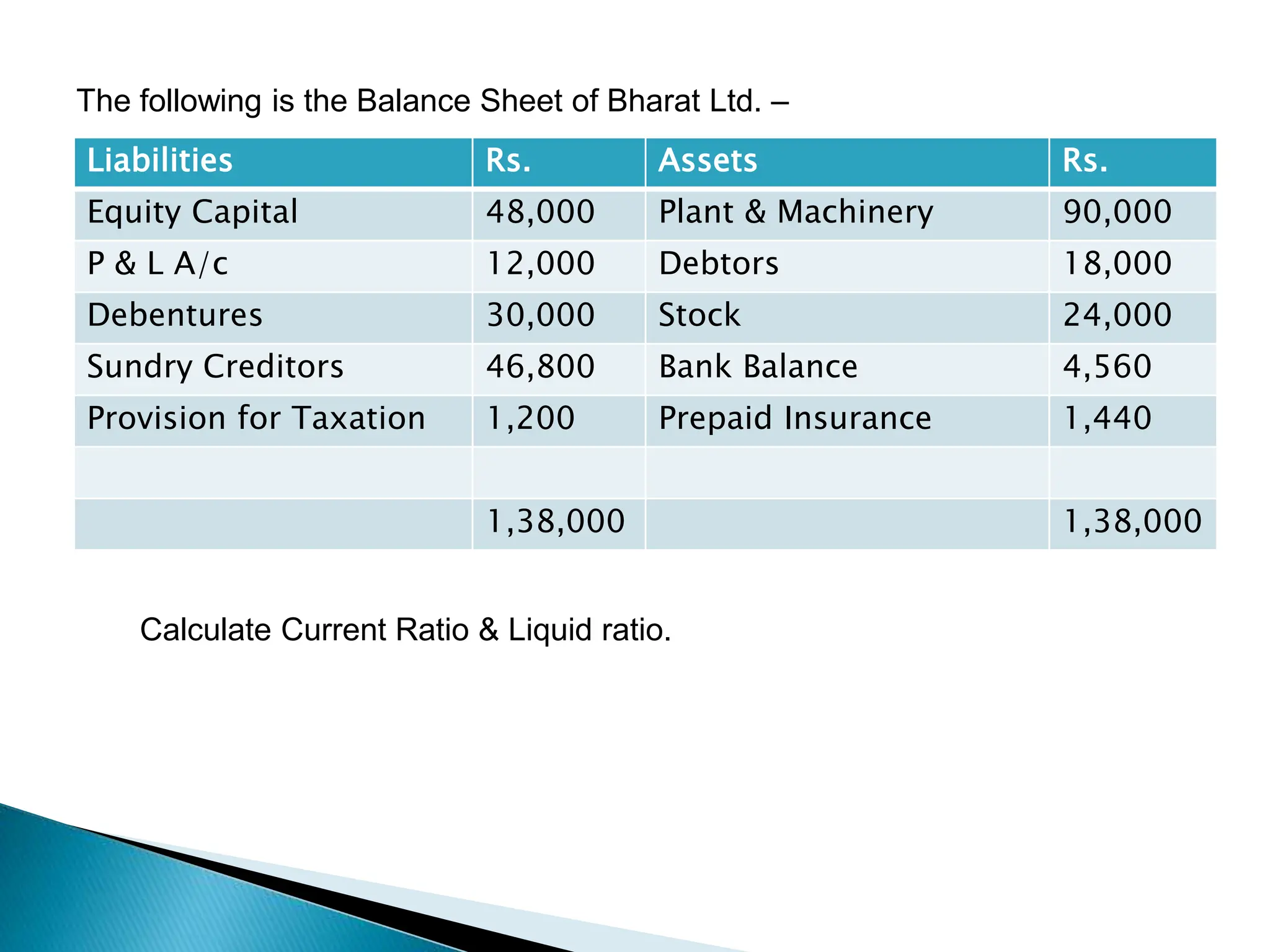
The following is the Balance Sheet of Bharat Ltd. –
Liabilities Rs. Assets Rs.
Equity Capital 48,000 Plant & Machinery 90,000
P & L A/c 12,000 Debtors 18,000
Debentures 30,000 Stock 24,000
Sundry Creditors 46,800 Bank Balance 4,560
Provision for Taxation 1,200 Prepaid Insurance 1,440
1,38,000 1,38,000
Calculate Current Ratio & Liquid ratio.
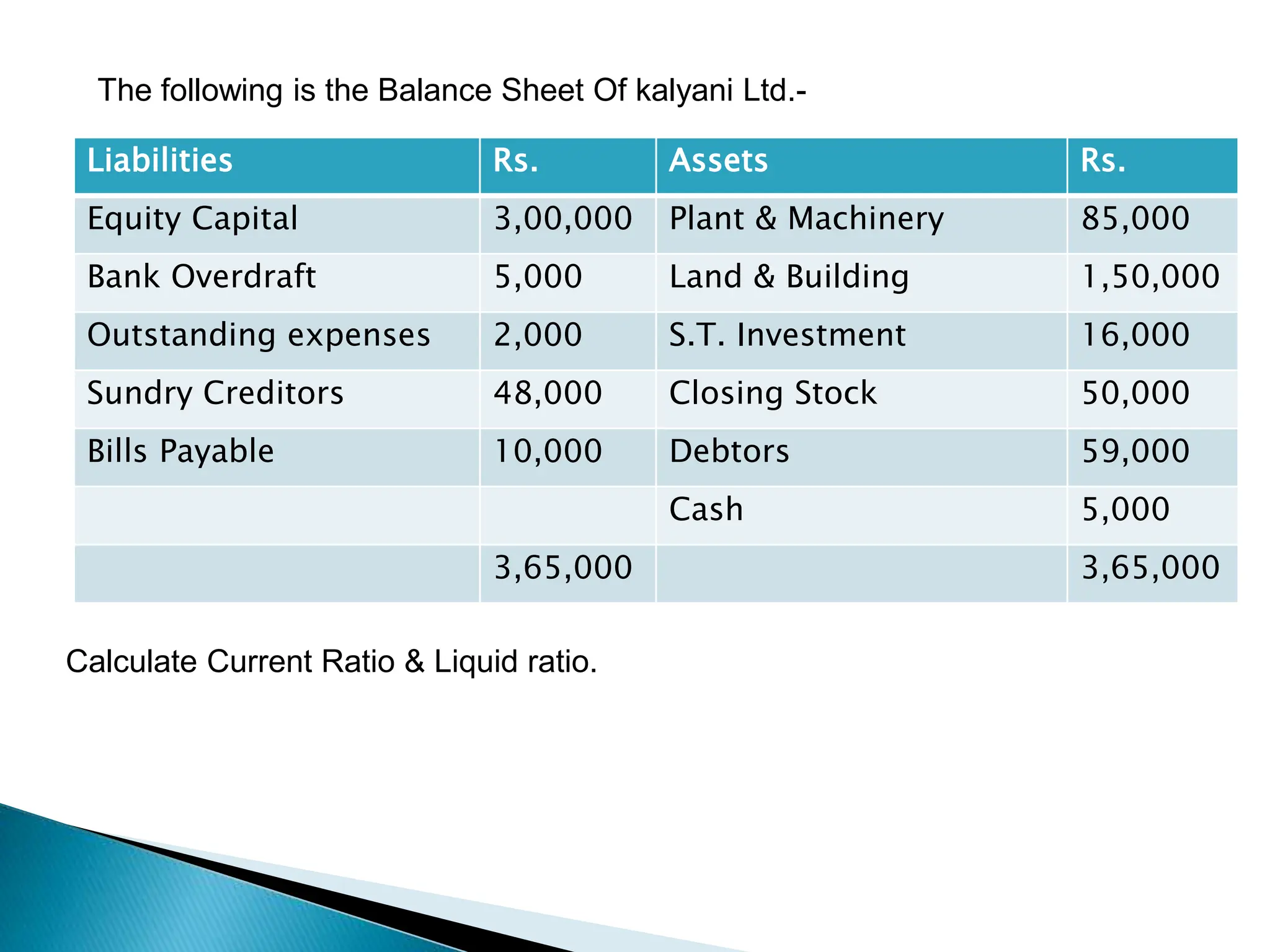
The following is the Balance Sheet Of kalyani Ltd.-
Liabilities Rs. Assets Rs.
Equity Capital 3,00,000 Plant & Machinery 85,000
Bank Overdraft 5,000 Land & Building 1,50,000
Outstanding expenses 2,000 S.T. Investment 16,000
Sundry Creditors 48,000 Closing Stock 50,000
Bills Payable 10,000 Debtors 59,000
Cash 5,000
3,65,000 3,65,000
Calculate Current Ratio & Liquid ratio.
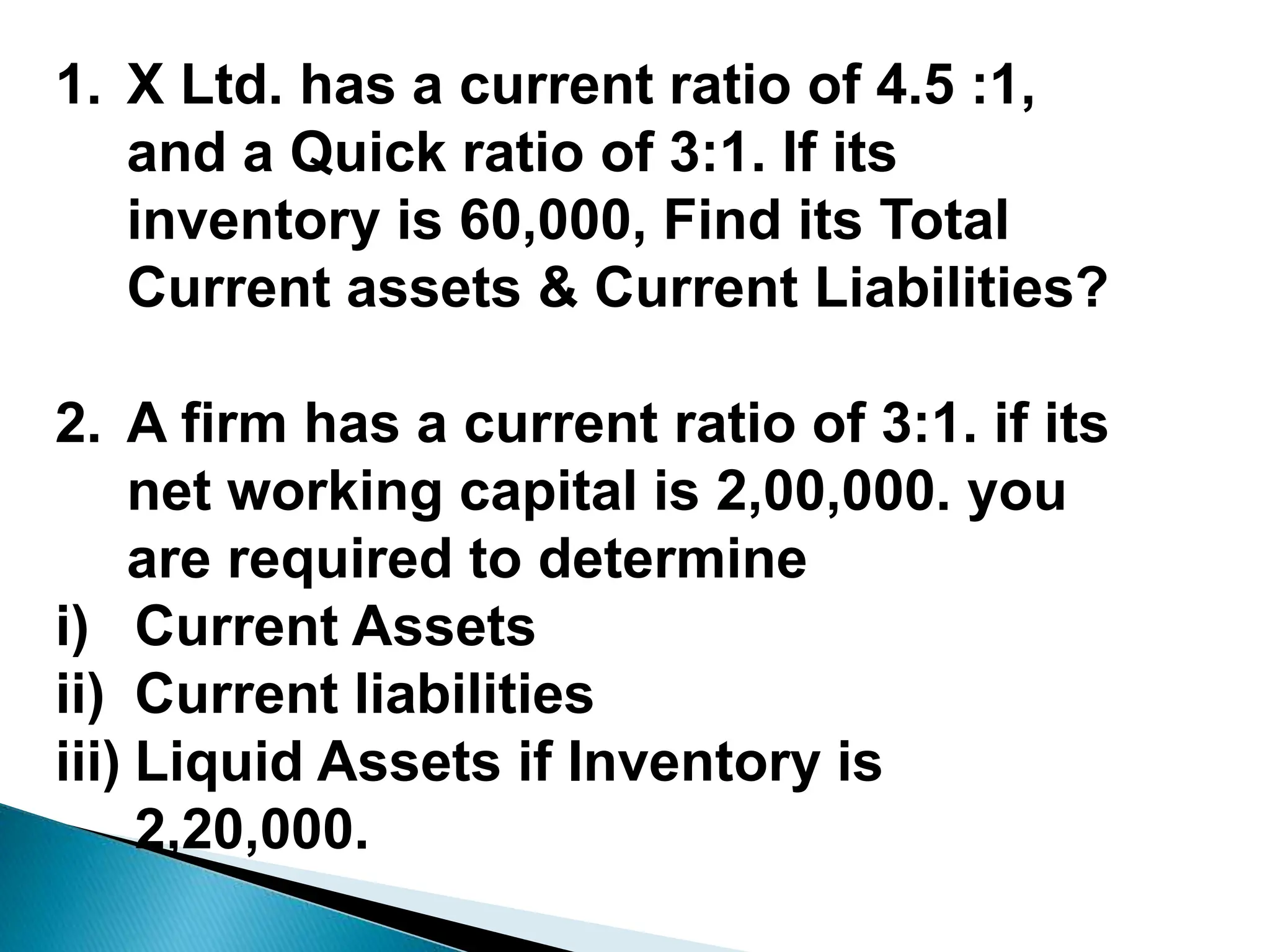
1. X Ltd. has a current ratio of 4.5 :1,
and a Quick ratio of 3:1. If its
inventory is 60,000, Find its Total
Current assets & Current Liabilities?
2. A firm has a current ratio of 3:1. if its
net working capital is 2,00,000. you
are required to determine
i) Current Assets
ii) Current liabilities
iii) Liquid Assets if Inventory is
2,20,000.
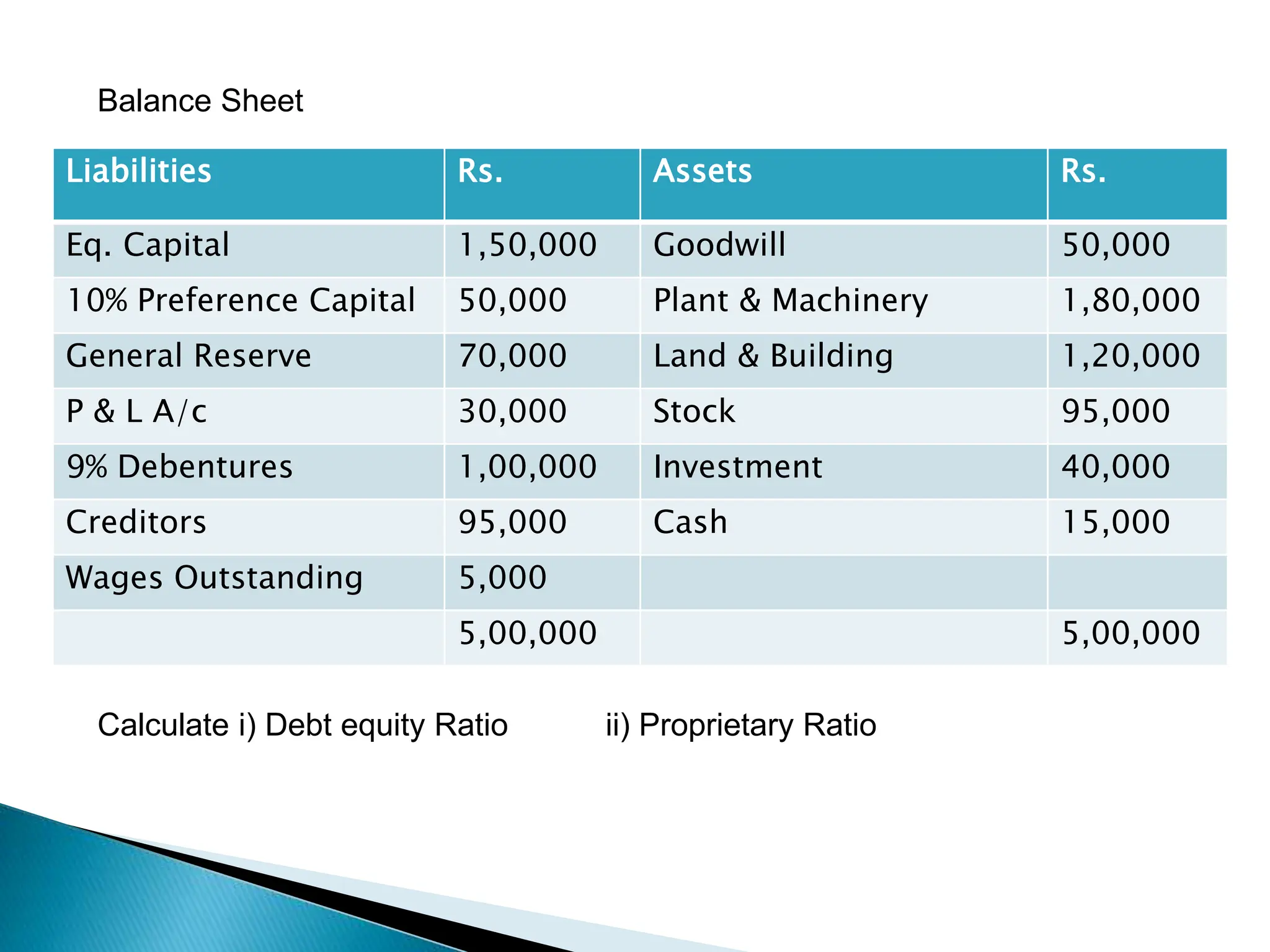
Balance Sheet
Liabilities Rs. Assets Rs.
Eq. Capital 1,50,000 Goodwill 50,000
10% Preference Capital 50,000 Plant & Machinery 1,80,000
General Reserve 70,000 Land & Building 1,20,000
P & L A/c 30,000 Stock 95,000
9% Debentures 1,00,000 Investment 40,000
Creditors 95,000 Cash 15,000
Wages Outstanding 5,000
5,00,000 5,00,000
Calculate i) Debt equity Ratio ii) Proprietary Ratio
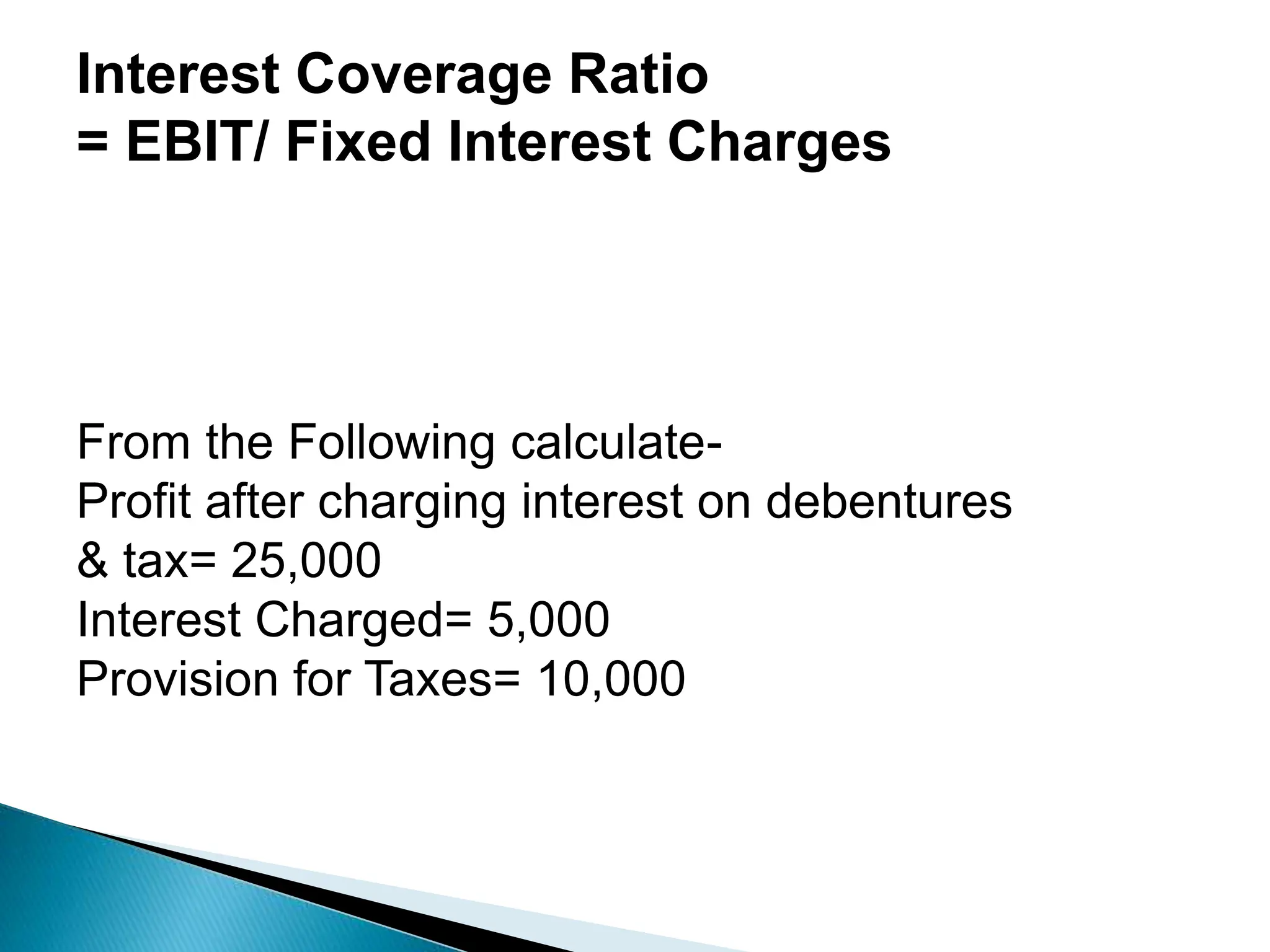
Interest Coverage Ratio
= EBIT/ Fixed Interest Charges
From the Following calculate-
Profit after charging interest on debentures
& tax= 25,000
Interest Charged= 5,000
Provision for Taxes= 10,000
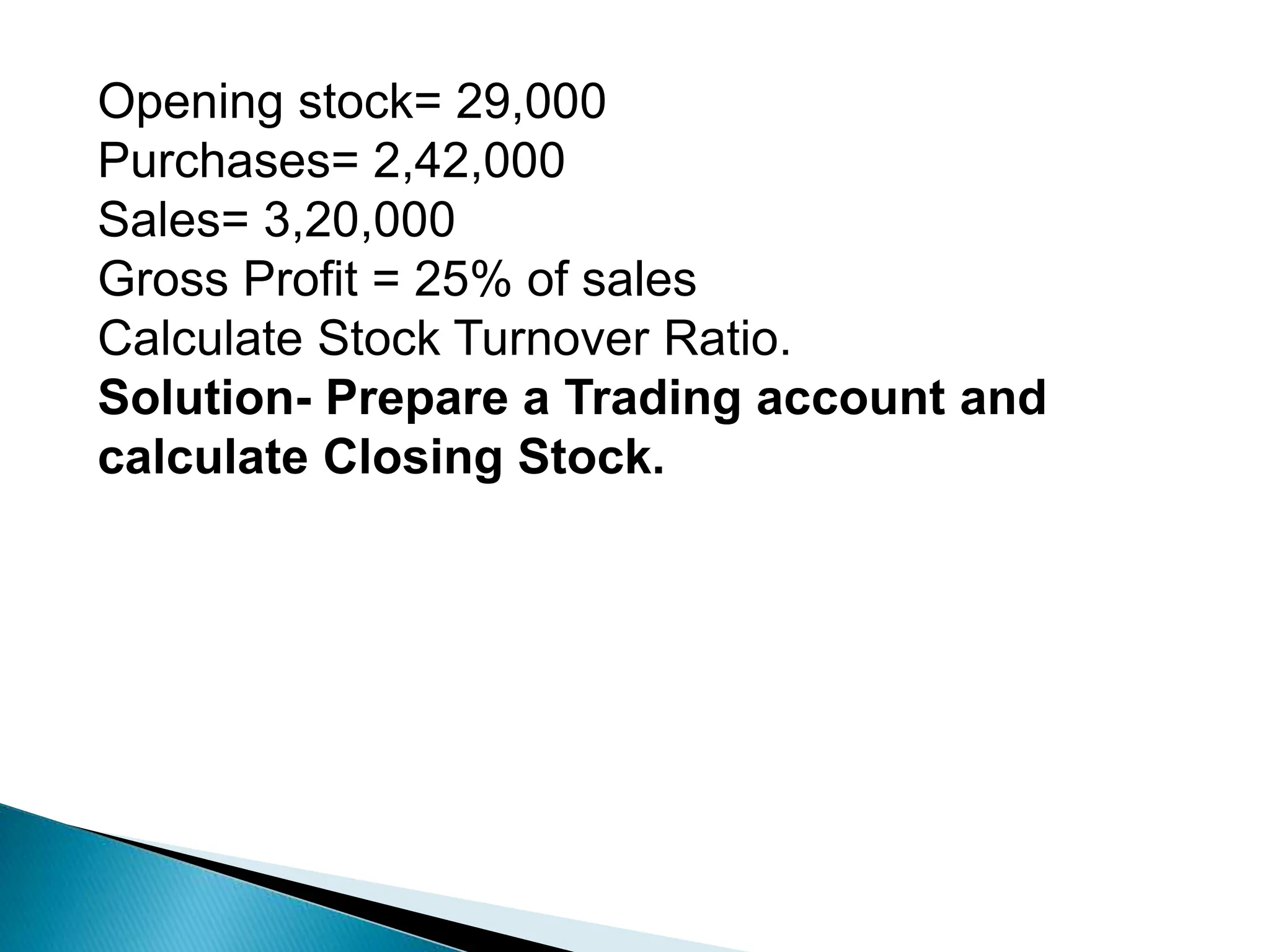
Opening stock= 29,000
Purchases= 2,42,000
Sales= 3,20,000
Gross Profit = 25% of sales
Calculate Stock Turnover Ratio.
Solution- Prepare a Trading account and
calculate Closing Stock.
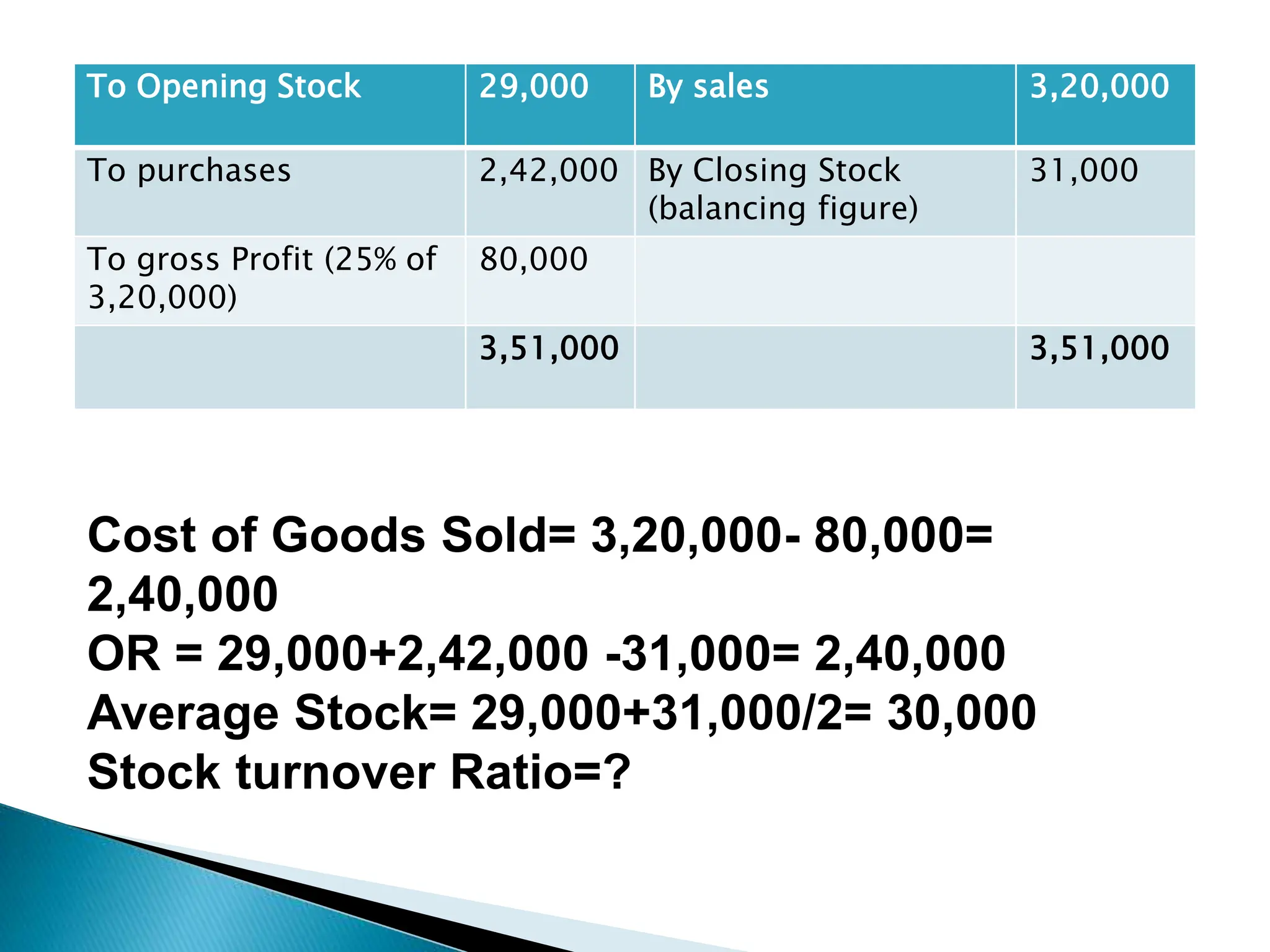
To Opening Stock 29,000 By sales 3,20,000
To purchases 2,42,000 By Closing Stock
(balancing figure)
31,000
To gross Profit (25% of
3,20,000)
80,000
3,51,000 3,51,000
Cost of Goods Sold= 3,20,000- 80,000=
2,40,000
OR = 29,000+2,42,000 -31,000= 2,40,000
Average Stock= 29,000+31,000/2= 30,000
Stock turnover Ratio=?
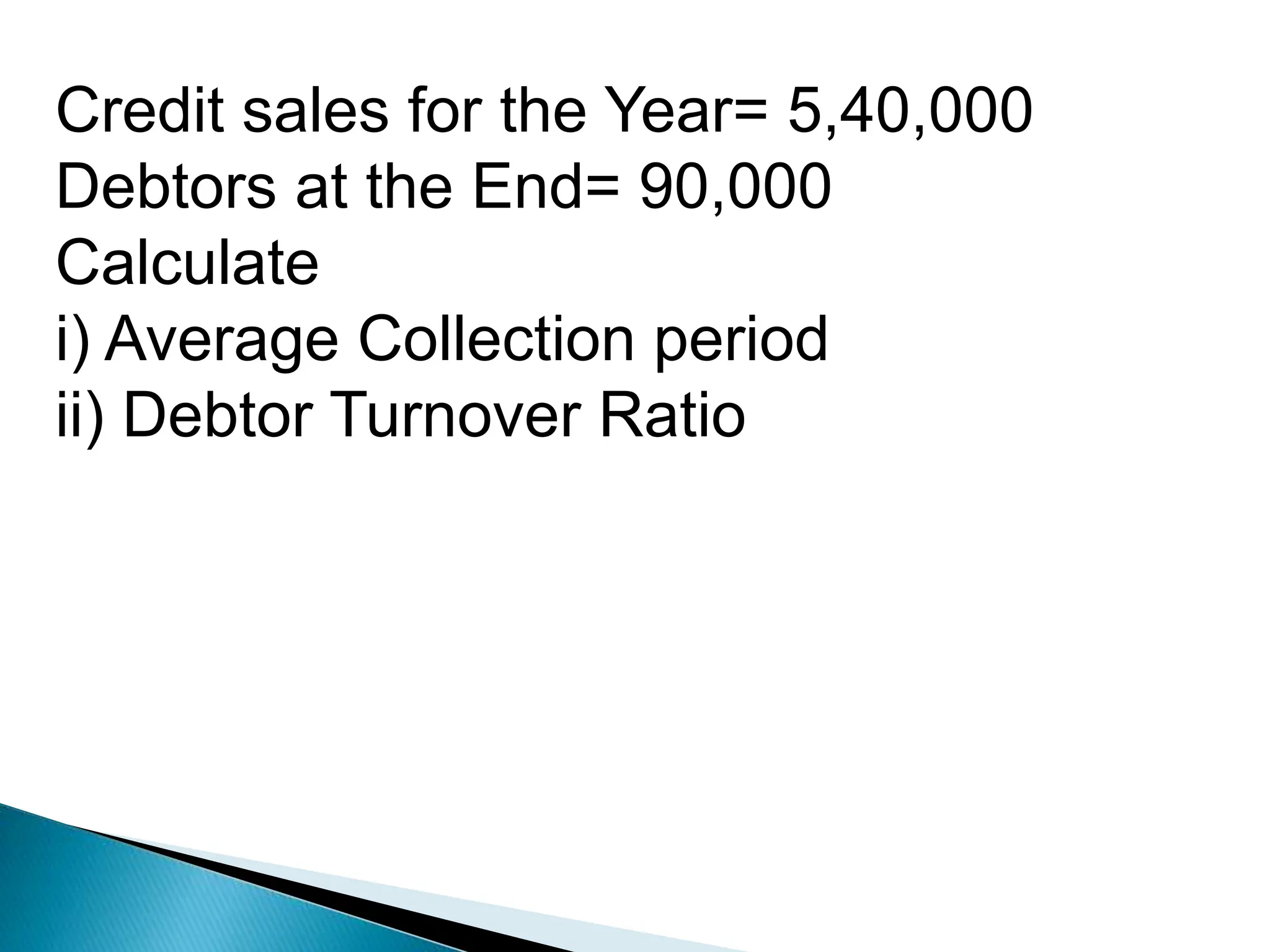
Credit sales for the Year= 5,40,000
Debtors at the End= 90,000
Calculate
i) Average Collection period
ii) Debtor Turnover Ratio
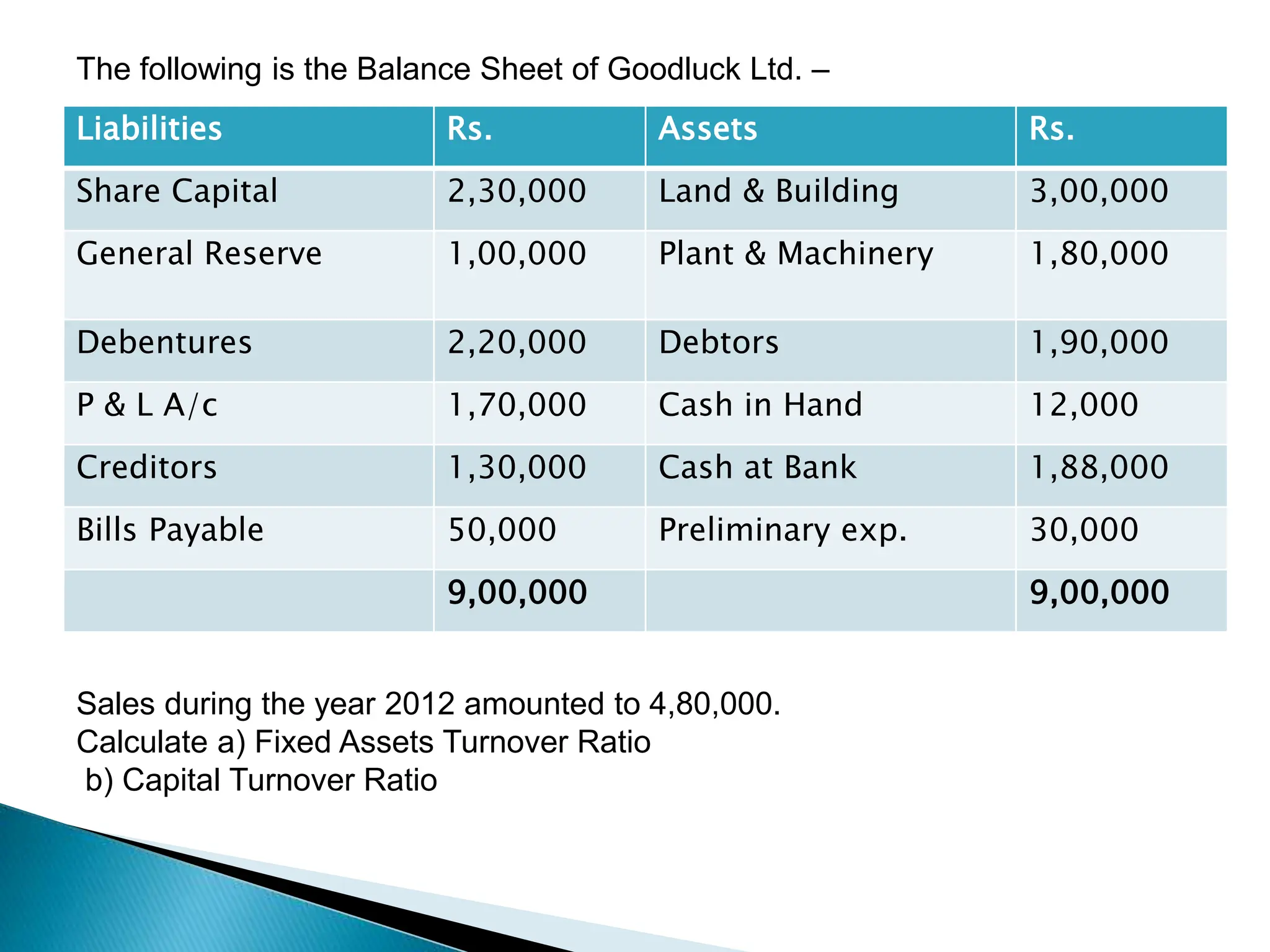
The following is the Balance Sheet of Goodluck Ltd. –
Liabilities Rs. Assets Rs.
Share Capital 2,30,000 Land & Building 3,00,000
General Reserve 1,00,000 Plant & Machinery 1,80,000
Debentures 2,20,000 Debtors 1,90,000
P & L A/c 1,70,000 Cash in Hand 12,000
Creditors 1,30,000 Cash at Bank 1,88,000
Bills Payable 50,000 Preliminary exp. 30,000
9,00,000 9,00,000
Sales during the year 2012 amounted to 4,80,000.
Calculate a) Fixed Assets Turnover Ratio
b) Capital Turnover Ratio
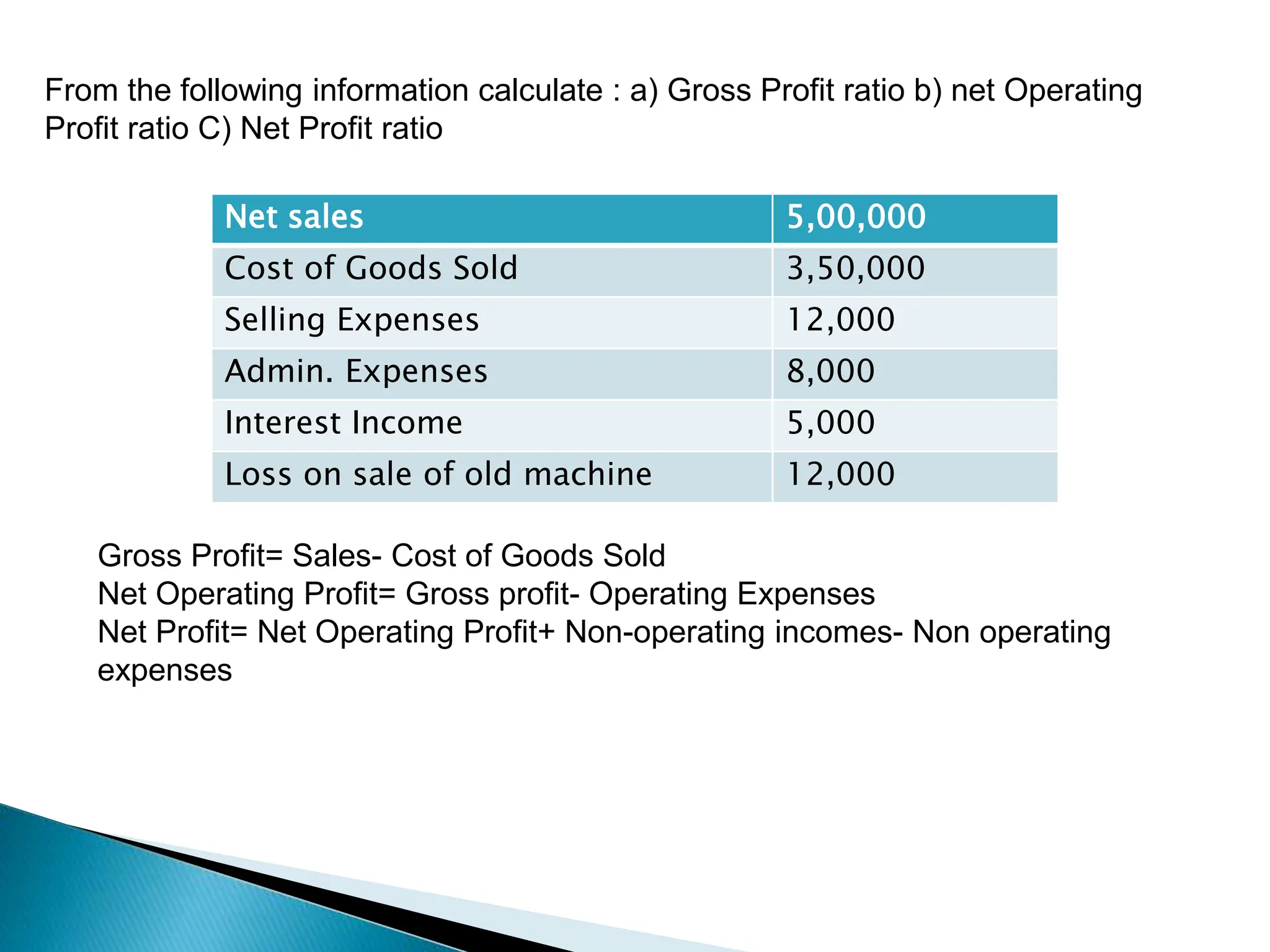
From the following information calculate : a) Gross Profit ratio b) net Operating
Profit ratio C) Net Profit ratio
Net sales 5,00,000
Cost of Goods Sold 3,50,000
Selling Expenses 12,000
Admin. Expenses 8,000
Interest Income 5,000
Loss on sale of old machine 12,000
Gross Profit= Sales- Cost of Goods Sold
Net Operating Profit= Gross profit- Operating Expenses
Net Profit= Net Operating Profit+ Non-operating incomes- Non operating
expenses
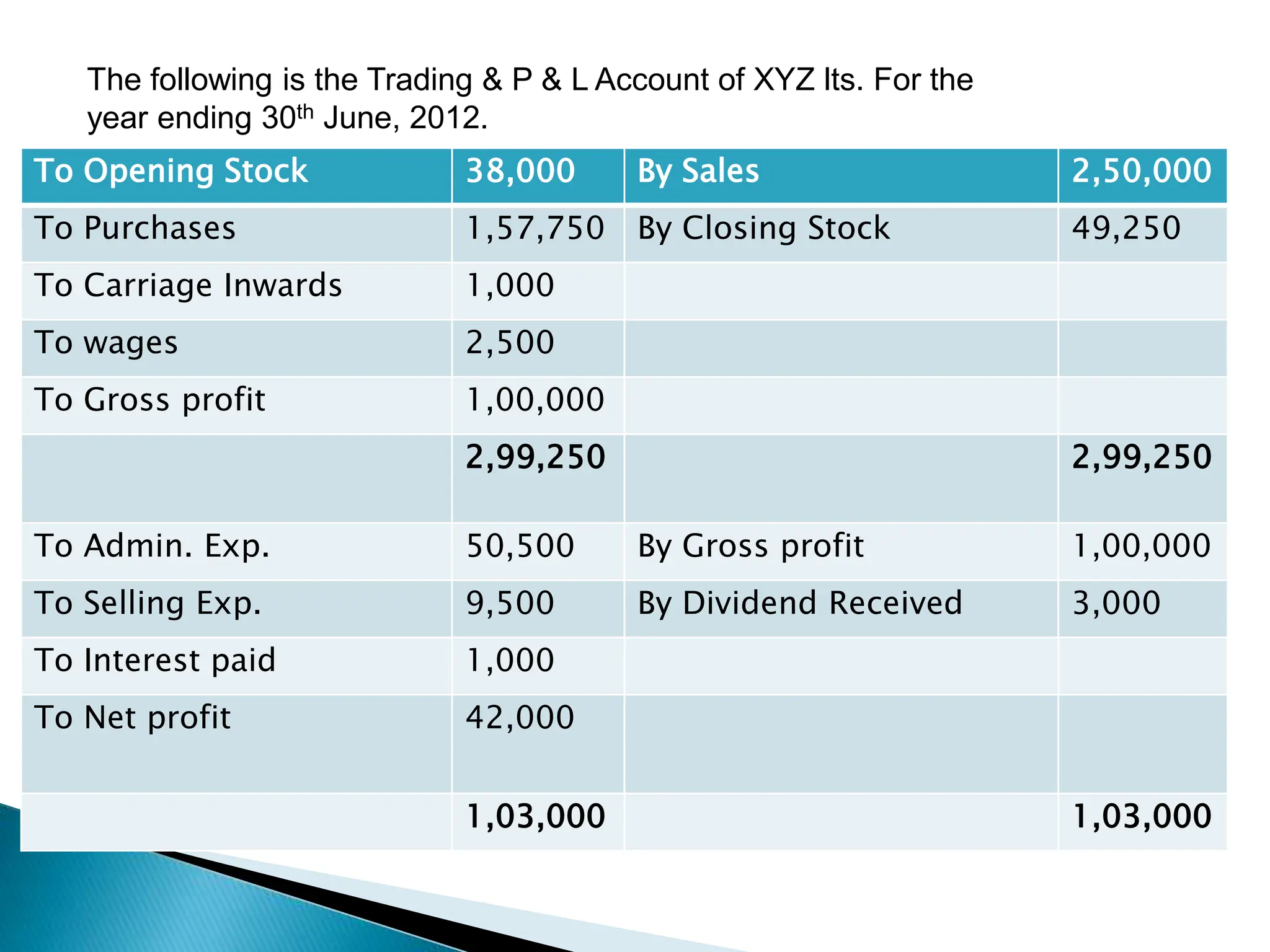
The following is the Trading & P & L Account of XYZ lts. For the
year ending 30th June, 2012.
To Opening Stock 38,000 By Sales 2,50,000
To Purchases 1,57,750 By Closing Stock 49,250
To Carriage Inwards 1,000
To wages 2,500
To Gross profit 1,00,000
2,99,250 2,99,250
To Admin. Exp. 50,500 By Gross profit 1,00,000
To Selling Exp. 9,500 By Dividend Received 3,000
To Interest paid 1,000
To Net profit 42,000
1,03,000 1,03,000
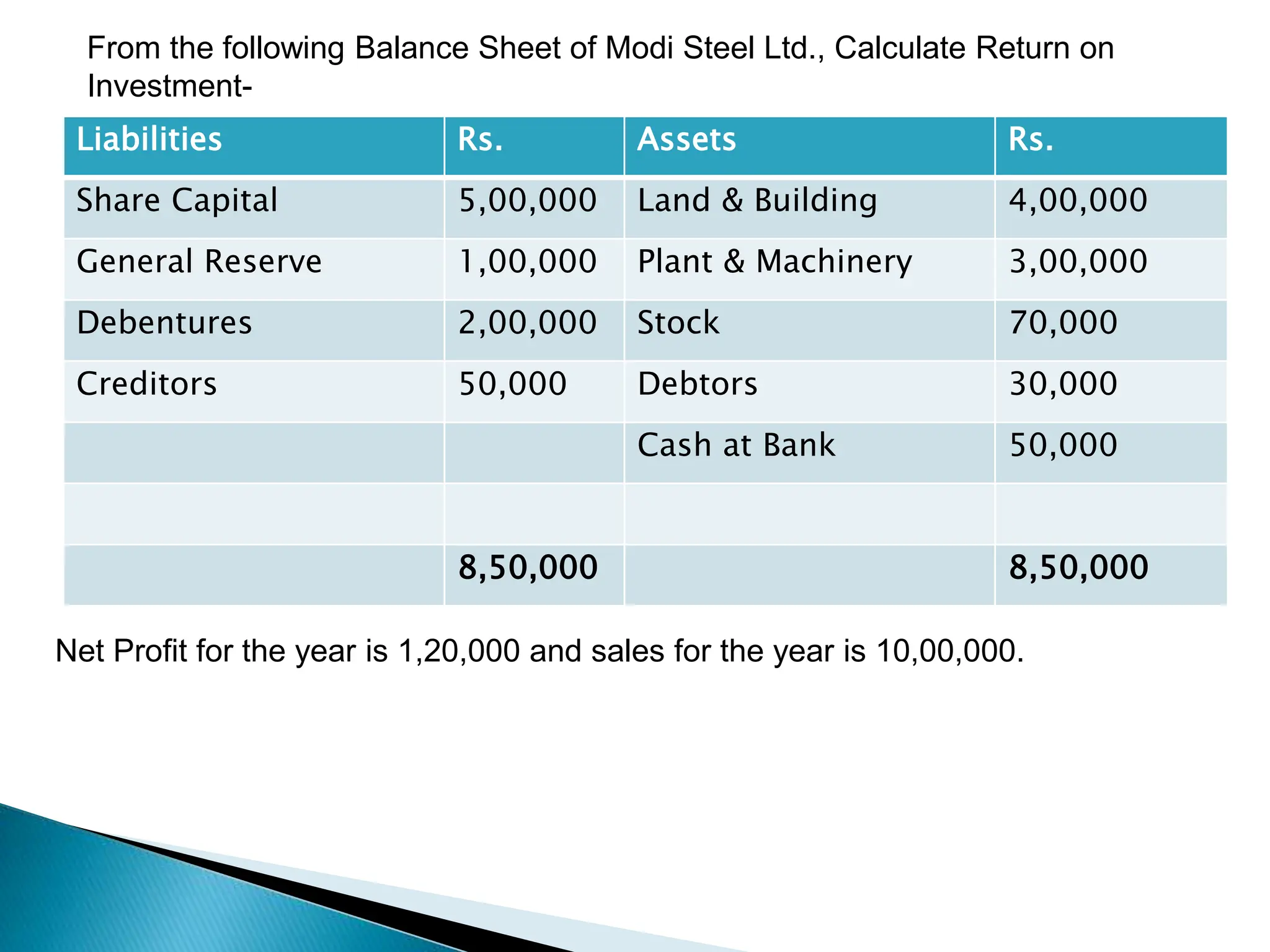
From the following Balance Sheet of Modi Steel Ltd., Calculate Return on
Investment-
Liabilities Rs. Assets Rs.
Share Capital 5,00,000 Land & Building 4,00,000
General Reserve 1,00,000 Plant & Machinery 3,00,000
Debentures 2,00,000 Stock 70,000
Creditors 50,000 Debtors 30,000
Cash at Bank 50,000
8,50,000 8,50,000
Net Profit for the year is 1,20,000 and sales for the year is 10,00,000.
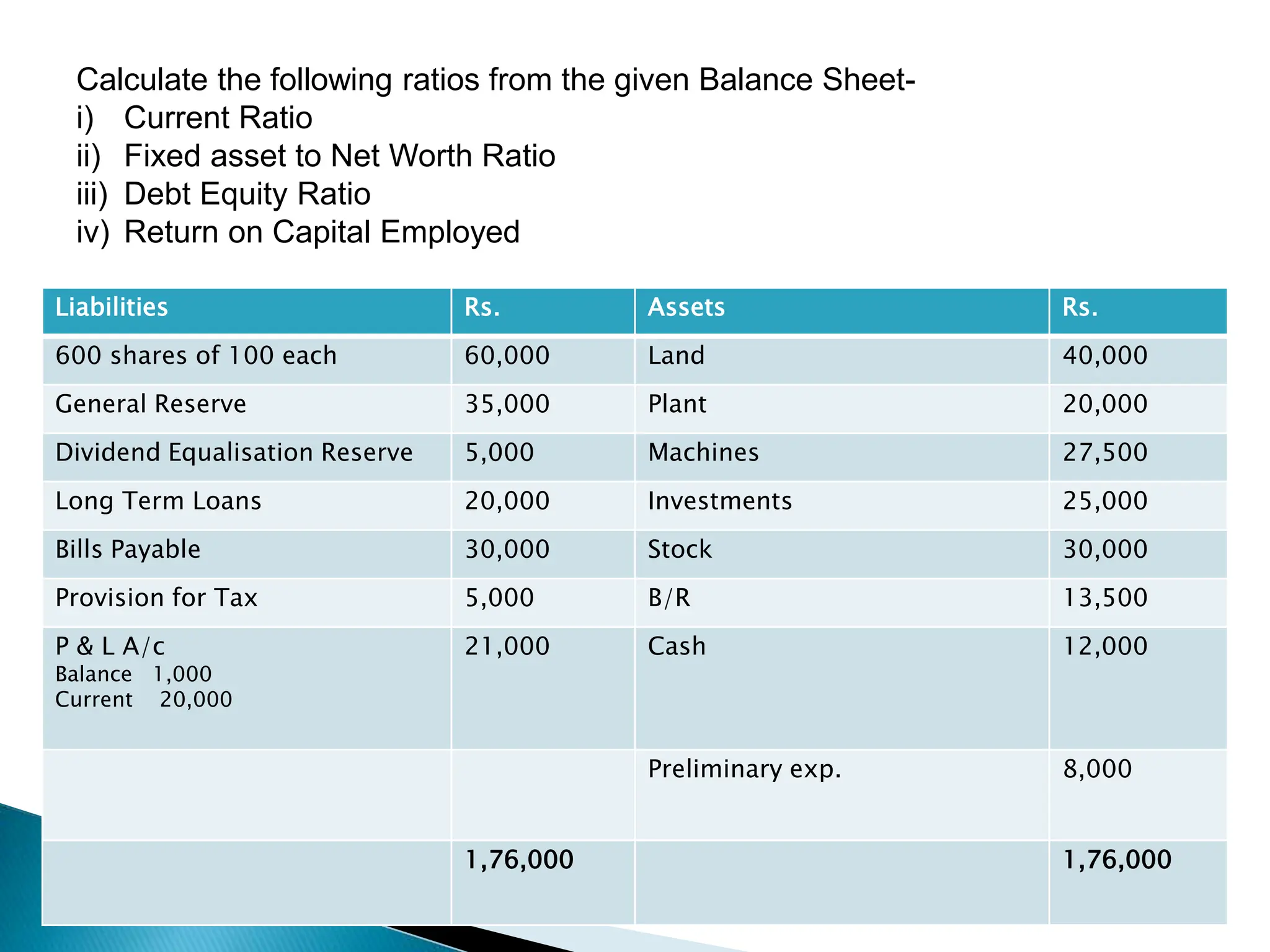
Calculate the following ratios from the given Balance Sheet-
i) Current Ratio
ii) Fixed asset to Net Worth Ratio
iii) Debt Equity Ratio
iv) Return on Capital Employed
Liabilities Rs. Assets Rs.
600 shares of 100 each 60,000 Land 40,000
General Reserve 35,000 Plant 20,000
Dividend Equalisation Reserve 5,000 Machines 27,500
Long Term Loans 20,000 Investments 25,000
Bills Payable 30,000 Stock 30,000
Provision for Tax 5,000 B/R 13,500
P & L A/c
Balance 1,000
Current 20,000
21,000 Cash 12,000
Preliminary exp. 8,000
1,76,000 1,76,000
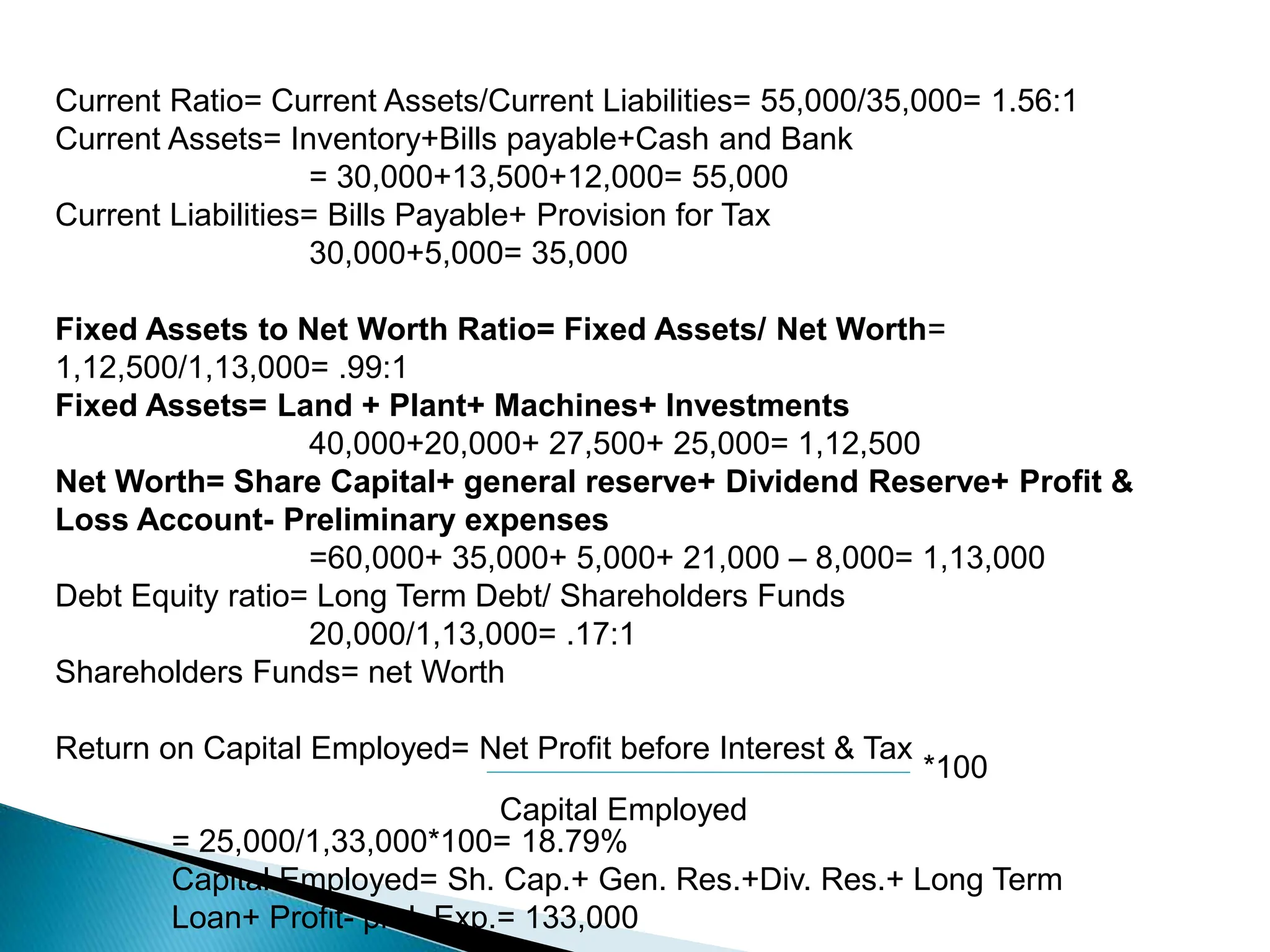
Current Ratio= Current Assets/Current Liabilities= 55,000/35,000= 1.56:1
Current Assets= Inventory+Bills payable+Cash and Bank
= 30,000+13,500+12,000= 55,000
Current Liabilities= Bills Payable+ Provision for Tax
30,000+5,000= 35,000
Fixed Assets to Net Worth Ratio= Fixed Assets/ Net Worth=
1,12,500/1,13,000= .99:1
Fixed Assets= Land + Plant+ Machines+ Investments
40,000+20,000+ 27,500+ 25,000= 1,12,500
Net Worth= Share Capital+ general reserve+ Dividend Reserve+ Profit &
Loss Account- Preliminary expenses
=60,000+ 35,000+ 5,000+ 21,000 – 8,000= 1,13,000
Debt Equity ratio= Long Term Debt/ Shareholders Funds
20,000/1,13,000= .17:1
Shareholders Funds= net Worth
Return on Capital Employed= Net Profit before Interest & Tax
Capital Employed
*100
= 25,000/1,33,000*100= 18.79%
Capital Employed= Sh. Cap.+ Gen. Res.+Div. Res.+ Long Term
Loan+ Profit- prel. Exp.= 133,000

ratio analysis.ppt.ppt

  • 4.
    Ratio-analysis is appliedto financial statements to analyze the success, failure and progress of a business. RATIO ANALYSIS
  • 5.
    Ratio-analysis means theprocess of computing, determining and presenting the relationship of related items and groups of items of the financial statements. They provide in a summarized and concise form a fairly good idea about the financial position of a unit. They are important tools for financial analysis. RATIO ANALYSIS
  • 6.
     To knowthe areas of the business which need more attention;  To know about the potential areas which can be improved  To provide a deeper analysis of the profitability, liquidity, solvency and efficiency levels in the business;  To provide information for making cross-sectional analysis by comparing the performance with the best industry standards; and  To provide information derived from financial statements useful for making projections and estimates for the future.
  • 7.
     Liquidity ratio Capital Structure Ratio  Turnover/Activity Ratio  Profitability Ratio
  • 8.
     Current ratio=Current Assets/Current Liabilities  Liquid Ratio(Quick ratio)= Liquid Assets/Current Liabilities  Quick Assets= Cash +Bank Balances+Marketable Securities+Debtors (Stock & Prepaid Exp. Not included)
  • 9.
     Debt EquityRatio = Long Term Debts/Shareholders Equity  Proprietary Ratio = Shareholders Funds/Total Assets  Interest Coverage Ratio= Earning before Interest & Taxes/ Fixed Interest charges  Capital Gearing Ratio= Fixed Income Securities/Equity Shareholders Funds or  Loan Capital/Total Capital Employed*100 The shareholder funds include equity share capital, preference share capital, reserves and surplus including accumulated profits. However fictitious assets like accumulated deferred expenses etc should be deducted from the total of these items to shareholder funds. The shareholder funds so calculated are known as net worth of the business.
  • 10.
     Inventory turnoverRatio= Cost of Goods Sold/Average Inventory  Debtor Turnover Ratio= Net Credit Sales /Average Debtor  Average Collection Period= Debtor/Credit Sales* 365
  • 11.
     Fixed AssetTurnover Ratio= Cost of Sales/ Fixed Assets  Capital Turnover Ratio= Cost of Sales/ Capital employed=(Eq. Cap.+Pref.Cap.+Reserves+Debentures+Lon g Term Loans – Fictitious Assets- Non operating Investments)
  • 12.
     Gross Profitratio= G.P./Net Sales*100  Net Profit Ratio= N.P./Net Sales*100  Operating Profit Ratio= Operating Profit/Net Sales
  • 13.
    Return on Investment(ROI)= Net Profit before interest & taxes/Total Capital Employed*100 Earning Per Share=net Profit after taxes- Preference Dividends/ No. of Equity Share Price Earning ratio= Market Price Per Share/Earning Per share Dividend Payout ratio= Dividend per Share/Earning Per Share
  • 14.
    The following isthe Balance Sheet of Bharat Ltd. – Liabilities Rs. Assets Rs. Equity Capital 48,000 Plant & Machinery 90,000 P & L A/c 12,000 Debtors 18,000 Debentures 30,000 Stock 24,000 Sundry Creditors 46,800 Bank Balance 4,560 Provision for Taxation 1,200 Prepaid Insurance 1,440 1,38,000 1,38,000 Calculate Current Ratio & Liquid ratio.
  • 15.
    The following isthe Balance Sheet Of kalyani Ltd.- Liabilities Rs. Assets Rs. Equity Capital 3,00,000 Plant & Machinery 85,000 Bank Overdraft 5,000 Land & Building 1,50,000 Outstanding expenses 2,000 S.T. Investment 16,000 Sundry Creditors 48,000 Closing Stock 50,000 Bills Payable 10,000 Debtors 59,000 Cash 5,000 3,65,000 3,65,000 Calculate Current Ratio & Liquid ratio.
  • 16.
    1. X Ltd.has a current ratio of 4.5 :1, and a Quick ratio of 3:1. If its inventory is 60,000, Find its Total Current assets & Current Liabilities? 2. A firm has a current ratio of 3:1. if its net working capital is 2,00,000. you are required to determine i) Current Assets ii) Current liabilities iii) Liquid Assets if Inventory is 2,20,000.
  • 17.
    Balance Sheet Liabilities Rs.Assets Rs. Eq. Capital 1,50,000 Goodwill 50,000 10% Preference Capital 50,000 Plant & Machinery 1,80,000 General Reserve 70,000 Land & Building 1,20,000 P & L A/c 30,000 Stock 95,000 9% Debentures 1,00,000 Investment 40,000 Creditors 95,000 Cash 15,000 Wages Outstanding 5,000 5,00,000 5,00,000 Calculate i) Debt equity Ratio ii) Proprietary Ratio
  • 18.
    Interest Coverage Ratio =EBIT/ Fixed Interest Charges From the Following calculate- Profit after charging interest on debentures & tax= 25,000 Interest Charged= 5,000 Provision for Taxes= 10,000
  • 19.
    Opening stock= 29,000 Purchases=2,42,000 Sales= 3,20,000 Gross Profit = 25% of sales Calculate Stock Turnover Ratio. Solution- Prepare a Trading account and calculate Closing Stock.
  • 20.
    To Opening Stock29,000 By sales 3,20,000 To purchases 2,42,000 By Closing Stock (balancing figure) 31,000 To gross Profit (25% of 3,20,000) 80,000 3,51,000 3,51,000 Cost of Goods Sold= 3,20,000- 80,000= 2,40,000 OR = 29,000+2,42,000 -31,000= 2,40,000 Average Stock= 29,000+31,000/2= 30,000 Stock turnover Ratio=?
  • 21.
    Credit sales forthe Year= 5,40,000 Debtors at the End= 90,000 Calculate i) Average Collection period ii) Debtor Turnover Ratio
  • 22.
    The following isthe Balance Sheet of Goodluck Ltd. – Liabilities Rs. Assets Rs. Share Capital 2,30,000 Land & Building 3,00,000 General Reserve 1,00,000 Plant & Machinery 1,80,000 Debentures 2,20,000 Debtors 1,90,000 P & L A/c 1,70,000 Cash in Hand 12,000 Creditors 1,30,000 Cash at Bank 1,88,000 Bills Payable 50,000 Preliminary exp. 30,000 9,00,000 9,00,000 Sales during the year 2012 amounted to 4,80,000. Calculate a) Fixed Assets Turnover Ratio b) Capital Turnover Ratio
  • 23.
    From the followinginformation calculate : a) Gross Profit ratio b) net Operating Profit ratio C) Net Profit ratio Net sales 5,00,000 Cost of Goods Sold 3,50,000 Selling Expenses 12,000 Admin. Expenses 8,000 Interest Income 5,000 Loss on sale of old machine 12,000 Gross Profit= Sales- Cost of Goods Sold Net Operating Profit= Gross profit- Operating Expenses Net Profit= Net Operating Profit+ Non-operating incomes- Non operating expenses
  • 24.
    The following isthe Trading & P & L Account of XYZ lts. For the year ending 30th June, 2012. To Opening Stock 38,000 By Sales 2,50,000 To Purchases 1,57,750 By Closing Stock 49,250 To Carriage Inwards 1,000 To wages 2,500 To Gross profit 1,00,000 2,99,250 2,99,250 To Admin. Exp. 50,500 By Gross profit 1,00,000 To Selling Exp. 9,500 By Dividend Received 3,000 To Interest paid 1,000 To Net profit 42,000 1,03,000 1,03,000
  • 25.
    From the followingBalance Sheet of Modi Steel Ltd., Calculate Return on Investment- Liabilities Rs. Assets Rs. Share Capital 5,00,000 Land & Building 4,00,000 General Reserve 1,00,000 Plant & Machinery 3,00,000 Debentures 2,00,000 Stock 70,000 Creditors 50,000 Debtors 30,000 Cash at Bank 50,000 8,50,000 8,50,000 Net Profit for the year is 1,20,000 and sales for the year is 10,00,000.
  • 26.
    Calculate the followingratios from the given Balance Sheet- i) Current Ratio ii) Fixed asset to Net Worth Ratio iii) Debt Equity Ratio iv) Return on Capital Employed Liabilities Rs. Assets Rs. 600 shares of 100 each 60,000 Land 40,000 General Reserve 35,000 Plant 20,000 Dividend Equalisation Reserve 5,000 Machines 27,500 Long Term Loans 20,000 Investments 25,000 Bills Payable 30,000 Stock 30,000 Provision for Tax 5,000 B/R 13,500 P & L A/c Balance 1,000 Current 20,000 21,000 Cash 12,000 Preliminary exp. 8,000 1,76,000 1,76,000
  • 27.
    Current Ratio= CurrentAssets/Current Liabilities= 55,000/35,000= 1.56:1 Current Assets= Inventory+Bills payable+Cash and Bank = 30,000+13,500+12,000= 55,000 Current Liabilities= Bills Payable+ Provision for Tax 30,000+5,000= 35,000 Fixed Assets to Net Worth Ratio= Fixed Assets/ Net Worth= 1,12,500/1,13,000= .99:1 Fixed Assets= Land + Plant+ Machines+ Investments 40,000+20,000+ 27,500+ 25,000= 1,12,500 Net Worth= Share Capital+ general reserve+ Dividend Reserve+ Profit & Loss Account- Preliminary expenses =60,000+ 35,000+ 5,000+ 21,000 – 8,000= 1,13,000 Debt Equity ratio= Long Term Debt/ Shareholders Funds 20,000/1,13,000= .17:1 Shareholders Funds= net Worth Return on Capital Employed= Net Profit before Interest & Tax Capital Employed *100 = 25,000/1,33,000*100= 18.79% Capital Employed= Sh. Cap.+ Gen. Res.+Div. Res.+ Long Term Loan+ Profit- prel. Exp.= 133,000

Editor's Notes

  • #15 1:1, .47:1
  • #17 1,80,000= c.a c.l.-40,000 Quick assets=1,20,000
  • #18 D.E = 1:3, ii) prop 60%, Proprietary Ratio = Shareholders Funds/Total Assets
  • #19 8 times
  • #23 Fixed Asset Turnover Ratio= Cost of Sales/ Fixed Assets Capital Turnover Ratio= Cost of Sales/Capital Employed
  • #25 g.p.=40%, Np.=16.8%, Net operating profit= 16%