This document consists of 10 printed pages and 2 blank pages.
IB07 11_9706_02/4RP
© UCLES 2007 [Turn over
*6100355900*
For Examiner's Use
1
2
3
Total
UNIVERSITY OF CAMBRIDGE INTERNATIONAL EXAMINATIONS
General Certificate of Education
Advanced Subsidiary Level and Advanced Level
ACCOUNTING 9706/02
Paper 2 Structured Questions October/November 2007
1 hour 30 minutes
Candidates answer on the Question Paper.
No Additional Materials are required.
READ THESE INSTRUCTIONS FIRST
Write your Centre number, candidate number and name on all the work you hand in.
Write in dark blue or black pen.
You may use a soft pencil for rough working.
Do not use staples, paper clips, highlighters, glue or correction fluid.
DO NOT WRITE IN ANY BARCODES.
Answer all questions.
You may use a calculator.
At the end of the examination, fasten all your work securely together.
The number of marks is given in brackets [ ] at the end of each question or part question.
2
© UCLES 2007 9706/02/O/N/07
For
Examiner's
Use
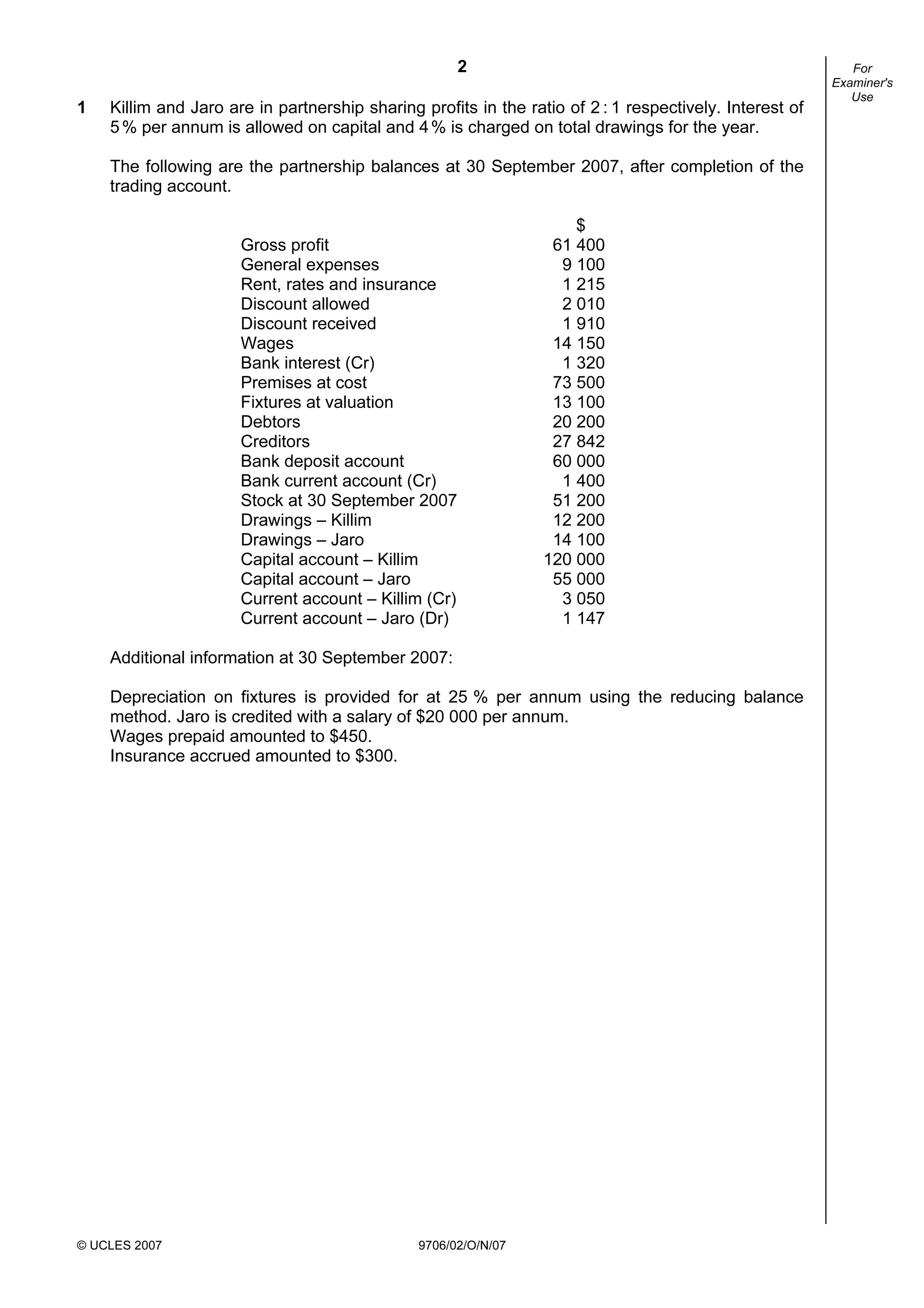
1 Killim and Jaro are in partnership sharing profits in the ratio of 2 : 1 respectively. Interest of
5% per annum is allowed on capital and 4% is charged on total drawings for the year.
The following are the partnership balances at 30 September 2007, after completion of the
trading account.
$
Gross profit 61 400
General expenses 9 100
Rent, rates and insurance 1 215
Discount allowed 2 010
Discount received 1 910
Wages 14 150
Bank interest (Cr) 1 320
Premises at cost 73 500
Fixtures at valuation 13 100
Debtors 20 200
Creditors 27 842
Bank deposit account 60 000
Bank current account (Cr) 1 400
Stock at 30 September 2007 51 200
Drawings – Killim 12 200
Drawings – Jaro 14 100
Capital account – Killim 120 000
Capital account – Jaro 55 000
Current account – Killim (Cr) 3 050
Current account – Jaro (Dr) 1 147
Additional information at 30 September 2007:
Depreciation on fixtures is provided for at 25 % per annum using the reducing balance
method. Jaro is credited with a salary of $20 000 per annum.
Wages prepaid amounted to $450.
Insurance accrued amounted to $300.
3
© UCLES 2007 9706/02/O/N/07 [Turn over
For
Examiner's
Use
REQUIRED
(a) Prepare a profit and loss and appropriation account for the year ended
30 September 2007.
[16]
4
© UCLES 2007 9706/02/O/N/07
For
Examiner's
Use
(b) Prepare Jaro’s current account for the year ended 30 September 2007.
[8]
The partnership has recently purchased new premises and needs new equipment costing
over $100 000.
REQUIRED
(c) Identify two methods of raising extra finance and state one advantage and one
disadvantage of each method.
[6]
[Total: 30]
5
BLANK PAGE
9706/02/O/N/07 [Turn over
Question 2 is on the following page
6
© UCLES 2007 9706/02/O/N/07
For
Examiner's
Use
2 Gabriel is a sole trader who keeps the minimum of accounting records. His bank balance on
1 October 2006 was $7400 and debtors owed him $5010. For the year ended
30 September 2007 his records showed the following:
$
Payments by cheque:
Van purchased on 1 October 2006 6 800
Electricity 2 400
Van maintenance 250
General expenses 2 620
Purchase of stock for resale 182 600
Paid in to bank:
Shop takings 273 200
Receipts from debtors 3 040
At 1 October 2006 Gabriel stopped all credit sales as debtors were not paying on time thus
affecting his cash flow. Amounts still owed by debtors at 30 September 2007 were to be
considered bad debts.
All shop takings for the year were paid into the bank with the exception of the following,
which were paid from shop takings.
$
General expenses 1 100
Wages 12 000
Drawings 1 200 per calendar month
Petrol for van 80 per calendar month
At 30 September 2007 $21 200 was owed for purchases.
Stock at 1 October 2006 was valued at $22 000.
Stock at 30 September 2007 was valued at $31 250.
Depreciation on the van is provided for at 25% per annum, reducing balance.
REQUIRED
(a) Calculate Gabriel’s sales for the year ended 30 September 2007.
[6]
7
© UCLES 2007 9706/02/O/N/07 [Turn over
For
Examiner's
Use
(b) Prepare Gabriel’s trading and profit and loss accounts for the year ended
30 September 2007.
[15]
8
© UCLES 2007 9706/02/O/N/07
For
Examiner's
Use
(c) Calculate the following to two decimal places:
(i) Gross profit as a percentage of sales;
(ii) Net profit as a percentage of sales;
(iii) Rate of stockturn in weeks.
(i)
[2]
(ii)
[2]
(iii)
[2]
(d) Explain briefly one use of accounting ratios.
[3]
[Total: 30]
9
BLANK PAGE
9706/02/O/N/07 [Turn over
Question 3 is on the following page
10
© UCLES 2007 9706/02/O/N/07
For
Examiner's
Use
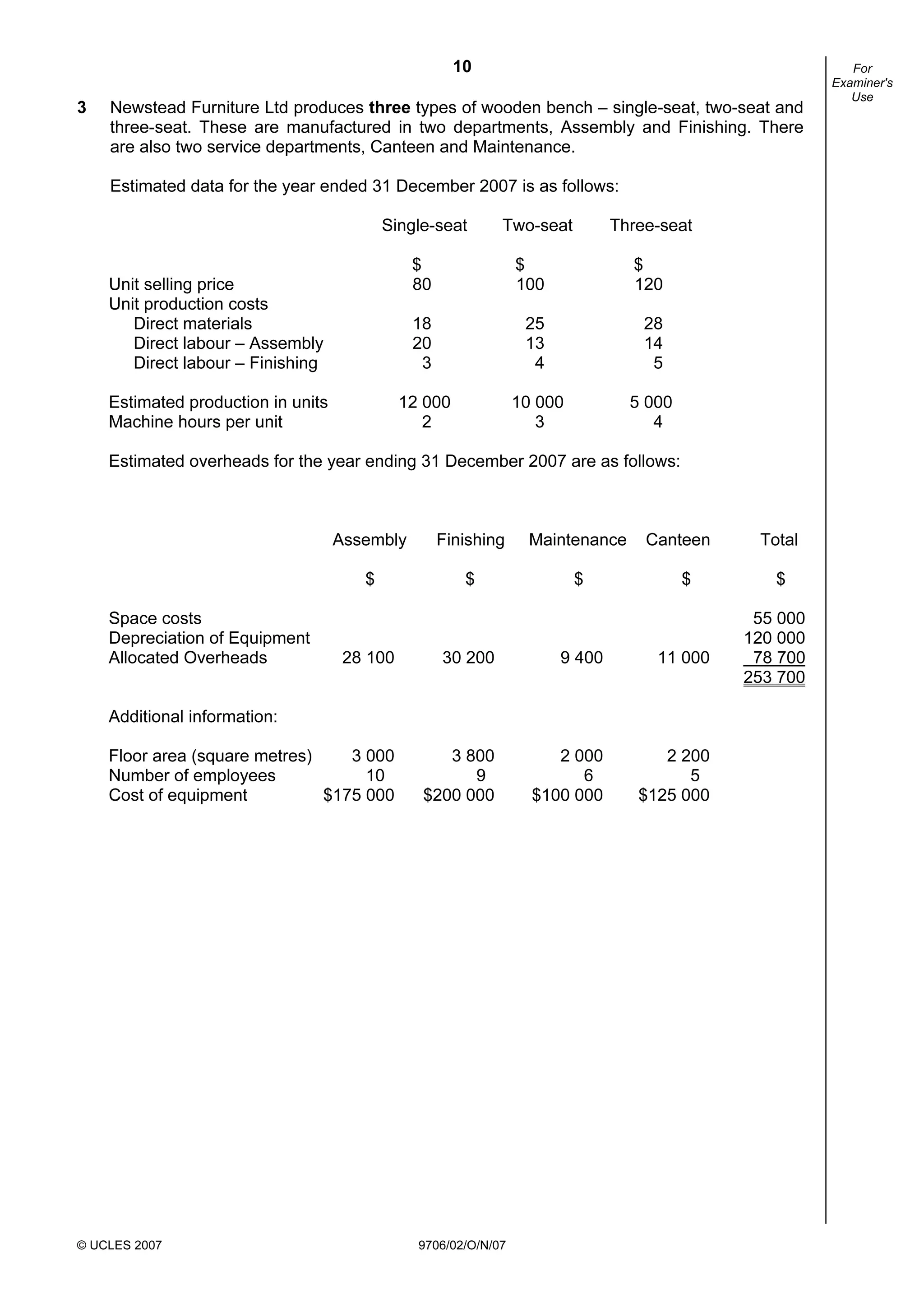
3 Newstead Furniture Ltd produces three types of wooden bench – single-seat, two-seat and
three-seat. These are manufactured in two departments, Assembly and Finishing. There
are also two service departments, Canteen and Maintenance.
Estimated data for the year ended 31 December 2007 is as follows:
Single-seat Two-seat Three-seat
$ $ $
Unit selling price 80 100 120
Unit production costs
Direct materials 18 25 28
Direct labour – Assembly 20 13 14
Direct labour – Finishing 3 4 5
Estimated production in units 12 000 10 000 5 000
Machine hours per unit 2 3 4
Estimated overheads for the year ending 31 December 2007 are as follows:
Assembly Finishing Maintenance Canteen Total
$ $ $ $ $
Space costs 55 000
Depreciation of Equipment 120 000
Allocated Overheads 28 100 30 200 9 400 11 000 78 700
253 700
Additional information:
Floor area (square metres) 3 000 3 800 2 000 2 200
Number of employees 10 9 6 5
Cost of equipment $175 000 $200 000 $100 000 $125 000
11
© UCLES 2007 9706/02/O/N/07 [Turn over
For
Examiner's
Use
REQUIRED
(a) Use the table below to prepare an overhead analysis sheet for the year ending
31 December 2007 detailing overheads for the Assembly and Finishing departments.
Canteen costs are shared amongst all other departments on the basis of the number of
employees. Maintenance costs are shared between the Assembly and Finishing
departments on the basis of 60% Assembly and 40% Finishing.
Newstead Furniture Ltd Assembly Finishing Maintenance Canteen
$ $ $ $
Allocated overheads
Space costs
Depreciation
Canteen
Maintenance
Total
[17]
(b) Calculate, correct to two decimal places, the overhead recovery rate for:
(i) the Assembly department, based on direct wages;
(ii) the Finishing department, based on machine hours.
(i) Assembly department
[3]
12
Permission to reproduce items where third-party owned material protected by copyright is included has been sought and cleared where possible. Every
reasonable effort has been made by the publisher (UCLES) to trace copyright holders, but if any items requiring clearance have unwittingly been included, the
publisher will be pleased to make amends at the earliest possible opportunity.
University of Cambridge International Examinations is part of the Cambridge Assessment Group. Cambridge Assessment is the brand name of University of
Cambridge Local Examinations Syndicate (UCLES), which is itself a department of the University of Cambridge.
© UCLES 2007 9706/02/O/N/07
For
Examiner's
Use
(ii) Finishing department
(c) State the reason for using different methods of calculating the overhead recovery rate
in (b).
[2]
(d) Calculate, to two decimal places, the total cost of one two-seat bench.
[5]
[Total: 30]
[3]

Accounting 970602 paper 2 structured questions october november 2007

  • 1.
    This document consistsof 10 printed pages and 2 blank pages. IB07 11_9706_02/4RP © UCLES 2007 [Turn over *6100355900* For Examiner's Use 1 2 3 Total UNIVERSITY OF CAMBRIDGE INTERNATIONAL EXAMINATIONS General Certificate of Education Advanced Subsidiary Level and Advanced Level ACCOUNTING 9706/02 Paper 2 Structured Questions October/November 2007 1 hour 30 minutes Candidates answer on the Question Paper. No Additional Materials are required. READ THESE INSTRUCTIONS FIRST Write your Centre number, candidate number and name on all the work you hand in. Write in dark blue or black pen. You may use a soft pencil for rough working. Do not use staples, paper clips, highlighters, glue or correction fluid. DO NOT WRITE IN ANY BARCODES. Answer all questions. You may use a calculator. At the end of the examination, fasten all your work securely together. The number of marks is given in brackets [ ] at the end of each question or part question.
  • 2.
    2 © UCLES 20079706/02/O/N/07 For Examiner's Use 1 Killim and Jaro are in partnership sharing profits in the ratio of 2 : 1 respectively. Interest of 5% per annum is allowed on capital and 4% is charged on total drawings for the year. The following are the partnership balances at 30 September 2007, after completion of the trading account. $ Gross profit 61 400 General expenses 9 100 Rent, rates and insurance 1 215 Discount allowed 2 010 Discount received 1 910 Wages 14 150 Bank interest (Cr) 1 320 Premises at cost 73 500 Fixtures at valuation 13 100 Debtors 20 200 Creditors 27 842 Bank deposit account 60 000 Bank current account (Cr) 1 400 Stock at 30 September 2007 51 200 Drawings – Killim 12 200 Drawings – Jaro 14 100 Capital account – Killim 120 000 Capital account – Jaro 55 000 Current account – Killim (Cr) 3 050 Current account – Jaro (Dr) 1 147 Additional information at 30 September 2007: Depreciation on fixtures is provided for at 25 % per annum using the reducing balance method. Jaro is credited with a salary of $20 000 per annum. Wages prepaid amounted to $450. Insurance accrued amounted to $300.
  • 3.
    3 © UCLES 20079706/02/O/N/07 [Turn over For Examiner's Use REQUIRED (a) Prepare a profit and loss and appropriation account for the year ended 30 September 2007. [16]
  • 4.
    4 © UCLES 20079706/02/O/N/07 For Examiner's Use (b) Prepare Jaro’s current account for the year ended 30 September 2007. [8] The partnership has recently purchased new premises and needs new equipment costing over $100 000. REQUIRED (c) Identify two methods of raising extra finance and state one advantage and one disadvantage of each method. [6] [Total: 30]
  • 5.
    5 BLANK PAGE 9706/02/O/N/07 [Turnover Question 2 is on the following page
  • 6.
    6 © UCLES 20079706/02/O/N/07 For Examiner's Use 2 Gabriel is a sole trader who keeps the minimum of accounting records. His bank balance on 1 October 2006 was $7400 and debtors owed him $5010. For the year ended 30 September 2007 his records showed the following: $ Payments by cheque: Van purchased on 1 October 2006 6 800 Electricity 2 400 Van maintenance 250 General expenses 2 620 Purchase of stock for resale 182 600 Paid in to bank: Shop takings 273 200 Receipts from debtors 3 040 At 1 October 2006 Gabriel stopped all credit sales as debtors were not paying on time thus affecting his cash flow. Amounts still owed by debtors at 30 September 2007 were to be considered bad debts. All shop takings for the year were paid into the bank with the exception of the following, which were paid from shop takings. $ General expenses 1 100 Wages 12 000 Drawings 1 200 per calendar month Petrol for van 80 per calendar month At 30 September 2007 $21 200 was owed for purchases. Stock at 1 October 2006 was valued at $22 000. Stock at 30 September 2007 was valued at $31 250. Depreciation on the van is provided for at 25% per annum, reducing balance. REQUIRED (a) Calculate Gabriel’s sales for the year ended 30 September 2007. [6]
  • 7.
    7 © UCLES 20079706/02/O/N/07 [Turn over For Examiner's Use (b) Prepare Gabriel’s trading and profit and loss accounts for the year ended 30 September 2007. [15]
  • 8.
    8 © UCLES 20079706/02/O/N/07 For Examiner's Use (c) Calculate the following to two decimal places: (i) Gross profit as a percentage of sales; (ii) Net profit as a percentage of sales; (iii) Rate of stockturn in weeks. (i) [2] (ii) [2] (iii) [2] (d) Explain briefly one use of accounting ratios. [3] [Total: 30]
  • 9.
    9 BLANK PAGE 9706/02/O/N/07 [Turnover Question 3 is on the following page
  • 10.
    10 © UCLES 20079706/02/O/N/07 For Examiner's Use 3 Newstead Furniture Ltd produces three types of wooden bench – single-seat, two-seat and three-seat. These are manufactured in two departments, Assembly and Finishing. There are also two service departments, Canteen and Maintenance. Estimated data for the year ended 31 December 2007 is as follows: Single-seat Two-seat Three-seat $ $ $ Unit selling price 80 100 120 Unit production costs Direct materials 18 25 28 Direct labour – Assembly 20 13 14 Direct labour – Finishing 3 4 5 Estimated production in units 12 000 10 000 5 000 Machine hours per unit 2 3 4 Estimated overheads for the year ending 31 December 2007 are as follows: Assembly Finishing Maintenance Canteen Total $ $ $ $ $ Space costs 55 000 Depreciation of Equipment 120 000 Allocated Overheads 28 100 30 200 9 400 11 000 78 700 253 700 Additional information: Floor area (square metres) 3 000 3 800 2 000 2 200 Number of employees 10 9 6 5 Cost of equipment $175 000 $200 000 $100 000 $125 000
  • 11.
    11 © UCLES 20079706/02/O/N/07 [Turn over For Examiner's Use REQUIRED (a) Use the table below to prepare an overhead analysis sheet for the year ending 31 December 2007 detailing overheads for the Assembly and Finishing departments. Canteen costs are shared amongst all other departments on the basis of the number of employees. Maintenance costs are shared between the Assembly and Finishing departments on the basis of 60% Assembly and 40% Finishing. Newstead Furniture Ltd Assembly Finishing Maintenance Canteen $ $ $ $ Allocated overheads Space costs Depreciation Canteen Maintenance Total [17] (b) Calculate, correct to two decimal places, the overhead recovery rate for: (i) the Assembly department, based on direct wages; (ii) the Finishing department, based on machine hours. (i) Assembly department [3]
  • 12.
    12 Permission to reproduceitems where third-party owned material protected by copyright is included has been sought and cleared where possible. Every reasonable effort has been made by the publisher (UCLES) to trace copyright holders, but if any items requiring clearance have unwittingly been included, the publisher will be pleased to make amends at the earliest possible opportunity. University of Cambridge International Examinations is part of the Cambridge Assessment Group. Cambridge Assessment is the brand name of University of Cambridge Local Examinations Syndicate (UCLES), which is itself a department of the University of Cambridge. © UCLES 2007 9706/02/O/N/07 For Examiner's Use (ii) Finishing department (c) State the reason for using different methods of calculating the overhead recovery rate in (b). [2] (d) Calculate, to two decimal places, the total cost of one two-seat bench. [5] [Total: 30] [3]