Solving Rational
Equations and
Inequalities
M11GM-Ib-3
solves rational equations and inequalities.
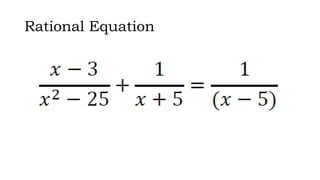
Rational Equation
1. Find the Least Common Denominator(LCD).
2. Multiply both sides of the equation by it’s the LCD.
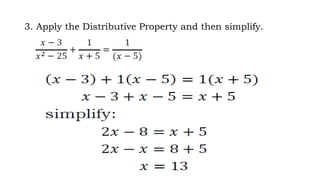
3. Apply the Distributive Property and then simplify.
4. Find all the possible values of x.
5. Check each value by substituting into original equation
and reject any extraneous root/s
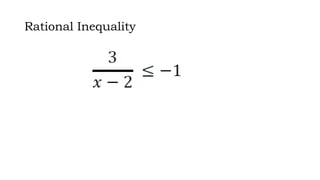
Rational Inequality
Rational Inequality
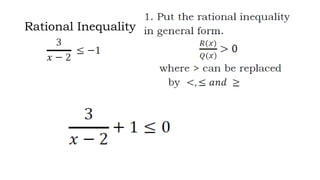
Rational Inequality
Rational Inequality
Rational Inequality
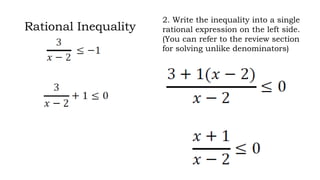
2. Write the inequality into a single
rational expression on the left side.
(You can refer to the review section
for solving unlike denominators)
Rational Inequality
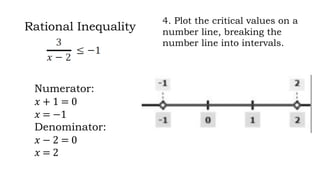
4. Plot the critical values on a
number line, breaking the
number line into intervals.
Numerator:
𝑥 + 1 = 0
𝑥 = −1
Denominator:
𝑥 − 2 = 0
𝑥 = 2
Rational Inequality
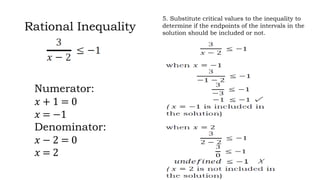
5. Substitute critical values to the inequality to
determine if the endpoints of the intervals in the
solution should be included or not.
Numerator:
𝑥 + 1 = 0
𝑥 = −1
Denominator:
𝑥 − 2 = 0
𝑥 = 2
Rational Inequality
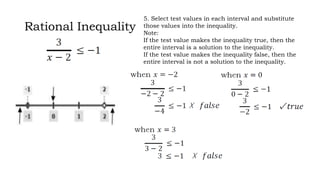
5. Select test values in each interval and substitute
those values into the inequality.
Note:
If the test value makes the inequality true, then the
entire interval is a solution to the inequality.
If the test value makes the inequality false, then the
entire interval is not a solution to the inequality.
Rational Inequality
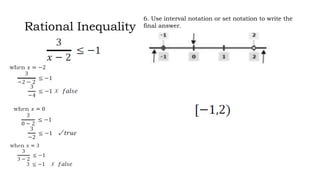
6. Use interval notation or set notation to write the
final answer.
Rational Inequality
Step 1. Put the rational inequality in the general form where > can be replaced by
<, ≤ 𝑎𝑛𝑑 ≥.
Step 2. Write the inequality into a single rational expression on the left-hand side.
Step 3. Set the numerator and denominator equal to zero and solve. The values you
get are called critical values.
Step 4. Plot the critical values on a number line, breaking the number line into
intervals.
Step 5. Substitute critical values to the inequality to determine if the endpoints of
the intervals in the solution should be included or not.
Rational Inequality
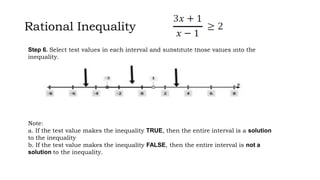
Step 6. Select test values in each interval and substitute those values into the
inequality.
Note:
a. If the test value makes the inequality TRUE, then the entire interval is a solution
to the inequality
b. If the test value makes the inequality FALSE, then the entire interval is not a
solution to the inequality.
Rational Inequality
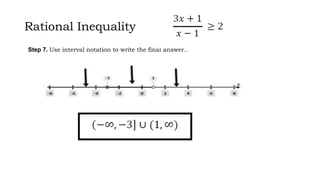
Step 7. Use interval notation to write the final answer..
Rational-Inequality.pptx

Rational-Inequality.pptx

  • 1.
  • 2.
  • 3.
    1. Find theLeast Common Denominator(LCD).
  • 4.
    2. Multiply bothsides of the equation by it’s the LCD.
  • 5.
    3. Apply theDistributive Property and then simplify.
  • 6.
    4. Find allthe possible values of x.
  • 7.
    5. Check eachvalue by substituting into original equation and reject any extraneous root/s
  • 8.
  • 9.
  • 10.
  • 11.
  • 12.
    Rational Inequality 2. Writethe inequality into a single rational expression on the left side. (You can refer to the review section for solving unlike denominators)
  • 13.
    Rational Inequality 4. Plotthe critical values on a number line, breaking the number line into intervals. Numerator: 𝑥 + 1 = 0 𝑥 = −1 Denominator: 𝑥 − 2 = 0 𝑥 = 2
  • 14.
    Rational Inequality 5. Substitutecritical values to the inequality to determine if the endpoints of the intervals in the solution should be included or not. Numerator: 𝑥 + 1 = 0 𝑥 = −1 Denominator: 𝑥 − 2 = 0 𝑥 = 2
  • 15.
    Rational Inequality 5. Selecttest values in each interval and substitute those values into the inequality. Note: If the test value makes the inequality true, then the entire interval is a solution to the inequality. If the test value makes the inequality false, then the entire interval is not a solution to the inequality.
  • 16.
    Rational Inequality 6. Useinterval notation or set notation to write the final answer.
  • 17.
    Rational Inequality Step 1.Put the rational inequality in the general form where > can be replaced by <, ≤ 𝑎𝑛𝑑 ≥. Step 2. Write the inequality into a single rational expression on the left-hand side. Step 3. Set the numerator and denominator equal to zero and solve. The values you get are called critical values. Step 4. Plot the critical values on a number line, breaking the number line into intervals. Step 5. Substitute critical values to the inequality to determine if the endpoints of the intervals in the solution should be included or not.
  • 18.
    Rational Inequality Step 6.Select test values in each interval and substitute those values into the inequality. Note: a. If the test value makes the inequality TRUE, then the entire interval is a solution to the inequality b. If the test value makes the inequality FALSE, then the entire interval is not a solution to the inequality.
  • 19.
    Rational Inequality Step 7.Use interval notation to write the final answer..