Financial Statement Analysis
Rationale of Financial Statement
Analysis
 Financial statement – summary of
figures as of any given date
 To identify relevant information
 Draw meaningful interpretations
Process of Analysis
 Identification of significant
information
 Highlight significant relationships
 Interpretation
Tools of Financial Analysis
 Fund flow Statement
 Cash Flow Statement
 Ratio Analysis
 Common size statements
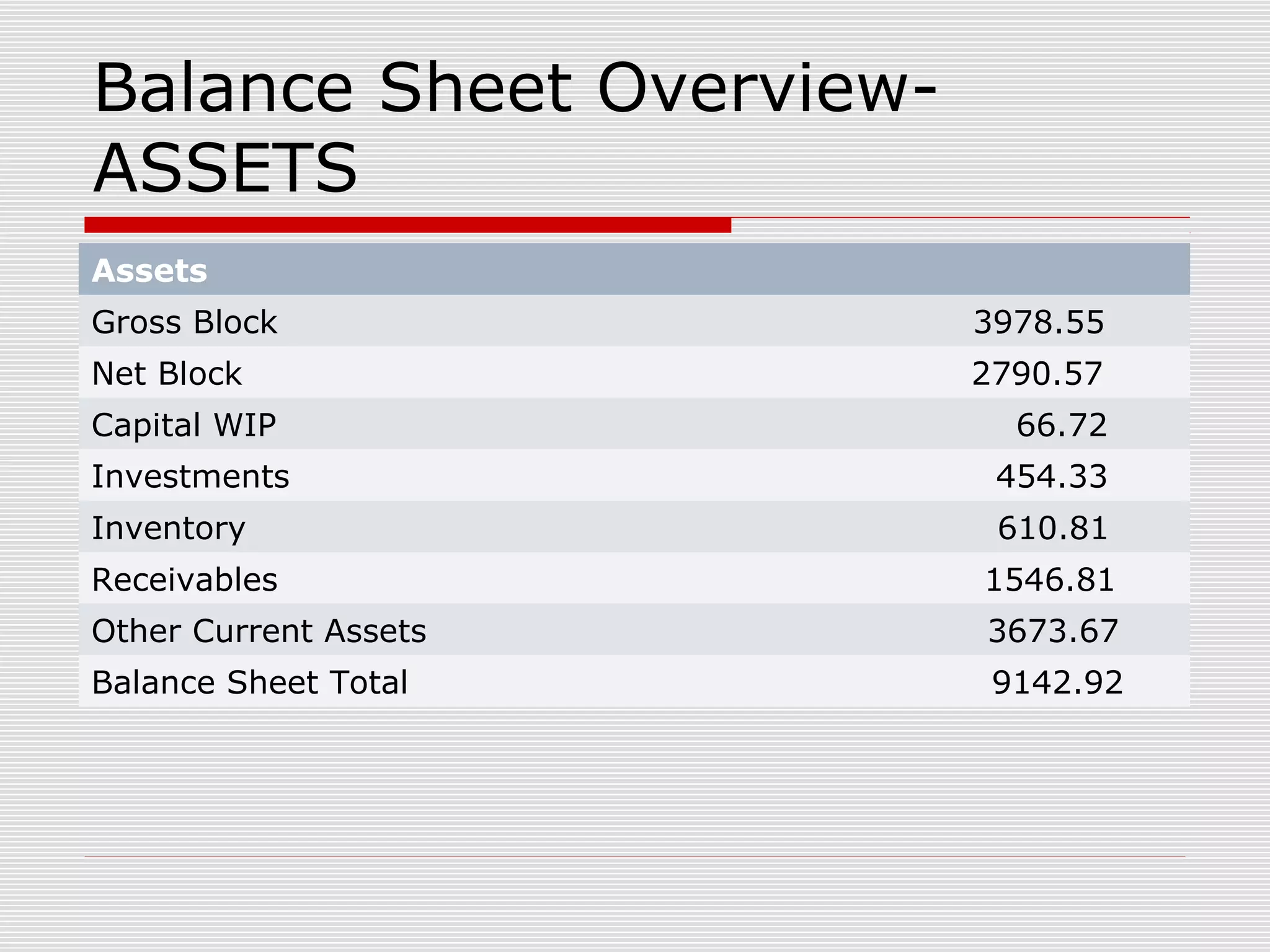
Balance Sheet Overview-
ASSETS
Assets
Gross Block 3978.55
Net Block 2790.57
Capital WIP 66.72
Investments 454.33
Inventory 610.81
Receivables 1546.81
Other Current Assets 3673.67
Balance Sheet Total 9142.92
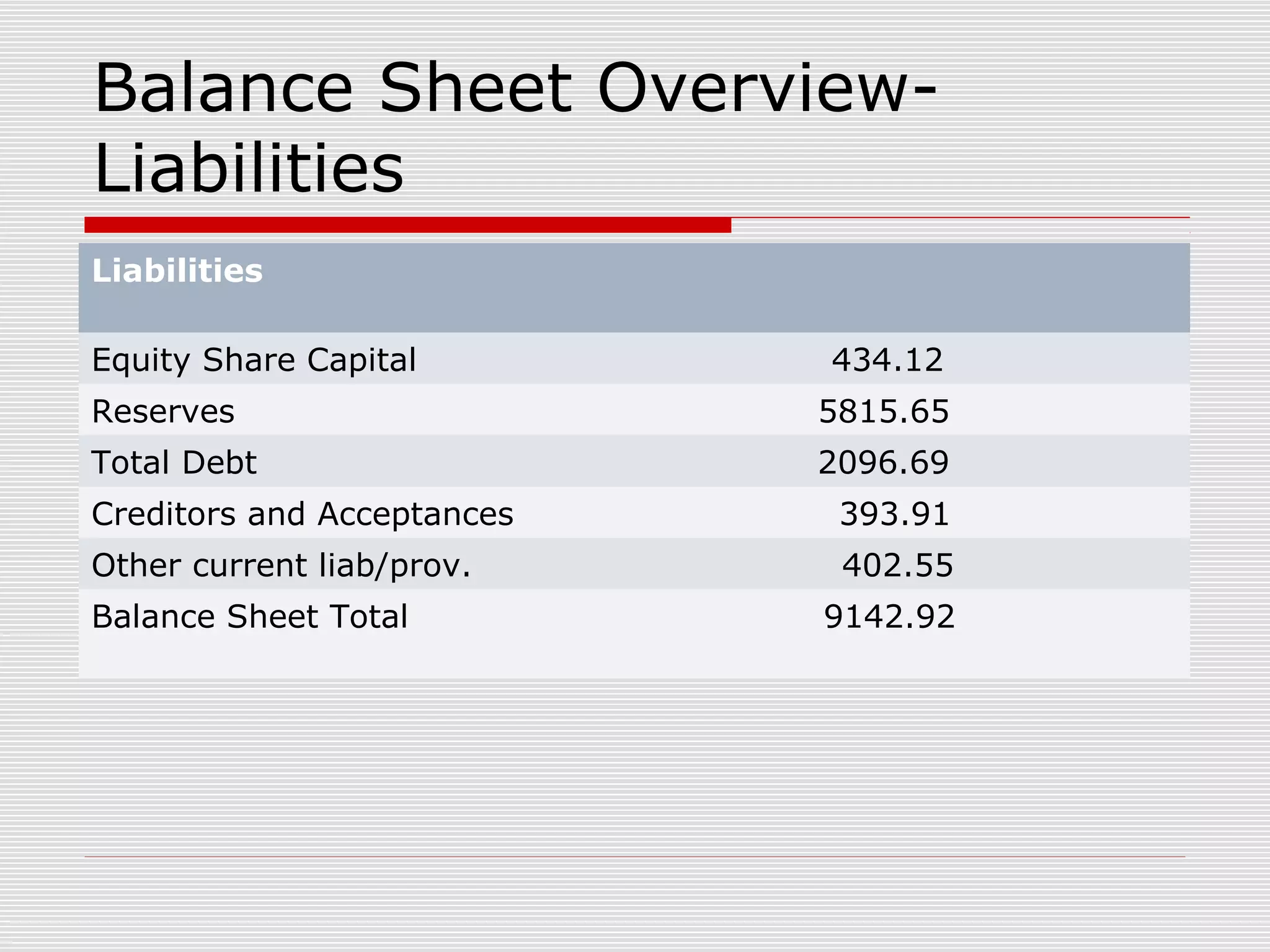
Balance Sheet Overview-
Liabilities
Liabilities
Equity Share Capital 434.12
Reserves 5815.65
Total Debt 2096.69
Creditors and Acceptances 393.91
Other current liab/prov. 402.55
Balance Sheet Total 9142.92
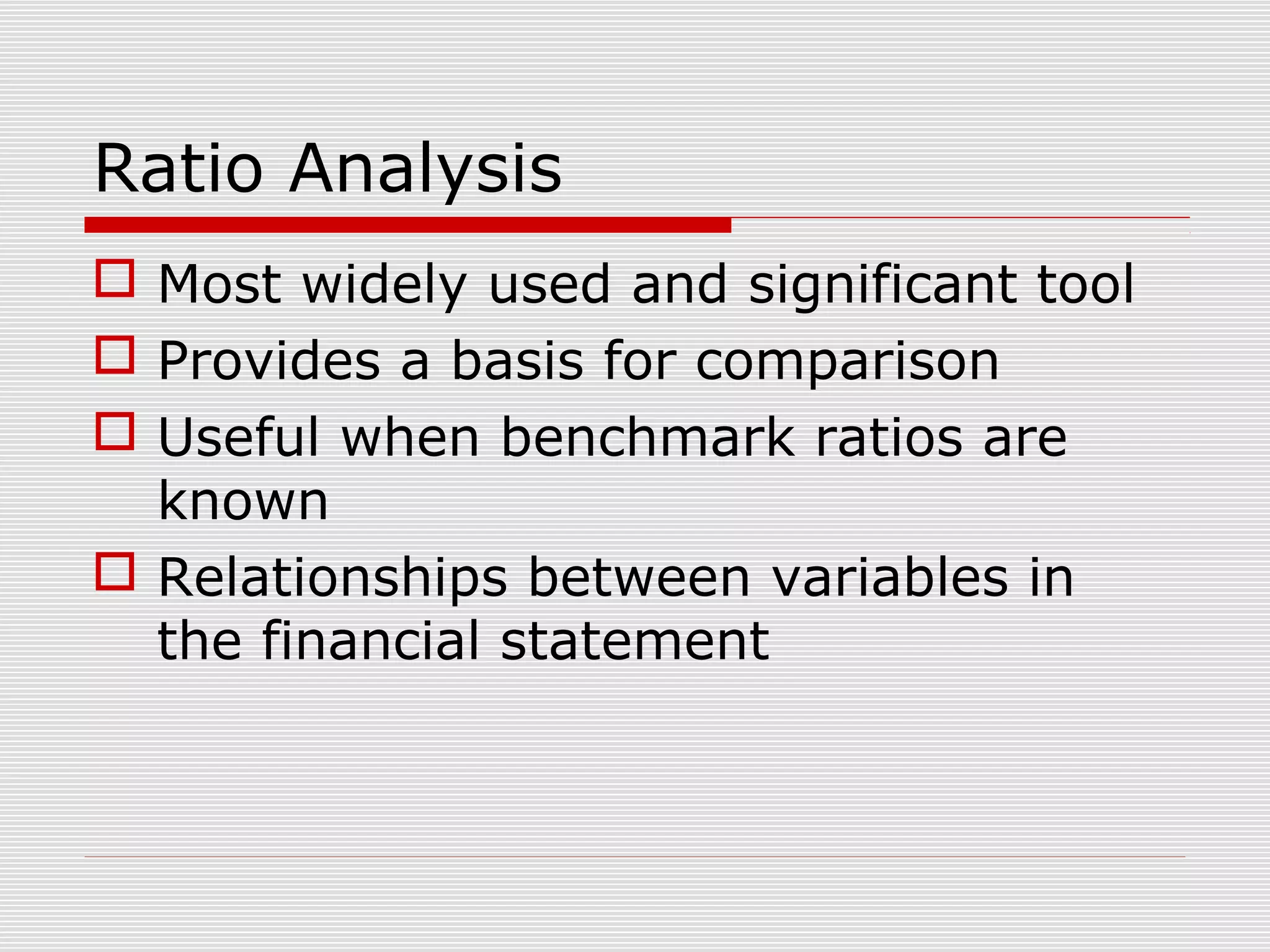
Ratio Analysis
 Most widely used and significant tool
 Provides a basis for comparison
 Useful when benchmark ratios are
known
 Relationships between variables in
the financial statement
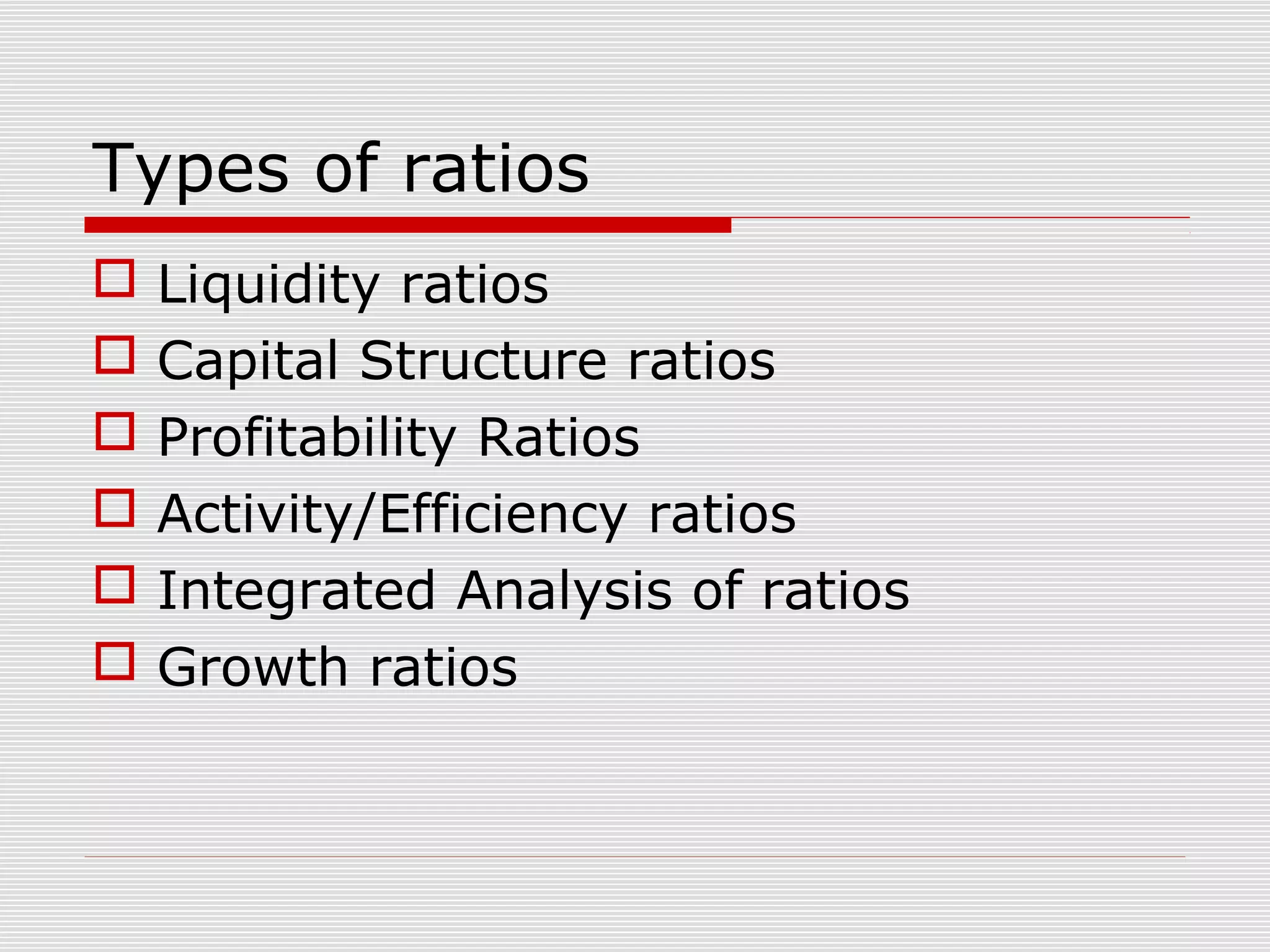
Types of ratios
 Liquidity ratios
 Capital Structure ratios
 Profitability Ratios
 Activity/Efficiency ratios
 Integrated Analysis of ratios
 Growth ratios
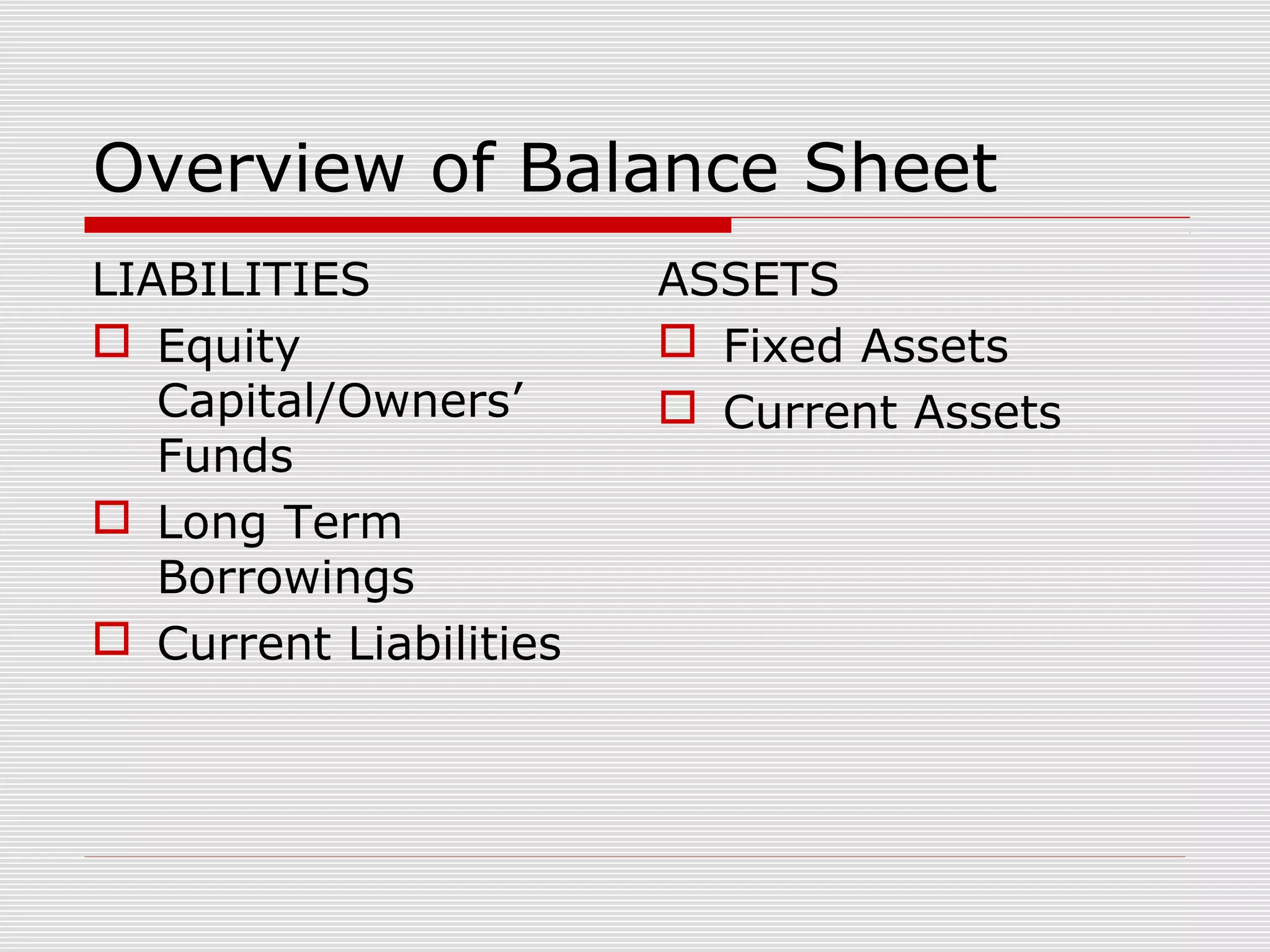
Overview of Balance Sheet
LIABILITIES
 Equity
Capital/Owners’
Funds
 Long Term
Borrowings
 Current Liabilities
ASSETS
 Fixed Assets
 Current Assets
Liquidity Ratios
 Measure the ability of firm to meet
short term obligations
 Reflect short term financial strength
 Why short term??- of interest to
creditors..
 Ratios- Current ratio, Liquid ratio,
Turnover ratios, cash flow from
operation ratio
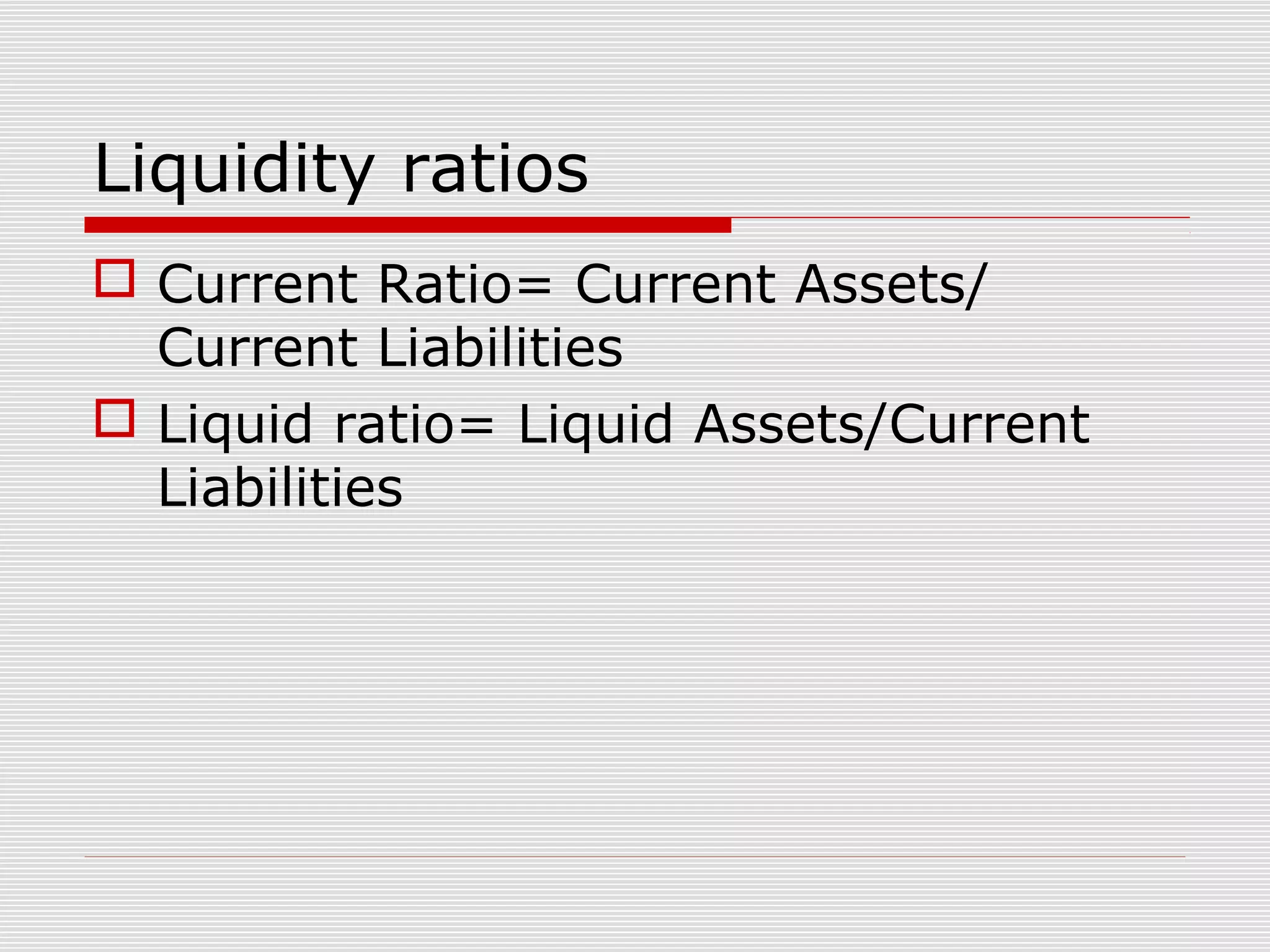
Liquidity ratios
 Current Ratio= Current Assets/
Current Liabilities
 Liquid ratio= Liquid Assets/Current
Liabilities
NEED FOR LIQUIDITY
 Assume stocks are bought on credit
 Converted to inventory
 Sales=0
 Current Ratio??
 Liquid Ratio??
 Implications on liquidity-serious
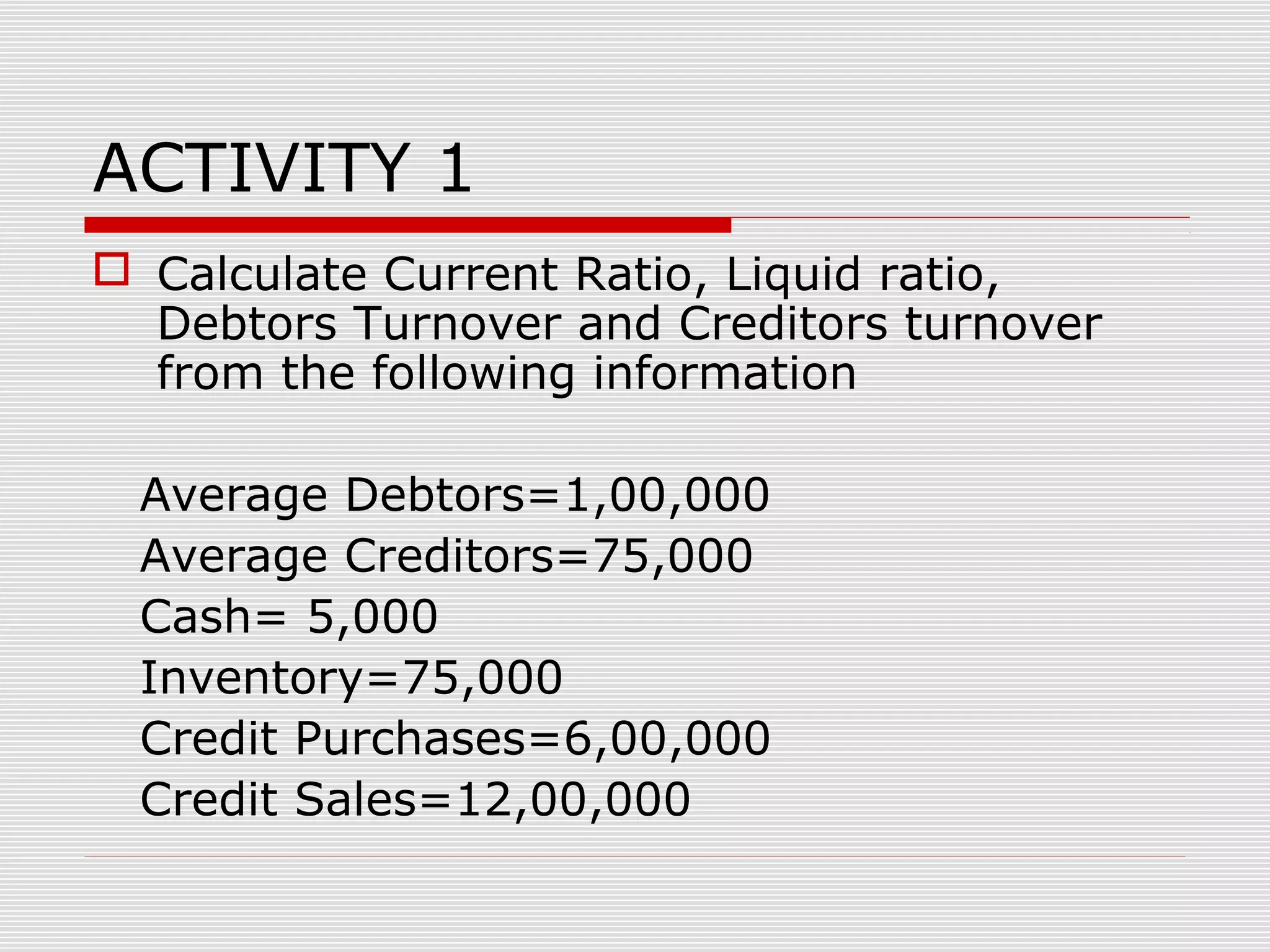
ACTIVITY 1
 Calculate Current Ratio, Liquid ratio,
Debtors Turnover and Creditors turnover
from the following information
Average Debtors=1,00,000
Average Creditors=75,000
Cash= 5,000
Inventory=75,000
Credit Purchases=6,00,000
Credit Sales=12,00,000
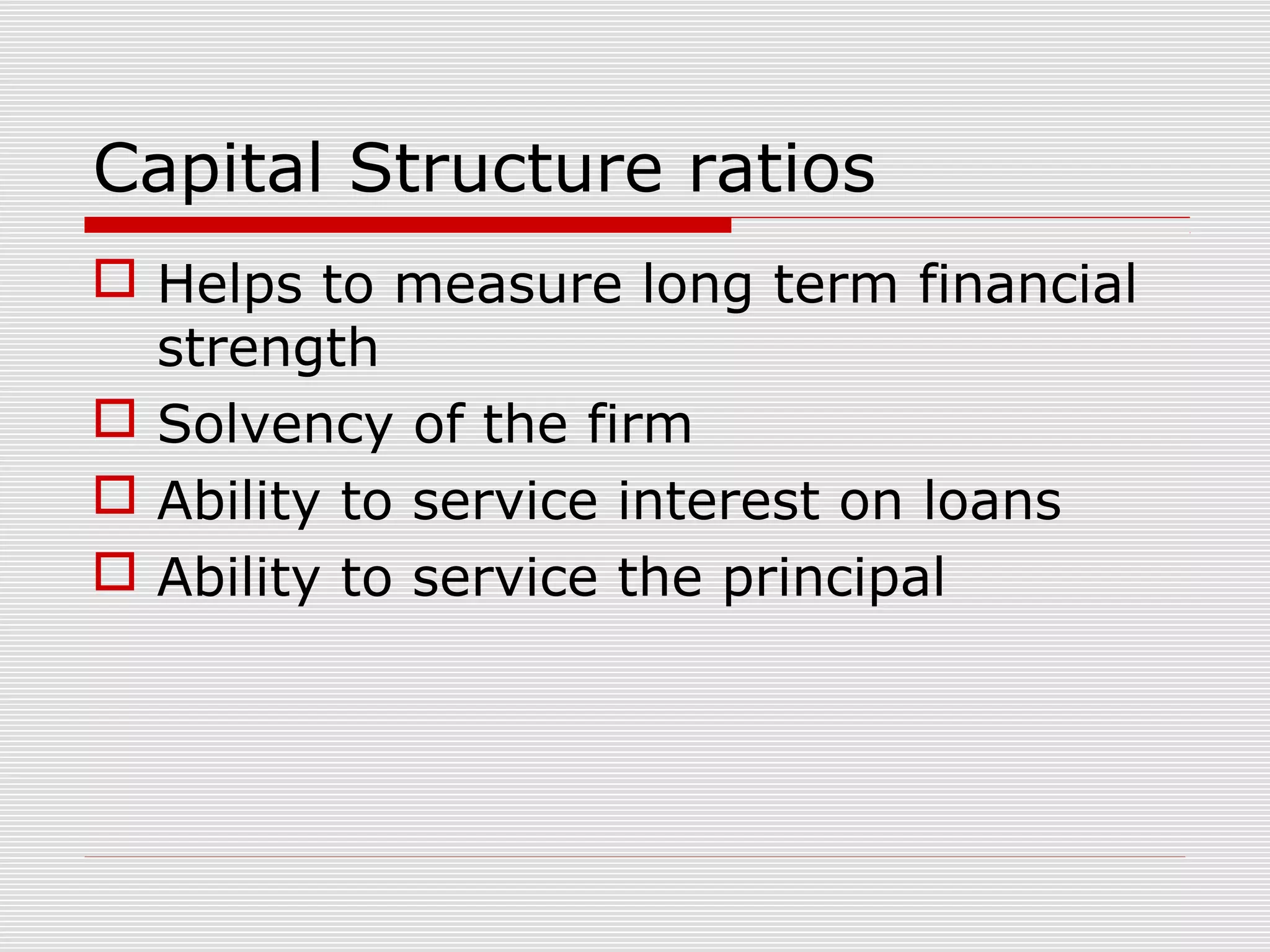
Capital Structure ratios
 Helps to measure long term financial
strength
 Solvency of the firm
 Ability to service interest on loans
 Ability to service the principal
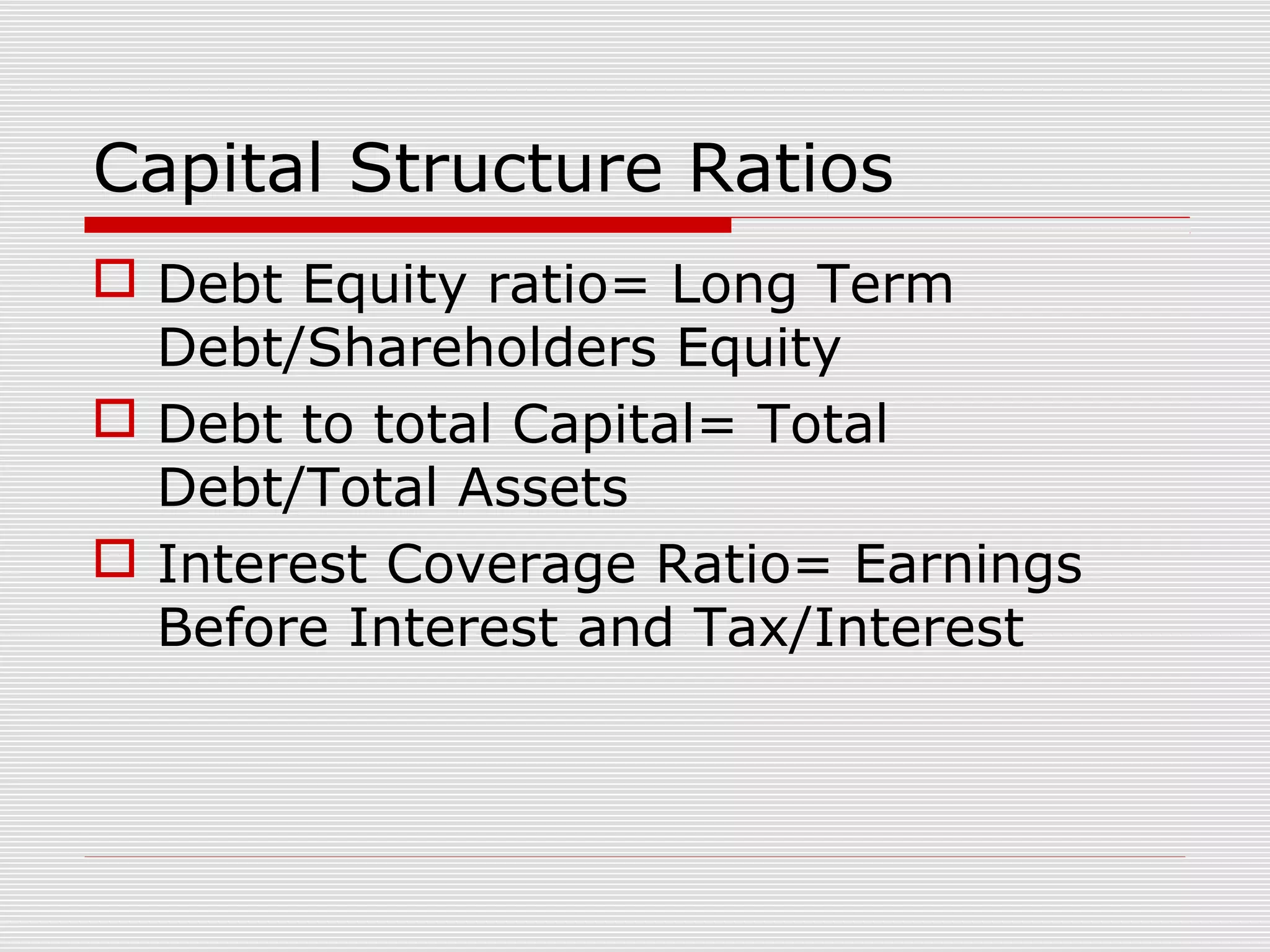
Capital Structure Ratios
 Debt Equity ratio= Long Term
Debt/Shareholders Equity
 Debt to total Capital= Total
Debt/Total Assets
 Interest Coverage Ratio= Earnings
Before Interest and Tax/Interest
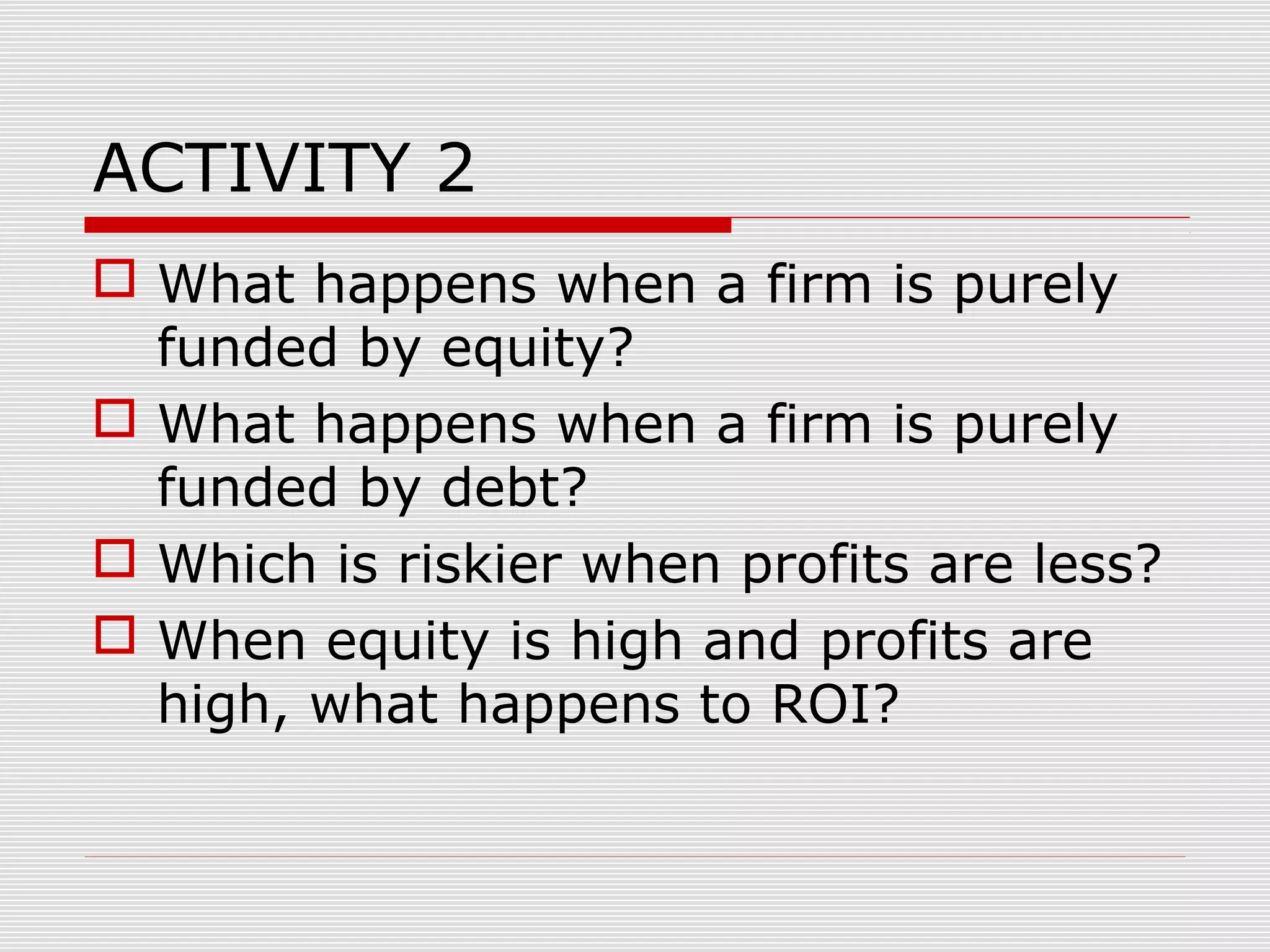
ACTIVITY 2
 What happens when a firm is purely
funded by equity?
 What happens when a firm is purely
funded by debt?
 Which is riskier when profits are less?
 When equity is high and profits are
high, what happens to ROI?
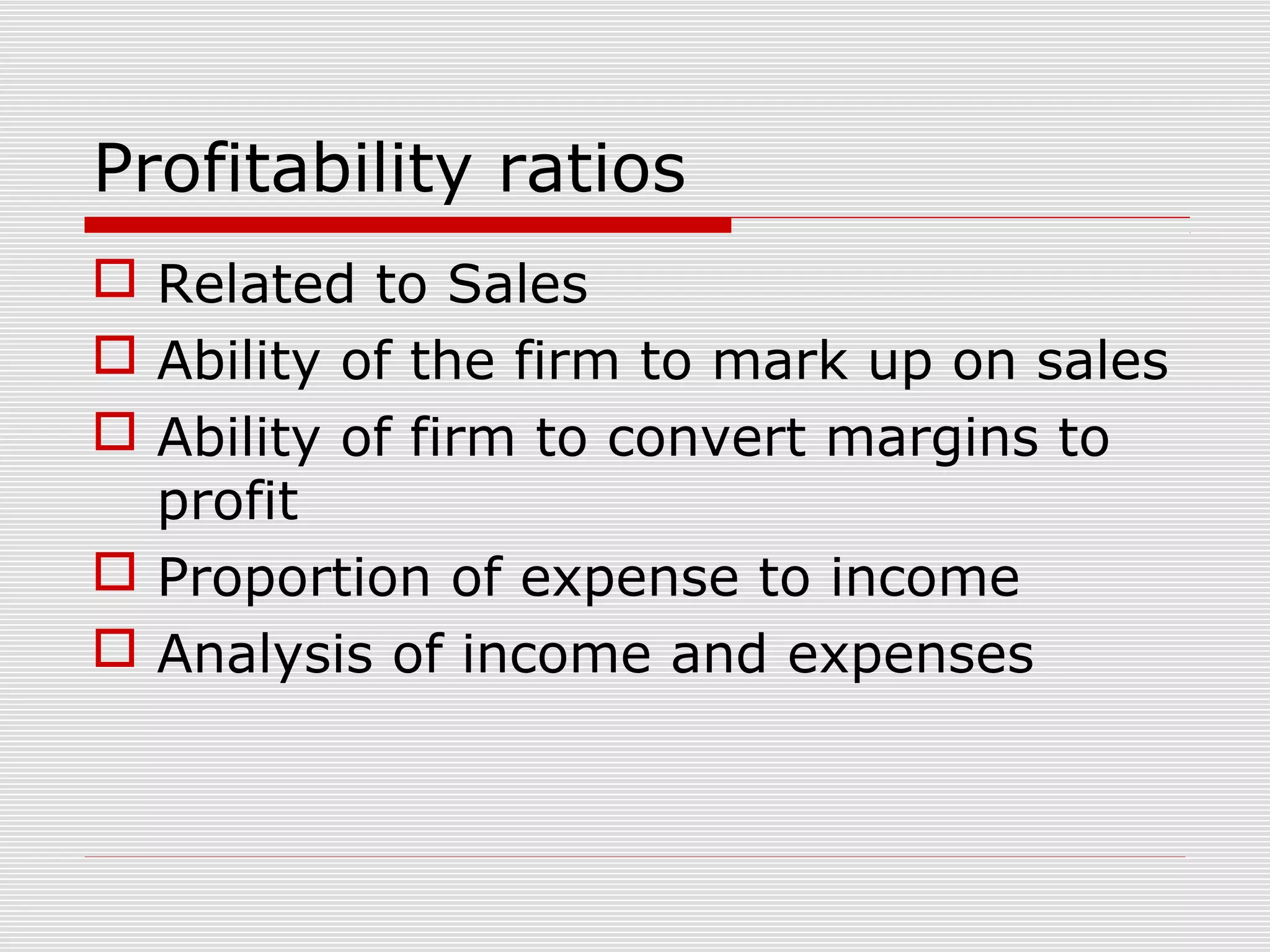
Profitability ratios
 Related to Sales
 Ability of the firm to mark up on sales
 Ability of firm to convert margins to
profit
 Proportion of expense to income
 Analysis of income and expenses
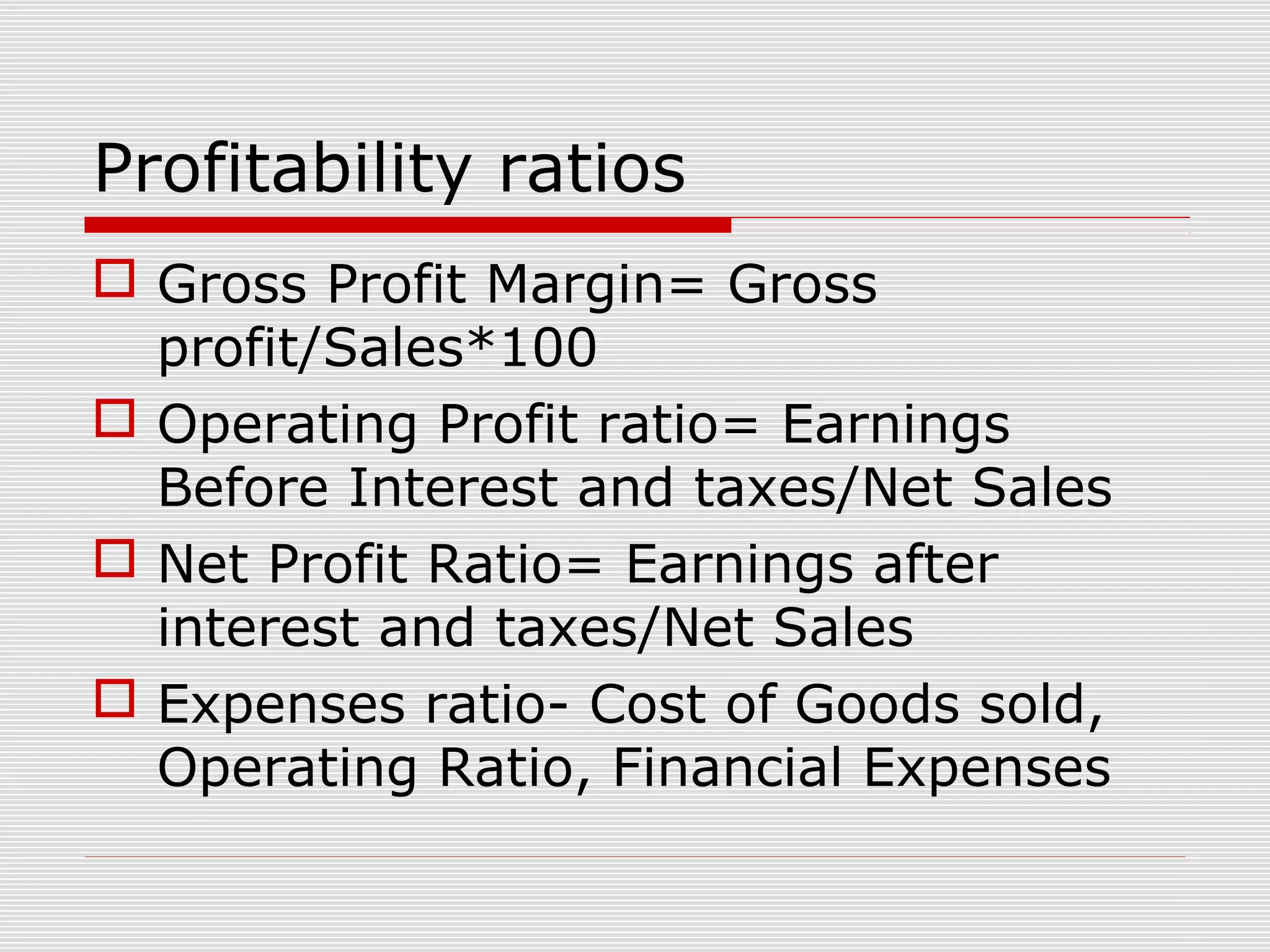
Profitability ratios
 Gross Profit Margin= Gross
profit/Sales*100
 Operating Profit ratio= Earnings
Before Interest and taxes/Net Sales
 Net Profit Ratio= Earnings after
interest and taxes/Net Sales
 Expenses ratio- Cost of Goods sold,
Operating Ratio, Financial Expenses
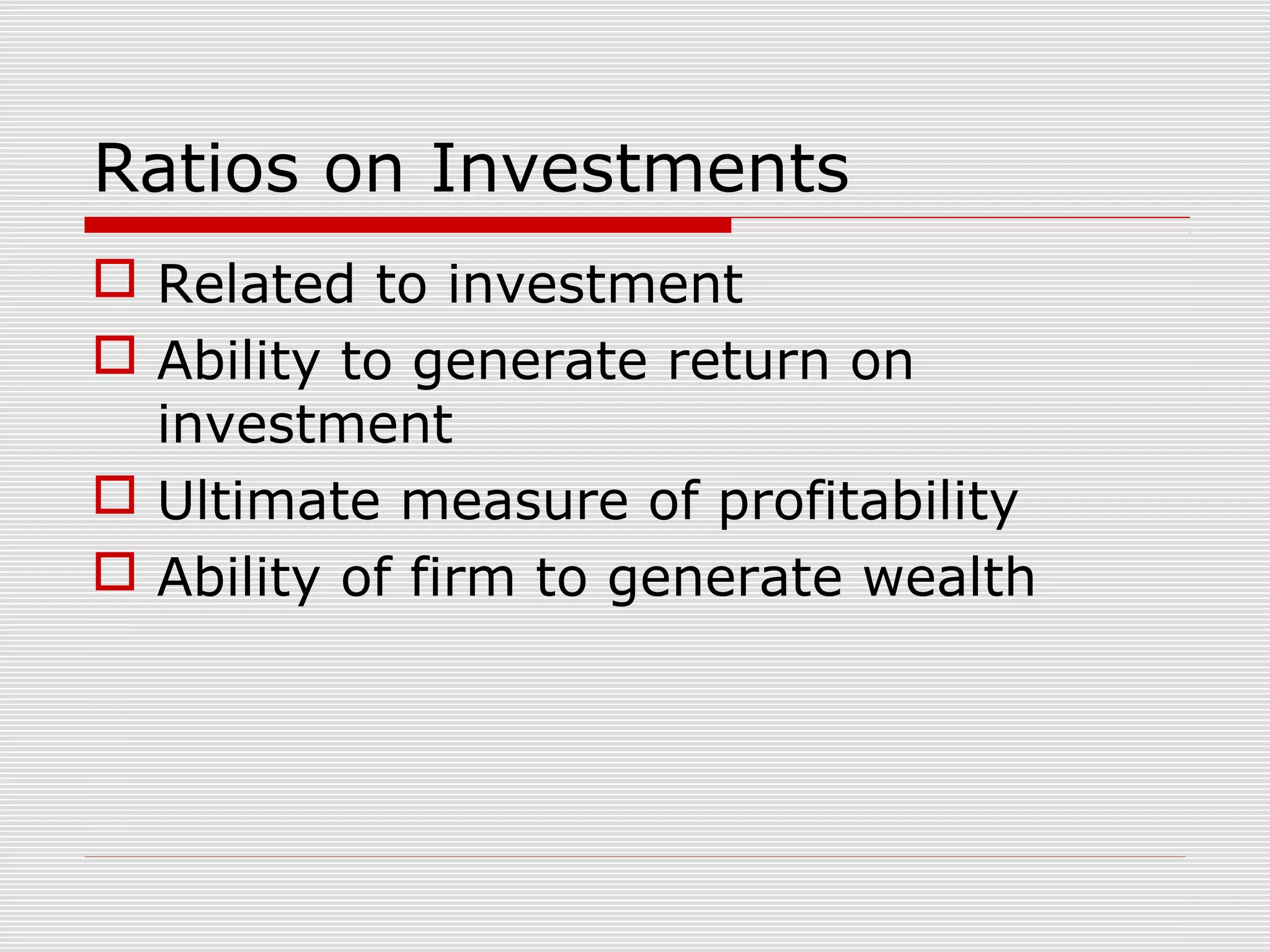
Ratios on Investments
 Related to investment
 Ability to generate return on
investment
 Ultimate measure of profitability
 Ability of firm to generate wealth
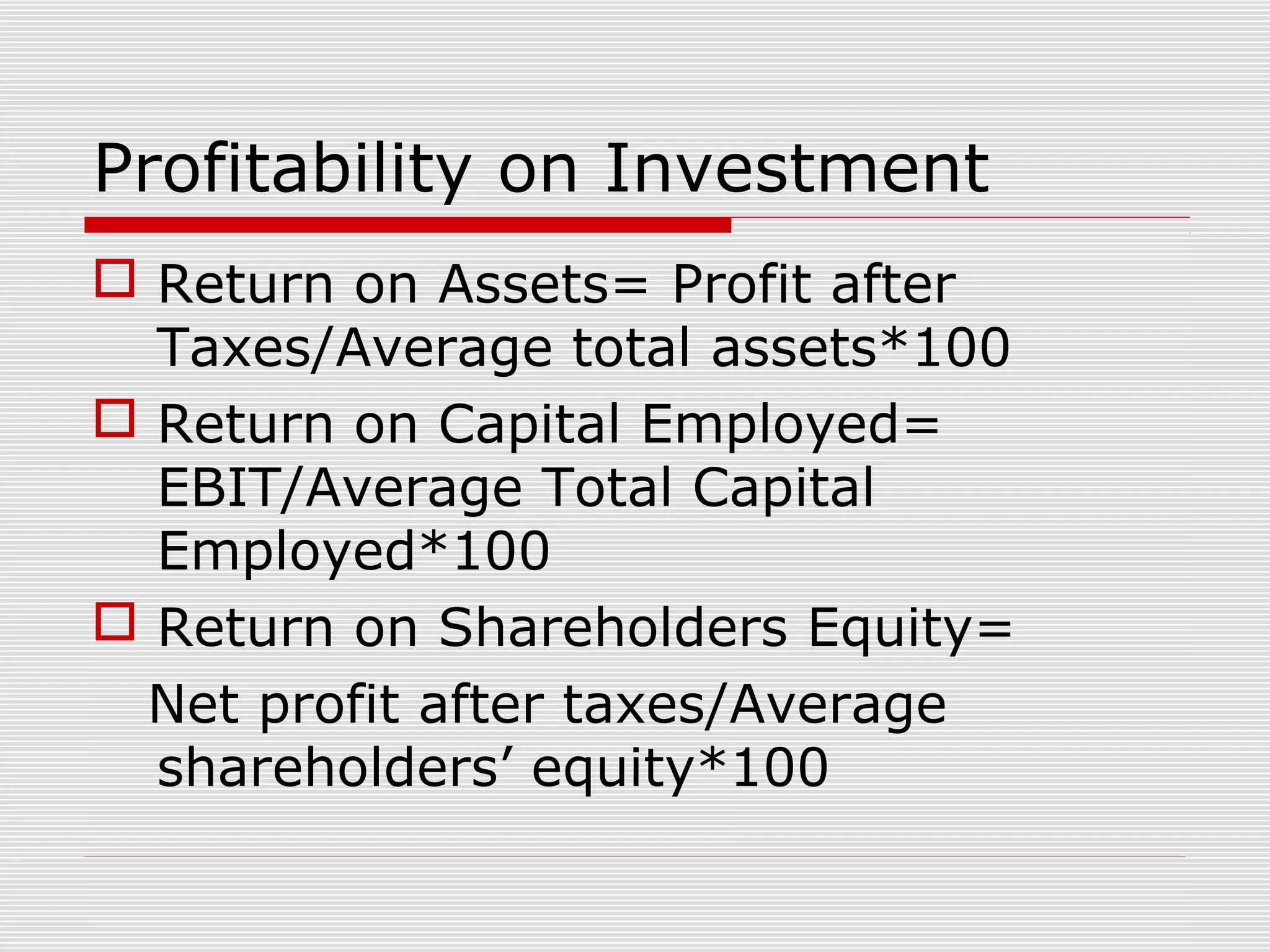
Profitability on Investment
 Return on Assets= Profit after
Taxes/Average total assets*100
 Return on Capital Employed=
EBIT/Average Total Capital
Employed*100
 Return on Shareholders Equity=
Net profit after taxes/Average
shareholders’ equity*100
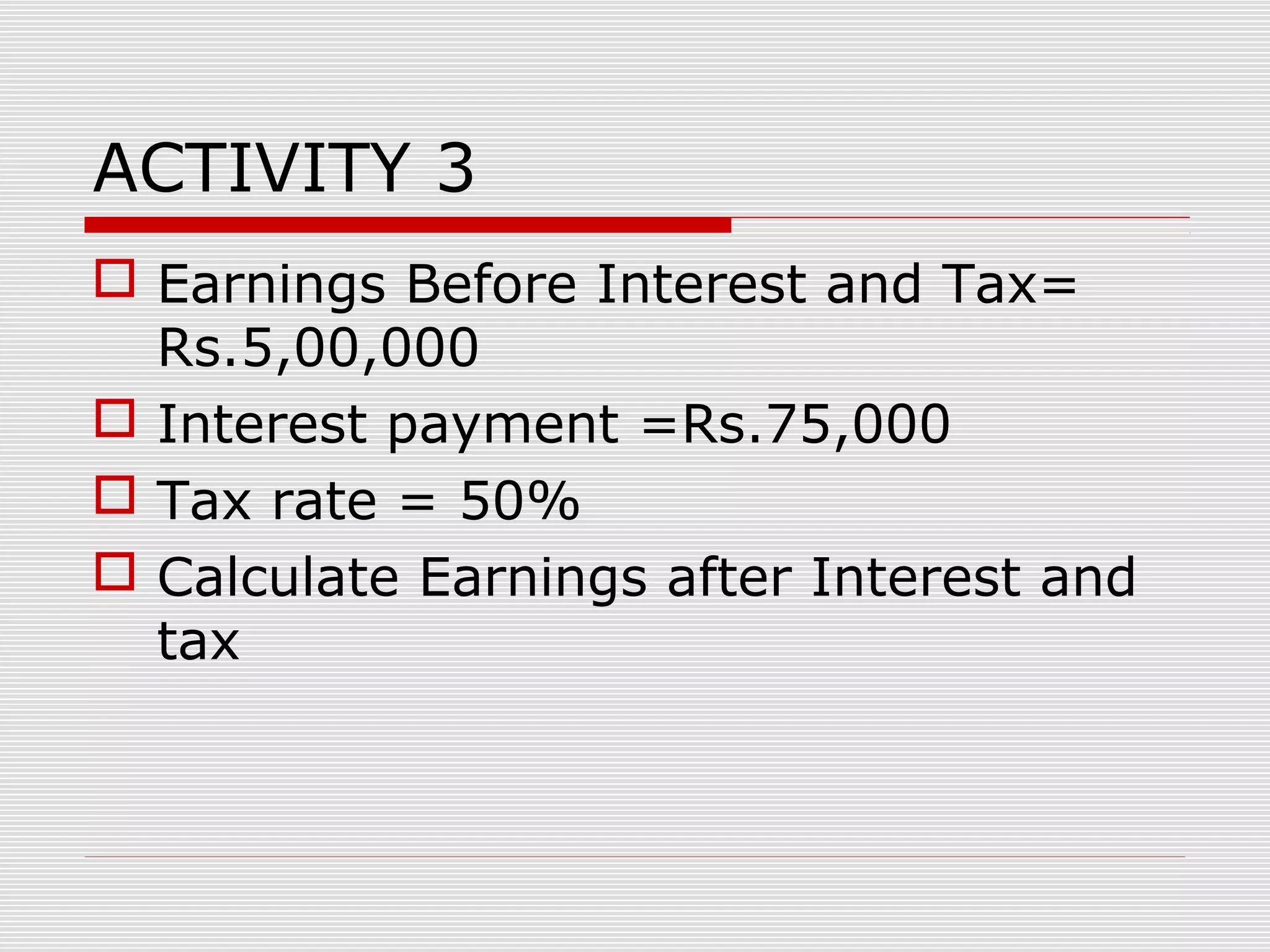
ACTIVITY 3
 Earnings Before Interest and Tax=
Rs.5,00,000
 Interest payment =Rs.75,000
 Tax rate = 50%
 Calculate Earnings after Interest and
tax
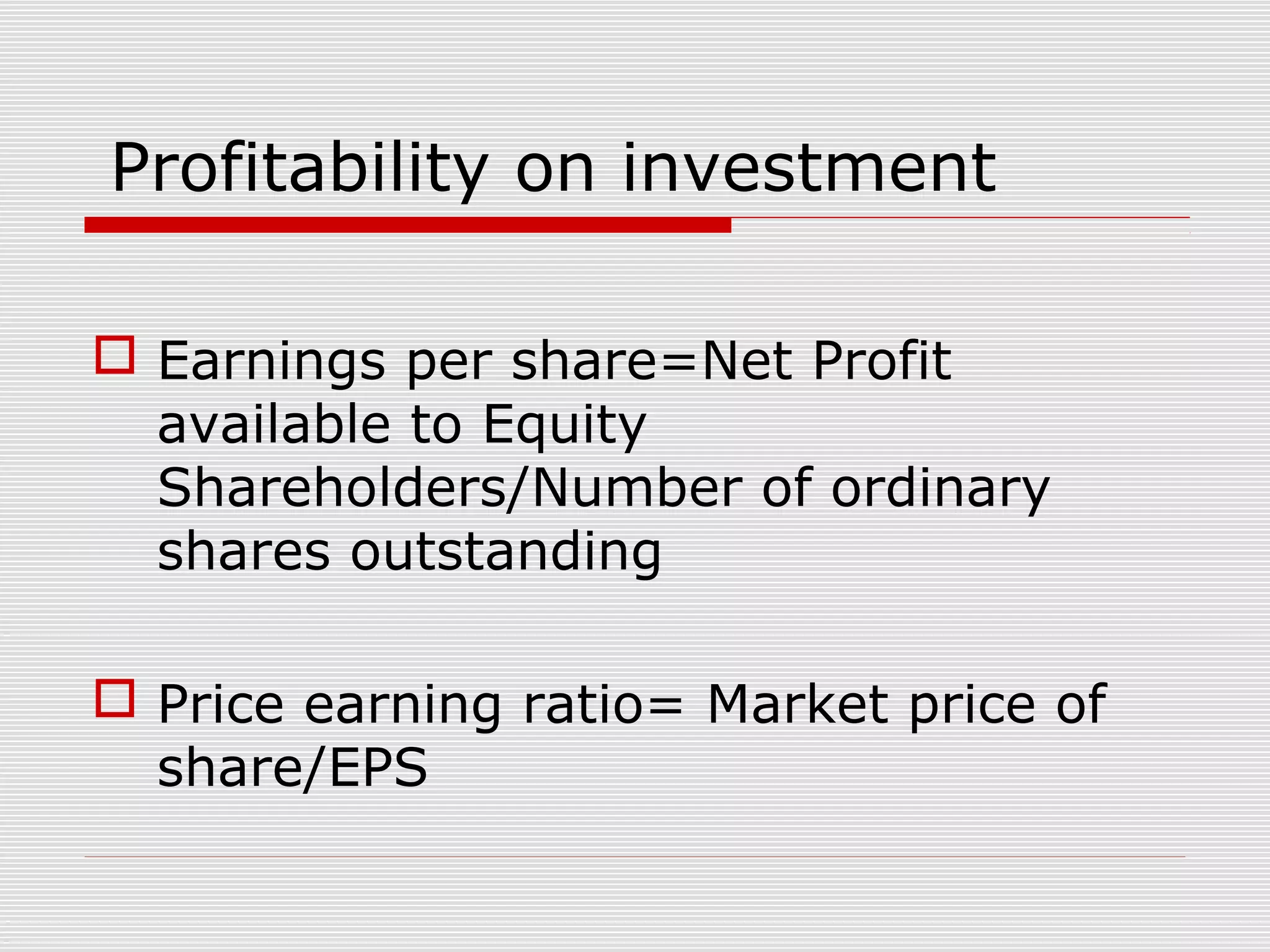
Profitability on investment
 Earnings per share=Net Profit
available to Equity
Shareholders/Number of ordinary
shares outstanding
 Price earning ratio= Market price of
share/EPS
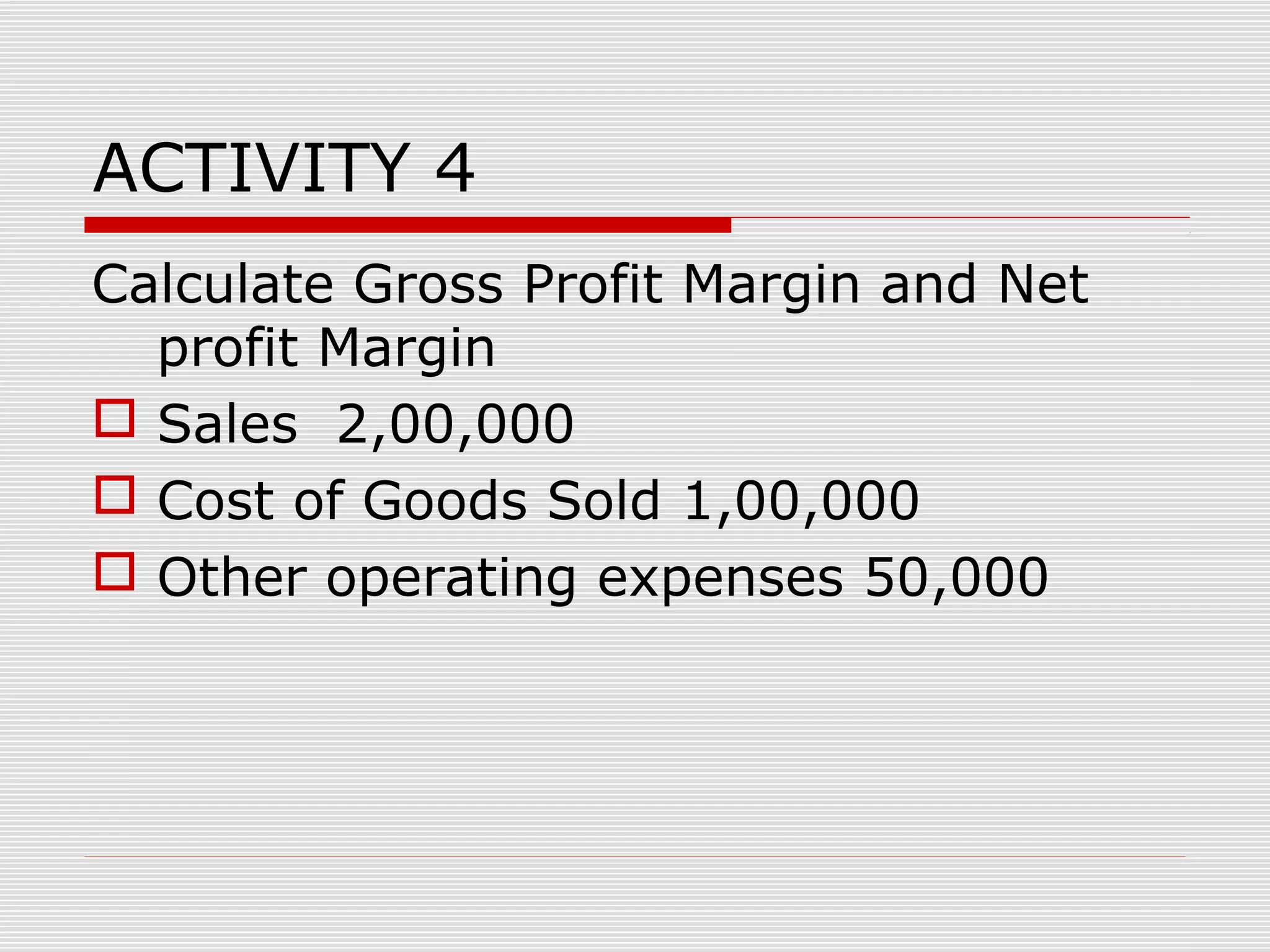
ACTIVITY 4
Calculate Gross Profit Margin and Net
profit Margin
 Sales 2,00,000
 Cost of Goods Sold 1,00,000
 Other operating expenses 50,000
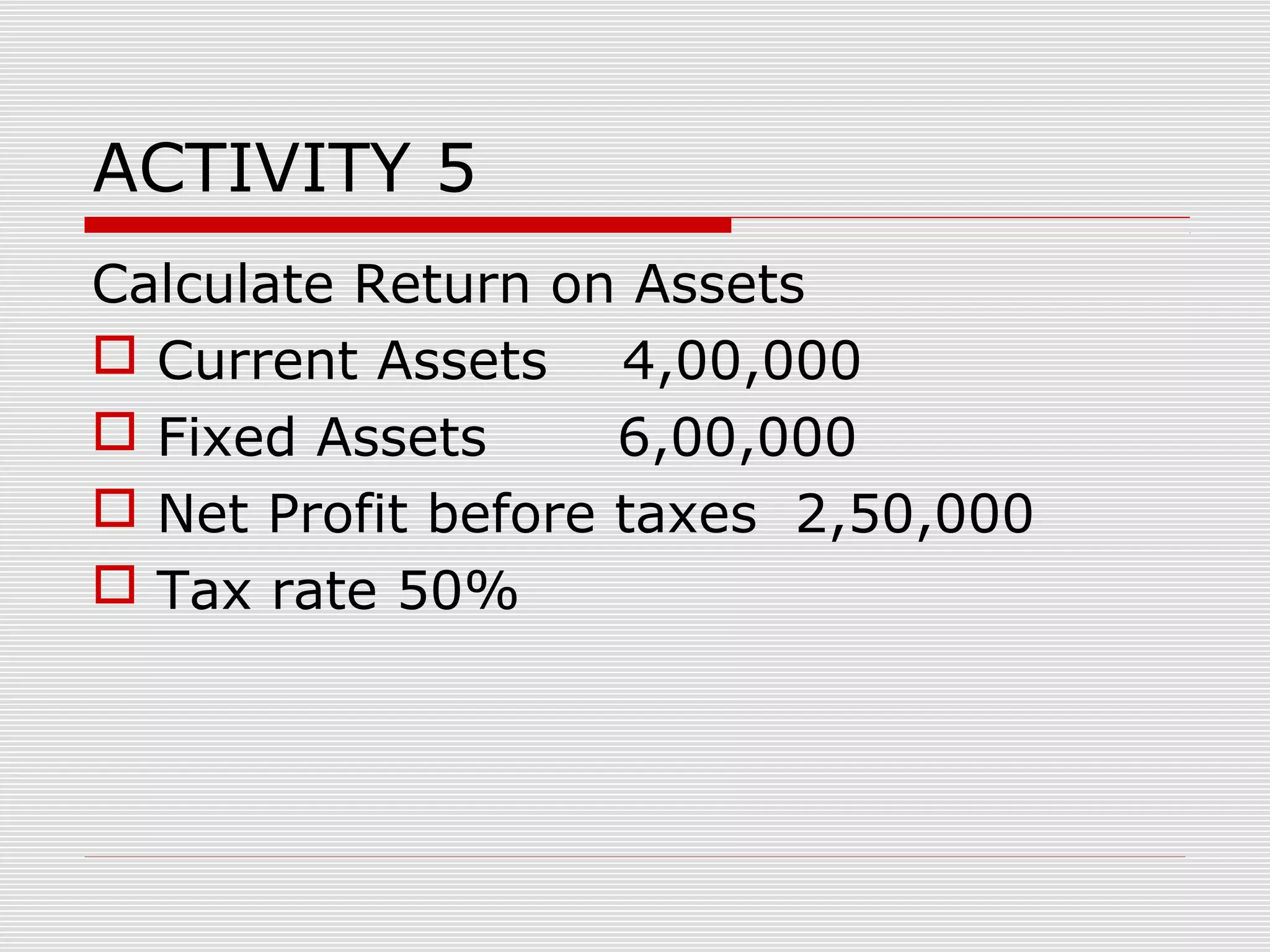
ACTIVITY 5
Calculate Return on Assets
 Current Assets 4,00,000
 Fixed Assets 6,00,000
 Net Profit before taxes 2,50,000
 Tax rate 50%
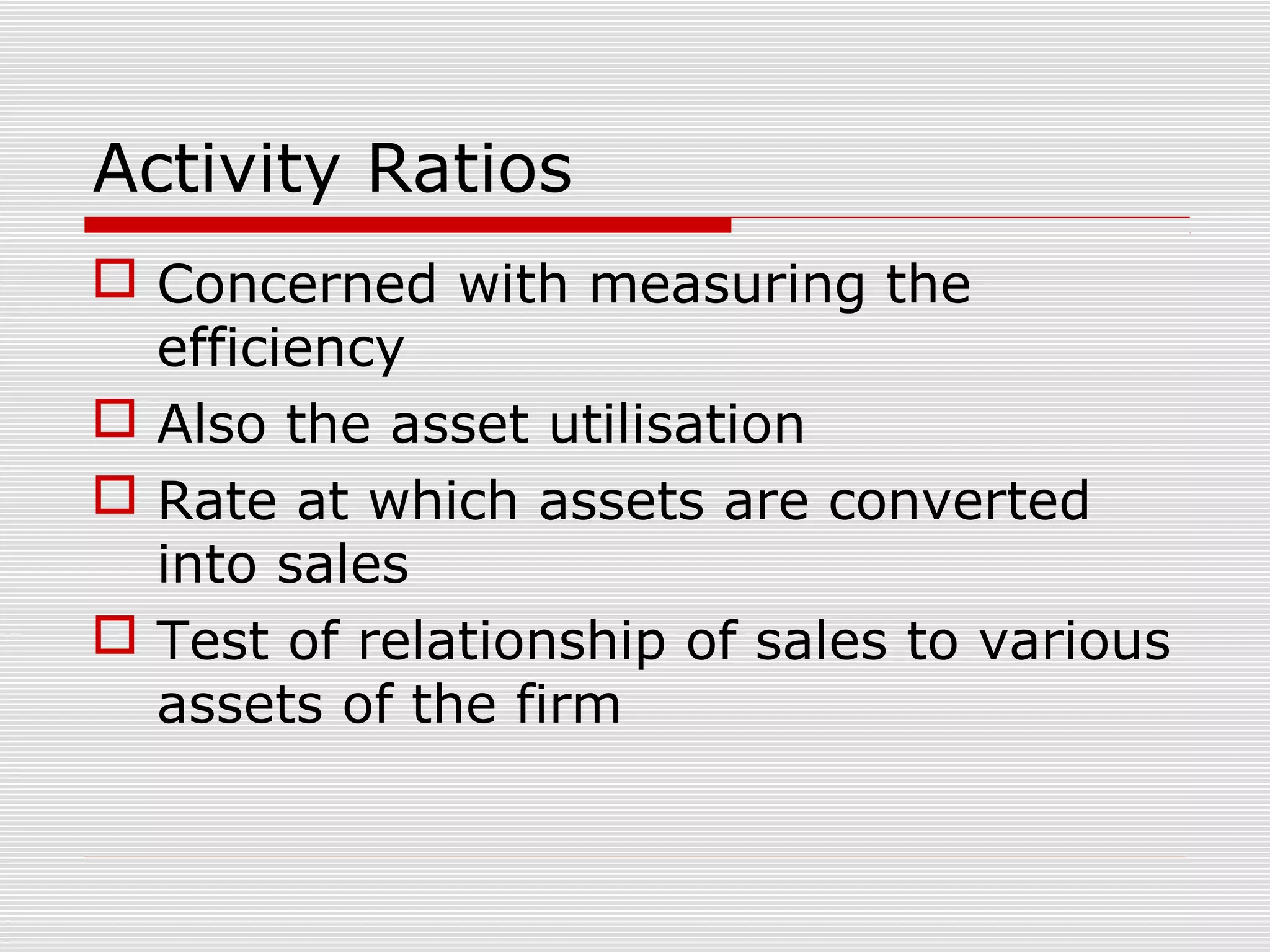
Activity Ratios
 Concerned with measuring the
efficiency
 Also the asset utilisation
 Rate at which assets are converted
into sales
 Test of relationship of sales to various
assets of the firm
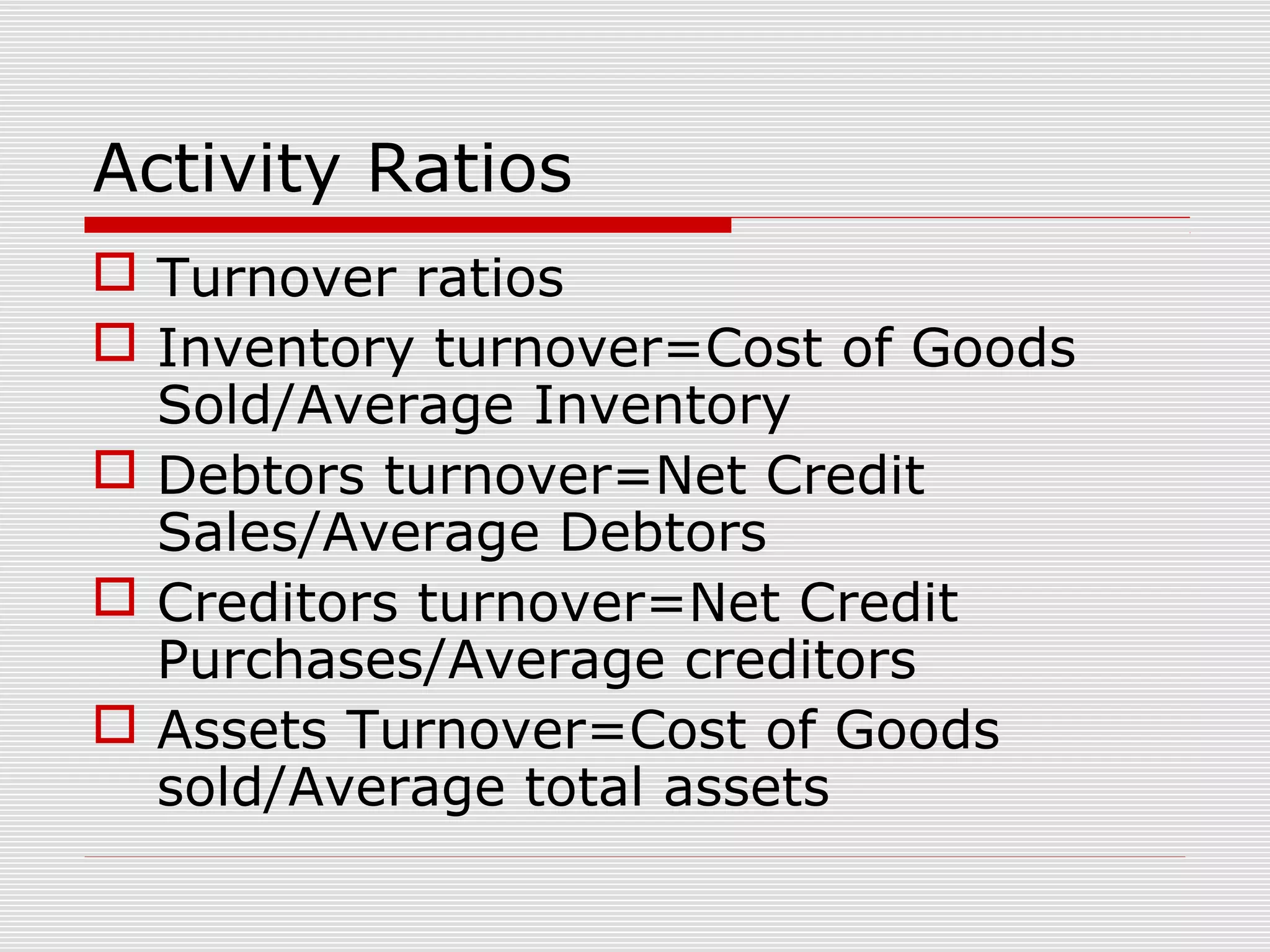
Activity Ratios
 Turnover ratios
 Inventory turnover=Cost of Goods
Sold/Average Inventory
 Debtors turnover=Net Credit
Sales/Average Debtors
 Creditors turnover=Net Credit
Purchases/Average creditors
 Assets Turnover=Cost of Goods
sold/Average total assets
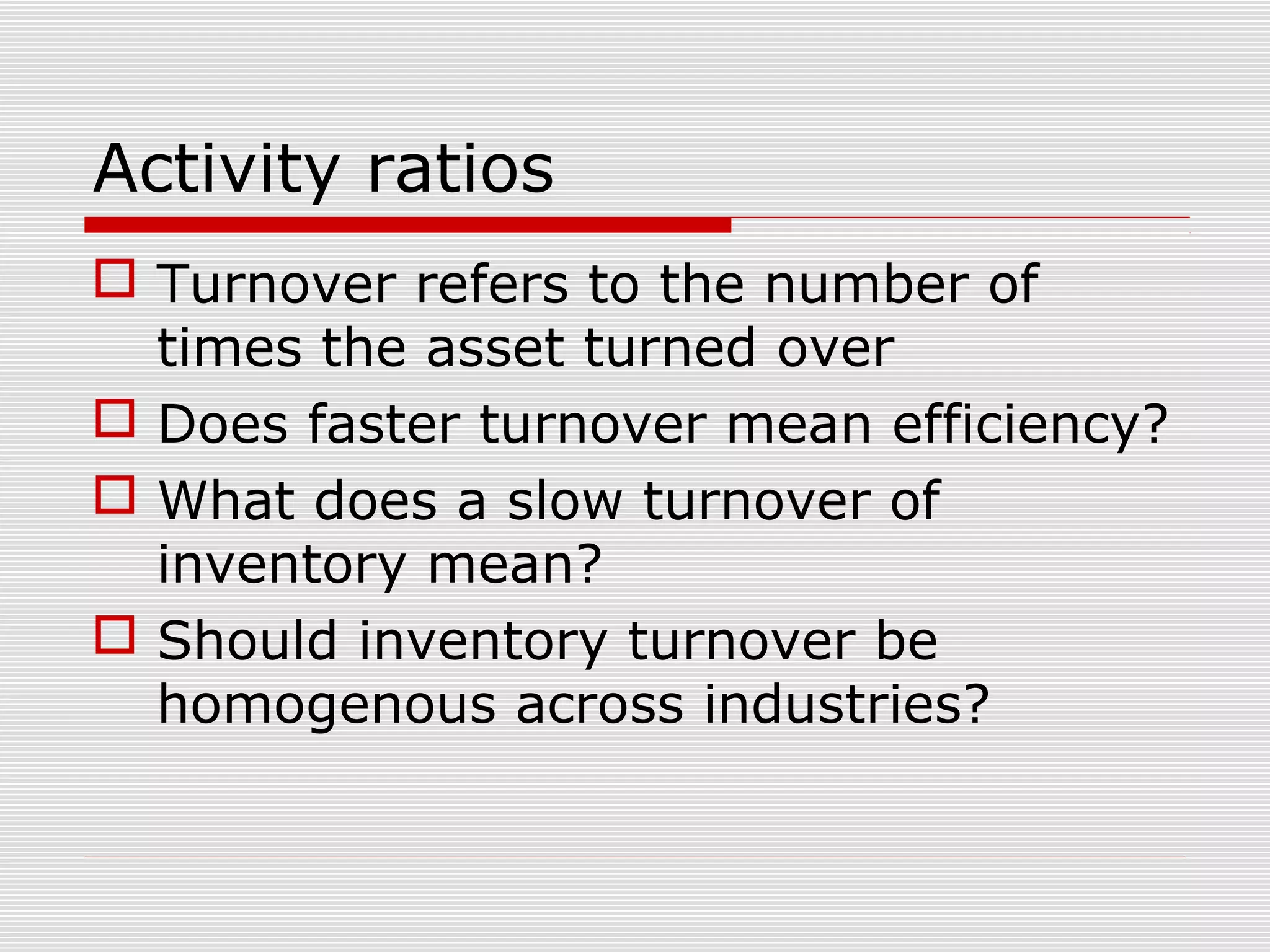
Activity ratios
 Turnover refers to the number of
times the asset turned over
 Does faster turnover mean efficiency?
 What does a slow turnover of
inventory mean?
 Should inventory turnover be
homogenous across industries?
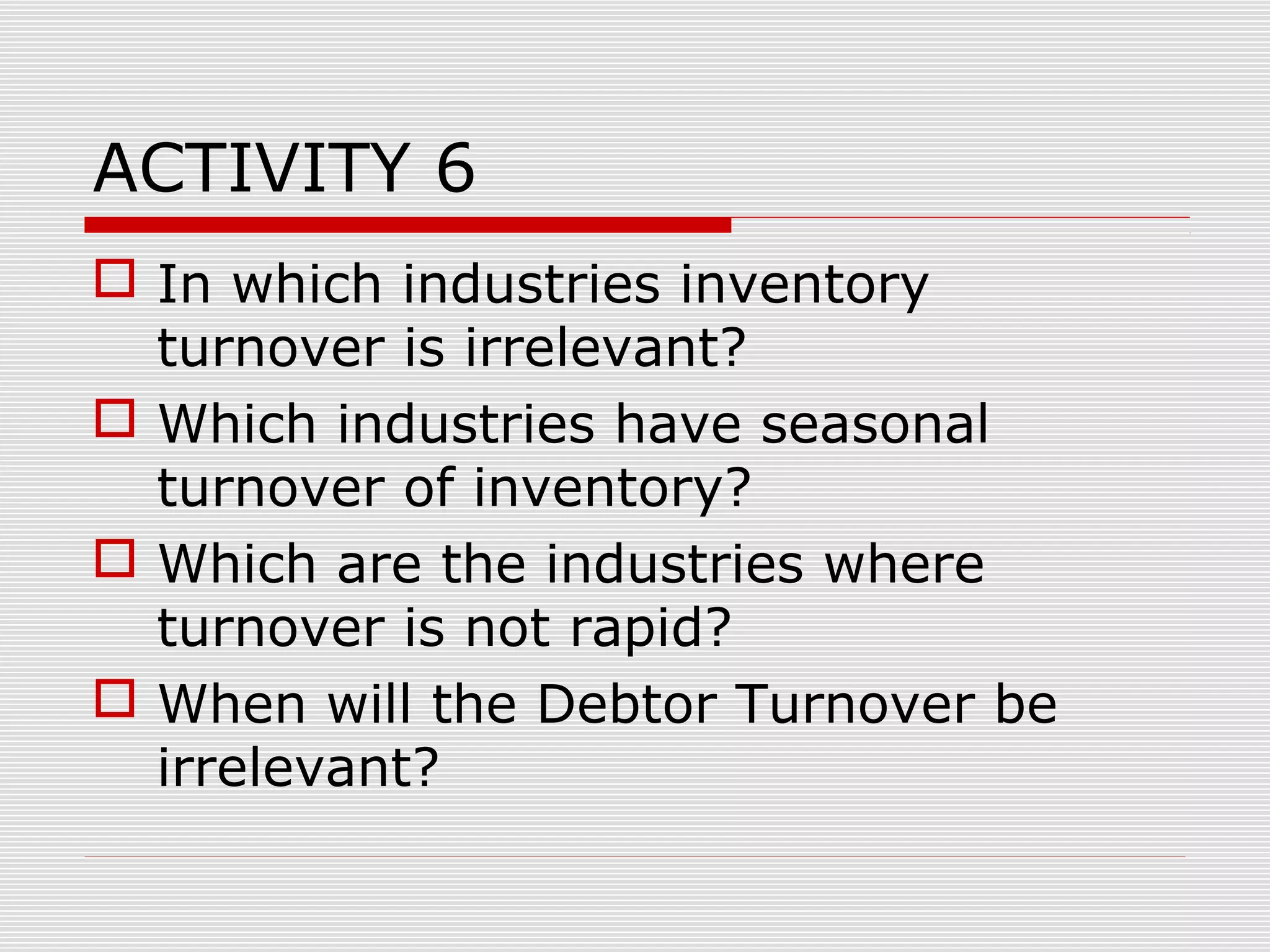
ACTIVITY 6
 In which industries inventory
turnover is irrelevant?
 Which industries have seasonal
turnover of inventory?
 Which are the industries where
turnover is not rapid?
 When will the Debtor Turnover be
irrelevant?
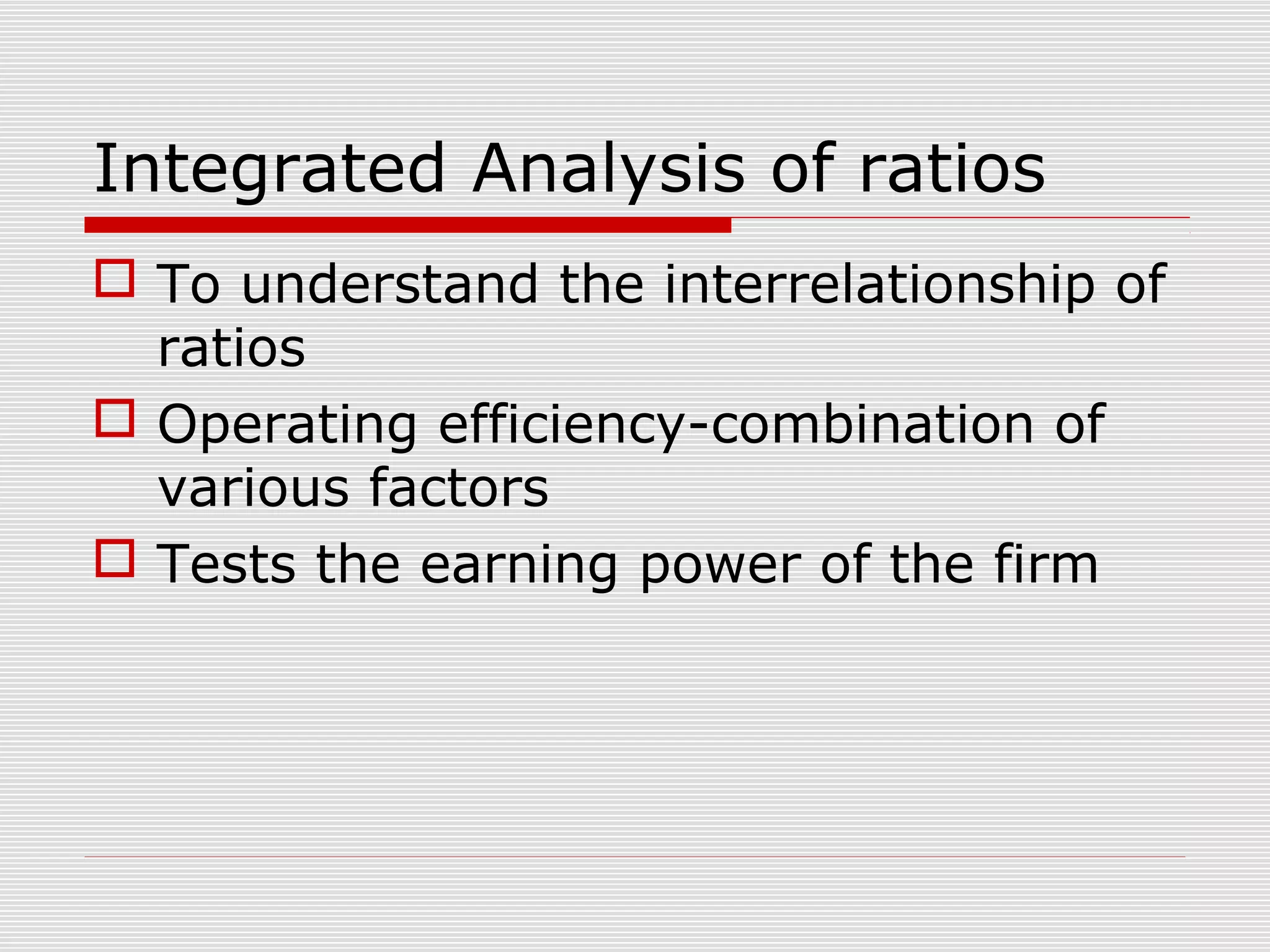
Integrated Analysis of ratios
 To understand the interrelationship of
ratios
 Operating efficiency-combination of
various factors
 Tests the earning power of the firm
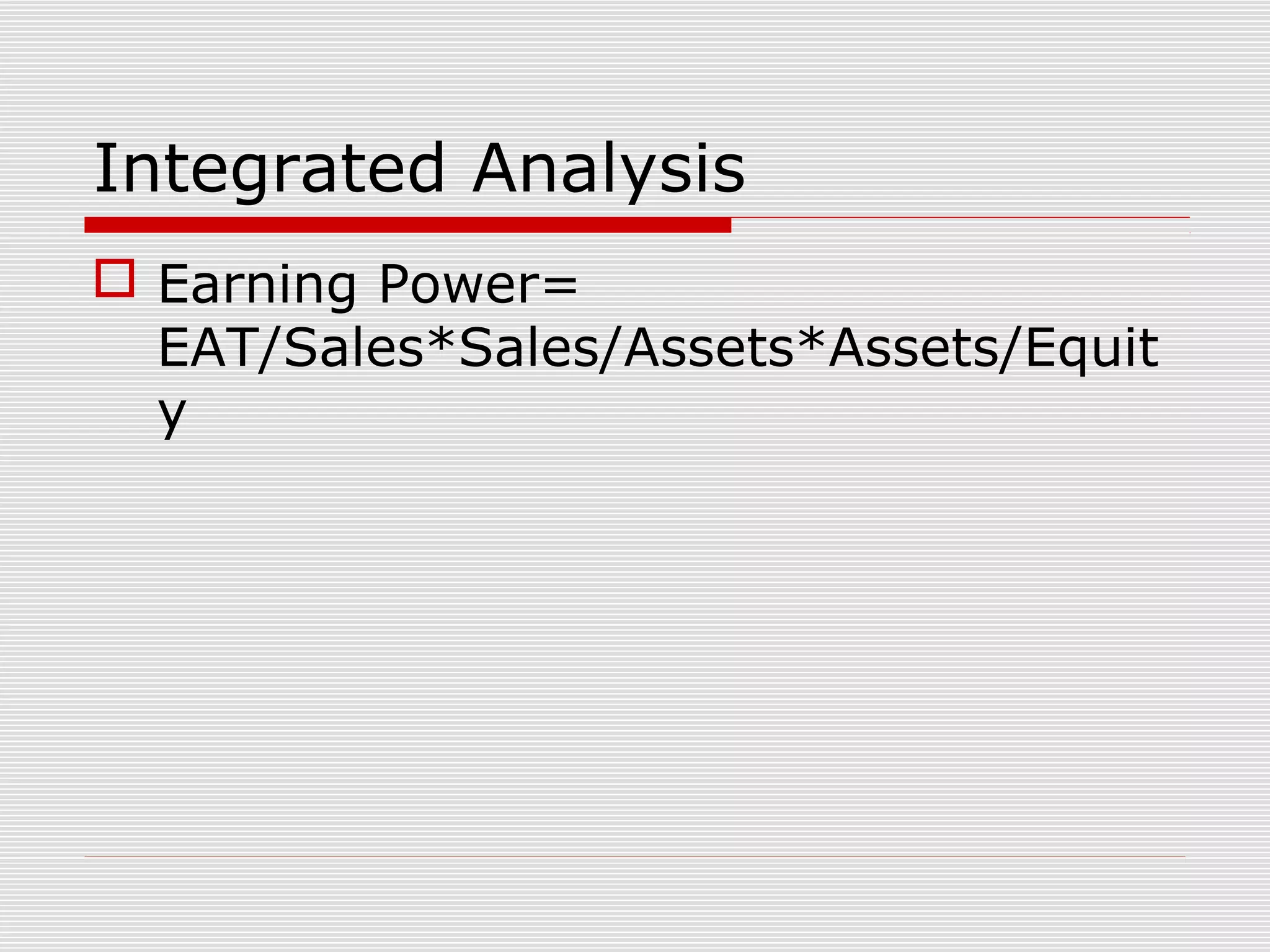
Integrated Analysis
 Earning Power=
EAT/Sales*Sales/Assets*Assets/Equit
y
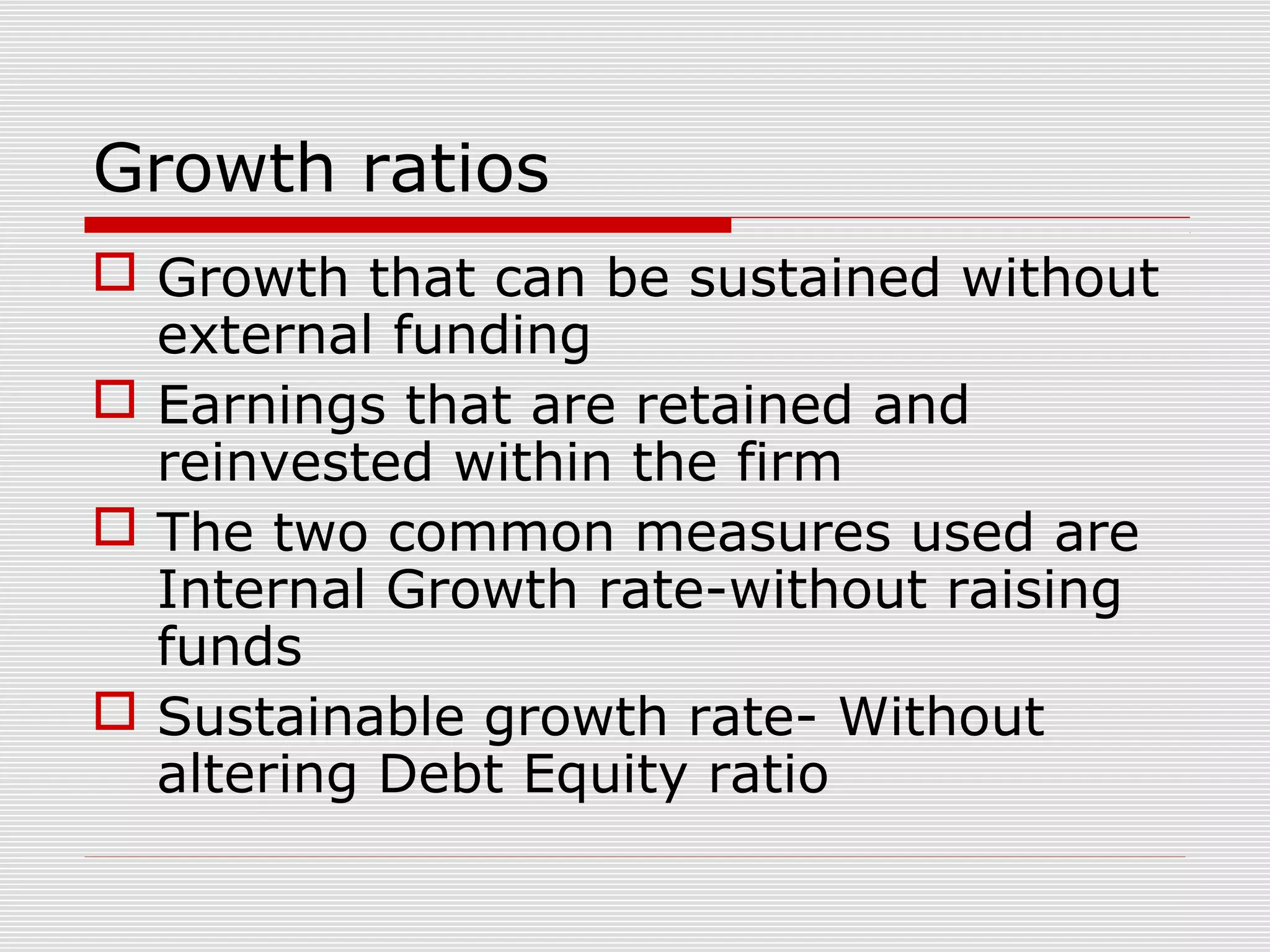
Growth ratios
 Growth that can be sustained without
external funding
 Earnings that are retained and
reinvested within the firm
 The two common measures used are
Internal Growth rate-without raising
funds
 Sustainable growth rate- Without
altering Debt Equity ratio
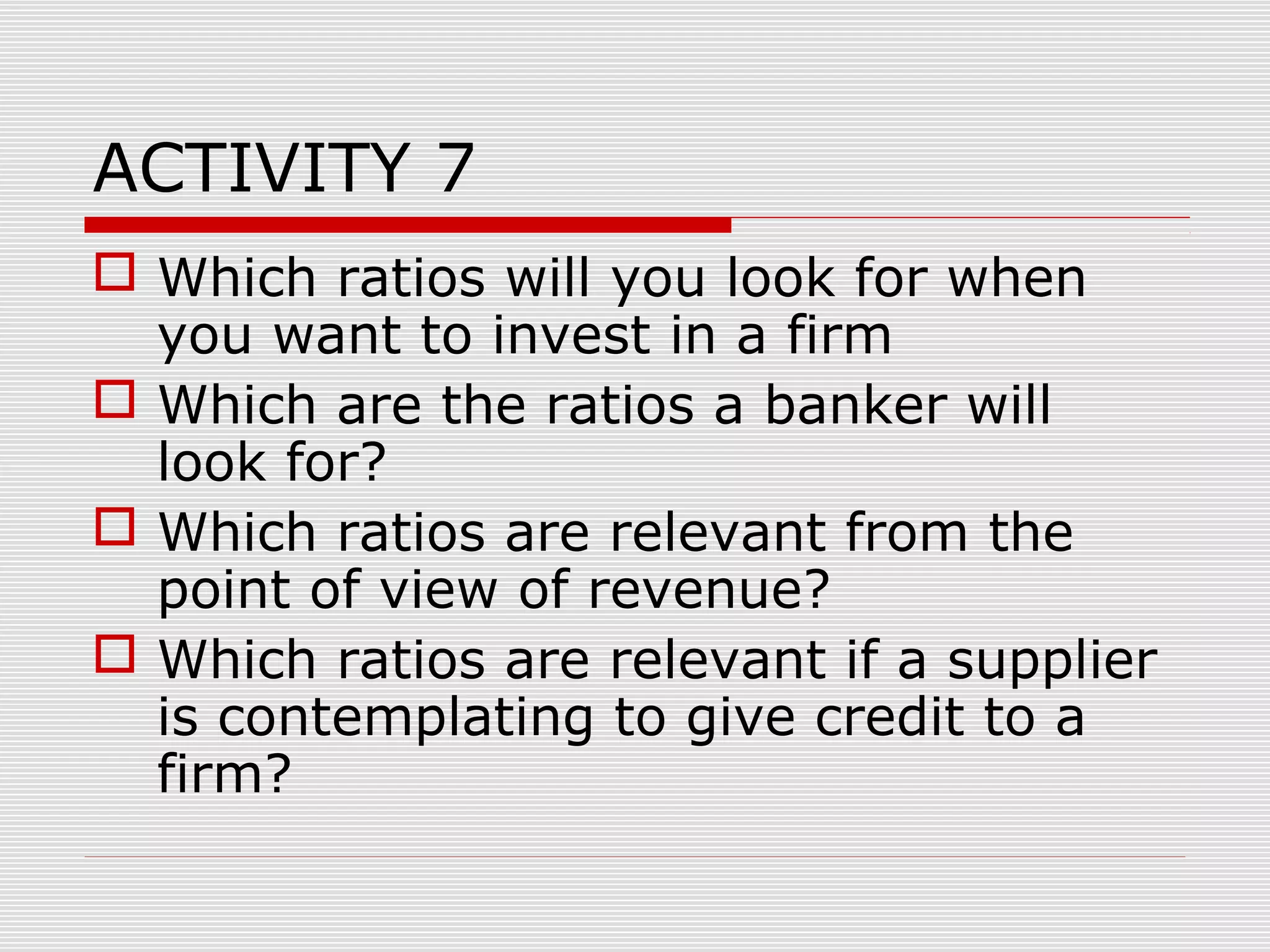
ACTIVITY 7
 Which ratios will you look for when
you want to invest in a firm
 Which are the ratios a banker will
look for?
 Which ratios are relevant from the
point of view of revenue?
 Which ratios are relevant if a supplier
is contemplating to give credit to a
firm?
What you must remember while
calculating ratios
 Nature of Industry-Service, Seasonal,
Heavy Engineering, Infrastructure..
 Age of the firm
 Industry benchmark
 Peculiarities in the business
 Risk Factors
Importance of ratio Anlaysis
 Liquidity
 Solvency
 Operating efficiency
 Overall Profitability
 Interfirm Comparison
 Trend Analysis
Limitations of ratio Analysis
 Individual accounting variations
 Impact of inflation
 Conceptual diversity
 Only quantifiable inputs can be
evaluated

Financial statement analysis[1]

  • 1.
  • 2.
    Rationale of FinancialStatement Analysis  Financial statement – summary of figures as of any given date  To identify relevant information  Draw meaningful interpretations
  • 3.
    Process of Analysis Identification of significant information  Highlight significant relationships  Interpretation
  • 4.
    Tools of FinancialAnalysis  Fund flow Statement  Cash Flow Statement  Ratio Analysis  Common size statements
  • 5.
    Balance Sheet Overview- ASSETS Assets GrossBlock 3978.55 Net Block 2790.57 Capital WIP 66.72 Investments 454.33 Inventory 610.81 Receivables 1546.81 Other Current Assets 3673.67 Balance Sheet Total 9142.92
  • 6.
    Balance Sheet Overview- Liabilities Liabilities EquityShare Capital 434.12 Reserves 5815.65 Total Debt 2096.69 Creditors and Acceptances 393.91 Other current liab/prov. 402.55 Balance Sheet Total 9142.92
  • 7.
    Ratio Analysis  Mostwidely used and significant tool  Provides a basis for comparison  Useful when benchmark ratios are known  Relationships between variables in the financial statement
  • 8.
    Types of ratios Liquidity ratios  Capital Structure ratios  Profitability Ratios  Activity/Efficiency ratios  Integrated Analysis of ratios  Growth ratios
  • 9.
    Overview of BalanceSheet LIABILITIES  Equity Capital/Owners’ Funds  Long Term Borrowings  Current Liabilities ASSETS  Fixed Assets  Current Assets
  • 10.
    Liquidity Ratios  Measurethe ability of firm to meet short term obligations  Reflect short term financial strength  Why short term??- of interest to creditors..  Ratios- Current ratio, Liquid ratio, Turnover ratios, cash flow from operation ratio
  • 11.
    Liquidity ratios  CurrentRatio= Current Assets/ Current Liabilities  Liquid ratio= Liquid Assets/Current Liabilities
  • 12.
    NEED FOR LIQUIDITY Assume stocks are bought on credit  Converted to inventory  Sales=0  Current Ratio??  Liquid Ratio??  Implications on liquidity-serious
  • 13.
    ACTIVITY 1  CalculateCurrent Ratio, Liquid ratio, Debtors Turnover and Creditors turnover from the following information Average Debtors=1,00,000 Average Creditors=75,000 Cash= 5,000 Inventory=75,000 Credit Purchases=6,00,000 Credit Sales=12,00,000
  • 14.
    Capital Structure ratios Helps to measure long term financial strength  Solvency of the firm  Ability to service interest on loans  Ability to service the principal
  • 15.
    Capital Structure Ratios Debt Equity ratio= Long Term Debt/Shareholders Equity  Debt to total Capital= Total Debt/Total Assets  Interest Coverage Ratio= Earnings Before Interest and Tax/Interest
  • 16.
    ACTIVITY 2  Whathappens when a firm is purely funded by equity?  What happens when a firm is purely funded by debt?  Which is riskier when profits are less?  When equity is high and profits are high, what happens to ROI?
  • 17.
    Profitability ratios  Relatedto Sales  Ability of the firm to mark up on sales  Ability of firm to convert margins to profit  Proportion of expense to income  Analysis of income and expenses
  • 18.
    Profitability ratios  GrossProfit Margin= Gross profit/Sales*100  Operating Profit ratio= Earnings Before Interest and taxes/Net Sales  Net Profit Ratio= Earnings after interest and taxes/Net Sales  Expenses ratio- Cost of Goods sold, Operating Ratio, Financial Expenses
  • 19.
    Ratios on Investments Related to investment  Ability to generate return on investment  Ultimate measure of profitability  Ability of firm to generate wealth
  • 20.
    Profitability on Investment Return on Assets= Profit after Taxes/Average total assets*100  Return on Capital Employed= EBIT/Average Total Capital Employed*100  Return on Shareholders Equity= Net profit after taxes/Average shareholders’ equity*100
  • 21.
    ACTIVITY 3  EarningsBefore Interest and Tax= Rs.5,00,000  Interest payment =Rs.75,000  Tax rate = 50%  Calculate Earnings after Interest and tax
  • 22.
    Profitability on investment Earnings per share=Net Profit available to Equity Shareholders/Number of ordinary shares outstanding  Price earning ratio= Market price of share/EPS
  • 23.
    ACTIVITY 4 Calculate GrossProfit Margin and Net profit Margin  Sales 2,00,000  Cost of Goods Sold 1,00,000  Other operating expenses 50,000
  • 24.
    ACTIVITY 5 Calculate Returnon Assets  Current Assets 4,00,000  Fixed Assets 6,00,000  Net Profit before taxes 2,50,000  Tax rate 50%
  • 25.
    Activity Ratios  Concernedwith measuring the efficiency  Also the asset utilisation  Rate at which assets are converted into sales  Test of relationship of sales to various assets of the firm
  • 26.
    Activity Ratios  Turnoverratios  Inventory turnover=Cost of Goods Sold/Average Inventory  Debtors turnover=Net Credit Sales/Average Debtors  Creditors turnover=Net Credit Purchases/Average creditors  Assets Turnover=Cost of Goods sold/Average total assets
  • 27.
    Activity ratios  Turnoverrefers to the number of times the asset turned over  Does faster turnover mean efficiency?  What does a slow turnover of inventory mean?  Should inventory turnover be homogenous across industries?
  • 28.
    ACTIVITY 6  Inwhich industries inventory turnover is irrelevant?  Which industries have seasonal turnover of inventory?  Which are the industries where turnover is not rapid?  When will the Debtor Turnover be irrelevant?
  • 29.
    Integrated Analysis ofratios  To understand the interrelationship of ratios  Operating efficiency-combination of various factors  Tests the earning power of the firm
  • 30.
    Integrated Analysis  EarningPower= EAT/Sales*Sales/Assets*Assets/Equit y
  • 31.
    Growth ratios  Growththat can be sustained without external funding  Earnings that are retained and reinvested within the firm  The two common measures used are Internal Growth rate-without raising funds  Sustainable growth rate- Without altering Debt Equity ratio
  • 32.
    ACTIVITY 7  Whichratios will you look for when you want to invest in a firm  Which are the ratios a banker will look for?  Which ratios are relevant from the point of view of revenue?  Which ratios are relevant if a supplier is contemplating to give credit to a firm?
  • 33.
    What you mustremember while calculating ratios  Nature of Industry-Service, Seasonal, Heavy Engineering, Infrastructure..  Age of the firm  Industry benchmark  Peculiarities in the business  Risk Factors
  • 34.
    Importance of ratioAnlaysis  Liquidity  Solvency  Operating efficiency  Overall Profitability  Interfirm Comparison  Trend Analysis
  • 35.
    Limitations of ratioAnalysis  Individual accounting variations  Impact of inflation  Conceptual diversity  Only quantifiable inputs can be evaluated