Charotar University Of Science And Technology
Indukaka Ipcowala Institute Of Management (I2IM)
Faculty Of Management Studies (FMS)
Course Name :- Business Legend
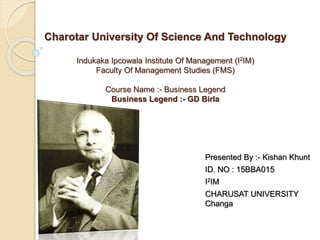
Business Legend :- GD Birla
Presented By :- Kishan Khunt
ID. NO : 15BBA015
I2IM
CHARUSAT UNIVERSITY
Changa
 Resume
 Journey
 SWOT analysis
 About company
 Challenges
 Learning
Name Ghanshyam Das Birla
Born April 10, 1894, Pilani
Died June 11, 1983, London, United Kingdom
Organizations
founded:
Aditya Birla Group, more
Net worth 7.9 billion USD 2015
Spouse Durga Devi
Children Krishna Kumar and Basant Kumar
Books In the shadow of the Mahatma, more
Grandchildren Aditya Vikram Birla, Jayshree Mohta, Manjushree
Khaitan
Resume
 Birla Family The Industrialist Public Career GD & Mahatma…
Achievements/ Contributions Awards / Honors Memorial NEW
ERA In Kerala Beyond business Ghanshyamdas Birla was a
complex public figure, businessman, merchant, philanthropist,
political figure, and builder of magnificent temples.
 He was deeply involved in the affairs of the Indian National
Congress and was its most important benefactor.
 He challenged the colonial domination of the Indian economy and
was an industrial pioneer whose initiatives helped create a climate in
which Indian enterprise could flourish.
Strengths
1. Strong brand name
2.Stablemanagement and strong workforce
3.Great customer base across India
Weaknesses
1.Limited marketing strategy compared to global
leaders
2. Dependent on the Indian market only and govt.
intervention causes operational issues
Opportunities
1. Looking for overseas markets
2. Developing strong R & D department
3. Using its strong CSR branding to promote its
products
Threats
1. Small companies serving niche markets
2. Intense competition
3. Unfavorable govt. policies and economic
conditions
SWOT
 Birla Corporation Limited, is an Indian-based flagship company of the M
P Birla group of companies, founded by Shri Ghanshyam Das Birla in the
late 1910s and carried on by Madhav Prasad Birla.
 In the 1890s, Birla Corporation was a jute manufacturing company, but
over time, it grew to operate four main divisions: cement, jute, linoleums,
and auto trim. It is not a part of the Aditya Birla Group, a multinational
conglomerate with products ranging from metals, cements, textiles,
agricultural businesses, telecommunications, IT, and financial services.
Formerly known as Birla Jute Manufacturing Company Limited, with the
expansion of divisions, the company changed their name in 1998 to Birla
Corporation Limited.
 Ghanashyam had to brave several challenges from the British
and worked hard to build up a new industrial empire in India.
 In the light of the dramatic transformation of the economic and
business environment, Aditya Vikram Birla examines its
impact on Indian industry and suggests ways in which
companies can meet the challenge of change.
 Always keep Learning.
 Look for opportunities.
 Take chances in your youth.
 Don’t be afraid to try n numbers of time.
 Customers are first; employees, second; shareholders, third.
 Forget about the money.
G d birla

G d birla

  • 1.
    Charotar University OfScience And Technology Indukaka Ipcowala Institute Of Management (I2IM) Faculty Of Management Studies (FMS) Course Name :- Business Legend Business Legend :- GD Birla Presented By :- Kishan Khunt ID. NO : 15BBA015 I2IM CHARUSAT UNIVERSITY Changa
  • 2.
     Resume  Journey SWOT analysis  About company  Challenges  Learning
  • 3.
    Name Ghanshyam DasBirla Born April 10, 1894, Pilani Died June 11, 1983, London, United Kingdom Organizations founded: Aditya Birla Group, more Net worth 7.9 billion USD 2015 Spouse Durga Devi Children Krishna Kumar and Basant Kumar Books In the shadow of the Mahatma, more Grandchildren Aditya Vikram Birla, Jayshree Mohta, Manjushree Khaitan Resume
  • 4.
     Birla FamilyThe Industrialist Public Career GD & Mahatma… Achievements/ Contributions Awards / Honors Memorial NEW ERA In Kerala Beyond business Ghanshyamdas Birla was a complex public figure, businessman, merchant, philanthropist, political figure, and builder of magnificent temples.  He was deeply involved in the affairs of the Indian National Congress and was its most important benefactor.  He challenged the colonial domination of the Indian economy and was an industrial pioneer whose initiatives helped create a climate in which Indian enterprise could flourish.
  • 5.
    Strengths 1. Strong brandname 2.Stablemanagement and strong workforce 3.Great customer base across India Weaknesses 1.Limited marketing strategy compared to global leaders 2. Dependent on the Indian market only and govt. intervention causes operational issues Opportunities 1. Looking for overseas markets 2. Developing strong R & D department 3. Using its strong CSR branding to promote its products Threats 1. Small companies serving niche markets 2. Intense competition 3. Unfavorable govt. policies and economic conditions SWOT
  • 6.
     Birla CorporationLimited, is an Indian-based flagship company of the M P Birla group of companies, founded by Shri Ghanshyam Das Birla in the late 1910s and carried on by Madhav Prasad Birla.  In the 1890s, Birla Corporation was a jute manufacturing company, but over time, it grew to operate four main divisions: cement, jute, linoleums, and auto trim. It is not a part of the Aditya Birla Group, a multinational conglomerate with products ranging from metals, cements, textiles, agricultural businesses, telecommunications, IT, and financial services. Formerly known as Birla Jute Manufacturing Company Limited, with the expansion of divisions, the company changed their name in 1998 to Birla Corporation Limited.
  • 7.
     Ghanashyam hadto brave several challenges from the British and worked hard to build up a new industrial empire in India.  In the light of the dramatic transformation of the economic and business environment, Aditya Vikram Birla examines its impact on Indian industry and suggests ways in which companies can meet the challenge of change.
  • 8.
     Always keepLearning.  Look for opportunities.  Take chances in your youth.  Don’t be afraid to try n numbers of time.  Customers are first; employees, second; shareholders, third.  Forget about the money.