The Agile Adoption
Roadmap
Presented by Tim Abbott
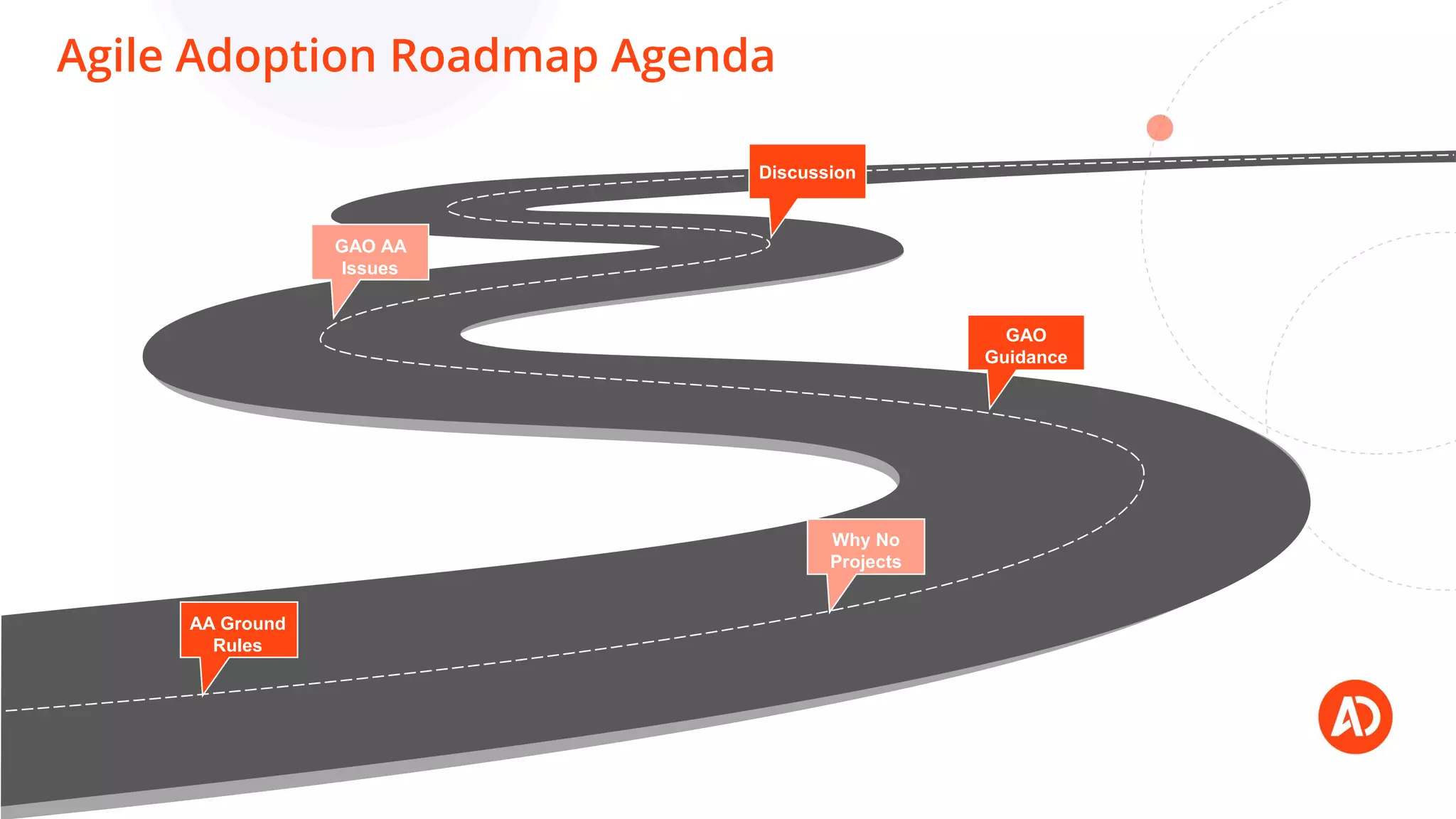
Agile Adoption Roadmap Agenda
AA Ground
Rules
GAO
Guidance
Why No
Projects
GAO AA
Issues
Discussion
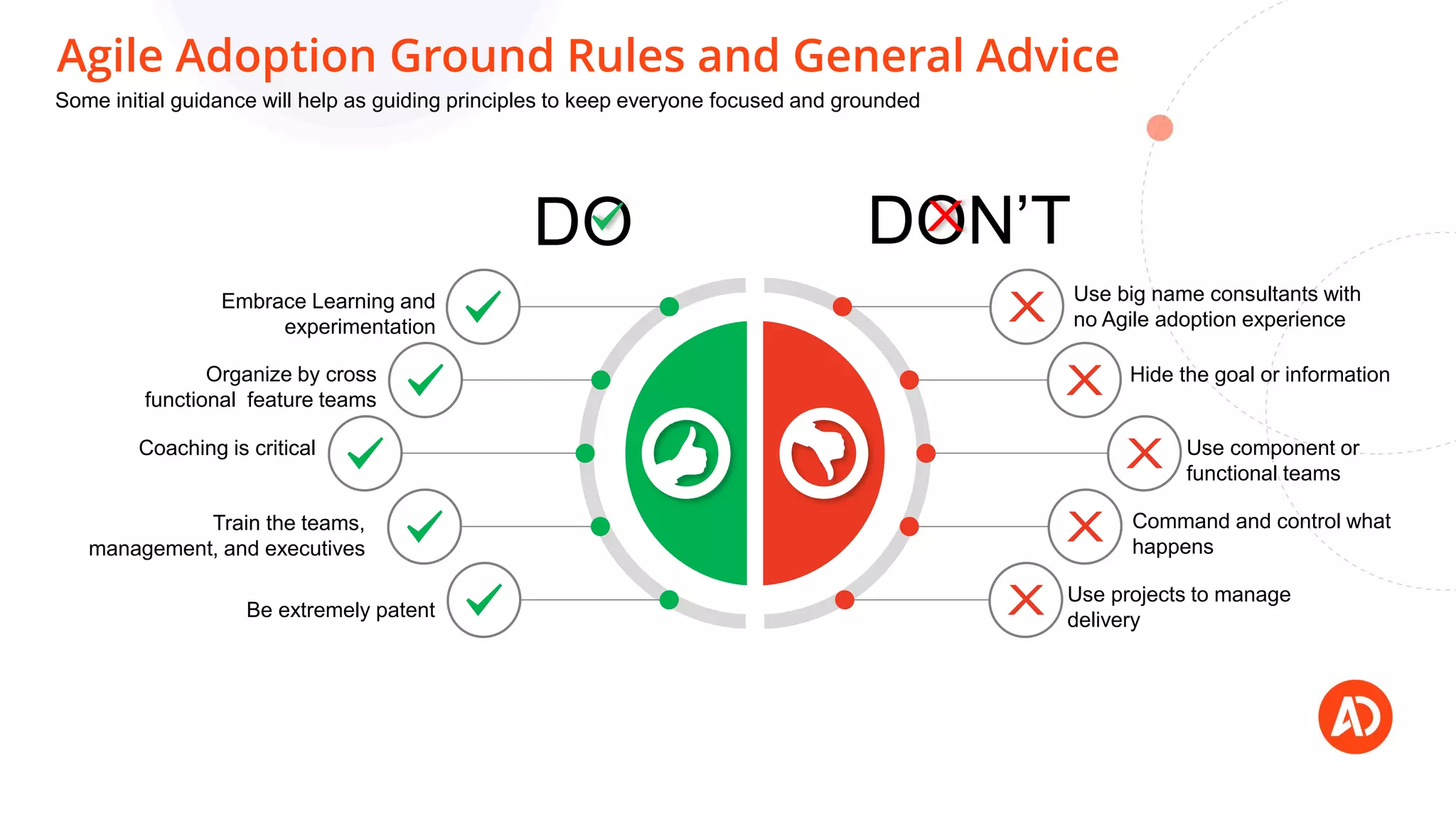
Agile Adoption Ground Rules and General Advice
Some initial guidance will help as guiding principles to keep everyone focused and grounded
DON’TDO
Use big name consultants with
no Agile adoption experience
Hide the goal or information
Use component or
functional teams
Command and control what
happens
Use projects to manage
delivery
Embrace Learning and
experimentation
Coaching is critical
Organize by cross
functional feature teams
Be extremely patent
Train the teams,
management, and executives
j
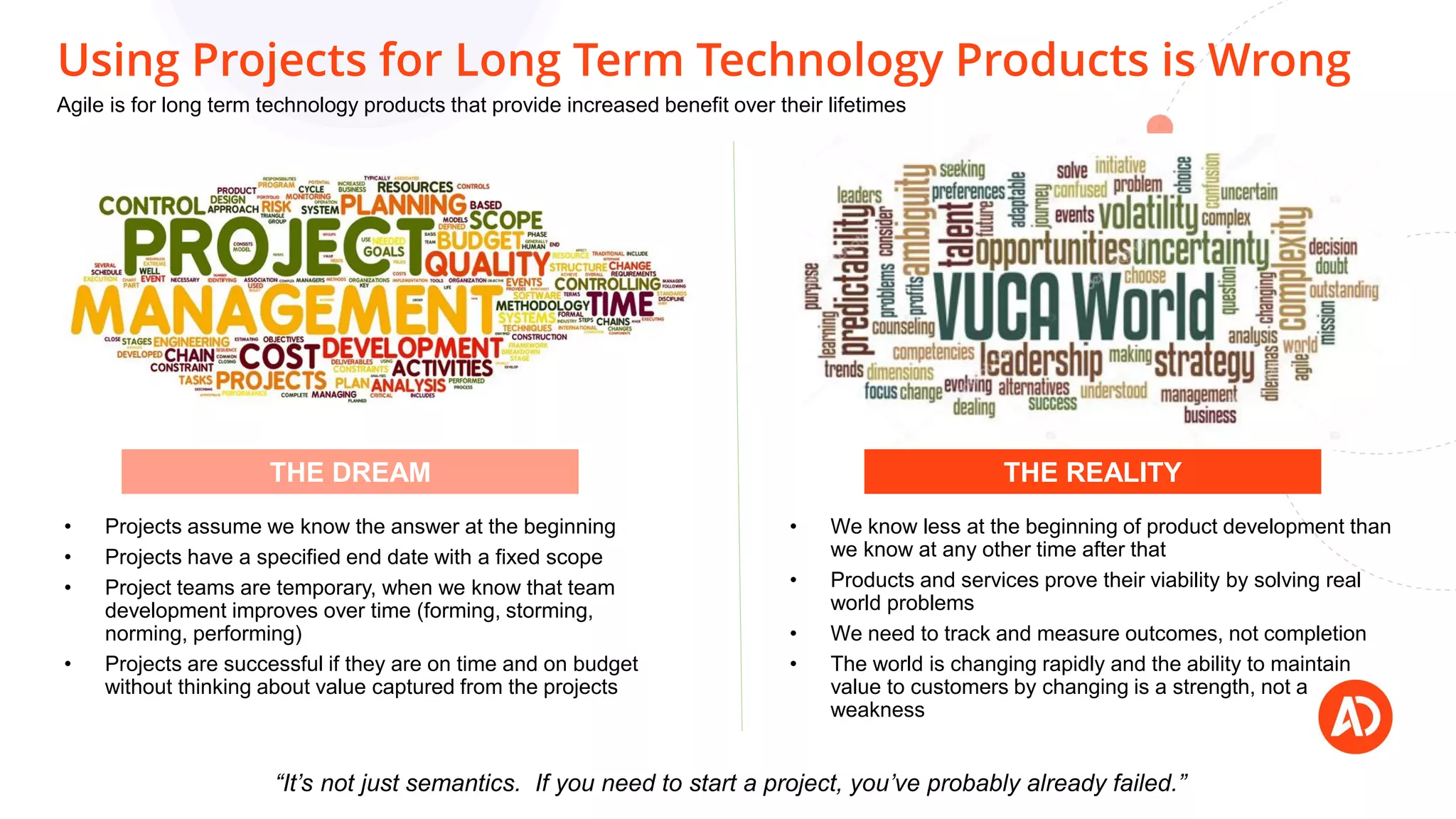
Using Projects for Long Term Technology Products is Wrong
• Projects assume we know the answer at the beginning
• Projects have a specified end date with a fixed scope
• Project teams are temporary, when we know that team
development improves over time (forming, storming,
norming, performing)
• Projects are successful if they are on time and on budget
without thinking about value captured from the projects
• We know less at the beginning of product development than
we know at any other time after that
• Products and services prove their viability by solving real
world problems
• We need to track and measure outcomes, not completion
• The world is changing rapidly and the ability to maintain
value to customers by changing is a strength, not a
weakness
THE DREAM THE REALITY
“It’s not just semantics. If you need to start a project, you’ve probably already failed.”
Agile is for long term technology products that provide increased benefit over their lifetimes
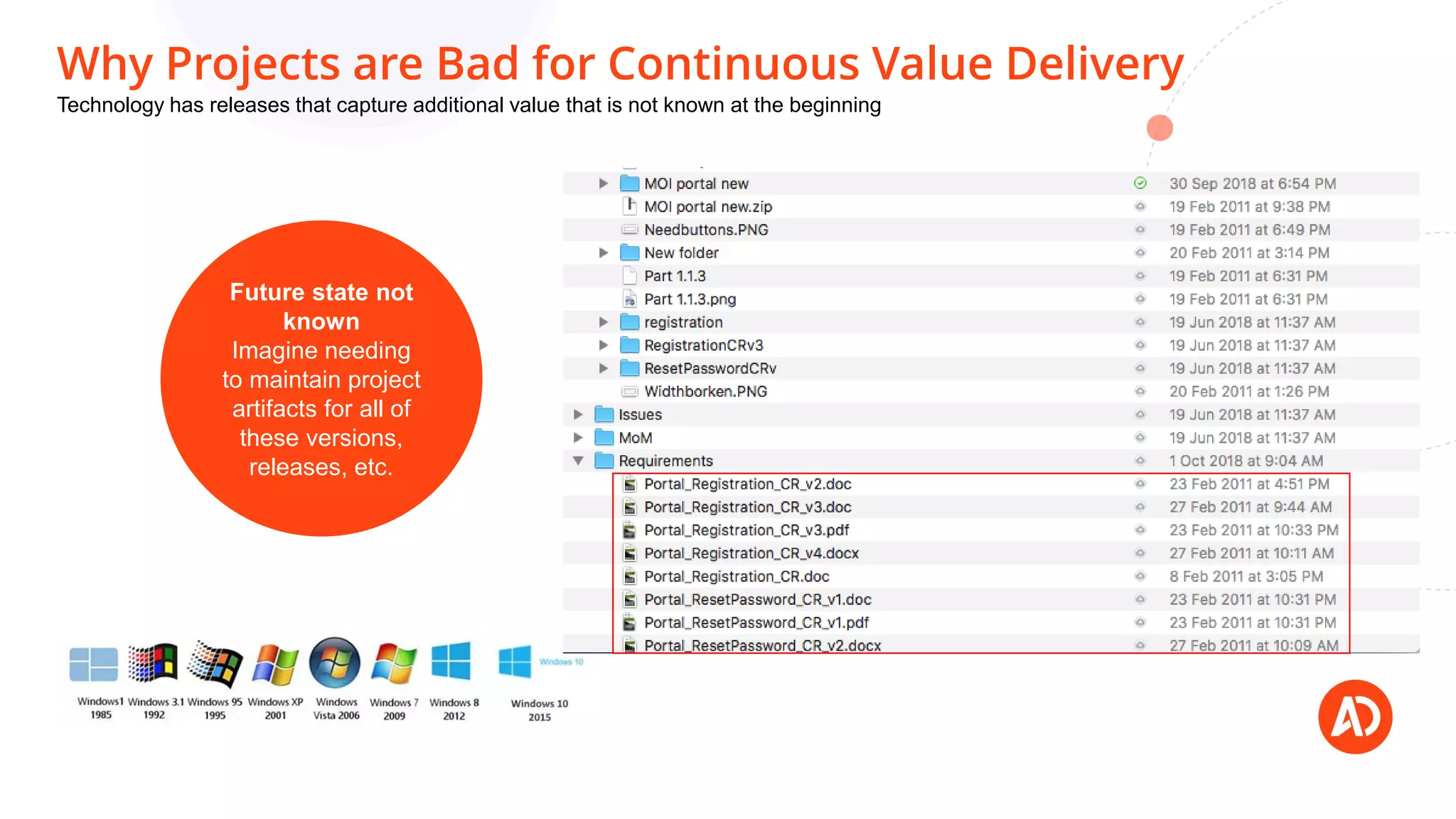
Why Projects are Bad for Continuous Value Delivery
Future state not
known
Imagine needing
to maintain project
artifacts for all of
these versions,
releases, etc.
Technology has releases that capture additional value that is not known at the beginning
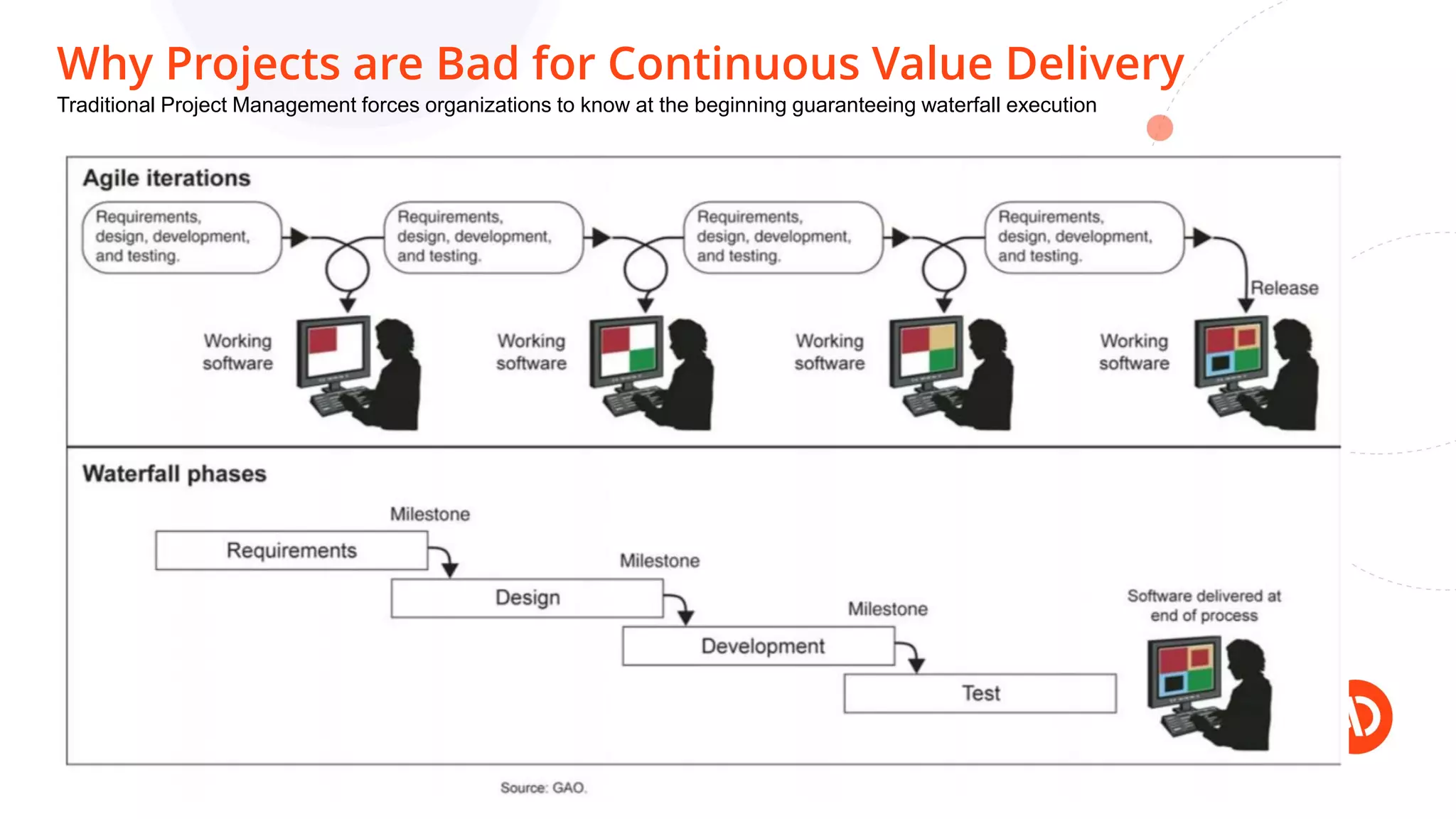
Why Projects are Bad for Continuous Value Delivery
Traditional Project Management forces organizations to know at the beginning guaranteeing waterfall execution
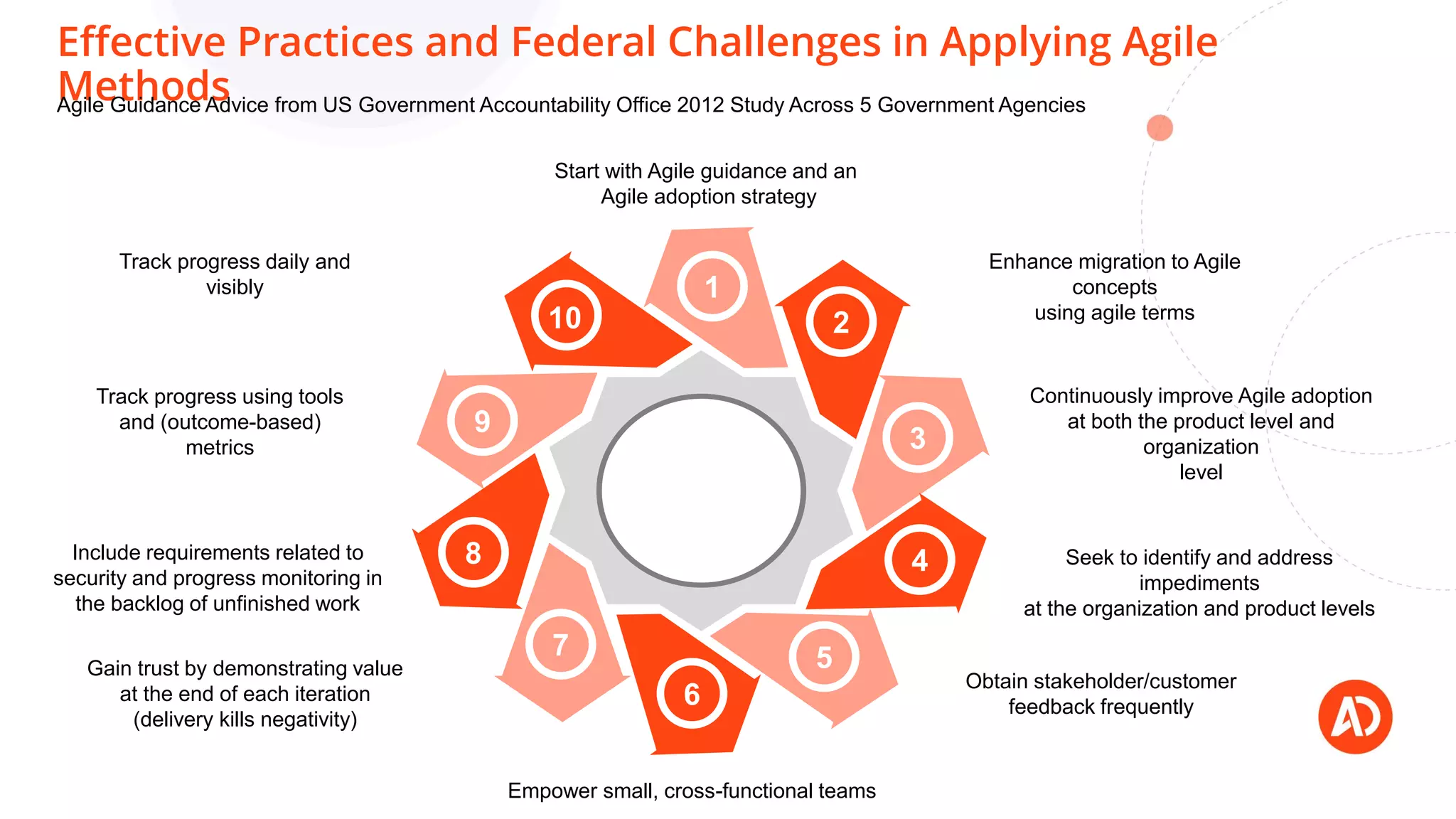
Effective Practices and Federal Challenges in Applying Agile
MethodsAgile Guidance Advice from US Government Accountability Office 2012 Study Across 5 Government Agencies
1
2
3
4
5
6
7
8
9
10
Start with Agile guidance and an
Agile adoption strategy
Enhance migration to Agile
concepts
using agile terms
Continuously improve Agile adoption
at both the product level and
organization
level
Seek to identify and address
impediments
at the organization and product levels
Obtain stakeholder/customer
feedback frequently
Empower small, cross-functional teams
Include requirements related to
security and progress monitoring in
the backlog of unfinished work
Gain trust by demonstrating value
at the end of each iteration
(delivery kills negativity)
Track progress daily and
visibly
Track progress using tools
and (outcome-based)
metrics
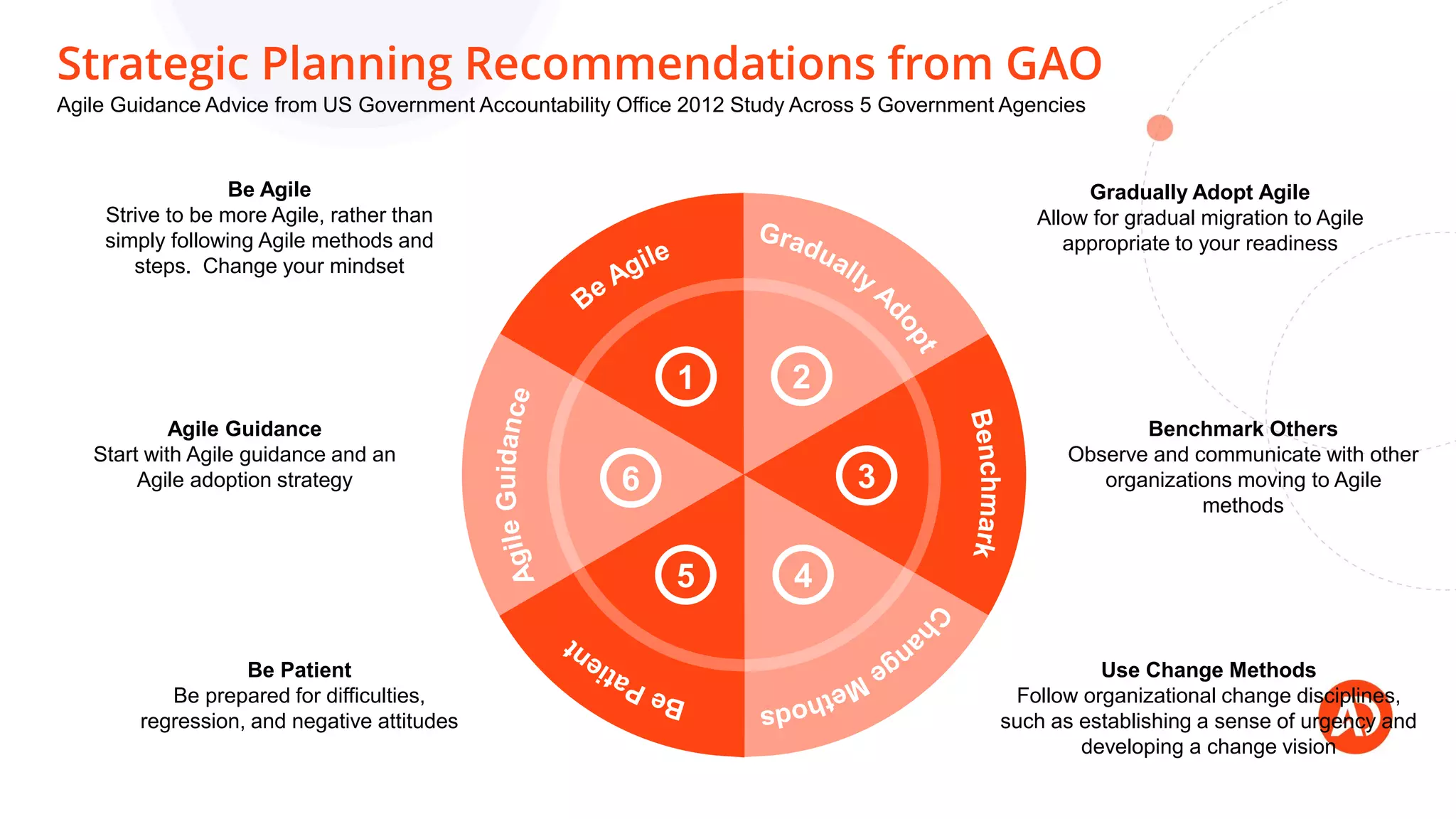
Strategic Planning Recommendations from GAO
Agile Guidance Advice from US Government Accountability Office 2012 Study Across 5 Government Agencies
Gradually Adopt Agile
Allow for gradual migration to Agile
appropriate to your readiness
Benchmark Others
Observe and communicate with other
organizations moving to Agile
methods
Use Change Methods
Follow organizational change disciplines,
such as establishing a sense of urgency and
developing a change vision
Be Agile
Strive to be more Agile, rather than
simply following Agile methods and
steps. Change your mindset
Agile Guidance
Start with Agile guidance and an
Agile adoption strategy
Be Patient
Be prepared for difficulties,
regression, and negative attitudes
1 2
3
45
6
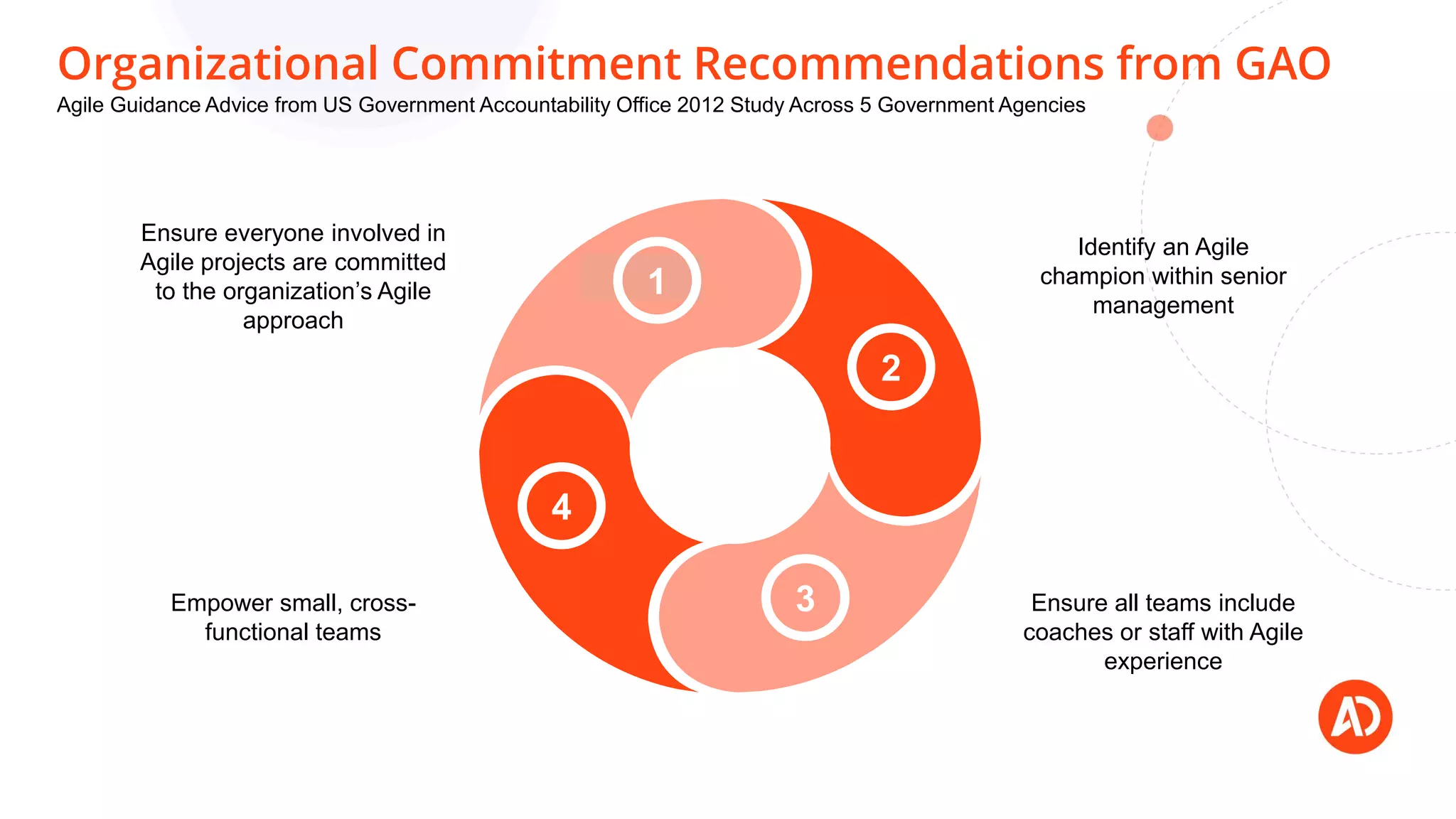
Organizational Commitment Recommendations from GAO
Agile Guidance Advice from US Government Accountability Office 2012 Study Across 5 Government Agencies
Ensure all teams include
coaches or staff with Agile
experience
Identify an Agile
champion within senior
management
Empower small, cross-
functional teams
Ensure everyone involved in
Agile projects are committed
to the organization’s Agile
approach
2
3
4
1
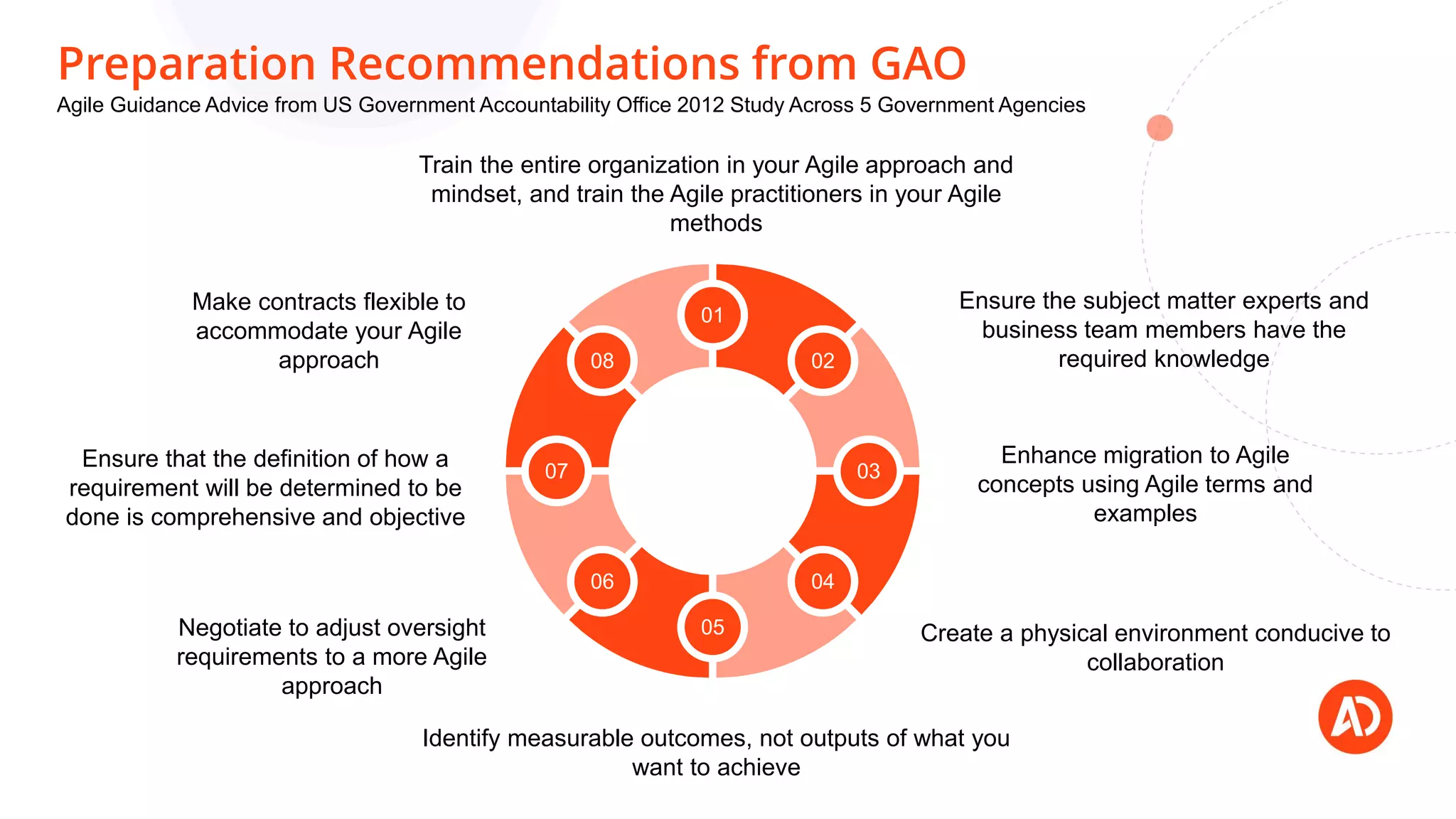
Preparation Recommendations from GAO
Agile Guidance Advice from US Government Accountability Office 2012 Study Across 5 Government Agencies
01
02
03
04
05
06
07
08
Make contracts flexible to
accommodate your Agile
approach
Ensure that the definition of how a
requirement will be determined to be
done is comprehensive and objective
Negotiate to adjust oversight
requirements to a more Agile
approach
Identify measurable outcomes, not outputs of what you
want to achieve
Train the entire organization in your Agile approach and
mindset, and train the Agile practitioners in your Agile
methods
Ensure the subject matter experts and
business team members have the
required knowledge
Enhance migration to Agile
concepts using Agile terms and
examples
Create a physical environment conducive to
collaboration
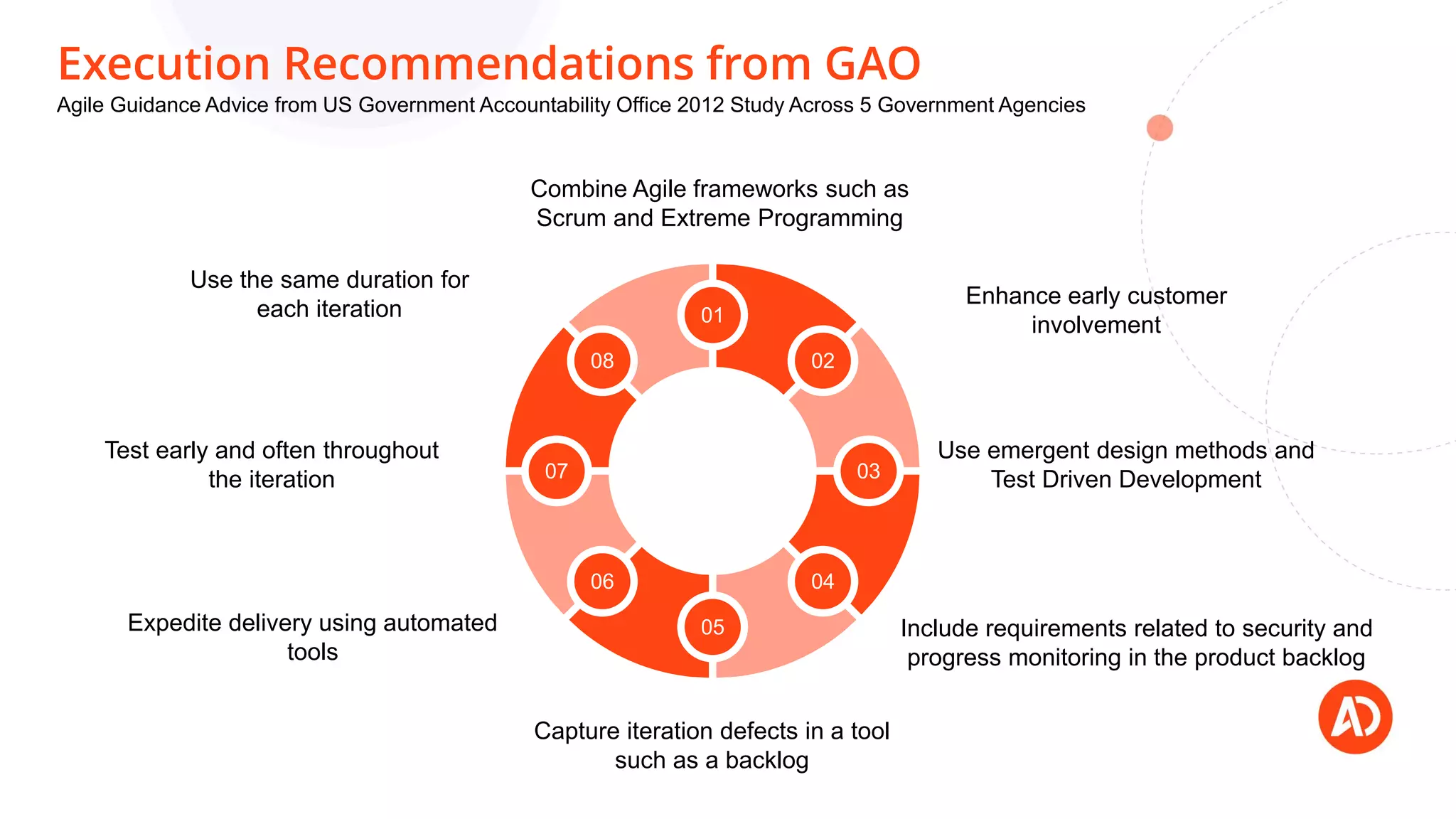
Execution Recommendations from GAO
Agile Guidance Advice from US Government Accountability Office 2012 Study Across 5 Government Agencies
Use the same duration for
each iteration
Test early and often throughout
the iteration
Expedite delivery using automated
tools
Capture iteration defects in a tool
such as a backlog
Combine Agile frameworks such as
Scrum and Extreme Programming
Enhance early customer
involvement
Use emergent design methods and
Test Driven Development
Include requirements related to security and
progress monitoring in the product backlog
01
02
03
04
05
06
07
08
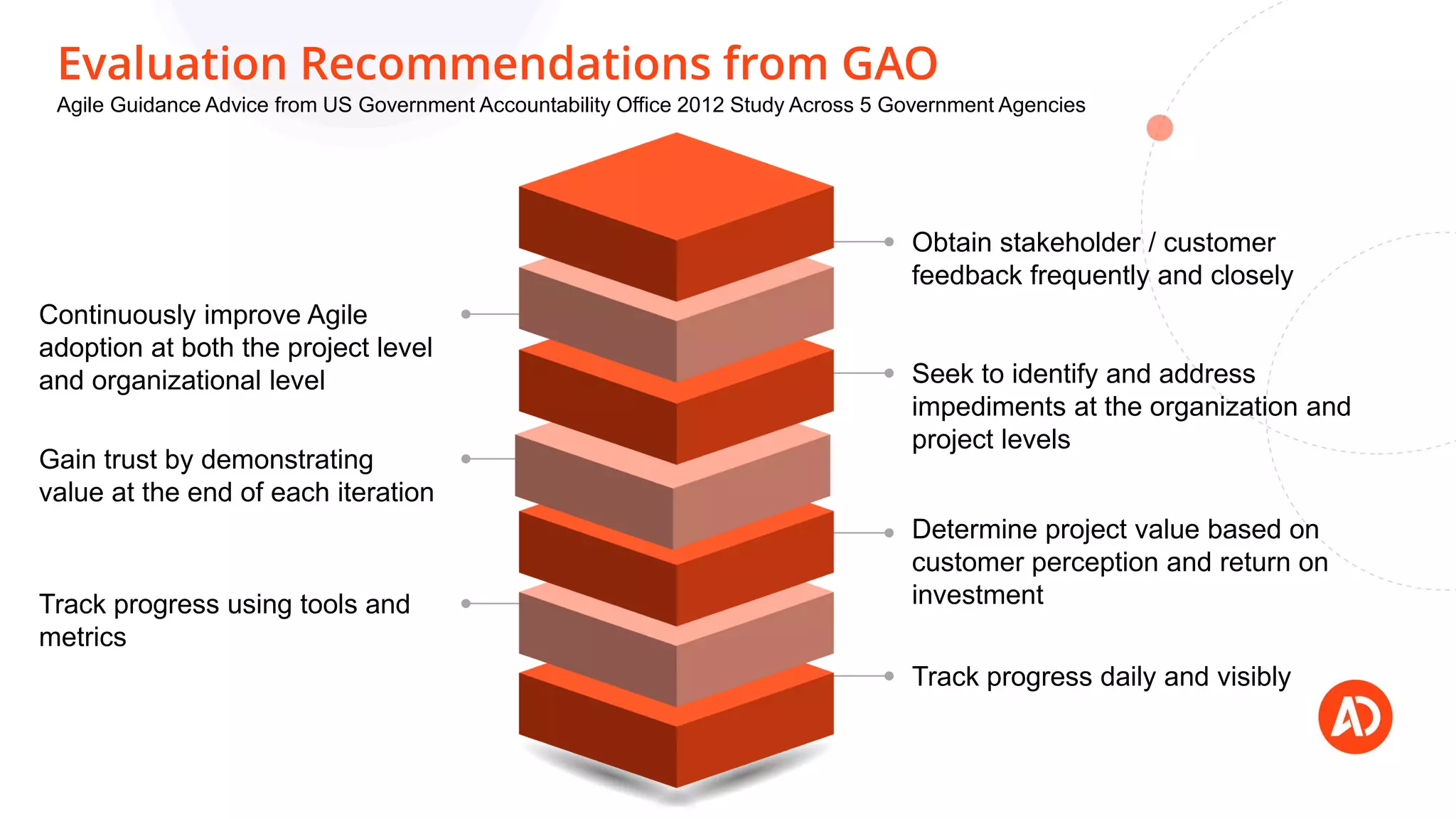
Continuously improve Agile
adoption at both the project level
and organizational level
Gain trust by demonstrating
value at the end of each iteration
Track progress using tools and
metrics
Obtain stakeholder / customer
feedback frequently and closely
Seek to identify and address
impediments at the organization and
project levels
Track progress daily and visibly
Determine project value based on
customer perception and return on
investment
Evaluation Recommendations from GAO
Agile Guidance Advice from US Government Accountability Office 2012 Study Across 5 Government Agencies
01
02
03
04
05
06
07
08
09
10
11
12
13
14
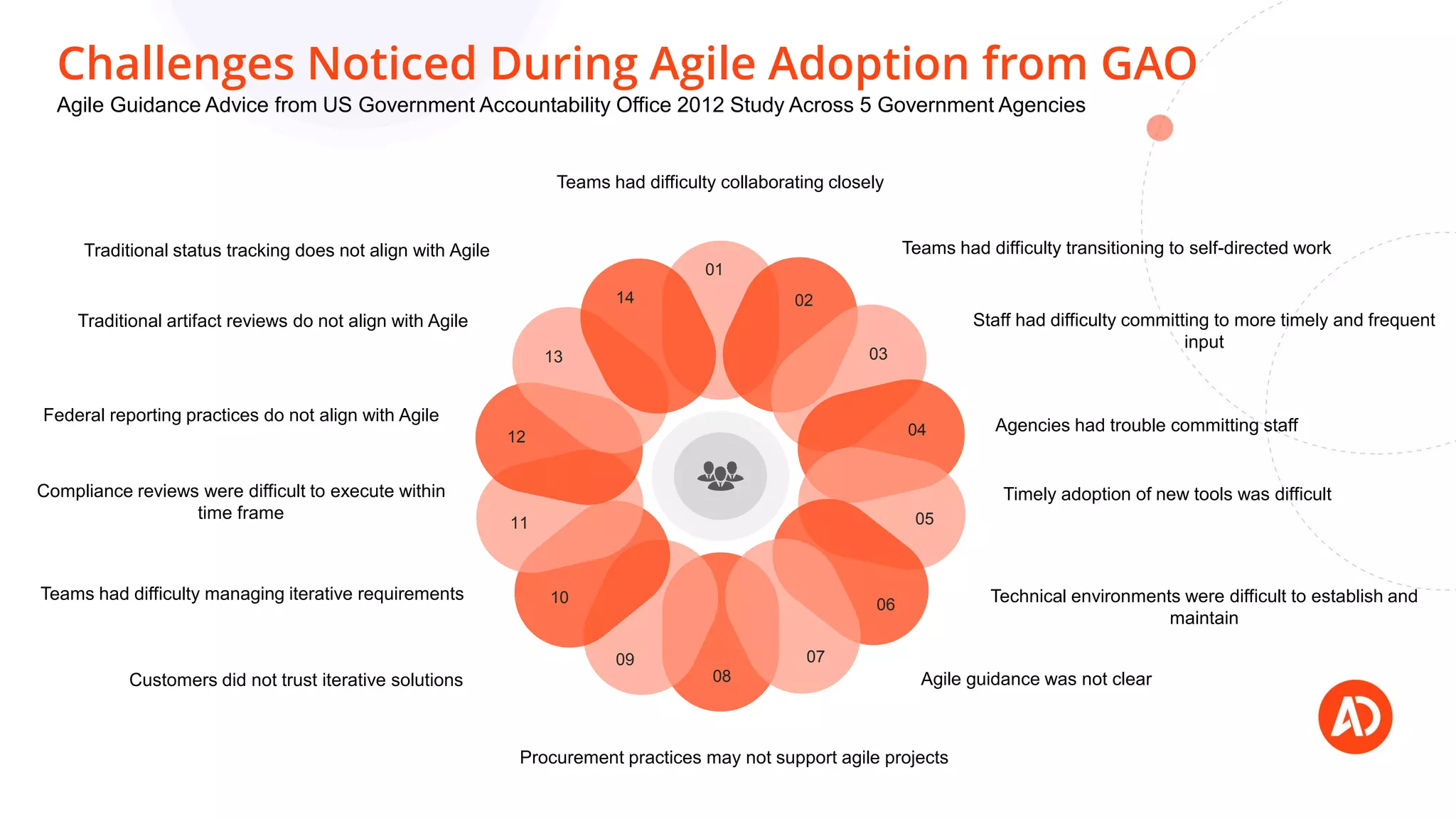
Teams had difficulty collaborating closely
Teams had difficulty transitioning to self-directed work
Staff had difficulty committing to more timely and frequent
input
Agencies had trouble committing staff
Timely adoption of new tools was difficult
Technical environments were difficult to establish and
maintain
Agile guidance was not clear
Procurement practices may not support agile projects
Customers did not trust iterative solutions
Teams had difficulty managing iterative requirements
Compliance reviews were difficult to execute within
time frame
Federal reporting practices do not align with Agile
Traditional artifact reviews do not align with Agile
Traditional status tracking does not align with Agile
Challenges Noticed During Agile Adoption from GAO
Agile Guidance Advice from US Government Accountability Office 2012 Study Across 5 Government Agencies
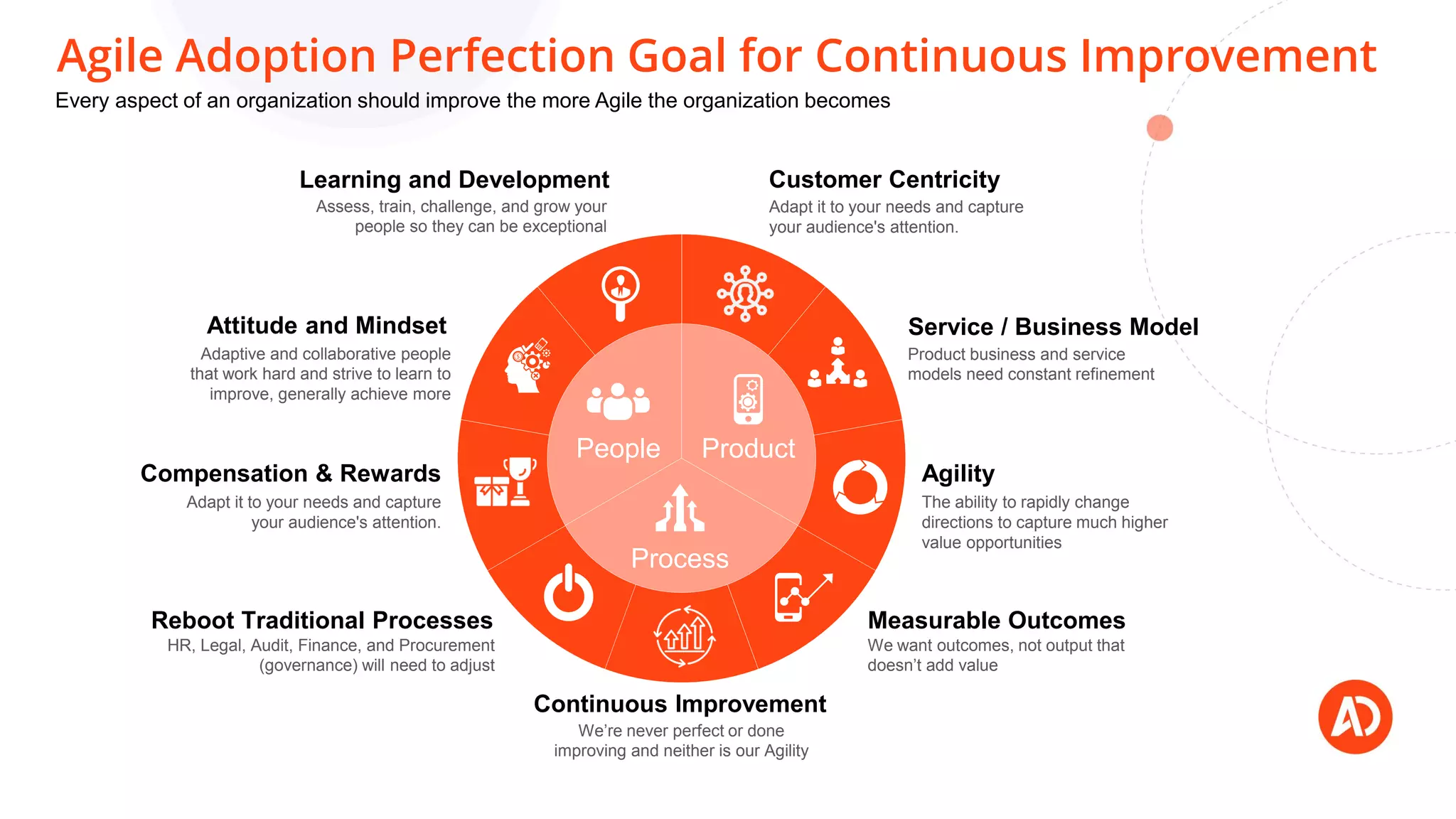
Product
Process
People
Customer Centricity
Adapt it to your needs and capture
your audience's attention.
Service / Business Model
Product business and service
models need constant refinement
Agility
The ability to rapidly change
directions to capture much higher
value opportunities
Measurable Outcomes
We want outcomes, not output that
doesn’t add value
Learning and Development
Assess, train, challenge, and grow your
people so they can be exceptional
Attitude and Mindset
Adaptive and collaborative people
that work hard and strive to learn to
improve, generally achieve more
Compensation & Rewards
Adapt it to your needs and capture
your audience's attention.
Reboot Traditional Processes
HR, Legal, Audit, Finance, and Procurement
(governance) will need to adjust
Continuous Improvement
We’re never perfect or done
improving and neither is our Agility
Agile Adoption Perfection Goal for Continuous Improvement
Every aspect of an organization should improve the more Agile the organization becomes

The Agile Adoption Roadmap (Keynote by Tim Abbott)

  • 1.
  • 2.
    Agile Adoption RoadmapAgenda AA Ground Rules GAO Guidance Why No Projects GAO AA Issues Discussion
  • 3.
    Agile Adoption GroundRules and General Advice Some initial guidance will help as guiding principles to keep everyone focused and grounded DON’TDO Use big name consultants with no Agile adoption experience Hide the goal or information Use component or functional teams Command and control what happens Use projects to manage delivery Embrace Learning and experimentation Coaching is critical Organize by cross functional feature teams Be extremely patent Train the teams, management, and executives j
  • 4.
    Using Projects forLong Term Technology Products is Wrong • Projects assume we know the answer at the beginning • Projects have a specified end date with a fixed scope • Project teams are temporary, when we know that team development improves over time (forming, storming, norming, performing) • Projects are successful if they are on time and on budget without thinking about value captured from the projects • We know less at the beginning of product development than we know at any other time after that • Products and services prove their viability by solving real world problems • We need to track and measure outcomes, not completion • The world is changing rapidly and the ability to maintain value to customers by changing is a strength, not a weakness THE DREAM THE REALITY “It’s not just semantics. If you need to start a project, you’ve probably already failed.” Agile is for long term technology products that provide increased benefit over their lifetimes
  • 5.
    Why Projects areBad for Continuous Value Delivery Future state not known Imagine needing to maintain project artifacts for all of these versions, releases, etc. Technology has releases that capture additional value that is not known at the beginning
  • 6.
    Why Projects areBad for Continuous Value Delivery Traditional Project Management forces organizations to know at the beginning guaranteeing waterfall execution
  • 7.
    Effective Practices andFederal Challenges in Applying Agile MethodsAgile Guidance Advice from US Government Accountability Office 2012 Study Across 5 Government Agencies 1 2 3 4 5 6 7 8 9 10 Start with Agile guidance and an Agile adoption strategy Enhance migration to Agile concepts using agile terms Continuously improve Agile adoption at both the product level and organization level Seek to identify and address impediments at the organization and product levels Obtain stakeholder/customer feedback frequently Empower small, cross-functional teams Include requirements related to security and progress monitoring in the backlog of unfinished work Gain trust by demonstrating value at the end of each iteration (delivery kills negativity) Track progress daily and visibly Track progress using tools and (outcome-based) metrics
  • 8.
    Strategic Planning Recommendationsfrom GAO Agile Guidance Advice from US Government Accountability Office 2012 Study Across 5 Government Agencies Gradually Adopt Agile Allow for gradual migration to Agile appropriate to your readiness Benchmark Others Observe and communicate with other organizations moving to Agile methods Use Change Methods Follow organizational change disciplines, such as establishing a sense of urgency and developing a change vision Be Agile Strive to be more Agile, rather than simply following Agile methods and steps. Change your mindset Agile Guidance Start with Agile guidance and an Agile adoption strategy Be Patient Be prepared for difficulties, regression, and negative attitudes 1 2 3 45 6
  • 9.
    Organizational Commitment Recommendationsfrom GAO Agile Guidance Advice from US Government Accountability Office 2012 Study Across 5 Government Agencies Ensure all teams include coaches or staff with Agile experience Identify an Agile champion within senior management Empower small, cross- functional teams Ensure everyone involved in Agile projects are committed to the organization’s Agile approach 2 3 4 1
  • 10.
    Preparation Recommendations fromGAO Agile Guidance Advice from US Government Accountability Office 2012 Study Across 5 Government Agencies 01 02 03 04 05 06 07 08 Make contracts flexible to accommodate your Agile approach Ensure that the definition of how a requirement will be determined to be done is comprehensive and objective Negotiate to adjust oversight requirements to a more Agile approach Identify measurable outcomes, not outputs of what you want to achieve Train the entire organization in your Agile approach and mindset, and train the Agile practitioners in your Agile methods Ensure the subject matter experts and business team members have the required knowledge Enhance migration to Agile concepts using Agile terms and examples Create a physical environment conducive to collaboration
  • 11.
    Execution Recommendations fromGAO Agile Guidance Advice from US Government Accountability Office 2012 Study Across 5 Government Agencies Use the same duration for each iteration Test early and often throughout the iteration Expedite delivery using automated tools Capture iteration defects in a tool such as a backlog Combine Agile frameworks such as Scrum and Extreme Programming Enhance early customer involvement Use emergent design methods and Test Driven Development Include requirements related to security and progress monitoring in the product backlog 01 02 03 04 05 06 07 08
  • 12.
    Continuously improve Agile adoptionat both the project level and organizational level Gain trust by demonstrating value at the end of each iteration Track progress using tools and metrics Obtain stakeholder / customer feedback frequently and closely Seek to identify and address impediments at the organization and project levels Track progress daily and visibly Determine project value based on customer perception and return on investment Evaluation Recommendations from GAO Agile Guidance Advice from US Government Accountability Office 2012 Study Across 5 Government Agencies
  • 13.
    01 02 03 04 05 06 07 08 09 10 11 12 13 14 Teams had difficultycollaborating closely Teams had difficulty transitioning to self-directed work Staff had difficulty committing to more timely and frequent input Agencies had trouble committing staff Timely adoption of new tools was difficult Technical environments were difficult to establish and maintain Agile guidance was not clear Procurement practices may not support agile projects Customers did not trust iterative solutions Teams had difficulty managing iterative requirements Compliance reviews were difficult to execute within time frame Federal reporting practices do not align with Agile Traditional artifact reviews do not align with Agile Traditional status tracking does not align with Agile Challenges Noticed During Agile Adoption from GAO Agile Guidance Advice from US Government Accountability Office 2012 Study Across 5 Government Agencies
  • 14.
    Product Process People Customer Centricity Adapt itto your needs and capture your audience's attention. Service / Business Model Product business and service models need constant refinement Agility The ability to rapidly change directions to capture much higher value opportunities Measurable Outcomes We want outcomes, not output that doesn’t add value Learning and Development Assess, train, challenge, and grow your people so they can be exceptional Attitude and Mindset Adaptive and collaborative people that work hard and strive to learn to improve, generally achieve more Compensation & Rewards Adapt it to your needs and capture your audience's attention. Reboot Traditional Processes HR, Legal, Audit, Finance, and Procurement (governance) will need to adjust Continuous Improvement We’re never perfect or done improving and neither is our Agility Agile Adoption Perfection Goal for Continuous Improvement Every aspect of an organization should improve the more Agile the organization becomes