Randomized Algorithm
Min-cut Problem and it’s solution using Karger’s Algorithm
Guided By :-
👩 Prof. Sonia Mittal
👦 Gaurang Savaliya (16MCA058)
Nirma University, Ahmedabad,
Gujarat,India
Introduction
2
 A randomized algorithm is an algorithm that receives, in addition to its
input, a stream of random bits which is used to make random choices.
 The random bits are assumed to be independent of the input.
 A salient feature is that repeated runs of a randomized algorithm with
fixed input data will, in general, not produce the same result.
 You might be perplexed that such a lack of definiteness is desirable,
but consider that this feature allows to transform deterministic
algorithms with bad worst case behaviour into randomized algorithms
that perform well with high probability on any input.
 I hope that the next example can convey that randomized algorithms
are often simple and efficient.
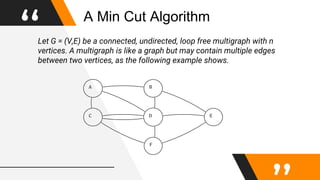
“Let G = (V,E) be a connected, undirected, loop free multigraph with n
vertices. A multigraph is like a graph but may contain multiple edges
between two vertices, as the following example shows.
A Min Cut Algorithm
A B
C D E
F
A Min Cut Problem
▸A cut in the multigraph G = (V,E) is a partition of the vertex set V into
two disjoint nonempty sets V = V1∪V2.
▸ An edge with one end in V1 and the other in V2 is said to cross the cut.
The cut is often identified with the multiset of crossing edges.
▸The term cut is chosen because the removal of the edges in a cut
partitions the multigraph.
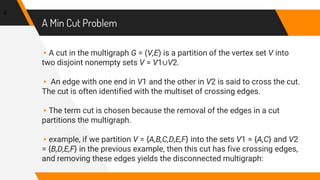
▸example, if we partition V = {A,B,C,D,E,F} into the sets V1 = {A,C} and V2
= {B,D,E,F} in the previous example, then this cut has five crossing edges,
and removing these edges yields the disconnected multigraph:
4
A B
C D E
F
 The size of the cut is given by the number of edges crossing the cut. Our
goal is to determine the minimum size of a cut in a given multigraph G.
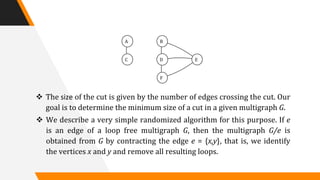
 We describe a very simple randomized algorithm for this purpose. If e
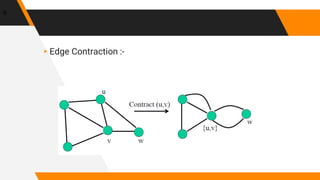
is an edge of a loop free multigraph G, then the multigraph G/e is
obtained from G by contracting the edge e = {x,y}, that is, we identify
the vertices x and y and remove all resulting loops.
▸Edge Contraction :-
6
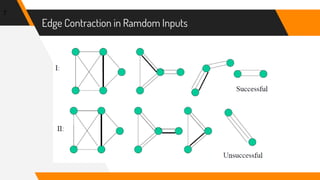
Edge Contraction in Ramdom Inputs
7
Karger’s Min cut algorithm
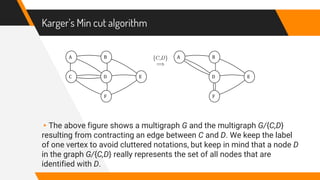
▸The above figure shows a multigraph G and the multigraph G/{C,D}
resulting from contracting an edge between C and D. We keep the label
of one vertex to avoid cluttered notations, but keep in mind that a node D
in the graph G/{C,D} really represents the set of all nodes that are
identified with D.
A B
C D E
F
A B
D E
F
A Min Cut Algorithm
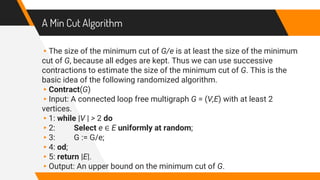
▸The size of the minimum cut of G/e is at least the size of the minimum
cut of G, because all edges are kept. Thus we can use successive
contractions to estimate the size of the minimum cut of G. This is the
basic idea of the following randomized algorithm.
▸Contract(G)
▸Input: A connected loop free multigraph G = (V,E) with at least 2
vertices.
▸1: while |V | > 2 do
▸2: Select e ∈ E uniformly at random;
▸3: G := G/e;
▸4: od;
▸5: return |E|.
▸Output: An upper bound on the minimum cut of G.
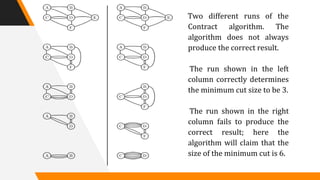
Two different runs of the
Contract algorithm. The
algorithm does not always
produce the correct result.
The run shown in the left
column correctly determines
the minimum cut size to be 3.
The run shown in the right
column fails to produce the
correct result; here the
algorithm will claim that the
size of the minimum cut is 6.
Analysis
▸It is not difficult to show that the correct size of a minimum cut will be
found by the algorithm Contract with probability Ω(n), where n denotes
the number of vertices of the multigraph.
▸ Repeating the algorithm O(n2 logn) times and choosing the smallest
value returned by the runs yields the correct size of the minimum cut
with high probability.
Analysis
 The beauty of this scheme is its simplicity.
 If G is represented as a labeled graph, where the labels denote
the multiplicity of the edges, then Contract can be implemented
with O(n2) operations; running the algorithm repeatedly, as
suggested before, yields at total of O(n4 logn) operations.
Remarks
 The running time of the best deterministic minimum cut
algorithm is O(nm + n2 logn), where m denotes the number of
edges, that is, in the labeled graph representation the running
time is at most O(n3), see for instance [2]. It turns out that size
of the minimum cut can be determined with high probability in
O(n2 log3 n) steps using a refined version of the contraction
algorithm, see [1].
14
THANKS!

Randomized algorithm min cut problem and its solution using karger's algorithm

  • 1.
    Randomized Algorithm Min-cut Problemand it’s solution using Karger’s Algorithm Guided By :- 👩 Prof. Sonia Mittal 👦 Gaurang Savaliya (16MCA058) Nirma University, Ahmedabad, Gujarat,India
  • 2.
    Introduction 2  A randomizedalgorithm is an algorithm that receives, in addition to its input, a stream of random bits which is used to make random choices.  The random bits are assumed to be independent of the input.  A salient feature is that repeated runs of a randomized algorithm with fixed input data will, in general, not produce the same result.  You might be perplexed that such a lack of definiteness is desirable, but consider that this feature allows to transform deterministic algorithms with bad worst case behaviour into randomized algorithms that perform well with high probability on any input.  I hope that the next example can convey that randomized algorithms are often simple and efficient.
  • 3.
    “Let G =(V,E) be a connected, undirected, loop free multigraph with n vertices. A multigraph is like a graph but may contain multiple edges between two vertices, as the following example shows. A Min Cut Algorithm A B C D E F
  • 4.
    A Min CutProblem ▸A cut in the multigraph G = (V,E) is a partition of the vertex set V into two disjoint nonempty sets V = V1∪V2. ▸ An edge with one end in V1 and the other in V2 is said to cross the cut. The cut is often identified with the multiset of crossing edges. ▸The term cut is chosen because the removal of the edges in a cut partitions the multigraph. ▸example, if we partition V = {A,B,C,D,E,F} into the sets V1 = {A,C} and V2 = {B,D,E,F} in the previous example, then this cut has five crossing edges, and removing these edges yields the disconnected multigraph: 4
  • 5.
    A B C DE F  The size of the cut is given by the number of edges crossing the cut. Our goal is to determine the minimum size of a cut in a given multigraph G.  We describe a very simple randomized algorithm for this purpose. If e is an edge of a loop free multigraph G, then the multigraph G/e is obtained from G by contracting the edge e = {x,y}, that is, we identify the vertices x and y and remove all resulting loops.
  • 6.
  • 7.
    Edge Contraction inRamdom Inputs 7
  • 8.
    Karger’s Min cutalgorithm ▸The above figure shows a multigraph G and the multigraph G/{C,D} resulting from contracting an edge between C and D. We keep the label of one vertex to avoid cluttered notations, but keep in mind that a node D in the graph G/{C,D} really represents the set of all nodes that are identified with D. A B C D E F A B D E F
  • 9.
    A Min CutAlgorithm ▸The size of the minimum cut of G/e is at least the size of the minimum cut of G, because all edges are kept. Thus we can use successive contractions to estimate the size of the minimum cut of G. This is the basic idea of the following randomized algorithm. ▸Contract(G) ▸Input: A connected loop free multigraph G = (V,E) with at least 2 vertices. ▸1: while |V | > 2 do ▸2: Select e ∈ E uniformly at random; ▸3: G := G/e; ▸4: od; ▸5: return |E|. ▸Output: An upper bound on the minimum cut of G.
  • 10.
    Two different runsof the Contract algorithm. The algorithm does not always produce the correct result. The run shown in the left column correctly determines the minimum cut size to be 3. The run shown in the right column fails to produce the correct result; here the algorithm will claim that the size of the minimum cut is 6.
  • 11.
    Analysis ▸It is notdifficult to show that the correct size of a minimum cut will be found by the algorithm Contract with probability Ω(n), where n denotes the number of vertices of the multigraph. ▸ Repeating the algorithm O(n2 logn) times and choosing the smallest value returned by the runs yields the correct size of the minimum cut with high probability.
  • 12.
    Analysis  The beautyof this scheme is its simplicity.  If G is represented as a labeled graph, where the labels denote the multiplicity of the edges, then Contract can be implemented with O(n2) operations; running the algorithm repeatedly, as suggested before, yields at total of O(n4 logn) operations.
  • 13.
    Remarks  The runningtime of the best deterministic minimum cut algorithm is O(nm + n2 logn), where m denotes the number of edges, that is, in the labeled graph representation the running time is at most O(n3), see for instance [2]. It turns out that size of the minimum cut can be determined with high probability in O(n2 log3 n) steps using a refined version of the contraction algorithm, see [1].
  • 14.