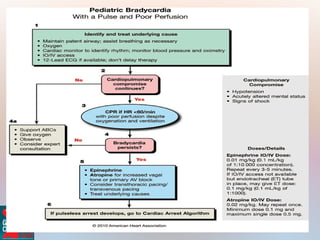
BLS 2010
In special situation
Pediatric Advanced Life
Support
2
Compression TechniquesCompression Techniques
Position:
for all ages: compress the lower third of the sternum
number of hands:children: use one or two hands: depressing the sternum
by approximately one third of the depth of the chest
Compression hand position
Adult CPR: Two hands in the center of the chest
Child CPR: One or two hands in the center of the chest
Infant CPR: Two fingers in the center of the chest
Depth of compressions
Adult CPR: Two inches
Child CPR:Two inches
Infant CPR One and a half inches
• Head position when attempting rescue breaths
• Child CPR: When attempting rescue breaths, be very
careful not to tilt a child’s head back too far. Children
have fragile airways and in the case of infants you
can actually block the airway if you do this.
Children’s bones ----- flexible
Tongues take up more space in their mouths;
Narrower airways -can be impacted by inflammation.
Infant CPR: For infants, tilt the head into the ā€˜sniffer’s
position,’ which is just far enough back for the baby to look
like he or she is sniffing the air.
Circulation/pulse
Where to check for a pulse also differs among adults,
children and infants.
Adult CPR: Check the carotid artery (located in the neck)
Child CPR: Check the carotid artery(located in the neck)
Infant CPR: Look for the brachial artery (located on the inside
of the upper arm)
Highlights
Same as adult CPR with some differences
• One rescuer : 30 comp. -2 Breaths
• Two rescuer : 15 comp.- 2 Breaths
• If pulse present but < 60 / min. needs
Chest compressions and recheck pulse
every 2 min.
01/22/13 07:28 AM Esmaeil Azizi Fini 10
Pregnancy
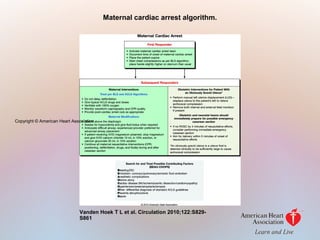
Maternal cardiac arrest algorithm.
Vanden Hoek T L et al. Circulation 2010;122:S829-
S861
Copyright Ā© American Heart Association
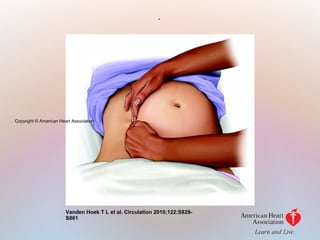
.
Vanden Hoek T L et al. Circulation 2010;122:S829-
S861
Copyright Ā© American Heart Association
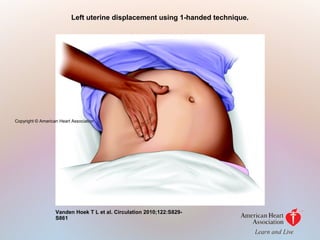
Left uterine displacement using 1-handed technique.
Vanden Hoek T L et al. Circulation 2010;122:S829-
S861
Copyright Ā© American Heart Association
Patient in a 30° left-lateral tilt using a firm wedge to support pelvis and thorax.
Vanden Hoek T L et al. Circulation 2010;122:S829-
S861
Copyright Ā© American Heart Association
Drowning
NO .....CAB-----ABC
Attempts to remove water from the breathing passages by any
means other than suction (eg, abdominal thrusts or the
Heimlich maneuver) are unnecessary and potentially
dangerous.
THANK YOU

Raj special situation cpr

  • 1.
  • 2.
  • 3.
    Compression TechniquesCompression Techniques Position: forall ages: compress the lower third of the sternum number of hands:children: use one or two hands: depressing the sternum by approximately one third of the depth of the chest
  • 4.
    Compression hand position AdultCPR: Two hands in the center of the chest Child CPR: One or two hands in the center of the chest Infant CPR: Two fingers in the center of the chest Depth of compressions Adult CPR: Two inches Child CPR:Two inches Infant CPR One and a half inches
  • 5.
    • Head positionwhen attempting rescue breaths • Child CPR: When attempting rescue breaths, be very careful not to tilt a child’s head back too far. Children have fragile airways and in the case of infants you can actually block the airway if you do this.
  • 6.
    Children’s bones -----flexible Tongues take up more space in their mouths; Narrower airways -can be impacted by inflammation. Infant CPR: For infants, tilt the head into the ā€˜sniffer’s position,’ which is just far enough back for the baby to look like he or she is sniffing the air.
  • 7.
    Circulation/pulse Where to checkfor a pulse also differs among adults, children and infants. Adult CPR: Check the carotid artery (located in the neck) Child CPR: Check the carotid artery(located in the neck) Infant CPR: Look for the brachial artery (located on the inside of the upper arm)
  • 9.
    Highlights Same as adultCPR with some differences • One rescuer : 30 comp. -2 Breaths • Two rescuer : 15 comp.- 2 Breaths • If pulse present but < 60 / min. needs Chest compressions and recheck pulse every 2 min.
  • 10.
    01/22/13 07:28 AMEsmaeil Azizi Fini 10
  • 11.
  • 12.
    Maternal cardiac arrestalgorithm. Vanden Hoek T L et al. Circulation 2010;122:S829- S861 Copyright Ā© American Heart Association
  • 13.
    . Vanden Hoek TL et al. Circulation 2010;122:S829- S861 Copyright Ā© American Heart Association
  • 14.
    Left uterine displacementusing 1-handed technique. Vanden Hoek T L et al. Circulation 2010;122:S829- S861 Copyright Ā© American Heart Association
  • 15.
    Patient in a30° left-lateral tilt using a firm wedge to support pelvis and thorax. Vanden Hoek T L et al. Circulation 2010;122:S829- S861 Copyright © American Heart Association
  • 16.
    Drowning NO .....CAB-----ABC Attempts toremove water from the breathing passages by any means other than suction (eg, abdominal thrusts or the Heimlich maneuver) are unnecessary and potentially dangerous.
  • 17.

Editor's Notes

  • #13Ā Maternal cardiac arrest algorithm.
  • #14Ā . Left uterine displacement with 2-handed technique.
  • #15Ā Left uterine displacement using 1-handed technique.
  • #16Ā Patient in a 30° left-lateral tilt using a firm wedge to support pelvis and thorax.