Carbon Dating
BY ASMA QURESHI
8006
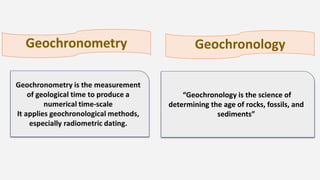
Geochronology
“Geochronology is the science of
determining the age of rocks, fossils, and
sediments”
Commonly used techniques
▪ Radiocarbon dating
▪ Uranium–lead (U-Pb) dating
▪ Uranium–thorium (U-Th)
▪ Potassium–argon (K-Ar) dating and argon–argon (Ar-Ar) dating
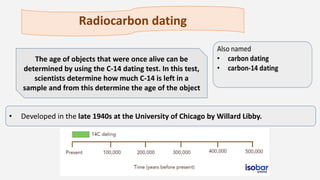
Radiocarbon dating
• Developed in the late 1940s at the University of Chicago by Willard Libby.
The age of objects that were once alive can be
determined by using the C-14 dating test. In this test,
scientists determine how much C-14 is left in a
sample and from this determine the age of the object
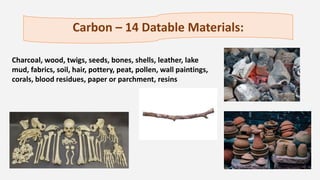
Carbon – 14 Datable Materials:
Charcoal, wood, twigs, seeds, bones, shells, leather, lake
mud, fabrics, soil, hair, pottery, peat, pollen, wall paintings,
corals, blood residues, paper or parchment, resins
Radiocarbon dating
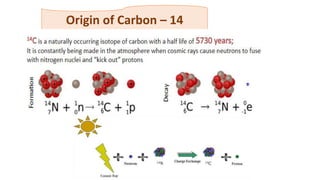
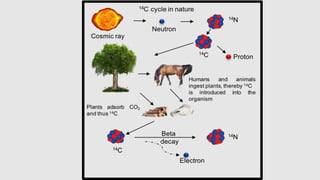
Origin of Carbon – 14
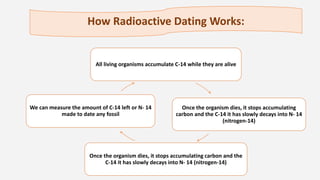
How Radioactive Dating Works:
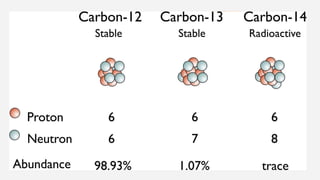
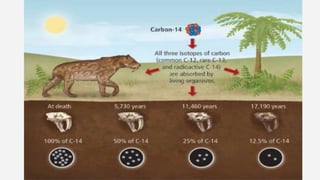
All living organisms accumulate C-14 while they are alive
Once the organism dies, it stops accumulating
carbon and the C-14 it has slowly decays into N- 14
(nitrogen-14)
Once the organism dies, it stops accumulating carbon and the
C-14 it has slowly decays into N- 14 (nitrogen-14)
We can measure the amount of C-14 left or N- 14
made to date any fossil
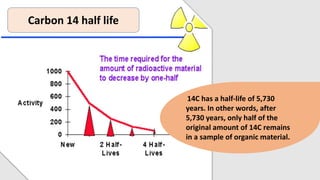
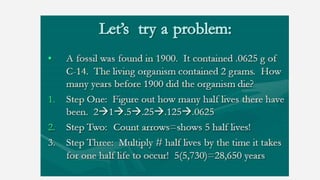
14C has a half-life of 5,730
years. In other words, after
5,730 years, only half of the
original amount of 14C remains
in a sample of organic material.
Carbon 14 half life
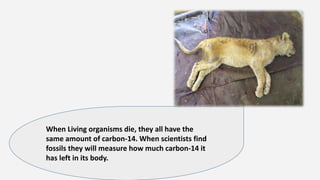
When Living organisms die, they all have the
same amount of carbon-14. When scientists find
fossils they will measure how much carbon-14 it
has left in its body.
An animal dies
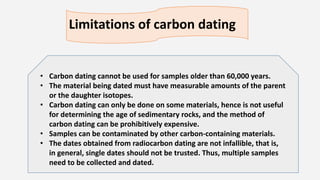
Limitations of carbon dating
• Carbon dating cannot be used for samples older than 60,000 years.
• The material being dated must have measurable amounts of the parent
or the daughter isotopes.
• Carbon dating can only be done on some materials, hence is not useful
for determining the age of sedimentary rocks, and the method of
carbon dating can be prohibitively expensive.
• Samples can be contaminated by other carbon-containing materials.
• The dates obtained from radiocarbon dating are not infallible, that is,
in general, single dates should not be trusted. Thus, multiple samples
need to be collected and dated.
Dead Sea Scroll
• The Dead Sea Scrolls (also the
Qumran Caves Scrolls) are ancient
Jewish and Hebrew religious
manuscripts discovered in 1946/7
at the Qumran Caves
• It dates to 250-130BC according to
radiocarbon dating, or 150-125BC
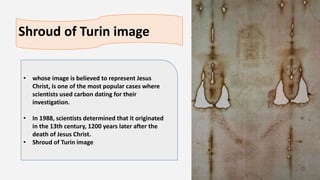
Shroud of Turin image
• whose image is believed to represent Jesus
Christ, is one of the most popular cases where
scientists used carbon dating for their
investigation.
• In 1988, scientists determined that it originated
in the 13th century, 1200 years later after the
death of Jesus Christ.
• Shroud of Turin image
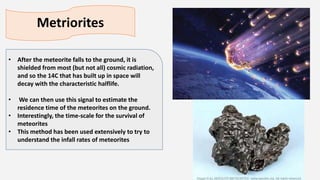
Metriorites
• After the meteorite falls to the ground, it is
shielded from most (but not all) cosmic radiation,
and so the 14C that has built up in space will
decay with the characteristic halflife.
• We can then use this signal to estimate the
residence time of the meteorites on the ground.
• Interestingly, the time-scale for the survival of
meteorites
• This method has been used extensively to try to
understand the infall rates of meteorites
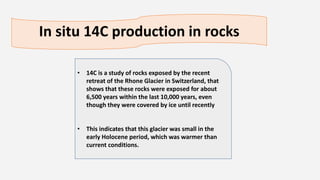
In situ 14C production in rocks
• 14C is a study of rocks exposed by the recent
retreat of the Rhone Glacier in Switzerland, that
shows that these rocks were exposed for about
6,500 years within the last 10,000 years, even
though they were covered by ice until recently
• This indicates that this glacier was small in the
early Holocene period, which was warmer than
current conditions.
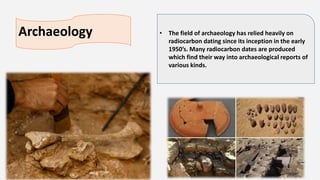
Archaeology • The field of archaeology has relied heavily on
radiocarbon dating since its inception in the early
1950’s. Many radiocarbon dates are produced
which find their way into archaeological reports of
various kinds.

Carbon dating

  • 1.
  • 2.
    Geochronology “Geochronology is thescience of determining the age of rocks, fossils, and sediments”
  • 3.
    Commonly used techniques ▪Radiocarbon dating ▪ Uranium–lead (U-Pb) dating ▪ Uranium–thorium (U-Th) ▪ Potassium–argon (K-Ar) dating and argon–argon (Ar-Ar) dating
  • 4.
    Radiocarbon dating • Developedin the late 1940s at the University of Chicago by Willard Libby. The age of objects that were once alive can be determined by using the C-14 dating test. In this test, scientists determine how much C-14 is left in a sample and from this determine the age of the object
  • 5.
    Carbon – 14Datable Materials: Charcoal, wood, twigs, seeds, bones, shells, leather, lake mud, fabrics, soil, hair, pottery, peat, pollen, wall paintings, corals, blood residues, paper or parchment, resins
  • 6.
  • 7.
  • 8.
    How Radioactive DatingWorks: All living organisms accumulate C-14 while they are alive Once the organism dies, it stops accumulating carbon and the C-14 it has slowly decays into N- 14 (nitrogen-14) Once the organism dies, it stops accumulating carbon and the C-14 it has slowly decays into N- 14 (nitrogen-14) We can measure the amount of C-14 left or N- 14 made to date any fossil
  • 10.
    14C has ahalf-life of 5,730 years. In other words, after 5,730 years, only half of the original amount of 14C remains in a sample of organic material. Carbon 14 half life
  • 11.
    When Living organismsdie, they all have the same amount of carbon-14. When scientists find fossils they will measure how much carbon-14 it has left in its body.
  • 12.
  • 14.
    Limitations of carbondating • Carbon dating cannot be used for samples older than 60,000 years. • The material being dated must have measurable amounts of the parent or the daughter isotopes. • Carbon dating can only be done on some materials, hence is not useful for determining the age of sedimentary rocks, and the method of carbon dating can be prohibitively expensive. • Samples can be contaminated by other carbon-containing materials. • The dates obtained from radiocarbon dating are not infallible, that is, in general, single dates should not be trusted. Thus, multiple samples need to be collected and dated.
  • 15.
    Dead Sea Scroll •The Dead Sea Scrolls (also the Qumran Caves Scrolls) are ancient Jewish and Hebrew religious manuscripts discovered in 1946/7 at the Qumran Caves • It dates to 250-130BC according to radiocarbon dating, or 150-125BC
  • 16.
    Shroud of Turinimage • whose image is believed to represent Jesus Christ, is one of the most popular cases where scientists used carbon dating for their investigation. • In 1988, scientists determined that it originated in the 13th century, 1200 years later after the death of Jesus Christ. • Shroud of Turin image
  • 17.
    Metriorites • After themeteorite falls to the ground, it is shielded from most (but not all) cosmic radiation, and so the 14C that has built up in space will decay with the characteristic halflife. • We can then use this signal to estimate the residence time of the meteorites on the ground. • Interestingly, the time-scale for the survival of meteorites • This method has been used extensively to try to understand the infall rates of meteorites
  • 18.
    In situ 14Cproduction in rocks • 14C is a study of rocks exposed by the recent retreat of the Rhone Glacier in Switzerland, that shows that these rocks were exposed for about 6,500 years within the last 10,000 years, even though they were covered by ice until recently • This indicates that this glacier was small in the early Holocene period, which was warmer than current conditions.
  • 19.
    Archaeology • Thefield of archaeology has relied heavily on radiocarbon dating since its inception in the early 1950’s. Many radiocarbon dates are produced which find their way into archaeological reports of various kinds.

Editor's Notes

  • #12 The exploitation of natural resources should not be for the benefit of a few people but should be distributed equally for all. While extracting and using natural resources ,plan for the safe disposal of wastes so that no damage is caused to the environment
  • #14 The exploitation of natural resources should not be for the benefit of a few people but should be distributed equally for all. While extracting and using natural resources ,plan for the safe disposal of wastes so that no damage is caused to the environment
  • #15 The exploitation of natural resources should not be for the benefit of a few people but should be distributed equally for all. While extracting and using natural resources ,plan for the safe disposal of wastes so that no damage is caused to the environment
  • #16 The exploitation of natural resources should not be for the benefit of a few people but should be distributed equally for all. While extracting and using natural resources ,plan for the safe disposal of wastes so that no damage is caused to the environment
  • #17 The exploitation of natural resources should not be for the benefit of a few people but should be distributed equally for all. While extracting and using natural resources ,plan for the safe disposal of wastes so that no damage is caused to the environment
  • #18 The exploitation of natural resources should not be for the benefit of a few people but should be distributed equally for all. While extracting and using natural resources ,plan for the safe disposal of wastes so that no damage is caused to the environment
  • #19 The exploitation of natural resources should not be for the benefit of a few people but should be distributed equally for all. While extracting and using natural resources ,plan for the safe disposal of wastes so that no damage is caused to the environment
  • #20 The exploitation of natural resources should not be for the benefit of a few people but should be distributed equally for all. While extracting and using natural resources ,plan for the safe disposal of wastes so that no damage is caused to the environment