Introduction to
Radiocarbon Dating
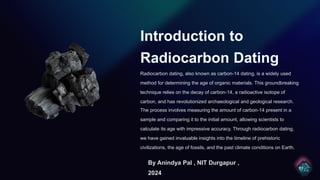
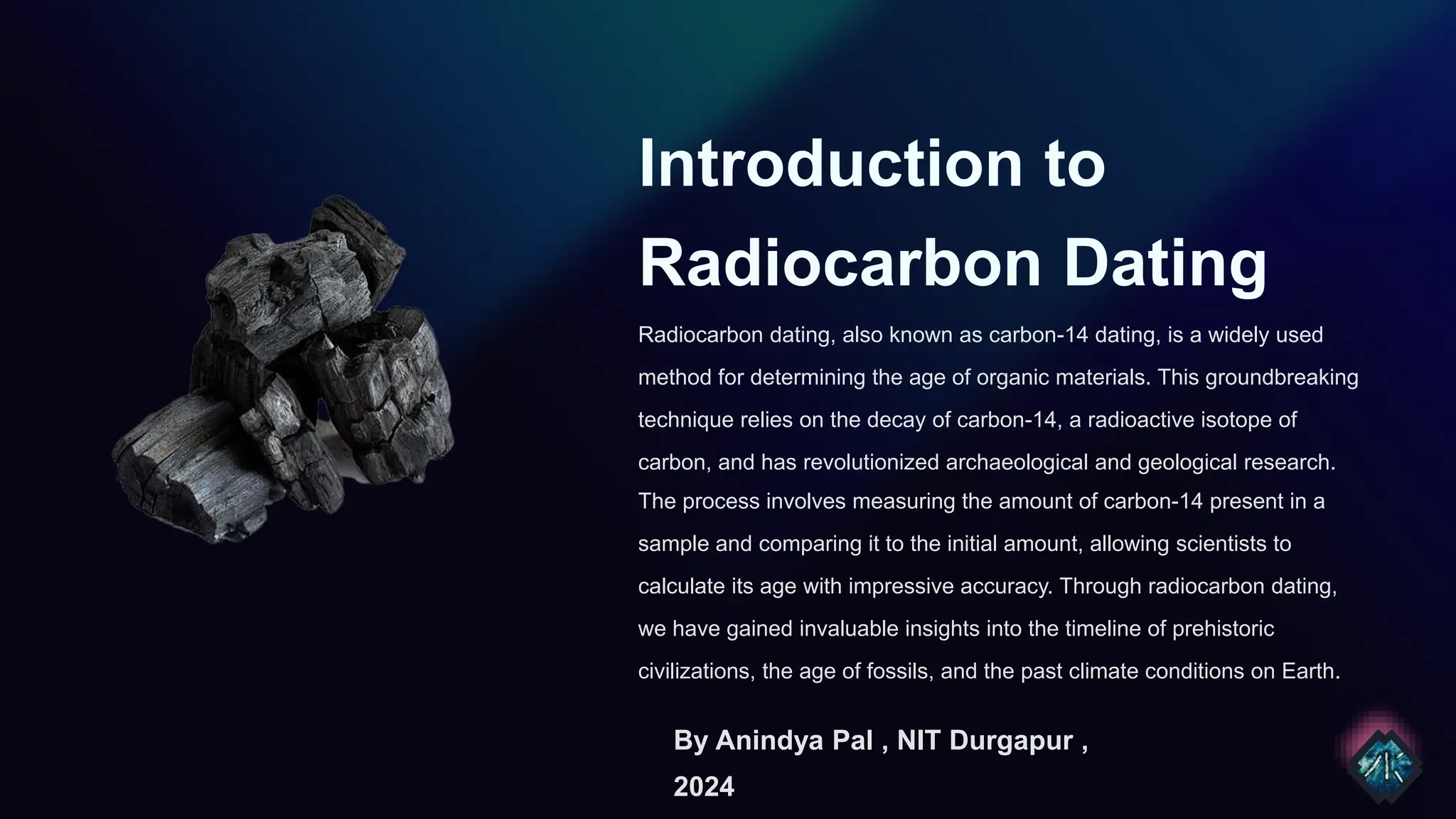
Radiocarbon dating, also known as carbon-14 dating, is a widely used
method for determining the age of organic materials. This groundbreaking
technique relies on the decay of carbon-14, a radioactive isotope of
carbon, and has revolutionized archaeological and geological research.
The process involves measuring the amount of carbon-14 present in a
sample and comparing it to the initial amount, allowing scientists to
calculate its age with impressive accuracy. Through radiocarbon dating,
we have gained invaluable insights into the timeline of prehistoric
civilizations, the age of fossils, and the past climate conditions on Earth.
By Anindya Pal , NIT Durgapur ,
2024
What is Radiocarbon Dating?
Carbon Isotopes
Radiocarbon dating is a method used
to determine the age of organic
materials based on the decay rate of
carbon isotopes. Specifically, it focuses
on the isotope carbon-14, which is
present in all living organisms and
decays at a consistent rate over time.
Half-Life Principle
At the heart of radiocarbon dating is the
principle of half-life, which allows
scientists to calculate the age of a sample
by measuring the remaining amount of
carbon-14. This principle has
revolutionized the field of archaeology by
providing a reliable way to date ancient
artifacts and analyze past civilizations.
Calibration and Corrections
One of the challenges of radiocarbon
dating is the need for calibration and
corrections to account for fluctuations in
atmospheric carbon-14 levels over time.
Scientists use advanced techniques to
refine and adjust the dating results,
ensuring the accuracy of the final age
estimates.
Applications
Radiocarbon dating has diverse
applications, from determining the age
of historical manuscripts to unraveling
the timelines of human evolution. Its
impact extends to environmental
studies, geology, and climatology,
making it an indispensable tool in
multiple scientific disciplines.
How does Radiocarbon Dating works
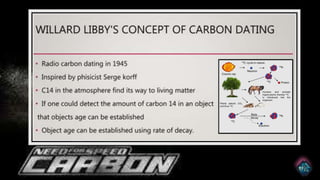
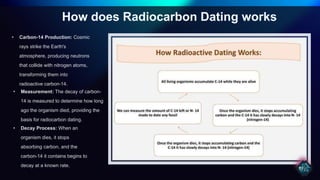
• Carbon-14 Production: Cosmic
rays strike the Earth's
atmosphere, producing neutrons
that collide with nitrogen atoms,
transforming them into
radioactive carbon-14.
• Decay Process: When an
organism dies, it stops
absorbing carbon, and the
carbon-14 it contains begins to
decay at a known rate.
• Measurement: The decay of carbon-
14 is measured to determine how long
ago the organism died, providing the
basis for radiocarbon dating.
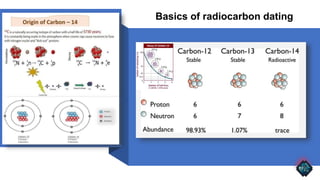
Basics of radiocarbon dating
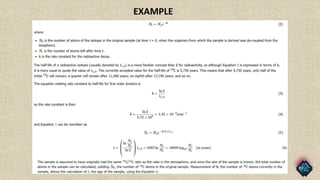
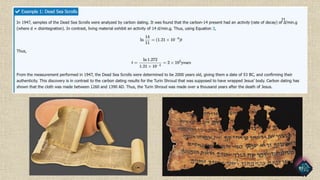
EXAMPLE
11
Applications of
Radiocarbon Dating
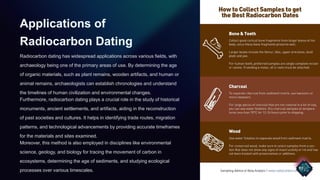
Radiocarbon dating has widespread applications across various fields, with
archaeology being one of the primary areas of use. By determining the age
of organic materials, such as plant remains, wooden artifacts, and human or
animal remains, archaeologists can establish chronologies and understand
the timelines of human civilization and environmental changes.
Furthermore, radiocarbon dating plays a crucial role in the study of historical
monuments, ancient settlements, and artifacts, aiding in the reconstruction
of past societies and cultures. It helps in identifying trade routes, migration
patterns, and technological advancements by providing accurate timeframes
for the materials and sites examined.
Moreover, this method is also employed in disciplines like environmental
science, geology, and biology for tracing the movement of carbon in
ecosystems, determining the age of sediments, and studying ecological
processes over various timescales.
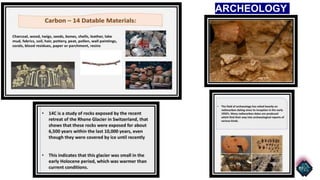
ARCHEOLOGY
Limitations and Uncertainties of
Radiocarbon Dating
1 Sample Contamination
One of the major limitations of radiocarbon dating is the potential for sample
contamination. This can occur from handling, storage, or environmental
factors, which can lead to inaccurate results. Researchers must take great
care to minimize contamination and ensure the accuracy of the date.
2 Calibration Curve Variability
Radiocarbon dates are calibrated using a curve that accounts for changes in
atmospheric carbon-14 levels over time. However, this calibration curve itself
has uncertainties, and variations in the curve can lead to inaccuracies in
dating. This variability must be carefully considered when interpreting
radiocarbon dates.
3 Age Range Limitations
Radiocarbon dating is most effective for samples up to around 50,000 years
old. Beyond this, the amount of carbon-14 remaining is too low to be
accurately measured. This limitation restricts the applicability of radiocarbon
dating for older archaeological or geological samples.
Advances in Radiocarbon Dating
Technology
Accelerator Mass Spectrometry
(AMS)
One of the significant advances in radiocarbon
dating technology is the development and
widespread application of Accelerator Mass
Spectrometry (AMS). This method allows for
smaller sample sizes and increased precision,
enabling researchers to date much older
samples and obtain more accurate results.
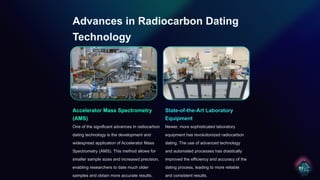
State-of-the-Art Laboratory
Equipment
Newer, more sophisticated laboratory
equipment has revolutionized radiocarbon
dating. The use of advanced technology
and automated processes has drastically
improved the efficiency and accuracy of the
dating process, leading to more reliable
and consistent results.
Conclusion: Impact and significance of
Radiocarbon Dating
1 Revolutionizing Archaeology
2 Timeframe Precision
3 Environmental Studies
4 Future
Developments
Radiocarbon dating has revolutionized the field of archaeology, providing invaluable insights
into human history and the evolution of civilizations. Its ability to precisely determine the
timeframe of artifacts, fossils, and ancient materials has fundamentally changed the way we
understand the past. Additionally, radiocarbon dating has significantly contributed to
environmental studies, helping scientists track climate change and environmental shifts over
the centuries. Looking ahead, the ongoing advancements in radiocarbon dating technology
hold immense potential for future developments in archaeological and scientific research,
promising even greater accuracy and detail in dating ancient objects and materials.
Introduction Radiocarbon Dating and Application.pptx

Introduction Radiocarbon Dating and Application.pptx

  • 1.
    Introduction to Radiocarbon Dating Radiocarbondating, also known as carbon-14 dating, is a widely used method for determining the age of organic materials. This groundbreaking technique relies on the decay of carbon-14, a radioactive isotope of carbon, and has revolutionized archaeological and geological research. The process involves measuring the amount of carbon-14 present in a sample and comparing it to the initial amount, allowing scientists to calculate its age with impressive accuracy. Through radiocarbon dating, we have gained invaluable insights into the timeline of prehistoric civilizations, the age of fossils, and the past climate conditions on Earth. By Anindya Pal , NIT Durgapur , 2024
  • 2.
    What is RadiocarbonDating? Carbon Isotopes Radiocarbon dating is a method used to determine the age of organic materials based on the decay rate of carbon isotopes. Specifically, it focuses on the isotope carbon-14, which is present in all living organisms and decays at a consistent rate over time. Half-Life Principle At the heart of radiocarbon dating is the principle of half-life, which allows scientists to calculate the age of a sample by measuring the remaining amount of carbon-14. This principle has revolutionized the field of archaeology by providing a reliable way to date ancient artifacts and analyze past civilizations. Calibration and Corrections One of the challenges of radiocarbon dating is the need for calibration and corrections to account for fluctuations in atmospheric carbon-14 levels over time. Scientists use advanced techniques to refine and adjust the dating results, ensuring the accuracy of the final age estimates. Applications Radiocarbon dating has diverse applications, from determining the age of historical manuscripts to unraveling the timelines of human evolution. Its impact extends to environmental studies, geology, and climatology, making it an indispensable tool in multiple scientific disciplines.
  • 5.
    How does RadiocarbonDating works • Carbon-14 Production: Cosmic rays strike the Earth's atmosphere, producing neutrons that collide with nitrogen atoms, transforming them into radioactive carbon-14. • Decay Process: When an organism dies, it stops absorbing carbon, and the carbon-14 it contains begins to decay at a known rate. • Measurement: The decay of carbon- 14 is measured to determine how long ago the organism died, providing the basis for radiocarbon dating.
  • 6.
  • 7.
  • 8.
  • 9.
    Applications of Radiocarbon Dating Radiocarbondating has widespread applications across various fields, with archaeology being one of the primary areas of use. By determining the age of organic materials, such as plant remains, wooden artifacts, and human or animal remains, archaeologists can establish chronologies and understand the timelines of human civilization and environmental changes. Furthermore, radiocarbon dating plays a crucial role in the study of historical monuments, ancient settlements, and artifacts, aiding in the reconstruction of past societies and cultures. It helps in identifying trade routes, migration patterns, and technological advancements by providing accurate timeframes for the materials and sites examined. Moreover, this method is also employed in disciplines like environmental science, geology, and biology for tracing the movement of carbon in ecosystems, determining the age of sediments, and studying ecological processes over various timescales.
  • 10.
  • 11.
    Limitations and Uncertaintiesof Radiocarbon Dating 1 Sample Contamination One of the major limitations of radiocarbon dating is the potential for sample contamination. This can occur from handling, storage, or environmental factors, which can lead to inaccurate results. Researchers must take great care to minimize contamination and ensure the accuracy of the date. 2 Calibration Curve Variability Radiocarbon dates are calibrated using a curve that accounts for changes in atmospheric carbon-14 levels over time. However, this calibration curve itself has uncertainties, and variations in the curve can lead to inaccuracies in dating. This variability must be carefully considered when interpreting radiocarbon dates. 3 Age Range Limitations Radiocarbon dating is most effective for samples up to around 50,000 years old. Beyond this, the amount of carbon-14 remaining is too low to be accurately measured. This limitation restricts the applicability of radiocarbon dating for older archaeological or geological samples.
  • 12.
    Advances in RadiocarbonDating Technology Accelerator Mass Spectrometry (AMS) One of the significant advances in radiocarbon dating technology is the development and widespread application of Accelerator Mass Spectrometry (AMS). This method allows for smaller sample sizes and increased precision, enabling researchers to date much older samples and obtain more accurate results. State-of-the-Art Laboratory Equipment Newer, more sophisticated laboratory equipment has revolutionized radiocarbon dating. The use of advanced technology and automated processes has drastically improved the efficiency and accuracy of the dating process, leading to more reliable and consistent results.
  • 13.
    Conclusion: Impact andsignificance of Radiocarbon Dating 1 Revolutionizing Archaeology 2 Timeframe Precision 3 Environmental Studies 4 Future Developments Radiocarbon dating has revolutionized the field of archaeology, providing invaluable insights into human history and the evolution of civilizations. Its ability to precisely determine the timeframe of artifacts, fossils, and ancient materials has fundamentally changed the way we understand the past. Additionally, radiocarbon dating has significantly contributed to environmental studies, helping scientists track climate change and environmental shifts over the centuries. Looking ahead, the ongoing advancements in radiocarbon dating technology hold immense potential for future developments in archaeological and scientific research, promising even greater accuracy and detail in dating ancient objects and materials.