Square root and
Pythagoras Theorem
1. Square root
2. History & Definition of
Pythagoras theorem
3. Example
Sheri Davis
MATH 114
February 2018
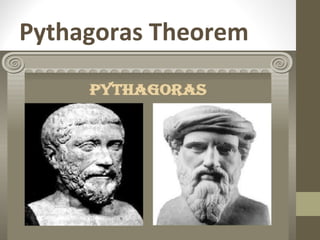
Pythagoras Theorem
Square Root and
The Pythagoras Theorem
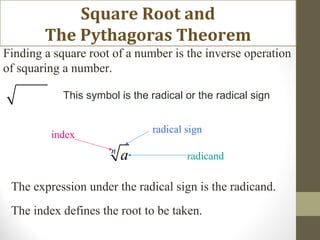
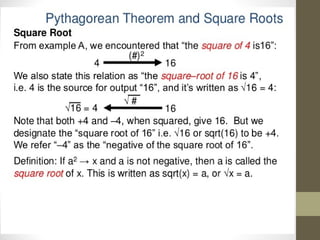
Finding a square root of a number is the inverse operation
of squaring a number.
This symbol is the radical or the radical sign
n
a
index
radical sign
radicand
The expression under the radical sign is the radicand.
The index defines the root to be taken.
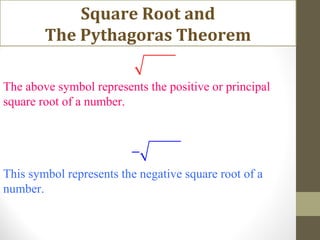
This symbol represents the negative square root of a
number.
The above symbol represents the positive or principal
square root of a number.
−
Square Root and
The Pythagoras Theorem
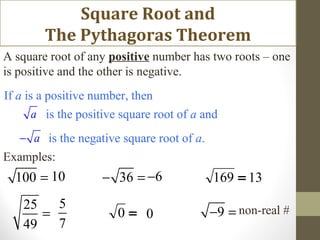
If a is a positive number, then
a is the positive square root of a and
100 =
a− is the negative square root of a.
A square root of any positive number has two roots – one
is positive and the other is negative.
Examples:
10
25
49
=
5
7
36− = 6−
9− = non-real #
=169 13
Square Root and
The Pythagoras Theorem
=0 0
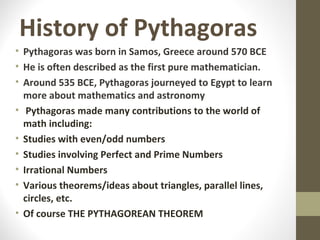
History of Pythagoras
• Pythagoras was born in Samos, Greece around 570 BCE
• He is often described as the first pure mathematician.
• Around 535 BCE, Pythagoras journeyed to Egypt to learn
more about mathematics and astronomy
• Pythagoras made many contributions to the world of
math including:
• Studies with even/odd numbers
• Studies involving Perfect and Prime Numbers
• Irrational Numbers
• Various theorems/ideas about triangles, parallel lines,
circles, etc.
• Of course THE PYTHAGOREAN THEOREM
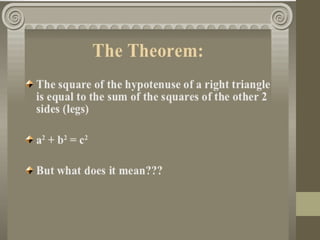
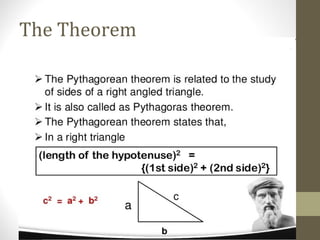
The Theorem
THE END
Thank You !!!

Pythagoras and square root new week5

  • 1.
    Square root and PythagorasTheorem 1. Square root 2. History & Definition of Pythagoras theorem 3. Example Sheri Davis MATH 114 February 2018
  • 2.
  • 3.
    Square Root and ThePythagoras Theorem Finding a square root of a number is the inverse operation of squaring a number. This symbol is the radical or the radical sign n a index radical sign radicand The expression under the radical sign is the radicand. The index defines the root to be taken.
  • 4.
    This symbol representsthe negative square root of a number. The above symbol represents the positive or principal square root of a number. − Square Root and The Pythagoras Theorem
  • 5.
    If a isa positive number, then a is the positive square root of a and 100 = a− is the negative square root of a. A square root of any positive number has two roots – one is positive and the other is negative. Examples: 10 25 49 = 5 7 36− = 6− 9− = non-real # =169 13 Square Root and The Pythagoras Theorem =0 0
  • 7.
    History of Pythagoras •Pythagoras was born in Samos, Greece around 570 BCE • He is often described as the first pure mathematician. • Around 535 BCE, Pythagoras journeyed to Egypt to learn more about mathematics and astronomy • Pythagoras made many contributions to the world of math including: • Studies with even/odd numbers • Studies involving Perfect and Prime Numbers • Irrational Numbers • Various theorems/ideas about triangles, parallel lines, circles, etc. • Of course THE PYTHAGOREAN THEOREM
  • 9.
  • 14.