RADIATIONS APPLICATION
IN PLANT SCIENCE.
Presented by :-
Medat bharati
Paper :-CBO – 406
Roll no :- 9
M.Sc sem 2 (Botany).
Department of Life Sciences
H. N. G. U. Patan.
CONTENTS
Introduction
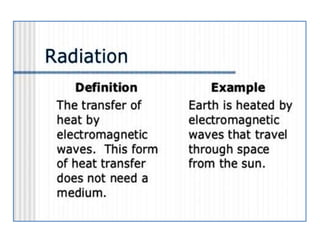
Radiation defintion and examples
Radiation types
Effects of radiation on plant growth &
development
Reference.
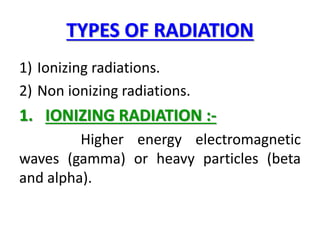
TYPES OF RADIATION
1) Ionizing radiations.
2) Non ionizing radiations.
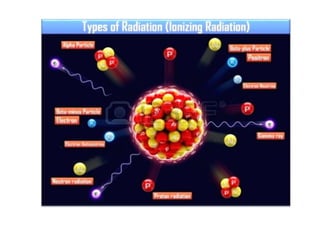
1. IONIZING RADIATION :-
Higher energy electromagnetic
waves (gamma) or heavy particles (beta
and alpha).
High enough energy to pull electron from
orbit.
 E.G :-
Alpha particles.
Beta particles.
Gamma rays.
2. NON IONIZING RADIATIONS :-
Longer wavelength and low energy.
Not enough energy to pull electron from
orbit.
Lower energy electro magenetic waves.
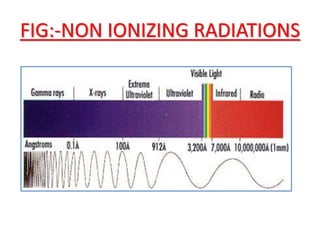
E.G:-
oUltraviolet radiations (UV).
o Visible light.
oInfrared radiation.
o Microwave radiation.
o Radio frequency radiation.
FIG:-NON IONIZING RADIATIONS
EFFECTS OF RADIATION ON PLANT
GROWTH & DEVELOPMENT
Prevents seed growth ultraviolet
radiation effects plant growth and
development in many ways.
First it gradually stops seed growth and
depended on the how much radiation is
released.
The stomata is a small air hole with in a
plant leaf that also controls water levels.
If the stomata is unable to open for a long
period of time ,the growth of the plant.
Damages plant cells.
The cells of living organism are also
damaged and killed by ultraviolet radiation.
Cells contain responsible for plant
reproduction.if the needed for
photosynthesis and normal plant growth.
DAMAGES PLANT CELLS
 The cells of living organism are also
damaged and killed by ultraviolet radiation.
 What allows plants to grow is the division
and expansion of cells as they take up
water.
 Cells contain chromosomes, the genetic
material responsible for plant reproduction.
 If the cell is overly damaged by radiation,
then reproduction is hindered.
EFFECTS PLANTS
REFERENCE
 J.L.Ryan, “Ionizing radiation : the good , the bad
and the ugly, ”J. Invest. Dermatol,
132,985(2012).
 www.scielo.br
 www.radsafe.com
THANKS..

Radiational application in plant

  • 1.
    RADIATIONS APPLICATION IN PLANTSCIENCE. Presented by :- Medat bharati Paper :-CBO – 406 Roll no :- 9 M.Sc sem 2 (Botany). Department of Life Sciences H. N. G. U. Patan.
  • 2.
    CONTENTS Introduction Radiation defintion andexamples Radiation types Effects of radiation on plant growth & development Reference.
  • 6.
    TYPES OF RADIATION 1)Ionizing radiations. 2) Non ionizing radiations. 1. IONIZING RADIATION :- Higher energy electromagnetic waves (gamma) or heavy particles (beta and alpha).
  • 8.
    High enough energyto pull electron from orbit.  E.G :- Alpha particles. Beta particles. Gamma rays. 2. NON IONIZING RADIATIONS :- Longer wavelength and low energy. Not enough energy to pull electron from orbit. Lower energy electro magenetic waves.
  • 9.
    E.G:- oUltraviolet radiations (UV). oVisible light. oInfrared radiation. o Microwave radiation. o Radio frequency radiation.
  • 10.
  • 11.
    EFFECTS OF RADIATIONON PLANT GROWTH & DEVELOPMENT Prevents seed growth ultraviolet radiation effects plant growth and development in many ways. First it gradually stops seed growth and depended on the how much radiation is released.
  • 12.
    The stomata isa small air hole with in a plant leaf that also controls water levels. If the stomata is unable to open for a long period of time ,the growth of the plant. Damages plant cells. The cells of living organism are also damaged and killed by ultraviolet radiation. Cells contain responsible for plant reproduction.if the needed for photosynthesis and normal plant growth.
  • 13.
    DAMAGES PLANT CELLS The cells of living organism are also damaged and killed by ultraviolet radiation.  What allows plants to grow is the division and expansion of cells as they take up water.  Cells contain chromosomes, the genetic material responsible for plant reproduction.  If the cell is overly damaged by radiation, then reproduction is hindered.
  • 14.
  • 15.
    REFERENCE  J.L.Ryan, “Ionizingradiation : the good , the bad and the ugly, ”J. Invest. Dermatol, 132,985(2012).  www.scielo.br  www.radsafe.com
  • 16.