INTRODUCTION TO RADIATION SAFETY
By
Ubani Rowland
ASSOCIATE MEMBER
NIGERIAN ENVIRONMENTAL SOCIETY
Nigerian Nuclear Regulatory Authority
North-East Zonal Office, Gombe
OUTLINE
 What is Radiation
 Types of Radiation
 Brief History of Radiation
 Occurrence of Radiation
 Radiation Contamination
 How Does Radiation Affect Me?
 Government Regulation of Radiation and Exposure
WHAT IS RADIATION?
Radiation is the process by which energy is emitted as either particles
or waves.
 However, generally use it to refer to radiation from
electromagnetic waves, ranging from radio waves, though the
visible light spectrum, and up through to gamma waves
The Electromagnetic Spectrum.
Types of Radiations
Non-Ionizing Radiation
Electromagnetic radiation ranging from extremely low frequency
(ELF) to ultraviolet (UV) comprise non-ionizing radiation. UV light
is unique in that while it is non-ionizing, it does have the capacity to
cause harmful effects similar to what ionizing radiation can create,
such as an increased risk of cancer due to damage to DNA
molecules.
Ionizing Radiation
The two types of ionizing radiation are particulate (alpha, beta,
neutrons) and electromagnetic (x-rays, gamma rays) radiation.
Brief History of Radiation
 Wilhelm Röntgen : modern understanding of ionizing radiation got its start
in 1895 (x-ray)
 Marie Curie & Henri Becquerel, awarded the Nobel Prize twice, once
alongside Henri Becquerel and her husband Pierre in Physics for their work
with radioactivity.
Atomic age
Hiroshima and Nagasaki.
Occurrence of Radiation
 Natural source
 Manmade source
Naturally Occurring Sources of Radiation
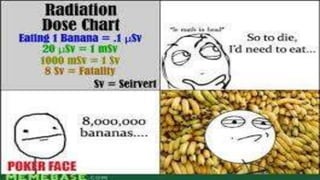
 Bananas
Naturally very high in potassium, consequently have a higher than usual amount of
potassium-40, a radioactive isotope. In fact, the term “banana equivalent dose”
 Other common foods
 Carrots
 White potatoes
 Lima beans
In all these foods, however, the levels are extremely low and not considered harmful,
and almost none of the radioactive material consumed while eating any of them is
retained in the body.
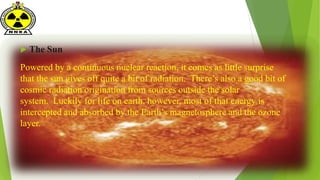
 The Sun
Powered by a continuous nuclear reaction, it comes as little surprise
that the sun gives off quite a bit of radiation. There’s also a good bit of
cosmic radiation origination from sources outside the solar
system. Luckily for life on earth, however, most of that energy is
intercepted and absorbed by the Earth’s magnetosphere and the ozone
layer.
 The ground beneath our feet (Radium, uranium, from Mining/Oil)
A major source of naturally occurring radiation is from minerals and materials buried
in the earth. Most common are:
 potassium-40
 uranium-238
 thorium-232
 radium-226
 radon-222
 Radon, being a gas, can become a problem in some houses and other buildings,
seeping in usually through cracks in solid foundations, and accumulating in rooms
with poor ventilation.
 Another area where terrestrial radiation can become something of an issue is in
the oil and natural gas mining industries, where it is referred to as Naturally
Occurring Radioactive Material.
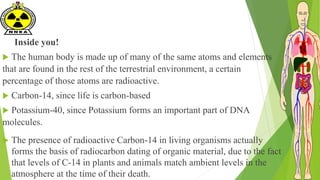
Inside you!
 The human body is made up of many of the same atoms and elements
that are found in the rest of the terrestrial environment, a certain
percentage of those atoms are radioactive.
 Carbon-14, since life is carbon-based
 Potassium-40, since Potassium forms an important part of DNA
molecules.
 The presence of radioactive Carbon-14 in living organisms actually
forms the basis of radiocarbon dating of organic material, due to the fact
that levels of C-14 in plants and animals match ambient levels in the
atmosphere at the time of their death.
Man-made Sources of Radiation
Nuclear power
Using fission reactions in uranium to turn water into
steam to power giant turbine generators, nuclear power
plants generate tremendous amounts of electricity.
Terrorism/Disaster/War
 Atomic bombs at Hiroshima and Nagasaki
 Nuclear bomb test
 Chernobyl nuclear power plant incident
OTHER OCCURANCES
 Medicine - X-Ray, CT, and PET machines
 Radiology
 Food safety
 Smoke detectors
Radiation Contamination
Radioactive contamination is just radioactive material somewhere it
shouldn’t be
TYPES
 Fixed
 Removable
Disposal of radioactive waste
 Reprocessing it for commercial use
 Burying it in concrete, rock, as this helps prevent the spread of the
contamination any further.
How Does Radiation Affect Me?
 . Radiation exposure is a measure of the radioactive dose absorbed
relative to its possible health effects on the body. This is called the
“equivalent dose”. Measured in Rem(US) and the Sievert (SI unit)
 The equivalent dose level is 1 mSv/year (public)
NNRA RADIATION SAFETY REGULATIONS 2006 SCHEDULE B691
‘Dose limits for occupational and public exposure’
Acute vs. Chronic Exposure
 Acute exposure is a dose of radiation received all at once. Examples
include doses involved in cancer therapy.
 Chronic exposure, on the other hand, is low levels of exposure over a
long period of time. Examples could be exposure from high levels of
radon in a basement
 The main health concern with chronic exposure is an increased risk
of cancer, as seen by the increase in thyroid cancers found in Belarus
since the Chernobyl disaster
Health Effects of Exposure

Radiation exposure can have varying effects, depending on the dose received, and
what the exposure was. Certain elements, when the exposure is internal, will
deposit in various organs or bones.
 Radioactive Iodine tends to seek out the thyroid (making it useful in cancer
treatment)
 Strontium-90, which tends to seek out bone and bone marrow, and can lead to
bone cancer and leukemia.
 For acute exposures, the first physical effects manifests as a drop in a person’s
white blood cells.
 Others include
 nausea fatigue hair loss
 skin reddening Death
Government Regulation
 .NNRA established by the Nuclear Safety and Radiation Protection act,1995
(act) in 2001 with the responsibility for nuclear Safety and Radiological
Protection regulation in Nigeria.
 Partnership with IAEA, United states Department of energy (US-DOE),
regulatory bodies in other countries like south Africa, Germany, Russian
federation among others has resulted in the establishment of manuals,
guidelines, regulations and acts to ensure radiation protection of workers,
patients and public; safety and security of radioactive sources, safeguard of
nuclear materials and the physical protection of nuclear installations in Nigeria
THANK YOU FOR YOUR LISTENING
QUESTIONS?
 .

INTRODUCTION_TO_RADIATION_SAFETY_ppt.pptx

  • 1.
    INTRODUCTION TO RADIATIONSAFETY By Ubani Rowland ASSOCIATE MEMBER NIGERIAN ENVIRONMENTAL SOCIETY Nigerian Nuclear Regulatory Authority North-East Zonal Office, Gombe
  • 2.
    OUTLINE  What isRadiation  Types of Radiation  Brief History of Radiation  Occurrence of Radiation  Radiation Contamination  How Does Radiation Affect Me?  Government Regulation of Radiation and Exposure
  • 3.
    WHAT IS RADIATION? Radiationis the process by which energy is emitted as either particles or waves.  However, generally use it to refer to radiation from electromagnetic waves, ranging from radio waves, though the visible light spectrum, and up through to gamma waves
  • 4.
  • 5.
    Types of Radiations Non-IonizingRadiation Electromagnetic radiation ranging from extremely low frequency (ELF) to ultraviolet (UV) comprise non-ionizing radiation. UV light is unique in that while it is non-ionizing, it does have the capacity to cause harmful effects similar to what ionizing radiation can create, such as an increased risk of cancer due to damage to DNA molecules. Ionizing Radiation The two types of ionizing radiation are particulate (alpha, beta, neutrons) and electromagnetic (x-rays, gamma rays) radiation.
  • 6.
    Brief History ofRadiation  Wilhelm Röntgen : modern understanding of ionizing radiation got its start in 1895 (x-ray)  Marie Curie & Henri Becquerel, awarded the Nobel Prize twice, once alongside Henri Becquerel and her husband Pierre in Physics for their work with radioactivity.
  • 7.
  • 8.
    Occurrence of Radiation Natural source  Manmade source
  • 9.
    Naturally Occurring Sourcesof Radiation  Bananas Naturally very high in potassium, consequently have a higher than usual amount of potassium-40, a radioactive isotope. In fact, the term “banana equivalent dose”  Other common foods  Carrots  White potatoes  Lima beans In all these foods, however, the levels are extremely low and not considered harmful, and almost none of the radioactive material consumed while eating any of them is retained in the body.
  • 11.
     The Sun Poweredby a continuous nuclear reaction, it comes as little surprise that the sun gives off quite a bit of radiation. There’s also a good bit of cosmic radiation origination from sources outside the solar system. Luckily for life on earth, however, most of that energy is intercepted and absorbed by the Earth’s magnetosphere and the ozone layer.
  • 12.
     The groundbeneath our feet (Radium, uranium, from Mining/Oil) A major source of naturally occurring radiation is from minerals and materials buried in the earth. Most common are:  potassium-40  uranium-238  thorium-232  radium-226  radon-222  Radon, being a gas, can become a problem in some houses and other buildings, seeping in usually through cracks in solid foundations, and accumulating in rooms with poor ventilation.  Another area where terrestrial radiation can become something of an issue is in the oil and natural gas mining industries, where it is referred to as Naturally Occurring Radioactive Material.
  • 13.
    Inside you!  Thehuman body is made up of many of the same atoms and elements that are found in the rest of the terrestrial environment, a certain percentage of those atoms are radioactive.  Carbon-14, since life is carbon-based  Potassium-40, since Potassium forms an important part of DNA molecules.  The presence of radioactive Carbon-14 in living organisms actually forms the basis of radiocarbon dating of organic material, due to the fact that levels of C-14 in plants and animals match ambient levels in the atmosphere at the time of their death.
  • 14.
    Man-made Sources ofRadiation Nuclear power Using fission reactions in uranium to turn water into steam to power giant turbine generators, nuclear power plants generate tremendous amounts of electricity.
  • 15.
    Terrorism/Disaster/War  Atomic bombsat Hiroshima and Nagasaki  Nuclear bomb test  Chernobyl nuclear power plant incident OTHER OCCURANCES  Medicine - X-Ray, CT, and PET machines  Radiology  Food safety  Smoke detectors
  • 16.
    Radiation Contamination Radioactive contaminationis just radioactive material somewhere it shouldn’t be TYPES  Fixed  Removable Disposal of radioactive waste  Reprocessing it for commercial use  Burying it in concrete, rock, as this helps prevent the spread of the contamination any further.
  • 17.
    How Does RadiationAffect Me?  . Radiation exposure is a measure of the radioactive dose absorbed relative to its possible health effects on the body. This is called the “equivalent dose”. Measured in Rem(US) and the Sievert (SI unit)  The equivalent dose level is 1 mSv/year (public) NNRA RADIATION SAFETY REGULATIONS 2006 SCHEDULE B691 ‘Dose limits for occupational and public exposure’
  • 18.
    Acute vs. ChronicExposure  Acute exposure is a dose of radiation received all at once. Examples include doses involved in cancer therapy.  Chronic exposure, on the other hand, is low levels of exposure over a long period of time. Examples could be exposure from high levels of radon in a basement  The main health concern with chronic exposure is an increased risk of cancer, as seen by the increase in thyroid cancers found in Belarus since the Chernobyl disaster
  • 19.
    Health Effects ofExposure  Radiation exposure can have varying effects, depending on the dose received, and what the exposure was. Certain elements, when the exposure is internal, will deposit in various organs or bones.  Radioactive Iodine tends to seek out the thyroid (making it useful in cancer treatment)  Strontium-90, which tends to seek out bone and bone marrow, and can lead to bone cancer and leukemia.  For acute exposures, the first physical effects manifests as a drop in a person’s white blood cells.  Others include  nausea fatigue hair loss  skin reddening Death
  • 20.
    Government Regulation  .NNRAestablished by the Nuclear Safety and Radiation Protection act,1995 (act) in 2001 with the responsibility for nuclear Safety and Radiological Protection regulation in Nigeria.  Partnership with IAEA, United states Department of energy (US-DOE), regulatory bodies in other countries like south Africa, Germany, Russian federation among others has resulted in the establishment of manuals, guidelines, regulations and acts to ensure radiation protection of workers, patients and public; safety and security of radioactive sources, safeguard of nuclear materials and the physical protection of nuclear installations in Nigeria
  • 21.
    THANK YOU FORYOUR LISTENING
  • 22.