RABIES
SURGICAL DEPT SUMY STATE UNIVERSIT
BY OMEJE EMMANUEL
ORDILLIAH CHEROTICH
GROUP 520
Etymology
The term is derived from the Latin rabies, "madness". This, in
turn, may be related to the Sanskrit rabhas, "to do violence".
The Greeks derived the word lyssa, from lud or "violent"; this
root is used in the genus name of the rabies virus, Lyssavirus
Rabies has been known since around 2000 B.C.[92] The first written record of rabies is in the Mesopotamian Codex of Eshnunna
(circa 1930 BC), which dictates that the owner of a dog showing symptoms of rabies should take preventive measure against bites. If
another person were bitten by a rabid dog and later died, the owner was heavily fined
Rabies appears to have originated in the Old World, the first epizootic in the New World occurring in Boston in.
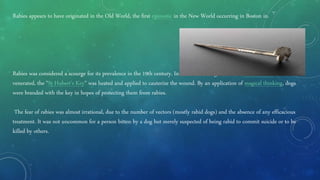
Rabies was considered a scourge for its prevalence in the 19th century. In France and Belgium, where Saint Hubert was
venerated, the "St Hubert's Key" was heated and applied to cauterize the wound. By an application of magical thinking, dogs
were branded with the key in hopes of protecting them from rabies.
The fear of rabies was almost irrational, due to the number of vectors (mostly rabid dogs) and the absence of any efficacious
treatment. It was not uncommon for a person bitten by a dog but merely suspected of being rabid to commit suicide or to be
killed by others.
.This gave Louis Pasteur ample opportunity to test post exposure treatments from 1885.
In ancient times, the attachment of the tongue (the lingual frenulum, a mucous membrane) was cut and removed as this was
where rabies was thought to originate.
It was the 1st century Roman writer Cardanus was the first to identify that the infection was spread through infected saliva
he first modern treatment was developed by the famous Louis Pasteur and Emile Roux in 1895.
Pasteur had reasoned that, since rabies affected the mind, the virus must attack the central nervous system. Pasteur had studied
Edward Jenner’s use of vaccines and believed that he could create one for rabies out of the nervous tissue of a diseased animal.
However, due to the terrible nature of
the disease, he was reluctant to attempt
human trials. His hand was forced by
Joseph Meister’s mother. Joseph,
nine years old, had been attacked and
mauled by a rabid dog in his
hometown of Alsace, France.
Over the next ten days Pasteur treated the child multiple times,
injecting him with the weakened viral vaccine.
Hopefully the child’s immune system would be moved into action long before the virus spread throughout the nervous system
and into the brain (which, by then, would be too late).
Joseph Meister survived and the procedure spread,
becoming the de facto treatment for rabies. However,
like St. Hubert’s Key,
the vaccine was dependent on expediency and quick reactions. Once symptoms
appeared, the patient would invariably die, no matter what.
PATHOGENESIS OF RABBIES
HYDROPHOBIA("fear of water")
It refers to a set of symptoms in the later stages of an infection in which the person has difficulty swallowing, shows panic when
presented with liquids to drink, and cannot quench his or her thirst. Any mammal infected with the virus may demonstrate
hydrophobia.
Saliva production is greatly increased, and attempts to drink, or even the intention or suggestion of drinking, may cause excruciatingly
painful spasms of the muscles in the throat and larynx. This can be attributed to the fact that the virus multiplies and assimilates in the
salivary glands of the infected animal for the purpose of further transmission through biting. The ability to transmit the virus would
decrease significantly if the infected individual could swallow saliva and water.
Hydrophobia is commonly associated with furious rabies, which affects 80% of rabies-infected people. The remaining 20% may experience a paralytic
form of rabies that is marked by muscle weakness, loss of sensation, and paralysis; this form of rabies does not usually cause fear of water
Differential diagnosis
The differential diagnosis in a case of suspected human rabies may initially include any cause of encephalitis, in particular infection
with viruses such as herpesviruses, enteroviruses, and arboviruses such as West Nile virus. The most important viruses to rule out
are herpes simplex virus type one, varicella zoster virus, and (less commonly) enteroviruses, including coxsackieviruses, echoviruses,
polioviruses, and human enteroviruses
New causes of viral encephalitis are also possible, as was evidenced by the 1999 outbreak in Malaysia of 300 cases of encephalitis
with a mortality rate of 40% caused by Nipah virus, a newly recognized paramyxovirus.
Likewise, well-known viruses may be introduced into new locales, as is illustrated by the outbreak of encephalitis due to West Nile
virus in the eastern United States.
Epidemiologic factors, such as season, geographic location, and the patient's age, travel history, and possible exposure to bites,
rodents, and ticks, may help direct the diagnosis
Rabies vaccine is a vaccine used to prevent rabies.
There are a number of vaccines available that are both safe and effective.[
They can be used to prevent rabies before and for a period of time after exposure to the virus such as by a dog or bat bite.
The immunity that develops is long lasting after a full course.
Doses are usually given by injection into the skin or muscle.
After exposure vaccination is typically used along with rabies immunoglobulin.
It is recommended that those who are at high risk of exposure be vaccinated before potential exposure.
Vaccines are effective in humans and other animals.
Vaccinating dogs is very effective in preventing the spread of rabies to humans.
Rabies vaccines may be safely used in all age groups.
About 35 to 45 percent of people develop a brief period of redness and pain
at the injection site.
About 5 to 15 percent of people may have fever, headaches, or nausea.
After exposure to rabies there is no contraindication to its use. Most vaccines
do not contain thimerosal. Vaccines made from nerve tissue are used in a few
countries, mainly in Asia and Latin America, but are less effective and have
greater side effects.[Their use is thus not recommended by the World Health
Organization.
Prognosis
In unvaccinated humans, rabies is almost always fatal after neurological symptoms have developed.[78]
Vaccination after exposure, PEP, is highly successful in preventing the disease if administered promptly,
in general within 6 days of infection. Begun with little or no delay, PEP is 100% effective against
rabies.[16] In the case of significant delay in administering PEP, the treatment still has a chance of
success.[23]
Five of the first 43 patients (12%) treated with the Milwaukee protocol survived, and those receiving
treatment survived longer than those not receiving the treatment.
Rabies presentation
Rabies presentation

Rabies presentation

  • 1.
    RABIES SURGICAL DEPT SUMYSTATE UNIVERSIT BY OMEJE EMMANUEL ORDILLIAH CHEROTICH GROUP 520
  • 3.
    Etymology The term isderived from the Latin rabies, "madness". This, in turn, may be related to the Sanskrit rabhas, "to do violence". The Greeks derived the word lyssa, from lud or "violent"; this root is used in the genus name of the rabies virus, Lyssavirus Rabies has been known since around 2000 B.C.[92] The first written record of rabies is in the Mesopotamian Codex of Eshnunna (circa 1930 BC), which dictates that the owner of a dog showing symptoms of rabies should take preventive measure against bites. If another person were bitten by a rabid dog and later died, the owner was heavily fined
  • 4.
    Rabies appears tohave originated in the Old World, the first epizootic in the New World occurring in Boston in. Rabies was considered a scourge for its prevalence in the 19th century. In France and Belgium, where Saint Hubert was venerated, the "St Hubert's Key" was heated and applied to cauterize the wound. By an application of magical thinking, dogs were branded with the key in hopes of protecting them from rabies. The fear of rabies was almost irrational, due to the number of vectors (mostly rabid dogs) and the absence of any efficacious treatment. It was not uncommon for a person bitten by a dog but merely suspected of being rabid to commit suicide or to be killed by others.
  • 5.
    .This gave LouisPasteur ample opportunity to test post exposure treatments from 1885. In ancient times, the attachment of the tongue (the lingual frenulum, a mucous membrane) was cut and removed as this was where rabies was thought to originate. It was the 1st century Roman writer Cardanus was the first to identify that the infection was spread through infected saliva
  • 6.
    he first moderntreatment was developed by the famous Louis Pasteur and Emile Roux in 1895. Pasteur had reasoned that, since rabies affected the mind, the virus must attack the central nervous system. Pasteur had studied Edward Jenner’s use of vaccines and believed that he could create one for rabies out of the nervous tissue of a diseased animal. However, due to the terrible nature of the disease, he was reluctant to attempt human trials. His hand was forced by Joseph Meister’s mother. Joseph, nine years old, had been attacked and mauled by a rabid dog in his hometown of Alsace, France.
  • 7.
    Over the nextten days Pasteur treated the child multiple times, injecting him with the weakened viral vaccine. Hopefully the child’s immune system would be moved into action long before the virus spread throughout the nervous system and into the brain (which, by then, would be too late). Joseph Meister survived and the procedure spread, becoming the de facto treatment for rabies. However, like St. Hubert’s Key, the vaccine was dependent on expediency and quick reactions. Once symptoms appeared, the patient would invariably die, no matter what.
  • 9.
  • 10.
    HYDROPHOBIA("fear of water") Itrefers to a set of symptoms in the later stages of an infection in which the person has difficulty swallowing, shows panic when presented with liquids to drink, and cannot quench his or her thirst. Any mammal infected with the virus may demonstrate hydrophobia. Saliva production is greatly increased, and attempts to drink, or even the intention or suggestion of drinking, may cause excruciatingly painful spasms of the muscles in the throat and larynx. This can be attributed to the fact that the virus multiplies and assimilates in the salivary glands of the infected animal for the purpose of further transmission through biting. The ability to transmit the virus would decrease significantly if the infected individual could swallow saliva and water.
  • 11.
    Hydrophobia is commonlyassociated with furious rabies, which affects 80% of rabies-infected people. The remaining 20% may experience a paralytic form of rabies that is marked by muscle weakness, loss of sensation, and paralysis; this form of rabies does not usually cause fear of water
  • 12.
    Differential diagnosis The differentialdiagnosis in a case of suspected human rabies may initially include any cause of encephalitis, in particular infection with viruses such as herpesviruses, enteroviruses, and arboviruses such as West Nile virus. The most important viruses to rule out are herpes simplex virus type one, varicella zoster virus, and (less commonly) enteroviruses, including coxsackieviruses, echoviruses, polioviruses, and human enteroviruses New causes of viral encephalitis are also possible, as was evidenced by the 1999 outbreak in Malaysia of 300 cases of encephalitis with a mortality rate of 40% caused by Nipah virus, a newly recognized paramyxovirus. Likewise, well-known viruses may be introduced into new locales, as is illustrated by the outbreak of encephalitis due to West Nile virus in the eastern United States. Epidemiologic factors, such as season, geographic location, and the patient's age, travel history, and possible exposure to bites, rodents, and ticks, may help direct the diagnosis
  • 15.
    Rabies vaccine isa vaccine used to prevent rabies. There are a number of vaccines available that are both safe and effective.[ They can be used to prevent rabies before and for a period of time after exposure to the virus such as by a dog or bat bite. The immunity that develops is long lasting after a full course. Doses are usually given by injection into the skin or muscle. After exposure vaccination is typically used along with rabies immunoglobulin. It is recommended that those who are at high risk of exposure be vaccinated before potential exposure. Vaccines are effective in humans and other animals. Vaccinating dogs is very effective in preventing the spread of rabies to humans.
  • 16.
    Rabies vaccines maybe safely used in all age groups. About 35 to 45 percent of people develop a brief period of redness and pain at the injection site. About 5 to 15 percent of people may have fever, headaches, or nausea. After exposure to rabies there is no contraindication to its use. Most vaccines do not contain thimerosal. Vaccines made from nerve tissue are used in a few countries, mainly in Asia and Latin America, but are less effective and have greater side effects.[Their use is thus not recommended by the World Health Organization.
  • 18.
    Prognosis In unvaccinated humans,rabies is almost always fatal after neurological symptoms have developed.[78] Vaccination after exposure, PEP, is highly successful in preventing the disease if administered promptly, in general within 6 days of infection. Begun with little or no delay, PEP is 100% effective against rabies.[16] In the case of significant delay in administering PEP, the treatment still has a chance of success.[23] Five of the first 43 patients (12%) treated with the Milwaukee protocol survived, and those receiving treatment survived longer than those not receiving the treatment.