Download to read offline
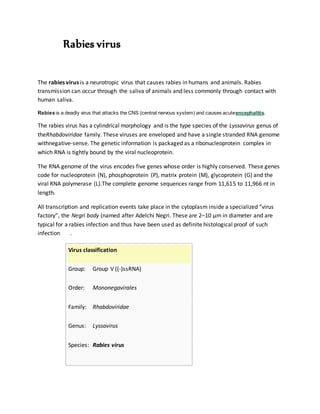
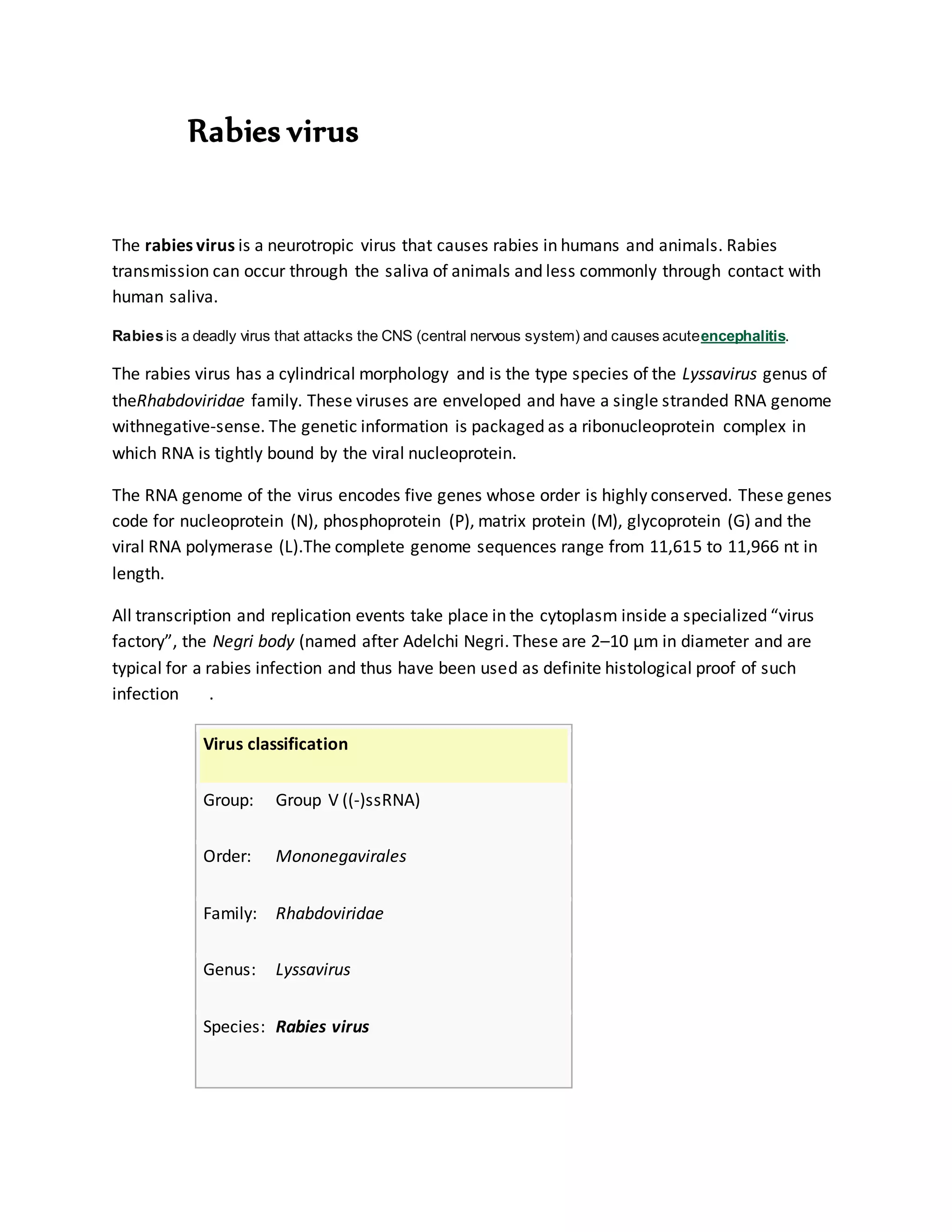
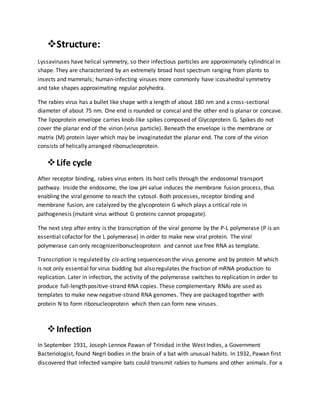
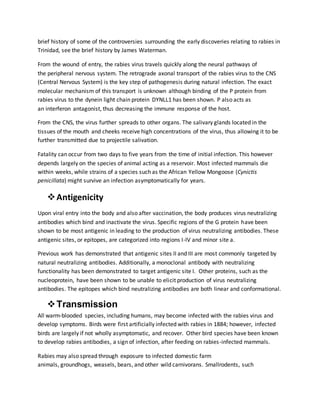
![as squirrels, hamsters, guinea pigs, gerbils, chipmunks, rats, and mice, and lagomorphs such
as rabbits and hares, are almost never found to be infected with rabies and are not known to
transmit rabies to humans. Bites from mice, rats, or squirrels rarely require rabies prevention
because these rodents are typically killed by any encounter with a larger, rabid animal, and
would, therefore, not be carriers. The Virginia opossum is resistant but not immune to rabies.
The virus is usually present in the nerves and saliva of a symptomatic rabid animal. The route
of infection is usually, but not always, by a bite. In many cases, the infected animal is
exceptionally aggressive, may attack without provocation, and exhibits otherwise
uncharacteristic behavior. This is an example of a viral pathogen modifying the behavior of its
host to facilitate its transmission to other hosts.
Evolution
All extant rabies viruses appear to have evolved within the last 1500 years. There are seven
genotypes of rabies virus. In Eurasia cases are due to three of these—genotype 1 (classical
rabies) and to a lesser extent genotypes 5 and 6 (European bat lyssaviruses type-1 and -2).
Genotype 1 evolved in Europe in the 17th century and spread to Asia, Africa and the Americas
as a result of European exploration and colonization.
Bat rabies in North America appears to have been present since 1281 CE (95% confidence
interval: 906–1577 CE).
Rabies vaccine
A rabies vaccine is a vaccine used to prevent rabies.[1] There are a number of available vaccines
that are both safe and effective. They can be used to prevent rabies before and for a period of
time after exposure to the virus such as by a dog or bat bite. The immunity that develops is long
lasting after three doses. They are usually given by injection into the skin or muscle.
After exposure vaccination is typically used along with rabies immunoglobulin. It is
recommended that those who are at high risk of exposure be vaccinated before potential
exposure. Vaccines are effective in humans and other animals. Immunizing dogs is very
effective in preventing human disease.
They may be safely used in all age groups. About 35 to 45 percent of people develop a brief
period of redness and pain at the injection site. About 5 to 15 percent of people may
have fever,headaches or nausea. After exposure to rabies there is no contraindication to its
use. Most vaccines do not contain thimerosal.](https://image.slidesharecdn.com/rabiesvirus-151102162332-lva1-app6891/85/Rabies-virus-4-320.jpg)
![Vaccines made from nerve tissue, and relied upon by a few countries, mainly in Asia and Latin
America, are less effective and have greater side effects.Their use is thus not recommended by
the World Health Organization.
Millions of people globally have been vaccinated and it is estimated that this saves more than
250,000 people a year.]It is on the World Health Organization's List of Essential Medicines, the
most important medication recommended for a basic health system.
Duck embryo vaccine
Purified Duck embryo vaccine (PDEV) was the first vaccine developed for human use in treating
pre- and postexposure to the rabies virus. It was developed in 1957 and was made of dried,
killed rabies virus. Vaccination with DEV involved a series of intradermal injections over several
days.
The World Health Organization still includes DEV in its list of recommended vaccines for
treatment of rabies virus exposure. However, newer vaccines are more commonly used. These
include the human diploid cell vaccine (HDCV) first introduced in 1978; purified chicken embyro
cell vaccine (PCECV), developed in 1984; and a purified Vero cell rabies vaccine (PVCRV)
developed in 1986.
Application
Rabies virus is used in research for viral neuronal tracing to establish synaptic connections and
directionality of synaptic transmission.
References
1. "Rabies Fact Sheet N°99". World Health Organization. July2013. Retrieved 28 February2014.
2. ^ Jump up to:a b c
Cotran RS, Kumar V, Fausto N (2005). Robbinsand Cotran Pathologic Basisof Disease (7th ed.).
Elsevier/Saunders. p. 1375.ISBN 0-7216-0187-1.
3. Jump up^"Rabies, Australian bat lyssavirus and other lyssaviruses". The Department of Health. Dec 2013. Retrieved 1
March 2014.
4. ^ Jump up to:a b c
Tintinalli, Judith E. (2010). EmergencyMedicine: A Comprehensive StudyGuide (EmergencyMedicine
(Tintinalli)). McGraw-Hill. pp. Chapter 152. ISBN 0-07-148480-9.
5. Jump up^William H. Wunner (2010). Rabies: Scientific Basis of the Disease and Its Management. Academic Press.
p. 556. ISBN 9780080550091.
6. Jump up^Hemachudha T, Ugolini G, Wacharapluesadee S, Sungkarat W, Shuangshoti S, Laothamatas J (May2013).
"Human rabies: neuropathogenesis, diagnosis, and management.". Lancet neurology 12(5): 498–
513. doi:10.1016/s1474-4422(13)70038-3.PMID 23602163.](https://image.slidesharecdn.com/rabiesvirus-151102162332-lva1-app6891/85/Rabies-virus-5-320.jpg)

The rabies virus causes rabies in humans and animals through transmission via saliva. It is a neurotropic virus that attacks the central nervous system. The virus has a bullet-like shape and encodes 5 genes in its RNA genome. It enters host cells through endocytosis mediated by the glycoprotein and then hijacks the host cell machinery to replicate. The virus spreads from the site of infection along neural pathways to the brain and then to salivary glands. A post-exposure vaccine is effective but must be administered promptly along with immunoglobulin to prevent fatal rabies.


![CTEV [ clubfoot] DR ARUN LAL ,DR MOHAMED ASHRAF travancore medical college k...](https://cdn.slidesharecdn.com/ss_thumbnails/ctevclubfootdrarunlaldrmohamedashraftravancoremedicalcollegekollamkeralaindia-260208063247-18fc466c-thumbnail.jpg?width=640&height=640&fit=bounds)


