
Concepts of health, disease & its dimensions
By: Prof: Najeeb Memon, BMC< LUMHS, Jamshoro, Pakistan
PROF: NAJEEB MEMON
COMMUNITY MEDICINE DEPTT:
BMC, LUMHS, JAMSHORO
PAKISTAN
Concepts
of health, disease & its dimensions
 Introduction to Community Medicine
 Concept of Health
 Concept of Disease
 Concept of Prevention
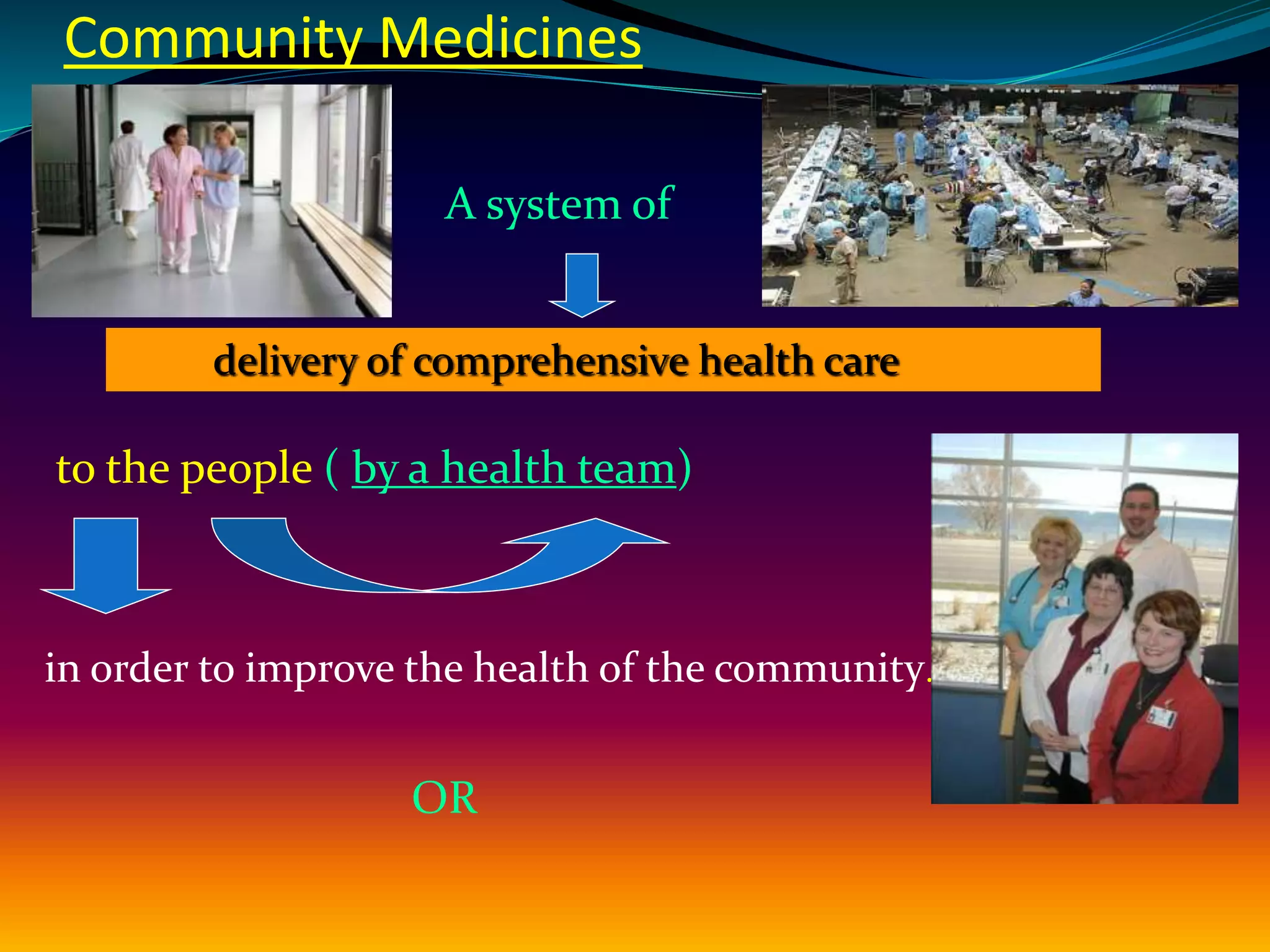
Community Medicines
A system of
to the people ( by a health team)
in order to improve the health of the community.
OR
delivery of comprehensive health care
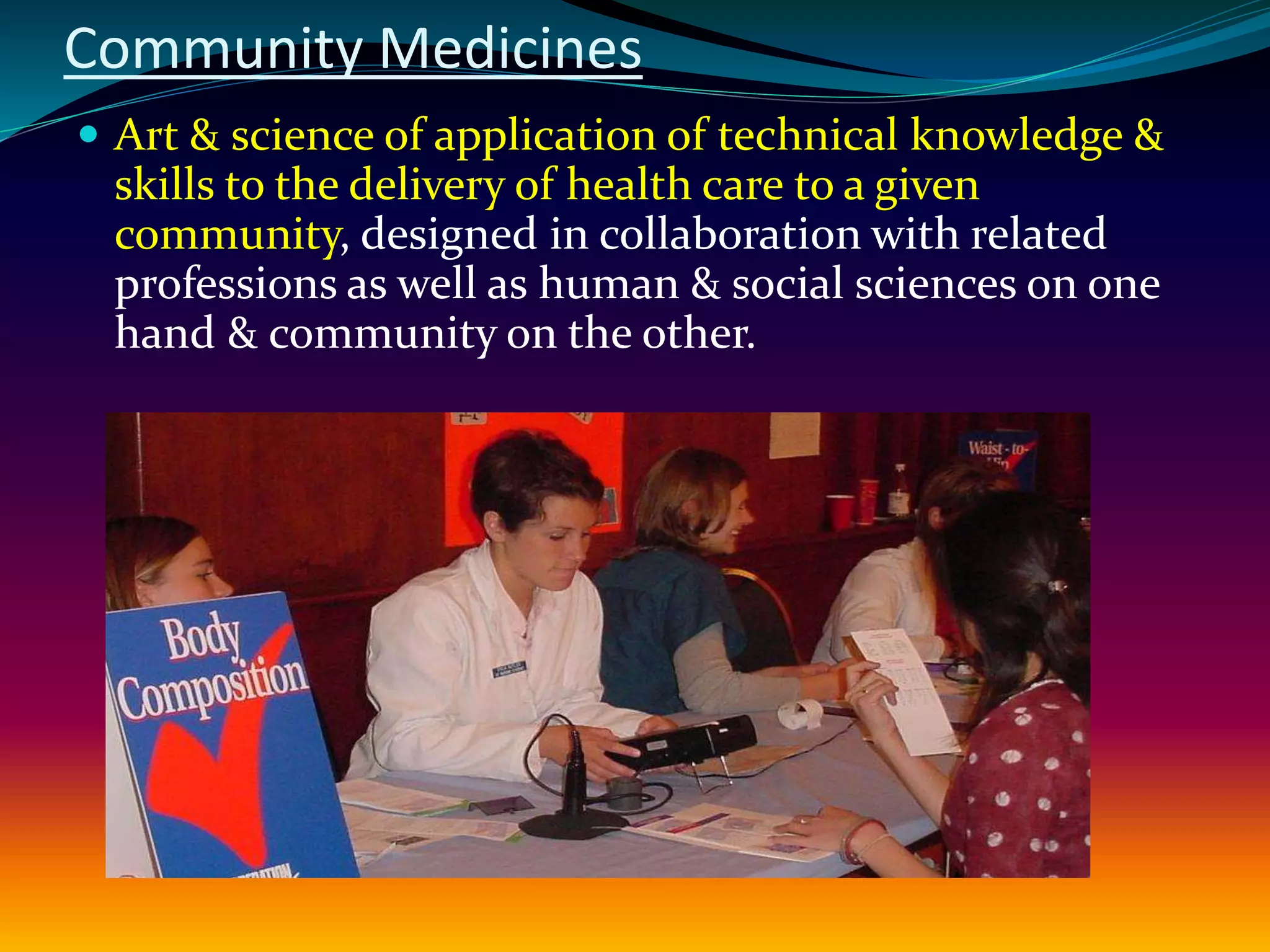
Community Medicines
 Art & science of application of technical knowledge &
skills to the delivery of health care to a given
community, designed in collaboration with related
professions as well as human & social sciences on one
hand & community on the other.
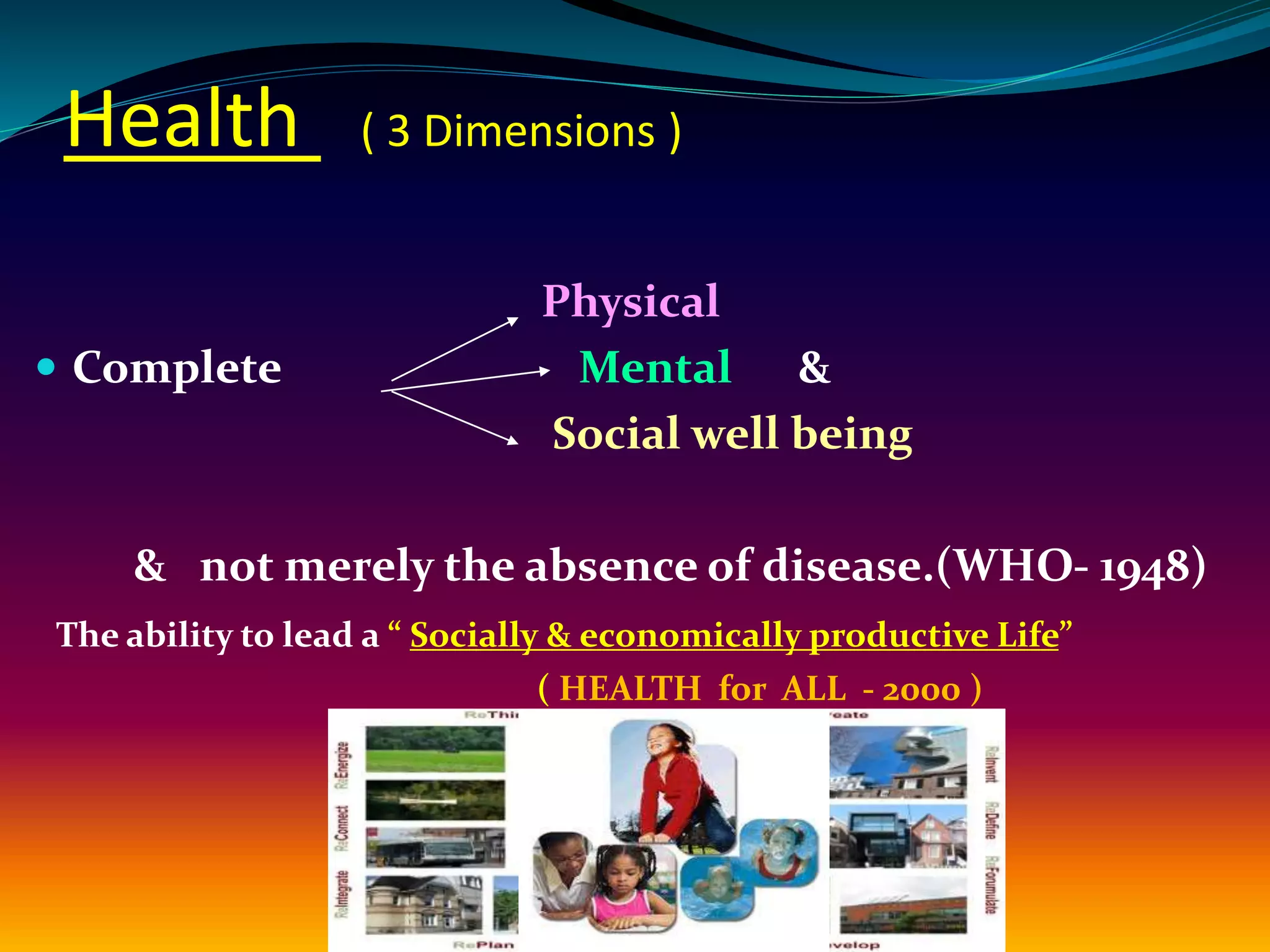
Health ( 3 Dimensions )
Physical
 Complete Mental &
Social well being
& not merely the absence of disease.(WHO- 1948)
The ability to lead a “ Socially & economically productive Life”
( HEALTH for ALL - 2000 )
Concepts
1. Biomedical concepts
2. Ecological concepts
3. Psychosocial concepts
4. Holistic concepts
Changing Concepts
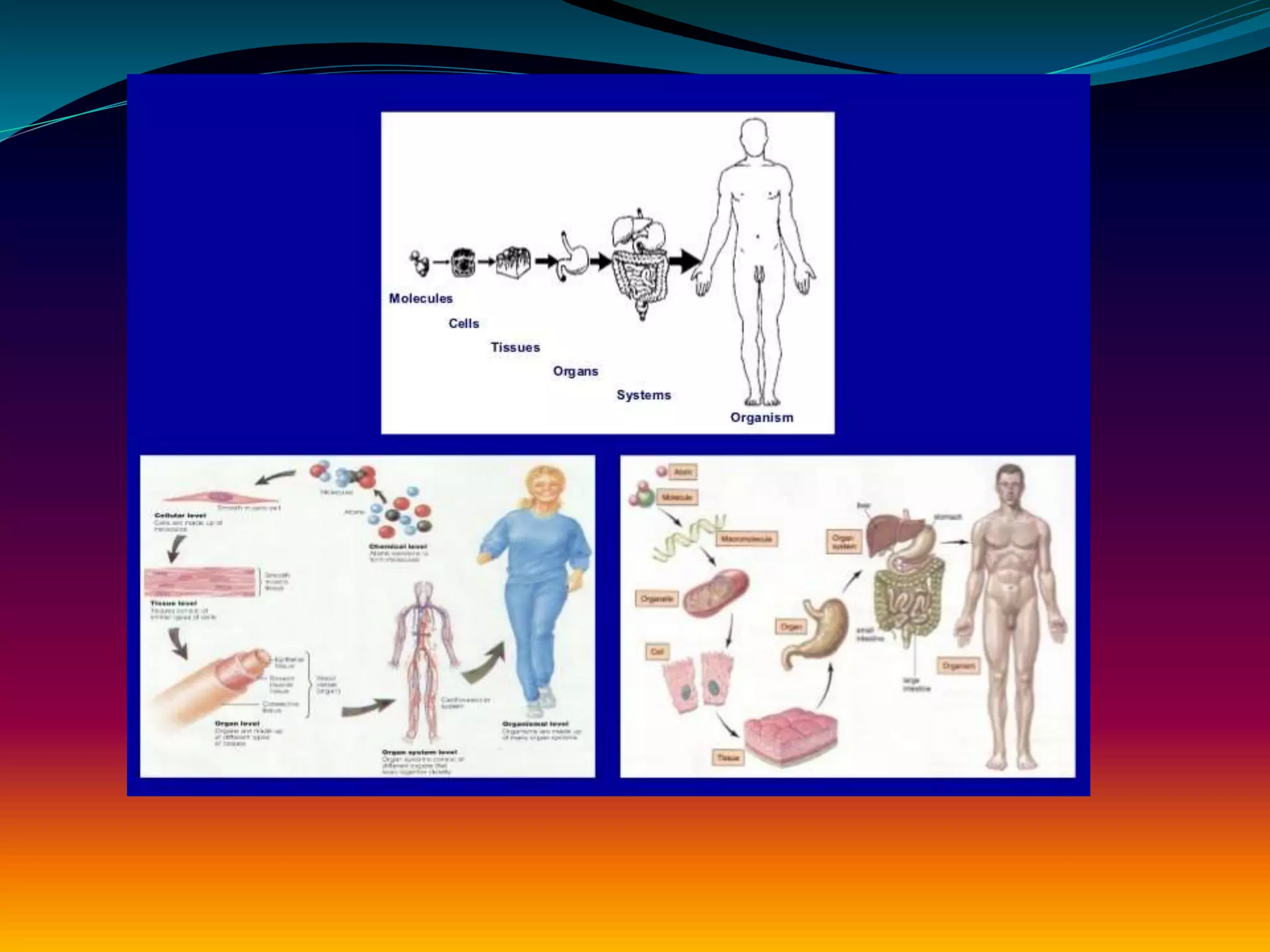
1. Biomedical concepts
 Absence of disease
 Free from disease
 Medical profession viewed human body as a
machine
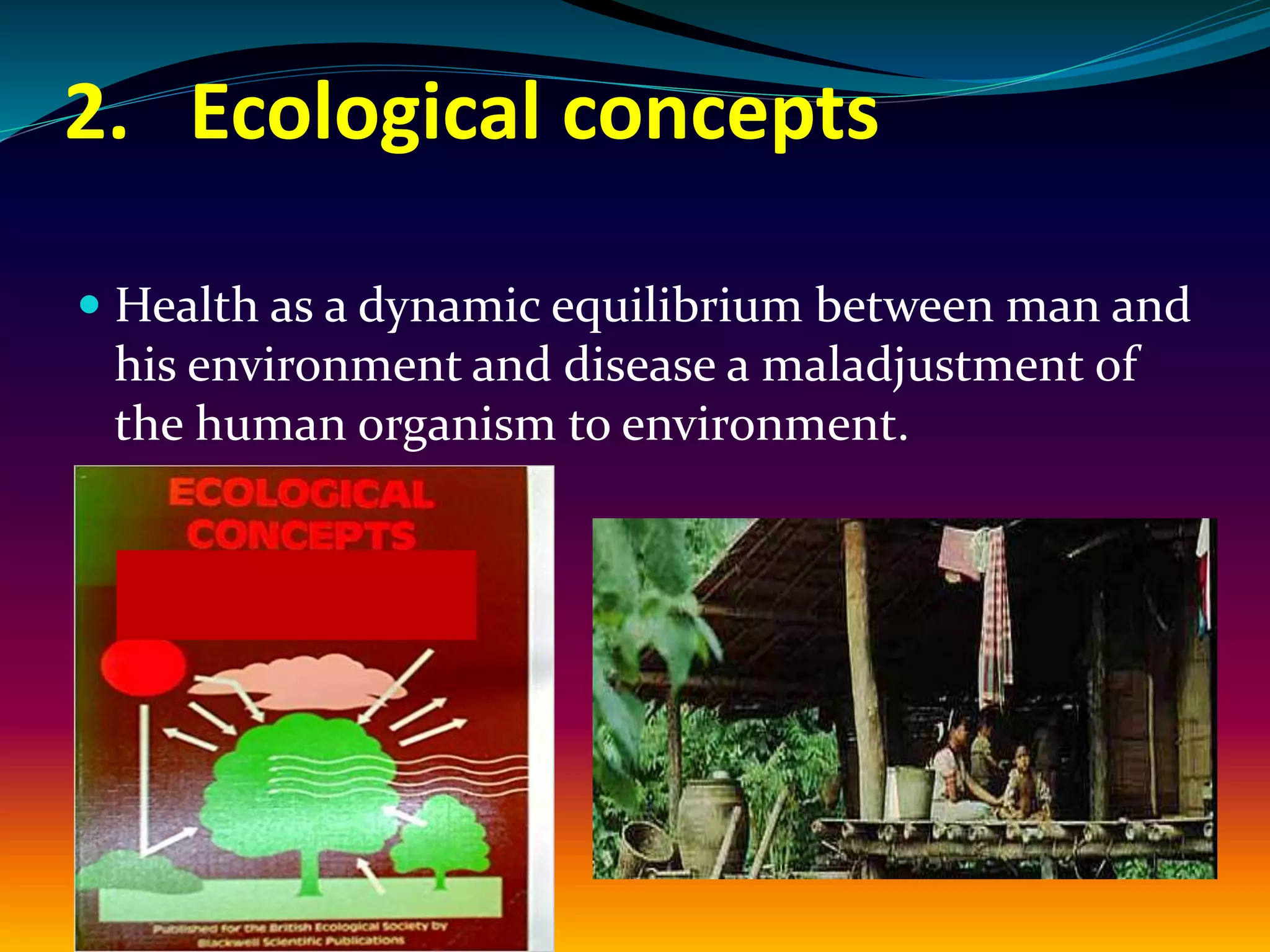
2. Ecological concepts
 Health as a dynamic equilibrium between man and
his environment and disease a maladjustment of
the human organism to environment.
3. Psychosocial concepts
 Health is influenced by:
social, psychological , cultural , economic and
political factors
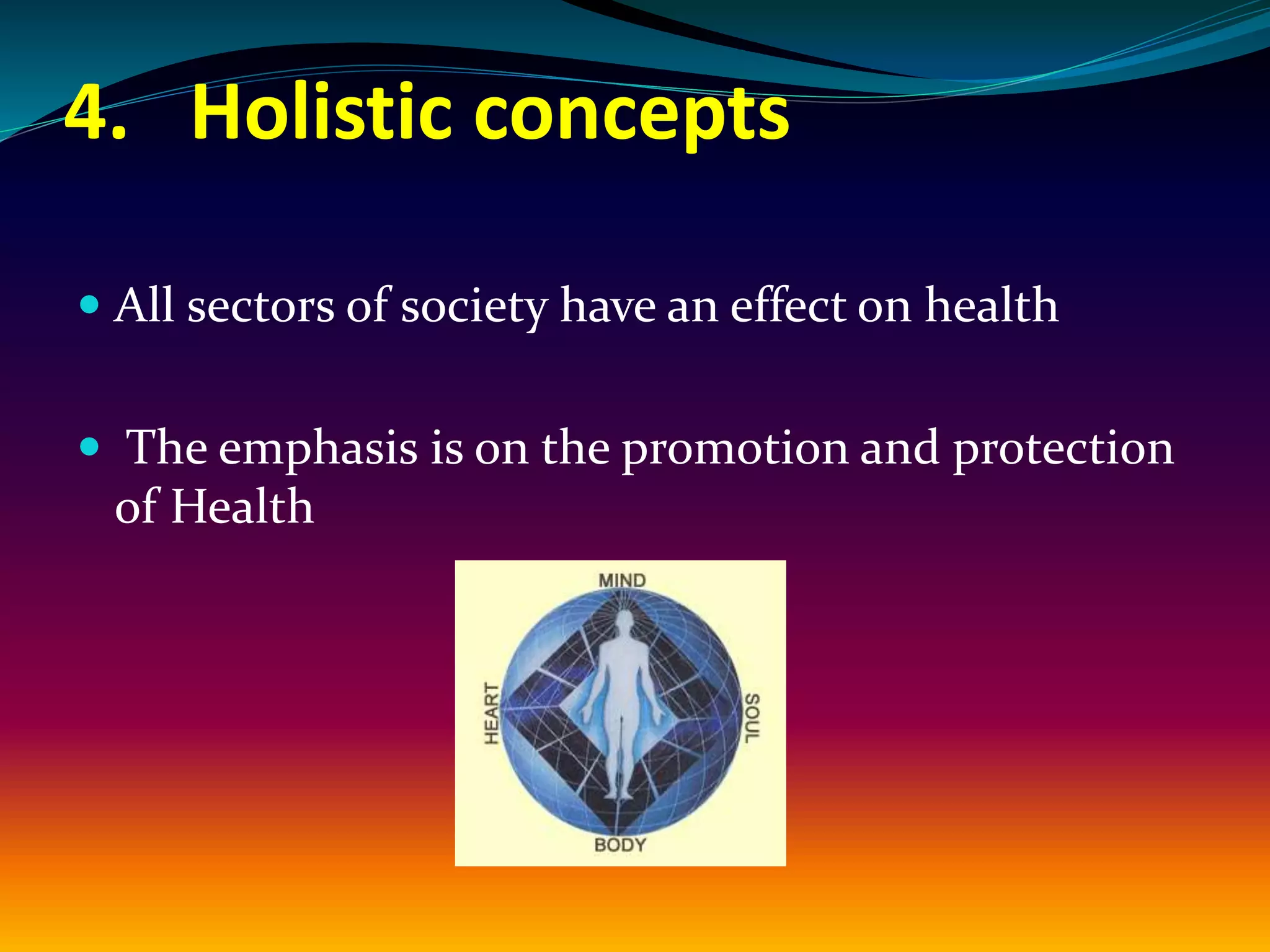
4. Holistic concepts
 All sectors of society have an effect on health
 The emphasis is on the promotion and protection
of Health
Dimensions
Dimensions of Health
 Physical
 Mental
 Social
 Spiritual
 Emotional
 Vocational
 Political
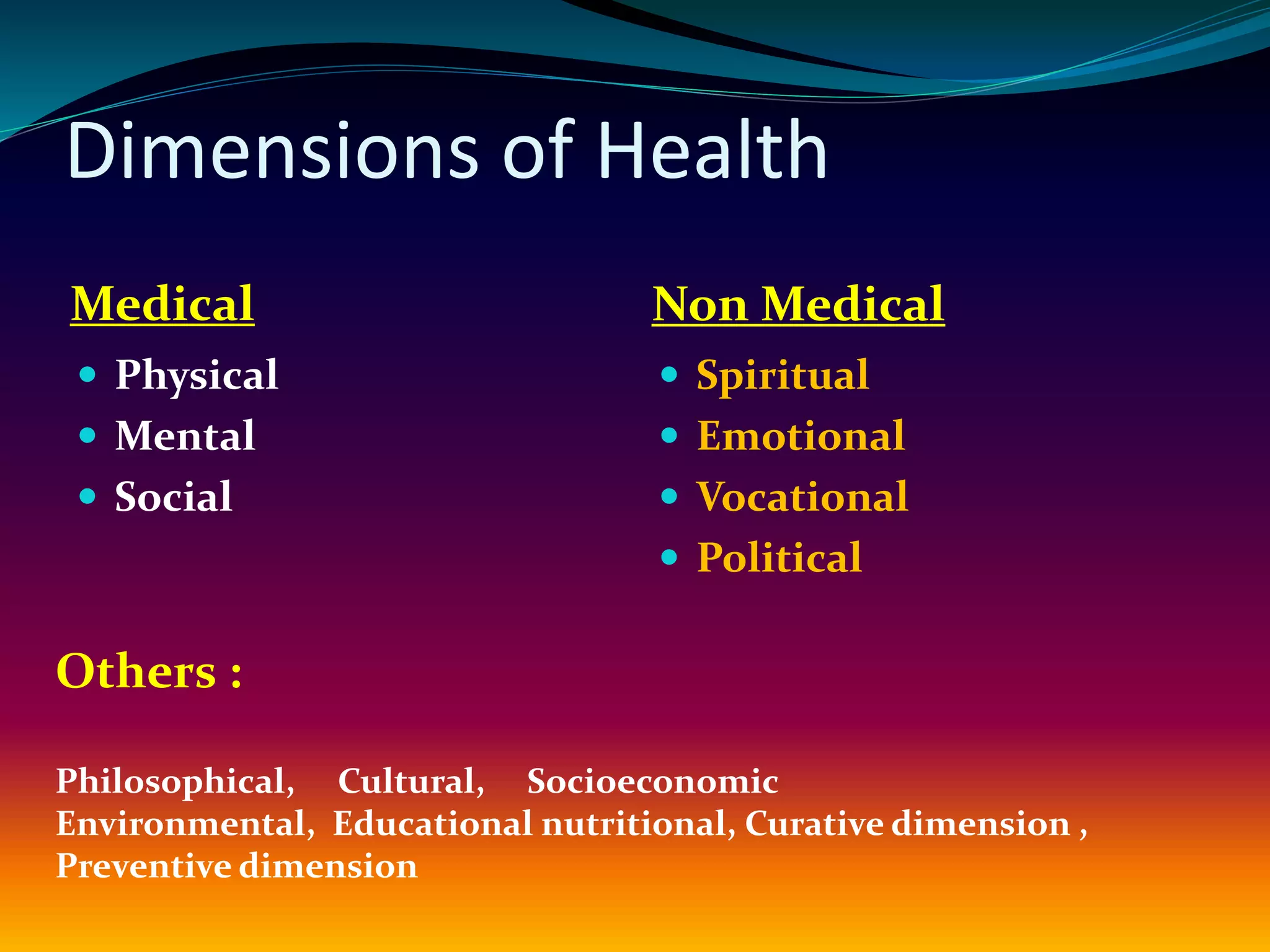
Dimensions of Health
Medical Non Medical
 Physical
 Mental
 Social
 Spiritual
 Emotional
 Vocational
 Political
Others :
Philosophical, Cultural, Socioeconomic
Environmental, Educational nutritional, Curative dimension ,
Preventive dimension
Physical Dimension
 The state of physical health implies the notion of
perfect functioning of the body.
 Every cell and every organ functioning at
optimum capacity and perfect harmony with the
rest of the body.
Characteristics: A good complexion, bright eyes , not too fat, Good appetite,
Sound sleep, Smooth easily coordinated bodily movements,
All organs of normal size and functioning normally
Pulse rate, BP exercise tolerance within normal ranges
Mental Dimension
Mental health is not mere absence of mental illness
Ability to respond to varied experiences of life
“ a state of balance between the individual and
surrounding world, a state of harmony between
oneself and others
Characteristics of Mentally healthy person
Free from internal conflicts , Well adjusted, Searches for identity,
Strong sense of self-esteem, Knows himself, his needs, problems and goals
Good self control, Coping with stress and anxiety.
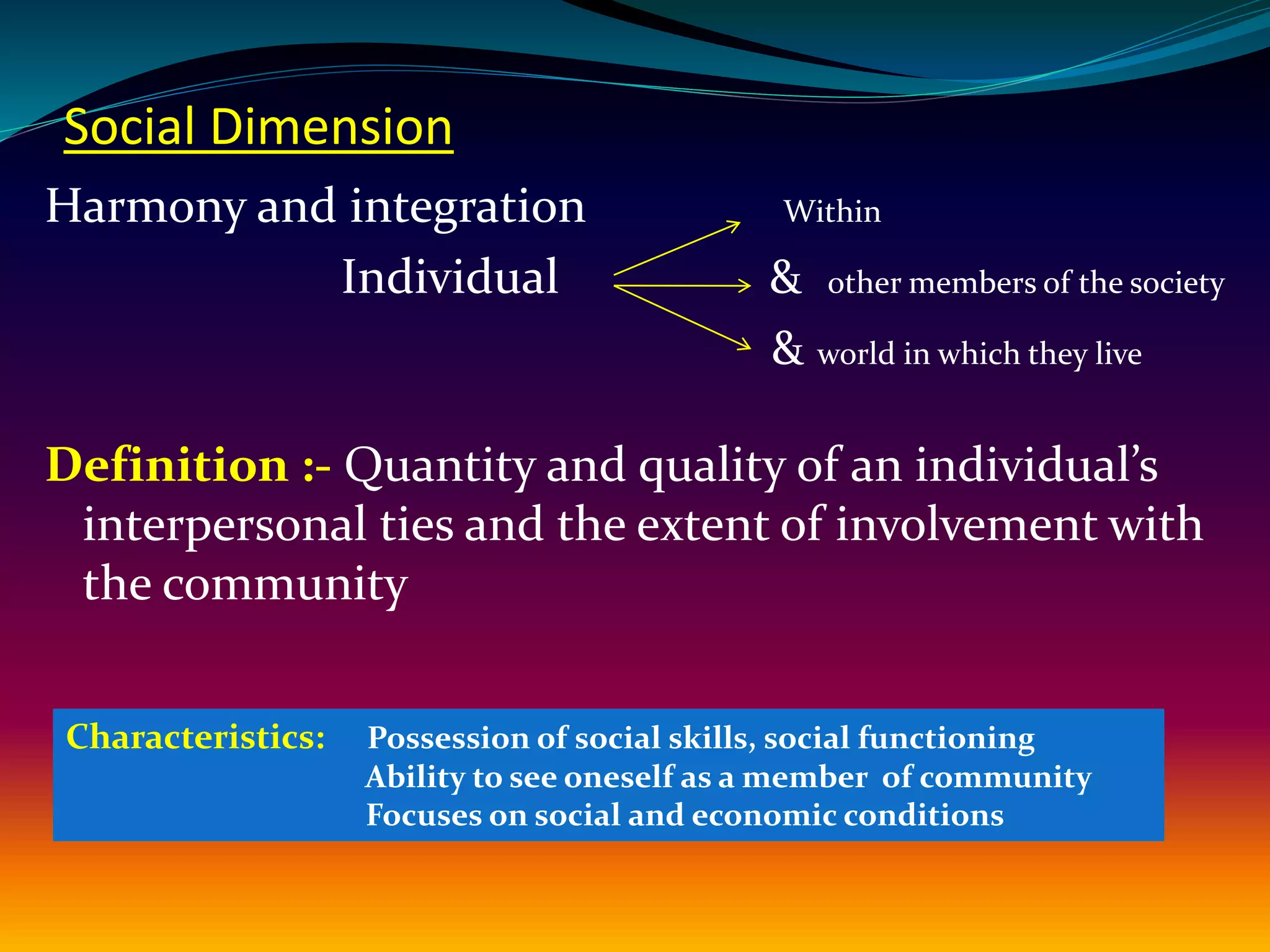
Social Dimension
Harmony and integration Within
Individual & other members of the society
& world in which they live
Definition :- Quantity and quality of an individual’s
interpersonal ties and the extent of involvement with
the community
Characteristics: Possession of social skills, social functioning
Ability to see oneself as a member of community
Focuses on social and economic conditions
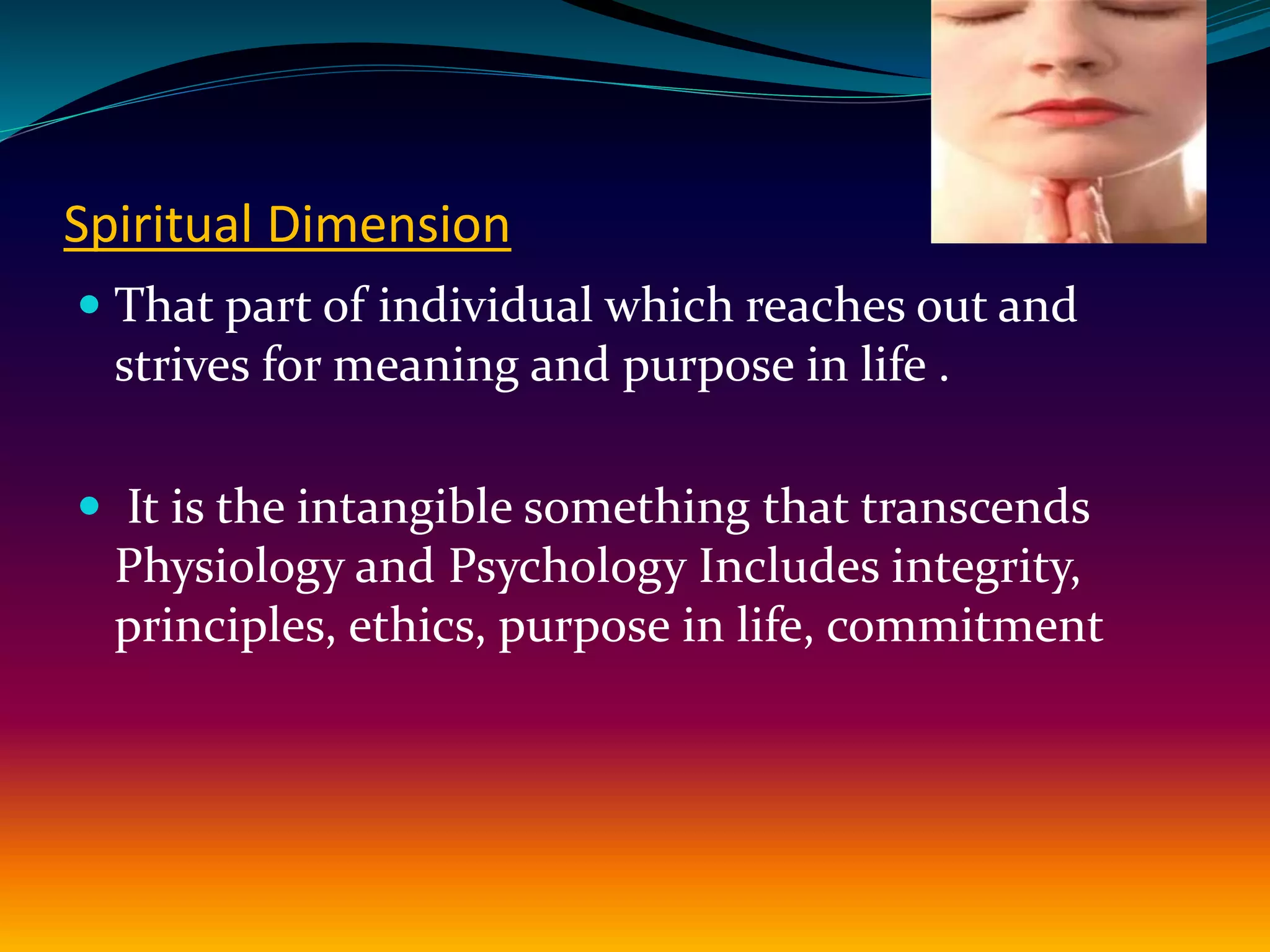
Spiritual Dimension
 That part of individual which reaches out and
strives for meaning and purpose in life .
 It is the intangible something that transcends
Physiology and Psychology Includes integrity,
principles, ethics, purpose in life, commitment
Emotional dimension
 of wellness emphasizes an awareness and
acceptance of one's feelings
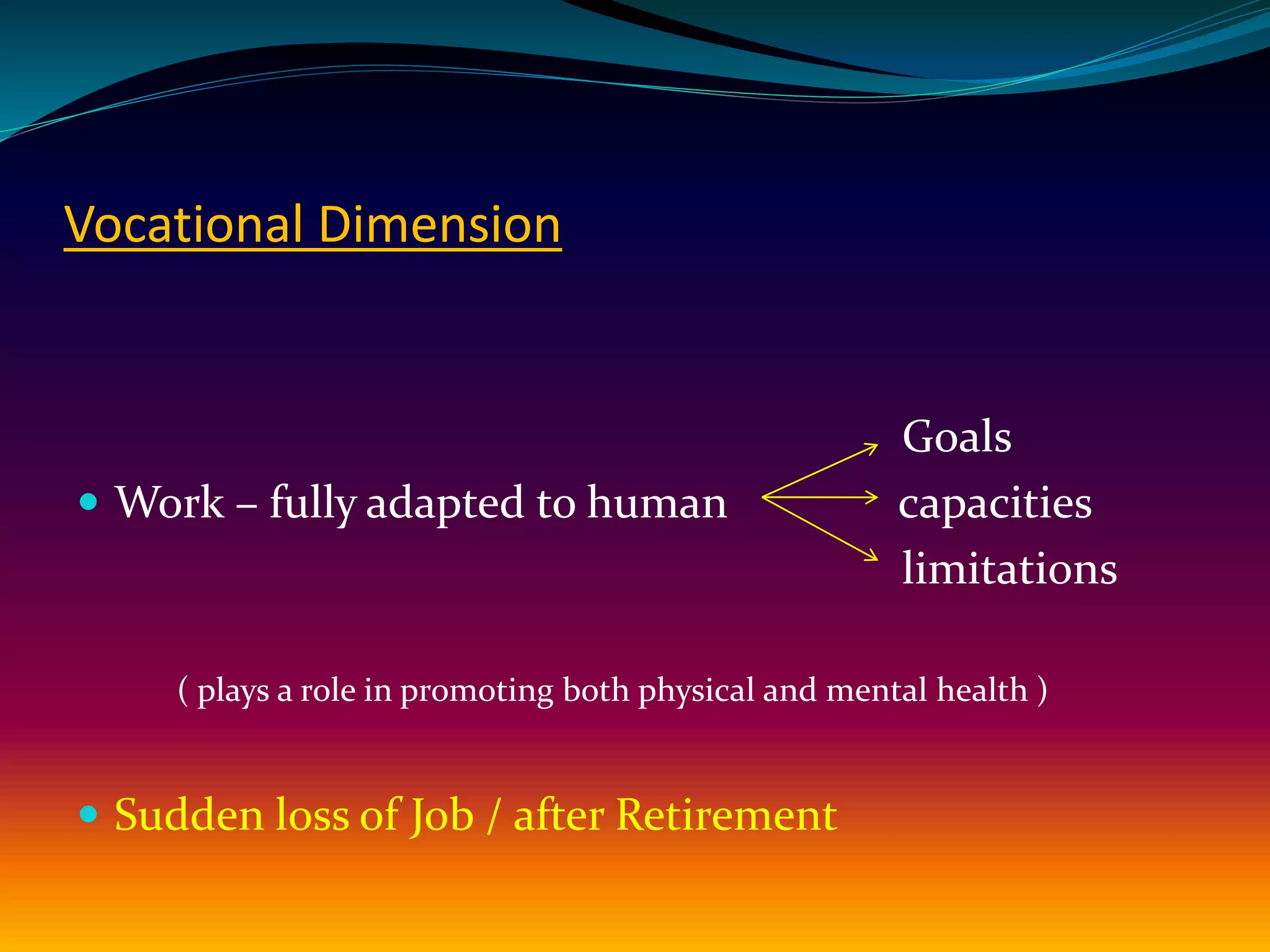
Vocational Dimension
Goals
 Work – fully adapted to human capacities
limitations
( plays a role in promoting both physical and mental health )
 Sudden loss of Job / after Retirement
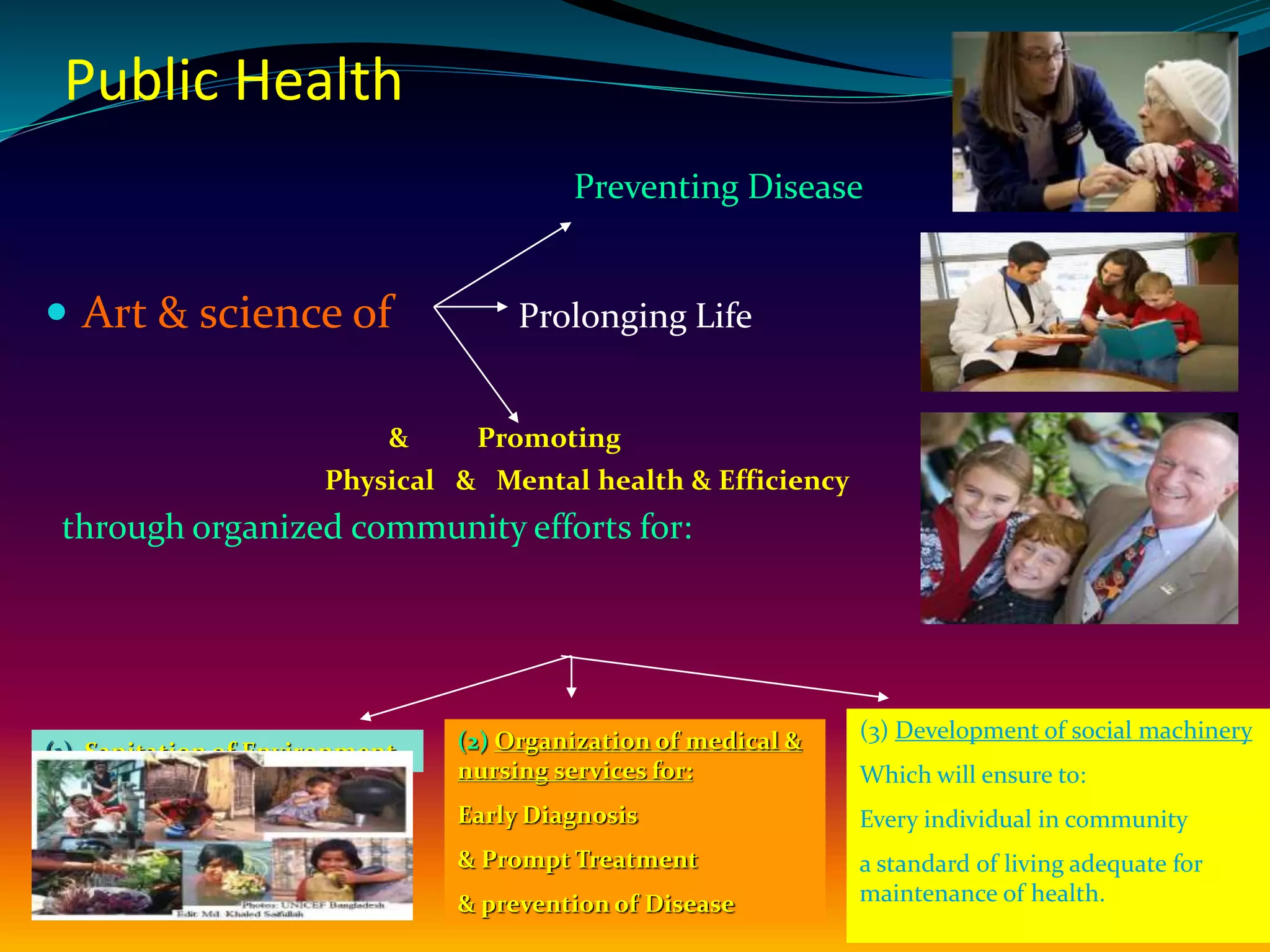
Public Health
Preventing Disease
 Art & science of Prolonging Life
& Promoting
Physical & Mental health & Efficiency
through organized community efforts for:
(1) Sanitation of Environment (2) Organization of medical &
nursing services for:
Early Diagnosis
& Prompt Treatment
& prevention of Disease
(3) Development of social machinery
Which will ensure to:
Every individual in community
a standard of living adequate for
maintenance of health.
Community Medicine & Public health
 It is an aspect of medical
practice.
Along with:
Biostatistics
Epidemiology
& other fields.
 Public Health is a “basic
science” of Community
Medicine.
 “Public” word refers to the
people of community, who
decide that concerned
action is needed, to
accomplish its goals.
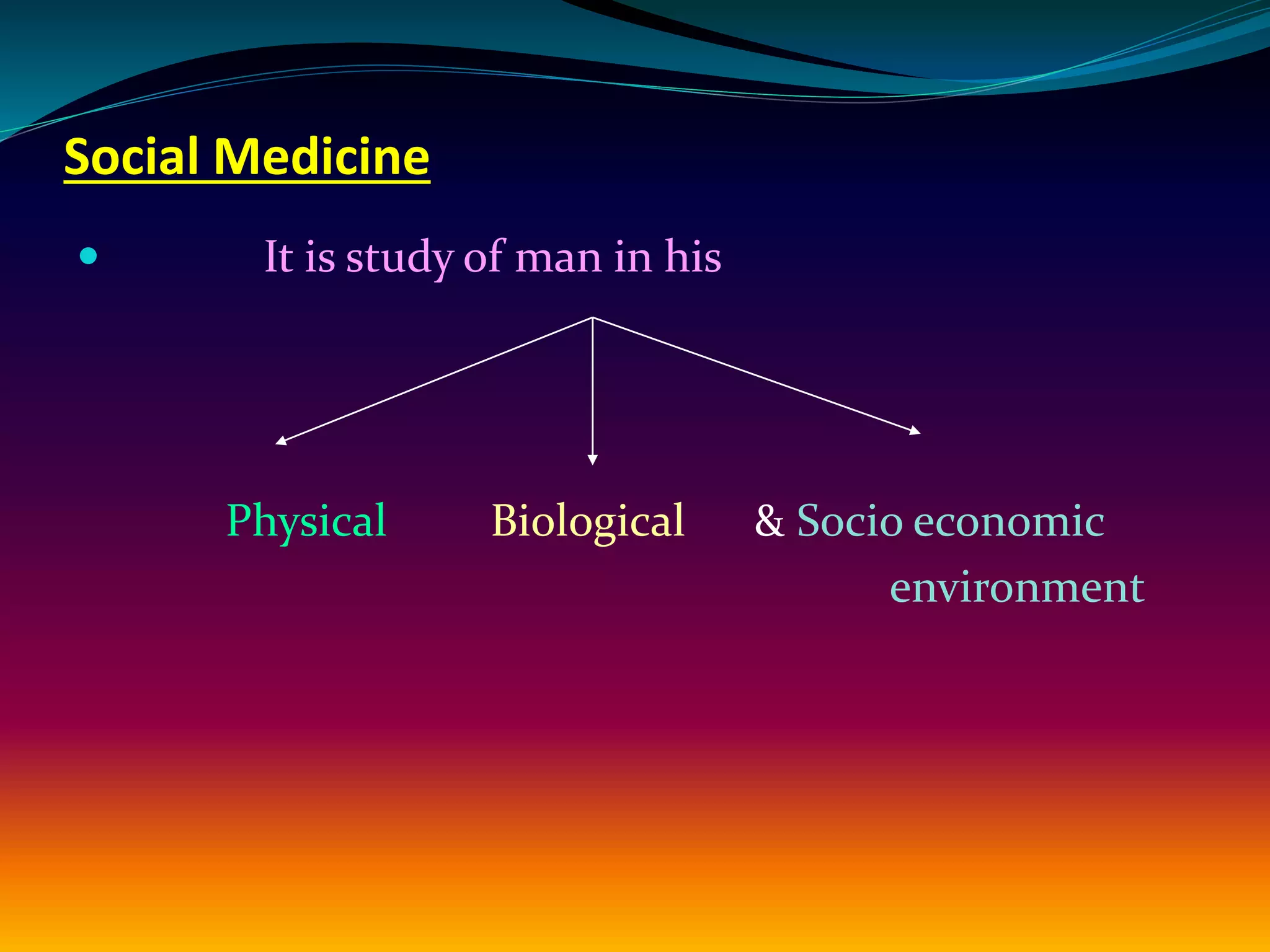
Social Medicine
 It is study of man in his
Physical Biological & Socio economic
environment
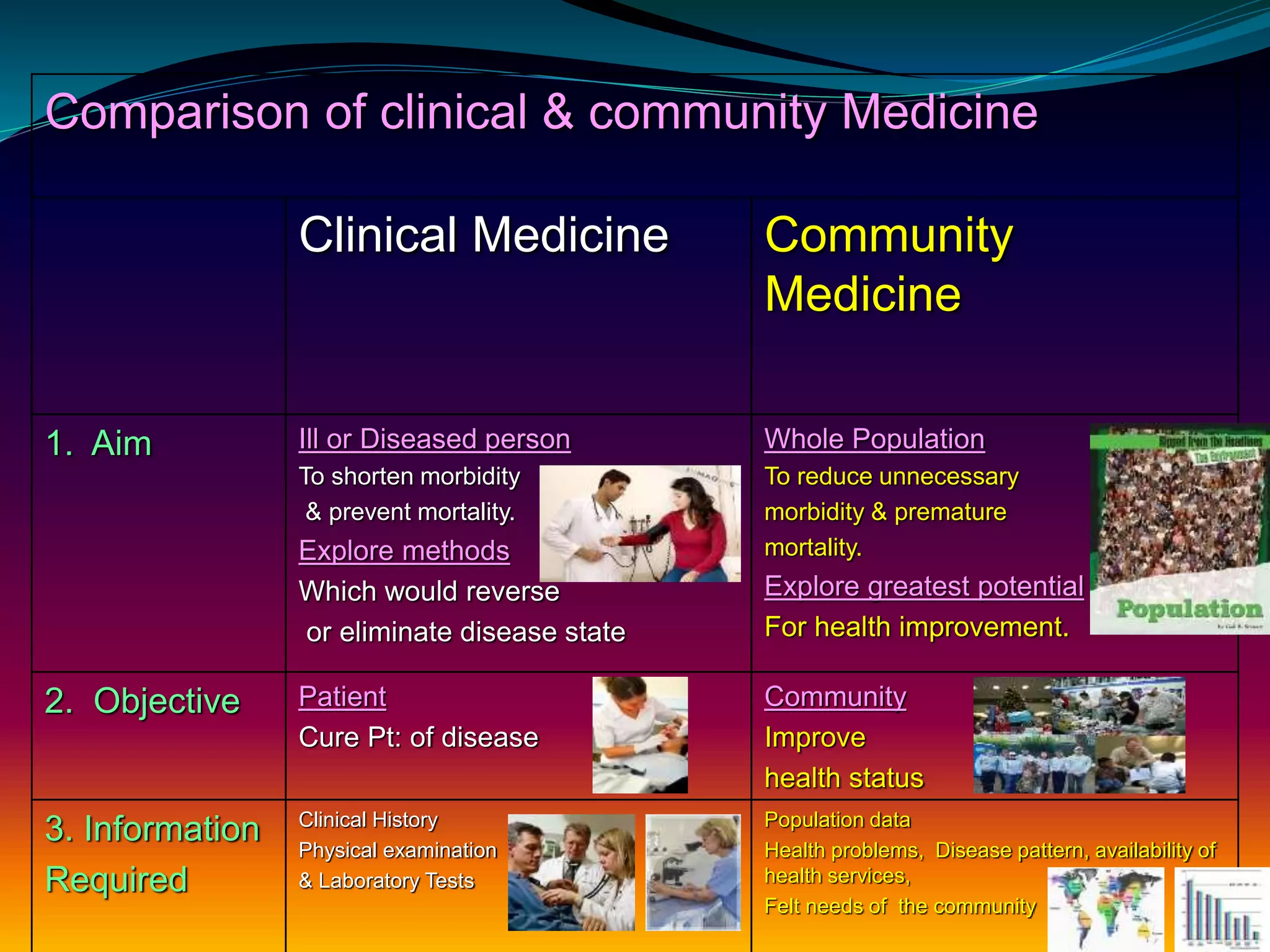
Comparison of clinical & community Medicine
Clinical Medicine Community
Medicine
1. Aim Ill or Diseased person
To shorten morbidity
& prevent mortality.
Explore methods
Which would reverse
or eliminate disease state
Whole Population
To reduce unnecessary
morbidity & premature
mortality.
Explore greatest potential
For health improvement.
2. Objective Patient
Cure Pt: of disease
Community
Improve
health status
3. Information
Required
Clinical History
Physical examination
& Laboratory Tests
Population data
Health problems, Disease pattern, availability of
health services,
Felt needs of the community
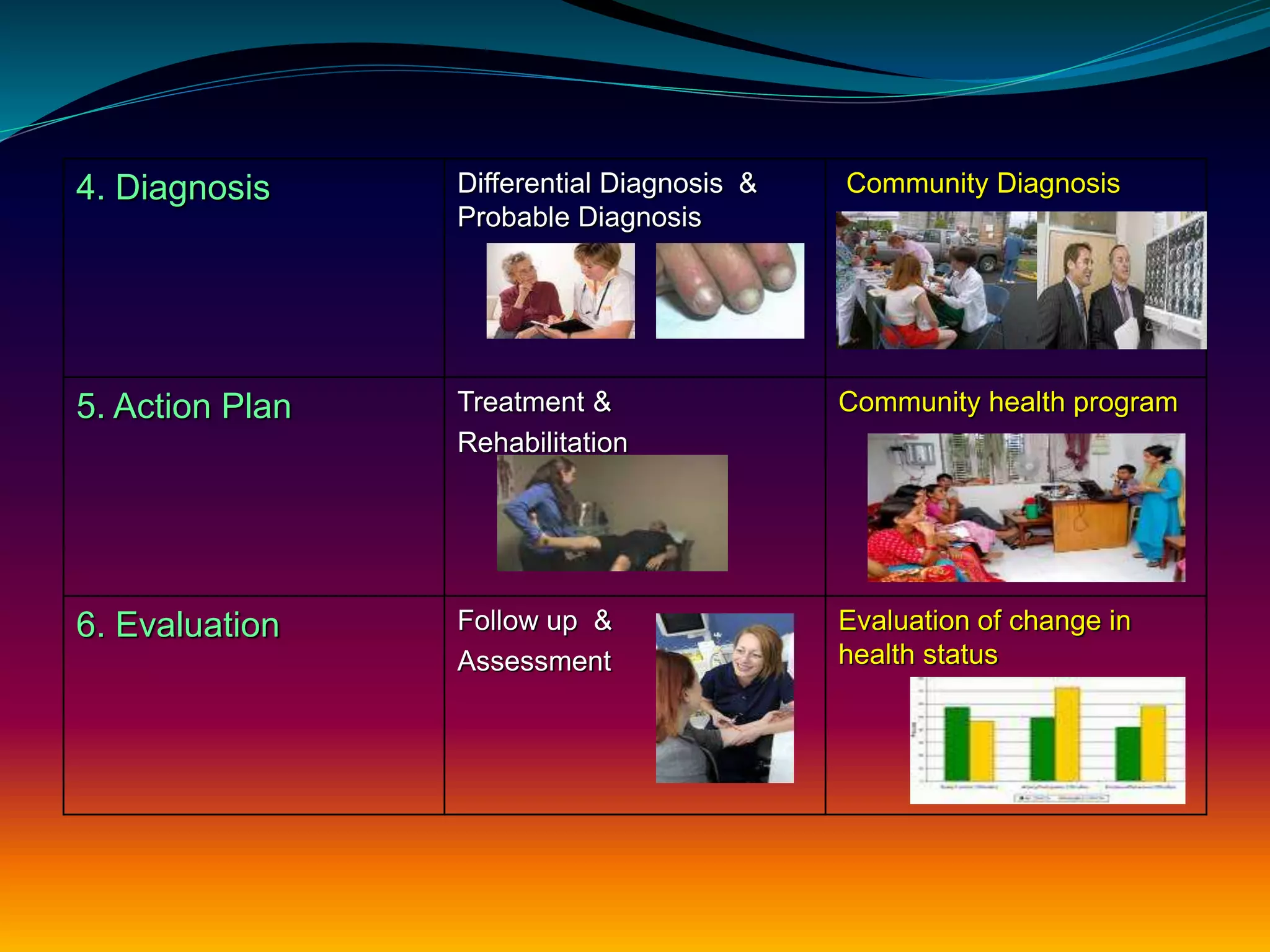
4. Diagnosis Differential Diagnosis &
Probable Diagnosis
Community Diagnosis
5. Action Plan Treatment &
Rehabilitation
Community health program
6. Evaluation Follow up &
Assessment
Evaluation of change in
health status
 Positive Health
 Well-being (Standard of living, Quality of Life )
PQLI (Physical Quality of Life Index)
 Human Development Index (HDI)
 GDP (Gross Domestic Product)
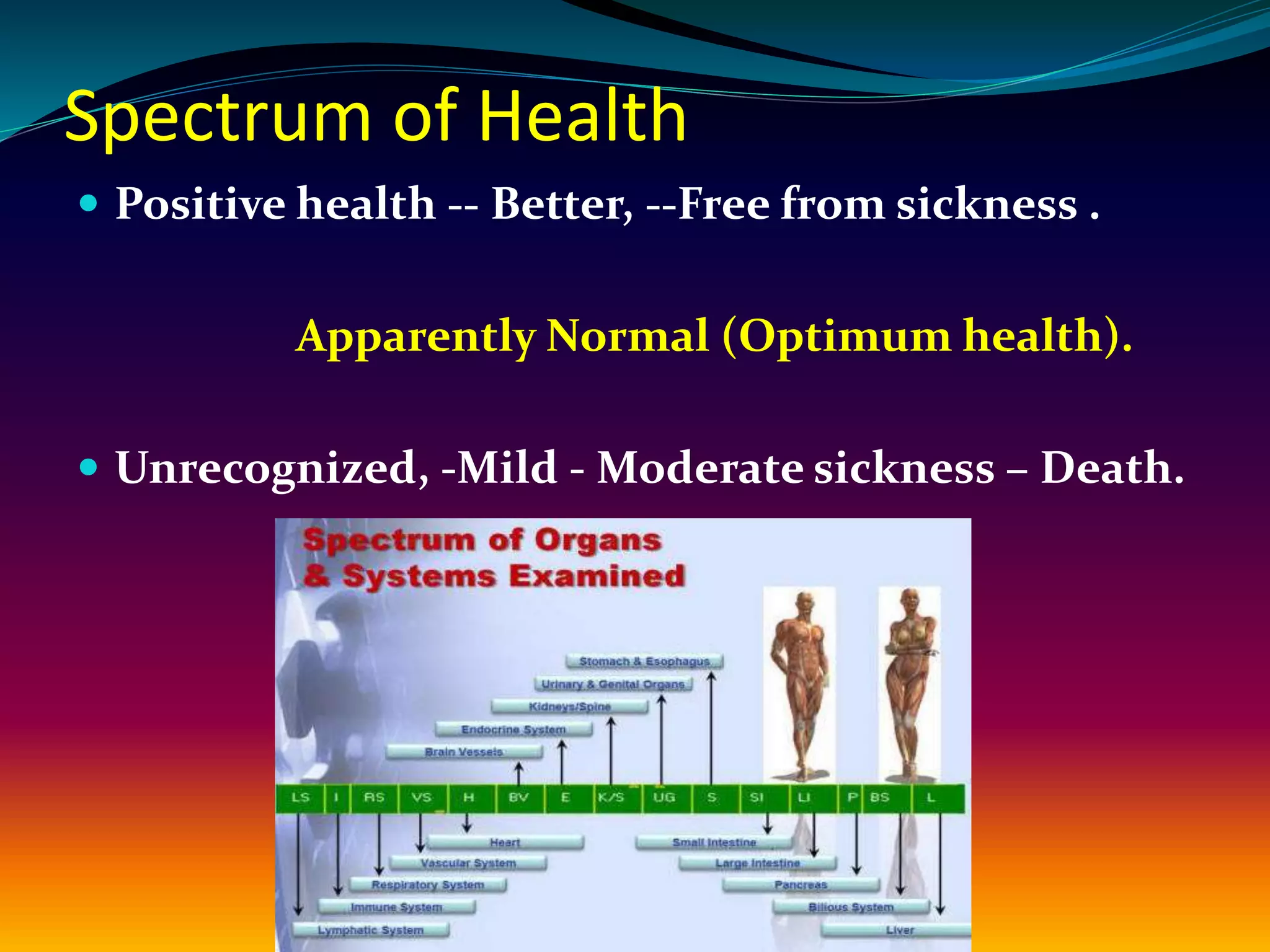
Spectrum of Health
 Positive health -- Better, --Free from sickness .
Apparently Normal (Optimum health).
 Unrecognized, -Mild - Moderate sickness – Death.
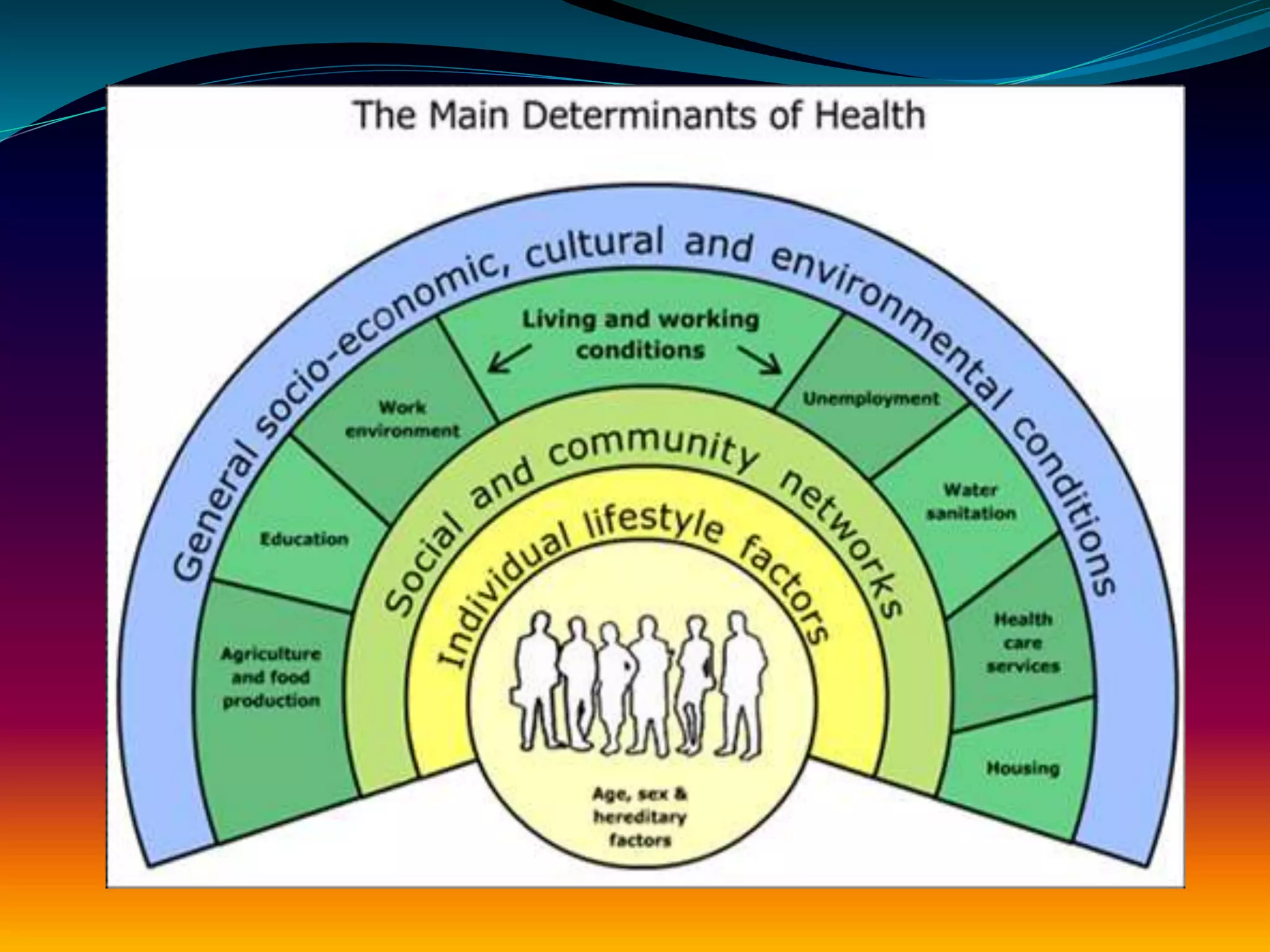
Determinants of Health:
 Genetic (Biological) Factors: (Diabetes)
 Environmental Factors :
(Any disturbance in internal OR External
environment disturb the health)
 Life style (Way of living):
(Smoking, Alcoholism, Exercise)
 Socioeconomic conditions :
(Education, Occupation, Income)
Health Services:
 Immunization services, Nutritional services etc
 Aging of the Patient: (Ch : Diseases, Disabilities)
 Other Factors: Education, Rural development, Good
roads, Lightening.
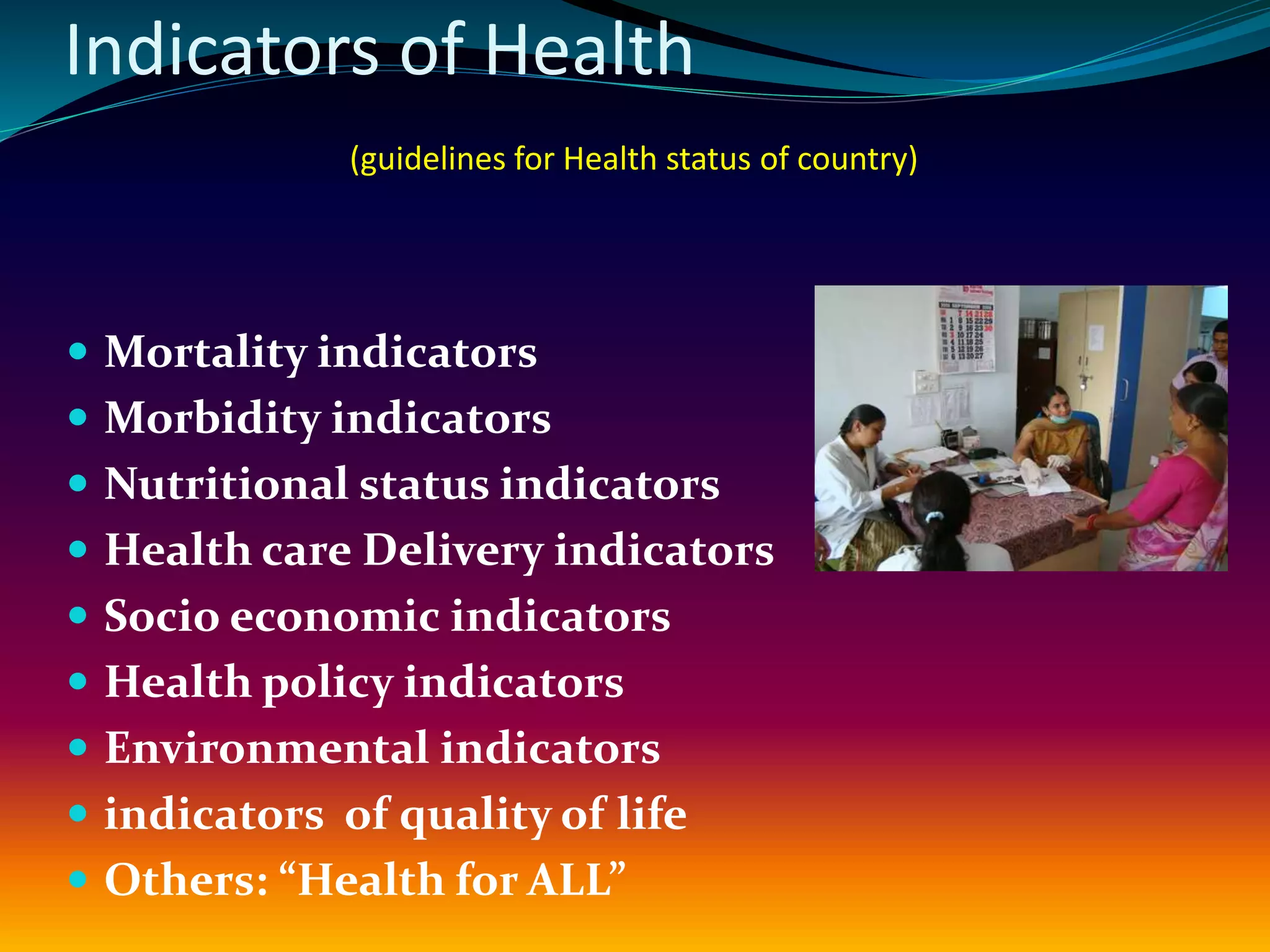
Indicators of Health
(guidelines for Health status of country)
 Mortality indicators
 Morbidity indicators
 Nutritional status indicators
 Health care Delivery indicators
 Socio economic indicators
 Health policy indicators
 Environmental indicators
 indicators of quality of life
 Others: “Health for ALL”
Concept of Disease
A condition in which body health is impaired
&
Performance of vital functions in body is interrupted.
Theories of Disease Causation
 Old Theories (Miasma)
 Germ Theory of Disease (human disease is caused by a microbe or germ)
 Web of Causation (Theory of Multifactorial Causation
 Epidemiological Triad
 Natural History of Disease
 Iceberg Phenomenon of Disease.
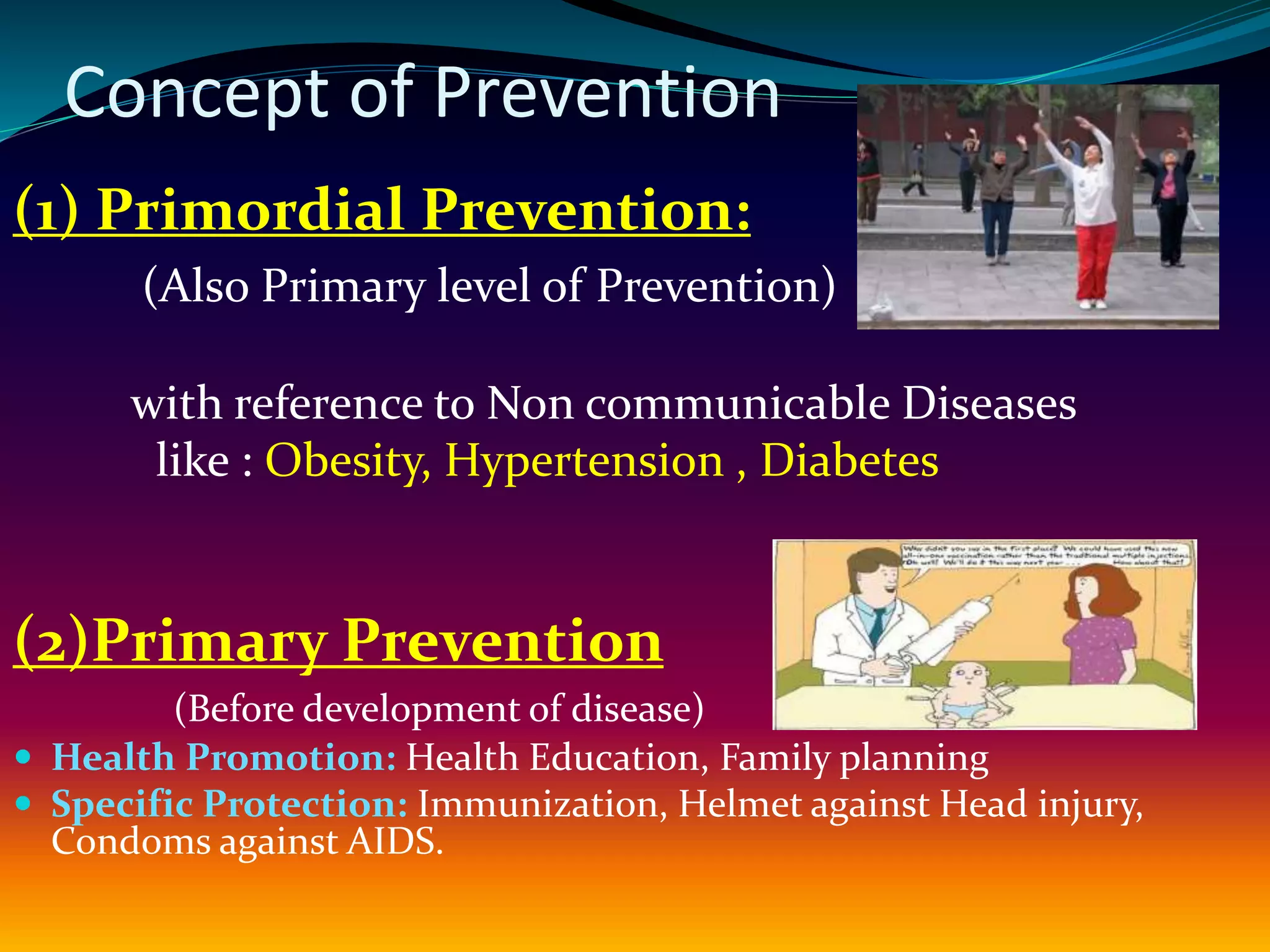
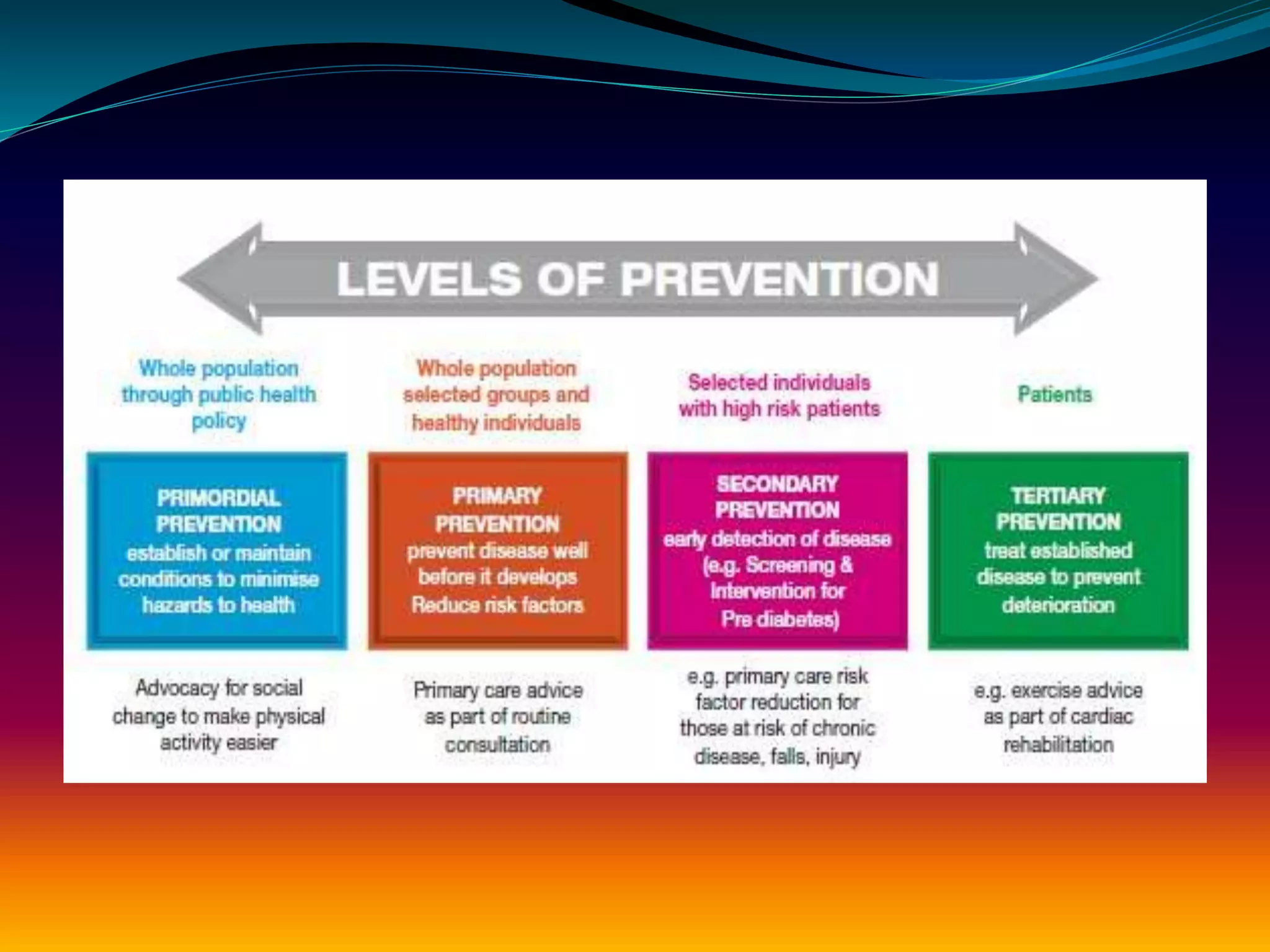
Concept of Prevention
(1) Primordial Prevention:
(Also Primary level of Prevention)
with reference to Non communicable Diseases
like : Obesity, Hypertension , Diabetes
(2)Primary Prevention
(Before development of disease)
 Health Promotion: Health Education, Family planning
 Specific Protection: Immunization, Helmet against Head injury,
Condoms against AIDS.
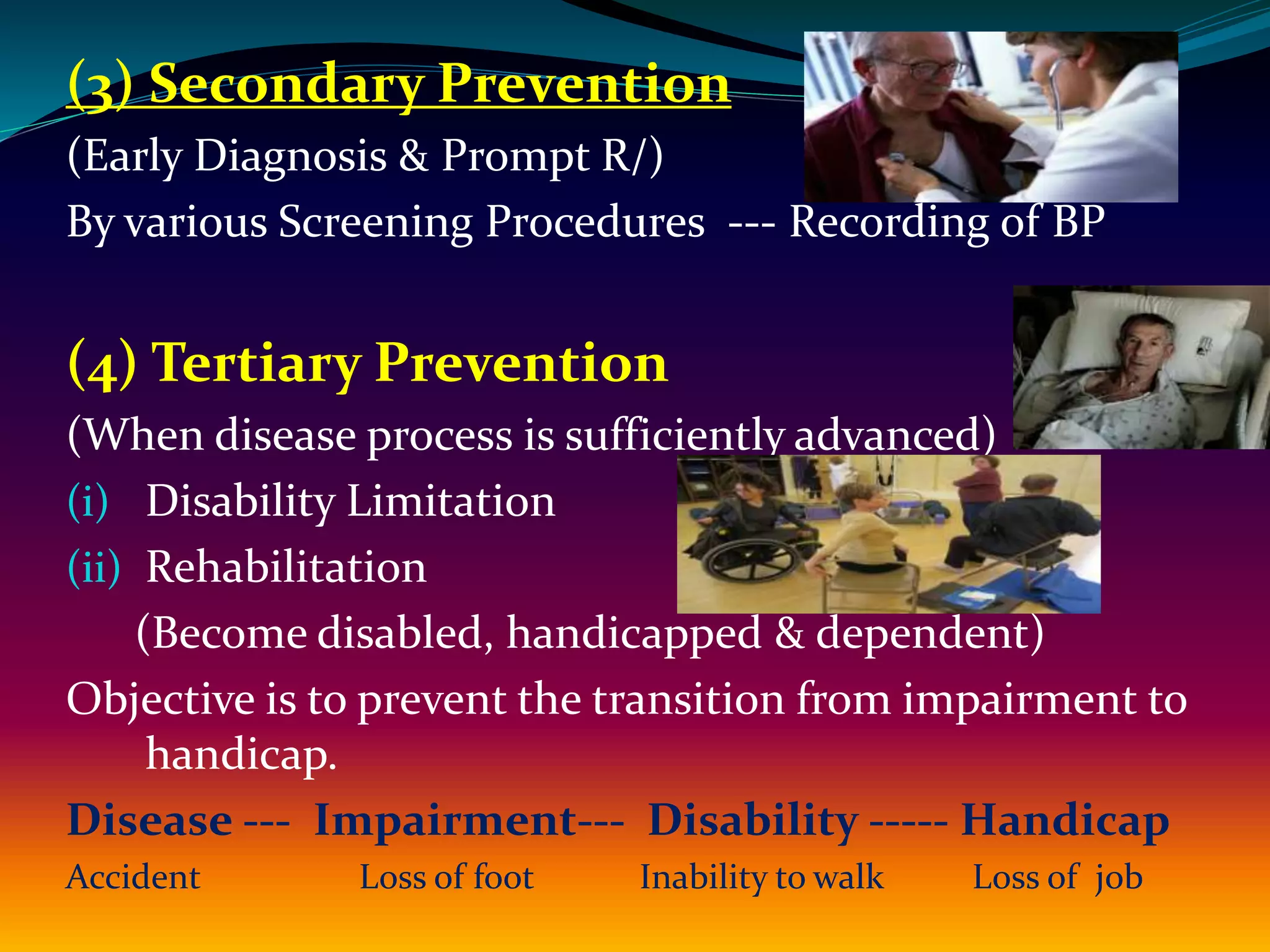
(3) Secondary Prevention
(Early Diagnosis & Prompt R/)
By various Screening Procedures --- Recording of BP
(4) Tertiary Prevention
(When disease process is sufficiently advanced)
(i) Disability Limitation
(ii) Rehabilitation
(Become disabled, handicapped & dependent)
Objective is to prevent the transition from impairment to
handicap.
Disease --- Impairment--- Disability ----- Handicap
Accident Loss of foot Inability to walk Loss of job
THANX

Concepts of health & disease, dimensions, determinants

  • 1.
    Concepts of health,disease & its dimensions By: Prof: Najeeb Memon, BMC< LUMHS, Jamshoro, Pakistan
  • 2.
    PROF: NAJEEB MEMON COMMUNITYMEDICINE DEPTT: BMC, LUMHS, JAMSHORO PAKISTAN
  • 3.
  • 4.
     Introduction toCommunity Medicine  Concept of Health  Concept of Disease  Concept of Prevention
  • 5.
    Community Medicines A systemof to the people ( by a health team) in order to improve the health of the community. OR delivery of comprehensive health care
  • 6.
    Community Medicines  Art& science of application of technical knowledge & skills to the delivery of health care to a given community, designed in collaboration with related professions as well as human & social sciences on one hand & community on the other.
  • 7.
    Health ( 3Dimensions ) Physical  Complete Mental & Social well being & not merely the absence of disease.(WHO- 1948) The ability to lead a “ Socially & economically productive Life” ( HEALTH for ALL - 2000 )
  • 8.
  • 9.
    1. Biomedical concepts 2.Ecological concepts 3. Psychosocial concepts 4. Holistic concepts Changing Concepts
  • 10.
    1. Biomedical concepts Absence of disease  Free from disease  Medical profession viewed human body as a machine
  • 12.
    2. Ecological concepts Health as a dynamic equilibrium between man and his environment and disease a maladjustment of the human organism to environment.
  • 13.
    3. Psychosocial concepts Health is influenced by: social, psychological , cultural , economic and political factors
  • 14.
    4. Holistic concepts All sectors of society have an effect on health  The emphasis is on the promotion and protection of Health
  • 15.
  • 16.
    Dimensions of Health Physical  Mental  Social  Spiritual  Emotional  Vocational  Political
  • 17.
    Dimensions of Health MedicalNon Medical  Physical  Mental  Social  Spiritual  Emotional  Vocational  Political Others : Philosophical, Cultural, Socioeconomic Environmental, Educational nutritional, Curative dimension , Preventive dimension
  • 18.
    Physical Dimension  Thestate of physical health implies the notion of perfect functioning of the body.  Every cell and every organ functioning at optimum capacity and perfect harmony with the rest of the body. Characteristics: A good complexion, bright eyes , not too fat, Good appetite, Sound sleep, Smooth easily coordinated bodily movements, All organs of normal size and functioning normally Pulse rate, BP exercise tolerance within normal ranges
  • 19.
    Mental Dimension Mental healthis not mere absence of mental illness Ability to respond to varied experiences of life “ a state of balance between the individual and surrounding world, a state of harmony between oneself and others Characteristics of Mentally healthy person Free from internal conflicts , Well adjusted, Searches for identity, Strong sense of self-esteem, Knows himself, his needs, problems and goals Good self control, Coping with stress and anxiety.
  • 20.
    Social Dimension Harmony andintegration Within Individual & other members of the society & world in which they live Definition :- Quantity and quality of an individual’s interpersonal ties and the extent of involvement with the community Characteristics: Possession of social skills, social functioning Ability to see oneself as a member of community Focuses on social and economic conditions
  • 21.
    Spiritual Dimension  Thatpart of individual which reaches out and strives for meaning and purpose in life .  It is the intangible something that transcends Physiology and Psychology Includes integrity, principles, ethics, purpose in life, commitment
  • 22.
    Emotional dimension  ofwellness emphasizes an awareness and acceptance of one's feelings
  • 23.
    Vocational Dimension Goals  Work– fully adapted to human capacities limitations ( plays a role in promoting both physical and mental health )  Sudden loss of Job / after Retirement
  • 24.
    Public Health Preventing Disease Art & science of Prolonging Life & Promoting Physical & Mental health & Efficiency through organized community efforts for: (1) Sanitation of Environment (2) Organization of medical & nursing services for: Early Diagnosis & Prompt Treatment & prevention of Disease (3) Development of social machinery Which will ensure to: Every individual in community a standard of living adequate for maintenance of health.
  • 25.
    Community Medicine &Public health  It is an aspect of medical practice. Along with: Biostatistics Epidemiology & other fields.  Public Health is a “basic science” of Community Medicine.  “Public” word refers to the people of community, who decide that concerned action is needed, to accomplish its goals.
  • 26.
    Social Medicine  Itis study of man in his Physical Biological & Socio economic environment
  • 27.
    Comparison of clinical& community Medicine Clinical Medicine Community Medicine 1. Aim Ill or Diseased person To shorten morbidity & prevent mortality. Explore methods Which would reverse or eliminate disease state Whole Population To reduce unnecessary morbidity & premature mortality. Explore greatest potential For health improvement. 2. Objective Patient Cure Pt: of disease Community Improve health status 3. Information Required Clinical History Physical examination & Laboratory Tests Population data Health problems, Disease pattern, availability of health services, Felt needs of the community
  • 28.
    4. Diagnosis DifferentialDiagnosis & Probable Diagnosis Community Diagnosis 5. Action Plan Treatment & Rehabilitation Community health program 6. Evaluation Follow up & Assessment Evaluation of change in health status
  • 29.
     Positive Health Well-being (Standard of living, Quality of Life ) PQLI (Physical Quality of Life Index)  Human Development Index (HDI)  GDP (Gross Domestic Product)
  • 30.
    Spectrum of Health Positive health -- Better, --Free from sickness . Apparently Normal (Optimum health).  Unrecognized, -Mild - Moderate sickness – Death.
  • 31.
    Determinants of Health: Genetic (Biological) Factors: (Diabetes)  Environmental Factors : (Any disturbance in internal OR External environment disturb the health)  Life style (Way of living): (Smoking, Alcoholism, Exercise)  Socioeconomic conditions : (Education, Occupation, Income)
  • 33.
    Health Services:  Immunizationservices, Nutritional services etc  Aging of the Patient: (Ch : Diseases, Disabilities)  Other Factors: Education, Rural development, Good roads, Lightening.
  • 34.
    Indicators of Health (guidelinesfor Health status of country)  Mortality indicators  Morbidity indicators  Nutritional status indicators  Health care Delivery indicators  Socio economic indicators  Health policy indicators  Environmental indicators  indicators of quality of life  Others: “Health for ALL”
  • 35.
    Concept of Disease Acondition in which body health is impaired & Performance of vital functions in body is interrupted. Theories of Disease Causation  Old Theories (Miasma)  Germ Theory of Disease (human disease is caused by a microbe or germ)  Web of Causation (Theory of Multifactorial Causation  Epidemiological Triad  Natural History of Disease  Iceberg Phenomenon of Disease.
  • 36.
    Concept of Prevention (1)Primordial Prevention: (Also Primary level of Prevention) with reference to Non communicable Diseases like : Obesity, Hypertension , Diabetes (2)Primary Prevention (Before development of disease)  Health Promotion: Health Education, Family planning  Specific Protection: Immunization, Helmet against Head injury, Condoms against AIDS.
  • 37.
    (3) Secondary Prevention (EarlyDiagnosis & Prompt R/) By various Screening Procedures --- Recording of BP (4) Tertiary Prevention (When disease process is sufficiently advanced) (i) Disability Limitation (ii) Rehabilitation (Become disabled, handicapped & dependent) Objective is to prevent the transition from impairment to handicap. Disease --- Impairment--- Disability ----- Handicap Accident Loss of foot Inability to walk Loss of job
  • 39.