Molecular Drive in Bacterial Genomes (This talk is really about sex.) Rosie Redfield, UBC
The BIG question:  Do bacteria have sex? Definition of sex? Answer? Importance? Any process that produces recombinational variation Yes! Evolutionary effects Any process that evolved  for  recombinational variation Evolution of sex ?
To find out, we study DNA uptake in  Haemophilus influenzae . Do bacteria have parasexual processes because they generate recombinational variation? Transduction Conjugation DNA uptake (transformation) Physical recombination Donor cell Recipient cell
Animation by Matt Baumann DNA uptake by  H. influenzae :
Why else might bacteria take up DNA? DNA is good food. Serving size:  1-200kb Servings per genome: many Nucleotides  Bases Sugars Carbon Nitrogen Phosphorus High-energy electrons Not a significant source of fats, amino acids or vitamins 100%  50% 30% Yes  Yes Yes LOTS!
But...  if DNA is just used as food, why do bacteria prefer closely related DNAs? Three kinds of evidence: From theory:   Predicted benefits of nucleotides are much larger than benefits of recombination. From molecular biology:   Bacteria use nutritional signals to regulate DNA uptake.  From ecology:   DNA from diverse sources is very abundant in natural environments.
The motifs are very common in the genomes of the same bacteria.  e.g.  ~1471 perfect copies in  H. influenzae  (expect 8 in a random sequence) Some bacteria* preferentially take up DNAs with specific motifs. * Neisseria  and  Pasteurellaceae What makes DNA uptake self-specific?
About the  H. influenzae  preferred motif:  (Uptake Signal Sequence, USS) ~1 USS motif/kb. Locations around the genome ~random (65% in genes). No known function (some are terminators). Very strong consensus. -1 1 2 3 4 5 6 7 8 9 10 11 12 13 14 15 16 17 18 19 20 21 22 23 24 25 26 27 28 core  flanking sequences  T G A C T T G G G T T T T T T T A A A A A T
H. influenzae  protein AAGTGCGGT gap gap gap SAV If USSs arise by insertion: AAGTGCGGT SAV SAL CAV SAI If USSs arise by mutation: Do USSs arise by copying and insertion? No, USSs arise by mutation. Only 24% of 100aa alignments have gaps anywhere.  Gaps are rare in USS-aligned positions. H. influenzae  protein Species with no USS Species with no USS
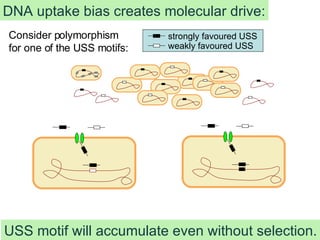
Consider polymorphism for one of the USS motifs: DNA uptake bias creates molecular drive: USS motif will accumulate even without selection. strongly favoured USS weakly favoured USS
Why would some DNA sequences be taken up more easily than others? Hypothesis:  Sequence bias arises from the mechanical difficulties of taking up DNA DNA must kink to enter the pore. outer membrane inner membrane
ComE (secretin) USS motifs may kink easily.
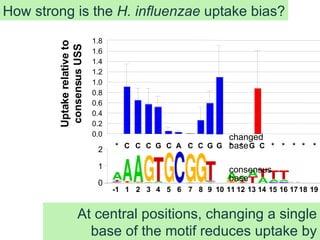
How strong is the  H. influenzae  uptake bias? Uptake relative to consensus USS At central positions, changing a single base of the motif reduces uptake by >90%. consensus base changed base
How strong does uptake bias need to be to drive accumulation of its motif in the genome? Factors to consider? Bias: Mutation rate - uptake specificity - availability of DNAs - recombination vs. degradation Factors can be evaluated with simulation models.
The model: Perfect consensus USS core Singly mismatched USS core mutation transformation Begin with random DNA  sequence Equilibrium reached  (mutation  transformation) Repeat many cycles
USS do not accumulate.  Random sequence Number of model cycles Bias = 0.1X mutation:  USS per kb Perfect USS cores Mutation = 0.001; Bias = 0.0001
USS per kilobase Range of perfect USS density in real genomes Range of one-off USS density in real genomes Singly mismatched USS cores Perfect USS cores Bias stronger than mutation drives accumulation of motifs in the genome. Random sequence Number of model cycles USS per kb Bias = 10X mutation:  Mutation = 0.0001; Bias = 0.001
HI0609 DILVVAVGKPNLISGDWIKE SAV VIDVGINRVD-GKLVGDVEF b0529 DLLIVAVGKPGFIPGDWIKEGAIVIDVGINRLENGKVVGDVVF VC1942 DILVVAVGKPNFIPGAWIKEGAVVVDVGINRLDTGKLVGDVEY PA1796 DLVVVAAGKPGLVKGEWIKEGAIVIDVGINRQADGRLVGDVEY *:::**.***.:: * ****.*:*:******  *::**** : AAGTGCGGT No USS How similar are these tripeptides to each other? How similar is the  H. influenzae  USS tripeptide to each of the others? Scoring coding constraints imposed by USS motifs Do USS motifs interfere with coding functions? Test by looking for reduced amino acid identity.
Compare unconstrained and USS-encoded tripeptides: Compare USS-encoded tripeptides to others Compare other tripeptides  USSs do not compromise coding function.
Summary: Biased DNA uptake plus recombination can drive USS accumulation. Even weak bias is sufficient. Real bias is quite strong. Motifs don’t compromise genome function. Molecular drive explains uptake sequences in the  H. influenzae  genome.
How widespread are USS motifs? All  Neisseria? All  Pasteurellaceae No other bacteria. Most competent bacteria take up any DNA. Ambur  et al . 2007 J. Bacteriol.
Want more?  Our lab web pages include our grant proposals.
Want even more?  Check out our research blogs. Other   contributors: NRC Ottawa: Wendy Findlay John Nash Imperial College: Simon Kroll Janine Bosse
Recap: The big question:  Do bacteria have sex? * (*processes evolved for recombinational variation) The only serious candidate was competence. The only remaining issue was self-specific  DNA uptake. Uptake bias parsimoniously explains  genomic USSs and thus self-specificity. The answer:  No .   Arguing that bacteria take up DNA to get new genes is like arguing that a hungry man eats steak to get a cow gene that will let him live on grass.

R. Redfield's SMBE talk slides

  • 1.
    Molecular Drive inBacterial Genomes (This talk is really about sex.) Rosie Redfield, UBC
  • 2.
    The BIG question: Do bacteria have sex? Definition of sex? Answer? Importance? Any process that produces recombinational variation Yes! Evolutionary effects Any process that evolved for recombinational variation Evolution of sex ?
  • 3.
    To find out,we study DNA uptake in Haemophilus influenzae . Do bacteria have parasexual processes because they generate recombinational variation? Transduction Conjugation DNA uptake (transformation) Physical recombination Donor cell Recipient cell
  • 4.
    Animation by MattBaumann DNA uptake by H. influenzae :
  • 5.
    Why else mightbacteria take up DNA? DNA is good food. Serving size: 1-200kb Servings per genome: many Nucleotides Bases Sugars Carbon Nitrogen Phosphorus High-energy electrons Not a significant source of fats, amino acids or vitamins 100% 50% 30% Yes Yes Yes LOTS!
  • 6.
    But... ifDNA is just used as food, why do bacteria prefer closely related DNAs? Three kinds of evidence: From theory: Predicted benefits of nucleotides are much larger than benefits of recombination. From molecular biology: Bacteria use nutritional signals to regulate DNA uptake. From ecology: DNA from diverse sources is very abundant in natural environments.
  • 7.
    The motifs arevery common in the genomes of the same bacteria. e.g. ~1471 perfect copies in H. influenzae (expect 8 in a random sequence) Some bacteria* preferentially take up DNAs with specific motifs. * Neisseria and Pasteurellaceae What makes DNA uptake self-specific?
  • 8.
    About the H. influenzae preferred motif: (Uptake Signal Sequence, USS) ~1 USS motif/kb. Locations around the genome ~random (65% in genes). No known function (some are terminators). Very strong consensus. -1 1 2 3 4 5 6 7 8 9 10 11 12 13 14 15 16 17 18 19 20 21 22 23 24 25 26 27 28 core flanking sequences T G A C T T G G G T T T T T T T A A A A A T
  • 9.
    H. influenzae protein AAGTGCGGT gap gap gap SAV If USSs arise by insertion: AAGTGCGGT SAV SAL CAV SAI If USSs arise by mutation: Do USSs arise by copying and insertion? No, USSs arise by mutation. Only 24% of 100aa alignments have gaps anywhere. Gaps are rare in USS-aligned positions. H. influenzae protein Species with no USS Species with no USS
  • 10.
    Consider polymorphism forone of the USS motifs: DNA uptake bias creates molecular drive: USS motif will accumulate even without selection. strongly favoured USS weakly favoured USS
  • 11.
    Why would someDNA sequences be taken up more easily than others? Hypothesis: Sequence bias arises from the mechanical difficulties of taking up DNA DNA must kink to enter the pore. outer membrane inner membrane
  • 12.
    ComE (secretin) USSmotifs may kink easily.
  • 13.
    How strong isthe H. influenzae uptake bias? Uptake relative to consensus USS At central positions, changing a single base of the motif reduces uptake by >90%. consensus base changed base
  • 14.
    How strong doesuptake bias need to be to drive accumulation of its motif in the genome? Factors to consider? Bias: Mutation rate - uptake specificity - availability of DNAs - recombination vs. degradation Factors can be evaluated with simulation models.
  • 15.
    The model: Perfectconsensus USS core Singly mismatched USS core mutation transformation Begin with random DNA sequence Equilibrium reached (mutation transformation) Repeat many cycles
  • 16.
    USS do notaccumulate. Random sequence Number of model cycles Bias = 0.1X mutation: USS per kb Perfect USS cores Mutation = 0.001; Bias = 0.0001
  • 17.
    USS per kilobaseRange of perfect USS density in real genomes Range of one-off USS density in real genomes Singly mismatched USS cores Perfect USS cores Bias stronger than mutation drives accumulation of motifs in the genome. Random sequence Number of model cycles USS per kb Bias = 10X mutation: Mutation = 0.0001; Bias = 0.001
  • 18.
    HI0609 DILVVAVGKPNLISGDWIKE SAVVIDVGINRVD-GKLVGDVEF b0529 DLLIVAVGKPGFIPGDWIKEGAIVIDVGINRLENGKVVGDVVF VC1942 DILVVAVGKPNFIPGAWIKEGAVVVDVGINRLDTGKLVGDVEY PA1796 DLVVVAAGKPGLVKGEWIKEGAIVIDVGINRQADGRLVGDVEY *:::**.***.:: * ****.*:*:****** *::**** : AAGTGCGGT No USS How similar are these tripeptides to each other? How similar is the H. influenzae USS tripeptide to each of the others? Scoring coding constraints imposed by USS motifs Do USS motifs interfere with coding functions? Test by looking for reduced amino acid identity.
  • 19.
    Compare unconstrained andUSS-encoded tripeptides: Compare USS-encoded tripeptides to others Compare other tripeptides USSs do not compromise coding function.
  • 20.
    Summary: Biased DNAuptake plus recombination can drive USS accumulation. Even weak bias is sufficient. Real bias is quite strong. Motifs don’t compromise genome function. Molecular drive explains uptake sequences in the H. influenzae genome.
  • 21.
    How widespread areUSS motifs? All Neisseria? All Pasteurellaceae No other bacteria. Most competent bacteria take up any DNA. Ambur et al . 2007 J. Bacteriol.
  • 22.
    Want more? Our lab web pages include our grant proposals.
  • 23.
    Want even more? Check out our research blogs. Other contributors: NRC Ottawa: Wendy Findlay John Nash Imperial College: Simon Kroll Janine Bosse
  • 24.
    Recap: The bigquestion: Do bacteria have sex? * (*processes evolved for recombinational variation) The only serious candidate was competence. The only remaining issue was self-specific DNA uptake. Uptake bias parsimoniously explains genomic USSs and thus self-specificity. The answer: No . Arguing that bacteria take up DNA to get new genes is like arguing that a hungry man eats steak to get a cow gene that will let him live on grass.

Editor's Notes

  • #2 Subtitle to make sure big picture doesn’t get lost in the details.