Quinolones
Ngaahule Phadziri 28846060
Paballo Shiri 25699881
Siyabonga Mashiane 29760097
Azwidali Nekokwane 28731220
Quinolones(Fluoroquinolone)
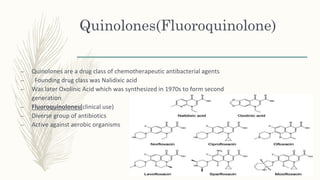
– Quinolones are a drug class of chemotherapeutic antibacterial agents
– Founding drug class was Nalidixic acid
– Was later Oxolinic Acid which was synthesized in 1970s to form second
generation
– Fluoroquinolones(clinical use)
– Diverse group of antibiotics
– Active against aerobic organisms
Ciprofloxacin
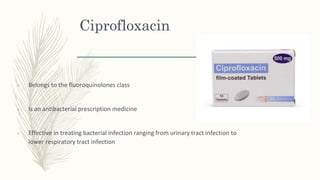
- Belongs to the fluoroquinolones class
- Is an antibacterial prescription medicine
- Effective in treating bacterial infection ranging from urinary tract infection to
lower respiratory tract infection
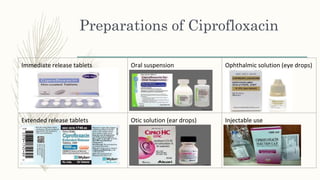
Preparations of Ciprofloxacin
Immediate release tablets Oral suspension Ophthalmic solution (eye drops)
Extended release tablets Otic solution (ear drops) Injectable use
Routes of administration
❖ Enteral route: Oral - Solid (Tablets)
-Liquid (Suspension)
*Cipro tablets should not be split, crushed, or chewed
❖ Parenteral route: Intravenous infusion ( Injected directly to the veins)
-400 mg for 60 minutes -200mg for 30 minutes
❖ Ophthalmic route: Eyes
❖ Otic route: Ear
Indication
Used to treat infections caused by bacteria such as:
❖ Respiratory tract infections -Bronchitis
-Pneumonia
❖ Urinary tract infections -Bladder infection
-Kidney infection
❖ Gastro intestinal infection -Bacterial diarrhoea
❖ Sexually transmitted diseases - Gonorrhea
❖ Bone and joint infections
❖ Bacterial ear and eye infections
Dosage
❖ General dosage for immediate-release Cipro is 250–750 mg every 12 hours for up to 14 days.
❖ Cipro dosage depends on factors such as
Age Children under 17: 10–20 mg/kg every 12 hours for 7- 21 days.
*<750mg every 12 hours.
Drug form and strength *Tablets: 250mg, 500 mg, 750 mg
*Powder for oral suspension: 250 mg and 500 mg
*Extended-release tablets (Cipro XR): 500 mg and 1,000 mg
Type and severity of condition *Respiratory infections: 500–750 mg every 12 hours for 7-14 days
*Bone & joint: 500–750 mg every 12 hours for 4-8 weeks
*Diarrhea by infection: 500 mg every 12 hours for 5- 7 days
*Severe UTI: Use cipro XR 1,000 mg once daily for 7-14 days.
Spectrum of activity
❖ Cipro is a broad-spectrum antibiotic. This means it is effective against
different types of bacteria.
❖ Fluoroquinolones have expanded activity against gram-positive cocci and
gram-negative activity of intracellular organisms such as Chlamydia,
Mycoplasma and mycobacteria
❖ Also effective against G aerobic bacteria
Pharmacodynamics of
Ciprofloxacin
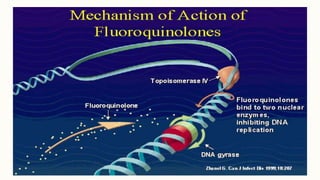
- Ciprofloxacin inhibits DNA gyrase hence stopping bacteria replication
- Gyrase is the primary targeted enzyme by Ciprofloxacin
Steps: Mechanism of Action
1. Fluoroquinolone bind at the ligation site of the DNA gyrase
2. Physically block gyrase enzymes from binding with the substrate
3. This causes substrate complex
4. Inability for double strand DNA to unwind; therefore blocking transcription
5. Prevention of bacterial protein synthesis
Pharmacokinetics of
Ciprofloxacin
Absorption:
- Has a high bioavailability in both oral and parenteral form
- Preferred drug due to 70% bioavailability in these forms
- No significant loss by first pass metabolism
Distribution:
- Non highly binding drugs
- Great distribution within body fluids and tissue
- Even able to reach bones and placenta when orally ingested
Elimination:
- Renal based
- After it is metabolised 40-50% of unchanged cipro is found in urine
- Traces of the drug found in bile
Serious complications
❖ Hallucinations
❖ Photosensitivity
❖ Musculoskeletal disorders in pediatric patients
❖ Development of drug resistant bacteria
❖ Anxiety,depression and suicide
Adverse reactions
● Increase the risk of tendinitis and tendon rupture
● Hypoglycemia
● Dysmenorrhea
● It may worsen muscle weakness in patients who have
myasthenia gravis
● Nerve damage
Key aspects of Clinical
Management
Assessment
- This involves the collection of information on patients likely to affect drug therapy.
- This information is used for individual medicine regimen.
- Forms the basis for the basic medical background of the patient.
Planning
– This step involves the expected outcomes of drug therapy.
– Long and short term goals of the therapy.
– Focus is on health promotion and rehabilitation and health education.
– Benefits or the drug therapy are outlined.
Key aspects of Clinical
Management cont.
Implementation
– This involves putting the health care plan into action.
– Interventions are implemented.
– Medicines are administered as prescribed.
Evaluation
– This involves assessing the patient's status in relation to those outlined
whilst planning.
– Governs future direction of healthcare plans according to expected
outcomes and actual outcomes
Drug resistance and alternative
❖ Overuse or misuse of ciprofloxacin because of a widespread availability of
generic versions of ciprofloxacin.
❖ After the introduction of generic ciprofloxacin in the market, an increase in
consumption of ciprofloxacin was observed.
❖ In another study, it was reported that the resistance of isolated E. coli
obtained from patients with UTI increased proportionally with the use of
quinolones.
Drug resistance and alternative
cont.
The following alternatives should be provided in the event of drug resistance:
❖ Trimethoprim
❖ Levofloxacin
❖ Ampicillin
Public health considerations
· There has been emerging resistance. This resistance is especially problematic for
Pseudomonas aeruginosa and Staphylococcus aureus. This potential problem
underscores the importance of the physician being familiar with the appropriate clinical
applications of these useful antibiotics.
· There are several circumstances in which resistance has limited therapeutic use.
· There is concern that expanded use of quinolones for treatment of respiratory
tract infections may pose a risk for development of resistance in S. pneumoniae.
· The use of fluoroquinolones in food animals has led to the emergence of
fluoroquinolone-resistant Campylobacter and of Salmonella with reduced susceptibility
to fluoroquinolones.
· Antibiotic effects on early pregnancy.
Conclusion
- Ciprofloxacin has been shown to be a safe and effective antibiotic in the
treatment of a wide variety of bacterial infections.
- Although there are some side effect and adverse reactions it has proven to
be effective in the reduction of a wide range of bacterial infections.
- We believe a priority for both the pharmaceutical industry and regulatory
authorities should be to prevent fluoroquinolone misuse and development
of antibiotic resistance.
Reference List
Aldred, K. J., Kerns, R. J., & Osheroff, N. (2014). Mechanism of quinolone action and
resistance. Biochemistry, 53(10), 1565–1574.
Healthline. (2018). Ciprofloxacin. Retrieved from https://www.healthline.com/health/cdi/cipro
Naeem, A., Badshah, S. L., Muska, M., Ahmad, N., & Khan, K. (2016). The Current Case of
Quinolones: Synthetic Approaches and Antibacterial Activity. Molecules (Basel, Switzerland),
21(4), 268. doi:10.3390/molecules21040268
National Institute of Neurological Disorders and Stroke. (2019). Myasthenia Gravis Fact Sheet.
Retrieved from: www.ninds.nih.gov
FDA. (2005). CIPRO. Retrieved from
https://www.accessdata.fda.gov/drugsatfda_docs/label/2005/019537s057,020780s019lbl.pdf
Singh,A., Bhat, T.K., Sharma, O.P,. (2011). Clinical Biochemistry of Hepatotoxicity. Journal of
Clinical Toxicology, 4(1),1-19
Sharma, D., Patel, R.P., Zaidi, S., Sarker, M., Lean, Q., Ming, L.C. (2017). Interplay of Quality
of Ciproflofaxin and Antibiotic Resistance in Developed Countries. Frontiers of Pharmacology,
8(546), 1-10.

Quinolones

  • 1.
    Quinolones Ngaahule Phadziri 28846060 PaballoShiri 25699881 Siyabonga Mashiane 29760097 Azwidali Nekokwane 28731220
  • 2.
    Quinolones(Fluoroquinolone) – Quinolones area drug class of chemotherapeutic antibacterial agents – Founding drug class was Nalidixic acid – Was later Oxolinic Acid which was synthesized in 1970s to form second generation – Fluoroquinolones(clinical use) – Diverse group of antibiotics – Active against aerobic organisms
  • 3.
    Ciprofloxacin - Belongs tothe fluoroquinolones class - Is an antibacterial prescription medicine - Effective in treating bacterial infection ranging from urinary tract infection to lower respiratory tract infection
  • 4.
    Preparations of Ciprofloxacin Immediaterelease tablets Oral suspension Ophthalmic solution (eye drops) Extended release tablets Otic solution (ear drops) Injectable use
  • 5.
    Routes of administration ❖Enteral route: Oral - Solid (Tablets) -Liquid (Suspension) *Cipro tablets should not be split, crushed, or chewed ❖ Parenteral route: Intravenous infusion ( Injected directly to the veins) -400 mg for 60 minutes -200mg for 30 minutes ❖ Ophthalmic route: Eyes ❖ Otic route: Ear
  • 6.
    Indication Used to treatinfections caused by bacteria such as: ❖ Respiratory tract infections -Bronchitis -Pneumonia ❖ Urinary tract infections -Bladder infection -Kidney infection ❖ Gastro intestinal infection -Bacterial diarrhoea ❖ Sexually transmitted diseases - Gonorrhea ❖ Bone and joint infections ❖ Bacterial ear and eye infections
  • 7.
    Dosage ❖ General dosagefor immediate-release Cipro is 250–750 mg every 12 hours for up to 14 days. ❖ Cipro dosage depends on factors such as Age Children under 17: 10–20 mg/kg every 12 hours for 7- 21 days. *<750mg every 12 hours. Drug form and strength *Tablets: 250mg, 500 mg, 750 mg *Powder for oral suspension: 250 mg and 500 mg *Extended-release tablets (Cipro XR): 500 mg and 1,000 mg Type and severity of condition *Respiratory infections: 500–750 mg every 12 hours for 7-14 days *Bone & joint: 500–750 mg every 12 hours for 4-8 weeks *Diarrhea by infection: 500 mg every 12 hours for 5- 7 days *Severe UTI: Use cipro XR 1,000 mg once daily for 7-14 days.
  • 8.
    Spectrum of activity ❖Cipro is a broad-spectrum antibiotic. This means it is effective against different types of bacteria. ❖ Fluoroquinolones have expanded activity against gram-positive cocci and gram-negative activity of intracellular organisms such as Chlamydia, Mycoplasma and mycobacteria ❖ Also effective against G aerobic bacteria
  • 9.
    Pharmacodynamics of Ciprofloxacin - Ciprofloxacininhibits DNA gyrase hence stopping bacteria replication - Gyrase is the primary targeted enzyme by Ciprofloxacin Steps: Mechanism of Action 1. Fluoroquinolone bind at the ligation site of the DNA gyrase 2. Physically block gyrase enzymes from binding with the substrate 3. This causes substrate complex 4. Inability for double strand DNA to unwind; therefore blocking transcription 5. Prevention of bacterial protein synthesis
  • 11.
    Pharmacokinetics of Ciprofloxacin Absorption: - Hasa high bioavailability in both oral and parenteral form - Preferred drug due to 70% bioavailability in these forms - No significant loss by first pass metabolism Distribution: - Non highly binding drugs - Great distribution within body fluids and tissue - Even able to reach bones and placenta when orally ingested Elimination: - Renal based - After it is metabolised 40-50% of unchanged cipro is found in urine - Traces of the drug found in bile
  • 12.
    Serious complications ❖ Hallucinations ❖Photosensitivity ❖ Musculoskeletal disorders in pediatric patients ❖ Development of drug resistant bacteria ❖ Anxiety,depression and suicide
  • 13.
    Adverse reactions ● Increasethe risk of tendinitis and tendon rupture ● Hypoglycemia ● Dysmenorrhea ● It may worsen muscle weakness in patients who have myasthenia gravis ● Nerve damage
  • 14.
    Key aspects ofClinical Management Assessment - This involves the collection of information on patients likely to affect drug therapy. - This information is used for individual medicine regimen. - Forms the basis for the basic medical background of the patient. Planning – This step involves the expected outcomes of drug therapy. – Long and short term goals of the therapy. – Focus is on health promotion and rehabilitation and health education. – Benefits or the drug therapy are outlined.
  • 15.
    Key aspects ofClinical Management cont. Implementation – This involves putting the health care plan into action. – Interventions are implemented. – Medicines are administered as prescribed. Evaluation – This involves assessing the patient's status in relation to those outlined whilst planning. – Governs future direction of healthcare plans according to expected outcomes and actual outcomes
  • 16.
    Drug resistance andalternative ❖ Overuse or misuse of ciprofloxacin because of a widespread availability of generic versions of ciprofloxacin. ❖ After the introduction of generic ciprofloxacin in the market, an increase in consumption of ciprofloxacin was observed. ❖ In another study, it was reported that the resistance of isolated E. coli obtained from patients with UTI increased proportionally with the use of quinolones.
  • 17.
    Drug resistance andalternative cont. The following alternatives should be provided in the event of drug resistance: ❖ Trimethoprim ❖ Levofloxacin ❖ Ampicillin
  • 18.
    Public health considerations ·There has been emerging resistance. This resistance is especially problematic for Pseudomonas aeruginosa and Staphylococcus aureus. This potential problem underscores the importance of the physician being familiar with the appropriate clinical applications of these useful antibiotics. · There are several circumstances in which resistance has limited therapeutic use. · There is concern that expanded use of quinolones for treatment of respiratory tract infections may pose a risk for development of resistance in S. pneumoniae. · The use of fluoroquinolones in food animals has led to the emergence of fluoroquinolone-resistant Campylobacter and of Salmonella with reduced susceptibility to fluoroquinolones. · Antibiotic effects on early pregnancy.
  • 19.
    Conclusion - Ciprofloxacin hasbeen shown to be a safe and effective antibiotic in the treatment of a wide variety of bacterial infections. - Although there are some side effect and adverse reactions it has proven to be effective in the reduction of a wide range of bacterial infections. - We believe a priority for both the pharmaceutical industry and regulatory authorities should be to prevent fluoroquinolone misuse and development of antibiotic resistance.
  • 20.
    Reference List Aldred, K.J., Kerns, R. J., & Osheroff, N. (2014). Mechanism of quinolone action and resistance. Biochemistry, 53(10), 1565–1574. Healthline. (2018). Ciprofloxacin. Retrieved from https://www.healthline.com/health/cdi/cipro Naeem, A., Badshah, S. L., Muska, M., Ahmad, N., & Khan, K. (2016). The Current Case of Quinolones: Synthetic Approaches and Antibacterial Activity. Molecules (Basel, Switzerland), 21(4), 268. doi:10.3390/molecules21040268 National Institute of Neurological Disorders and Stroke. (2019). Myasthenia Gravis Fact Sheet. Retrieved from: www.ninds.nih.gov FDA. (2005). CIPRO. Retrieved from https://www.accessdata.fda.gov/drugsatfda_docs/label/2005/019537s057,020780s019lbl.pdf Singh,A., Bhat, T.K., Sharma, O.P,. (2011). Clinical Biochemistry of Hepatotoxicity. Journal of Clinical Toxicology, 4(1),1-19 Sharma, D., Patel, R.P., Zaidi, S., Sarker, M., Lean, Q., Ming, L.C. (2017). Interplay of Quality of Ciproflofaxin and Antibiotic Resistance in Developed Countries. Frontiers of Pharmacology, 8(546), 1-10.