Page 1 of 7

QUEUE
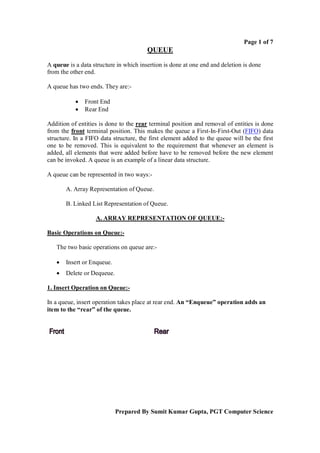
A queue is a data structure in which insertion is done at one end and deletion is done
from the other end.
A queue has two ends. They are:


Front End
Rear End

Addition of entities is done to the rear terminal position and removal of entities is done
from the front terminal position. This makes the queue a First-In-First-Out (FIFO) data
structure. In a FIFO data structure, the first element added to the queue will be the first
one to be removed. This is equivalent to the requirement that whenever an element is
added, all elements that were added before have to be removed before the new element
can be invoked. A queue is an example of a linear data structure.
A queue can be represented in two ways:A. Array Representation of Queue.
B. Linked List Representation of Queue.
A. ARRAY REPRESENTATION OF QUEUE:Basic Operations on Queue:The two basic operations on queue are:

Insert or Enqueue.



Delete or Dequeue.

1. Insert Operation on Queue:In a queue, insert operation takes place at rear end. An “Enqueue” operation adds an
item to the “rear” of the queue.

Prepared By Sumit Kumar Gupta, PGT Computer Science
Page 2 of 7

Steps for inserting an Element in a Queue:a. Initialize both the front and rear as -1, which means that the queue is empty.
b. When the first element will be inserted then the rear and front both will be
incremented by 1. But for the second element onwards only the rear will be
incremented.
c. The value of rear can be maximum up to Max-1, where Max is the maximum
number of elements a queue can hold.
d. If the rear reaches Max-1, then display a message that “The queue is full or Queue
Overflow”.
Algorithm for Insert Operation:If rear=MAX
Print “Queue is full”
Else
rear=rear+1
Queue[rear]=value
END

2. Delete Operation on Queue:In a queue, delete operation takes place at front end. The “Dequeue”operation removes
the item at the “front” of the queue and returns it.
Steps for deleting an Element in a Queue:a. When an element will be deleted from the queue the value of front will be
decremented by 1.
b. The value of front can be minimum up to 0.
c. If the front reaches -1, then display a message that “The queue is empty or Queue
Underflow”.
Prepared By Sumit Kumar Gupta, PGT Computer Science
Page 3 of 7

Algorithm for Delete Operation:If front=rear
Print “Queue is Empty” and Exit from the Program
Else
front=front+1
value=Queue[front]
END
B. LINKED LIST REPRESENTATION OF QUEUE:As we know if we implement the queue in array, sometimes number of memory location
remains unused. To overcome this drawback, it is better to implement queue using linked
list.

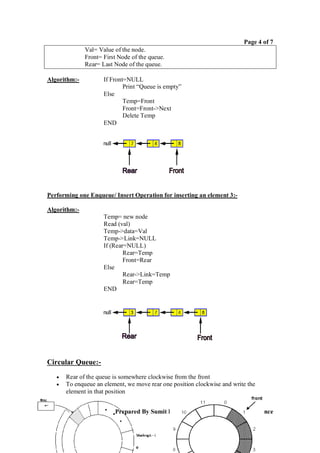
Performing one Dequeue/ Delete Operation:Here

Temp=New node.
Prepared By Sumit Kumar Gupta, PGT Computer Science
Page 4 of 7
Val= Value of the node.
Front= First Node of the queue.
Rear= Last Node of the queue.
Algorithm:-

If Front=NULL
Print “Queue is empty”
Else
Temp=Front
Front=Front->Next
Delete Temp
END

Performing one Enqueue/ Insert Operation for inserting an element 3:Algorithm:Temp= new node
Read (val)
Temp->data=Val
Temp->Link=NULL
If (Rear=NULL)
Rear=Temp
Front=Rear
Else
Rear->Link=Temp
Rear=Temp
END

Circular Queue:


Rear of the queue is somewhere clockwise from the front
To enqueue an element, we move rear one position clockwise and write the
element in that position
Prepared By Sumit Kumar Gupta, PGT Computer Science
Page 5 of 7





To dequeue, we simply move front one position clockwise
Queue migrates in a clockwise direction as we enqueue and dequeue
Emptiness and fullness to be checked carefully.
Apple

Orange

Banana

Front




Guava
Rear

In the above situation queue overflow will occur though the free spaces are also
available since the rear reaches the end. So, queue is full, but still there are two
free cells are available in queue. To avoid this problem, the queue can be arranged
in a circular way called circular queue.
In a circular queue as soon as the rear reaches the Max value, it should be reset to
1. So, if we have to insert Pineapple in the above queue we can insert it into the
first place.
Pineapple
Rear

Apple
Front

Orange

Banana

Guava

Algorithm to Insert an element in a Circular Queue:Note:- Let initially Rear=1 and Front=1.
If (rear+1) Mod Max=Front)
Print “Queue is full”
Else if Rear=Max
Rear=1
Else
Rear=Rear+1
End If
Queue[Rear]=Val
END

Algorithm to Delete an element in a Circular Queue:Prepared By Sumit Kumar Gupta, PGT Computer Science
Page 6 of 7

Note:- Let initially Rear=1 and Front=1.
If Front=Rear
Print “Queue is empty”
Else if Front=Max
Front=1
Else
Front=Front+1
End if
Val=Queue[Front]
END

QUESTION BANK
1. What does ‘front’ signify in a queue?
Ans: Removal of elements from a queue is done through the front terminal.
2. What does ‘rear’ signify in a queue? If in a queue, the ‘rear’ points to the ‘front’,
what is the queue called?
Ans: Insertion of element in a queue is done in the ‘rear’ end. If in a queue, the rear
points to the front, then the queue is considered to be empty.
3. What is the full form of a dequeue?
Ans: It is Double-ended queue.
4. What is the dequeue called that allows insertion at only one end but deletion at
both the ends of the list? What is the dequeue called that allows deletion at only
one end but insertion at both the ends of the list?
Ans:
i. Input restricted dequeue.
ii. Output restricted dequeue.
5. Consider the following circular queue, where CQUEUE is allocated N=6 memory
cells: CQUEUE: AAA, DDD, EEE, FFF, GGG, __________
Describe the queue as the following operation take place:
(a) Insert (CQUEUE, KKK) (b) POP (CQUEUE, ITEM)
(c) Insert (CQUEUE, LLL) (d) Insert (CQUEUE, SSS)
(e) POP (CQUEUE, ITEM) (f) Insert (CQUEUE, TTT)
Ans:
(a) AAA, DDD, EEE, FFF, GGG, KKK
Prepared By Sumit Kumar Gupta, PGT Computer Science
Page 7 of 7
(b) DDD, EEE, FFF, GGG, KKK
(c) DDD, EEE, FFF, GGG, KKK, LLL
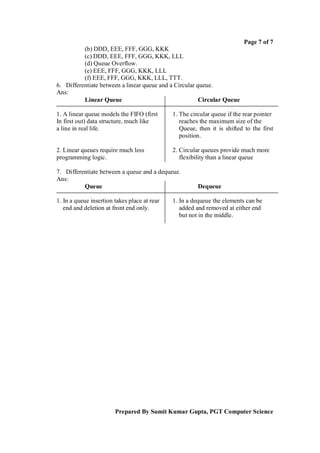
(d) Queue Overflow.
(e) EEE, FFF, GGG, KKK, LLL
(f) EEE, FFF, GGG, KKK, LLL, TTT.
6. Differentiate between a linear queue and a Circular queue.
Ans:
Linear Queue
Circular Queue
1. A linear queue models the FIFO (first
In first out) data structure, much like
a line in real life.

1. The circular queue if the rear pointer
reaches the maximum size of the
Queue, then it is shifted to the first
position.

2. Linear queues require much less
programming logic.

2. Circular queues provide much more
flexibility than a linear queue

7. Differentiate between a queue and a dequeue.
Ans:
Queue
1. In a queue insertion takes place at rear
end and deletion at front end only.

Dequeue

1. In a dequeue the elements can be
added and removed at either end
but not in the middle.

Prepared By Sumit Kumar Gupta, PGT Computer Science

Queue

  • 1.
    Page 1 of7 QUEUE A queue is a data structure in which insertion is done at one end and deletion is done from the other end. A queue has two ends. They are:  Front End Rear End Addition of entities is done to the rear terminal position and removal of entities is done from the front terminal position. This makes the queue a First-In-First-Out (FIFO) data structure. In a FIFO data structure, the first element added to the queue will be the first one to be removed. This is equivalent to the requirement that whenever an element is added, all elements that were added before have to be removed before the new element can be invoked. A queue is an example of a linear data structure. A queue can be represented in two ways:A. Array Representation of Queue. B. Linked List Representation of Queue. A. ARRAY REPRESENTATION OF QUEUE:Basic Operations on Queue:The two basic operations on queue are: Insert or Enqueue.  Delete or Dequeue. 1. Insert Operation on Queue:In a queue, insert operation takes place at rear end. An “Enqueue” operation adds an item to the “rear” of the queue. Prepared By Sumit Kumar Gupta, PGT Computer Science
  • 2.
    Page 2 of7 Steps for inserting an Element in a Queue:a. Initialize both the front and rear as -1, which means that the queue is empty. b. When the first element will be inserted then the rear and front both will be incremented by 1. But for the second element onwards only the rear will be incremented. c. The value of rear can be maximum up to Max-1, where Max is the maximum number of elements a queue can hold. d. If the rear reaches Max-1, then display a message that “The queue is full or Queue Overflow”. Algorithm for Insert Operation:If rear=MAX Print “Queue is full” Else rear=rear+1 Queue[rear]=value END 2. Delete Operation on Queue:In a queue, delete operation takes place at front end. The “Dequeue”operation removes the item at the “front” of the queue and returns it. Steps for deleting an Element in a Queue:a. When an element will be deleted from the queue the value of front will be decremented by 1. b. The value of front can be minimum up to 0. c. If the front reaches -1, then display a message that “The queue is empty or Queue Underflow”. Prepared By Sumit Kumar Gupta, PGT Computer Science
  • 3.
    Page 3 of7 Algorithm for Delete Operation:If front=rear Print “Queue is Empty” and Exit from the Program Else front=front+1 value=Queue[front] END B. LINKED LIST REPRESENTATION OF QUEUE:As we know if we implement the queue in array, sometimes number of memory location remains unused. To overcome this drawback, it is better to implement queue using linked list. Performing one Dequeue/ Delete Operation:Here Temp=New node. Prepared By Sumit Kumar Gupta, PGT Computer Science
  • 4.
    Page 4 of7 Val= Value of the node. Front= First Node of the queue. Rear= Last Node of the queue. Algorithm:- If Front=NULL Print “Queue is empty” Else Temp=Front Front=Front->Next Delete Temp END Performing one Enqueue/ Insert Operation for inserting an element 3:Algorithm:Temp= new node Read (val) Temp->data=Val Temp->Link=NULL If (Rear=NULL) Rear=Temp Front=Rear Else Rear->Link=Temp Rear=Temp END Circular Queue:  Rear of the queue is somewhere clockwise from the front To enqueue an element, we move rear one position clockwise and write the element in that position Prepared By Sumit Kumar Gupta, PGT Computer Science
  • 5.
    Page 5 of7    To dequeue, we simply move front one position clockwise Queue migrates in a clockwise direction as we enqueue and dequeue Emptiness and fullness to be checked carefully. Apple Orange Banana Front   Guava Rear In the above situation queue overflow will occur though the free spaces are also available since the rear reaches the end. So, queue is full, but still there are two free cells are available in queue. To avoid this problem, the queue can be arranged in a circular way called circular queue. In a circular queue as soon as the rear reaches the Max value, it should be reset to 1. So, if we have to insert Pineapple in the above queue we can insert it into the first place. Pineapple Rear Apple Front Orange Banana Guava Algorithm to Insert an element in a Circular Queue:Note:- Let initially Rear=1 and Front=1. If (rear+1) Mod Max=Front) Print “Queue is full” Else if Rear=Max Rear=1 Else Rear=Rear+1 End If Queue[Rear]=Val END Algorithm to Delete an element in a Circular Queue:Prepared By Sumit Kumar Gupta, PGT Computer Science
  • 6.
    Page 6 of7 Note:- Let initially Rear=1 and Front=1. If Front=Rear Print “Queue is empty” Else if Front=Max Front=1 Else Front=Front+1 End if Val=Queue[Front] END QUESTION BANK 1. What does ‘front’ signify in a queue? Ans: Removal of elements from a queue is done through the front terminal. 2. What does ‘rear’ signify in a queue? If in a queue, the ‘rear’ points to the ‘front’, what is the queue called? Ans: Insertion of element in a queue is done in the ‘rear’ end. If in a queue, the rear points to the front, then the queue is considered to be empty. 3. What is the full form of a dequeue? Ans: It is Double-ended queue. 4. What is the dequeue called that allows insertion at only one end but deletion at both the ends of the list? What is the dequeue called that allows deletion at only one end but insertion at both the ends of the list? Ans: i. Input restricted dequeue. ii. Output restricted dequeue. 5. Consider the following circular queue, where CQUEUE is allocated N=6 memory cells: CQUEUE: AAA, DDD, EEE, FFF, GGG, __________ Describe the queue as the following operation take place: (a) Insert (CQUEUE, KKK) (b) POP (CQUEUE, ITEM) (c) Insert (CQUEUE, LLL) (d) Insert (CQUEUE, SSS) (e) POP (CQUEUE, ITEM) (f) Insert (CQUEUE, TTT) Ans: (a) AAA, DDD, EEE, FFF, GGG, KKK Prepared By Sumit Kumar Gupta, PGT Computer Science
  • 7.
    Page 7 of7 (b) DDD, EEE, FFF, GGG, KKK (c) DDD, EEE, FFF, GGG, KKK, LLL (d) Queue Overflow. (e) EEE, FFF, GGG, KKK, LLL (f) EEE, FFF, GGG, KKK, LLL, TTT. 6. Differentiate between a linear queue and a Circular queue. Ans: Linear Queue Circular Queue 1. A linear queue models the FIFO (first In first out) data structure, much like a line in real life. 1. The circular queue if the rear pointer reaches the maximum size of the Queue, then it is shifted to the first position. 2. Linear queues require much less programming logic. 2. Circular queues provide much more flexibility than a linear queue 7. Differentiate between a queue and a dequeue. Ans: Queue 1. In a queue insertion takes place at rear end and deletion at front end only. Dequeue 1. In a dequeue the elements can be added and removed at either end but not in the middle. Prepared By Sumit Kumar Gupta, PGT Computer Science