11
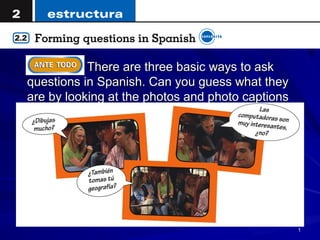
There are three basic ways to askThere are three basic ways to ask
questions in Spanish. Can you guess what theyquestions in Spanish. Can you guess what they
are by looking at the photos and photo captionsare by looking at the photos and photo captions
on this page?on this page?
22
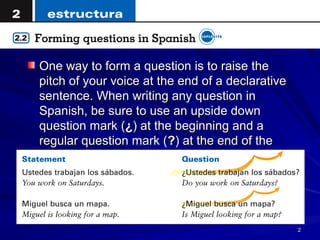
One way to form a question is to raise theOne way to form a question is to raise the
pitch of your voice at the end of a declarativepitch of your voice at the end of a declarative
sentence. When writing any question insentence. When writing any question in
Spanish, be sure to use an upside downSpanish, be sure to use an upside down
question mark (question mark (¿¿) at the beginning and a) at the beginning and a
regular question mark (regular question mark (??) at the end of the) at the end of the
sentence.sentence.
33
You can also form a question by invertingYou can also form a question by inverting
the order of the subject and the verb of athe order of the subject and the verb of a
declarative statement. The subject maydeclarative statement. The subject may
even be placed at the end of theeven be placed at the end of the
sentence.sentence.
44
Questions can also be formed by addingQuestions can also be formed by adding
the tagsthe tags ¿no?¿no? oror ¿verdad?¿verdad? at the end ofat the end of
a statement.a statement.
55
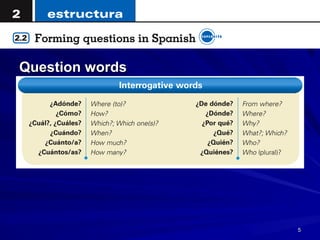
Question wordsQuestion words
66
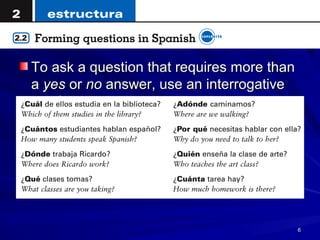
To ask a question that requires more thanTo ask a question that requires more than
aa yesyes oror nono answer, use an interrogativeanswer, use an interrogative
word.word.
77
When pronouncing this type of question,When pronouncing this type of question,
the pitch of your voice falls at the end ofthe pitch of your voice falls at the end of
the sentence.the sentence.
88
Notice the difference betweenNotice the difference between ¿por qué?¿por qué?,,
which is written as two words and has anwhich is written as two words and has an
accent, andaccent, and porqueporque, which is written as, which is written as
one word without an accent.one word without an accent.
99
In SpanishIn Spanish nono can mean bothcan mean both nono andand notnot..
Therefore, when answering a yes/noTherefore, when answering a yes/no
question in the negative, you need to usequestion in the negative, you need to use
nono twice.twice.
99
In SpanishIn Spanish nono can mean bothcan mean both nono andand notnot..
Therefore, when answering a yes/noTherefore, when answering a yes/no
question in the negative, you need to usequestion in the negative, you need to use
nono twice.twice.

Question forming

  • 1.
    11 There are threebasic ways to askThere are three basic ways to ask questions in Spanish. Can you guess what theyquestions in Spanish. Can you guess what they are by looking at the photos and photo captionsare by looking at the photos and photo captions on this page?on this page?
  • 2.
    22 One way toform a question is to raise theOne way to form a question is to raise the pitch of your voice at the end of a declarativepitch of your voice at the end of a declarative sentence. When writing any question insentence. When writing any question in Spanish, be sure to use an upside downSpanish, be sure to use an upside down question mark (question mark (¿¿) at the beginning and a) at the beginning and a regular question mark (regular question mark (??) at the end of the) at the end of the sentence.sentence.
  • 3.
    33 You can alsoform a question by invertingYou can also form a question by inverting the order of the subject and the verb of athe order of the subject and the verb of a declarative statement. The subject maydeclarative statement. The subject may even be placed at the end of theeven be placed at the end of the sentence.sentence.
  • 4.
    44 Questions can alsobe formed by addingQuestions can also be formed by adding the tagsthe tags ¿no?¿no? oror ¿verdad?¿verdad? at the end ofat the end of a statement.a statement.
  • 5.
  • 6.
    66 To ask aquestion that requires more thanTo ask a question that requires more than aa yesyes oror nono answer, use an interrogativeanswer, use an interrogative word.word.
  • 7.
    77 When pronouncing thistype of question,When pronouncing this type of question, the pitch of your voice falls at the end ofthe pitch of your voice falls at the end of the sentence.the sentence.
  • 8.
    88 Notice the differencebetweenNotice the difference between ¿por qué?¿por qué?,, which is written as two words and has anwhich is written as two words and has an accent, andaccent, and porqueporque, which is written as, which is written as one word without an accent.one word without an accent.
  • 9.
    99 In SpanishIn Spanishnono can mean bothcan mean both nono andand notnot.. Therefore, when answering a yes/noTherefore, when answering a yes/no question in the negative, you need to usequestion in the negative, you need to use nono twice.twice.
  • 10.
    99 In SpanishIn Spanishnono can mean bothcan mean both nono andand notnot.. Therefore, when answering a yes/noTherefore, when answering a yes/no question in the negative, you need to usequestion in the negative, you need to use nono twice.twice.