HOW TO MAKE
QUESTIONS
MARÍA JESÚS DUQUE SÁNCHEZ
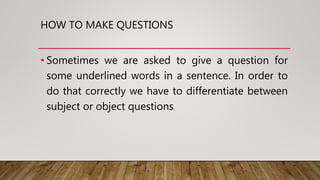
HOW TO MAKE QUESTIONS
• Sometimes we are asked to give a question for
some underlined words in a sentence. In order to
do that correctly we have to differentiate between
subject or object questions.
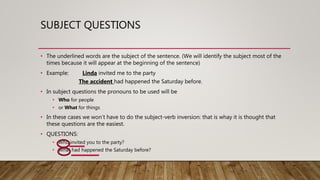
SUBJECT QUESTIONS
• The underlined words are the subject of the sentence. (We will identify the subject most of the
times because it will appear at the beginning of the sentence)
• Example: Linda invited me to the party
The accident had happened the Saturday before.
• In subject questions the pronouns to be used will be
• Who for people
• or What for things
• In these cases we won’t have to do the subject-verb inversion: that is whay it is thought that
these questions are the easiest.
• QUESTIONS:
• Who invited you to the party?
• What had happened the Saturday before?
OBJECT QUESTIONS
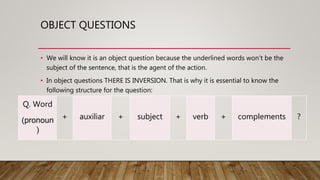
• We will know it is an object question because the underlined words won’t be the
subject of the sentence, that is the agent of the action.
• In object questions THERE IS INVERSION. That is why it is essential to know the
following structure for the question:
Q. Word
(pronoun
)
+ auxiliar + subject + verb + complements ?
OBJECT QUESTIONS
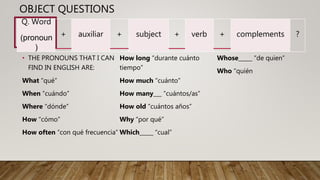
• THE PRONOUNS THAT I CAN
FIND IN ENGLISH ARE:
What “qué”
When “cuándo”
Where “dónde”
How “cómo”
How often “con qué frecuencia”
How long “durante cuánto
tiempo”
How much “cuánto”
How many___ “cuántos/as”
How old “cuántos años”
Why “por qué”
Which_____ “cual”
Whose_____ “de quien”
Who “quién
Q. Word
(pronoun
)
+ auxiliar + subject + verb + complements ?
What “qué”
When “cuándo”
Where “dónde”
How “cómo”
How often “con qué frecuencia”
How long “durante cuánto
tiempo”
How much “cuánto”
How many___ “cuántos/as”
How old “cuántos años”
Why “por qué”
Which_____ “cual”
Whose_____ “de quien”
Who “quién
Q. Word
(pronoun
)
+ auxiliar + subject + verb + complements ?
OBJECT QUESTIONS
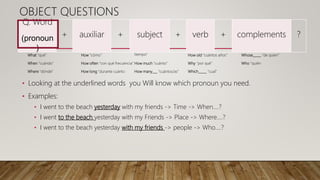
• Looking at the underlined words you Will know which pronoun you need.
• Examples:
• I went to the beach yesterday with my friends -> Time -> When….?
• I went to the beach yesterday with my Friends -> Place -> Where….?
• I went to the beach yesterday with my friends -> people -> Who….?
What “qué”
When “cuándo”
Where “dónde”
How “cómo”
How often “con qué frecuencia”
How long “durante cuánto
tiempo”
How much “cuánto”
How many___ “cuántos/as”
How old “cuántos años”
Why “por qué”
Which_____ “cual”
Whose_____ “de quien”
Who “quién
Q. Word
(pronoun
)
+ auxiliar + subject + verb + complements ?
OBJECT QUESTIONS
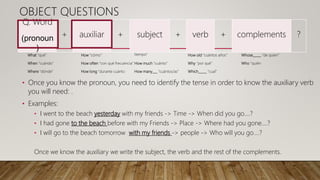
• Once you know the pronoun, you need to identify the tense in order to know the auxiliary verb
you will need: .
• Examples:
• I went to the beach yesterday with my friends -> Time -> When did you go….?
• I had gone to the beach before with my Friends -> Place -> Where had you gone….?
• I will go to the beach tomorrow with my friends -> people -> Who will you go….?
Once we know the auxiliary we write the subject, the verb and the rest of the complements.
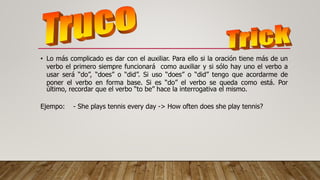
• Lo más complicado es dar con el auxiliar. Para ello si la oración tiene más de un
verbo el primero siempre funcionará como auxiliar y si sólo hay uno el verbo a
usar será “do”, “does” o “did”. Si uso “does” o “did” tengo que acordarme de
poner el verbo en forma base. Si es “do” el verbo se queda como está. Por
último, recordar que el verbo “to be” hace la interrogativa el mismo.
Ejempo: - She plays tennis every day -> How often does she play tennis?
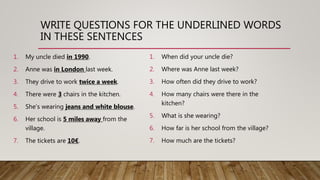
WRITE QUESTIONS FOR THE UNDERLINED WORDS
IN THESE SENTENCES
1. My uncle died in 1990.
2. Anne was in London last week.
3. They drive to work twice a week.
4. There were 3 chairs in the kitchen.
5. She’s wearing jeans and white blouse.
6. Her school is 5 miles away from the
village.
7. The tickets are 10€.
1. When did your uncle die?
2. Where was Anne last week?
3. How often did they drive to work?
4. How many chairs were there in the
kitchen?
5. What is she wearing?
6. How far is her school from the village?
7. How much are the tickets?

How to make questions

  • 1.
    HOW TO MAKE QUESTIONS MARÍAJESÚS DUQUE SÁNCHEZ
  • 2.
    HOW TO MAKEQUESTIONS • Sometimes we are asked to give a question for some underlined words in a sentence. In order to do that correctly we have to differentiate between subject or object questions.
  • 3.
    SUBJECT QUESTIONS • Theunderlined words are the subject of the sentence. (We will identify the subject most of the times because it will appear at the beginning of the sentence) • Example: Linda invited me to the party The accident had happened the Saturday before. • In subject questions the pronouns to be used will be • Who for people • or What for things • In these cases we won’t have to do the subject-verb inversion: that is whay it is thought that these questions are the easiest. • QUESTIONS: • Who invited you to the party? • What had happened the Saturday before?
  • 4.
    OBJECT QUESTIONS • Wewill know it is an object question because the underlined words won’t be the subject of the sentence, that is the agent of the action. • In object questions THERE IS INVERSION. That is why it is essential to know the following structure for the question: Q. Word (pronoun ) + auxiliar + subject + verb + complements ?
  • 5.
    OBJECT QUESTIONS • THEPRONOUNS THAT I CAN FIND IN ENGLISH ARE: What “qué” When “cuándo” Where “dónde” How “cómo” How often “con qué frecuencia” How long “durante cuánto tiempo” How much “cuánto” How many___ “cuántos/as” How old “cuántos años” Why “por qué” Which_____ “cual” Whose_____ “de quien” Who “quién Q. Word (pronoun ) + auxiliar + subject + verb + complements ?
  • 6.
    What “qué” When “cuándo” Where“dónde” How “cómo” How often “con qué frecuencia” How long “durante cuánto tiempo” How much “cuánto” How many___ “cuántos/as” How old “cuántos años” Why “por qué” Which_____ “cual” Whose_____ “de quien” Who “quién Q. Word (pronoun ) + auxiliar + subject + verb + complements ? OBJECT QUESTIONS • Looking at the underlined words you Will know which pronoun you need. • Examples: • I went to the beach yesterday with my friends -> Time -> When….? • I went to the beach yesterday with my Friends -> Place -> Where….? • I went to the beach yesterday with my friends -> people -> Who….?
  • 7.
    What “qué” When “cuándo” Where“dónde” How “cómo” How often “con qué frecuencia” How long “durante cuánto tiempo” How much “cuánto” How many___ “cuántos/as” How old “cuántos años” Why “por qué” Which_____ “cual” Whose_____ “de quien” Who “quién Q. Word (pronoun ) + auxiliar + subject + verb + complements ? OBJECT QUESTIONS • Once you know the pronoun, you need to identify the tense in order to know the auxiliary verb you will need: . • Examples: • I went to the beach yesterday with my friends -> Time -> When did you go….? • I had gone to the beach before with my Friends -> Place -> Where had you gone….? • I will go to the beach tomorrow with my friends -> people -> Who will you go….? Once we know the auxiliary we write the subject, the verb and the rest of the complements.
  • 8.
    • Lo máscomplicado es dar con el auxiliar. Para ello si la oración tiene más de un verbo el primero siempre funcionará como auxiliar y si sólo hay uno el verbo a usar será “do”, “does” o “did”. Si uso “does” o “did” tengo que acordarme de poner el verbo en forma base. Si es “do” el verbo se queda como está. Por último, recordar que el verbo “to be” hace la interrogativa el mismo. Ejempo: - She plays tennis every day -> How often does she play tennis?
  • 9.
    WRITE QUESTIONS FORTHE UNDERLINED WORDS IN THESE SENTENCES 1. My uncle died in 1990. 2. Anne was in London last week. 3. They drive to work twice a week. 4. There were 3 chairs in the kitchen. 5. She’s wearing jeans and white blouse. 6. Her school is 5 miles away from the village. 7. The tickets are 10€. 1. When did your uncle die? 2. Where was Anne last week? 3. How often did they drive to work? 4. How many chairs were there in the kitchen? 5. What is she wearing? 6. How far is her school from the village? 7. How much are the tickets?