How does your product
represent particular social
groups?
Social Groups that are represented
•The social groups that would be attracted to my music magazine are represented through the price, and narrative
style of the magazine.The pricing of the magazine can be linked to the social class of my target audience, as the price
reflects how much income my target audience has, and how much they can afford to spend each week. Due to the
price that I have chosen for my product, £1.50, my target audience’s social class could be middle and working class, and
would have part time jobs in order to be able to achieve this price each week.This also shows that my magazine is at a
cheaper price to existing magazines, which would appeal to the target audience as it is affordable but still has relevant
content.
•Another way in which my product represent social groups is through the narrative of the content in the magazine, as
the level of formality and technical lexis can appeal to certain social groups more than others.This is because the use
of complex lexis could be difficult to understand if the reader is used to non-standard English or simple lexis, this
would mean that the magazine does not appeal to them.Thus through the narrative technique a higher social class, of
readers who have an good education is presented in the content of the magazine.
•The final way that social groups are represented in my product is through the gender of my target audience, and
how this gender is used throughout the magazine.As my target audience is females, the female gender is represented
through the use of female models in the images, and use of colour in the magazine.The use female models suggests to
the audience that they can become as successful, and not to be ashamed of who they are and what they look like.The
use of purple as a font colour would appeal to the target audience as it can be stereotyped a “girls” colour.
Example of Social Groups from Target Audience
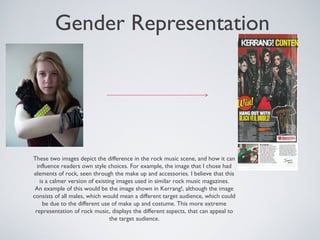
Gender Representation
These two images depict the difference in the rock music scene, and how it can
influence readers own style choices. For example, the image that I chose had
elements of rock, seen through the make up and accessories. I believe that this
is a calmer version of existing images used in similar rock music magazines.
An example of this would be the image shown in Kerrang!, although the image
consists of all males, which would mean a different target audience, which could
be due to the different use of make up and costume. This more extreme
representation of rock music, displays the different aspects, that can appeal to
the target audience.
Theorist: Branston and Stafford
•The social groups that are represented through the final music magazine, can be linked to a theorist view which was put forward
by Branston and Stafford.This view is based on the representation and stereotypes that are associated with certain social groups in
today’s society. Due to the gender of my target audience the social group that is represented through the magazine can be linked to
several stereotypes, as an image is put forward of girls who listen to the genre of music that my magazine is based on.These
stereotypes can have an negative effect on the audience as they may feel rejected by society, for example they could be stereotyped
to be Goth's , when this is not the case. In this case I have tried to go against this particular stereotype by using a bright colour for
the main font, and using a range of styles in images to suggest the variety of the readership.
•Another argument concerning the social groups represented in the magazine in terms of stereotypes and representation, is that
the use of rock music connotations is that the social group that the magazines is represented in a bad way by the media . For
example, Goths are represented in the media and society as wearing black cloths, having many piercings and having black dyed hair.
This is an negative representation of as there is no focus on the positive aspects, and this could be linked to the genre of the
magazine as due to the ‘gothic’ look of the double page spread, it could be assumed that only Goths read the magazine.This would
not be the case, as the readership that is represented thought the magazine is a wide range of different social groups, and the
magazine is open to a range of different readers as the magazine is not aimed toward a particular social group.
Stereotypical image of a Goth,
something that I tried not to use
in my own magazine
Theorist: Branston and Stafford
•The social groups that are represented through the final music magazine, can be linked to a theorist view which was put forward
by Branston and Stafford.This view is based on the representation and stereotypes that are associated with certain social groups in
today’s society. Due to the gender of my target audience the social group that is represented through the magazine can be linked to
several stereotypes, as an image is put forward of girls who listen to the genre of music that my magazine is based on.These
stereotypes can have an negative effect on the audience as they may feel rejected by society, for example they could be stereotyped
to be Goth's , when this is not the case. In this case I have tried to go against this particular stereotype by using a bright colour for
the main font, and using a range of styles in images to suggest the variety of the readership.
•Another argument concerning the social groups represented in the magazine in terms of stereotypes and representation, is that
the use of rock music connotations is that the social group that the magazines is represented in a bad way by the media . For
example, Goths are represented in the media and society as wearing black cloths, having many piercings and having black dyed hair.
This is an negative representation of as there is no focus on the positive aspects, and this could be linked to the genre of the
magazine as due to the ‘gothic’ look of the double page spread, it could be assumed that only Goths read the magazine.This would
not be the case, as the readership that is represented thought the magazine is a wide range of different social groups, and the
magazine is open to a range of different readers as the magazine is not aimed toward a particular social group.
Stereotypical image of a Goth,
something that I tried not to use
in my own magazine

Question 2

  • 1.
    How does yourproduct represent particular social groups?
  • 2.
    Social Groups thatare represented •The social groups that would be attracted to my music magazine are represented through the price, and narrative style of the magazine.The pricing of the magazine can be linked to the social class of my target audience, as the price reflects how much income my target audience has, and how much they can afford to spend each week. Due to the price that I have chosen for my product, £1.50, my target audience’s social class could be middle and working class, and would have part time jobs in order to be able to achieve this price each week.This also shows that my magazine is at a cheaper price to existing magazines, which would appeal to the target audience as it is affordable but still has relevant content. •Another way in which my product represent social groups is through the narrative of the content in the magazine, as the level of formality and technical lexis can appeal to certain social groups more than others.This is because the use of complex lexis could be difficult to understand if the reader is used to non-standard English or simple lexis, this would mean that the magazine does not appeal to them.Thus through the narrative technique a higher social class, of readers who have an good education is presented in the content of the magazine. •The final way that social groups are represented in my product is through the gender of my target audience, and how this gender is used throughout the magazine.As my target audience is females, the female gender is represented through the use of female models in the images, and use of colour in the magazine.The use female models suggests to the audience that they can become as successful, and not to be ashamed of who they are and what they look like.The use of purple as a font colour would appeal to the target audience as it can be stereotyped a “girls” colour.
  • 3.
    Example of SocialGroups from Target Audience
  • 4.
    Gender Representation These twoimages depict the difference in the rock music scene, and how it can influence readers own style choices. For example, the image that I chose had elements of rock, seen through the make up and accessories. I believe that this is a calmer version of existing images used in similar rock music magazines. An example of this would be the image shown in Kerrang!, although the image consists of all males, which would mean a different target audience, which could be due to the different use of make up and costume. This more extreme representation of rock music, displays the different aspects, that can appeal to the target audience.
  • 5.
    Theorist: Branston andStafford •The social groups that are represented through the final music magazine, can be linked to a theorist view which was put forward by Branston and Stafford.This view is based on the representation and stereotypes that are associated with certain social groups in today’s society. Due to the gender of my target audience the social group that is represented through the magazine can be linked to several stereotypes, as an image is put forward of girls who listen to the genre of music that my magazine is based on.These stereotypes can have an negative effect on the audience as they may feel rejected by society, for example they could be stereotyped to be Goth's , when this is not the case. In this case I have tried to go against this particular stereotype by using a bright colour for the main font, and using a range of styles in images to suggest the variety of the readership. •Another argument concerning the social groups represented in the magazine in terms of stereotypes and representation, is that the use of rock music connotations is that the social group that the magazines is represented in a bad way by the media . For example, Goths are represented in the media and society as wearing black cloths, having many piercings and having black dyed hair. This is an negative representation of as there is no focus on the positive aspects, and this could be linked to the genre of the magazine as due to the ‘gothic’ look of the double page spread, it could be assumed that only Goths read the magazine.This would not be the case, as the readership that is represented thought the magazine is a wide range of different social groups, and the magazine is open to a range of different readers as the magazine is not aimed toward a particular social group. Stereotypical image of a Goth, something that I tried not to use in my own magazine
  • 6.
    Theorist: Branston andStafford •The social groups that are represented through the final music magazine, can be linked to a theorist view which was put forward by Branston and Stafford.This view is based on the representation and stereotypes that are associated with certain social groups in today’s society. Due to the gender of my target audience the social group that is represented through the magazine can be linked to several stereotypes, as an image is put forward of girls who listen to the genre of music that my magazine is based on.These stereotypes can have an negative effect on the audience as they may feel rejected by society, for example they could be stereotyped to be Goth's , when this is not the case. In this case I have tried to go against this particular stereotype by using a bright colour for the main font, and using a range of styles in images to suggest the variety of the readership. •Another argument concerning the social groups represented in the magazine in terms of stereotypes and representation, is that the use of rock music connotations is that the social group that the magazines is represented in a bad way by the media . For example, Goths are represented in the media and society as wearing black cloths, having many piercings and having black dyed hair. This is an negative representation of as there is no focus on the positive aspects, and this could be linked to the genre of the magazine as due to the ‘gothic’ look of the double page spread, it could be assumed that only Goths read the magazine.This would not be the case, as the readership that is represented thought the magazine is a wide range of different social groups, and the magazine is open to a range of different readers as the magazine is not aimed toward a particular social group. Stereotypical image of a Goth, something that I tried not to use in my own magazine