Section A – Question 1 b)
Media Language and Preparation
Monday 12th May 2014
Unit G325: Critical Perspectives in
Media
Why?
Aims & Objectives
• Re-cap prior learning in relation to what is
expected of you for this Section of the exam.
• Go through the Key Concept Media Language and
establish and introduce some new approaches
YOU MUST apply in the exam IF you get a
question for Media Language .
• Plan and complete a Practice question on Media
Language.
• Review the learning.
AO2
Apply knowledge
and understanding
to show how
meanings are
created when
analyzing media
products and
evaluating your own
practical work
(Section A)
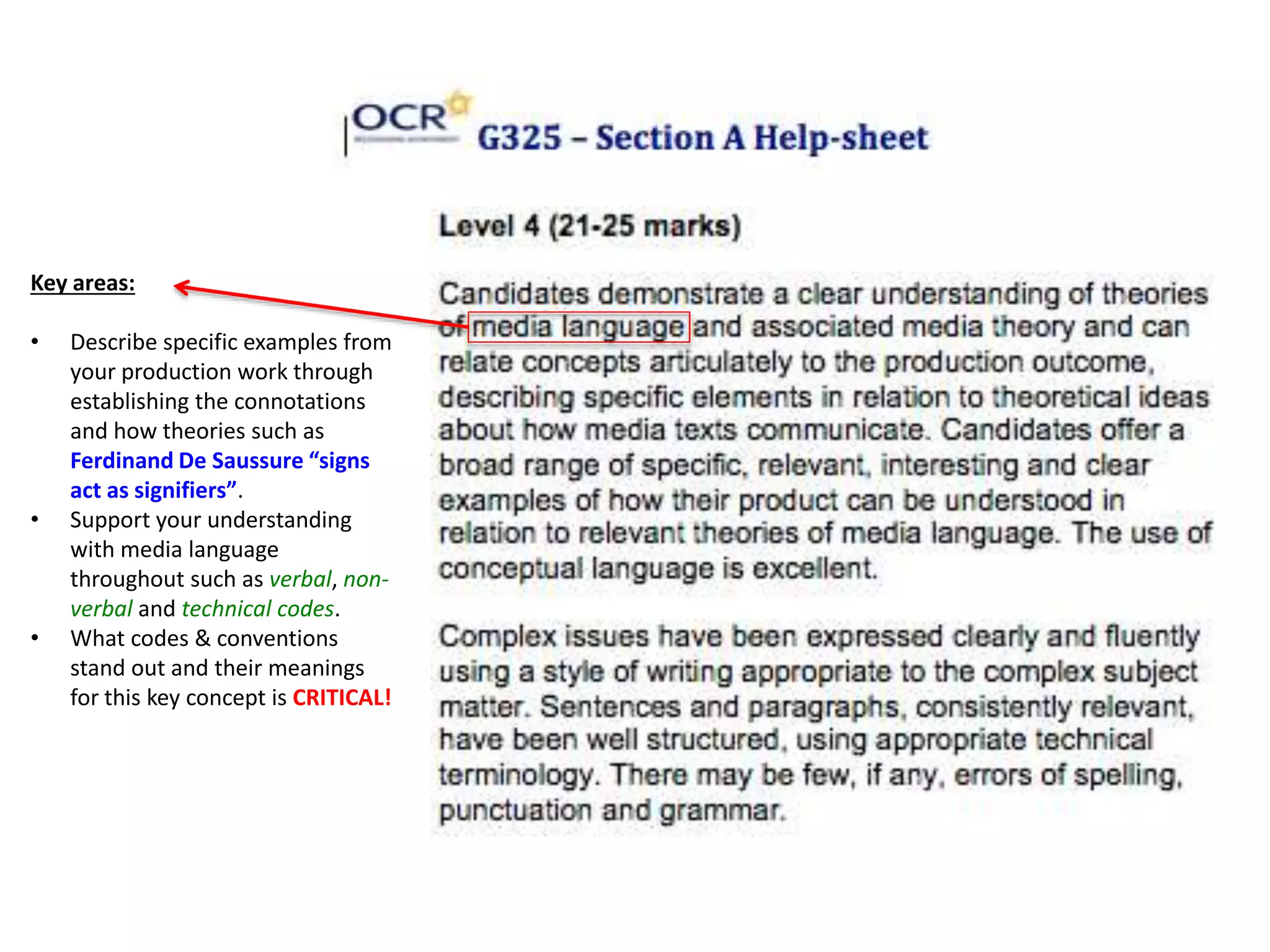
Key areas:
• Describe specific examples from
your production work through
establishing the connotations
and how theories such as
Ferdinand De Saussure “signs
act as signifiers”.
• Support your understanding
with media language
throughout such as verbal, non-
verbal and technical codes.
• What codes & conventions
stand out and their meanings
for this key concept is CRITICAL!
Media Language – What is it?
• Signs and symbols in media texts are polysemic which means they are open to
many interpretations.
• These are two important words concerned with the way an audience understands
the meaning of a media text:
Denotation is the basic, literal meaning of what is in the picture or scene.
Connotation means different interpretations suggested by the text, often associated
with additional meaning, values, or ideology.
These areas will apply to your coursework through deconstructing and critiquing non-
verbal codes such as mise-en-scene (everything the audience would see in your trailer for
example) and the associated micro elements such as lighting, props, colours, costume etc.
This level of textual analysis and reflection will also apply to technical codes such as
camera angles/shots, as well as verbal codes such as non-diegetic song lyrics.
Username: ncrafts84
Password: stpaulsmedia2014
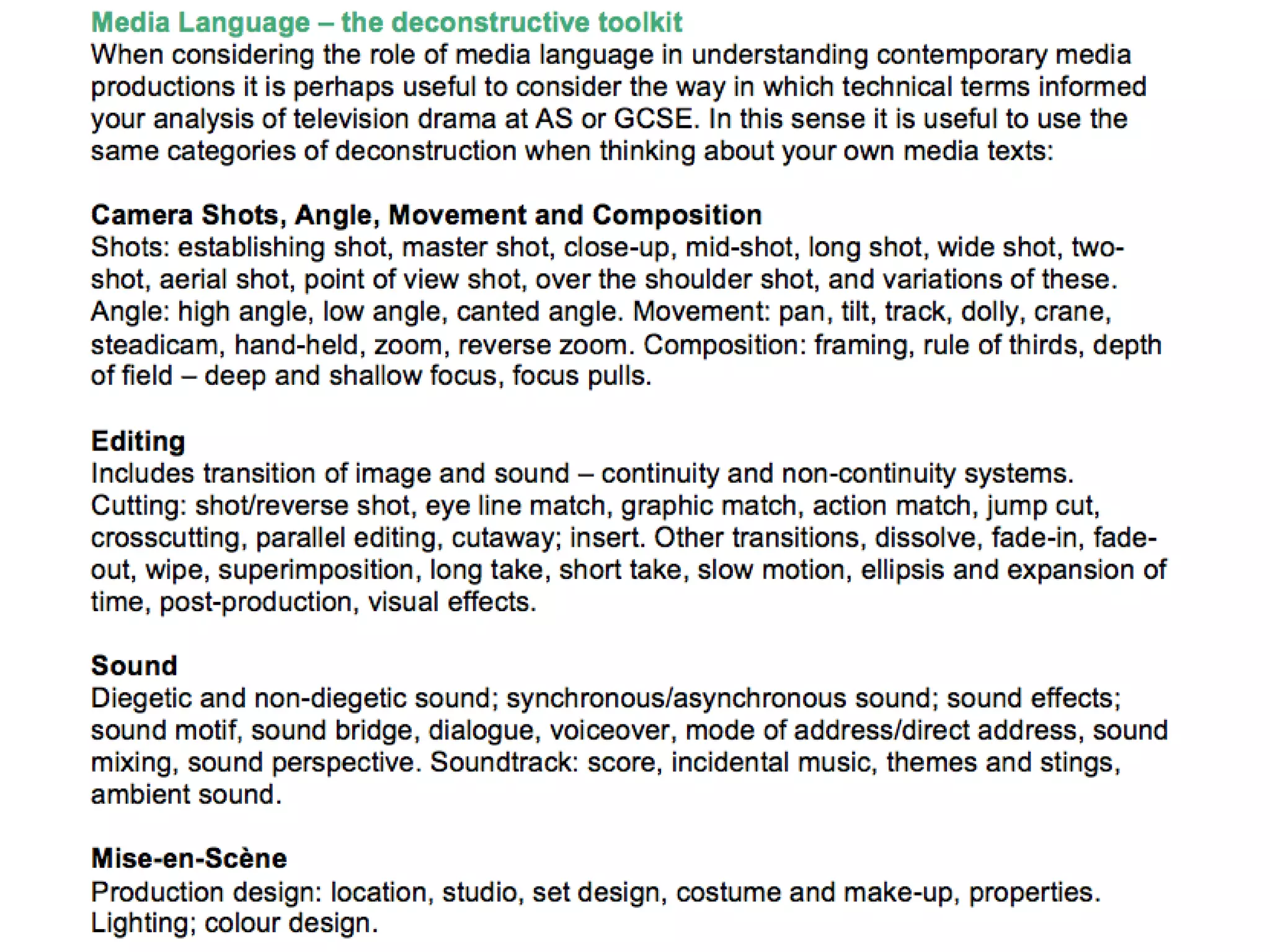
Media Language –
Media Language –non-verbal codes (Props, Lighting, Setting, Costume, Facial
expression/characterisation) technical codes (Shot types, camera angles, Camera
movement - Edit techniques/transitions, post-production effects applied) verbal codes
(Non-diegetic sound such as music lyrics, voiceover, pace of the music, tempo of music,
pitch of the music, synchronous and/or asynchronous sound), denotations, connotations.
Then complete a similar analysis of the Ancillary production (Magazine Cover and Poster)
and analyse where there is evidence of Synergy and/or Convergence. Also YOU MUST
draw upon stand out codes & conventions’ as well.
These are some of the areas YOU MUST apply in the exam IF you get a question for Media
Language.
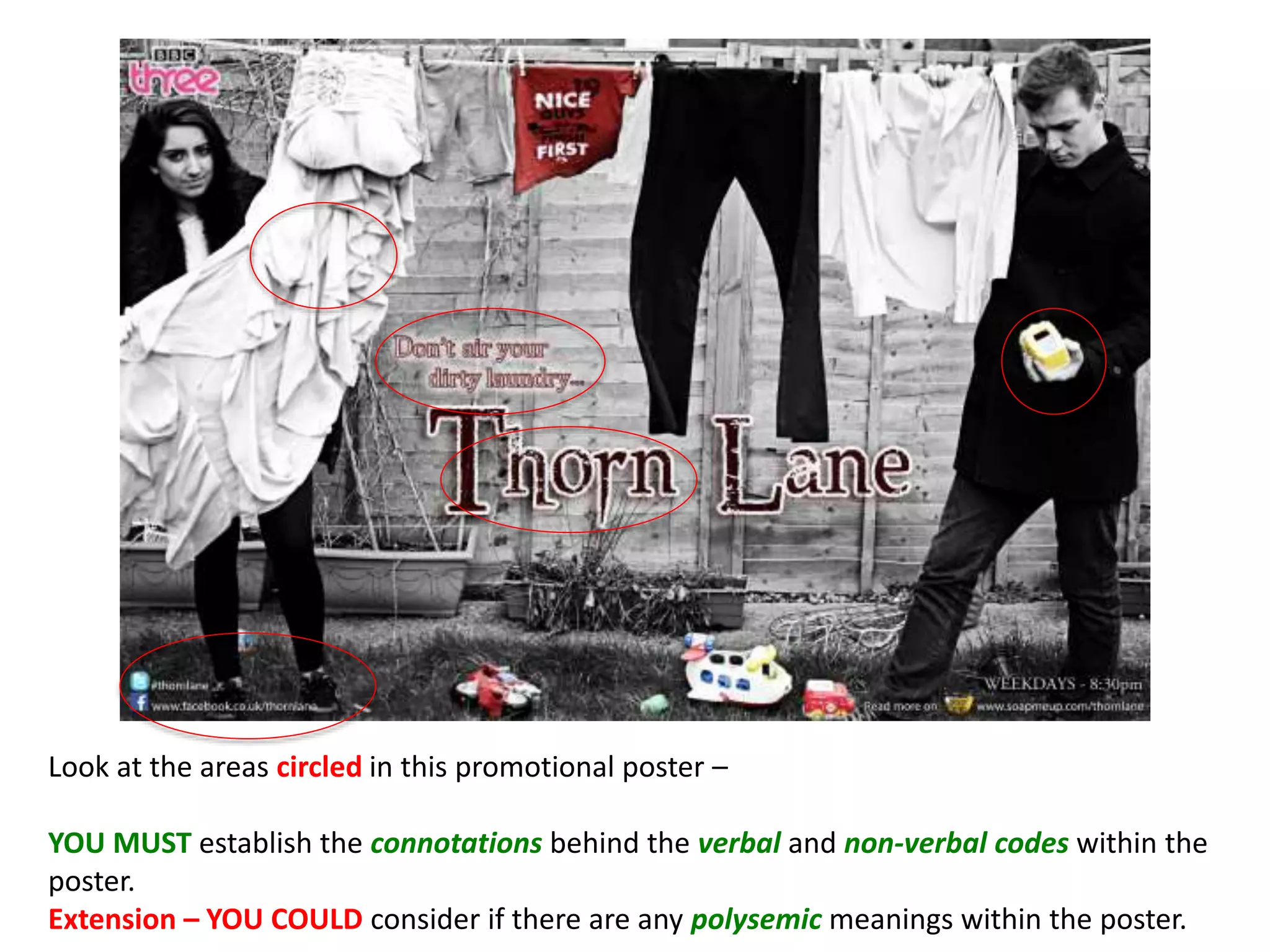
Look at the areas circled in this promotional poster –
YOU MUST establish the connotations behind the verbal and non-verbal codes within the
poster.
Extension – YOU COULD consider if there are any polysemic meanings within the poster.
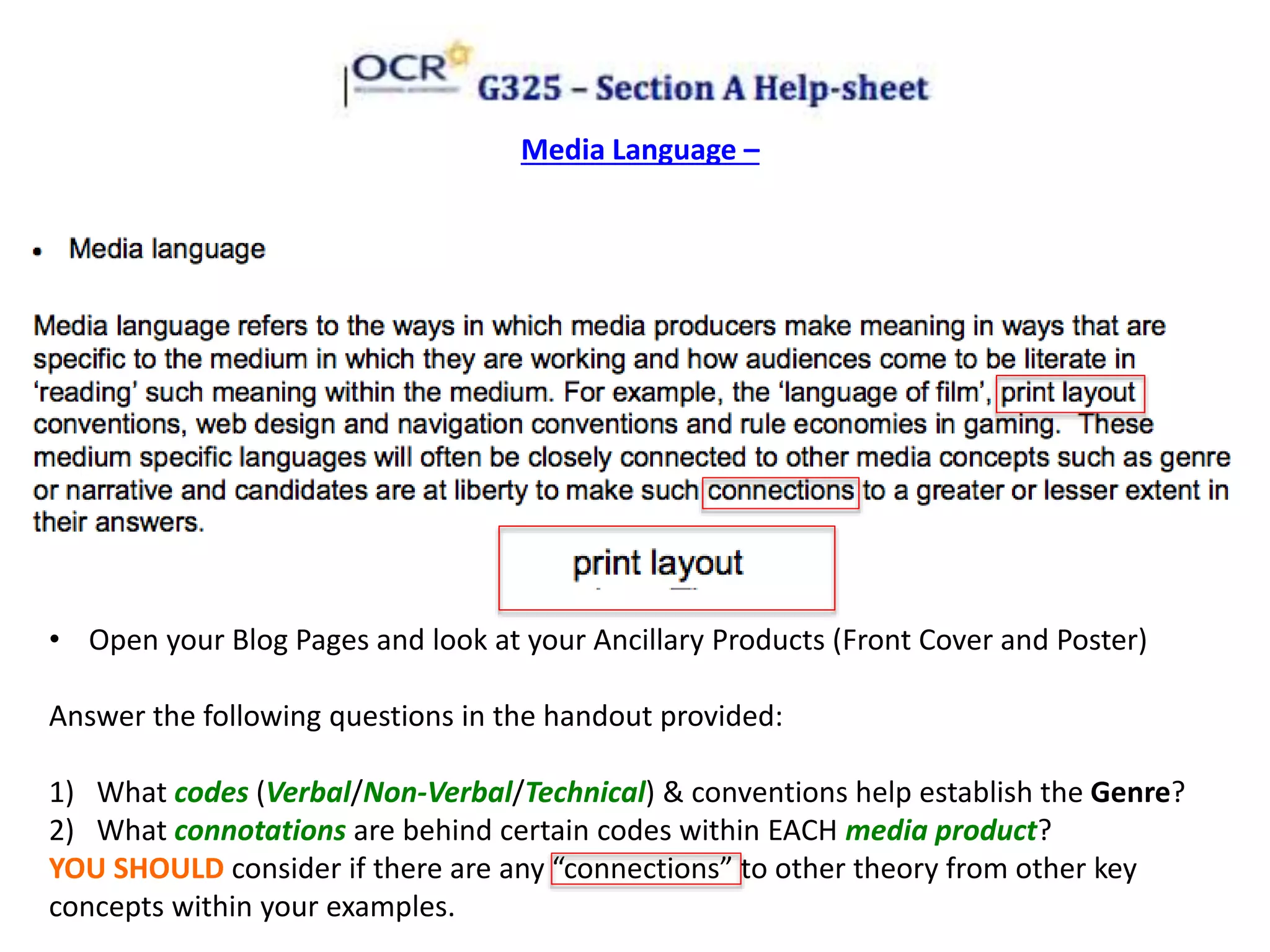
Media Language –
• Open your Blog Pages and look at your Ancillary Products (Front Cover and Poster)
Answer the following questions in the handout provided:
1) What codes (Verbal/Non-Verbal/Technical) & conventions help establish the Genre?
2) What connotations are behind certain codes within EACH media product?
YOU SHOULD consider if there are any “connections” to other theory from other key
concepts within your examples.
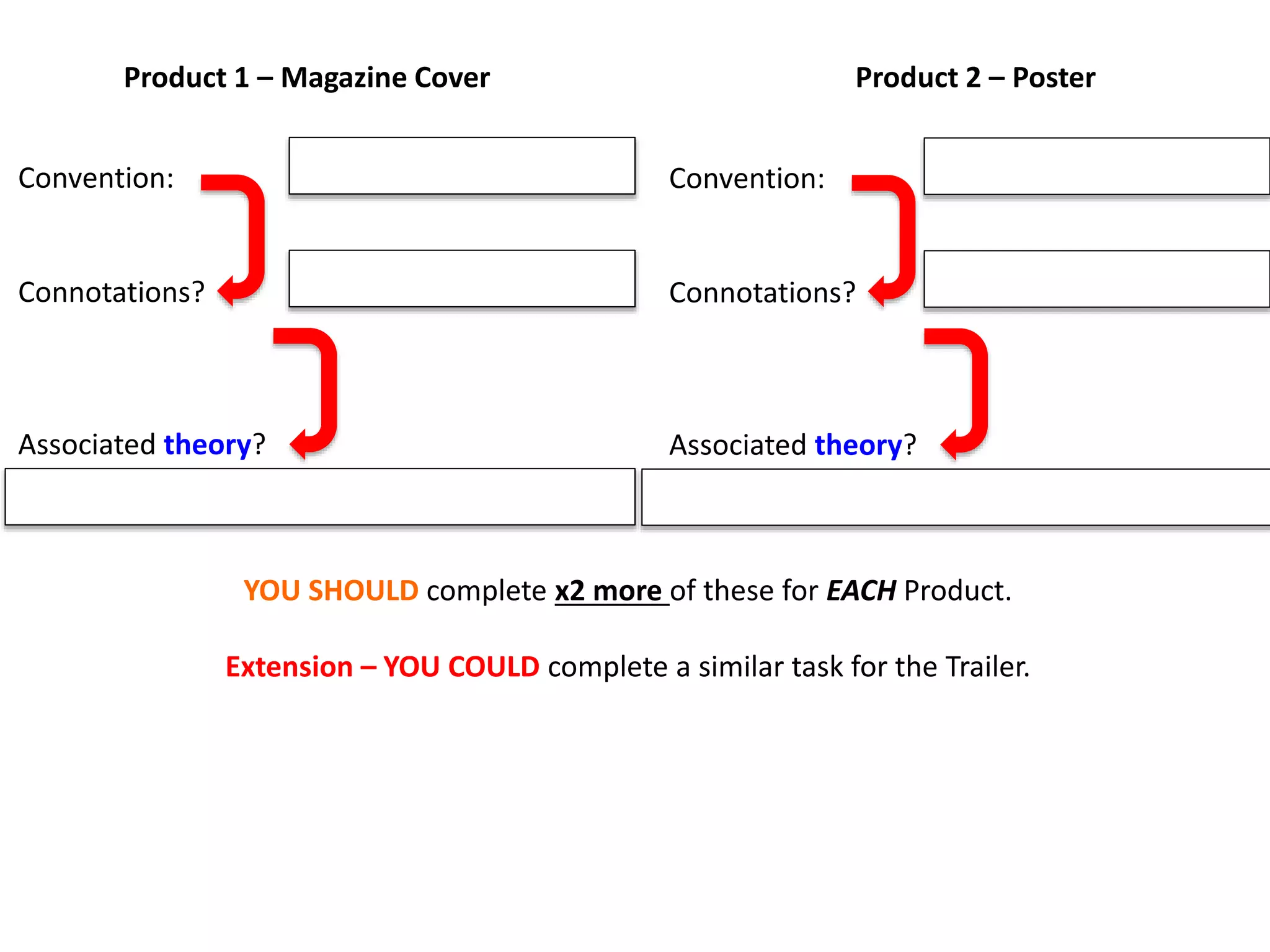
Product 1 – Magazine Cover Product 2 – Poster
Convention:
Connotations?
Associated theory?
Convention:
Connotations?
Associated theory?
YOU SHOULD complete x2 more of these for EACH Product.
Extension – YOU COULD complete a similar task for the Trailer.
FEEDBACK
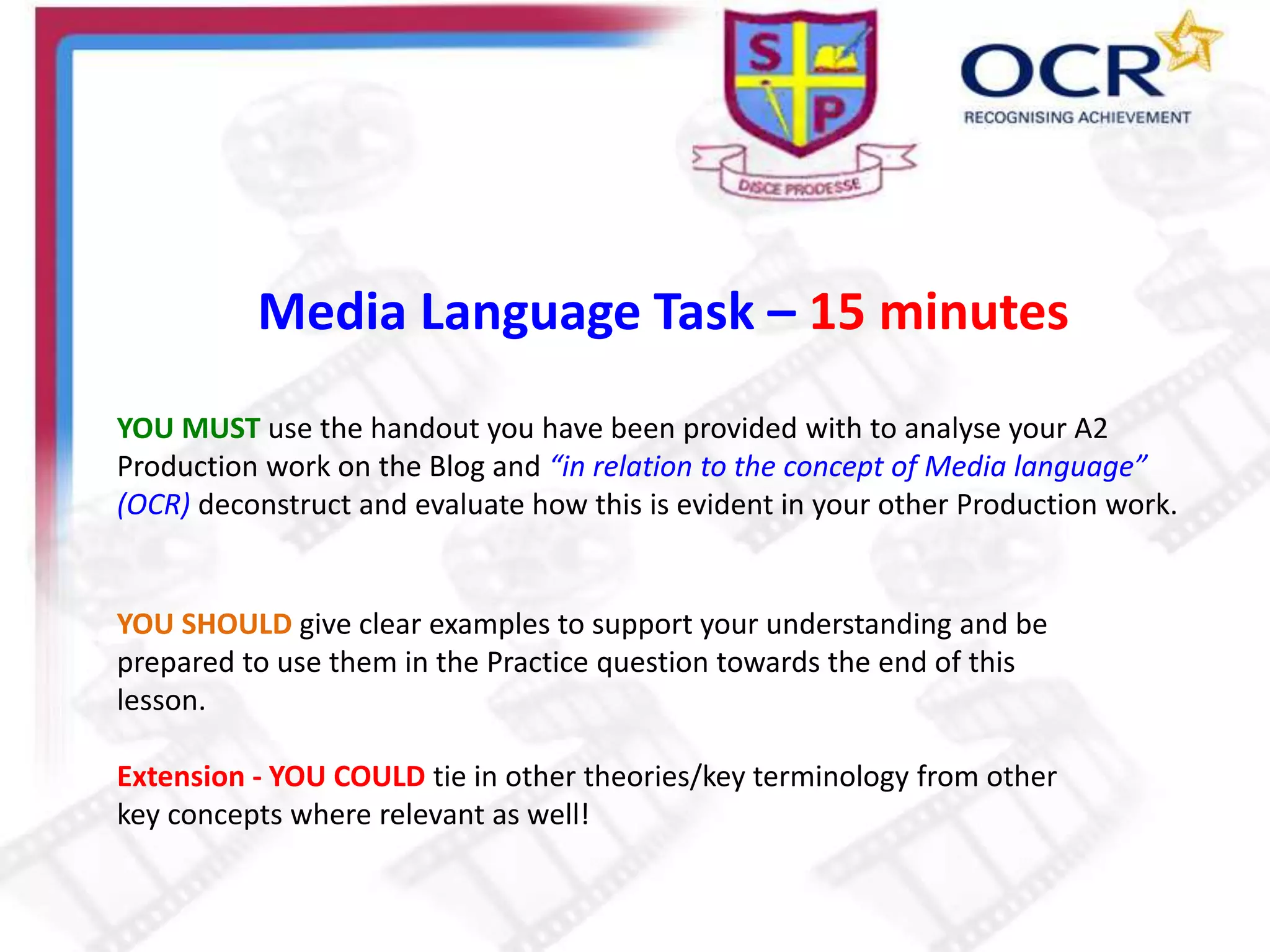
Media Language Task – 15 minutes
YOU MUST use the handout you have been provided with to analyse your A2
Production work on the Blog and “in relation to the concept of Media language”
(OCR) deconstruct and evaluate how this is evident in your other Production work.
YOU SHOULD give clear examples to support your understanding and be
prepared to use them in the Practice question towards the end of this
lesson.
Extension - YOU COULD tie in other theories/key terminology from other
key concepts where relevant as well!
FEEDBACK
Analyse one of your coursework productions in relation to the concept of Media Language
(25 marks)
YOU SHOULD designate no longer than 25-30 minutes answering this question
(dependent on how much planning you want to do for Section B).
1-2 Minutes – BRIEF Plan and Introduction
15 minutes – Main Task (Trailer) – 3-4 detailed examples and links to theory/key
terms.
10 minutes – Ancillary Products – 2-3 detailed examples and links to theory.
1-2 minutes - Conclusion
What you have learnt– Plenary
3 minutes
YOU MUST write down x1 thing
theorykey term/area you need to
address for Media Language
YOU COULD give more than x1
example.
Homework:
1) Revise!
2) COMPLETE a Media Language Question
Due: Monday 19th May 2013 – Period 4

Question 1 b) media language

  • 1.
    Section A –Question 1 b) Media Language and Preparation Monday 12th May 2014 Unit G325: Critical Perspectives in Media
  • 2.
    Why? Aims & Objectives •Re-cap prior learning in relation to what is expected of you for this Section of the exam. • Go through the Key Concept Media Language and establish and introduce some new approaches YOU MUST apply in the exam IF you get a question for Media Language . • Plan and complete a Practice question on Media Language. • Review the learning. AO2 Apply knowledge and understanding to show how meanings are created when analyzing media products and evaluating your own practical work (Section A)
  • 3.
    Key areas: • Describespecific examples from your production work through establishing the connotations and how theories such as Ferdinand De Saussure “signs act as signifiers”. • Support your understanding with media language throughout such as verbal, non- verbal and technical codes. • What codes & conventions stand out and their meanings for this key concept is CRITICAL!
  • 4.
    Media Language –What is it? • Signs and symbols in media texts are polysemic which means they are open to many interpretations. • These are two important words concerned with the way an audience understands the meaning of a media text: Denotation is the basic, literal meaning of what is in the picture or scene. Connotation means different interpretations suggested by the text, often associated with additional meaning, values, or ideology. These areas will apply to your coursework through deconstructing and critiquing non- verbal codes such as mise-en-scene (everything the audience would see in your trailer for example) and the associated micro elements such as lighting, props, colours, costume etc. This level of textual analysis and reflection will also apply to technical codes such as camera angles/shots, as well as verbal codes such as non-diegetic song lyrics. Username: ncrafts84 Password: stpaulsmedia2014
  • 5.
    Media Language – MediaLanguage –non-verbal codes (Props, Lighting, Setting, Costume, Facial expression/characterisation) technical codes (Shot types, camera angles, Camera movement - Edit techniques/transitions, post-production effects applied) verbal codes (Non-diegetic sound such as music lyrics, voiceover, pace of the music, tempo of music, pitch of the music, synchronous and/or asynchronous sound), denotations, connotations. Then complete a similar analysis of the Ancillary production (Magazine Cover and Poster) and analyse where there is evidence of Synergy and/or Convergence. Also YOU MUST draw upon stand out codes & conventions’ as well. These are some of the areas YOU MUST apply in the exam IF you get a question for Media Language.
  • 6.
    Look at theareas circled in this promotional poster – YOU MUST establish the connotations behind the verbal and non-verbal codes within the poster. Extension – YOU COULD consider if there are any polysemic meanings within the poster.
  • 7.
    Media Language – •Open your Blog Pages and look at your Ancillary Products (Front Cover and Poster) Answer the following questions in the handout provided: 1) What codes (Verbal/Non-Verbal/Technical) & conventions help establish the Genre? 2) What connotations are behind certain codes within EACH media product? YOU SHOULD consider if there are any “connections” to other theory from other key concepts within your examples.
  • 8.
    Product 1 –Magazine Cover Product 2 – Poster Convention: Connotations? Associated theory? Convention: Connotations? Associated theory? YOU SHOULD complete x2 more of these for EACH Product. Extension – YOU COULD complete a similar task for the Trailer.
  • 10.
  • 11.
    Media Language Task– 15 minutes YOU MUST use the handout you have been provided with to analyse your A2 Production work on the Blog and “in relation to the concept of Media language” (OCR) deconstruct and evaluate how this is evident in your other Production work. YOU SHOULD give clear examples to support your understanding and be prepared to use them in the Practice question towards the end of this lesson. Extension - YOU COULD tie in other theories/key terminology from other key concepts where relevant as well!
  • 12.
  • 13.
    Analyse one ofyour coursework productions in relation to the concept of Media Language (25 marks) YOU SHOULD designate no longer than 25-30 minutes answering this question (dependent on how much planning you want to do for Section B). 1-2 Minutes – BRIEF Plan and Introduction 15 minutes – Main Task (Trailer) – 3-4 detailed examples and links to theory/key terms. 10 minutes – Ancillary Products – 2-3 detailed examples and links to theory. 1-2 minutes - Conclusion
  • 14.
    What you havelearnt– Plenary 3 minutes YOU MUST write down x1 thing theorykey term/area you need to address for Media Language YOU COULD give more than x1 example.
  • 15.
    Homework: 1) Revise! 2) COMPLETEa Media Language Question Due: Monday 19th May 2013 – Period 4

Editor's Notes