OCR –
Level 3 Cambridge Introductory Diploma in
Media
Unit 01:
Analysing Media Products and Audiences
Evidence
Name:
Candidate Number:
Center Name: St. Andrew’s Catholic School
Center Number: 64135
Set Brief - Print
Project/Brief –
Music Magazine & Promotion
Publisher Logo HERE
Magazine Product Logo HERE
Contents
• YOU SHOULD, at the end of your research,
include a Contents Page or list of tasks carried
out and link them to the relevant LO’s on this
slide.
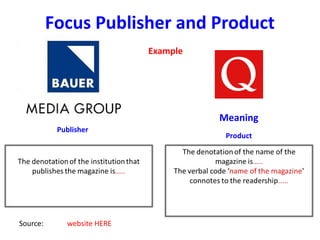
Focus Publisher and Product
• YOU SHOULD include the Logo of the
Publisher and the Product (Magazine) of
Focus.
• Finally, YOU SHOULD include some brief
information about BOTH Institutions on this
slide.
Focus Publisher and Product
Example
Publisher
Product
Source: website HERE
Meaning
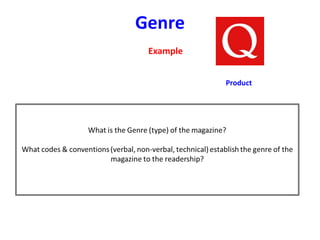
Genre
Example
Product
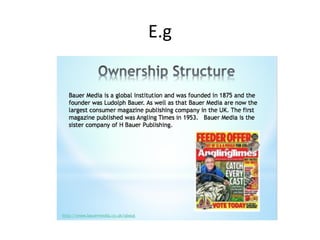
Ownership Structure
• This SHOULD be presented in the form of a
flow chart OR something that clearly
establishes the structure of the Institution.
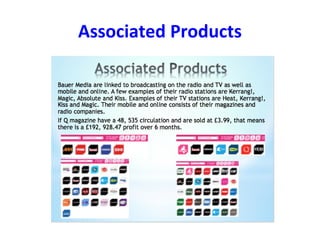
• Associated Products within/under the brand
• Make sure you include the Source for where
you obtained this information from, for
example:
http://www.bauermedia.co.uk/about
E.g
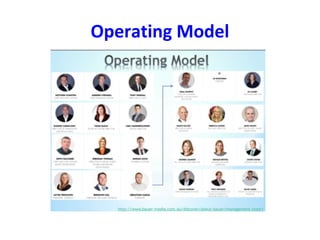
Operating Model
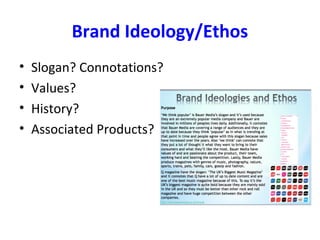
Brand Ideology/Ethos
• Slogan? Connotations?
• Values?
• History?
• Associated Products?
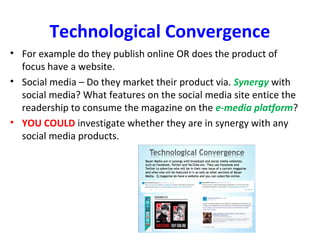
Technological Convergence
• For example do they publish online OR does the product of
focus have a website.
• Social media – Do they market their product via. Synergy with
social media? What features on the social media site entice the
readership to consume the magazine on the e-media platform?
• YOU COULD investigate whether they are in synergy with any
social media products.
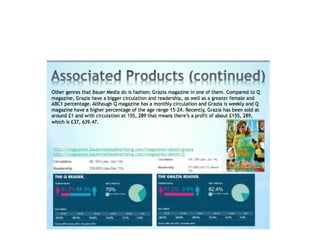
Associated Products
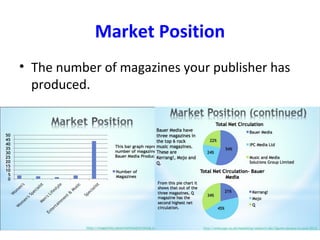
Market Position
• The number of magazines your publisher has
produced.
Competitors
• Who are the publishers competitors – research and
write about them.
• Create a table of similarities and differences for the
following:
1. Associated Products
2. Slogan
3. Readership figures (Circulation)
4. Technological Convergence
Front Cover analysis
Add in and analyse (connotations) magazine conventions
such as:
•Masthead
•Strapline
•Cover lines
•Main Image
•Puff Promotion
•Barcode
•Synergy with social media
•Anchorage Text
•Imagery – ‘Star Appeal’ (Richard Dyer)
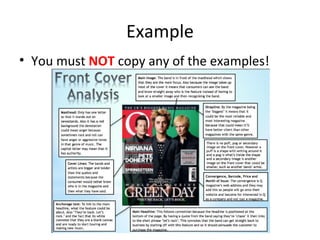
Example
• You must NOT copy any of the examples!
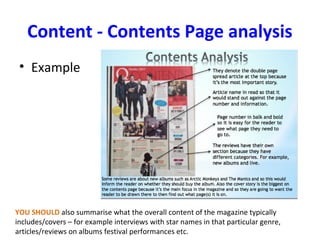
Content - Contents Page analysis
• Example
YOU SHOULD also summarise what the overall content of the magazine typically
includes/covers – for example interviews with star names in that particular genre,
articles/reviews on albums festival performances etc.
DPS analysis
• You MUST and analyse (connotations) magazine
conventions such as:
• Main Image
• Caption to support images (Anchorage)
• Drop Capital
• Stand First
• Issue month and year
• Page number/logo
• Differentiated Questions and Answers
• Pull Quote
Form and Style
• What colours does your magazine you’re
researching use?
• How are the Front Covers set out?
• What are the font styles like? Do they
“repeat” (Steve Neale - 1980) the font styles?
• You MUST answer these questions.
Production Process
• YOU MUST find out the Production Process
for you chosen magazine (you can find out by
emailing them).
• You need to screenshot your email to them
and add it onto your slide.
Synergy
• What social media does the magazine use and
why/where?
• Screenshot examples and look at their
wesbite.
Product Analysis
• Purpose
• Genre
• Form
Purpose = What is the Aim of the Product of investigation – for example
what are the connotations behind the Strapline (Slogan) of the Magazine?
Genre = What sub-genre is the music magazine from? Who are it’s
competitors? What codes & conventions help establish it’s sub-genre to the
audience?
Form = What type of product is it – Magazine? Fiction? Non-Fiction? Is it a
market leader in the Genre?
Demographics
• What type of readership male/female and
WHY?
• Look at the socio-economic graph
• Spending Power
• Lifestyle of consumer
Audience Theories
YOU MUST cover ALL audience theory
•Hartley
•Katz
•Maslow
•Socio-economics
•Psychographics
Product Target Audience –
Primary Research
• YOU SHOULD complete some primary
research into the appeal of your chosen
product using ONE or MORE of the following
options:
Video Focus Group
Primary Research
Survey Monkey
YOU MUST create your OWN survey
Questions examples:
How old are you?
Are you male or female?
How often do you buy a magazine?
Do you read any music magazines and if so what?
Do you subscribe to this magazine?
How much would you pay for a magazine?
You must CONCLUDE all your findings.
Secondary Research
• You MUST look at reviews on the internet and
conclude your findings.
• Analyse a Front Cover and DPS
• Analyse their website
• What do other people/products have to say
about your chosen Publisher and/or music
magazine?
Product Advertising & Marketing
• How is the product (Music Magazine)
advertised?
• What platforms (E-Media, Print, Broadcast)
are utilized to help promote the product?
• Marketing – Above the line and/or Below the
line
• Guerilla marketing?
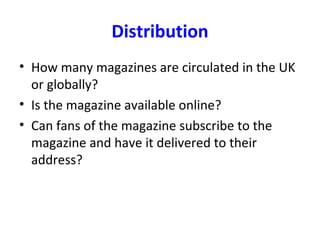
Distribution
• How many magazines are circulated in the UK
or globally?
• Is the magazine available online?
• Can fans of the magazine subscribe to the
magazine and have it delivered to their
address?
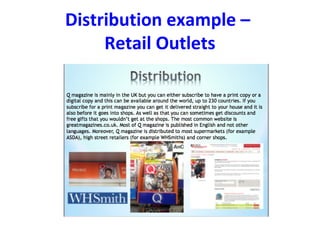
Distribution example –
Retail Outlets
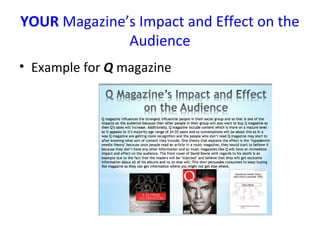
YOUR Magazine’s Impact and Effect on the
Audience
• Example for Q magazine
Relevant issues on Representation
• Stereotyping
• Who are their stereotypical
audience/readership?
• John Berger (1972) “men act, women appear”
• Laura Mulvey ‘male gaze’
• Diana Saco ‘female gaze’
Ethical & Legal Issues.
• See http://www.pcc.org.uk/
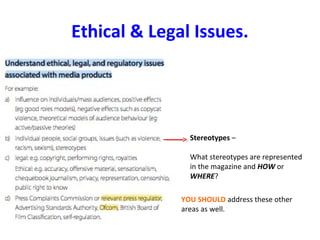
Ethical & Legal Issues.
Stereotypes –
What stereotypes are represented
in the magazine and HOW or
WHERE?
YOU SHOULD address these other
areas as well.
Role of Relevant Regulatory Bodies
Useful source:
https://www.ipso.co.uk/IPSO/cop.html
When it comes to creating magazines, there is
an editors code of practise – you need to find
these.
Ethical & Legal Issues.
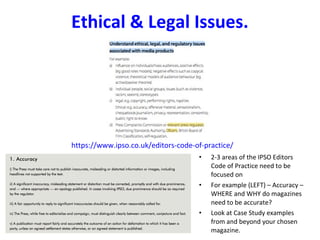
https://www.ipso.co.uk/editors-code-of-practice/
• 2-3 areas of the IPSO Editors
Code of Practice need to be
focused on
• For example (LEFT) – Accuracy –
WHERE and WHY do magazines
need to be accurate?
• Look at Case Study examples
from and beyond your chosen
magazine.
Copyright ©
• Copyright- is when there is a legal right which lasts for
a certain amount of years so you can’t print, publish,
perform, film, or record literary, artistic or musical
material that already exists.
• Relate to YOUR magazine you are researching.
• DO NOT forget to source information
• Where is there evidence of other intellectual property
(IP) being used in the magazine.
• © - On the magazine? Near the Barcode? IP of other
idents such as Facebook and/or twitter
Royalties
• Royalties is when a magazine has included
content which is copyrighted and if someone
else includes this information then they have
to pay the original magazine.
Relate to YOUR magazine you are researching.
DO NOT forget to source information
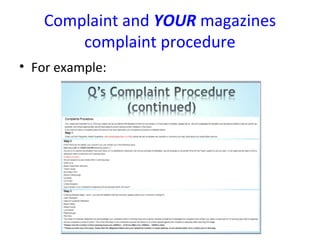
Complaint and YOUR magazines
complaint procedure
• For example:
Regulatory Issues
IP/Watermark
YOU NEED a description for example:
Content that usually has copyright can be referred to as
Intellectual Property (IP) and this is protected by the law. IP can
be divided into two categories; Industrial Property and
Copyright. . As well as IP on printed work, you can get a digital
watermark which protects any copyrighted content from any
magazine online and in any digital format. It is important to have
this because it means people will have to pay you to use your
information/ ideas. The best way to protect your IP is to acquire
a patent. However, this can take several years to get and costs
over $7000 in fees.
THEN relate to the magazine you are researching
Regulatory Issues
Data Protection Act (1998)
The Data Protection Act protects any personal
information and how personal information is
used within business
Research and DO NOT forget to source
information

Unit 0 - Student guide new 2017

  • 1.
    OCR – Level 3Cambridge Introductory Diploma in Media Unit 01: Analysing Media Products and Audiences Evidence Name: Candidate Number: Center Name: St. Andrew’s Catholic School Center Number: 64135 Set Brief - Print Project/Brief – Music Magazine & Promotion Publisher Logo HERE Magazine Product Logo HERE
  • 2.
    Contents • YOU SHOULD,at the end of your research, include a Contents Page or list of tasks carried out and link them to the relevant LO’s on this slide.
  • 3.
    Focus Publisher andProduct • YOU SHOULD include the Logo of the Publisher and the Product (Magazine) of Focus. • Finally, YOU SHOULD include some brief information about BOTH Institutions on this slide.
  • 4.
    Focus Publisher andProduct Example Publisher Product Source: website HERE Meaning
  • 6.
  • 7.
    Ownership Structure • ThisSHOULD be presented in the form of a flow chart OR something that clearly establishes the structure of the Institution. • Associated Products within/under the brand • Make sure you include the Source for where you obtained this information from, for example: http://www.bauermedia.co.uk/about
  • 8.
  • 9.
  • 10.
    Brand Ideology/Ethos • Slogan?Connotations? • Values? • History? • Associated Products?
  • 11.
    Technological Convergence • Forexample do they publish online OR does the product of focus have a website. • Social media – Do they market their product via. Synergy with social media? What features on the social media site entice the readership to consume the magazine on the e-media platform? • YOU COULD investigate whether they are in synergy with any social media products.
  • 12.
  • 14.
    Market Position • Thenumber of magazines your publisher has produced.
  • 15.
    Competitors • Who arethe publishers competitors – research and write about them. • Create a table of similarities and differences for the following: 1. Associated Products 2. Slogan 3. Readership figures (Circulation) 4. Technological Convergence
  • 16.
    Front Cover analysis Addin and analyse (connotations) magazine conventions such as: •Masthead •Strapline •Cover lines •Main Image •Puff Promotion •Barcode •Synergy with social media •Anchorage Text •Imagery – ‘Star Appeal’ (Richard Dyer)
  • 17.
    Example • You mustNOT copy any of the examples!
  • 18.
    Content - ContentsPage analysis • Example YOU SHOULD also summarise what the overall content of the magazine typically includes/covers – for example interviews with star names in that particular genre, articles/reviews on albums festival performances etc.
  • 19.
    DPS analysis • YouMUST and analyse (connotations) magazine conventions such as: • Main Image • Caption to support images (Anchorage) • Drop Capital • Stand First • Issue month and year • Page number/logo • Differentiated Questions and Answers • Pull Quote
  • 20.
    Form and Style •What colours does your magazine you’re researching use? • How are the Front Covers set out? • What are the font styles like? Do they “repeat” (Steve Neale - 1980) the font styles? • You MUST answer these questions.
  • 21.
    Production Process • YOUMUST find out the Production Process for you chosen magazine (you can find out by emailing them). • You need to screenshot your email to them and add it onto your slide.
  • 22.
    Synergy • What socialmedia does the magazine use and why/where? • Screenshot examples and look at their wesbite.
  • 24.
    Product Analysis • Purpose •Genre • Form Purpose = What is the Aim of the Product of investigation – for example what are the connotations behind the Strapline (Slogan) of the Magazine? Genre = What sub-genre is the music magazine from? Who are it’s competitors? What codes & conventions help establish it’s sub-genre to the audience? Form = What type of product is it – Magazine? Fiction? Non-Fiction? Is it a market leader in the Genre?
  • 25.
    Demographics • What typeof readership male/female and WHY? • Look at the socio-economic graph • Spending Power • Lifestyle of consumer
  • 26.
    Audience Theories YOU MUSTcover ALL audience theory •Hartley •Katz •Maslow •Socio-economics •Psychographics
  • 27.
    Product Target Audience– Primary Research • YOU SHOULD complete some primary research into the appeal of your chosen product using ONE or MORE of the following options: Video Focus Group
  • 28.
    Primary Research Survey Monkey YOUMUST create your OWN survey Questions examples: How old are you? Are you male or female? How often do you buy a magazine? Do you read any music magazines and if so what? Do you subscribe to this magazine? How much would you pay for a magazine? You must CONCLUDE all your findings.
  • 29.
    Secondary Research • YouMUST look at reviews on the internet and conclude your findings. • Analyse a Front Cover and DPS • Analyse their website • What do other people/products have to say about your chosen Publisher and/or music magazine?
  • 31.
    Product Advertising &Marketing • How is the product (Music Magazine) advertised? • What platforms (E-Media, Print, Broadcast) are utilized to help promote the product? • Marketing – Above the line and/or Below the line • Guerilla marketing?
  • 32.
    Distribution • How manymagazines are circulated in the UK or globally? • Is the magazine available online? • Can fans of the magazine subscribe to the magazine and have it delivered to their address?
  • 33.
  • 35.
    YOUR Magazine’s Impactand Effect on the Audience • Example for Q magazine
  • 36.
    Relevant issues onRepresentation • Stereotyping • Who are their stereotypical audience/readership? • John Berger (1972) “men act, women appear” • Laura Mulvey ‘male gaze’ • Diana Saco ‘female gaze’
  • 37.
    Ethical & LegalIssues. • See http://www.pcc.org.uk/
  • 38.
    Ethical & LegalIssues. Stereotypes – What stereotypes are represented in the magazine and HOW or WHERE? YOU SHOULD address these other areas as well.
  • 39.
    Role of RelevantRegulatory Bodies Useful source: https://www.ipso.co.uk/IPSO/cop.html When it comes to creating magazines, there is an editors code of practise – you need to find these.
  • 40.
    Ethical & LegalIssues. https://www.ipso.co.uk/editors-code-of-practice/ • 2-3 areas of the IPSO Editors Code of Practice need to be focused on • For example (LEFT) – Accuracy – WHERE and WHY do magazines need to be accurate? • Look at Case Study examples from and beyond your chosen magazine.
  • 41.
    Copyright © • Copyright-is when there is a legal right which lasts for a certain amount of years so you can’t print, publish, perform, film, or record literary, artistic or musical material that already exists. • Relate to YOUR magazine you are researching. • DO NOT forget to source information • Where is there evidence of other intellectual property (IP) being used in the magazine. • © - On the magazine? Near the Barcode? IP of other idents such as Facebook and/or twitter
  • 42.
    Royalties • Royalties iswhen a magazine has included content which is copyrighted and if someone else includes this information then they have to pay the original magazine. Relate to YOUR magazine you are researching. DO NOT forget to source information
  • 43.
    Complaint and YOURmagazines complaint procedure • For example:
  • 44.
    Regulatory Issues IP/Watermark YOU NEEDa description for example: Content that usually has copyright can be referred to as Intellectual Property (IP) and this is protected by the law. IP can be divided into two categories; Industrial Property and Copyright. . As well as IP on printed work, you can get a digital watermark which protects any copyrighted content from any magazine online and in any digital format. It is important to have this because it means people will have to pay you to use your information/ ideas. The best way to protect your IP is to acquire a patent. However, this can take several years to get and costs over $7000 in fees. THEN relate to the magazine you are researching
  • 45.
    Regulatory Issues Data ProtectionAct (1998) The Data Protection Act protects any personal information and how personal information is used within business Research and DO NOT forget to source information