IMPLEMENTATION OF THEMATATAG K TO 10 CURRICULUM
7
Lesson Exemplar
for Science
Lesson
5
Quarter 1
Lesson 1
Quarter 4
2.
2
Lesson Exemplar forScience Grade 7
Quarter 4: Lesson 5 (Week 5)
SY 2024-2025
This material is intended exclusively for the use of teachers participating in the implementation of the MATATAG K to 10 Curriculum during the School
Year 2023-2024. It aims to assist in delivering the curriculum content, standards, and lesson competencies. Any unauthorized reproduction, distribution,
modification, or utilization of this material beyond the designated scope is strictly prohibited and may result in appropriate legal actions and disciplinary measures.
Borrowed content included in this material are owned by their respective copyright holders. Every effort has been made to locate and obtain permission
to use these materials from their respective copyright owners. The publisher and development team do not represent nor claim ownership over them.
Every care has been taken to ensure the accuracy of the information provided in this material. For inquiries or feedback, please write or call the Office
of the Director of the Bureau of Learning Resources via telephone numbers (02) 8634-1072 and 8631-6922 or by email at blr.od@deped.gov.ph.
Development Team
Writers: Jaquilyn A. Floriano (Malabon National High School)
Validators: Dr. Shila Rose Sia-Pastor (Philippine Normal University)
Management Team
Philippine Normal University
Research Institute for Teacher Quality
SiMMER National Research Centre
3.
1
SCIENCE (EARTH ANDSPACE SCIENCE) /QUARTER 4/ GRADE 7
I. CURRICULUM CONTENT, STANDARDS, AND LESSON COMPETENCIES
A. Content
Standards
The learners learn that:
1. Sunlight is the Earth’s external source of energy.
B. Performance
Standards
By the end of the Quarter, learners use reliable scientific information to identify and explain how solar energy influences
the atmosphere and weather systems of the Earth and use such information to appreciate and explain the dominant
processes that influence the climate of the Philippines.
C. Learning
Competencies
and Objectives
Explain how energy from the Sun interacts with the atmosphere.
Lesson Objectives:
1. Describe the different layers of the atmosphere.
2. Differentiate the layers of the atmosphere in terms of temperature and altitude.
3. Explain the interaction of solar energy with the layers of Earth's atmosphere.
4. Describe the types of clouds.
D. Content Topic: Sun and the Earth’s Atmosphere
● Sub-Topic 1. Sunlight serves as Earth’s external source of energy, interacting with the layers of the atmosphere.
● Sub-Topic 2. Atmosphere interactions with sun and earth and elements of weather
● Sub-Topic 3. Types of clouds
E. Integration SDG#7 - Affordable and Clean Energy
SDG#13 - Climate Action
IKSP - Indigenous Knowledge Systems and Practices
4.
2
II. LEARNING RESOURCES
●Pavico, Josefna et.al (2013). Exploring Life Through Science. Phoenix Publishing Inc.
● Pepito, Leah Joy Desamparado-Walan, (2020). Science – Grade 7 Learner’s Module First Edition. DepEd – Instructional Materials Council Secretariat
(DepEd-IMCS. Pasig City
● Sunshine Trees Green Free Photo. (n.d.). https://www.needpix.com/photo/download/52892/sunshine-trees-green-landscape-sunny-day-bright-
white-clouds
● Atmosphere structure-en.svg - Wikimedia Commons. (2014, October 26). https://commons.wikimedia.org/wiki/File:Atmosphere_structure-en.svg
● Cloud types fr.svg - Wikimedia Commons. (2012, January 3).
https://commons.wikimedia.org/wiki/File:Cloud_types_fr.svg#/media/File:Cloud_types_en.svg
III. TEACHING AND LEARNING PROCEDURE NOTES TO TEACHERS
A. Activating Prior
Knowledge
1. Short Review (Day 1)
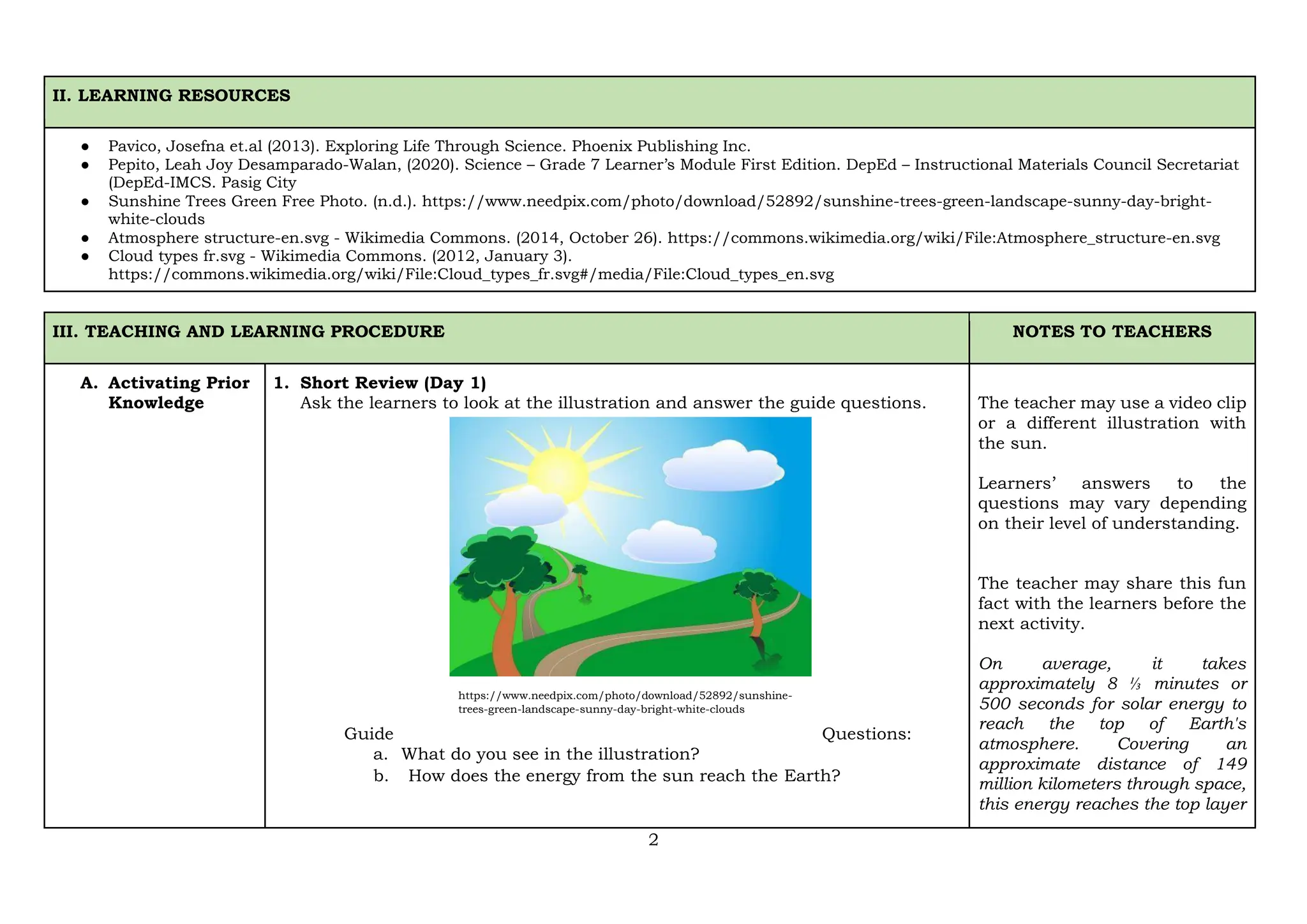
Ask the learners to look at the illustration and answer the guide questions.
Guide Questions:
a. What do you see in the illustration?
b. How does the energy from the sun reach the Earth?
The teacher may use a video clip
or a different illustration with
the sun.
Learners’ answers to the
questions may vary depending
on their level of understanding.
The teacher may share this fun
fact with the learners before the
next activity.
On average, it takes
approximately 8 ⅓ minutes or
500 seconds for solar energy to
reach the top of Earth's
atmosphere. Covering an
approximate distance of 149
million kilometers through space,
this energy reaches the top layer
https://www.needpix.com/photo/download/52892/sunshine-
trees-green-landscape-sunny-day-bright-white-clouds
5.
3
of Earth's atmosphere.Solar
energy propagates in waves from
the Sun, traveling at the speed of
light as electromagnetic radiation
within the vacuum of space.
B. Establishing
Lesson Purpose
2. Lesson Purpose
Self-Assessment
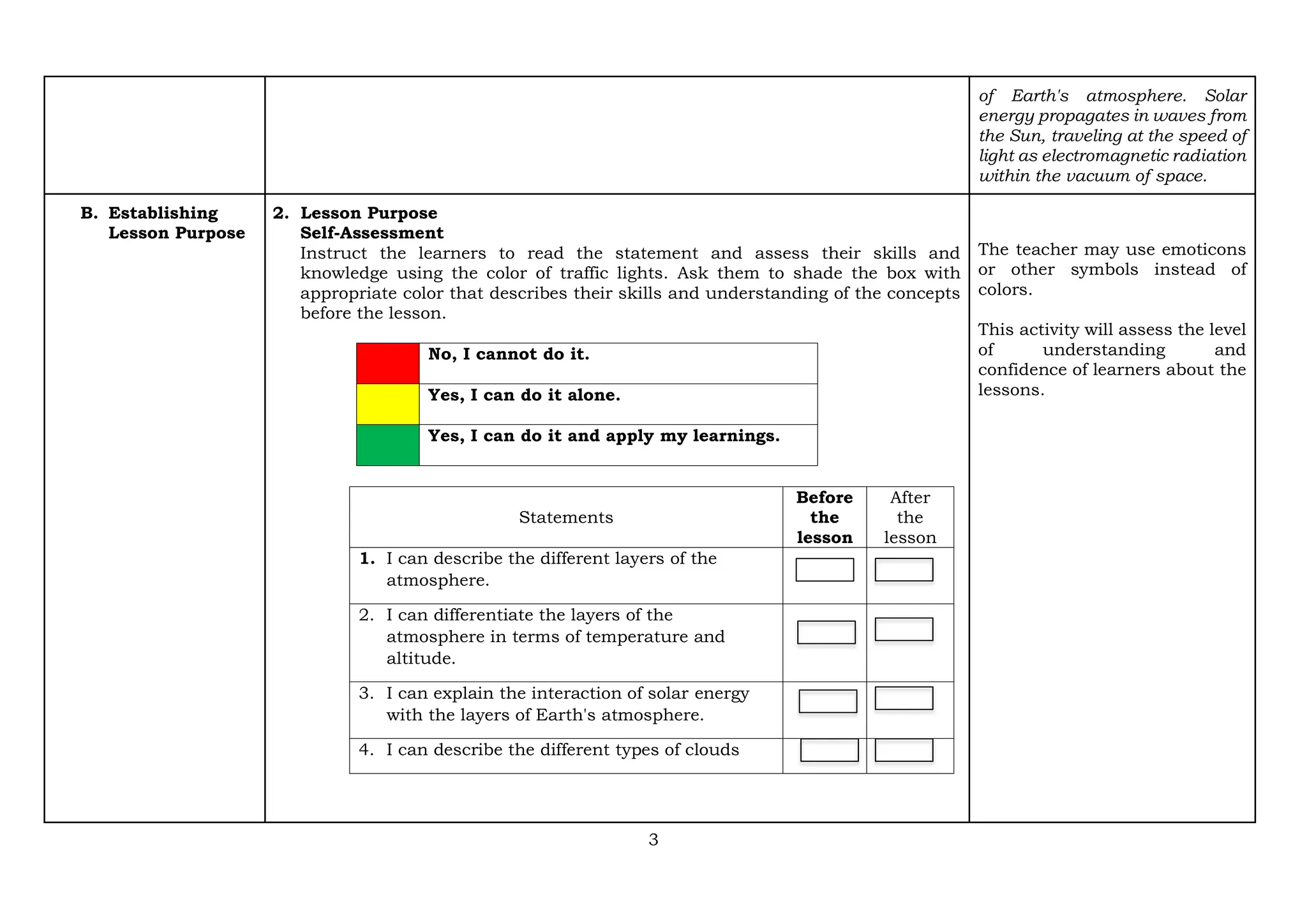
Instruct the learners to read the statement and assess their skills and
knowledge using the color of traffic lights. Ask them to shade the box with
appropriate color that describes their skills and understanding of the concepts
before the lesson.
No, I cannot do it.
Yes, I can do it alone.
Yes, I can do it and apply my learnings.
Statements
Before
the
lesson
After
the
lesson
1. I can describe the different layers of the
atmosphere.
2. I can differentiate the layers of the
atmosphere in terms of temperature and
altitude.
3. I can explain the interaction of solar energy
with the layers of Earth's atmosphere.
4. I can describe the different types of clouds
The teacher may use emoticons
or other symbols instead of
colors.
This activity will assess the level
of understanding and
confidence of learners about the
lessons.
6.
4
2. Unlocking ContentVocabulary
Ask the learners to connect dots to match the correct word that describes the
prefixes attached to the root word sphere.
1. Exosphere ● ● changes
2. Thermosphere ● ● outside
3. Mesosphere ● ● middle
4. Stratosphere ● ● heat
5. Troposphere ● ● layer
5. Developing and
Deepening
Understanding
SUB-TOPIC 1: SUNLIGHT SERVES AS EARTH’S EXTERNAL SOURCE OF
ENERGY, INTERACTING WITH THE LAYERS OF THE ATMOSPHERE.
a. Explicitation
Ask the learners to read the reading material “The Atmosphere of Earth.”
The Atmosphere of Earth
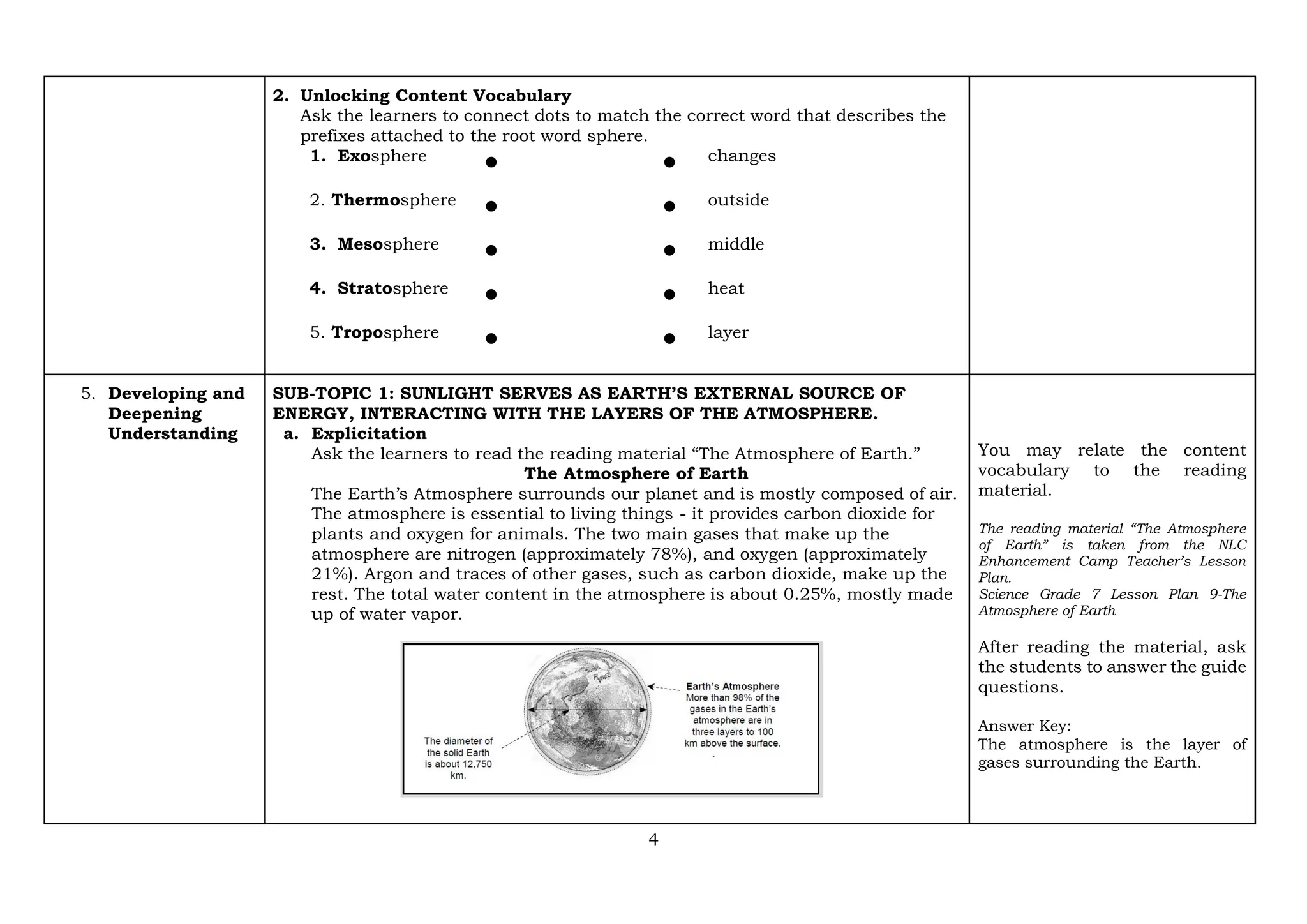
The Earth’s Atmosphere surrounds our planet and is mostly composed of air.
The atmosphere is essential to living things - it provides carbon dioxide for
plants and oxygen for animals. The two main gases that make up the
atmosphere are nitrogen (approximately 78%), and oxygen (approximately
21%). Argon and traces of other gases, such as carbon dioxide, make up the
rest. The total water content in the atmosphere is about 0.25%, mostly made
up of water vapor.
You may relate the content
vocabulary to the reading
material.
The reading material “The Atmosphere
of Earth” is taken from the NLC
Enhancement Camp Teacher’s Lesson
Plan.
Science Grade 7 Lesson Plan 9-The
Atmosphere of Earth
After reading the material, ask
the students to answer the guide
questions.
Answer Key:
The atmosphere is the layer of
gases surrounding the Earth.
7.
5
Guide Questions:
1. Whatis the atmosphere?
2. What is in the atmosphere?
b. Worked Example (Day 2)
Activity 1. Let the learners read about the “Layers of the Atmosphere” below
and answer the following guide questions.
Layers of the Atmosphere
Scientists believe that the atmosphere has five distinctive layers, but the
boundaries between layers are not sharp and can be hard to measure precisely.
The layers and some of their features are:
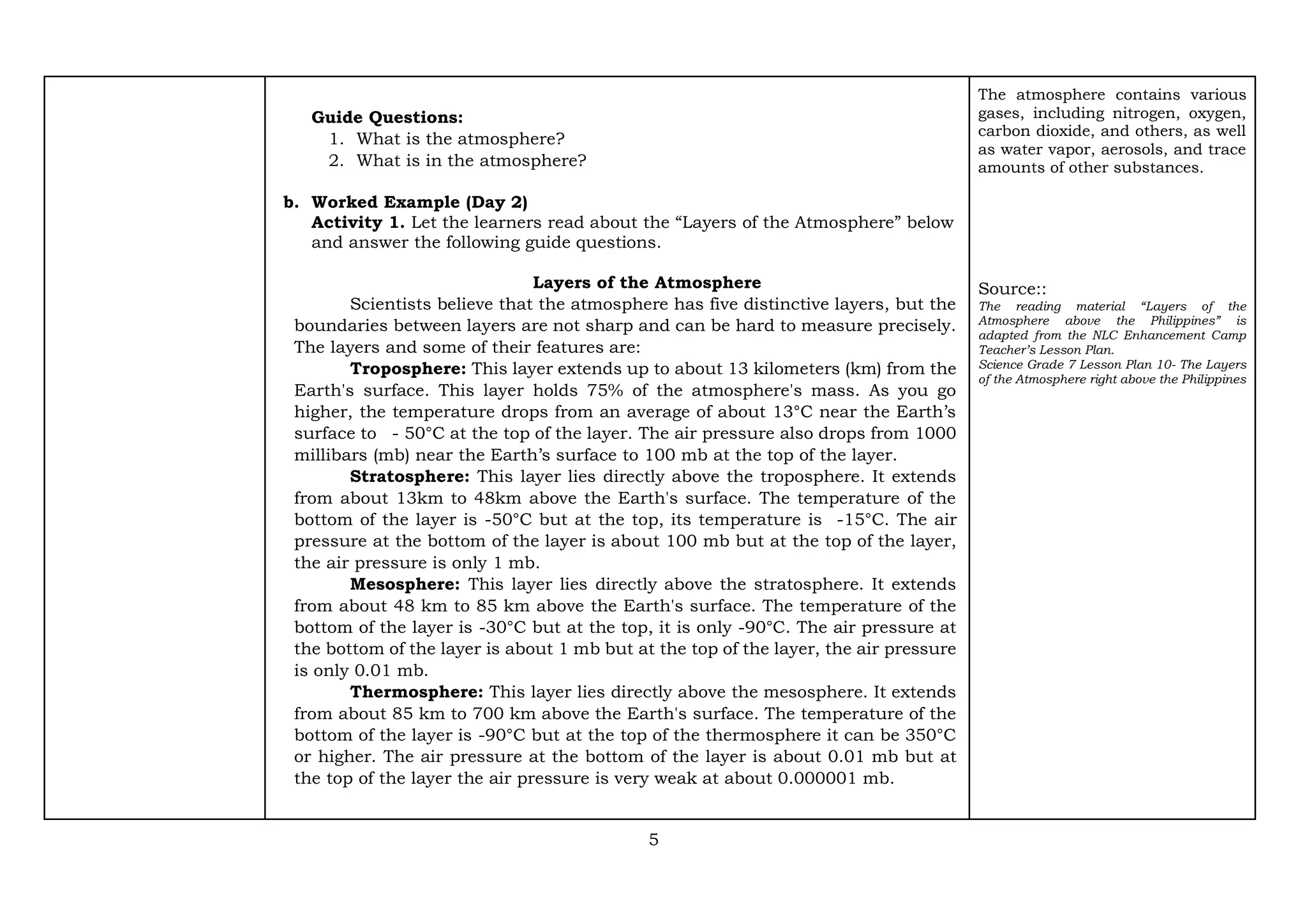
Troposphere: This layer extends up to about 13 kilometers (km) from the
Earth's surface. This layer holds 75% of the atmosphere's mass. As you go
higher, the temperature drops from an average of about 13°C near the Earth’s
surface to - 50°C at the top of the layer. The air pressure also drops from 1000
millibars (mb) near the Earth’s surface to 100 mb at the top of the layer.
Stratosphere: This layer lies directly above the troposphere. It extends
from about 13km to 48km above the Earth's surface. The temperature of the
bottom of the layer is -50°C but at the top, its temperature is -15°C. The air
pressure at the bottom of the layer is about 100 mb but at the top of the layer,
the air pressure is only 1 mb.
Mesosphere: This layer lies directly above the stratosphere. It extends
from about 48 km to 85 km above the Earth's surface. The temperature of the
bottom of the layer is -30°C but at the top, it is only -90°C. The air pressure at
the bottom of the layer is about 1 mb but at the top of the layer, the air pressure
is only 0.01 mb.
Thermosphere: This layer lies directly above the mesosphere. It extends
from about 85 km to 700 km above the Earth's surface. The temperature of the
bottom of the layer is -90°C but at the top of the thermosphere it can be 350°C
or higher. The air pressure at the bottom of the layer is about 0.01 mb but at
the top of the layer the air pressure is very weak at about 0.000001 mb.
The atmosphere contains various
gases, including nitrogen, oxygen,
carbon dioxide, and others, as well
as water vapor, aerosols, and trace
amounts of other substances.
Source::
The reading material “Layers of the
Atmosphere above the Philippines” is
adapted from the NLC Enhancement Camp
Teacher’s Lesson Plan.
Science Grade 7 Lesson Plan 10- The Layers
of the Atmosphere right above the Philippines
8.
6
Exosphere: This layeris the uppermost layer, and it extends 10,000 km
into space. In fact, it blends with what scientists consider to be outer space! The
pull of Earth’s gravity is so small in this layer that molecules of gas escape into
outer space.
Guide Questions:
1. What physical quantities were mentioned that characterize each layer
of the atmosphere?
2. How far above the surface is the Troposphere?
3. Which layer has the lowest temperature?
4. Which layer is the thinnest?
5. Which layer is the farthest from the surface?
c. Lesson Activity.
Activity 2.
Ask the learners to use the previous reading materials to complete the table
in worksheet 5.2. The data for the troposphere is given as an example.
Allow the students to analyze the tabulated data from the Worked Example.
Use the following as guide questions:
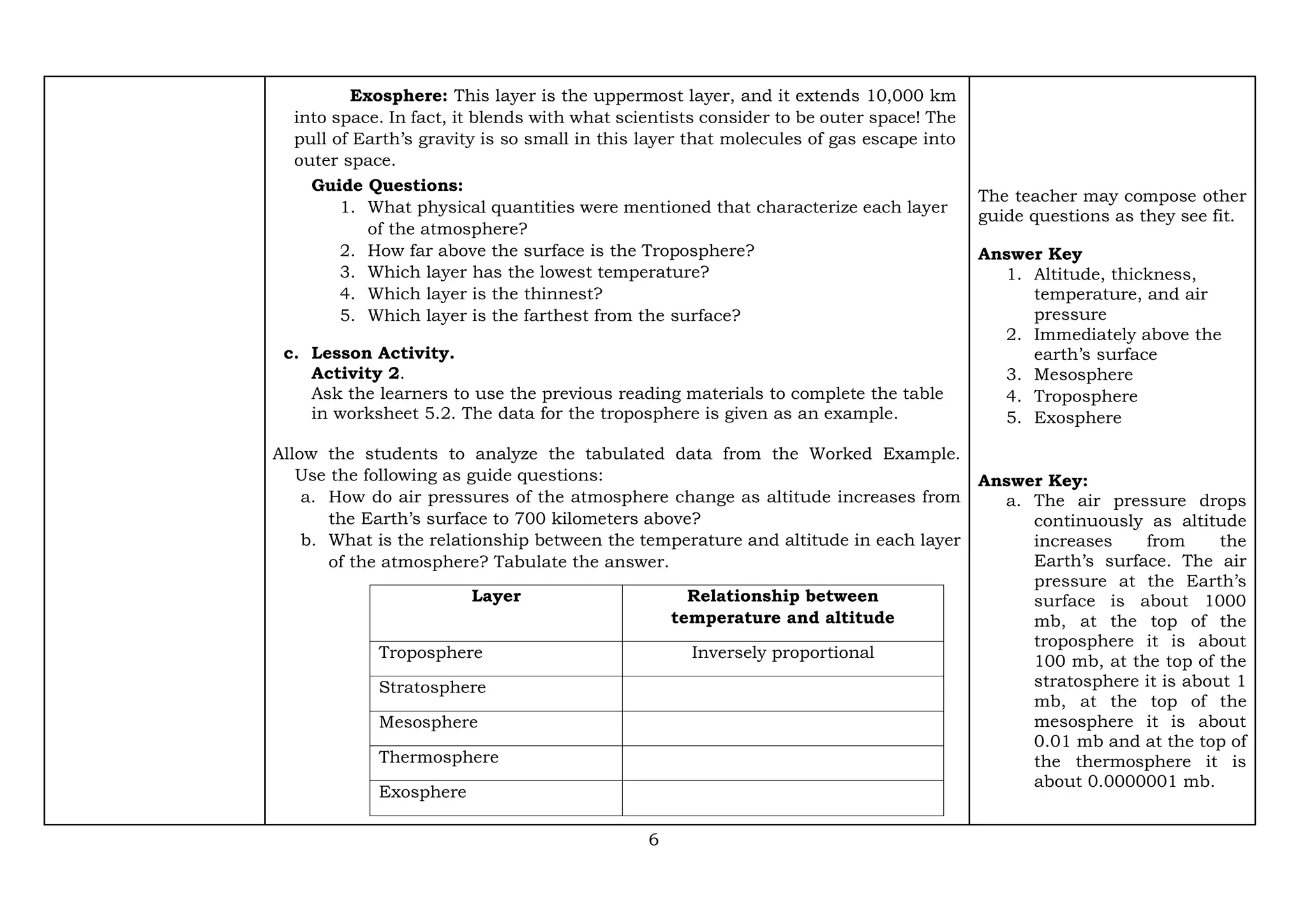
a. How do air pressures of the atmosphere change as altitude increases from
the Earth’s surface to 700 kilometers above?
b. What is the relationship between the temperature and altitude in each layer
of the atmosphere? Tabulate the answer.
Layer Relationship between
temperature and altitude
Troposphere Inversely proportional
Stratosphere
Mesosphere
Thermosphere
Exosphere
The teacher may compose other
guide questions as they see fit.
Answer Key
1. Altitude, thickness,
temperature, and air
pressure
2. Immediately above the
earth’s surface
3. Mesosphere
4. Troposphere
5. Exosphere
Answer Key:
a. The air pressure drops
continuously as altitude
increases from the
Earth’s surface. The air
pressure at the Earth’s
surface is about 1000
mb, at the top of the
troposphere it is about
100 mb, at the top of the
stratosphere it is about 1
mb, at the top of the
mesosphere it is about
0.01 mb and at the top of
the thermosphere it is
about 0.0000001 mb.
9.
7
SUB-TOPIC 2: ATMOSPHEREINTERACTIONS WITH THE SUN AND EARTH
AND ELEMENTS OF WEATHER
1. Explicitation
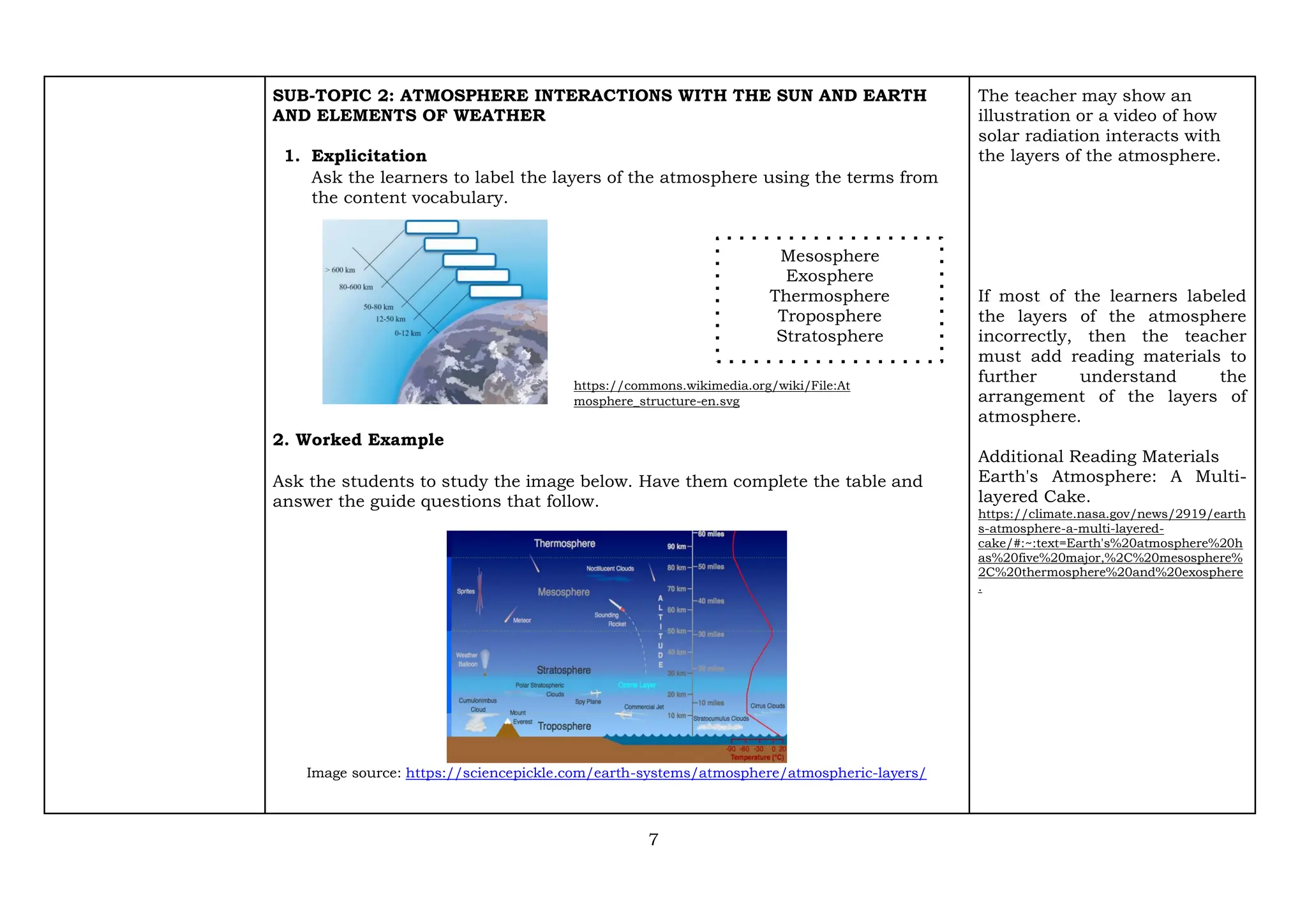
Ask the learners to label the layers of the atmosphere using the terms from
the content vocabulary.
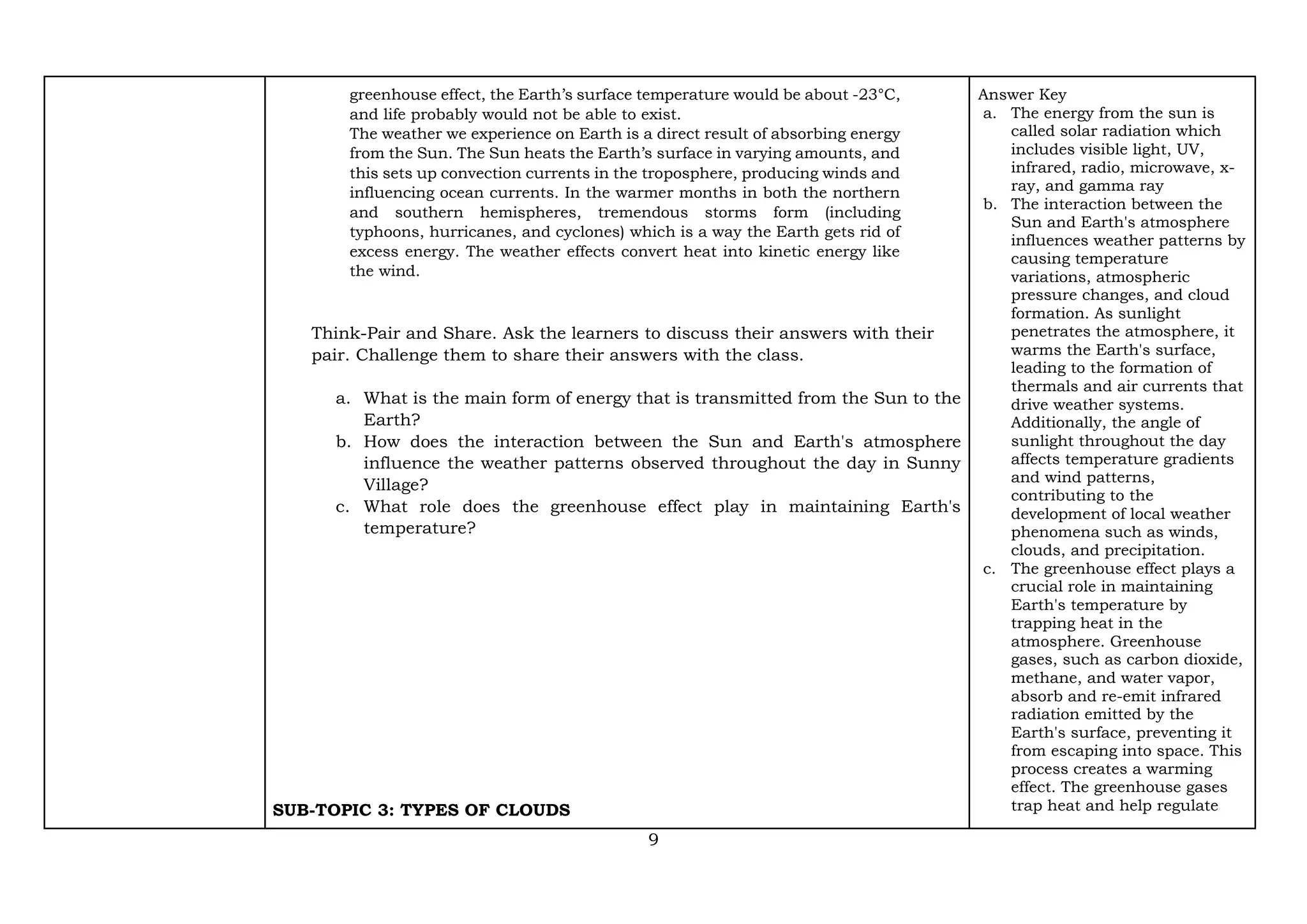
2. Worked Example
Ask the students to study the image below. Have them complete the table and
answer the guide questions that follow.
Image source: https://sciencepickle.com/earth-systems/atmosphere/atmospheric-layers/
The teacher may show an
illustration or a video of how
solar radiation interacts with
the layers of the atmosphere.
If most of the learners labeled
the layers of the atmosphere
incorrectly, then the teacher
must add reading materials to
further understand the
arrangement of the layers of
atmosphere.
Additional Reading Materials
Earth's Atmosphere: A Multi-
layered Cake.
https://climate.nasa.gov/news/2919/earth
s-atmosphere-a-multi-layered-
cake/#:~:text=Earth's%20atmosphere%20h
as%20five%20major,%2C%20mesosphere%
2C%20thermosphere%20and%20exosphere
.
Mesosphere
Exosphere
Thermosphere
Troposphere
Stratosphere
https://commons.wikimedia.org/wiki/File:At
mosphere_structure-en.svg
10.
8
Determine the notableevents, or features of each layer of the atmosphere
Layer of the Atmosphere Notable events or features
Troposphere
Stratosphere
Mesosphere
Thermosphere
Guide questions:
At which layer of the atmosphere do commercial jets fly? Why?
Why does the temperature increase in the stratosphere?
3. Lesson Activity (Day 3)
Ask the learners to read the material and answer the questions that follow.
The Sun Interacts with our Atmosphere
The Sun is the Earth's primary source of external energy. Energy from
the Sun heats our planet to the point where life can flourish. Most of the
energy from the Sun is transmitted to the Earth as short-wave radiation
(light and ultraviolet radiation). Because the atmosphere is mostly
transparent, much of the light reaches the Earth’s surface where it is
firstly absorbed. The Earth then re-radiates the absorbed energy into the
atmosphere in the form of infrared energy. Some atmospheric gases,
including carbon dioxide, ozone, nitrous oxide and water vapor, are
naturally occurring gases that absorb and emit infrared energy very
effectively. These gases are called greenhouse gases. The naturally
occurring greenhouse gases have a positive effect as they absorb some of
Earth’s heat energy so that it does not all escape into space. This keeps
the average temperature of the atmosphere to about 13°C. The
atmospheric warming effect is called the greenhouse effect. Without the
Teachers may also use graphs
instead of tabulated data.
Include in the discussions the
relevance of each layer of the
atmosphere.
Answer key:
1. Commercial jets fly at
the top of the
troposphere nearing the
stratosphere to lessen
the encounter with
clouds that cause
turbulence
2. The stratosphere
contains the ozone layer
which absorbs the
incoming ultraviolet
radiation leading to the
increase in temperature
Note:
The reading material “The Sun Interacts
with our Atmosphere”
is taken from the NLC Enhancement
Camp Teacher’s Lesson Plan. Science
Grade 7 Lesson Plan 11
11.
9
greenhouse effect, theEarth’s surface temperature would be about -23°C,
and life probably would not be able to exist.
The weather we experience on Earth is a direct result of absorbing energy
from the Sun. The Sun heats the Earth’s surface in varying amounts, and
this sets up convection currents in the troposphere, producing winds and
influencing ocean currents. In the warmer months in both the northern
and southern hemispheres, tremendous storms form (including
typhoons, hurricanes, and cyclones) which is a way the Earth gets rid of
excess energy. The weather effects convert heat into kinetic energy like
the wind.
Think-Pair and Share. Ask the learners to discuss their answers with their
pair. Challenge them to share their answers with the class.
a. What is the main form of energy that is transmitted from the Sun to the
Earth?
b. How does the interaction between the Sun and Earth's atmosphere
influence the weather patterns observed throughout the day in Sunny
Village?
c. What role does the greenhouse effect play in maintaining Earth's
temperature?
SUB-TOPIC 3: TYPES OF CLOUDS
Answer Key
a. The energy from the sun is
called solar radiation which
includes visible light, UV,
infrared, radio, microwave, x-
ray, and gamma ray
b. The interaction between the
Sun and Earth's atmosphere
influences weather patterns by
causing temperature
variations, atmospheric
pressure changes, and cloud
formation. As sunlight
penetrates the atmosphere, it
warms the Earth's surface,
leading to the formation of
thermals and air currents that
drive weather systems.
Additionally, the angle of
sunlight throughout the day
affects temperature gradients
and wind patterns,
contributing to the
development of local weather
phenomena such as winds,
clouds, and precipitation.
c. The greenhouse effect plays a
crucial role in maintaining
Earth's temperature by
trapping heat in the
atmosphere. Greenhouse
gases, such as carbon dioxide,
methane, and water vapor,
absorb and re-emit infrared
radiation emitted by the
Earth's surface, preventing it
from escaping into space. This
process creates a warming
effect. The greenhouse gases
trap heat and help regulate
12.
10
1. Explicitation (Day4)
Let the learners answer the riddle.
2. Worked Example
Have the students take a look outside and look at the clouds. If the weather is not
suitable for observations, show pictures of the different types of clouds.
Let the students describe the clouds according to appearance. Determine which
clouds are cumulus, stratus, and cirrus.
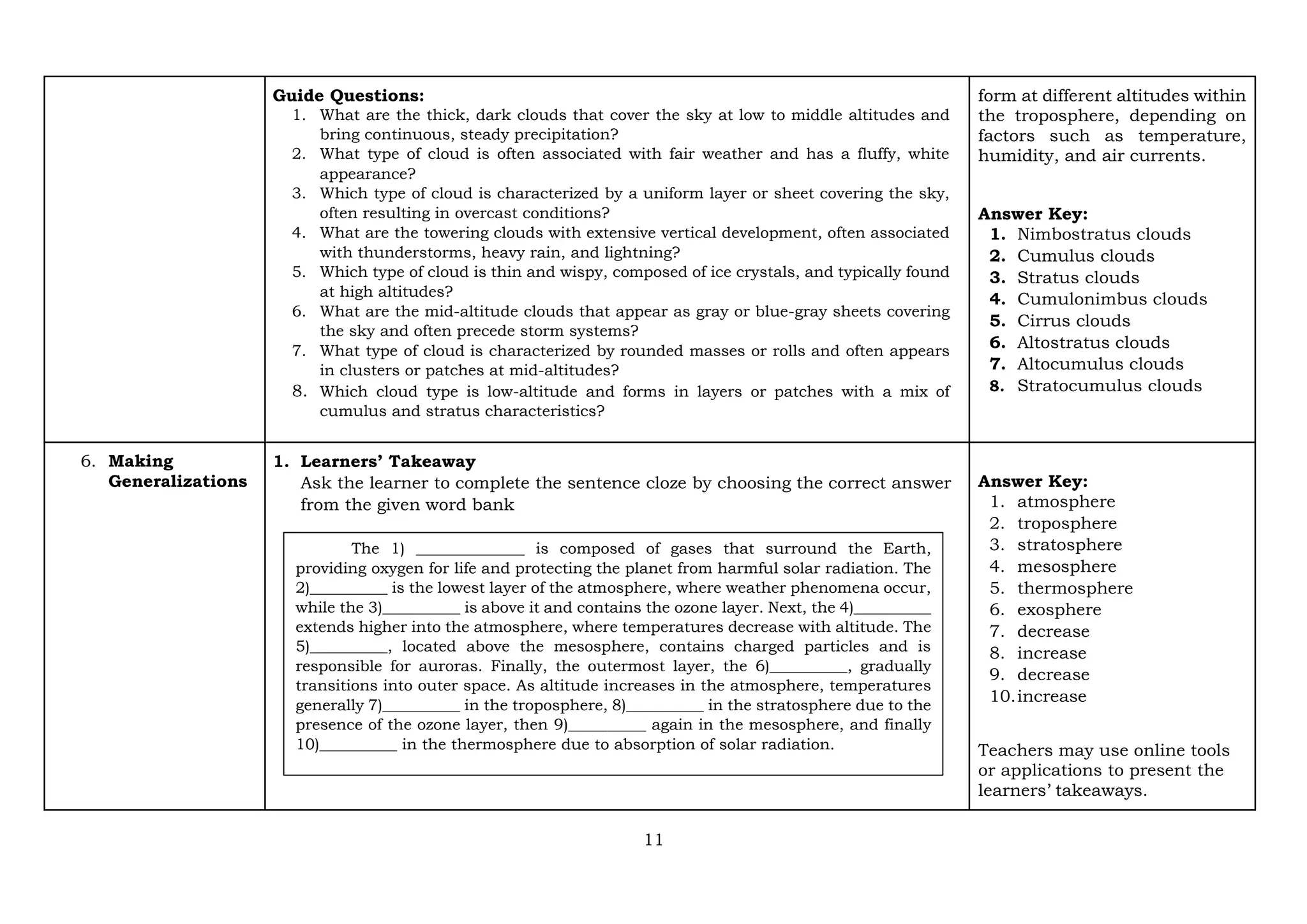
3. Lesson Activity
Ask the learners to analyze the illustration of clouds at different altitudes.
and use the illustration to identify the types of clouds asked below.
https://commons.wikimedia.org/wiki/File:Cloud_types_fr.svg#/media/File:Cloud_types_en.svg
Earth's temperature within a
habitable range. Without the
greenhouse effect, Earth
would be much colder, making
it unsuitable for life as we
know it.
Answer key: Sun, Clouds
The teacher needs to explain the
characteristics of each cloud to
deepen the concept.
The teacher may discuss that
clouds are formed within
specific layers of the
atmosphere, primarily the
troposphere, which is the lowest
layer where weather phenomena
occur. Different types of clouds
I float high above,
sometimes white,
sometimes gray, I bring
rain, or sunshine your way.
Formed from vapor in the
sky. Guess my name before
you say goodbye.
What am I?"
13.
11
Guide Questions:
1. Whatare the thick, dark clouds that cover the sky at low to middle altitudes and
bring continuous, steady precipitation?
2. What type of cloud is often associated with fair weather and has a fluffy, white
appearance?
3. Which type of cloud is characterized by a uniform layer or sheet covering the sky,
often resulting in overcast conditions?
4. What are the towering clouds with extensive vertical development, often associated
with thunderstorms, heavy rain, and lightning?
5. Which type of cloud is thin and wispy, composed of ice crystals, and typically found
at high altitudes?
6. What are the mid-altitude clouds that appear as gray or blue-gray sheets covering
the sky and often precede storm systems?
7. What type of cloud is characterized by rounded masses or rolls and often appears
in clusters or patches at mid-altitudes?
8. Which cloud type is low-altitude and forms in layers or patches with a mix of
cumulus and stratus characteristics?
form at different altitudes within
the troposphere, depending on
factors such as temperature,
humidity, and air currents.
Answer Key:
1. Nimbostratus clouds
2. Cumulus clouds
3. Stratus clouds
4. Cumulonimbus clouds
5. Cirrus clouds
6. Altostratus clouds
7. Altocumulus clouds
8. Stratocumulus clouds
6. Making
Generalizations
1. Learners’ Takeaway
Ask the learner to complete the sentence cloze by choosing the correct answer
from the given word bank
Answer Key:
1. atmosphere
2. troposphere
3. stratosphere
4. mesosphere
5. thermosphere
6. exosphere
7. decrease
8. increase
9. decrease
10.increase
Teachers may use online tools
or applications to present the
learners’ takeaways.
The 1) ______________ is composed of gases that surround the Earth,
providing oxygen for life and protecting the planet from harmful solar radiation. The
2)__________ is the lowest layer of the atmosphere, where weather phenomena occur,
while the 3)__________ is above it and contains the ozone layer. Next, the 4)__________
extends higher into the atmosphere, where temperatures decrease with altitude. The
5)__________, located above the mesosphere, contains charged particles and is
responsible for auroras. Finally, the outermost layer, the 6)__________, gradually
transitions into outer space. As altitude increases in the atmosphere, temperatures
generally 7)__________ in the troposphere, 8)__________ in the stratosphere due to the
presence of the ozone layer, then 9)__________ again in the mesosphere, and finally
10)__________ in the thermosphere due to absorption of solar radiation.
14.
12
2. Reflection onLearning
Instruct the learners to read the statement and assess their skills and
knowledge using the color of traffic lights. Ask them to shade the box with an
appropriate color that describes their skills and understanding of the concepts
after the lesson.
No, I cannot do it.
Yes, I can do it alone.
Yes, I can do it and apply my learnings.
Statements
Before
the
lesson
After
the
lesson
1. I can describe the different layers of the
atmosphere.
2. I can differentiate the layers of the atmosphere
in terms of temperature and altitude.
3. I can explain the interaction of solar energy
with the layers of Earth's atmosphere.
4. I can describe the different types of clouds
ii.
atmosphere decrease exosphere increase
mesosphere thermosphere troposphere stratosphere
15.
13
IV. EVALUATING LEARNING:FORMATIVE ASSESSMENT AND TEACHER’S REFLECTION NOTES TO TEACHERS
A. Evaluating
Learning
1. Formative Assessment
Multiple-Choice Questions: Encircle the letter of the best answer.
1. What is the CORRECT order of earth's atmospheric layers from its surface?
A. stratosphere, mesosphere, troposphere, thermosphere, exosphere
B. stratosphere, troposphere, mesosphere, thermosphere, exosphere
C. troposphere, mesosphere, stratosphere, thermosphere, exosphere
D. troposphere, stratosphere, mesosphere, thermosphere, exosphere
2. Which layer of atmosphere is the coldest?
A. mesosphere C. stratosphere
B. troposphere D. thermosphere
3. What happens to the temperature in the troposphere as the altitude increases?
A. Decreases C. Cannot be determined
B. Increases D. Remains the same.
4. In which layer of the atmosphere does passenger aircraft fly?
A. Lower Mesosphere C. Middle Thermosphere
B. Lower Stratosphere D. Upper Mesosphere
5. Which best describes the function of the atmosphere?
A. It is responsible for the tides.
B. It prevents heat from escaping into space too quickly.
C. It does not account for the heat gain or loss of the planet.
D. It allows heat to escape quickly into space to cool the planet.
6. Which best describes the greenhouse effect?
A. The ability of the stratosphere to receive sunlight.
B. The ability of the atmosphere to retain water vapor.
C. The ability of atmospheric gases to keep the planet warm.
D. The ability of clouds to scatter electromagnetic radiation in the atmosphere.
Answer Key:
1. D
2. A
3. A
4. B
5. B
6. C
7. D
8. B
9. D
10.B
11.A
12.A
16.
14
7. In whichlayer of the atmosphere makes the reception of radio waves around the
earth possible?
A. Troposphere C. Mesosphere
B. Stratosphere D. Thermosphere
8. Ozone layer serves as shield from the incoming solar radiation. In which layer of
the atmosphere contains the large amounts of ozone?
A. Mesosphere C. Troposphere
B. Stratosphere D. Thermosphere
9. Which is TRUE about stratosphere?
A. There is no moving air in the stratosphere
B. The stratosphere destroys the ozone layer
C. The temperature is the same all through the layer
D. The temperature of stratosphere increases with altitude
10. What is the most abundant gas in the earth's atmosphere?
A. argon C. oxygen
B. nitrogen D. carbon dioxide
11. Which is the electrified region of the upper atmosphere?
A. ionosphere C. stratosphere
B. mesosphere D. thermosphere
12. What is the basis for the division of the layers of the atmosphere?
A. Changing temperature
B. Changing amount of oxygen
C. Changing weather patterns
D. Changing composition of gases
B. Teacher’s
Remarks
Note observations on
any of the following
areas:
Effective Practices Problems Encountered
strategies explored
17.
15
materials used
learner engagement/
interaction
Others
C.Teacher’s
Reflection
Reflection guide or prompt can be on:
▪ principles behind the teaching
What principles and beliefs informed my lesson?
Why did I teach the lesson the way I did?
▪ students
What roles did my students play in my lesson?
What did my students learn? How did they learn?
▪ ways forward
What could I have done differently?
What can I explore in the next lesson?