CO_Q4_Science7_ Module3
Science
Quarter 4 – Module 3:
You Keep Me Warm
7
Science – Grade 7
Alternative Delivery Mode
Quarter 4 – Module 3: You Keep Me Warm
First Edition, 2020
Republic Act 8293, section 176 states that: No copyright shall subsist in any work of
the Government of the Philippines. However, prior approval of the government agency or office
wherein the work is created shall be necessary for exploitation of such work for profit. Such
agency or office may, among other things, impose as a condition the payment of royalties.
Borrowed materials (i.e., songs, stories, poems, pictures, photos, brand names,
trademarks, etc.) included in this module are owned by their respective copyright holders.
Every effort has been exerted to locate and seek permission to use these materials from their
respective copyright owners. The publisher and authors do not represent nor claim ownership
over them.
Published by the Department of Education
Secretary: Leonor Magtolis Briones
Undersecretary: Diosdado M. San Antonio
Printed in the Philippines by___________________________
Department of Education – SOCCSKSARGEN
Office Address: Regional Center, Brgy. Carpenter Hill, City of Koronadal
Telefax: (083) 2281893
E-mail Address: region12@deped.gov.ph
Development Team of the Module
Writers: Leah Joy Desamparado-Walan
Editors: Lenie G. Forro, Cynthia S. Bustillo, Miraflor O. Albios
Reviewers: Agabai S. Kandalayang, Marry Anne A. Barrientos,
Mary Joy D. Bautista, Yusof A. Aliudin
Layout Artist: Glen D. Napoles, Analyn J. Madera, Ana Lorma A. Dahiroc
Management Team: Allan G. Farnazo
Isagani S. Dela Cruz
Gilbert B. Barrera
Arturo D. Tingson, Jr.
Peter Van C. Ang-ug
Elpidio B. Daquipil
Juvy B. Nitura
Lenie G. Forro
7
Science
Quarter 4 – Module 3:
You Keep Me Warm
Introductory Message
This Self-Learning Module (SLM) is prepared so that you, our dear learners,
can continue your studies and learn while at home. Activities, questions, directions,
exercises, and discussions are carefully stated for you to understand each lesson.
Each SLM is composed of different parts. Each part shall guide you step-by-
step as you discover and understand the lesson prepared for you.
Pre-tests are provided to measure your prior knowledge on lessons in each
SLM. This will tell you if you need to proceed on completing this module or if you
need to ask your facilitator or your teacher’s assistance for better understanding of
the lesson. At the end of each module, you need to answer the post-test to self-check
your learning. Answer keys are provided for each activity and test. We trust that you
will be honest in using these.
In addition to the material in the main text, Notes to the Teacher are also
provided to our facilitators and parents for strategies and reminders on how they can
best help you on your home-based learning.
Please use this module with care. Do not put unnecessary marks on any part
of this SLM. Use a separate sheet of paper in answering the exercises and tests. And
read the instructions carefully before performing each task.
If you have any questions in using this SLM or any difficulty in answering the
tasks in this module, do not hesitate to consult your teacher or facilitator.
Thank you.
1 CO_Q4_Science7_ Module3
What I Need to Know
The sun supplies energy to Earth that is necessary for its survival. The heat
of the sun is too much to bear if not because of a blanket of air that surrounds the
Earth we call atmosphere. The atmosphere is not just a layer of air or gases but it is
more than that. It contains the oxygen that we breathe; it allows us to communicate;
and it has the ozone layer that protects us from harmful solar radiation.
A lot is happening in the atmosphere such as weather system and the
atmospheric phenomena caused by the sun or solar energy. Therefore it is necessary
that one should be familiar with the structure and composition of the atmosphere.
One then can give reasons for the weather events as well as global atmospheric
phenomena like greenhouse effect and global warming that result from changes in
the composition of the gases of the atmosphere brought by some human activities.
How is Earth’s atmosphere affected by solar energy? This module will guide
you in understanding how energy from the sun interacts with the layers of the
atmosphere. You will learn more about earth’s atmosphere -the place on earth that
is vital to our existence.
Most Essential Learning Competency:
Discuss how energy from the sun interacts with the layers of the atmosphere
(S7ES-IVd-5)
This module is divided into two lessons:
Lesson 1: Layers of the Atmosphere
Lesson 2: Greenhouse Effect
After going through this module, you are expected to:
1. explain the basis for the division of the layers of the atmosphere;
2. describe the features of each layer of the atmosphere;
3. describe greenhouse effect;
4. identify the sources of greenhouse gases; and
5. cite ways on how to slow down the effects of global warming.
What I Know
Directions: Choose the best answer from the given choices. Write the letter of your
choice on a separate sheet of paper.
1. In which layer of the atmosphere where nearly all weather phenomena occur?
A. Mesosphere
B. Stratosphere
C. Thermosphere
D. Troposphere
2 CO_Q4_Science7_ Module3
2. Which layer protects us from harmful ultraviolet rays?
A. Mesosphere
B. Stratosphere
C. Troposphere
D. Ozone layer
3. What are the most abundant gases in Earth’s atmosphere?
A. Nitrogen and Oxygen
B. Nitrogen and Hydrogen
C. Carbon Dioxide and Oxygen
D. Carbon Dioxide and Nitrogen
4. In which layer of the atmosphere do planes fly to get out from the weather
disturbances?
A. Exosphere
B. Mesosphere
C. Stratosphere
D. Thermosphere
5. What happens to the temperature as you go higher in the troposphere?
A. It increases.
B. It decreases.
C. It stays the same.
D. It increases then decreases.
6. In which layer of the earth’s atmosphere does meteoroids burn up?
A. Mesosphere
B. Stratosphere
C. Thermosphere
D. Troposphere
7. Why is the presence of ozone important for the survival of living things on Earth?
A. It warms Earth’s surface.
B. It helps in cloud formation.
C. It makes jets flying more comfortable.
D. It offers protection from the sun’s harmful ultraviolet rays.
8. Which of the following describes the temperature in the troposphere and
stratosphere?
A. The stratosphere is hotter than the troposphere.
B. The troposphere is hotter than the stratosphere.
C. Low temperature exists in the troposphere and stratosphere.
D.The temperature in the troposphere is equal to the stratosphere.
9. What is the correct order of Earth's atmospheric layers from bottom to top?
A. III, IV, V, I, II
B. V, IV, III, II, I
C. V, III, II, IV, I
D. III, V, II, IV, II
I. Exosphere II. Mesosphere III. Stratosphere
IV. Thermosphere V. Troposphere
3 CO_Q4_Science7_ Module3
10. Which of the following correctly describes the stratosphere?
A. It is an atmospheric ozone layer.
B. It has high concentration of ionized particles.
C. It is a layer important to telecommunications.
D. It is a layer extending to a height of about 8 km.
11. Which of the following are the special features of mesosphere?
A. I and II only
B. II and III only
C. II and IV only
D. III and IV only
12. How does energy from the sun enter the atmosphere?
A. It reaches Earth and enters the atmosphere through radiation.
B. The sun’s energy enters anywhere in the space including Earth.
C. It enters the atmosphere by vibrating through air particles of the
atmosphere.
D. The plants in the Earth attract the sun’s energy making it enter the Earth’s
atmosphere.
13. What characteristics differentiate troposphere from other layers of atmosphere?
A. I & II
B. II & III
C. I, II & III
D. I, II, III & IV
14. Layers of the atmosphere are classified according to changes in temperature. Is
the statement correct?
A. No, because it depends on the events that is happening on that layer.
B. Yes, because from troposphere to exosphere the temperature is gradually
increasing.
C. No, because layers of the atmosphere were classified based on their altitude
alone.
D.Yes, because there is a significant change in temperature in each layers of the
atmosphere.
I. It is where most water vapor is found.
II. It begins about 16 km above the Earth’s surface
III. It is where all weather phenomena takes place.
IV. It is where temperature decreases with altitude at 2°C/1000 ft.
I. It is where the ozone layer is found.
II. It is the coldest layer of the atmosphere.
III. It is where the formation of aurora occurs.
IV. It is where the meteors burn up upon entering the Earth.
4 CO_Q4_Science7_ Module3
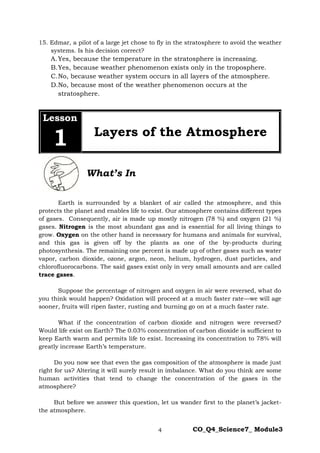
15. Edmar, a pilot of a large jet chose to fly in the stratosphere to avoid the weather
systems. Is his decision correct?
A.Yes, because the temperature in the stratosphere is increasing.
B.Yes, because weather phenomenon exists only in the troposphere.
C.No, because weather system occurs in all layers of the atmosphere.
D.No, because most of the weather phenomenon occurs at the
stratosphere.
Lesson
1 Layers of the Atmosphere
What’s In
Earth is surrounded by a blanket of air called the atmosphere, and this
protects the planet and enables life to exist. Our atmosphere contains different types
of gases. Consequently, air is made up mostly nitrogen (78 %) and oxygen (21 %)
gases. Nitrogen is the most abundant gas and is essential for all living things to
grow. Oxygen on the other hand is necessary for humans and animals for survival,
and this gas is given off by the plants as one of the by-products during
photosynthesis. The remaining one percent is made up of other gases such as water
vapor, carbon dioxide, ozone, argon, neon, helium, hydrogen, dust particles, and
chlorofluorocarbons. The said gases exist only in very small amounts and are called
trace gases.
Suppose the percentage of nitrogen and oxygen in air were reversed, what do
you think would happen? Oxidation will proceed at a much faster rate—we will age
sooner, fruits will ripen faster, rusting and burning go on at a much faster rate.
What if the concentration of carbon dioxide and nitrogen were reversed?
Would life exist on Earth? The 0.03% concentration of carbon dioxide is sufficient to
keep Earth warm and permits life to exist. Increasing its concentration to 78% will
greatly increase Earth’s temperature.
Do you now see that even the gas composition of the atmosphere is made just
right for us? Altering it will surely result in imbalance. What do you think are some
human activities that tend to change the concentration of the gases in the
atmosphere?
But before we answer this question, let us wander first to the planet’s jacket-
the atmosphere.
5 CO_Q4_Science7_ Module3
The atmosphere is a very interesting matter to study. We thought it as a thin
layer of gas but it has several layers. These layers differ in altitude, temperature, and
other characteristics. Since many processes and phenomena occur in the
atmosphere it is necessary for us to learn about these layers and the important
events happening in each layer. In addition, meteorology is the branch of science
which deals with the study of the atmosphere and its corresponding weather
patterns. People who study the atmosphere are called meteorologists.
What’s New
Activity 1. Atmosphere: How Are We Divided?
Objectives: In this activity you will be able to gather information about Earth’s
atmosphere based on a graph. Specifically, you will:
1. describe the features of each of the five layers;
2. compare the features of the five layers; and
3. explain the basis for the division of the layers of the atmosphere.
Materials:
 Graph in Figure 1
 A ruler, if available
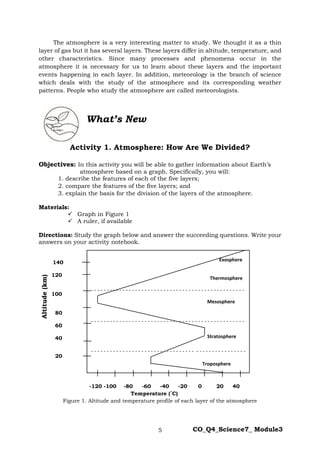
Directions: Study the graph below and answer the succeeding questions. Write your
answers on your activity notebook.
140
120
100
80
60
40
20
-120 -100 -80 -60 -40 -20 0 20 40
Temperature (˚C)
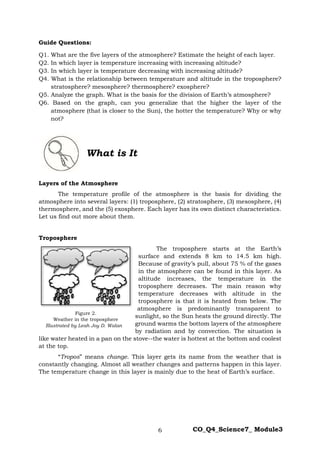
Figure 1. Altitude and temperature profile of each layer of the atmosphere
Exosphere
Thermosphere
- - - - - - - - - - - - - - - - - - - - - - - - - - - - - - - - - - - - - - - - - - - - - - - - -
Mesosphere
- - - - - - - - - - - - - - - - - - - - - - - - - - - - - - - - - - - - - - - - - - - - - - - - -
Stratosphere
- - - - - - - - - - - - - - - - - - - - - - - - - - - - - - - - - - - - - - - - - - - - - - - - -
Troposphere
Altitude
(km)
6 CO_Q4_Science7_ Module3
Guide Questions:
Q1. What are the five layers of the atmosphere? Estimate the height of each layer.
Q2. In which layer is temperature increasing with increasing altitude?
Q3. In which layer is temperature decreasing with increasing altitude?
Q4. What is the relationship between temperature and altitude in the troposphere?
stratosphere? mesosphere? thermosphere? exosphere?
Q5. Analyze the graph. What is the basis for the division of Earth’s atmosphere?
Q6. Based on the graph, can you generalize that the higher the layer of the
atmosphere (that is closer to the Sun), the hotter the temperature? Why or why
not?
What is It
Layers of the Atmosphere
The temperature profile of the atmosphere is the basis for dividing the
atmosphere into several layers: (1) troposphere, (2) stratosphere, (3) mesosphere, (4)
thermosphere, and the (5) exosphere. Each layer has its own distinct characteristics.
Let us find out more about them.
Troposphere
The troposphere starts at the Earth’s
surface and extends 8 km to 14.5 km high.
Because of gravity’s pull, about 75 % of the gases
in the atmosphere can be found in this layer. As
altitude increases, the temperature in the
troposphere decreases. The main reason why
temperature decreases with altitude in the
troposphere is that it is heated from below. The
atmosphere is predominantly transparent to
sunlight, so the Sun heats the ground directly. The
ground warms the bottom layers of the atmosphere
by radiation and by convection. The situation is
like water heated in a pan on the stove--the water is hottest at the bottom and coolest
at the top.
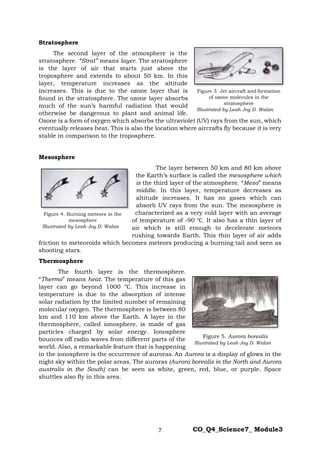
“Tropos” means change. This layer gets its name from the weather that is
constantly changing. Almost all weather changes and patterns happen in this layer.
The temperature change in this layer is mainly due to the heat of Earth’s surface.
Figure 2.
Weather in the troposphere
Illustrated by Leah Joy D. Walan
7 CO_Q4_Science7_ Module3
Stratosphere
The second layer of the atmosphere is the
stratosphere. “Strat” means layer. The stratosphere
is the layer of air that starts just above the
troposphere and extends to about 50 km. In this
layer, temperature increases as the altitude
increases. This is due to the ozone layer that is
found in the stratosphere. The ozone layer absorbs
much of the sun’s harmful radiation that would
otherwise be dangerous to plant and animal life.
Ozone is a form of oxygen which absorbs the ultraviolet (UV) rays from the sun, which
eventually releases heat. This is also the location where aircrafts fly because it is very
stable in comparison to the troposphere.
Mesosphere
The layer between 50 km and 80 km above
the Earth’s surface is called the mesosphere which
is the third layer of the atmosphere. “Meso” means
middle. In this layer, temperature decreases as
altitude increases. It has no gases which can
absorb UV rays from the sun. The mesosphere is
characterized as a very cold layer with an average
of temperature of -90 ℃. It also has a thin layer of
air which is still enough to decelerate meteors
rushing towards Earth. This thin layer of air adds
friction to meteoroids which becomes meteors producing a burning tail and seen as
shooting stars.
Thermosphere
The fourth layer is the thermosphere.
“Thermo” means heat. The temperature of this gas
layer can go beyond 1000 ℃. This increase in
temperature is due to the absorption of intense
solar radiation by the limited number of remaining
molecular oxygen. The thermosphere is between 80
km and 110 km above the Earth. A layer in the
thermosphere, called ionosphere, is made of gas
particles charged by solar energy. Ionosphere
bounces off radio waves from different parts of the
world. Also, a remarkable feature that is happening
in the ionosphere is the occurrence of auroras. An Aurora is a display of glows in the
night sky within the polar areas. The auroras (Aurora borealis in the North and Aurora
australis in the South) can be seen as white, green, red, blue, or purple. Space
shuttles also fly in this area.
Figure 3. Jet aircraft and formation
of ozone molecules in the
stratosphere
Illustrated by Leah Joy D. Walan
Figure 4. Burning meteors in the
mesosphere
Illustrated by Leah Joy D. Walan
Figure 5. Aurora borealis
Illustrated by Leah Joy D. Walan
8 CO_Q4_Science7_ Module3
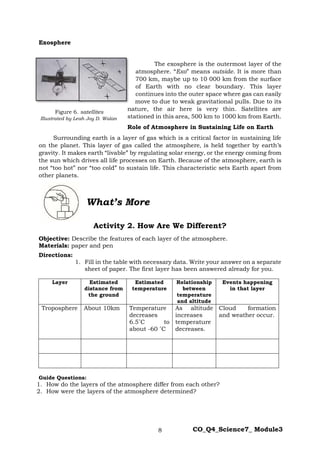
Exosphere
The exosphere is the outermost layer of the
atmosphere. “Exo” means outside. It is more than
700 km, maybe up to 10 000 km from the surface
of Earth with no clear boundary. This layer
continues into the outer space where gas can easily
move to due to weak gravitational pulls. Due to its
nature, the air here is very thin. Satellites are
stationed in this area, 500 km to 1000 km from Earth.
Role of Atmosphere in Sustaining Life on Earth
Surrounding earth is a layer of gas which is a critical factor in sustaining life
on the planet. This layer of gas called the atmosphere, is held together by earth’s
gravity. It makes earth “livable” by regulating solar energy, or the energy coming from
the sun which drives all life processes on Earth. Because of the atmosphere, earth is
not “too hot” nor “too cold” to sustain life. This characteristic sets Earth apart from
other planets.
What’s More
Activity 2. How Are We Different?
Objective: Describe the features of each layer of the atmosphere.
Materials: paper and pen
Directions:
1. Fill in the table with necessary data. Write your answer on a separate
sheet of paper. The first layer has been answered already for you.
Layer Estimated
distance from
the ground
Estimated
temperature
Relationship
between
temperature
and altitude
Events happening
in that layer
Troposphere About 10km Temperature
decreases
6.5˚C to
about -60 ˚C
As altitude
increases
temperature
decreases.
Cloud formation
and weather occur.
Guide Questions:
1. How do the layers of the atmosphere differ from each other?
2. How were the layers of the atmosphere determined?
Figure 6. satellites
Illustrated by Leah Joy D. Walan
9 CO_Q4_Science7_ Module3
What I Have Learned
Directions: Complete the sentences below by choosing from the pool of words given
in the box. Write your answer on your activity notebook.
What I Can Do
Directions: Write a thank you letter to the atmosphere for its job well done. You may
also include in your letter how you can help protect the Earth’s atmosphere. Write
your output on separate sheet of paper.
Rubrics in Writing a Letter
Excellent
(5 points)
Strong
(4 points)
Fair
(3 points)
Needs
Improvement
(2 points)
Letter Parts Has a heading,
greeting, body,
closing and
signature.
Has date,
greeting, body,
closing and
signature.
Has four of the
letter parts.
Has three or less
letter parts.
altitude atmosphere exosphere five
gases life mesosphere nitrogen
oxygen ozone protects radiation
temperature thermosphere troposphere weather
Earth is surrounded by a blanket of air called 1) _____________. It is a
mixture of 2) _____________. The most abundant gas found in the atmosphere is
3) _________. There are 4) __________ layers in the atmosphere namely: 5)
_____________, stratosphere, 6)_______________, 7)______________, 8)______________.
The two factors that are considered in determining the layers of the
atmosphere are 9) _____________ and 10) ______________.
The atmosphere has vital roles for us. First, it 11) _____________ us from
dangerous 12) ______________ from the Sun through the 13) _____________ layer.
Second, it contains the 14) _____________ we breathe. Lastly, it makes Earth
“livable” by regulating solar energy or the energy coming from the sun which
drives all life processes on Earth. Because of the atmosphere, earth is not “too
hot” nor “too cold” to sustain 15)_________.
10 CO_Q4_Science7_ Module3
Mechanics Excellent
punctuations,
spelling and
grammar with
less than five
errors.
Very good
punctuation,
spelling and
grammar with
less than eight
errors.
Punctuation,
spelling and
grammar are
not that good
and with ten or
less errors.
The correct use of
punctuation,
spelling and
grammar needs
improvement and
with more than
ten errors.
Content Message stated is
clear, precise and
shows insight.
Letter has three
or more
paragraphs.
Message is
clear. Letter
has two
paragraphs.
Message is
somewhat
clear. Letter is
one paragraph
in length.
Message is not
focused and ideas
given are far from
the topic.
Organization Information is
relevant and
presented in a
logical order.
Information is
relevant but
not in a logical
order.
Information is
somewhat
relevant.
Information is not
relevant.
Assessment
Directions: Choose the best answer from the given choices. Write the letter of your
choice in your activity notebook.
1. What do you call to a mixture of gases and particles that surround a planet, held
by gravity?
A. Atmosphere
B. Blanket
C. Greenhouse
D. Ozone
2. What layer of the atmosphere that starts just above the troposphere and extends
to about 50 km?
A. Exosphere
B. Mesosphere
C. Stratosphere
D. Thermosphere
3. In which atmospheric layer is Aurora borealis found?
A. Troposphere
B. Stratosphere
C. Mesosphere
D. Thermosphere
4. What is the most abundant element in the Earth's atmosphere?
A. Argon
B. Carbon dioxide
C. Nitrogen
D. Oxygen
11 CO_Q4_Science7_ Module3
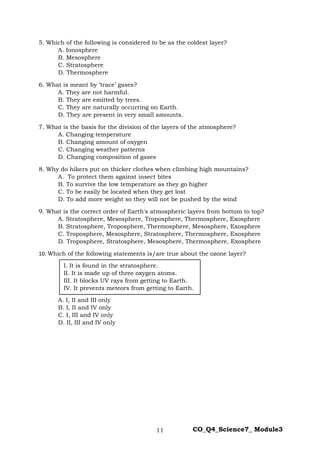
5. Which of the following is considered to be as the coldest layer?
A. Ionosphere
B. Mesosphere
C. Stratosphere
D. Thermosphere
6. What is meant by ‘trace’ gases?
A. They are not harmful.
B. They are emitted by trees.
C. They are naturally occurring on Earth.
D. They are present in very small amounts.
7. What is the basis for the division of the layers of the atmosphere?
A. Changing temperature
B. Changing amount of oxygen
C. Changing weather patterns
D. Changing composition of gases
8. Why do hikers put on thicker clothes when climbing high mountains?
A. To protect them against insect bites
B. To survive the low temperature as they go higher
C. To be easily be located when they get lost
D. To add more weight so they will not be pushed by the wind
9. What is the correct order of Earth's atmospheric layers from bottom to top?
A. Stratosphere, Mesosphere, Troposphere, Thermosphere, Exosphere
B. Stratosphere, Troposphere, Thermosphere, Mesosphere, Exosphere
C. Troposphere, Mesosphere, Stratosphere, Thermosphere, Exosphere
D. Troposphere, Stratosphere, Mesosphere, Thermosphere, Exosphere
10. Which of the following statements is/are true about the ozone layer?
A. I, II and III only
B. I, II and IV only
C. I, III and IV only
D. II, III and IV only
I. It is found in the stratosphere.
II. It is made up of three oxygen atoms.
III. It blocks UV rays from getting to Earth.
IV. It prevents meteors from getting to Earth.
12 CO_Q4_Science7_ Module3
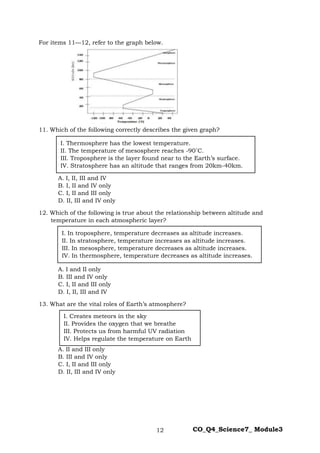
For items 11—12, refer to the graph below.
11. Which of the following correctly describes the given graph?
A. I, II, III and IV
B. I, II and IV only
C. I, II and III only
D. II, III and IV only
12. Which of the following is true about the relationship between altitude and
temperature in each atmospheric layer?
A. I and II only
B. III and IV only
C. I, II and III only
D. I, II, III and IV
13. What are the vital roles of Earth’s atmosphere?
A. II and III only
B. III and IV only
C. I, II and III only
D. II, III and IV only
I. Creates meteors in the sky
II. Provides the oxygen that we breathe
III. Protects us from harmful UV radiation
IV. Helps regulate the temperature on Earth
I. Thermosphere has the lowest temperature.
II. The temperature of mesosphere reaches -90˚C.
III. Troposphere is the layer found near to the Earth’s surface.
IV. Stratosphere has an altitude that ranges from 20km-40km.
I. In troposphere, temperature decreases as altitude increases.
II. In stratosphere, temperature increases as altitude increases.
III. In mesosphere, temperature decreases as altitude increases.
IV. In thermosphere, temperature decreases as altitude increases.
13 CO_Q4_Science7_ Module3
14. Life on Earth would be impossible without the presence of atmosphere. Is the
statement correct?
A. No, because even without atmosphere living things can still survive.
B. Yes, because most of the carbon dioxide is released in the atmosphere.
C. No, because life has existed on Earth even before the formation of the
atmosphere.
D. Yes, because it protects life on Earth by absorbing UV radiation and
regulating the planet’s temperature.
15. Meteors make it through exosphere and thermosphere without much trouble but
not the same case when they start to enter the mesosphere because of the gases
that cause friction and create heat. Would it be better if meteors can freely enter
the Earth’s surface?
A. No, because it affects our ozone layer.
B. Yes, because meteors cause no harm at all.
C. No, because it may lead to destruction of lives.
D. Yes, because meteors are of great importance to the Earth’s surface.
Additional Activities
Wow! That was a tough job. You have finished studying the first lesson. But,
before you completely exit, try to answer this additional activity. Complete the
crossword by identifying the words being described in each item below. Write your
answer on your activity notebook.
Across:
2. It is the most abundant gas in the atmosphere.
3. It is an atmospheric layer located between the mesosphere and exosphere.
5. It is a blanket of air that surrounds Earth.
8. It is the air that we breathe; necessary for our survival
9. It is in this layer where the ozone is found.
14 CO_Q4_Science7_ Module3
Down:
1. It is where the meteors burn before entering Earth.
4. It is the outermost layer of the atmosphere.
6. It is the vertical elevation of an object above a surface (such as sea level or
land) of a planet or natural satellite.
7. It is in this layer where most of the weather occurs.
10. It is made up of three oxygen atoms.
You will now proceed to Lesson 2 of this module which is about the
Greenhouse Effect. To check your prior knowledge on this topic, you have to answer
first the pre-test given below.
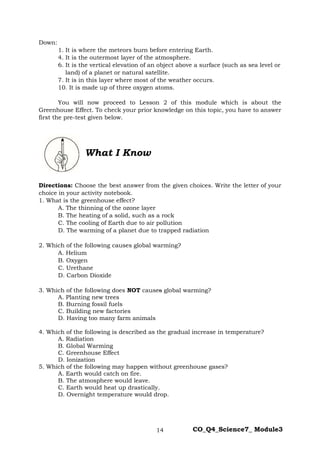
Directions: Choose the best answer from the given choices. Write the letter of your
choice in your activity notebook.
1. What is the greenhouse effect?
A. The thinning of the ozone layer
B. The heating of a solid, such as a rock
C. The cooling of Earth due to air pollution
D. The warming of a planet due to trapped radiation
2. Which of the following causes global warming?
A. Helium
B. Oxygen
C. Urethane
D. Carbon Dioxide
3. Which of the following does NOT causes global warming?
A. Planting new trees
B. Burning fossil fuels
C. Building new factories
D. Having too many farm animals
4. Which of the following is described as the gradual increase in temperature?
A. Radiation
B. Global Warming
C. Greenhouse Effect
D. Ionization
5. Which of the following may happen without greenhouse gases?
A. Earth would catch on fire.
B. The atmosphere would leave.
C. Earth would heat up drastically.
D. Overnight temperature would drop.
What I Know
15 CO_Q4_Science7_ Module3
6. What is the role of greenhouse gases?
A. Absorb Earth’s outgoing heat
B. Reflect Earth’s incoming heat
C. Block the Sun’s infrared radiation
D. Magnify ultraviolet radiation in the atmosphere.
7. Which of the following is NOT an effect of global warming?
A. Polar ice caps will melt.
B. Some areas will experience serious droughts.
C. Coastal regions will be covered with rising sea levels.
D. Earth’s rotation will slow down and eventually will stop.
For items 8-9, refer to the graph below.
8. Which fossil fuel has the highest contribution to carbon dioxide concentration in
the atmosphere?
A. Coal
B. Petroleum
C. Natural Gas
D. Cement Production
9. What is the total amount in million metric of tons of carbon dioxide emitted by
petroleum in the year 2000?
A. 1000
B. 2200
C. 2800
D. 6800
10. The greenhouse effect is a natural phenomenon. Without a natural greenhouse
effect, the temperature of the Earth would be about -18°C instead of its present
14°C. Why are scientists concerned about the greenhouse effect?
A. I and II only
B. III and IV only
C. I, III and IV only
D. I, II, III, and IV
I. There is no technology that will keep the temperature of Earth constant.
II. There is a significant change in Earth’s temperature that leads to global
warming.
III. Human activities like burning of fossil fuels and deforestation enhance the
greenhouse effect.
IV. The human population is increasing rapidly; more carbon dioxide will be
released to the atmosphere.
16 CO_Q4_Science7_ Module3
11. Why is increasing the amount of greenhouse gases an alarming issue?
A. It leads to the establishment of more factories.
B. It can lead to abrupt increase in greenhouse.
C. It causes a major decrease in human population.
D. It causes climate change and increases in the global temperature.
12. What happens to the temperature on earth if more greenhouse gases are released
into the atmosphere?
A. It goes up.
B. It goes down.
C. It stays the same.
D. It fluctuates drastically.
13. Greenhouse gases are naturally occurring gases that traps radiation from the
Earth to keep the Earth warm. Records show that there is a change in the
amount of greenhouses gases present in the atmosphere resulting to a much
higher carbon dioxide. Which of the following activities leads to this imbalance?
A. I and III only
B. I, II and III only
C. I, III and IV only
D. I, II, III and IV
14. We should never concern ourselves in the issue of global warming since we will
not be affected by the melting of polar ice caps only the polar regions. Do you
agree with the statement?
A. No, because we might never be able to visit Antarctica and see polar bears.
B. Yes, because Philippines is located near the equator where there are no ice
caps.
C. Yes, because we will never be affected with the change in climate since we
only have wet and dry seasons.
D. No, because global warming is a worldwide issue where everything on Earth
will be greatly affected.
15. One way of reducing the greenhouse effect is using energy efficiently like turning
off lights when not in use. Should everyone be encouraged to efficiently use
energy at home? Why or why not?
A. Yes, because energy cost is getting too high.
B. No, because using energy efficiently at home is not enough to minimize
greenhouse effect.
C. Yes, because all of us should work together and be responsible in
minimizing the greenhouse effect.
D. No, because others can afford in paying high bills for electricity thus they
have the right to use it leisurely.
I. Cutting down and burning of trees.
II. Plants absorbing carbon dioxide for photosynthesis
III. Humans burning fossil fuels such as coal, oil and gas as a source of energy
IV. Using of chlorofluorocarbons (CFCs) as refrigerants in refrigerators and in
making foam plastics
17 CO_Q4_Science7_ Module3
Hello! In the previous lesson, you have learned the structure and composition
of the Earth’s atmosphere. You were able to describe the special features of each
layer of the atmosphere. Also, you have learned that more than three quarters of
Earth’s atmosphere is made up of nitrogen while one fifth is oxygen. The remaining
1% is a mixture of carbon dioxide, water vapour, ozone and other gases. These gases
not only produce important weather features such as cloud and rain, but also have
considerable influence on the overall climate of the Earth, through the greenhouse
effect and global warming.
Activity 1. Label the Greenhouse Effect
Directions: Complete the diagram with the correct phrases about greenhouse effect.
Choose your answer from the box given below. Write your answer on a separate sheet
of paper.
Lesson
2 Greenhouse Effect
What’s In
Some heat escapes to space Infrared heat from Earth
Most heat is contained in the atmosphere solar radiation enters Earth
Illustrated by
Leah Joy D. Walan
18 CO_Q4_Science7_ Module3
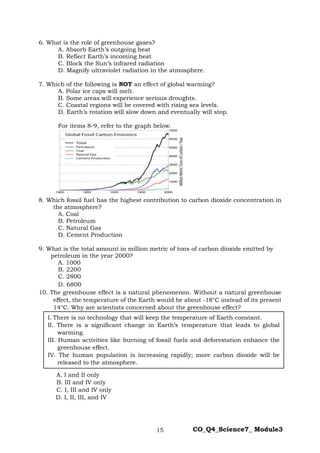
Activity 2: What’s Going On?
Objectives: In this activity you will be able to describe the greenhouse effect.
Materials:
 Graph in Figure 1
 Paper and pen
Directions: Study the diagram below about the greenhouse effect and answer the
questions that follow. Write your answer on your activity notebook.
Guide Questions:
Q1.What is the Earth’s major source of heat?
Q2. What do the arrows represent?
Q3. What will happen to Earth without the Sun’s energy?
Q4. What are the greenhouse gases as shown in the figure?
Q5. What is the work of the greenhouse gases?
Q6. Based on the diagram, what then is a greenhouse effect?
SPACE
What’s New
ATMOSPHERE
Some heat escapes into space
The sun’s
rays warms
the Earth
Greenhouse gases absorb
infrared radiation from
the earth and re-radiate it
back to the Earth.
Illustrated by Leah Joy D. Walan
19 CO_Q4_Science7_ Module3
What is Greenhouse Effect?
Are you familiar with greenhouses? In temperate countries, a greenhouse is
used to grow seedlings in the late winter and early spring and later, planted in the
open field when the weather is warmer. Greenhouses also protect plants from
weather phenomena such snowstorm or dust storms. In tropical countries,
greenhouses are used by commercial plant growers to protect flowering and
ornamental plants from harsh weather conditions and insect attack.
Figure 1. Different sizes of greenhouses.
Source: DepEd Grade 7 LM
How does a greenhouse work?
Greenhouses allow sunlight to enter but prevent heat from escaping. The
transparent covering of the greenhouse allows visible light to enter without
obstruction. It warms the inside of the greenhouse as energy is absorbed by the
plants, soil, and other things inside the building. Air warmed by the heat inside is
retained in the building by the roof and wall. The transparent covering also prevents
the heat from leaving by reflecting the energy back into the greenhouse and
preventing outside winds from carrying it away.
The Earth’s atmosphere is compared to a greenhouse. You know that besides
nitrogen and oxygen, Earth’s atmosphere contains trace gases such as carbon
dioxide, water vapor, methane, and ozone. Like the glass in a greenhouse, the trace
gases have a similar effect on the Sun’s rays. They allow sunlight to pass through,
resulting in the warming up of the Earth’s surface. But they absorb the infrared
radiation coming from the Earth’s surface, keeping the Earth’s temperature suitable
for life on Earth. The process by which the Earth’s atmosphere warms up is called
greenhouse effect, and the above mentioned trace gases are referred to as
‘greenhouse gases.’
The greenhouse effect is the Earth’s natural process of warming itself. Without
the greenhouse effect, Earth would be very cold, too cold for living things, especially
at night.
The diagram below shows how the Sun’s rays are trapped by the greenhouse
gases in the atmosphere.
What is It
20 CO_Q4_Science7_ Module3
Figure 2. The Greenhouse Effect
Illustrated by Leah Joy D. Walan
Is Earth Getting Warmer? What is the Evidence?
Studies have shown that before
1750 (called the pre-industrialization
years), carbon dioxide concentration was
about 0.028 percent or 280 parts per
million (ppm) by volume. Figure 3 below
shows the concentration of carbon dioxide
from 1958 to 2003. Recent studies report
that in 2000-2009, carbon dioxide rose by
2.0 ppm per year. In 2011, the level is
higher than at any time during the last 800
thousand years. Local temperatures
fluctuate naturally, over the past 50 years
but the average global temperature has
increased at the fastest rate in recorded
history. So what if there is increasing
emission of greenhouse gases like carbon
dioxide into the atmosphere? What is the
problem with a small increase in carbon
dioxide concentration in the atmosphere?
http://en.wikipedia.org/wiki/File:Mauna_Loa_Carbon_Dioxide-en.svg#file
More carbon dioxide means that more heat cannot return back to space and
is trapped in the Earth’s atmosphere. More heat trapped by the greenhouse gases
such as carbon dioxide leads to a warmer Earth. The increasing temperature
phenomenon is known as global warming. Global means that all countries and
people around the world are affected even if that country is not a major contributor
of greenhouse gases. Many scientists now agree that human activities emit more
greenhouses gases into the atmosphere, making the natural greenhouse effect
stronger. Scientists are also saying that if we continue on emitting greenhouse gases
into the atmosphere, it will have a dangerous effect on the Earth.
Figure 3. Carbon dioxide measurements
in Mauna Loa Observatory, Hawaii
Source: DepEd Grade 7 LM
21 CO_Q4_Science7_ Module3
Sources of Greenhouse Gases
Carbon dioxide is
naturally produced when
people and animals breathe.
Plants and trees take in and
use carbon dioxide to
produce their own food.
Volcanoes also produce
carbon dioxide. Methane
comes from grazing animals
as they digest their food and
from decaying matter in wet rice fields.
Ozone is also naturally present in the
stratosphere. But human activities emit a lot
of greenhouse gases into the atmosphere.
The figure 4 below shows the global fossil carbon emission from the year 1960-2020.
Are we also contributing to the increase in carbon dioxide concentration in
the atmosphere? Why or why not? Carbon dioxide comes from the burning of fossil
fuel such as coal, crude oil and natural gas. Cutting down and burning of trees
releases carbon dioxide. Methane can also be released from buried waste. For
example, the left-over food, garden wastes, and animal wastes collected from our
homes are thrown into dumpsites. When lots of wastes are compressed and packed
together, they produce methane. Coal mining also produces methane. Another group
of greenhouse gases includes the chlorofluorocarbons or CFCs for short. CFCs have
been used in spray cans as propellants, in refrigerators as refrigerants, and in
making foam plastics as foaming agents.
Points to Remember
There are natural processes in the atmosphere that protect and sustain life
on Earth. For example, the greenhouse effect keeps temperature on Earth just right
for living things. For as long as the concentration of greenhouse gases are controlled,
we will have no problem on the global temperature. But human activities have
emitted greenhouse gases into the atmosphere, increasing their levels to quantities
that have adverse effects on people, plants, animals and the physical environment.
Burning of fossil fuels, for example, has increased levels of carbon dioxide thus
trapping more heat, increasing air temperature, and causing global warming. Such
global phenomenon is feared to melt polar ice caps and cause flooding to low-lying
areas that will result to reduction in biodiversity. It is even feared that global warming
is already changing climates around the globe, causing stronger typhoons, and
creating many health-related problems.
Global warming is a potential increase in average global atmospheric
temperatures resulting from the greenhouse effect.
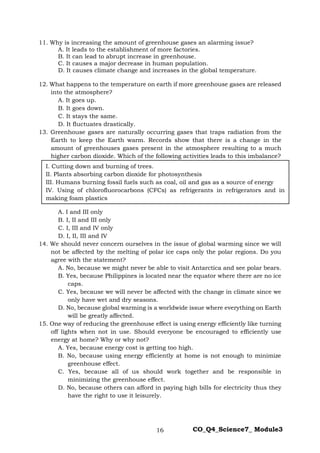
Figure 4. Fossil Fuel Carbon Dioxide
Emission
Source: DepEd Grade 7 LM
22 CO_Q4_Science7_ Module3
Activity 3: Is It A Yes or A No?
Directions: Read the statements given below. Write YES if it is correct and NO if it
is not correct on a separate sheet of paper.
1. Is the Earth warmed by the Sun’s heat?
2. Is carbon dioxide a greenhouse gas?
3. Do greenhouse gases trap the Sun’s heat?
4. Are carbon dioxide, methane, water vapour and ozone natural greenhouse gases?
5. Are cholorofluorocarbons (CFCs) a group of man-made greenhouse gases?
6. Is the Earth cooled by greenhouse effect?
7. Is the temperature in the Philippines going to be cooler with global warming?
8. Has the amount of greenhouse gases in the atmosphere decreased since the
Industrial Revolution?
9. Is saving energy a good way to help reduce the effects of global warming?
10. Is the sea level going to rise as a result of global warming?
11. Can planting trees help reduce the carbon dioxide level in the atmosphere?
12. Does greenhouse effect keep the Earth warm?
13. Is global warming the result of a reduced carbon dioxide level?
14. Are burning and cutting down of trees release carbon dioxide?
15. Can we help in slowing down the effects of global warming?
What’s More
23 CO_Q4_Science7_ Module3
Directions: Complete the following statements below by writing what you have
learned about greenhouse effect. Write your answers on a separate sheet of paper.
I know that I know about _________________________________________________.
First, I know that _________________________________________________________.
Second, I know that ______________________________________________________.
Finally, I know that _______________________________________________________.
Now you know that I know something about _______________________________.
An Energy Inefficient Kitchen
Directions: The picture below shows how a kitchen can be inefficient. Make a list
of how it is wasting energy and suggest ways in which the kitchen could be made
more efficient to contribute in reducing the effects of global warming. The first one
has been done for you. Write your answers on a separate sheet of paper.
List of activities that shows wasting
of energy
What to do to become more efficient
1. The light is on even during daytime. Turn off the light during daytime
especially when no one is using it.
What I Have Learned
What I Can Do
Illustrated by Leah Joy D. Walan
24 CO_Q4_Science7_ Module3
Directions: Choose the best answer from the given choices. Write the letter of your
choice on a separate sheet of paper.
1. Which of the following gases is released by animals as a waste product of digestion
that can contribute to global warming?
A. Methane
B. Nitrogen
C. Carbon Dioxide
D. Chlorofluorocarbon
2. Which of the following is NOT a greenhouse gas?
A. Methane
B. Chlorine
C. Nitrous Oxide
D. Carbon Dioxide
3. Which of the following activities contributes the most to carbon emissions globally?
A. Agriculture
B. Respiration
C. Deforestation
D. Burning fossil fuels
4. Which of the following may happen to planet Earth without the greenhouse effect?
A. It will die.
B. It will stay normal.
C. It will become warm.
D. It will become very cold.
5. In the past, refrigerators, aerosol spray, propellants and solvents were all sources
of greenhouse gas. What do you call to these gases?
A. Methane
B. Nitrous Oxide
C. Carbon Dioxide
D. Chorofluorocarbons (CFC)
6. What do you call the certain gases in the atmosphere such as water vapour, carbon
dioxide, methane and nitrous oxide which help maintain the Earth’s
temperature?
A. Solar gases
B. Ozone gases
C. Chorofluorocarbons (CFC)
D. Greenhouse gases
Assessment
25 CO_Q4_Science7_ Module3
7. Why is Ozone important to life on Earth?
A. It provides all the oxygen to Earth.
B. It reflects all the ultraviolet radiation of the sun.
C. It absorbs all the heat that come up from the Earth.
D. It protects the Earth’s atmosphere and the life on Earth from harmful
radiant energy emitted by the sun.
8. What happened to the level of carbon dioxide in the atmosphere over the past 200
years?
A. Decreased slightly
B. Increased steadily
C. Stayed about the same
D. Increased until recently and then decreased
9. How does the increased in carbon dioxide cause global warming?
A. It reflects more sunlight from clouds.
B. It traps more heat in the atmosphere.
C. It reduces the amount of oxygen in the air.
D. It allows more sunlight into the atmosphere.
For items 10—11, refer to the figure below.
Illustrated by Leah Joy D. Walan
10. Which of the following statements are true about the figure shown above?
A. I and III only
B. I and IV only
C. II and IV only
D. I, II, III and IV
I. Sun is the Earth’s major source of energy.
II. Greenhouse gases include CO2, CH4, ozone and water vapour.
III. Not all the sun’s heat is absorbed by the Earth; some is reflected back in space.
IV. Greenhouse gases absorbs infrared radiation from the earth and re-radiate it
back to the Earth.
26 CO_Q4_Science7_ Module3
11. What are the important roles of the greenhouse gases?
A. IV only
B. II and IV only
C. II and III only
D. I, II and III only
12. What can you say about the two statements below?
I. Greenhouse effect is Earth’s natural process of warming itself.
II. Greenhouse gases include oxygen, nitrogen and carbon dioxide.
A. Statement I and II are both TRUE.
B. Statement I and II are both FALSE.
C. Statement I is TRUE while statement II is FALSE.
D. Statement I is FALSE while statement II is TRUE.
13. Which of the following are the best things to do to help slow down global
warming?
A. I and II only
B. II and IV only
C. I, IV and V only
D. I, II and IV only
14. National government has been looking for ways to help solve the issue on global
warming. Is planting trees one of the best ways to help solve the problem? Why
or why not?
A. Yes, because trees give us shed and protects us from the heat of the sun.
B. No, because trees only to the carbon dioxide level in the atmosphere.
C. No, because trees only gives off oxygen as its by products in the
photosynthesis.
D. Yes, because trees help in absorbing the carbon dioxide, one of the gases
that traps the heat in the atmosphere.
15. CFCs are used as refrigerants in refrigerators. The use of CFCs has been banned
worldwide. Do you agree with the government’s idea of not using CFCs anymore?
Why or why not?
A. Yes, because CFCs are dangerous to human health.
B. No, because there is no study that supports the idea.
C. Yes, because CFCs causes global warming.
D. No, because CFCs play a vital role in refrigerator.
I. Use energy efficiently at home.
II. Participate in tree planting activities.
III. Continue using the single use plastics.
IV. Practice the 5Rs (Reduce, Reuse, Recycle, Repair and Recover).
V. Promote the use of CFCs in the refrigerators and aerosol sprays.
I. It is necessary for communication.
II. It reflects back the sun’s rays to Earth to keep it cold.
III. It helps the Sun in providing the energy needed by Earth.
IV. It absorbs infrared radiation from the earth and re-radiate it back to the Earth.
27 CO_Q4_Science7_ Module3
Wow! That was a tough job. At last! You have finished studying lesson 2. But,
before you completely exit, try to answer this additional activity.
Directions: Complete by sentence by writing the learning you gained from our lesson
on greenhouse effect.
1. I learned that ___________________________________________________________
__________________________________________________________________________.
2. One important thing I want to share to my friend is that _________________
__________________________________________________________________________.
3. I can help lessen global warming through _______________________________
__________________________________________________________________________.
Additional Activities
28 CO_Q4_Science7_ Module3
Answer Key
What
I
Know
1.
B
2.
D
3.
A
4.
C
5.
B
6.
A
7.
D
8.
A
9.
C
10.
A
11.
C
12.A
13.
D
14.
D
15.
B
What’s
New:
Activity
1
1.
Based
on
the
graph,
the
five
layers
of
the
atmosphere
starting
from
the
Earth’s
surface
are:
troposphere
(8-14.5
km),
stratosphere
(about
50
km),
mesosphere
(about
50-80
km),
thermosphere
(about
80-110
km),
and
exosphere
(cannot
be
determined
from
the
graph).
2.
In
the
lower
part
of
the
stratosphere,
the
temperature
increases
with
height.
The
same
is
observed
starting
from
the
thermosphere
up
to
the
exosphere.
3.
Both
in
the
troposphere
and
mesosphere,
the
temperature
decreases
as
height
increases.
4.
In
the
troposphere,
the
temperature
decreases
as
the
altitude
(height
of
the
atmosphere)
increases.
In
the
stratosphere,
at
heights
around
10-20
km
above
the
ground,
the
temperature
is
almost
the
same.
From
about
20
to
50
km
above,
the
temperature
increases.
In
the
mesosphere,
the
temperature
decreases
as
height
increases.
In
the
thermosphere,
from
heights
about
87
to
100
km,
the
temperature
change
is
small;
it
increases
gradually
from
about
100
to
110
km.
From
110
km
to
the
end
of
the
layer
the
temperature
steadily
increases
with
height.
The
gradual
increase
in
temperature
with
altitude
continues
to
the
exosphere.
5.
The
layers
of
Earth’s
atmosphere
is
divided
based
on
temperature
differences
6.
Overall,
the
graph
shows
that
the
closer
the
atmospheric
layer
is
to
the
Sun,
e.g.
thermosphere
and
exosphere,
the
hotter
the
temperature.
However,
if
one
studies
the
temperature
in
the
lower
layer,
the
reverse
trend
is
observed.
For
example,
in
the
troposphere,
the
temperature
close
to
Earth
is
higher
than
the
temperature
above
the
ground.
What’s
More:
Activity
2
Layer
Estimated
distance
from
the
ground
Estimated
temperature
Relationship
between
temperature
and
altitude
Events
happening
in
that
layer
Troposphere
About
8-
14.5km
Temperature
decreases
6.5˚C
to
about
-60
˚C
As
altitude
increases
temperature
decreases.
Cloud
formation
and
weather
occur.
Stratosphere
About
50km
Temperature
increases
from
an
average
-51˚C
to
-15˚C.
Temperature
increases
as
the
altitude
increases.
Formation
of
ozone
molecules
occur.
Mesosphere
Between
50-
80km
Average
of
temperature
of
-90
℃.
temperature
decreases
as
altitude
increases.
Burning
of
meteors
occur
Thermosphere
Between
80-
110km
The
temperature
can
go
beyond
1000˚C
Temperature
increases
as
the
altitude
increases.
Formation
of
aurora
borealis
and
aurora
australis.
Exosphere
700-
10,000km
Temperature
can
reach
up
to
1700˚C
Temperature
increases
as
the
altitude
increases.
Satellites
are
stationed
in
this
area.
Lesson
1
29 CO_Q4_Science7_ Module3
What
I
Know
1.
D
2.
D
3.
A
4.
B
5.
D
6.
A
7.
D
8.
B
9.
C
10.
D
11.
D
12.
A
13.
A
14.
D
15.
C
Assessment
1.
A
2.
B
3.
D
4.
D
5.
D
6.
D
7.
D
8.
B
9.
B
10.
C
11.
A
12.
C
13.
D
14.
D
15.
C
Assessment
1.
A
2.
A
3.
D
4.
C
5.
B
6.
D
7.
A
8.
B
9.
D
10.
D
11.
D
12.
C
13.
B
14.
D
15.
C
What
I
Have
Learned
1.
atmosphere
2.
gases
3.
nitrogen
4.
five
5.
troposphere
6.
mesosphere
7.
thermosphere
8.
exosphere
9.
temperature
10.
altitude
11.
protects
12.
radiation
13.
ozone
14.
oxygen
15.
life
Additional
Activities
Across
2.
nitrogen
3.
thermosphere
5.
atmosphere
8.
oxygen
9.
stratosphere
Down
1.
mesosphere
4.
exosphere
6.
altitude
7.
troposphere
10.
ozone
What’s
In:
Activity
1
1.
some
heat
escape
to
space
2.
most
heat
is
contained
in
the
atmosphere
3.
infrared
heat
from
heat
4.
solar
radiation
enters
Earth
What’s
New
Activity
2
1.
The
Earth’s
major
source
of
heat
is
the
sun.
2.
The
arrows
represent
the
incoming
and
outgoing
heat.
3.
Without
the
Suns’
energy
the
Earth
would
be
very
cold.
4.
The
greenhouse
gases
are
CO
2
,
CH
4
,
O
3
and
water
vapour.
5.
Greenhouse
gases
absorb
infrared
radiation
from
the
earth
and
re-radiate
it
back
to
the
Earth.
6.
Greenhouse
effect
is
the
Earth’s
natural
process
of
warming
itself.
What’s
More
Activity
3
1.
Yes
2.
Yes
3.
Yes
4.
Yes
5.
Yes
6.
No
7.
No
8.
No
9.
Yes
10.
Yes
11.
Yes
12.
Yes
13.
No
14.
Yes
15.
Yes
Lesson
2
30 CO_Q4_Science7_ Module3
References
Books
Asuncion, Alvie J., et al. 2017. K to 12 Science Grade 7 Learner’s Material. First
Edition. Pasig City: Bureau of Learning Resources (DepEd-BLR).
Asuncion, Alvie J., et al. 2017. K to 12 Science Grade 7 Teacher’s Guide. First Edition.
Pasig City: Bureau of Learning Resources (DepEd-BLR).
K to 12 Science Curriculum Guide. Pasig City: Department of Education.
For inquiries or feedback, please write or call:
Department of Education - Bureau of Learning Resources (DepEd-BLR)
Ground Floor, Bonifacio Bldg., DepEd Complex
Meralco Avenue, Pasig City, Philippines 1600
Telefax: (632) 8634-1072; 8634-1054; 8631-4985
Email Address: blr.lrqad@deped.gov.ph * blr.lrpd@deped.gov.ph

SCI7 Q4 MOD3.pdf

  • 1.
    CO_Q4_Science7_ Module3 Science Quarter 4– Module 3: You Keep Me Warm 7
  • 2.
    Science – Grade7 Alternative Delivery Mode Quarter 4 – Module 3: You Keep Me Warm First Edition, 2020 Republic Act 8293, section 176 states that: No copyright shall subsist in any work of the Government of the Philippines. However, prior approval of the government agency or office wherein the work is created shall be necessary for exploitation of such work for profit. Such agency or office may, among other things, impose as a condition the payment of royalties. Borrowed materials (i.e., songs, stories, poems, pictures, photos, brand names, trademarks, etc.) included in this module are owned by their respective copyright holders. Every effort has been exerted to locate and seek permission to use these materials from their respective copyright owners. The publisher and authors do not represent nor claim ownership over them. Published by the Department of Education Secretary: Leonor Magtolis Briones Undersecretary: Diosdado M. San Antonio Printed in the Philippines by___________________________ Department of Education – SOCCSKSARGEN Office Address: Regional Center, Brgy. Carpenter Hill, City of Koronadal Telefax: (083) 2281893 E-mail Address: region12@deped.gov.ph Development Team of the Module Writers: Leah Joy Desamparado-Walan Editors: Lenie G. Forro, Cynthia S. Bustillo, Miraflor O. Albios Reviewers: Agabai S. Kandalayang, Marry Anne A. Barrientos, Mary Joy D. Bautista, Yusof A. Aliudin Layout Artist: Glen D. Napoles, Analyn J. Madera, Ana Lorma A. Dahiroc Management Team: Allan G. Farnazo Isagani S. Dela Cruz Gilbert B. Barrera Arturo D. Tingson, Jr. Peter Van C. Ang-ug Elpidio B. Daquipil Juvy B. Nitura Lenie G. Forro
  • 3.
    7 Science Quarter 4 –Module 3: You Keep Me Warm
  • 4.
    Introductory Message This Self-LearningModule (SLM) is prepared so that you, our dear learners, can continue your studies and learn while at home. Activities, questions, directions, exercises, and discussions are carefully stated for you to understand each lesson. Each SLM is composed of different parts. Each part shall guide you step-by- step as you discover and understand the lesson prepared for you. Pre-tests are provided to measure your prior knowledge on lessons in each SLM. This will tell you if you need to proceed on completing this module or if you need to ask your facilitator or your teacher’s assistance for better understanding of the lesson. At the end of each module, you need to answer the post-test to self-check your learning. Answer keys are provided for each activity and test. We trust that you will be honest in using these. In addition to the material in the main text, Notes to the Teacher are also provided to our facilitators and parents for strategies and reminders on how they can best help you on your home-based learning. Please use this module with care. Do not put unnecessary marks on any part of this SLM. Use a separate sheet of paper in answering the exercises and tests. And read the instructions carefully before performing each task. If you have any questions in using this SLM or any difficulty in answering the tasks in this module, do not hesitate to consult your teacher or facilitator. Thank you.
  • 5.
    1 CO_Q4_Science7_ Module3 WhatI Need to Know The sun supplies energy to Earth that is necessary for its survival. The heat of the sun is too much to bear if not because of a blanket of air that surrounds the Earth we call atmosphere. The atmosphere is not just a layer of air or gases but it is more than that. It contains the oxygen that we breathe; it allows us to communicate; and it has the ozone layer that protects us from harmful solar radiation. A lot is happening in the atmosphere such as weather system and the atmospheric phenomena caused by the sun or solar energy. Therefore it is necessary that one should be familiar with the structure and composition of the atmosphere. One then can give reasons for the weather events as well as global atmospheric phenomena like greenhouse effect and global warming that result from changes in the composition of the gases of the atmosphere brought by some human activities. How is Earth’s atmosphere affected by solar energy? This module will guide you in understanding how energy from the sun interacts with the layers of the atmosphere. You will learn more about earth’s atmosphere -the place on earth that is vital to our existence. Most Essential Learning Competency: Discuss how energy from the sun interacts with the layers of the atmosphere (S7ES-IVd-5) This module is divided into two lessons: Lesson 1: Layers of the Atmosphere Lesson 2: Greenhouse Effect After going through this module, you are expected to: 1. explain the basis for the division of the layers of the atmosphere; 2. describe the features of each layer of the atmosphere; 3. describe greenhouse effect; 4. identify the sources of greenhouse gases; and 5. cite ways on how to slow down the effects of global warming. What I Know Directions: Choose the best answer from the given choices. Write the letter of your choice on a separate sheet of paper. 1. In which layer of the atmosphere where nearly all weather phenomena occur? A. Mesosphere B. Stratosphere C. Thermosphere D. Troposphere
  • 6.
    2 CO_Q4_Science7_ Module3 2.Which layer protects us from harmful ultraviolet rays? A. Mesosphere B. Stratosphere C. Troposphere D. Ozone layer 3. What are the most abundant gases in Earth’s atmosphere? A. Nitrogen and Oxygen B. Nitrogen and Hydrogen C. Carbon Dioxide and Oxygen D. Carbon Dioxide and Nitrogen 4. In which layer of the atmosphere do planes fly to get out from the weather disturbances? A. Exosphere B. Mesosphere C. Stratosphere D. Thermosphere 5. What happens to the temperature as you go higher in the troposphere? A. It increases. B. It decreases. C. It stays the same. D. It increases then decreases. 6. In which layer of the earth’s atmosphere does meteoroids burn up? A. Mesosphere B. Stratosphere C. Thermosphere D. Troposphere 7. Why is the presence of ozone important for the survival of living things on Earth? A. It warms Earth’s surface. B. It helps in cloud formation. C. It makes jets flying more comfortable. D. It offers protection from the sun’s harmful ultraviolet rays. 8. Which of the following describes the temperature in the troposphere and stratosphere? A. The stratosphere is hotter than the troposphere. B. The troposphere is hotter than the stratosphere. C. Low temperature exists in the troposphere and stratosphere. D.The temperature in the troposphere is equal to the stratosphere. 9. What is the correct order of Earth's atmospheric layers from bottom to top? A. III, IV, V, I, II B. V, IV, III, II, I C. V, III, II, IV, I D. III, V, II, IV, II I. Exosphere II. Mesosphere III. Stratosphere IV. Thermosphere V. Troposphere
  • 7.
    3 CO_Q4_Science7_ Module3 10.Which of the following correctly describes the stratosphere? A. It is an atmospheric ozone layer. B. It has high concentration of ionized particles. C. It is a layer important to telecommunications. D. It is a layer extending to a height of about 8 km. 11. Which of the following are the special features of mesosphere? A. I and II only B. II and III only C. II and IV only D. III and IV only 12. How does energy from the sun enter the atmosphere? A. It reaches Earth and enters the atmosphere through radiation. B. The sun’s energy enters anywhere in the space including Earth. C. It enters the atmosphere by vibrating through air particles of the atmosphere. D. The plants in the Earth attract the sun’s energy making it enter the Earth’s atmosphere. 13. What characteristics differentiate troposphere from other layers of atmosphere? A. I & II B. II & III C. I, II & III D. I, II, III & IV 14. Layers of the atmosphere are classified according to changes in temperature. Is the statement correct? A. No, because it depends on the events that is happening on that layer. B. Yes, because from troposphere to exosphere the temperature is gradually increasing. C. No, because layers of the atmosphere were classified based on their altitude alone. D.Yes, because there is a significant change in temperature in each layers of the atmosphere. I. It is where most water vapor is found. II. It begins about 16 km above the Earth’s surface III. It is where all weather phenomena takes place. IV. It is where temperature decreases with altitude at 2°C/1000 ft. I. It is where the ozone layer is found. II. It is the coldest layer of the atmosphere. III. It is where the formation of aurora occurs. IV. It is where the meteors burn up upon entering the Earth.
  • 8.
    4 CO_Q4_Science7_ Module3 15.Edmar, a pilot of a large jet chose to fly in the stratosphere to avoid the weather systems. Is his decision correct? A.Yes, because the temperature in the stratosphere is increasing. B.Yes, because weather phenomenon exists only in the troposphere. C.No, because weather system occurs in all layers of the atmosphere. D.No, because most of the weather phenomenon occurs at the stratosphere. Lesson 1 Layers of the Atmosphere What’s In Earth is surrounded by a blanket of air called the atmosphere, and this protects the planet and enables life to exist. Our atmosphere contains different types of gases. Consequently, air is made up mostly nitrogen (78 %) and oxygen (21 %) gases. Nitrogen is the most abundant gas and is essential for all living things to grow. Oxygen on the other hand is necessary for humans and animals for survival, and this gas is given off by the plants as one of the by-products during photosynthesis. The remaining one percent is made up of other gases such as water vapor, carbon dioxide, ozone, argon, neon, helium, hydrogen, dust particles, and chlorofluorocarbons. The said gases exist only in very small amounts and are called trace gases. Suppose the percentage of nitrogen and oxygen in air were reversed, what do you think would happen? Oxidation will proceed at a much faster rate—we will age sooner, fruits will ripen faster, rusting and burning go on at a much faster rate. What if the concentration of carbon dioxide and nitrogen were reversed? Would life exist on Earth? The 0.03% concentration of carbon dioxide is sufficient to keep Earth warm and permits life to exist. Increasing its concentration to 78% will greatly increase Earth’s temperature. Do you now see that even the gas composition of the atmosphere is made just right for us? Altering it will surely result in imbalance. What do you think are some human activities that tend to change the concentration of the gases in the atmosphere? But before we answer this question, let us wander first to the planet’s jacket- the atmosphere.
  • 9.
    5 CO_Q4_Science7_ Module3 Theatmosphere is a very interesting matter to study. We thought it as a thin layer of gas but it has several layers. These layers differ in altitude, temperature, and other characteristics. Since many processes and phenomena occur in the atmosphere it is necessary for us to learn about these layers and the important events happening in each layer. In addition, meteorology is the branch of science which deals with the study of the atmosphere and its corresponding weather patterns. People who study the atmosphere are called meteorologists. What’s New Activity 1. Atmosphere: How Are We Divided? Objectives: In this activity you will be able to gather information about Earth’s atmosphere based on a graph. Specifically, you will: 1. describe the features of each of the five layers; 2. compare the features of the five layers; and 3. explain the basis for the division of the layers of the atmosphere. Materials:  Graph in Figure 1  A ruler, if available Directions: Study the graph below and answer the succeeding questions. Write your answers on your activity notebook. 140 120 100 80 60 40 20 -120 -100 -80 -60 -40 -20 0 20 40 Temperature (˚C) Figure 1. Altitude and temperature profile of each layer of the atmosphere Exosphere Thermosphere - - - - - - - - - - - - - - - - - - - - - - - - - - - - - - - - - - - - - - - - - - - - - - - - - Mesosphere - - - - - - - - - - - - - - - - - - - - - - - - - - - - - - - - - - - - - - - - - - - - - - - - - Stratosphere - - - - - - - - - - - - - - - - - - - - - - - - - - - - - - - - - - - - - - - - - - - - - - - - - Troposphere Altitude (km)
  • 10.
    6 CO_Q4_Science7_ Module3 GuideQuestions: Q1. What are the five layers of the atmosphere? Estimate the height of each layer. Q2. In which layer is temperature increasing with increasing altitude? Q3. In which layer is temperature decreasing with increasing altitude? Q4. What is the relationship between temperature and altitude in the troposphere? stratosphere? mesosphere? thermosphere? exosphere? Q5. Analyze the graph. What is the basis for the division of Earth’s atmosphere? Q6. Based on the graph, can you generalize that the higher the layer of the atmosphere (that is closer to the Sun), the hotter the temperature? Why or why not? What is It Layers of the Atmosphere The temperature profile of the atmosphere is the basis for dividing the atmosphere into several layers: (1) troposphere, (2) stratosphere, (3) mesosphere, (4) thermosphere, and the (5) exosphere. Each layer has its own distinct characteristics. Let us find out more about them. Troposphere The troposphere starts at the Earth’s surface and extends 8 km to 14.5 km high. Because of gravity’s pull, about 75 % of the gases in the atmosphere can be found in this layer. As altitude increases, the temperature in the troposphere decreases. The main reason why temperature decreases with altitude in the troposphere is that it is heated from below. The atmosphere is predominantly transparent to sunlight, so the Sun heats the ground directly. The ground warms the bottom layers of the atmosphere by radiation and by convection. The situation is like water heated in a pan on the stove--the water is hottest at the bottom and coolest at the top. “Tropos” means change. This layer gets its name from the weather that is constantly changing. Almost all weather changes and patterns happen in this layer. The temperature change in this layer is mainly due to the heat of Earth’s surface. Figure 2. Weather in the troposphere Illustrated by Leah Joy D. Walan
  • 11.
    7 CO_Q4_Science7_ Module3 Stratosphere Thesecond layer of the atmosphere is the stratosphere. “Strat” means layer. The stratosphere is the layer of air that starts just above the troposphere and extends to about 50 km. In this layer, temperature increases as the altitude increases. This is due to the ozone layer that is found in the stratosphere. The ozone layer absorbs much of the sun’s harmful radiation that would otherwise be dangerous to plant and animal life. Ozone is a form of oxygen which absorbs the ultraviolet (UV) rays from the sun, which eventually releases heat. This is also the location where aircrafts fly because it is very stable in comparison to the troposphere. Mesosphere The layer between 50 km and 80 km above the Earth’s surface is called the mesosphere which is the third layer of the atmosphere. “Meso” means middle. In this layer, temperature decreases as altitude increases. It has no gases which can absorb UV rays from the sun. The mesosphere is characterized as a very cold layer with an average of temperature of -90 ℃. It also has a thin layer of air which is still enough to decelerate meteors rushing towards Earth. This thin layer of air adds friction to meteoroids which becomes meteors producing a burning tail and seen as shooting stars. Thermosphere The fourth layer is the thermosphere. “Thermo” means heat. The temperature of this gas layer can go beyond 1000 ℃. This increase in temperature is due to the absorption of intense solar radiation by the limited number of remaining molecular oxygen. The thermosphere is between 80 km and 110 km above the Earth. A layer in the thermosphere, called ionosphere, is made of gas particles charged by solar energy. Ionosphere bounces off radio waves from different parts of the world. Also, a remarkable feature that is happening in the ionosphere is the occurrence of auroras. An Aurora is a display of glows in the night sky within the polar areas. The auroras (Aurora borealis in the North and Aurora australis in the South) can be seen as white, green, red, blue, or purple. Space shuttles also fly in this area. Figure 3. Jet aircraft and formation of ozone molecules in the stratosphere Illustrated by Leah Joy D. Walan Figure 4. Burning meteors in the mesosphere Illustrated by Leah Joy D. Walan Figure 5. Aurora borealis Illustrated by Leah Joy D. Walan
  • 12.
    8 CO_Q4_Science7_ Module3 Exosphere Theexosphere is the outermost layer of the atmosphere. “Exo” means outside. It is more than 700 km, maybe up to 10 000 km from the surface of Earth with no clear boundary. This layer continues into the outer space where gas can easily move to due to weak gravitational pulls. Due to its nature, the air here is very thin. Satellites are stationed in this area, 500 km to 1000 km from Earth. Role of Atmosphere in Sustaining Life on Earth Surrounding earth is a layer of gas which is a critical factor in sustaining life on the planet. This layer of gas called the atmosphere, is held together by earth’s gravity. It makes earth “livable” by regulating solar energy, or the energy coming from the sun which drives all life processes on Earth. Because of the atmosphere, earth is not “too hot” nor “too cold” to sustain life. This characteristic sets Earth apart from other planets. What’s More Activity 2. How Are We Different? Objective: Describe the features of each layer of the atmosphere. Materials: paper and pen Directions: 1. Fill in the table with necessary data. Write your answer on a separate sheet of paper. The first layer has been answered already for you. Layer Estimated distance from the ground Estimated temperature Relationship between temperature and altitude Events happening in that layer Troposphere About 10km Temperature decreases 6.5˚C to about -60 ˚C As altitude increases temperature decreases. Cloud formation and weather occur. Guide Questions: 1. How do the layers of the atmosphere differ from each other? 2. How were the layers of the atmosphere determined? Figure 6. satellites Illustrated by Leah Joy D. Walan
  • 13.
    9 CO_Q4_Science7_ Module3 WhatI Have Learned Directions: Complete the sentences below by choosing from the pool of words given in the box. Write your answer on your activity notebook. What I Can Do Directions: Write a thank you letter to the atmosphere for its job well done. You may also include in your letter how you can help protect the Earth’s atmosphere. Write your output on separate sheet of paper. Rubrics in Writing a Letter Excellent (5 points) Strong (4 points) Fair (3 points) Needs Improvement (2 points) Letter Parts Has a heading, greeting, body, closing and signature. Has date, greeting, body, closing and signature. Has four of the letter parts. Has three or less letter parts. altitude atmosphere exosphere five gases life mesosphere nitrogen oxygen ozone protects radiation temperature thermosphere troposphere weather Earth is surrounded by a blanket of air called 1) _____________. It is a mixture of 2) _____________. The most abundant gas found in the atmosphere is 3) _________. There are 4) __________ layers in the atmosphere namely: 5) _____________, stratosphere, 6)_______________, 7)______________, 8)______________. The two factors that are considered in determining the layers of the atmosphere are 9) _____________ and 10) ______________. The atmosphere has vital roles for us. First, it 11) _____________ us from dangerous 12) ______________ from the Sun through the 13) _____________ layer. Second, it contains the 14) _____________ we breathe. Lastly, it makes Earth “livable” by regulating solar energy or the energy coming from the sun which drives all life processes on Earth. Because of the atmosphere, earth is not “too hot” nor “too cold” to sustain 15)_________.
  • 14.
    10 CO_Q4_Science7_ Module3 MechanicsExcellent punctuations, spelling and grammar with less than five errors. Very good punctuation, spelling and grammar with less than eight errors. Punctuation, spelling and grammar are not that good and with ten or less errors. The correct use of punctuation, spelling and grammar needs improvement and with more than ten errors. Content Message stated is clear, precise and shows insight. Letter has three or more paragraphs. Message is clear. Letter has two paragraphs. Message is somewhat clear. Letter is one paragraph in length. Message is not focused and ideas given are far from the topic. Organization Information is relevant and presented in a logical order. Information is relevant but not in a logical order. Information is somewhat relevant. Information is not relevant. Assessment Directions: Choose the best answer from the given choices. Write the letter of your choice in your activity notebook. 1. What do you call to a mixture of gases and particles that surround a planet, held by gravity? A. Atmosphere B. Blanket C. Greenhouse D. Ozone 2. What layer of the atmosphere that starts just above the troposphere and extends to about 50 km? A. Exosphere B. Mesosphere C. Stratosphere D. Thermosphere 3. In which atmospheric layer is Aurora borealis found? A. Troposphere B. Stratosphere C. Mesosphere D. Thermosphere 4. What is the most abundant element in the Earth's atmosphere? A. Argon B. Carbon dioxide C. Nitrogen D. Oxygen
  • 15.
    11 CO_Q4_Science7_ Module3 5.Which of the following is considered to be as the coldest layer? A. Ionosphere B. Mesosphere C. Stratosphere D. Thermosphere 6. What is meant by ‘trace’ gases? A. They are not harmful. B. They are emitted by trees. C. They are naturally occurring on Earth. D. They are present in very small amounts. 7. What is the basis for the division of the layers of the atmosphere? A. Changing temperature B. Changing amount of oxygen C. Changing weather patterns D. Changing composition of gases 8. Why do hikers put on thicker clothes when climbing high mountains? A. To protect them against insect bites B. To survive the low temperature as they go higher C. To be easily be located when they get lost D. To add more weight so they will not be pushed by the wind 9. What is the correct order of Earth's atmospheric layers from bottom to top? A. Stratosphere, Mesosphere, Troposphere, Thermosphere, Exosphere B. Stratosphere, Troposphere, Thermosphere, Mesosphere, Exosphere C. Troposphere, Mesosphere, Stratosphere, Thermosphere, Exosphere D. Troposphere, Stratosphere, Mesosphere, Thermosphere, Exosphere 10. Which of the following statements is/are true about the ozone layer? A. I, II and III only B. I, II and IV only C. I, III and IV only D. II, III and IV only I. It is found in the stratosphere. II. It is made up of three oxygen atoms. III. It blocks UV rays from getting to Earth. IV. It prevents meteors from getting to Earth.
  • 16.
    12 CO_Q4_Science7_ Module3 Foritems 11—12, refer to the graph below. 11. Which of the following correctly describes the given graph? A. I, II, III and IV B. I, II and IV only C. I, II and III only D. II, III and IV only 12. Which of the following is true about the relationship between altitude and temperature in each atmospheric layer? A. I and II only B. III and IV only C. I, II and III only D. I, II, III and IV 13. What are the vital roles of Earth’s atmosphere? A. II and III only B. III and IV only C. I, II and III only D. II, III and IV only I. Creates meteors in the sky II. Provides the oxygen that we breathe III. Protects us from harmful UV radiation IV. Helps regulate the temperature on Earth I. Thermosphere has the lowest temperature. II. The temperature of mesosphere reaches -90˚C. III. Troposphere is the layer found near to the Earth’s surface. IV. Stratosphere has an altitude that ranges from 20km-40km. I. In troposphere, temperature decreases as altitude increases. II. In stratosphere, temperature increases as altitude increases. III. In mesosphere, temperature decreases as altitude increases. IV. In thermosphere, temperature decreases as altitude increases.
  • 17.
    13 CO_Q4_Science7_ Module3 14.Life on Earth would be impossible without the presence of atmosphere. Is the statement correct? A. No, because even without atmosphere living things can still survive. B. Yes, because most of the carbon dioxide is released in the atmosphere. C. No, because life has existed on Earth even before the formation of the atmosphere. D. Yes, because it protects life on Earth by absorbing UV radiation and regulating the planet’s temperature. 15. Meteors make it through exosphere and thermosphere without much trouble but not the same case when they start to enter the mesosphere because of the gases that cause friction and create heat. Would it be better if meteors can freely enter the Earth’s surface? A. No, because it affects our ozone layer. B. Yes, because meteors cause no harm at all. C. No, because it may lead to destruction of lives. D. Yes, because meteors are of great importance to the Earth’s surface. Additional Activities Wow! That was a tough job. You have finished studying the first lesson. But, before you completely exit, try to answer this additional activity. Complete the crossword by identifying the words being described in each item below. Write your answer on your activity notebook. Across: 2. It is the most abundant gas in the atmosphere. 3. It is an atmospheric layer located between the mesosphere and exosphere. 5. It is a blanket of air that surrounds Earth. 8. It is the air that we breathe; necessary for our survival 9. It is in this layer where the ozone is found.
  • 18.
    14 CO_Q4_Science7_ Module3 Down: 1.It is where the meteors burn before entering Earth. 4. It is the outermost layer of the atmosphere. 6. It is the vertical elevation of an object above a surface (such as sea level or land) of a planet or natural satellite. 7. It is in this layer where most of the weather occurs. 10. It is made up of three oxygen atoms. You will now proceed to Lesson 2 of this module which is about the Greenhouse Effect. To check your prior knowledge on this topic, you have to answer first the pre-test given below. Directions: Choose the best answer from the given choices. Write the letter of your choice in your activity notebook. 1. What is the greenhouse effect? A. The thinning of the ozone layer B. The heating of a solid, such as a rock C. The cooling of Earth due to air pollution D. The warming of a planet due to trapped radiation 2. Which of the following causes global warming? A. Helium B. Oxygen C. Urethane D. Carbon Dioxide 3. Which of the following does NOT causes global warming? A. Planting new trees B. Burning fossil fuels C. Building new factories D. Having too many farm animals 4. Which of the following is described as the gradual increase in temperature? A. Radiation B. Global Warming C. Greenhouse Effect D. Ionization 5. Which of the following may happen without greenhouse gases? A. Earth would catch on fire. B. The atmosphere would leave. C. Earth would heat up drastically. D. Overnight temperature would drop. What I Know
  • 19.
    15 CO_Q4_Science7_ Module3 6.What is the role of greenhouse gases? A. Absorb Earth’s outgoing heat B. Reflect Earth’s incoming heat C. Block the Sun’s infrared radiation D. Magnify ultraviolet radiation in the atmosphere. 7. Which of the following is NOT an effect of global warming? A. Polar ice caps will melt. B. Some areas will experience serious droughts. C. Coastal regions will be covered with rising sea levels. D. Earth’s rotation will slow down and eventually will stop. For items 8-9, refer to the graph below. 8. Which fossil fuel has the highest contribution to carbon dioxide concentration in the atmosphere? A. Coal B. Petroleum C. Natural Gas D. Cement Production 9. What is the total amount in million metric of tons of carbon dioxide emitted by petroleum in the year 2000? A. 1000 B. 2200 C. 2800 D. 6800 10. The greenhouse effect is a natural phenomenon. Without a natural greenhouse effect, the temperature of the Earth would be about -18°C instead of its present 14°C. Why are scientists concerned about the greenhouse effect? A. I and II only B. III and IV only C. I, III and IV only D. I, II, III, and IV I. There is no technology that will keep the temperature of Earth constant. II. There is a significant change in Earth’s temperature that leads to global warming. III. Human activities like burning of fossil fuels and deforestation enhance the greenhouse effect. IV. The human population is increasing rapidly; more carbon dioxide will be released to the atmosphere.
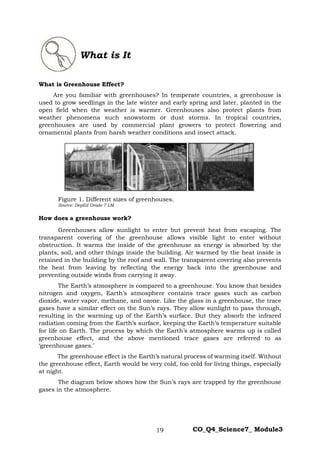
  • 20.
    16 CO_Q4_Science7_ Module3 11.Why is increasing the amount of greenhouse gases an alarming issue? A. It leads to the establishment of more factories. B. It can lead to abrupt increase in greenhouse. C. It causes a major decrease in human population. D. It causes climate change and increases in the global temperature. 12. What happens to the temperature on earth if more greenhouse gases are released into the atmosphere? A. It goes up. B. It goes down. C. It stays the same. D. It fluctuates drastically. 13. Greenhouse gases are naturally occurring gases that traps radiation from the Earth to keep the Earth warm. Records show that there is a change in the amount of greenhouses gases present in the atmosphere resulting to a much higher carbon dioxide. Which of the following activities leads to this imbalance? A. I and III only B. I, II and III only C. I, III and IV only D. I, II, III and IV 14. We should never concern ourselves in the issue of global warming since we will not be affected by the melting of polar ice caps only the polar regions. Do you agree with the statement? A. No, because we might never be able to visit Antarctica and see polar bears. B. Yes, because Philippines is located near the equator where there are no ice caps. C. Yes, because we will never be affected with the change in climate since we only have wet and dry seasons. D. No, because global warming is a worldwide issue where everything on Earth will be greatly affected. 15. One way of reducing the greenhouse effect is using energy efficiently like turning off lights when not in use. Should everyone be encouraged to efficiently use energy at home? Why or why not? A. Yes, because energy cost is getting too high. B. No, because using energy efficiently at home is not enough to minimize greenhouse effect. C. Yes, because all of us should work together and be responsible in minimizing the greenhouse effect. D. No, because others can afford in paying high bills for electricity thus they have the right to use it leisurely. I. Cutting down and burning of trees. II. Plants absorbing carbon dioxide for photosynthesis III. Humans burning fossil fuels such as coal, oil and gas as a source of energy IV. Using of chlorofluorocarbons (CFCs) as refrigerants in refrigerators and in making foam plastics
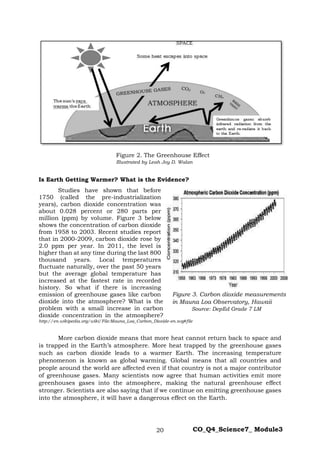
  • 21.
    17 CO_Q4_Science7_ Module3 Hello!In the previous lesson, you have learned the structure and composition of the Earth’s atmosphere. You were able to describe the special features of each layer of the atmosphere. Also, you have learned that more than three quarters of Earth’s atmosphere is made up of nitrogen while one fifth is oxygen. The remaining 1% is a mixture of carbon dioxide, water vapour, ozone and other gases. These gases not only produce important weather features such as cloud and rain, but also have considerable influence on the overall climate of the Earth, through the greenhouse effect and global warming. Activity 1. Label the Greenhouse Effect Directions: Complete the diagram with the correct phrases about greenhouse effect. Choose your answer from the box given below. Write your answer on a separate sheet of paper. Lesson 2 Greenhouse Effect What’s In Some heat escapes to space Infrared heat from Earth Most heat is contained in the atmosphere solar radiation enters Earth Illustrated by Leah Joy D. Walan
  • 22.
    18 CO_Q4_Science7_ Module3 Activity2: What’s Going On? Objectives: In this activity you will be able to describe the greenhouse effect. Materials:  Graph in Figure 1  Paper and pen Directions: Study the diagram below about the greenhouse effect and answer the questions that follow. Write your answer on your activity notebook. Guide Questions: Q1.What is the Earth’s major source of heat? Q2. What do the arrows represent? Q3. What will happen to Earth without the Sun’s energy? Q4. What are the greenhouse gases as shown in the figure? Q5. What is the work of the greenhouse gases? Q6. Based on the diagram, what then is a greenhouse effect? SPACE What’s New ATMOSPHERE Some heat escapes into space The sun’s rays warms the Earth Greenhouse gases absorb infrared radiation from the earth and re-radiate it back to the Earth. Illustrated by Leah Joy D. Walan
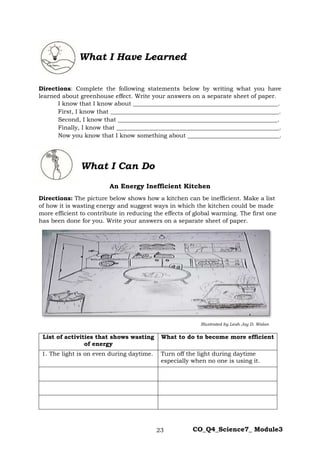
  • 23.
    19 CO_Q4_Science7_ Module3 Whatis Greenhouse Effect? Are you familiar with greenhouses? In temperate countries, a greenhouse is used to grow seedlings in the late winter and early spring and later, planted in the open field when the weather is warmer. Greenhouses also protect plants from weather phenomena such snowstorm or dust storms. In tropical countries, greenhouses are used by commercial plant growers to protect flowering and ornamental plants from harsh weather conditions and insect attack. Figure 1. Different sizes of greenhouses. Source: DepEd Grade 7 LM How does a greenhouse work? Greenhouses allow sunlight to enter but prevent heat from escaping. The transparent covering of the greenhouse allows visible light to enter without obstruction. It warms the inside of the greenhouse as energy is absorbed by the plants, soil, and other things inside the building. Air warmed by the heat inside is retained in the building by the roof and wall. The transparent covering also prevents the heat from leaving by reflecting the energy back into the greenhouse and preventing outside winds from carrying it away. The Earth’s atmosphere is compared to a greenhouse. You know that besides nitrogen and oxygen, Earth’s atmosphere contains trace gases such as carbon dioxide, water vapor, methane, and ozone. Like the glass in a greenhouse, the trace gases have a similar effect on the Sun’s rays. They allow sunlight to pass through, resulting in the warming up of the Earth’s surface. But they absorb the infrared radiation coming from the Earth’s surface, keeping the Earth’s temperature suitable for life on Earth. The process by which the Earth’s atmosphere warms up is called greenhouse effect, and the above mentioned trace gases are referred to as ‘greenhouse gases.’ The greenhouse effect is the Earth’s natural process of warming itself. Without the greenhouse effect, Earth would be very cold, too cold for living things, especially at night. The diagram below shows how the Sun’s rays are trapped by the greenhouse gases in the atmosphere. What is It
  • 24.
    20 CO_Q4_Science7_ Module3 Figure2. The Greenhouse Effect Illustrated by Leah Joy D. Walan Is Earth Getting Warmer? What is the Evidence? Studies have shown that before 1750 (called the pre-industrialization years), carbon dioxide concentration was about 0.028 percent or 280 parts per million (ppm) by volume. Figure 3 below shows the concentration of carbon dioxide from 1958 to 2003. Recent studies report that in 2000-2009, carbon dioxide rose by 2.0 ppm per year. In 2011, the level is higher than at any time during the last 800 thousand years. Local temperatures fluctuate naturally, over the past 50 years but the average global temperature has increased at the fastest rate in recorded history. So what if there is increasing emission of greenhouse gases like carbon dioxide into the atmosphere? What is the problem with a small increase in carbon dioxide concentration in the atmosphere? http://en.wikipedia.org/wiki/File:Mauna_Loa_Carbon_Dioxide-en.svg#file More carbon dioxide means that more heat cannot return back to space and is trapped in the Earth’s atmosphere. More heat trapped by the greenhouse gases such as carbon dioxide leads to a warmer Earth. The increasing temperature phenomenon is known as global warming. Global means that all countries and people around the world are affected even if that country is not a major contributor of greenhouse gases. Many scientists now agree that human activities emit more greenhouses gases into the atmosphere, making the natural greenhouse effect stronger. Scientists are also saying that if we continue on emitting greenhouse gases into the atmosphere, it will have a dangerous effect on the Earth. Figure 3. Carbon dioxide measurements in Mauna Loa Observatory, Hawaii Source: DepEd Grade 7 LM
  • 25.
    21 CO_Q4_Science7_ Module3 Sourcesof Greenhouse Gases Carbon dioxide is naturally produced when people and animals breathe. Plants and trees take in and use carbon dioxide to produce their own food. Volcanoes also produce carbon dioxide. Methane comes from grazing animals as they digest their food and from decaying matter in wet rice fields. Ozone is also naturally present in the stratosphere. But human activities emit a lot of greenhouse gases into the atmosphere. The figure 4 below shows the global fossil carbon emission from the year 1960-2020. Are we also contributing to the increase in carbon dioxide concentration in the atmosphere? Why or why not? Carbon dioxide comes from the burning of fossil fuel such as coal, crude oil and natural gas. Cutting down and burning of trees releases carbon dioxide. Methane can also be released from buried waste. For example, the left-over food, garden wastes, and animal wastes collected from our homes are thrown into dumpsites. When lots of wastes are compressed and packed together, they produce methane. Coal mining also produces methane. Another group of greenhouse gases includes the chlorofluorocarbons or CFCs for short. CFCs have been used in spray cans as propellants, in refrigerators as refrigerants, and in making foam plastics as foaming agents. Points to Remember There are natural processes in the atmosphere that protect and sustain life on Earth. For example, the greenhouse effect keeps temperature on Earth just right for living things. For as long as the concentration of greenhouse gases are controlled, we will have no problem on the global temperature. But human activities have emitted greenhouse gases into the atmosphere, increasing their levels to quantities that have adverse effects on people, plants, animals and the physical environment. Burning of fossil fuels, for example, has increased levels of carbon dioxide thus trapping more heat, increasing air temperature, and causing global warming. Such global phenomenon is feared to melt polar ice caps and cause flooding to low-lying areas that will result to reduction in biodiversity. It is even feared that global warming is already changing climates around the globe, causing stronger typhoons, and creating many health-related problems. Global warming is a potential increase in average global atmospheric temperatures resulting from the greenhouse effect. Figure 4. Fossil Fuel Carbon Dioxide Emission Source: DepEd Grade 7 LM
  • 26.
    22 CO_Q4_Science7_ Module3 Activity3: Is It A Yes or A No? Directions: Read the statements given below. Write YES if it is correct and NO if it is not correct on a separate sheet of paper. 1. Is the Earth warmed by the Sun’s heat? 2. Is carbon dioxide a greenhouse gas? 3. Do greenhouse gases trap the Sun’s heat? 4. Are carbon dioxide, methane, water vapour and ozone natural greenhouse gases? 5. Are cholorofluorocarbons (CFCs) a group of man-made greenhouse gases? 6. Is the Earth cooled by greenhouse effect? 7. Is the temperature in the Philippines going to be cooler with global warming? 8. Has the amount of greenhouse gases in the atmosphere decreased since the Industrial Revolution? 9. Is saving energy a good way to help reduce the effects of global warming? 10. Is the sea level going to rise as a result of global warming? 11. Can planting trees help reduce the carbon dioxide level in the atmosphere? 12. Does greenhouse effect keep the Earth warm? 13. Is global warming the result of a reduced carbon dioxide level? 14. Are burning and cutting down of trees release carbon dioxide? 15. Can we help in slowing down the effects of global warming? What’s More
  • 27.
    23 CO_Q4_Science7_ Module3 Directions:Complete the following statements below by writing what you have learned about greenhouse effect. Write your answers on a separate sheet of paper. I know that I know about _________________________________________________. First, I know that _________________________________________________________. Second, I know that ______________________________________________________. Finally, I know that _______________________________________________________. Now you know that I know something about _______________________________. An Energy Inefficient Kitchen Directions: The picture below shows how a kitchen can be inefficient. Make a list of how it is wasting energy and suggest ways in which the kitchen could be made more efficient to contribute in reducing the effects of global warming. The first one has been done for you. Write your answers on a separate sheet of paper. List of activities that shows wasting of energy What to do to become more efficient 1. The light is on even during daytime. Turn off the light during daytime especially when no one is using it. What I Have Learned What I Can Do Illustrated by Leah Joy D. Walan
  • 28.
    24 CO_Q4_Science7_ Module3 Directions:Choose the best answer from the given choices. Write the letter of your choice on a separate sheet of paper. 1. Which of the following gases is released by animals as a waste product of digestion that can contribute to global warming? A. Methane B. Nitrogen C. Carbon Dioxide D. Chlorofluorocarbon 2. Which of the following is NOT a greenhouse gas? A. Methane B. Chlorine C. Nitrous Oxide D. Carbon Dioxide 3. Which of the following activities contributes the most to carbon emissions globally? A. Agriculture B. Respiration C. Deforestation D. Burning fossil fuels 4. Which of the following may happen to planet Earth without the greenhouse effect? A. It will die. B. It will stay normal. C. It will become warm. D. It will become very cold. 5. In the past, refrigerators, aerosol spray, propellants and solvents were all sources of greenhouse gas. What do you call to these gases? A. Methane B. Nitrous Oxide C. Carbon Dioxide D. Chorofluorocarbons (CFC) 6. What do you call the certain gases in the atmosphere such as water vapour, carbon dioxide, methane and nitrous oxide which help maintain the Earth’s temperature? A. Solar gases B. Ozone gases C. Chorofluorocarbons (CFC) D. Greenhouse gases Assessment
  • 29.
    25 CO_Q4_Science7_ Module3 7.Why is Ozone important to life on Earth? A. It provides all the oxygen to Earth. B. It reflects all the ultraviolet radiation of the sun. C. It absorbs all the heat that come up from the Earth. D. It protects the Earth’s atmosphere and the life on Earth from harmful radiant energy emitted by the sun. 8. What happened to the level of carbon dioxide in the atmosphere over the past 200 years? A. Decreased slightly B. Increased steadily C. Stayed about the same D. Increased until recently and then decreased 9. How does the increased in carbon dioxide cause global warming? A. It reflects more sunlight from clouds. B. It traps more heat in the atmosphere. C. It reduces the amount of oxygen in the air. D. It allows more sunlight into the atmosphere. For items 10—11, refer to the figure below. Illustrated by Leah Joy D. Walan 10. Which of the following statements are true about the figure shown above? A. I and III only B. I and IV only C. II and IV only D. I, II, III and IV I. Sun is the Earth’s major source of energy. II. Greenhouse gases include CO2, CH4, ozone and water vapour. III. Not all the sun’s heat is absorbed by the Earth; some is reflected back in space. IV. Greenhouse gases absorbs infrared radiation from the earth and re-radiate it back to the Earth.
  • 30.
    26 CO_Q4_Science7_ Module3 11.What are the important roles of the greenhouse gases? A. IV only B. II and IV only C. II and III only D. I, II and III only 12. What can you say about the two statements below? I. Greenhouse effect is Earth’s natural process of warming itself. II. Greenhouse gases include oxygen, nitrogen and carbon dioxide. A. Statement I and II are both TRUE. B. Statement I and II are both FALSE. C. Statement I is TRUE while statement II is FALSE. D. Statement I is FALSE while statement II is TRUE. 13. Which of the following are the best things to do to help slow down global warming? A. I and II only B. II and IV only C. I, IV and V only D. I, II and IV only 14. National government has been looking for ways to help solve the issue on global warming. Is planting trees one of the best ways to help solve the problem? Why or why not? A. Yes, because trees give us shed and protects us from the heat of the sun. B. No, because trees only to the carbon dioxide level in the atmosphere. C. No, because trees only gives off oxygen as its by products in the photosynthesis. D. Yes, because trees help in absorbing the carbon dioxide, one of the gases that traps the heat in the atmosphere. 15. CFCs are used as refrigerants in refrigerators. The use of CFCs has been banned worldwide. Do you agree with the government’s idea of not using CFCs anymore? Why or why not? A. Yes, because CFCs are dangerous to human health. B. No, because there is no study that supports the idea. C. Yes, because CFCs causes global warming. D. No, because CFCs play a vital role in refrigerator. I. Use energy efficiently at home. II. Participate in tree planting activities. III. Continue using the single use plastics. IV. Practice the 5Rs (Reduce, Reuse, Recycle, Repair and Recover). V. Promote the use of CFCs in the refrigerators and aerosol sprays. I. It is necessary for communication. II. It reflects back the sun’s rays to Earth to keep it cold. III. It helps the Sun in providing the energy needed by Earth. IV. It absorbs infrared radiation from the earth and re-radiate it back to the Earth.
  • 31.
    27 CO_Q4_Science7_ Module3 Wow!That was a tough job. At last! You have finished studying lesson 2. But, before you completely exit, try to answer this additional activity. Directions: Complete by sentence by writing the learning you gained from our lesson on greenhouse effect. 1. I learned that ___________________________________________________________ __________________________________________________________________________. 2. One important thing I want to share to my friend is that _________________ __________________________________________________________________________. 3. I can help lessen global warming through _______________________________ __________________________________________________________________________. Additional Activities
  • 32.
    28 CO_Q4_Science7_ Module3 AnswerKey What I Know 1. B 2. D 3. A 4. C 5. B 6. A 7. D 8. A 9. C 10. A 11. C 12.A 13. D 14. D 15. B What’s New: Activity 1 1. Based on the graph, the five layers of the atmosphere starting from the Earth’s surface are: troposphere (8-14.5 km), stratosphere (about 50 km), mesosphere (about 50-80 km), thermosphere (about 80-110 km), and exosphere (cannot be determined from the graph). 2. In the lower part of the stratosphere, the temperature increases with height. The same is observed starting from the thermosphere up to the exosphere. 3. Both in the troposphere and mesosphere, the temperature decreases as height increases. 4. In the troposphere, the temperature decreases as the altitude (height of the atmosphere) increases. In the stratosphere, at heights around 10-20 km above the ground, the temperature is almost the same. From about 20 to 50 km above, the temperature increases. In the mesosphere, the temperature decreases as height increases. In the thermosphere, from heights about 87 to 100 km, the temperature change is small; it increases gradually from about 100 to 110 km. From 110 km to the end of the layer the temperature steadily increases with height. The gradual increase in temperature with altitude continues to the exosphere. 5. The layers of Earth’s atmosphere is divided based on temperature differences 6. Overall, the graph shows that the closer the atmospheric layer is to the Sun, e.g. thermosphere and exosphere, the hotter the temperature. However, if one studies the temperature in the lower layer, the reverse trend is observed. For example, in the troposphere, the temperature close to Earth is higher than the temperature above the ground. What’s More: Activity 2 Layer Estimated distance from the ground Estimated temperature Relationship between temperature and altitude Events happening in that layer Troposphere About 8- 14.5km Temperature decreases 6.5˚C to about -60 ˚C As altitude increases temperature decreases. Cloud formation and weather occur. Stratosphere About 50km Temperature increases from an average -51˚C to -15˚C. Temperature increases as the altitude increases. Formation of ozone molecules occur. Mesosphere Between 50- 80km Average of temperature of -90 ℃. temperature decreases as altitude increases. Burning of meteors occur Thermosphere Between 80- 110km The temperature can go beyond 1000˚C Temperature increases as the altitude increases. Formation of aurora borealis and aurora australis. Exosphere 700- 10,000km Temperature can reach up to 1700˚C Temperature increases as the altitude increases. Satellites are stationed in this area. Lesson 1
  • 33.
    29 CO_Q4_Science7_ Module3 What I Know 1. D 2. D 3. A 4. B 5. D 6. A 7. D 8. B 9. C 10. D 11. D 12. A 13. A 14. D 15. C Assessment 1. A 2. B 3. D 4. D 5. D 6. D 7. D 8. B 9. B 10. C 11. A 12. C 13. D 14. D 15. C Assessment 1. A 2. A 3. D 4. C 5. B 6. D 7. A 8. B 9. D 10. D 11. D 12. C 13. B 14. D 15. C What I Have Learned 1. atmosphere 2. gases 3. nitrogen 4. five 5. troposphere 6. mesosphere 7. thermosphere 8. exosphere 9. temperature 10. altitude 11. protects 12. radiation 13. ozone 14. oxygen 15. life Additional Activities Across 2. nitrogen 3. thermosphere 5. atmosphere 8. oxygen 9. stratosphere Down 1. mesosphere 4. exosphere 6. altitude 7. troposphere 10. ozone What’s In: Activity 1 1. some heat escape to space 2. most heat is contained in the atmosphere 3. infrared heat from heat 4. solar radiation enters Earth What’s New Activity 2 1. The Earth’s major source of heat is the sun. 2. The arrows represent the incoming and outgoing heat. 3. Without the Suns’ energy the Earth would be very cold. 4. The greenhouse gases are CO 2 , CH 4 , O 3 and water vapour. 5. Greenhouse gases absorb infrared radiation from the earth and re-radiate it back to the Earth. 6. Greenhouse effect is the Earth’s natural process of warming itself. What’s More Activity 3 1. Yes 2. Yes 3. Yes 4. Yes 5. Yes 6. No 7. No 8. No 9. Yes 10. Yes 11. Yes 12. Yes 13. No 14. Yes 15. Yes Lesson 2
  • 34.
    30 CO_Q4_Science7_ Module3 References Books Asuncion,Alvie J., et al. 2017. K to 12 Science Grade 7 Learner’s Material. First Edition. Pasig City: Bureau of Learning Resources (DepEd-BLR). Asuncion, Alvie J., et al. 2017. K to 12 Science Grade 7 Teacher’s Guide. First Edition. Pasig City: Bureau of Learning Resources (DepEd-BLR). K to 12 Science Curriculum Guide. Pasig City: Department of Education.
  • 35.
    For inquiries orfeedback, please write or call: Department of Education - Bureau of Learning Resources (DepEd-BLR) Ground Floor, Bonifacio Bldg., DepEd Complex Meralco Avenue, Pasig City, Philippines 1600 Telefax: (632) 8634-1072; 8634-1054; 8631-4985 Email Address: blr.lrqad@deped.gov.ph * blr.lrpd@deped.gov.ph