Republic of the Philippines
Department of Education
Region VIII-Eastern Visayas
Division of Biliran
NAVAL SCHOOL OF FISHERIES
Caraycaray, Naval, Biliran
A Detailed Lesson Plan in
Earth and Space
I. Content: Volcanoes
Content Standards: The learners demonstrate an understanding of volcanoes found in
the Philippines.
Performance Standards: The learners shall be able to participate in activities that
reduce risks and lessen effects of climate change.
Learning Competency: should be able to explain what happens when volcanoes erupt
CG – S9ES – IIIb – 28
II. Subject Matter
A. Topic: Volcanoes
B. Sub-topic: Volcanic Eruption
C. Materials: multimedia
volcano model
baking soda
red food color
vinegar
D. Reference: Science and Technology I
Integrated Science Textbook. NISMED. 2012. pp. 189-191
E. Values Integration: cooperation
III. Procedure
Teacher’s Activity
A. Preliminary Activity
“Raymart kindly lead the prayer.”
“Good morning class!”
B. Review
“What was our lesson last meeting?”
Student’s Activity
“Let’s bow our heads and feel the
presence of the Lord… Amen.”
“Good morning Ma’am!”
“Active and inactive volcanoes
Ma’am.”
“Who can differentiate between active
and inactive volcanoes? Yes, Kathy.”
“Very good! According to PHIVOLCS,
our country has more than a hundred
volcanoes as of 2013. Twenty-three are
active while the rest are inactive.”
C. Motivation
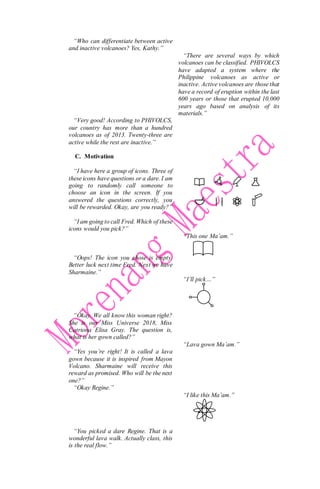
“I have here a group of icons. Three of
these icons have questions or a dare. I am
going to randomly call someone to
choose an icon in the screen. If you
answered the questions correctly, you
will be rewarded. Okay, are you ready?”
“I am going to call Fred. Which of these
icons would you pick?”
“Oops! The icon you chose is empty.
Better luck next time Fred. Next we have
Sharmaine.”
“Okay. We all know this woman right?
She is our Miss Universe 2018, Miss
Catriona Elisa Gray. The question is,
what is her gown called?”
“Yes you’re right! It is called a lava
gown because it is inspired from Mayon
Volcano. Sharmaine will receive this
reward as promised. Who will be the next
one?”
“Okay Regine.”
“You picked a dare Regine. That is a
wonderful lava walk. Actually class, this
is the real flow.”
“There are several ways by which
volcanoes can be classified. PHIVOLCS
have adapted a system where the
Philippine volcanoes as active or
inactive. Active volcanoes are those that
have a record of eruption within the last
600 years or those that erupted 10,000
years ago based on analysis of its
materials.”
“This one Ma’am.”
“I’ll pick…”
“Lava gown Ma’am.”
“I like this Ma’am.”
“Did you enjoy our game?”
D. Lesson Proper
A. Activity
“I have here a model of a volcano. I will
be calling 2 representatives to help me
with the experiment.”
“All of you must observe on what will
happen when we combine these 3
ingredients, baking soda, red food color
and baking soda, down the volcano.”
“What will you think would happen?”
“Hmm… Maybe. That would be a big
misfortune to us we will be having a huge
mess in here. Any other assumptions?”
“Okay. Let’s see. First, we pour in the
baking soda. Next is the food color.
Lastly, the vinegar. Observe what
happens.”
B. Analysis
“What happened after pouring the
vinegar?”
“Now that’s what we call a volcanic
eruption. Lava, represented by vinegar,
may appear to be the primary material
ejected from a volcano, but this is not
always the case. Aside from lava, broken
rocks, lava bombs, fine ash and dust are
also ejected.”
“Does this have any effect on the
volcanic shape? Let’s find out how.
C. Abstraction
“Volcanoes come in different shapes
and sizes, and each structure has a
unique history of eruption. However,
volcanologists have been able to classify
them according to their landforms and
eruptive patterns.”
“Yes Ma’am! It is both fun and
informative.”
“The volcano will explode Ma’am.”
“I think the vinegar will flow outside
the volcano because of the chemical
reaction.
“There is an overflow of bubbles from
the volcano Ma’am.”
“Let us first discuss the external parts
of a volcano. What are those?”
“Okay very good! A volcano usually
has a summit, slope and base. At the
summit, there is an opening which maybe
a crater or a caldera. What is a crater?”
“What about the caldera?”
“Very good! A volcano can have one
crater like Mayon volcano, or can be
more than one like Taal volcano that has
47 craters. What do you think determines
the nature of eruption?”
“What is viscosity?”
“Yes. Very good! The more viscous ad
thicker the material is, the greater is its
resistance to flow. For instance, syrup is
more viscous than water.”
“Let us discuss how each factor affects
the viscosity of magma. How does
temperature of magma affect its
viscosity? Yes, Allan.”
“How about the composition of
magma.”
“Lastly the amount of gases contained
in the magma affects its viscosity. Other
factors being equal, gas (mainly water
vapor) dissolved in magma tends to
increase its ability to flow. Therefore, in
“summit, slope and base Ma’am”
“A crater is a funnel shaped opening
at the top of the volcano.”
“A caldera is formed when a part of
the wall collapses following an explosive
eruption.
“There are primary factors affecting
the volcano’s eruptive style, namely: the
magma’s temperature, its chemical
composition, and the amount of
dissolved gases it contains. These
factors can affect the magma’s viscosity
in different ways.”
“Viscosity is the property of the
material’s resistance to flow. It is also
described as the liquid’s thickness and
stickiness.”
“The viscosity of magma decreases
with temperature. The higher the
temperature of magma, the lower is its
viscosity. As lava flows, it cools and
begins to harden, its ability to flow
decreases and eventually it stops.
“Magmas with high silica content are
more viscous than those with low silica
content. The magma that contains less
silica s relatively fluid and travels far
before solidifying.”
near-surface environments, the loss of
gases makes magma more viscous,
forming a dome or a columnar.”
D. Application
“Okay class let’s see if you listened to
our discussion. Form 2 groups because
we will be having a quiz bee. I will give
each group a slit card and a marker to
write your answers. Whichever group
that answered the question quickly and
correctly will have 1 point. The group
with the highest score with a maximum
point of 3 will win.”
“First question, it is the property of the
material’s resistance to flow.”
“First point goes to group 2.”
“Next question, what is the shape of the
crater?”
“This will be the last question if group
2 got this point. What are the external
parts of the volcano?”
“Our winner is group 2!”
E. Generalization
“Anyone from the class who can give
the summary and realization about our
topic this morning?”
“Yes, France.”
“Very good France.”
“What else? Yes, Kim.”
Group 1: viscosity 3
Group 2: viscosity 1
Group 3: viscosity 2
Group 1: elongated 1
Group 2: funnel 2
Group 3: funnel 3
Group 1: base, summit 2
Group 2: summit, slope, base 1
Group 3: slope, base 3
“I learned that lava is not the only
material being ejected by the volcano.
Aside from lava, broken rocks, lava
bombs, fine ash and dust are also
ejected.
“The external parts of the volcano are
the summit, slope and base. Summit has
two different classification of opening; it
can either be a crater or a caldera where
a crater is a funnel shaped opening
while the caldera is formed when a part
“Excellent!”
of the wall collapses following an
explosive eruption.”
IV. Evaluation
Direction: Answer the following.
1. What will happen when a volcano erupts?
2. What is a crater?
3. How does temperature affect the viscosity of magma?
4. How does the composition of magma affect the viscosity of magma?
5. Draw and label the parts of the volcano.
V. Assignment
Directions: Read in advance the types of volcanic eruption.
Prepared by:
CASSIELYN C. BRECIO
Teacher I Applicant

Sample Detailed Lesson plan in Physical Science (Junior High)

  • 1.
    Republic of thePhilippines Department of Education Region VIII-Eastern Visayas Division of Biliran NAVAL SCHOOL OF FISHERIES Caraycaray, Naval, Biliran A Detailed Lesson Plan in Earth and Space I. Content: Volcanoes Content Standards: The learners demonstrate an understanding of volcanoes found in the Philippines. Performance Standards: The learners shall be able to participate in activities that reduce risks and lessen effects of climate change. Learning Competency: should be able to explain what happens when volcanoes erupt CG – S9ES – IIIb – 28 II. Subject Matter A. Topic: Volcanoes B. Sub-topic: Volcanic Eruption C. Materials: multimedia volcano model baking soda red food color vinegar D. Reference: Science and Technology I Integrated Science Textbook. NISMED. 2012. pp. 189-191 E. Values Integration: cooperation III. Procedure Teacher’s Activity A. Preliminary Activity “Raymart kindly lead the prayer.” “Good morning class!” B. Review “What was our lesson last meeting?” Student’s Activity “Let’s bow our heads and feel the presence of the Lord… Amen.” “Good morning Ma’am!” “Active and inactive volcanoes Ma’am.”
  • 2.
    “Who can differentiatebetween active and inactive volcanoes? Yes, Kathy.” “Very good! According to PHIVOLCS, our country has more than a hundred volcanoes as of 2013. Twenty-three are active while the rest are inactive.” C. Motivation “I have here a group of icons. Three of these icons have questions or a dare. I am going to randomly call someone to choose an icon in the screen. If you answered the questions correctly, you will be rewarded. Okay, are you ready?” “I am going to call Fred. Which of these icons would you pick?” “Oops! The icon you chose is empty. Better luck next time Fred. Next we have Sharmaine.” “Okay. We all know this woman right? She is our Miss Universe 2018, Miss Catriona Elisa Gray. The question is, what is her gown called?” “Yes you’re right! It is called a lava gown because it is inspired from Mayon Volcano. Sharmaine will receive this reward as promised. Who will be the next one?” “Okay Regine.” “You picked a dare Regine. That is a wonderful lava walk. Actually class, this is the real flow.” “There are several ways by which volcanoes can be classified. PHIVOLCS have adapted a system where the Philippine volcanoes as active or inactive. Active volcanoes are those that have a record of eruption within the last 600 years or those that erupted 10,000 years ago based on analysis of its materials.” “This one Ma’am.” “I’ll pick…” “Lava gown Ma’am.” “I like this Ma’am.”
  • 3.
    “Did you enjoyour game?” D. Lesson Proper A. Activity “I have here a model of a volcano. I will be calling 2 representatives to help me with the experiment.” “All of you must observe on what will happen when we combine these 3 ingredients, baking soda, red food color and baking soda, down the volcano.” “What will you think would happen?” “Hmm… Maybe. That would be a big misfortune to us we will be having a huge mess in here. Any other assumptions?” “Okay. Let’s see. First, we pour in the baking soda. Next is the food color. Lastly, the vinegar. Observe what happens.” B. Analysis “What happened after pouring the vinegar?” “Now that’s what we call a volcanic eruption. Lava, represented by vinegar, may appear to be the primary material ejected from a volcano, but this is not always the case. Aside from lava, broken rocks, lava bombs, fine ash and dust are also ejected.” “Does this have any effect on the volcanic shape? Let’s find out how. C. Abstraction “Volcanoes come in different shapes and sizes, and each structure has a unique history of eruption. However, volcanologists have been able to classify them according to their landforms and eruptive patterns.” “Yes Ma’am! It is both fun and informative.” “The volcano will explode Ma’am.” “I think the vinegar will flow outside the volcano because of the chemical reaction. “There is an overflow of bubbles from the volcano Ma’am.”
  • 4.
    “Let us firstdiscuss the external parts of a volcano. What are those?” “Okay very good! A volcano usually has a summit, slope and base. At the summit, there is an opening which maybe a crater or a caldera. What is a crater?” “What about the caldera?” “Very good! A volcano can have one crater like Mayon volcano, or can be more than one like Taal volcano that has 47 craters. What do you think determines the nature of eruption?” “What is viscosity?” “Yes. Very good! The more viscous ad thicker the material is, the greater is its resistance to flow. For instance, syrup is more viscous than water.” “Let us discuss how each factor affects the viscosity of magma. How does temperature of magma affect its viscosity? Yes, Allan.” “How about the composition of magma.” “Lastly the amount of gases contained in the magma affects its viscosity. Other factors being equal, gas (mainly water vapor) dissolved in magma tends to increase its ability to flow. Therefore, in “summit, slope and base Ma’am” “A crater is a funnel shaped opening at the top of the volcano.” “A caldera is formed when a part of the wall collapses following an explosive eruption. “There are primary factors affecting the volcano’s eruptive style, namely: the magma’s temperature, its chemical composition, and the amount of dissolved gases it contains. These factors can affect the magma’s viscosity in different ways.” “Viscosity is the property of the material’s resistance to flow. It is also described as the liquid’s thickness and stickiness.” “The viscosity of magma decreases with temperature. The higher the temperature of magma, the lower is its viscosity. As lava flows, it cools and begins to harden, its ability to flow decreases and eventually it stops. “Magmas with high silica content are more viscous than those with low silica content. The magma that contains less silica s relatively fluid and travels far before solidifying.”
  • 5.
    near-surface environments, theloss of gases makes magma more viscous, forming a dome or a columnar.” D. Application “Okay class let’s see if you listened to our discussion. Form 2 groups because we will be having a quiz bee. I will give each group a slit card and a marker to write your answers. Whichever group that answered the question quickly and correctly will have 1 point. The group with the highest score with a maximum point of 3 will win.” “First question, it is the property of the material’s resistance to flow.” “First point goes to group 2.” “Next question, what is the shape of the crater?” “This will be the last question if group 2 got this point. What are the external parts of the volcano?” “Our winner is group 2!” E. Generalization “Anyone from the class who can give the summary and realization about our topic this morning?” “Yes, France.” “Very good France.” “What else? Yes, Kim.” Group 1: viscosity 3 Group 2: viscosity 1 Group 3: viscosity 2 Group 1: elongated 1 Group 2: funnel 2 Group 3: funnel 3 Group 1: base, summit 2 Group 2: summit, slope, base 1 Group 3: slope, base 3 “I learned that lava is not the only material being ejected by the volcano. Aside from lava, broken rocks, lava bombs, fine ash and dust are also ejected. “The external parts of the volcano are the summit, slope and base. Summit has two different classification of opening; it can either be a crater or a caldera where a crater is a funnel shaped opening while the caldera is formed when a part
  • 6.
    “Excellent!” of the wallcollapses following an explosive eruption.” IV. Evaluation Direction: Answer the following. 1. What will happen when a volcano erupts? 2. What is a crater? 3. How does temperature affect the viscosity of magma? 4. How does the composition of magma affect the viscosity of magma? 5. Draw and label the parts of the volcano. V. Assignment Directions: Read in advance the types of volcanic eruption. Prepared by: CASSIELYN C. BRECIO Teacher I Applicant