1
PHY3TSP, 1 & 2 1
Lecture 1
1. Quantum states
2. An Elementary Soluble System
- States of the model system
- The degeneracy function
- Sharp peak of degeneracy function
PHY3TSP, 1 & 2 2
Quantum State
Stationary Quantum State: introduced by Niels Bohr, 1913:
A property of a stationary quantum state of a physical system of constant
energy is that probability to find a particle in any element of volume is
independent of the time. A stationary quantum state may be defined as a
condition of a system such that all observable physical properties are
independent of the time.
Statistical Physics: we are concerned with states of a system of many
particles. Each stationary quantum state has a definite energy, but it may
happen that several states have identical or nearly identical energies.
From now on: when we discuss quantum state we mean stationary
quantum state.
The degeneracy of an energy level is defined as the number of quantum
states having the given energy or having an energy in a narrow range.
PHY3TSP, 1 & 2 3
Degeneracy of an energy level
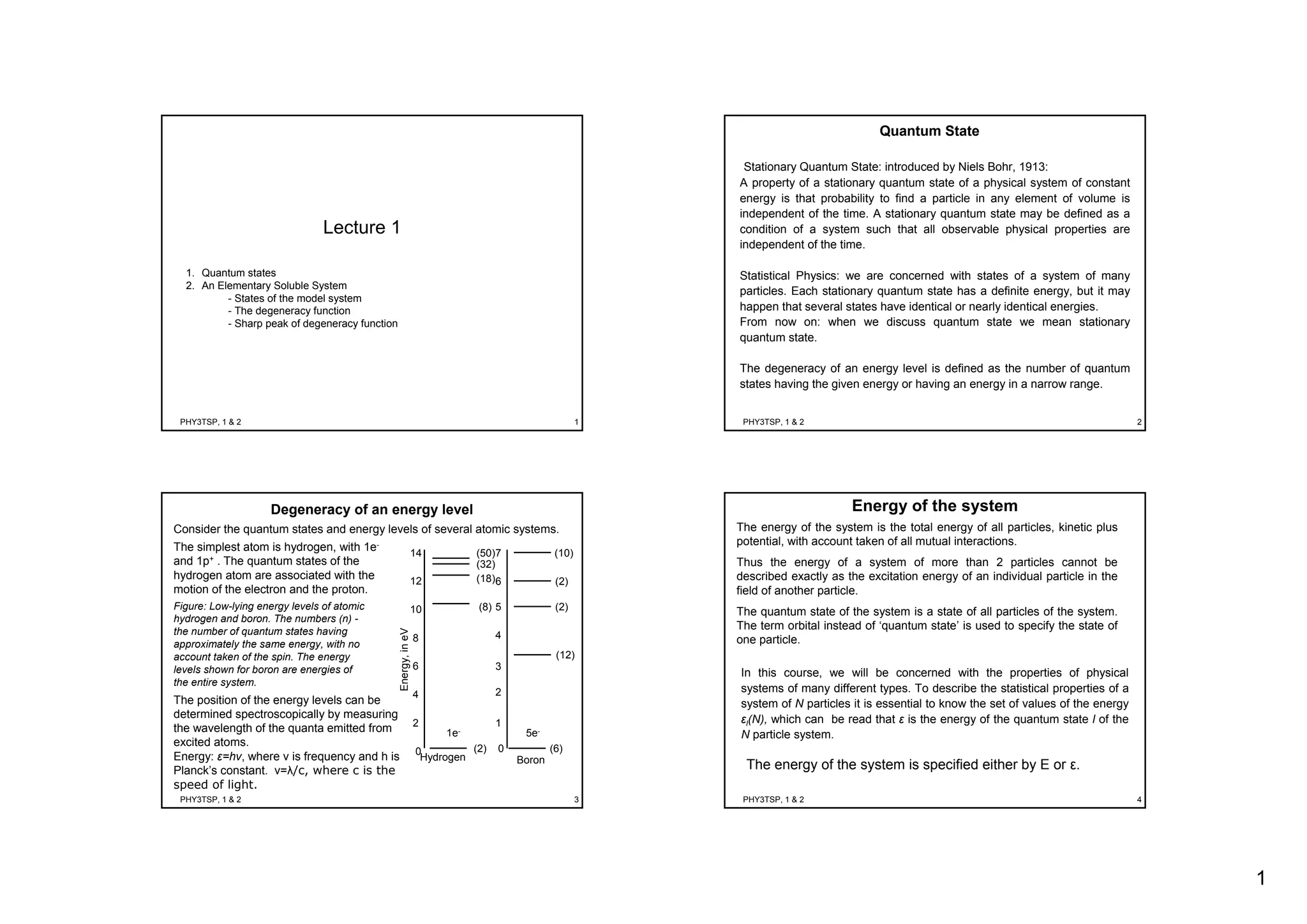
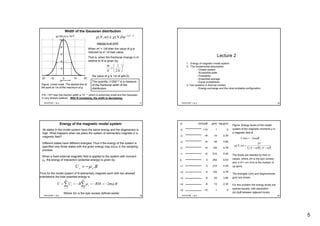
Figure: Low-lying energy levels of atomic
hydrogen and boron. The numbers (n) -
the number of quantum states having
approximately the same energy, with no
account taken of the spin. The energy
levels shown for boron are energies of
the entire system.
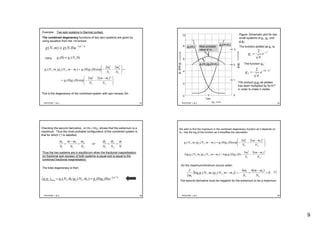
Consider the quantum states and energy levels of several atomic systems.
The simplest atom is hydrogen, with 1e-
and 1p+ . The quantum states of the
hydrogen atom are associated with the
motion of the electron and the proton.
The position of the energy levels can be
determined spectroscopically by measuring
the wavelength of the quanta emitted from
excited atoms.
Energy: ε=hν, where v is frequency and h is
Planck’s constant. v=λ/c, where c is the
speed of light.
Boron
Energy,ineV
Hydrogen
0
2
4
6
8
10
12
14
(2)
(8)
(18)
(32)
(50)
(6)0
1
2
3
4
5
6
7
(12)
(2)
(2)
(10)
1e- 5e-
PHY3TSP, 1 & 2 4
Energy of the system
The energy of the system is specified either by E or ε.
The energy of the system is the total energy of all particles, kinetic plus
potential, with account taken of all mutual interactions.
Thus the energy of a system of more than 2 particles cannot be
described exactly as the excitation energy of an individual particle in the
field of another particle.
The quantum state of the system is a state of all particles of the system.
The term orbital instead of ‘quantum state’ is used to specify the state of
one particle.
In this course, we will be concerned with the properties of physical
systems of many different types. To describe the statistical properties of a
system of N particles it is essential to know the set of values of the energy
εl(N), which can be read that ε is the energy of the quantum state l of the
N particle system.
2
PHY3TSP, 1 & 2 5
( )222
2
zyx
2
nnn
L2m
++⎟
⎠
⎞
⎜
⎝
⎛
=
π
ε
Energy,relativescale
0
5
10
15
1 1 1 1
3 2 1 1
3 2 2 1
3 3 1 1
6 3 2 1
1 2 2 2
g
Representative set
nx ny nz
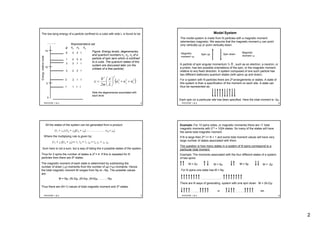
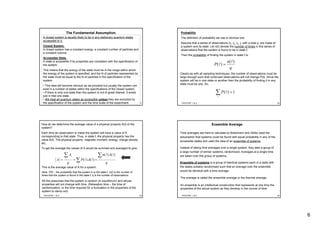
Figure: Energy levels, degeneracies,
and quantum numbers nx, ny, nz of a
particle of spin zero which is confined
to a cube. The quantum states of this
system are discussed later (on the
orbitals of a free particle).
……..
Note the degeneracies associated with
each level.
The low-lying energy of a particle confined to a cube with side L is found to be
PHY3TSP, 1 & 2 6
Model System
The model system is made from N particles with a magnetic moment
(elementary magnets). We assume that the magnetic moment μ can point
only vertically up or point vertically down.
Spin up Spin down
For a system with N particles there are 2N arrangements or states. A state of
this system is then a specification of the moment on each site. A state can
thus be represented as:
Each spin on a particular site has been specified. Here the total moment is -2μ.
Magnetic
moment +μ
Magnetic
moment -μ
A particle of spin angular momentum ½ , such as an electron, a neutron, or
a proton, has two possible orientations of the spin, or the magnetic moment,
relative to any fixed direction. A system composed of one such particle has
two different stationary quantum states (with spins up and down).
PHY3TSP, 1 & 2 7
All the states of the system can be generated from a product:
(↑1 + ↓1) (↑2 + ↓2)(↑3 + ↓3)……………….. (↑N + ↓N)
Where the multiplying rule is given by:
(↑1 + ↓1)(↑2 + ↓2) = ↑1 ↑2 + ↑1 ↓2 + ↑2 ↓1 + ↓1 ↓2
Sum here is not a sum, but a way of listing the 4 possible states of the system.
Thus for 2 spins the number of states is 22 = 4. If this is repeated for N
particles then there are 2N states.
The magnetic moment of each state is determined by subtracting the
number of down (-μ) moments from the number of up (+μ) moments. Hence
the total magnetic moment M ranges from Nμ to –Nμ. The possible values
are:
M = Nμ, (N-2)μ, (N-4)μ, (N-6)μ, …… , -Nμ
Thus there are (N+1) values of total magnetic moment and 2N states.
PHY3TSP, 1 & 2 8
Example: For 10 spins (sites, or magnetic moments) there are 11 total
magnetic moments with 210 = 1024 states. So many of the states will have
the same total magnetic moment.
If N is large then 2N >> N + 1 and some total moment values will have very
large number of states associated with them.
The question is how many states in a system of N spins correspond to a
particular total moment.
Example: The moments associated with the four different states of a system
of two spins:
M = 2μ M = 0μ M = 0μ M = -2μ
For N spins one state has M = Nμ
……………………
There are N ways of generating system with one spin down M = (N-2)μ
………. or ………. etc
3
PHY3TSP, 1 & 2 9
Degeneracy of States.
For a system with N spins we can write the number of spins up as ½N + m
and the number of spins down as ½N – m so that the total moment is:
( ) ( ) μμμ mmNmNM 22
1
2
1
=−−+=
The value 2m is called the spin excess = (number up) – (number down)
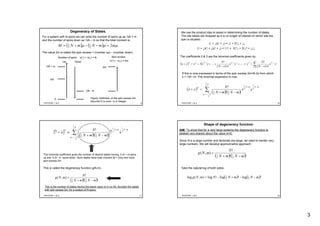
Number of spins Spin excess
Up Down
0
½N
½N + m
½N - m
2m
n(↑) – n(↓) = 2m
Figure: Definition of the spin excess 2m.
Assume N is even. m is integer.
n(↑) + n(↓) = N
PHY3TSP, 1 & 2 10
We use the product idea to assist in determining the number of states.
The site labels are dropped as it is no longer of interest on which site the
spin is situated.
(↑ + ↓)(↑ + ↓) = ↑↑ + 2↑↓ + ↓↓
(↑ + ↓)(↑ + ↓)(↑ + ↓) = ↑↑↑ + 3↑2↓ + 3↑↓2 + ↓↓↓
The coefficients 2 & 3 are the binomial coefficients given by
( ) ∑=
−−−
−
=++
−
+++=+
N
s
ssNNssNNNN
yx
ssN
N
yyx
ssN
N
yNxxyx
0
1
!)!(
!
.....
!)!(
!
....
( )
( )( )∑
−=
−+
−+
=+
N
Nm
mNmNN
yx
mNmN
N
yx
2
1
2
1
2
1
2
1
2
1
2
1
!!
!
If this is now expressed in terms of the spin excess 2m=N-2s from which
s = ½N –m. The binomial expansion is now:
PHY3TSP, 1 & 2 11
This is called the degeneracy function g(N,m).
( )( )!!
!
),(
2
1
2
1
mNmN
N
mNg
−+
=
( ) ( )( )∑
−=
−+
↓↑
−+
≡↓+↑
N
Nm
mNmNN
mNmN
N2
1
2
1
2
1
2
1
2
1
2
1
!!
!
This binomial coefficient gives the number of distinct states having ½ N + m spins
up and ½ N - m spins down. Such states have total moment M = 2mμ and have
spin excess 2m.
This is the number of states having the same value of m (or M). Number the states
with spin excess 2m, for a system of N spins.
PHY3TSP, 1 & 2 12
Shape of degeneracy function
Since N is a large number and factorials are large, we need to handle very
large numbers. We will develop approximative approach:
Take the natural log of both sides:
( ) ( )!log!log!log),(log 2
1
2
1
mNmNNmNg −−+−=
AIM: To show that for a very large systems the degeneracy function is
peaked very sharply about the value m=0.
( )( )!!
!
),(
2
1
2
1
mNmN
N
mNg
−+
=
4
PHY3TSP, 1 & 2 13
( ) ( ) ( )∑=
++=+
m
s
sNNmN
1
2
1
2
1
2
1
log!log!log
( ) ( ) ( )∑=
+−−=−
m
s
sNNmN
1
2
1
2
1
2
1
1log!log!log
Now:
So:
( ) ( ) ( )( ) ( )mNNNNmN +++=+ 2
1
2
1
2
1
2
1
2
1
.....21!!
So:
( ) ( ) ( ) ∑= −
+
+≈−++
m
s Ns
Ns
NmNmN
1
2
1
2
1
2
1
)/2(1
)/2(1
log!log2!log!log
How to approximate the log of numbers close to 1 (since N is large 2s/N is
small). Use:
....1 2
2
1
+++= xxex
....1 2
2
1
−+−=−
xxe x
PHY3TSP, 1 & 2 14
x
x
x
xxxex
2
1
1
log)1(log1 ≈
−
+
+≈+≈
∑ ∑= =
≈+=≈
−
+m
s
m
s N
m
mm
N
s
NNs
Ns
1 1
2
2
1 2
)1(
44
)/2(1
)/2(1
log
N
m
NNmNg
2
2
1 2
!)log(2!log),(log −−≈
But since x is small we neglect all terms after the 2nd and:
Apply this to the last term above (previous page) and:
Thus:
)1(log1 xxxe x
−≈−−≈−
Used here:
)1(......321 2
1
+=++++ mmm
PHY3TSP, 1 & 2 15
Taking the exponential of both sides gives:
( ) ( )
Nm
e
NN
N
mNg /2
2
1
2
1
2
!!
!
),( −
≅
Nm
eNgmNg /2 2
)0,(),( −
≅
Thus, for 1 <<|m| << N, approximation of the degeneracy function:
Where:
( ) ( )!!
!
)0,(
2
1
2
1
NN
N
Ng =
The distribution is called a Gaussian curve.
Gaussian curve
PHY3TSP, 1 & 2 16
Gaussian g(100,m)
0 10 20 30 40 50-50 -40 -30 -20 -10
10
20
30
log10g(100,m)
Gaussian
approximation
Exact
binomial
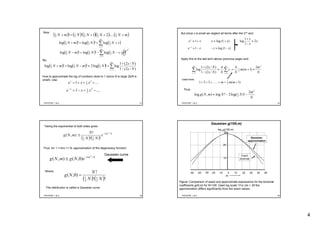
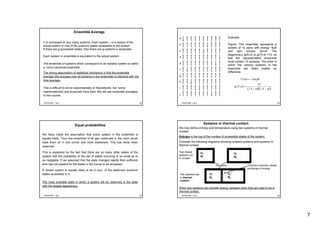
Figure: Comparison of exact and approximate expressions for the binomial
coefficients g(N,m) for N=100. Used log scale ! For |m| > 30 the
approximation differs significantly from the exact values.
m
5
PHY3TSP, 1 & 2 17
Width of the Gaussian distribution
0 10 20-10-20
2
4
6
8
10
m
g(100,m) x 10-28 Nm
eNgmNg /2 2
)0,(),( −
≅
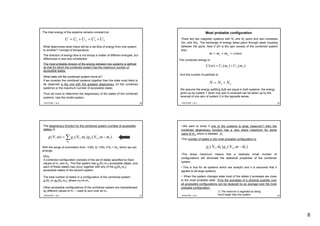
When m2 = ½N then the value of g is
reduced by e-1 of max value.
That is, when the fractional change in m
relative to N is given by:
2
1
2
1
⎟
⎠
⎞
⎜
⎝
⎛
=
NN
m
the value of g is 1/e of g(N,0).
The quantity (1/2N)1/2 is a measure
of the fractional width of the
distribution.
Figure: Linear scale. The dashed line at
the point at 1/e of the maximum of g.
max(g) is at m=0
If N ~1022 then the fraction width is 10 -11 which is extremely small and the Gaussian
is very sharply peaked. With N increasing, the width is decreasing.
PHY3TSP, 1 & 2 18
Lecture 2
1. Energy of magnetic model system
2. The fundamental assumption
- Closed system
- Accessible state
- Probability
- Ensemble average
- Equal probabilities
3. Two systems in thermal contact
- Energy exchange and the most probable configuration.
PHY3TSP, 1 & 2 19
Energy of the magnetic model system
All states in the model system have the same energy and the degeneracy is
high. What happens when we place the system of elementary magnets in a
magnetic field?
Different states have different energies. Thus if the energy of the system is
specified only those states with the given energy may occur in the sampling
process.
When a fixed external magnetic field is applied to the system with moment
μs, the energy of interaction (potential energy) is given by:
BU ss .μ−=
Thus for the model system of N elementary magnets each with two allowed
orientations the total potential energy is:
∑ ∑= =
−=−=−==
N
s
N
s
ss BmMBBUU
1 1
2 μμ
Where 2m is the spin excess defined earlier.
PHY3TSP, 1 & 2 20
Figure: Energy levels of the model
system of ten magnetic moments μ in
a magnetic field B.
The levels are labelled by their m
values, where 2m is the spin excess
and ½ N + m= 5+m is the number of
up spins.
The energies U(m) and degeneracies
g(m) are shown.
For this problem the energy levels are
spaced equally, with separation
Δε=2μB between adjacent levels.
m
-5
-4
-3
-2
-1
0
+1
+2
+3
+4
+5
U(m)/μB
+10
+8
+6
+4
+2
0
-2
-4
-6
-8
-10
g(m)
1
10
45
120
210
252
210
120
45
10
1
log g(m)
0
2.30
3.80
4.78
5.35
5.53
5.35
4.78
3.80
2.30
0
BmmU μ2)( −=
( )( )!!
!
),(
2
1
2
1
mNmN
N
mNg
−+
=
6
PHY3TSP, 1 & 2 21
The Fundamental Assumption.
A closed system is equally likely to be in any stationary quantum states
accessible to it.
Closed System.
A closed system has a constant energy, a constant number of particles and
a constant volume.
Accessible State.
A state is accessible if its properties are consistent with the specification of
the system.
This means that the energy of the state must be in the range within which
the energy of the system is specified, and the N of particles represented by
the state must be equal to the N of particles in the specification of the
system.
• This idea will become obvious as we proceed but usually the system can
exist in a number of states within the specifications of the closed system.
• If there is only one state then the system is not of great interest. It exists
just in that one state.
• We treat all quantum states as accessible unless they are excluded by
the specification of the system and the time scale of the experiment. PHY3TSP, 1 & 2 22
Probability
The definition of probability we use is obvious one.
Assume that a series of observations (t1, t2, t3..), with a total q, are made of
a system and its state. Let n(ℓ) denote the number of times in this series of
observations that the system is found to be in state ℓ.
Then the probability of finding the system in state ℓ is:
q
n
P
)(
)( =
Clearly as with all sampling techniques, the number of observations must be
large enough such that continued observations will not change P(ℓ). Since the
system will be in one state or another then the probability of finding it in any
state must be one. So:
∑ =1)(P
PHY3TSP, 1 & 2 23
How do we determine the average value of a physical property A(ℓ) of the
system?
Each time an observation is made the system will have a value of A
corresponding to that state. Thus, in state ℓ, the physical property has the
value A(ℓ). The physical property: magnetic moment, energy, charge density
etc..
To get the average the values of A would be summed and averaged to give:
q
An
AP
q
A
A s
s ∑
∑
∑
===
)()(
)()(
This is the average value of A for a system.
Here: P(ℓ) – the probability that the system is in the state ℓ, n(ℓ) is the number of
times that the system is found in the state ℓ; q is the number of observations.
All this presumes that the system is random (in equilibrium) and whose
properties will not change with time. (Relaxation time – the time of
randomization, or the time required for a fluctuation in the properties of the
system to damp out).
PHY3TSP, 1 & 2 24
Ensemble Average
Time averages are hard to calculate so Boltzmann and Gibbs used the
assumption that systems could be found with equal probability in any of the
accessible states and used the idea of an ensemble of systems.
Instead of taking time averages over a single system, they take a group of
a large number of similar systems, randomized. Averages at a single time
are taken over this group of systems.
Ensemble of systems is a group of identical systems each in a state with
the states suitably randomised such that an average over the ensemble
would be identical with a time average.
The average is called the ensemble average or the thermal average.
An ensemble is an intellectual construction that represents at one time the
properties of the actual system as they develop in the course of time.
7
PHY3TSP, 1 & 2 25
Ensemble Average
It is composed of very many systems. Each system – is a replica of the
actual system in one of the quantum states accessible to the system.
If there are g accessible states, then there are g systems in ensemble.
Each system in ensemble is equivalent to the actual system.
The ensemble of systems which correspond to an isolated system is called
a ‘micro canonical ensemble’.
The strong assumption of statistical mechanics is that the ensemble
average (the average over all systems in the ensemble) is identical with the
time average.
This is difficult to prove experimentally or theoretically, but some
mathematicians and physicists have tried. We will use ensemble averages
in this course.
PHY3TSP, 1 & 2 26
Example:
Figure: This ensemble represents a
system of 10 spins with energy -8μB
and spin excess 2m=8. The
degeneracy g(N,m) is g(10,4) =10, so
that the representative ensemble
must contain 10 systems. The order in
which the various systems in the
ensemble are listed makes no
difference.
a
b
c
d
e
f
g
h
i
j
BmmU μ2)( −=
( )( )!!
!
),(
2
1
2
1
mNmN
N
mNg
−+
=
PHY3TSP, 1 & 2 27
Equal probabilities
We have made the assumption that every system in the ensemble is
equally likely. Thus one ensemble of all gas molecules in the room would
have them all in one corner and none elsewhere. This has never been
observed.
This is explained by the fact that there are so many other states of the
system that the probability of this set of states occurring is so small as to
be negligible. If we assumed that the state changed rapidly then sufficient
time has not passed for the states in the corner to be accessed.
A closed system is equally likely to be in any of the stationary quantum
states accessible to it.
The most probable state in which a system will be observed is the state
with the largest degeneracy.
PHY3TSP, 1 & 2 28
Systems in thermal contact.
We now define entropy and temperature using two systems in thermal
contact.
Entropy is the log of the number of accessible states of the system.
Consider the following diagrams showing isolated systems and systems in
thermal contact.
Two closed
systems not
in contact
U1
N1
U2
N2
Insulation
U2’
N2
U1’
N1
The systems are
in thermal
contact
Thermal conductor allows
exchange of energy.
When two systems can transfer energy between them they are said to be in
thermal contact.
8
PHY3TSP, 1 & 2 29
The total energy of the systems remains constant so:
'
2
'
121 UUUUU +=+=
What state will the combined system move to?
If we consider the combined systems together then the state most likely to
be observed is the one with the greatest degeneracy (of the combined
systems) or the maximum number of accessible states.
Thus we have to determine the degeneracy of the states of the combined
systems. Use the model system.
What determines when there will be a net flow of energy from one system
to another? Concept of temperature.
The direction of energy flow is not simply a matter of different energies, but
differences in size and constitution.
The most probable division of the energy between two systems is defined
as that for which the combined system has the maximum number of
accessible states.
PHY3TSP, 1 & 2 30
Most probable configuration
There are two magnetic systems with N1 and N2 spins and spin excesses
2m1 and 2m2. The exchange of energy takes place through weak coupling
between the spins. Now if 2m is the spin excess of the combined system
then:
constmmm =+= 21
)()()( 2211 mUmUmU +=
21 NNN +=
The combined energy is:
And the number of particles is:
We assume the energy splitting 2μB are equal in both systems: the energy
given up by system 1 when one spin is reversed can be taken up by the
reversal of one spin of system 2 in the opposite sense.
PHY3TSP, 1 & 2 31
∑ −=
1
),(),(),( 122111
m
mmNgmNgmNg
The degeneracy function for the combined system (number of accessible
states) is:
With the range of summation from -1/2N1 to 1/2N1 if N1 < N2, which we can
arrange.
Why:
A combined configuration consists of the set of states specified by fixed
values of m1 and m2. The first system has g1(N1,m1) accessible states, and
each of these states may occur together with any of the g2(N2,m2)
accessible states of the second system.
The total number of states in a configuration of the combined system:
g1(N1,m1)g2(N2,m2), where m2=m-m1.
Other accessible configurations of the combined system are characterised
by different values of m1 – need to sum over all m1.
PHY3TSP, 1 & 2 32
• We want to show if one of the systems is large (reservoir*) then the
combined degeneracy function has a very sharp maximum for some
value of m1, which is labelled .
•The number of states in the most probable configuration is:
•The sharp maximum means that a relatively small number of
configurations will dominate the statistical properties of the combined
system.
• This is true for all systems which are analytic and it is assumed that it
applies to all large systems.
• When the system changes state most of the states it accesses are close
to the most probable state. Thus the averages of a physical quantity over
all accessible configurations can be replaced by an average over the most
probable configuration.
1
ˆm
)ˆ,()ˆ,( 122111 mmNgmNg −
(*) The reservoir is regarded as being
much larger than the system.
9
PHY3TSP, 1 & 2 33
Example: Two spin systems in thermal contact.
The combined degeneracy functions of two spin systems are given by
using equation from the 1st lecture:
⎟⎟
⎠
⎞
⎜⎜
⎝
⎛ −
−−=
=⎟⎟
⎠
⎞
⎜⎜
⎝
⎛
−−=−
2
2
1
1
2
1
21
2
2
2
1
2
1
21122111
)(22
exp)0()0(
22
exp)0()0(),(),(
N
mm
N
m
gg
N
m
N
m
ggmmNgmNg
)0,()0( 111 Ngg ≡
This is the degeneracy of the combined system with spin excess 2m.
Nm
eNgmNg /2 2
)0,(),( −
≅
Using:
PHY3TSP, 1 & 2 34
Figure: Schematic plot for two
small systems of g1, g2, and
g1g2.
The function plotted as g1 is:
0 0
2
4
6
8
10
g1andg2
½m
m1
g1g2
2
1
3
g1(m1)
g2(m-m1)
g1(m1)g2(m-m1)
Most probable
value of m1 22
1
x
eg −
=
π
2
)8(
2
2 x
eg −−
=
π
The function g2:
The product g1g2 as plotted
has been multiplied by 5x10¹³
in order to make it visible.
PHY3TSP, 1 & 2 35
N
m
N
m
N
m
or
N
m
N
mm
N
m
===
−
=
2
2
1
1
2
2
2
1
1
1
ˆˆ
Nm
eggmNgmNggg
2
2
21222111max21 )0()0()ˆ,()ˆ,()( −
==
Checking the second derivative, -4(1/N1+1/N2), shows that the extremum is a
maximum. Thus the most probable configuration of the combined system is
that for which (*) is satisfied:
Thus the two systems are in equilibrium when the fractional magnetisation
(or fractional spin excess) of both systems is equal and is equal to the
combined fractional magnetisation.
The total degeneracy is then:
PHY3TSP, 1 & 2 36
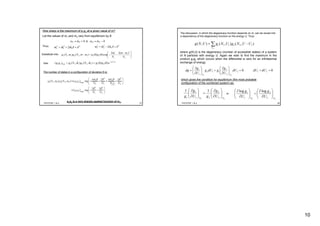
We wish to find the maximum in the combined degeneracy function as it depends on
m1. Use the log of the function as it simplifies the calculation.
2
2
1
1
2
1
21122111
)(22
)0()0(log),(),(log
N
mm
N
m
ggmmNgmNg
−
−−=−
⎟⎟
⎠
⎞
⎜⎜
⎝
⎛ −
−−=−
2
2
1
1
2
1
21122111
)(22
exp)0()0(),(),(
N
mm
N
m
ggmmNgmNg
So the maximum/minimum occurs when:
{ } 0
)(44
),(),(log
2
1
1
1
122111
1
=
−
+−=−
∂
∂
N
mm
N
m
mmNgmNg
m
The second derivative must be negative for the extremum to be a maximum.
(*)
10
PHY3TSP, 1 & 2 37
How sharp is the maximum of g1g2 at a given value of m?
Let the values of m1 and m2 vary from equilibrium by δ:
Thus: 2
1
2
1
2
1
ˆ2ˆ δδ ++= mmm
2
2
2
2
2
2
ˆ2ˆ δδ +−= mmm
⎟⎟
⎠
⎞
⎜⎜
⎝
⎛ −
−−=−
2
2
1
1
2
1
21122111
)(22
exp)0()0(),(),(
N
mm
N
m
ggmmNgmNgSubstitute into:
Use:
Nm
eggmNgmNggg
2
2
21222111max21 )0()0()ˆ,()ˆ,()( −
==
The number of states in a configuration of deviation δ is:
2
g1g2 is a very sharply peaked function of m1.
PHY3TSP, 1 & 2 38
The discussion, in which the degeneracy function depends on m, can be recast into
a dependency of the degeneracy function on the energy U. Thus:
∑ −=
1
),(),(),( 122111
U
UUNgUNgUNg
00 212
2
2
112
1
1
21
=+=⎟⎟
⎠
⎞
⎜⎜
⎝
⎛
∂
∂
+⎟⎟
⎠
⎞
⎜⎜
⎝
⎛
∂
∂
= dUdUdU
U
g
gdUg
U
g
dg
NN
21
2
2
21
1
1
11
NN
U
g
gU
g
g ⎟⎟
⎠
⎞
⎜⎜
⎝
⎛
∂
∂
=⎟⎟
⎠
⎞
⎜⎜
⎝
⎛
∂
∂
21
2
2
1
1 loglog
NN
U
g
U
g
⎟⎟
⎠
⎞
⎜⎜
⎝
⎛
∂
∂
=⎟⎟
⎠
⎞
⎜⎜
⎝
⎛
∂
∂
where g(N,U) is the degeneracy (number of accessible states) of a system
of N particles with energy U. Again we wish to find the maximum in the
product g1g2 which occurs when the differential is zero for an infinitesimal
exchange of energy:
which gives the condition for equilibrium (the most probable
configuration of the combined system) as:
or

Quantum state

  • 1.
    1 PHY3TSP, 1 &2 1 Lecture 1 1. Quantum states 2. An Elementary Soluble System - States of the model system - The degeneracy function - Sharp peak of degeneracy function PHY3TSP, 1 & 2 2 Quantum State Stationary Quantum State: introduced by Niels Bohr, 1913: A property of a stationary quantum state of a physical system of constant energy is that probability to find a particle in any element of volume is independent of the time. A stationary quantum state may be defined as a condition of a system such that all observable physical properties are independent of the time. Statistical Physics: we are concerned with states of a system of many particles. Each stationary quantum state has a definite energy, but it may happen that several states have identical or nearly identical energies. From now on: when we discuss quantum state we mean stationary quantum state. The degeneracy of an energy level is defined as the number of quantum states having the given energy or having an energy in a narrow range. PHY3TSP, 1 & 2 3 Degeneracy of an energy level Figure: Low-lying energy levels of atomic hydrogen and boron. The numbers (n) - the number of quantum states having approximately the same energy, with no account taken of the spin. The energy levels shown for boron are energies of the entire system. Consider the quantum states and energy levels of several atomic systems. The simplest atom is hydrogen, with 1e- and 1p+ . The quantum states of the hydrogen atom are associated with the motion of the electron and the proton. The position of the energy levels can be determined spectroscopically by measuring the wavelength of the quanta emitted from excited atoms. Energy: ε=hν, where v is frequency and h is Planck’s constant. v=λ/c, where c is the speed of light. Boron Energy,ineV Hydrogen 0 2 4 6 8 10 12 14 (2) (8) (18) (32) (50) (6)0 1 2 3 4 5 6 7 (12) (2) (2) (10) 1e- 5e- PHY3TSP, 1 & 2 4 Energy of the system The energy of the system is specified either by E or ε. The energy of the system is the total energy of all particles, kinetic plus potential, with account taken of all mutual interactions. Thus the energy of a system of more than 2 particles cannot be described exactly as the excitation energy of an individual particle in the field of another particle. The quantum state of the system is a state of all particles of the system. The term orbital instead of ‘quantum state’ is used to specify the state of one particle. In this course, we will be concerned with the properties of physical systems of many different types. To describe the statistical properties of a system of N particles it is essential to know the set of values of the energy εl(N), which can be read that ε is the energy of the quantum state l of the N particle system.
  • 2.
    2 PHY3TSP, 1 &2 5 ( )222 2 zyx 2 nnn L2m ++⎟ ⎠ ⎞ ⎜ ⎝ ⎛ = π ε Energy,relativescale 0 5 10 15 1 1 1 1 3 2 1 1 3 2 2 1 3 3 1 1 6 3 2 1 1 2 2 2 g Representative set nx ny nz Figure: Energy levels, degeneracies, and quantum numbers nx, ny, nz of a particle of spin zero which is confined to a cube. The quantum states of this system are discussed later (on the orbitals of a free particle). …….. Note the degeneracies associated with each level. The low-lying energy of a particle confined to a cube with side L is found to be PHY3TSP, 1 & 2 6 Model System The model system is made from N particles with a magnetic moment (elementary magnets). We assume that the magnetic moment μ can point only vertically up or point vertically down. Spin up Spin down For a system with N particles there are 2N arrangements or states. A state of this system is then a specification of the moment on each site. A state can thus be represented as: Each spin on a particular site has been specified. Here the total moment is -2μ. Magnetic moment +μ Magnetic moment -μ A particle of spin angular momentum ½ , such as an electron, a neutron, or a proton, has two possible orientations of the spin, or the magnetic moment, relative to any fixed direction. A system composed of one such particle has two different stationary quantum states (with spins up and down). PHY3TSP, 1 & 2 7 All the states of the system can be generated from a product: (↑1 + ↓1) (↑2 + ↓2)(↑3 + ↓3)……………….. (↑N + ↓N) Where the multiplying rule is given by: (↑1 + ↓1)(↑2 + ↓2) = ↑1 ↑2 + ↑1 ↓2 + ↑2 ↓1 + ↓1 ↓2 Sum here is not a sum, but a way of listing the 4 possible states of the system. Thus for 2 spins the number of states is 22 = 4. If this is repeated for N particles then there are 2N states. The magnetic moment of each state is determined by subtracting the number of down (-μ) moments from the number of up (+μ) moments. Hence the total magnetic moment M ranges from Nμ to –Nμ. The possible values are: M = Nμ, (N-2)μ, (N-4)μ, (N-6)μ, …… , -Nμ Thus there are (N+1) values of total magnetic moment and 2N states. PHY3TSP, 1 & 2 8 Example: For 10 spins (sites, or magnetic moments) there are 11 total magnetic moments with 210 = 1024 states. So many of the states will have the same total magnetic moment. If N is large then 2N >> N + 1 and some total moment values will have very large number of states associated with them. The question is how many states in a system of N spins correspond to a particular total moment. Example: The moments associated with the four different states of a system of two spins: M = 2μ M = 0μ M = 0μ M = -2μ For N spins one state has M = Nμ …………………… There are N ways of generating system with one spin down M = (N-2)μ ………. or ………. etc
  • 3.
    3 PHY3TSP, 1 &2 9 Degeneracy of States. For a system with N spins we can write the number of spins up as ½N + m and the number of spins down as ½N – m so that the total moment is: ( ) ( ) μμμ mmNmNM 22 1 2 1 =−−+= The value 2m is called the spin excess = (number up) – (number down) Number of spins Spin excess Up Down 0 ½N ½N + m ½N - m 2m n(↑) – n(↓) = 2m Figure: Definition of the spin excess 2m. Assume N is even. m is integer. n(↑) + n(↓) = N PHY3TSP, 1 & 2 10 We use the product idea to assist in determining the number of states. The site labels are dropped as it is no longer of interest on which site the spin is situated. (↑ + ↓)(↑ + ↓) = ↑↑ + 2↑↓ + ↓↓ (↑ + ↓)(↑ + ↓)(↑ + ↓) = ↑↑↑ + 3↑2↓ + 3↑↓2 + ↓↓↓ The coefficients 2 & 3 are the binomial coefficients given by ( ) ∑= −−− − =++ − +++=+ N s ssNNssNNNN yx ssN N yyx ssN N yNxxyx 0 1 !)!( ! ..... !)!( ! .... ( ) ( )( )∑ −= −+ −+ =+ N Nm mNmNN yx mNmN N yx 2 1 2 1 2 1 2 1 2 1 2 1 !! ! If this is now expressed in terms of the spin excess 2m=N-2s from which s = ½N –m. The binomial expansion is now: PHY3TSP, 1 & 2 11 This is called the degeneracy function g(N,m). ( )( )!! ! ),( 2 1 2 1 mNmN N mNg −+ = ( ) ( )( )∑ −= −+ ↓↑ −+ ≡↓+↑ N Nm mNmNN mNmN N2 1 2 1 2 1 2 1 2 1 2 1 !! ! This binomial coefficient gives the number of distinct states having ½ N + m spins up and ½ N - m spins down. Such states have total moment M = 2mμ and have spin excess 2m. This is the number of states having the same value of m (or M). Number the states with spin excess 2m, for a system of N spins. PHY3TSP, 1 & 2 12 Shape of degeneracy function Since N is a large number and factorials are large, we need to handle very large numbers. We will develop approximative approach: Take the natural log of both sides: ( ) ( )!log!log!log),(log 2 1 2 1 mNmNNmNg −−+−= AIM: To show that for a very large systems the degeneracy function is peaked very sharply about the value m=0. ( )( )!! ! ),( 2 1 2 1 mNmN N mNg −+ =
  • 4.
    4 PHY3TSP, 1 &2 13 ( ) ( ) ( )∑= ++=+ m s sNNmN 1 2 1 2 1 2 1 log!log!log ( ) ( ) ( )∑= +−−=− m s sNNmN 1 2 1 2 1 2 1 1log!log!log Now: So: ( ) ( ) ( )( ) ( )mNNNNmN +++=+ 2 1 2 1 2 1 2 1 2 1 .....21!! So: ( ) ( ) ( ) ∑= − + +≈−++ m s Ns Ns NmNmN 1 2 1 2 1 2 1 )/2(1 )/2(1 log!log2!log!log How to approximate the log of numbers close to 1 (since N is large 2s/N is small). Use: ....1 2 2 1 +++= xxex ....1 2 2 1 −+−=− xxe x PHY3TSP, 1 & 2 14 x x x xxxex 2 1 1 log)1(log1 ≈ − + +≈+≈ ∑ ∑= = ≈+=≈ − +m s m s N m mm N s NNs Ns 1 1 2 2 1 2 )1( 44 )/2(1 )/2(1 log N m NNmNg 2 2 1 2 !)log(2!log),(log −−≈ But since x is small we neglect all terms after the 2nd and: Apply this to the last term above (previous page) and: Thus: )1(log1 xxxe x −≈−−≈− Used here: )1(......321 2 1 +=++++ mmm PHY3TSP, 1 & 2 15 Taking the exponential of both sides gives: ( ) ( ) Nm e NN N mNg /2 2 1 2 1 2 !! ! ),( − ≅ Nm eNgmNg /2 2 )0,(),( − ≅ Thus, for 1 <<|m| << N, approximation of the degeneracy function: Where: ( ) ( )!! ! )0,( 2 1 2 1 NN N Ng = The distribution is called a Gaussian curve. Gaussian curve PHY3TSP, 1 & 2 16 Gaussian g(100,m) 0 10 20 30 40 50-50 -40 -30 -20 -10 10 20 30 log10g(100,m) Gaussian approximation Exact binomial Figure: Comparison of exact and approximate expressions for the binomial coefficients g(N,m) for N=100. Used log scale ! For |m| > 30 the approximation differs significantly from the exact values. m
  • 5.
    5 PHY3TSP, 1 &2 17 Width of the Gaussian distribution 0 10 20-10-20 2 4 6 8 10 m g(100,m) x 10-28 Nm eNgmNg /2 2 )0,(),( − ≅ When m2 = ½N then the value of g is reduced by e-1 of max value. That is, when the fractional change in m relative to N is given by: 2 1 2 1 ⎟ ⎠ ⎞ ⎜ ⎝ ⎛ = NN m the value of g is 1/e of g(N,0). The quantity (1/2N)1/2 is a measure of the fractional width of the distribution. Figure: Linear scale. The dashed line at the point at 1/e of the maximum of g. max(g) is at m=0 If N ~1022 then the fraction width is 10 -11 which is extremely small and the Gaussian is very sharply peaked. With N increasing, the width is decreasing. PHY3TSP, 1 & 2 18 Lecture 2 1. Energy of magnetic model system 2. The fundamental assumption - Closed system - Accessible state - Probability - Ensemble average - Equal probabilities 3. Two systems in thermal contact - Energy exchange and the most probable configuration. PHY3TSP, 1 & 2 19 Energy of the magnetic model system All states in the model system have the same energy and the degeneracy is high. What happens when we place the system of elementary magnets in a magnetic field? Different states have different energies. Thus if the energy of the system is specified only those states with the given energy may occur in the sampling process. When a fixed external magnetic field is applied to the system with moment μs, the energy of interaction (potential energy) is given by: BU ss .μ−= Thus for the model system of N elementary magnets each with two allowed orientations the total potential energy is: ∑ ∑= = −=−=−== N s N s ss BmMBBUU 1 1 2 μμ Where 2m is the spin excess defined earlier. PHY3TSP, 1 & 2 20 Figure: Energy levels of the model system of ten magnetic moments μ in a magnetic field B. The levels are labelled by their m values, where 2m is the spin excess and ½ N + m= 5+m is the number of up spins. The energies U(m) and degeneracies g(m) are shown. For this problem the energy levels are spaced equally, with separation Δε=2μB between adjacent levels. m -5 -4 -3 -2 -1 0 +1 +2 +3 +4 +5 U(m)/μB +10 +8 +6 +4 +2 0 -2 -4 -6 -8 -10 g(m) 1 10 45 120 210 252 210 120 45 10 1 log g(m) 0 2.30 3.80 4.78 5.35 5.53 5.35 4.78 3.80 2.30 0 BmmU μ2)( −= ( )( )!! ! ),( 2 1 2 1 mNmN N mNg −+ =
  • 6.
    6 PHY3TSP, 1 &2 21 The Fundamental Assumption. A closed system is equally likely to be in any stationary quantum states accessible to it. Closed System. A closed system has a constant energy, a constant number of particles and a constant volume. Accessible State. A state is accessible if its properties are consistent with the specification of the system. This means that the energy of the state must be in the range within which the energy of the system is specified, and the N of particles represented by the state must be equal to the N of particles in the specification of the system. • This idea will become obvious as we proceed but usually the system can exist in a number of states within the specifications of the closed system. • If there is only one state then the system is not of great interest. It exists just in that one state. • We treat all quantum states as accessible unless they are excluded by the specification of the system and the time scale of the experiment. PHY3TSP, 1 & 2 22 Probability The definition of probability we use is obvious one. Assume that a series of observations (t1, t2, t3..), with a total q, are made of a system and its state. Let n(ℓ) denote the number of times in this series of observations that the system is found to be in state ℓ. Then the probability of finding the system in state ℓ is: q n P )( )( = Clearly as with all sampling techniques, the number of observations must be large enough such that continued observations will not change P(ℓ). Since the system will be in one state or another then the probability of finding it in any state must be one. So: ∑ =1)(P PHY3TSP, 1 & 2 23 How do we determine the average value of a physical property A(ℓ) of the system? Each time an observation is made the system will have a value of A corresponding to that state. Thus, in state ℓ, the physical property has the value A(ℓ). The physical property: magnetic moment, energy, charge density etc.. To get the average the values of A would be summed and averaged to give: q An AP q A A s s ∑ ∑ ∑ === )()( )()( This is the average value of A for a system. Here: P(ℓ) – the probability that the system is in the state ℓ, n(ℓ) is the number of times that the system is found in the state ℓ; q is the number of observations. All this presumes that the system is random (in equilibrium) and whose properties will not change with time. (Relaxation time – the time of randomization, or the time required for a fluctuation in the properties of the system to damp out). PHY3TSP, 1 & 2 24 Ensemble Average Time averages are hard to calculate so Boltzmann and Gibbs used the assumption that systems could be found with equal probability in any of the accessible states and used the idea of an ensemble of systems. Instead of taking time averages over a single system, they take a group of a large number of similar systems, randomized. Averages at a single time are taken over this group of systems. Ensemble of systems is a group of identical systems each in a state with the states suitably randomised such that an average over the ensemble would be identical with a time average. The average is called the ensemble average or the thermal average. An ensemble is an intellectual construction that represents at one time the properties of the actual system as they develop in the course of time.
  • 7.
    7 PHY3TSP, 1 &2 25 Ensemble Average It is composed of very many systems. Each system – is a replica of the actual system in one of the quantum states accessible to the system. If there are g accessible states, then there are g systems in ensemble. Each system in ensemble is equivalent to the actual system. The ensemble of systems which correspond to an isolated system is called a ‘micro canonical ensemble’. The strong assumption of statistical mechanics is that the ensemble average (the average over all systems in the ensemble) is identical with the time average. This is difficult to prove experimentally or theoretically, but some mathematicians and physicists have tried. We will use ensemble averages in this course. PHY3TSP, 1 & 2 26 Example: Figure: This ensemble represents a system of 10 spins with energy -8μB and spin excess 2m=8. The degeneracy g(N,m) is g(10,4) =10, so that the representative ensemble must contain 10 systems. The order in which the various systems in the ensemble are listed makes no difference. a b c d e f g h i j BmmU μ2)( −= ( )( )!! ! ),( 2 1 2 1 mNmN N mNg −+ = PHY3TSP, 1 & 2 27 Equal probabilities We have made the assumption that every system in the ensemble is equally likely. Thus one ensemble of all gas molecules in the room would have them all in one corner and none elsewhere. This has never been observed. This is explained by the fact that there are so many other states of the system that the probability of this set of states occurring is so small as to be negligible. If we assumed that the state changed rapidly then sufficient time has not passed for the states in the corner to be accessed. A closed system is equally likely to be in any of the stationary quantum states accessible to it. The most probable state in which a system will be observed is the state with the largest degeneracy. PHY3TSP, 1 & 2 28 Systems in thermal contact. We now define entropy and temperature using two systems in thermal contact. Entropy is the log of the number of accessible states of the system. Consider the following diagrams showing isolated systems and systems in thermal contact. Two closed systems not in contact U1 N1 U2 N2 Insulation U2’ N2 U1’ N1 The systems are in thermal contact Thermal conductor allows exchange of energy. When two systems can transfer energy between them they are said to be in thermal contact.
  • 8.
    8 PHY3TSP, 1 &2 29 The total energy of the systems remains constant so: ' 2 ' 121 UUUUU +=+= What state will the combined system move to? If we consider the combined systems together then the state most likely to be observed is the one with the greatest degeneracy (of the combined systems) or the maximum number of accessible states. Thus we have to determine the degeneracy of the states of the combined systems. Use the model system. What determines when there will be a net flow of energy from one system to another? Concept of temperature. The direction of energy flow is not simply a matter of different energies, but differences in size and constitution. The most probable division of the energy between two systems is defined as that for which the combined system has the maximum number of accessible states. PHY3TSP, 1 & 2 30 Most probable configuration There are two magnetic systems with N1 and N2 spins and spin excesses 2m1 and 2m2. The exchange of energy takes place through weak coupling between the spins. Now if 2m is the spin excess of the combined system then: constmmm =+= 21 )()()( 2211 mUmUmU += 21 NNN += The combined energy is: And the number of particles is: We assume the energy splitting 2μB are equal in both systems: the energy given up by system 1 when one spin is reversed can be taken up by the reversal of one spin of system 2 in the opposite sense. PHY3TSP, 1 & 2 31 ∑ −= 1 ),(),(),( 122111 m mmNgmNgmNg The degeneracy function for the combined system (number of accessible states) is: With the range of summation from -1/2N1 to 1/2N1 if N1 < N2, which we can arrange. Why: A combined configuration consists of the set of states specified by fixed values of m1 and m2. The first system has g1(N1,m1) accessible states, and each of these states may occur together with any of the g2(N2,m2) accessible states of the second system. The total number of states in a configuration of the combined system: g1(N1,m1)g2(N2,m2), where m2=m-m1. Other accessible configurations of the combined system are characterised by different values of m1 – need to sum over all m1. PHY3TSP, 1 & 2 32 • We want to show if one of the systems is large (reservoir*) then the combined degeneracy function has a very sharp maximum for some value of m1, which is labelled . •The number of states in the most probable configuration is: •The sharp maximum means that a relatively small number of configurations will dominate the statistical properties of the combined system. • This is true for all systems which are analytic and it is assumed that it applies to all large systems. • When the system changes state most of the states it accesses are close to the most probable state. Thus the averages of a physical quantity over all accessible configurations can be replaced by an average over the most probable configuration. 1 ˆm )ˆ,()ˆ,( 122111 mmNgmNg − (*) The reservoir is regarded as being much larger than the system.
  • 9.
    9 PHY3TSP, 1 &2 33 Example: Two spin systems in thermal contact. The combined degeneracy functions of two spin systems are given by using equation from the 1st lecture: ⎟⎟ ⎠ ⎞ ⎜⎜ ⎝ ⎛ − −−= =⎟⎟ ⎠ ⎞ ⎜⎜ ⎝ ⎛ −−=− 2 2 1 1 2 1 21 2 2 2 1 2 1 21122111 )(22 exp)0()0( 22 exp)0()0(),(),( N mm N m gg N m N m ggmmNgmNg )0,()0( 111 Ngg ≡ This is the degeneracy of the combined system with spin excess 2m. Nm eNgmNg /2 2 )0,(),( − ≅ Using: PHY3TSP, 1 & 2 34 Figure: Schematic plot for two small systems of g1, g2, and g1g2. The function plotted as g1 is: 0 0 2 4 6 8 10 g1andg2 ½m m1 g1g2 2 1 3 g1(m1) g2(m-m1) g1(m1)g2(m-m1) Most probable value of m1 22 1 x eg − = π 2 )8( 2 2 x eg −− = π The function g2: The product g1g2 as plotted has been multiplied by 5x10¹³ in order to make it visible. PHY3TSP, 1 & 2 35 N m N m N m or N m N mm N m === − = 2 2 1 1 2 2 2 1 1 1 ˆˆ Nm eggmNgmNggg 2 2 21222111max21 )0()0()ˆ,()ˆ,()( − == Checking the second derivative, -4(1/N1+1/N2), shows that the extremum is a maximum. Thus the most probable configuration of the combined system is that for which (*) is satisfied: Thus the two systems are in equilibrium when the fractional magnetisation (or fractional spin excess) of both systems is equal and is equal to the combined fractional magnetisation. The total degeneracy is then: PHY3TSP, 1 & 2 36 We wish to find the maximum in the combined degeneracy function as it depends on m1. Use the log of the function as it simplifies the calculation. 2 2 1 1 2 1 21122111 )(22 )0()0(log),(),(log N mm N m ggmmNgmNg − −−=− ⎟⎟ ⎠ ⎞ ⎜⎜ ⎝ ⎛ − −−=− 2 2 1 1 2 1 21122111 )(22 exp)0()0(),(),( N mm N m ggmmNgmNg So the maximum/minimum occurs when: { } 0 )(44 ),(),(log 2 1 1 1 122111 1 = − +−=− ∂ ∂ N mm N m mmNgmNg m The second derivative must be negative for the extremum to be a maximum. (*)
  • 10.
    10 PHY3TSP, 1 &2 37 How sharp is the maximum of g1g2 at a given value of m? Let the values of m1 and m2 vary from equilibrium by δ: Thus: 2 1 2 1 2 1 ˆ2ˆ δδ ++= mmm 2 2 2 2 2 2 ˆ2ˆ δδ +−= mmm ⎟⎟ ⎠ ⎞ ⎜⎜ ⎝ ⎛ − −−=− 2 2 1 1 2 1 21122111 )(22 exp)0()0(),(),( N mm N m ggmmNgmNgSubstitute into: Use: Nm eggmNgmNggg 2 2 21222111max21 )0()0()ˆ,()ˆ,()( − == The number of states in a configuration of deviation δ is: 2 g1g2 is a very sharply peaked function of m1. PHY3TSP, 1 & 2 38 The discussion, in which the degeneracy function depends on m, can be recast into a dependency of the degeneracy function on the energy U. Thus: ∑ −= 1 ),(),(),( 122111 U UUNgUNgUNg 00 212 2 2 112 1 1 21 =+=⎟⎟ ⎠ ⎞ ⎜⎜ ⎝ ⎛ ∂ ∂ +⎟⎟ ⎠ ⎞ ⎜⎜ ⎝ ⎛ ∂ ∂ = dUdUdU U g gdUg U g dg NN 21 2 2 21 1 1 11 NN U g gU g g ⎟⎟ ⎠ ⎞ ⎜⎜ ⎝ ⎛ ∂ ∂ =⎟⎟ ⎠ ⎞ ⎜⎜ ⎝ ⎛ ∂ ∂ 21 2 2 1 1 loglog NN U g U g ⎟⎟ ⎠ ⎞ ⎜⎜ ⎝ ⎛ ∂ ∂ =⎟⎟ ⎠ ⎞ ⎜⎜ ⎝ ⎛ ∂ ∂ where g(N,U) is the degeneracy (number of accessible states) of a system of N particles with energy U. Again we wish to find the maximum in the product g1g2 which occurs when the differential is zero for an infinitesimal exchange of energy: which gives the condition for equilibrium (the most probable configuration of the combined system) as: or