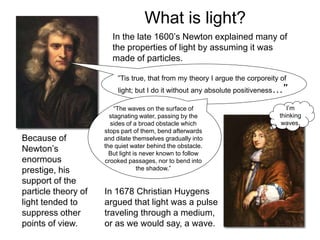
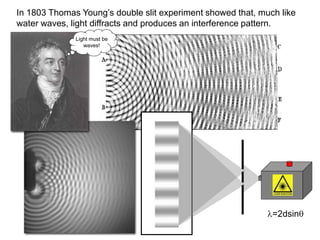
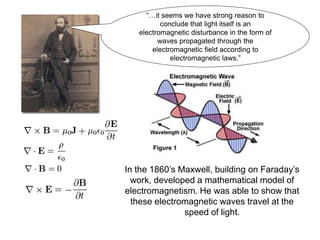
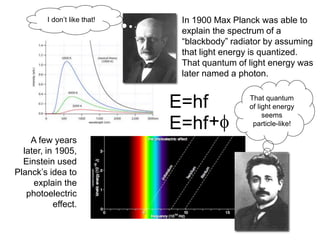
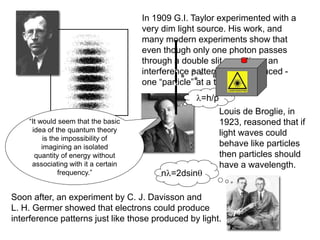
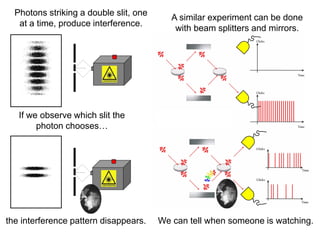
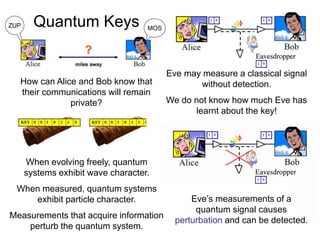
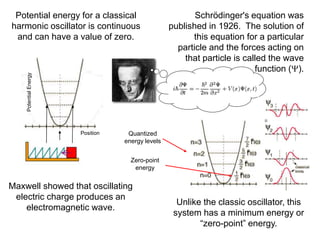
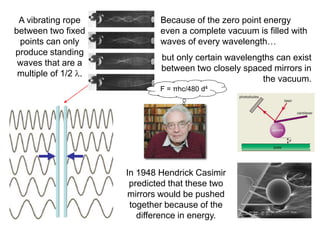
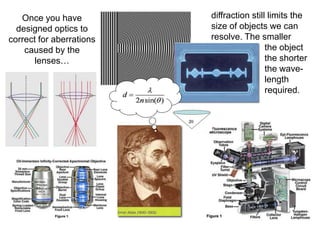
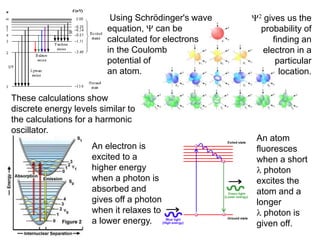
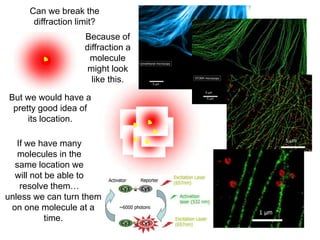
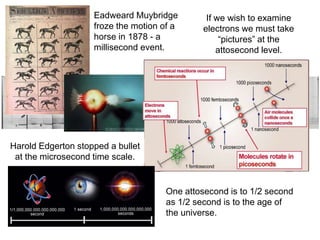
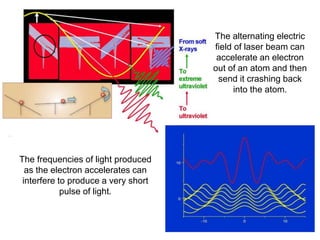
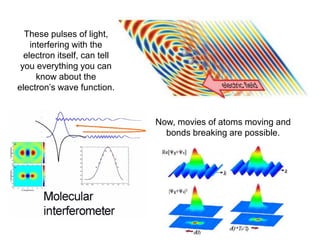
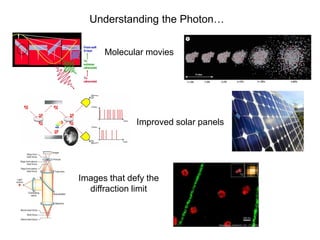
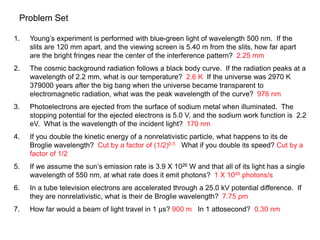
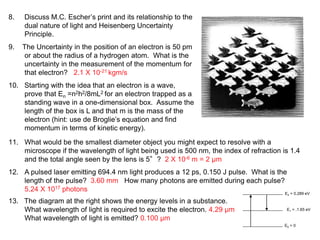
This document provides an overview of the history and development of our understanding of the nature of light. It begins in the late 1600s when Newton proposed that light was made of particles. In the late 1600s and 1700s, Huygens and Young provided evidence that light behaves as waves through experiments demonstrating diffraction and interference. In the 1860s, Maxwell developed his theory of electromagnetism and showed that light is an electromagnetic wave. In the early 1900s, Planck and Einstein provided evidence that light also behaves as discrete packets of energy called photons. Later experiments demonstrated that light and other quantum objects exhibit both wave-like and particle-like properties, leading to the modern understanding of light in quantum mechanics.