Gene Interactions
Dr. Rashmi Nagesh
Definition
•Gene interactions refer to the relationships between
genes that affect the phenotype of an organism.
•Gene interactions occur when allelic or non-allelic
genes affect the expression of specific phenotypic
traits in an organism.
• Unlike Mendel’s initial observations, it was discovered that inheritance is
not a simple one-gene, one-trait relationship.
• It involves the interaction of multiple genes, and their combined effects
cannot be predicted by studying them individually.
• Bateson and Punnett conducted breeding experiments with chickens,
shortly after Mendel’s paper was rediscovered, and their research
provided early evidence that traits can be influenced by multiple genes.
• They noticed that the observed ratios of inherited traits did not always
follow Mendelian patterns, indicating that genes interact with each other.
Types of Gene Interactions
1. Allelic Gene Interaction
Allelic gene interactions occur between different forms (alleles) of a
single gene.
Ex: Complete Dominance
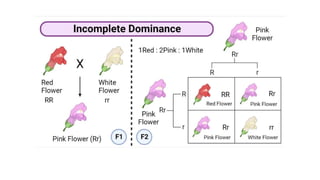
Incomplete Dominance
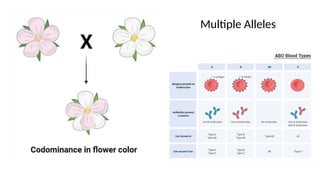
Codominance
Multiple Alleles
Multiple Alleles
2. Non-Allelic Gene Interaction: Non-allelic gene interactions refer to
interactions between genes that are located on the same or different
chromosomes but do not involve alleles of the same gene.
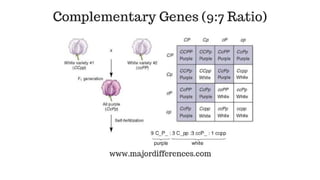
Ex: Complementary Genes
Epistasis - Dominant and Recessive
Supplementary Genes
Duplicate Genes
Cumulative effect
Significance of Gene Interactions
• Gene interactions can be studied in model organisms to understand
the functional relationships between genes and their gene products.
• Gene interactions are important for understanding the key
components and mechanisms involved in genetic pathways.
• Gene interactions play a crucial role in understanding the complex
phenotypic variation in organisms. This helps us to understand how
different genes work together to express different phenotypic traits.
• Gene interactions are important for understanding how complex
genetic systems evolve by studying how genes interact and change
over time.
• Gene interactions are complex and involve various molecular
mechanisms. Understanding these complex interactions is essential
for understanding how genes work together and their impact on
different biological processes.

Principles of Genetics - Gene Interaction.pptx

  • 1.
  • 2.
    Definition •Gene interactions referto the relationships between genes that affect the phenotype of an organism. •Gene interactions occur when allelic or non-allelic genes affect the expression of specific phenotypic traits in an organism.
  • 3.
    • Unlike Mendel’sinitial observations, it was discovered that inheritance is not a simple one-gene, one-trait relationship. • It involves the interaction of multiple genes, and their combined effects cannot be predicted by studying them individually. • Bateson and Punnett conducted breeding experiments with chickens, shortly after Mendel’s paper was rediscovered, and their research provided early evidence that traits can be influenced by multiple genes. • They noticed that the observed ratios of inherited traits did not always follow Mendelian patterns, indicating that genes interact with each other.
  • 4.
    Types of GeneInteractions 1. Allelic Gene Interaction Allelic gene interactions occur between different forms (alleles) of a single gene. Ex: Complete Dominance Incomplete Dominance Codominance Multiple Alleles
  • 7.
  • 8.
    2. Non-Allelic GeneInteraction: Non-allelic gene interactions refer to interactions between genes that are located on the same or different chromosomes but do not involve alleles of the same gene. Ex: Complementary Genes Epistasis - Dominant and Recessive Supplementary Genes Duplicate Genes Cumulative effect
  • 9.
    Significance of GeneInteractions • Gene interactions can be studied in model organisms to understand the functional relationships between genes and their gene products. • Gene interactions are important for understanding the key components and mechanisms involved in genetic pathways. • Gene interactions play a crucial role in understanding the complex phenotypic variation in organisms. This helps us to understand how different genes work together to express different phenotypic traits.
  • 10.
    • Gene interactionsare important for understanding how complex genetic systems evolve by studying how genes interact and change over time. • Gene interactions are complex and involve various molecular mechanisms. Understanding these complex interactions is essential for understanding how genes work together and their impact on different biological processes.