ContentTable of
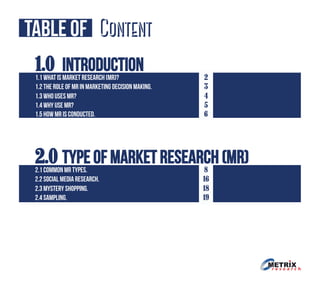
1.0 introduction1.1 what is market research (mr)?
1.2 The role of mr in marketing decision making.
1.3 Who uses mr?
1.4 why use mr?
1.5 how mr is conducted.
2
3
4
5
6
2.0 type of market research (mr)2.1 common mr types.
2.2 social media research.
2.3 mystery shopping.
2.4 sampling.
8
16
18
19
ContentTable of
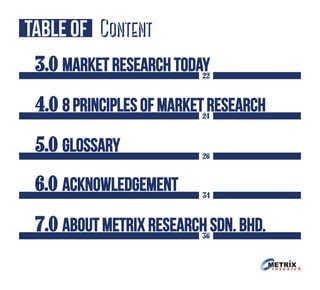
3.0 market research today22
4.0 8 principles of market research24
5.0 glossary 26
6.0 acknowledgement 34
7.0 about metrix research sdn. bhd.36
Introduction.1.1 what is market research (mr)?
1.2 The role of mr in marketing decision making.
1.3 Who uses mr?
1.4 why use mr?
1.5 how mr is conducted.
2
3
4
5
6
1 0
ductionintro
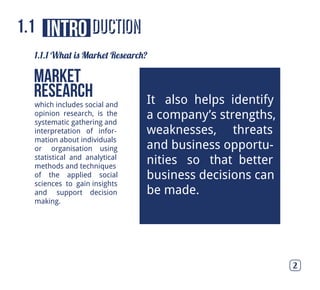
which includes social and
opinion research, is the
systematic gathering and
interpretation of infor-
mation about individuals
or organisation using
statistical and analytical
methods and techniques
of the applied social
sciences to gain insights
and support decision
making.
Market
Research
1.1.1 What is Market Research?
It also helps identify
a company’s strengths,
weaknesses, threats
and business opportu-
nities so that better
business decisions can
be made.
1.1
2
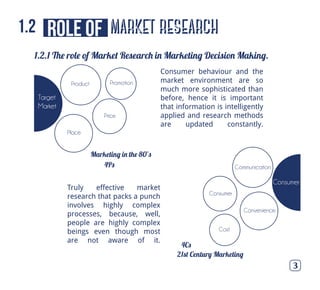
1.2.1 The role of Market Research in Marketing Decision Making.
Consumer behaviour and the
market environment are so
much more sophisticated than
before, hence it is important
that information is intelligently
applied and research methods
are updated constantly.
Truly effective market
research that packs a punch
involves highly complex
processes, because, well,
people are highly complex
beings even though most
are not aware of it.
3
Product
Place
Price
Promotion
Consumer
Convenience
Cost
Communication
Marketing in the 80’s
4Ps
Target
Market
Consumer
21st Century Marketing
4Cs
market researchrole of1.2
4
In the past, MR was used
by large organisations or
businesses that want to gain
competitive advantage by
having a better understanding
of their business landscape.
Nowadays, MR services are em-
ployed by all types of businesses as
well as NGOs, government agencies
and political parties that need
to make informed decisions in their
business or operation management.
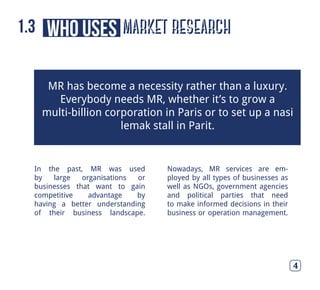
MR has become a necessity rather than a luxury.
Everybody needs MR, whether it’s to grow a
multi-billion corporation in Paris or to set up a nasi
lemak stall in Parit.
market researchwho uses1.3
market research
1.4.1 Why conduct Market Research?
5
Have you been in a situation
where you had to make a
decision with nothing to go by?
No facts, no parameters, no list of
criteria that define what a good
decision is. All you had was ‘gut
feel’ and the sun shining on you.
Admittedly, MR does not
guarantee that your dream
will come true, but it can
get you there a lot faster and
with less risk!
Scary isn’t it?
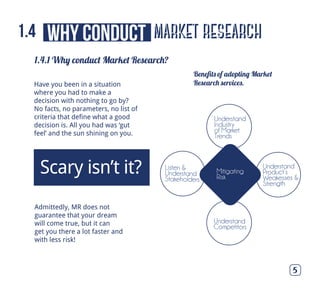
Benefits of adopting Market
Research services.
why conduct1.4
Mitigating
Risk
Understand
Industry
of Market
Trends
Understand
Competitors
Understand
Product’s
Weakesses &
Strength
Listen &
Understand
Stakeholders
is conducted
6
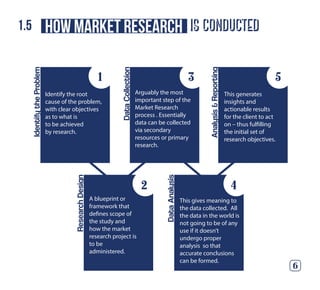
IdentifytheProblem
ResearchDesign
Identify the root
cause of the problem,
with clear objectives
as to what is
to be achieved
by research.
A blueprint or
framework that
defines scope of
the study and
how the market
research project is
to be
administered.
DataCollection
Analysis&Reporting
DataAnalysis
Arguably the most
important step of the
Market Research
process . Essentially
data can be collected
via secondary
resources or primary
research.
This gives meaning to
the data collected. All
the data in the world is
not going to be of any
use if it doesn’t
undergo proper
analysis so that
accurate conclusions
can be formed.
This generates
insights and
actionable results
for the client to act
on – thus fulfilling
the initial set of
research objectives.
1
2
3
4
5
HOW market research1.5
Types of Market Research.
2 0
2.1 common mr types.
2.2 social media research.
2.3 mystery shopping.
2.4 sampling.
8
16
18
19
research types
2.1.1 What is Qualitative Market Research.
8
common market2.1
One of the most common
way of clarifying types of market
research is to describe work as
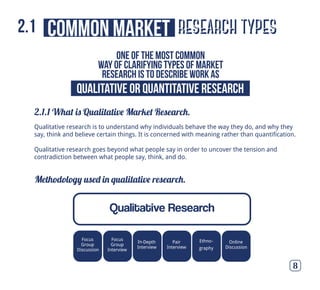
Qualitative research is to understand why individuals behave the way they do, and why they
say, think and believe certain things. It is concerned with meaning rather than quantification.
Qualitative research goes beyond what people say in order to uncover the tension and
contradiction between what people say, think, and do.
Qualitative or Quantitative Research
Methodology used in qualitative research.
Qualitative Research
Focus
Group
Discussion
Focus
Group
Interview
Depth
Interview
Pair
Interview
Ethno-
graphy
Online
Discussion
In-
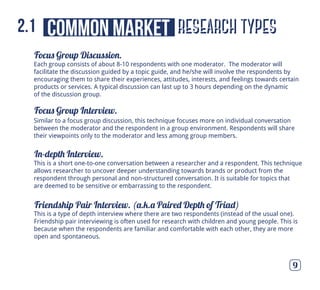
Focus Group Discussion.
Focus Group Interview.
In-depth Interview.
Friendship Pair Interview. (a.k.a Paired Depth of Triad)
9
Similar to a focus group discussion, this technique focuses more on individual conversation
between the moderator and the respondent in a group environment. Respondents will share
their viewpoints only to the moderator and less among group members.
This is a short one-to-one conversation between a researcher and a respondent. This technique
allows researcher to uncover deeper understanding towards brands or product from the
respondent through personal and non-structured conversation. It is suitable for topics that
are deemed to be sensitive or embarrassing to the respondent.
This is a type of depth interview where there are two respondents (instead of the usual one).
Friendship pair interviewing is often used for research with children and young people. This is
because when the respondents are familiar and comfortable with each other, they are more
open and spontaneous.
Each group consists of about 8-10 respondents with one moderator. The moderator will
facilitate the discussion guided by a topic guide, and he/she will involve the respondents by
encouraging them to share their experiences, attitudes, interests, and feelings towards certain
products or services. A typical discussion can last up to 3 hours depending on the dynamic
of the discussion group.
research typescommon market2.1
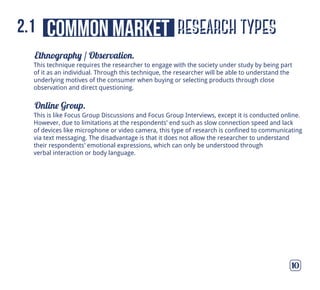
Ethnography / Observation.
Online Group.
10
This technique requires the researcher to engage with the society under study by being part
of it as an individual. Through this technique, the researcher will be able to understand the
underlying motives of the consumer when buying or selecting products through close
observation and direct questioning.
This is like Focus Group Discussions and Focus Group Interviews, except it is conducted online.
However, due to limitations at the respondents’ end such as slow connection speed and lack
of devices like microphone or video camera, this type of research is confined to communicating
via text messaging. The disadvantage is that it does not allow the researcher to understand
their respondents’ emotional expressions, which can only be understood through
verbal interaction or body language.
research typescommon market2.1
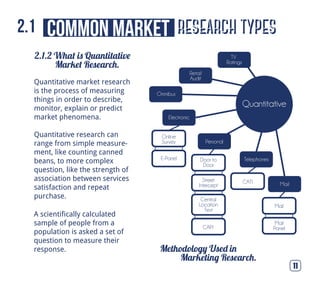
2.1.2 What is Quantitative
Market Research.
Methodology Used in
Marketing Research.
11
Quantitative market research
is the process of measuring
things in order to describe,
monitor, explain or predict
market phenomena.
Quantitative research can
range from simple measure-
ment, like counting canned
beans, to more complex
question, like the strength of
association between services
satisfaction and repeat
purchase.
A scientifically calculated
sample of people from a
population is asked a set of
question to measure their
response.
Quantitative
Electronic
TV
Ratings
Retail
Audit
Omnibus
Telephones
Personal
MailCATI
Door to
Door
Street
Intercept
Central
Location
Test
E-Panel
CAPI
Mail
Mail
Panel
Online
Survey
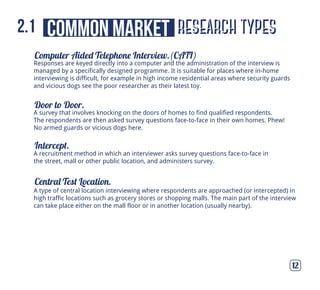
research typescommon market2.1
Computer Aided Telephone Interview.(CATI)
Door to Door.
Intercept.
Central Test Location.
12
A survey that involves knocking on the doors of homes to find qualified respondents.
The respondents are then asked survey questions face-to-face in their own homes. Phew!
No armed guards or vicious dogs here.
A recruitment method in which an interviewer asks survey questions face-to-face in
the street, mall or other public location, and administers survey.
A type of central location interviewing where respondents are approached (or intercepted) in
high traffic locations such as grocery stores or shopping malls. The main part of the interview
can take place either on the mall floor or in another location (usually nearby).
Responses are keyed directly into a computer and the administration of the interview is
managed by a specifically designed programme. It is suitable for places where in-home
interviewing is difficult, for example in high income residential areas where security guards
and vicious dogs see the poor researcher as their latest toy.
research typescommon market2.1
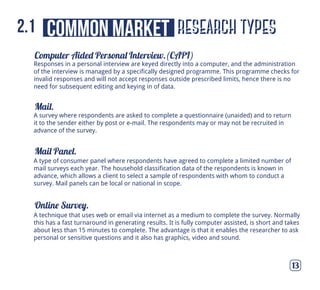
Computer Aided Personal Interview.(CAPI)
Mail.
Mail Panel.
Online Survey.
13
A type of consumer panel where respondents have agreed to complete a limited number of
mail surveys each year. The household classification data of the respondents is known in
advance, which allows a client to select a sample of respondents with whom to conduct a
survey. Mail panels can be local or national in scope.
A survey where respondents are asked to complete a questionnaire (unaided) and to return
it to the sender either by post or e-mail. The respondents may or may not be recruited in
advance of the survey.
A technique that uses web or email via internet as a medium to complete the survey. Normally
this has a fast turnaround in generating results. It is fully computer assisted, is short and takes
about less than 15 minutes to complete. The advantage is that it enables the researcher to ask
personal or sensitive questions and it also has graphics, video and sound.
Responses in a personal interview are keyed directly into a computer, and the administration
of the interview is managed by a specifically designed programme. This programme checks for
invalid responses and will not accept responses outside prescribed limits, hence there is no
need for subsequent editing and keying in of data.
research typescommon market2.1
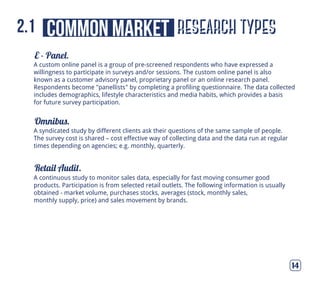
E - Panel.
Omnibus.
Retail Audit.
14
A syndicated study by different clients ask their questions of the same sample of people.
The survey cost is shared – cost effective way of collecting data and the data run at regular
times depending on agencies; e.g. monthly, quarterly.
A continuous study to monitor sales data, especially for fast moving consumer good
products. Participation is from selected retail outlets. The following information is usually
obtained - market volume, purchases stocks, averages (stock, monthly sales,
monthly supply, price) and sales movement by brands.
A custom online panel is a group of pre-screened respondents who have expressed a
willingness to participate in surveys and/or sessions. The custom online panel is also
known as a customer advisory panel, proprietary panel or an online research panel.
Respondents become "panellists" by completing a profiling questionnaire. The data collected
includes demographics, lifestyle characteristics and media habits, which provides a basis
for future survey participation.
research typescommon market2.1
A survey that involves a group of respondents (recruited via panel) that agree to have a meter
device connected to their TV/Cable to measure penetration of TV programmes.
Information gathered over a period of time from groups of people on a
specific product.
TV Ratings.
Consumer Panel.
15
research typescommon market2.1
When watching American Idol, how
many times have you thought, “What?
He can’t even sing, and he’s the winner?
Are you kidding me?”
Well, welcome to a brand new world of
citizen judges, writers,
journalists, bloggers,
commentators, raters,
editors, publisers,
networkers, and aggregators.
These are the new influencers, whereby
the advantage is that they can be more
influential and convincing than the
professionals.
They are consumers who talk with each
other on a large scale, using the new
media tools of the Internet. People who
connect, converse, and create communities
to share knowledge and opinions.
And they talk about brands,
products and B2B conversations too.
research
2.2.1 Introduction.
16
social media2.2
Yes, it’s a double-edged sword.
They could lift you or drop you.
Which is not a bad thing, as
corporations have to be on their
toes and not allow themselves to
get complacent. Tough, but that’s
how the world has evolved.
“Tough, but that’s
how the
world has
evolved”
research
2.2.2 So what exactly is Social Media Marketing Research?
17
social media2.2
Do you want the technical definition, or the juicy version? Well, technically, it is marketing
research. Juicily, it’s voyeurism. You use data obtained from naturally occuring conversation on
social media websites for the purpose of market research.
Social network like Facebook, microblogs like Twitter, blog hostings sites like WordPress, video
sites like YouTube and photo sites like Instagram can most commonly used ‘platform’ for social
media research. You lurk and listen to what they’re saying just about anything, really. Behind
the computer screen, people have no inhibitions. Like naked people they willingly display
everything for all to see - their behaviours, attitudes, perceptions, opinions, beliefs, and
emotions. Yes, you get to see all that, and also how they relate to your brand/product, and
what they’re saying about them. You get to know about trends and hot topics.
Then comes the analysis of the information gathered to optimise brands, products, and media
marketing campaigns, and to influence your target markets. For some, the term social media
research encompasses techniques such as conducting online focus groups, sampling from
social media websites, conducting polls from social media websites, and utilizing communities
within social media.
While others, however prefer a more narrow definition which focuses on the collection and
analysis of naturally occuring comments, opinions and messages in social media, and using
that data to report on brand trends, satisfaction and other common market research
measures.
There are a few definition of social media
research within the MR community
shopping
2.3.1 What’s this? 2.3.2 How it is applied.
2.3.3 Why is it important?
18
mystery2.3
Mystery shopping is a covert operation
that measures the quality of service or
compliance to regulation, or to gather
specific information about products and
services whereby the establishment
that’s being evaluated does not know
the identity of the researcher.
People hired as mystery shoppers perform
specific tasks such as purchasing a product,
asking questions, registering complaints
and being a pain, or behaving in a certain
way, and then provide detailed reports or
feedback about their experiences.
Mystery shopping is a tool that can be used
externally by market research companies or
watchdog organisations or internally by
the companies themselves.
It’s a lazy
sale person’s
nightmare
come true.
1. Preparation for new competition.
2. Monitoring competitors.
3. Employee recognition/ incentive programs.
4. Measuring training.
Mystery shopping can be used in any industry,
with the most common venues being retail
stores, hotels, movie theatres, restaurants, fast
food chains, banks, petrol stations, car
dealerships, apartments, health clubs and
health care facilities.
Since 2010, mystery shopping has become abun-
dant in the medical tourism industry, with health-
care providers and medical facilities using the
tool to assess and improve the customer service
experience.
pling
2.4.1 What’s this?
2.4.2 What is the purpose?
2.4.3 Advantages of Sampling.
19
sam2.4
To draw conclusions about populations from samples, we must use inferential
statistics, to enable us to determine a population’s characteristics by directly
observing only a portion (or sample) of the population.
1. It involves a smaller amount of subjects, which reduces investment in time and money.
2. Sampling can actually be more accurate than studying an entire population, because it
affords researchers a lot more control over the subjects. Large studies can bury interesting
correlations amongst the ‘noise.’
3. Statistical manipulations are much easier with smaller data sets, and it is easier to avoid
human error when inputting and analysing the data.
Sampling is the survey of a small part of a population to gain information about the whole.
People who are selecting from a particular population are assumed to represent the
population, whether it’s a group of individuals, objects, or items. These respondents
provide knowledge about the whole population, especially for the purposes of making
predictions based on statistical inference.
pling
2.4.4 Disadvantages of Sampling.
2.4.5 Sampling Variability.
20
sam2.4
There is room for potential bias in the selection of suitable subjects for the research.
This may be because the researcher selects subjects that are more likely to give the desired
results, or that the subjects tend to select themselves.
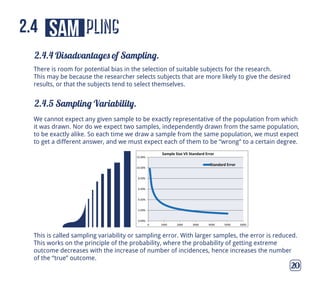
We cannot expect any given sample to be exactly representative of the population from which
it was drawn. Nor do we expect two samples, independently drawn from the same population,
to be exactly alike. So each time we draw a sample from the same population, we must expect
to get a different answer, and we must expect each of them to be “wrong” to a certain degree.
This is called sampling variability or sampling error. With larger samples, the error is reduced.
This works on the principle of the probability, where the probability of getting extreme
outcome decreases with the increase of number of incidences, hence increases the number
of the “true” outcome.
0.00%
2.00%
4.00%
6.00%
8.00%
10.00%
12.00%
0 1000 2000 3000 4000 5000 6000
Sample Size VS Standard Error
Standard Error
Market Research Today.
3 0
Market research today. 22
today
3.1.1 It ain’t what it was before.
3.1.2 Moving forward.
market research3.1
22
Name one thing that the internet has not
affected. Even ascetics are often seen
tapping on their smart phones while
walking barefoot from village to village.
Internet has changed everyone and the
way we live. It has also changed how
market research agencies and
researchers collect and analyse data.
Today, collecting data in market research
requires researchers to look into video
blogs, online portals, emotional
measurement, data mining, analysis of
comments in online forums, social media
and other private online communities.
Market researchers are expected to play a more
important role in client business decisions,
providing key actionable insights – rather than
just data. Understanding the role of emotions
and mindset of consumer will become more
critical in decision processes as well as in
planning on consumer behaviour.
Moving forward, there will still be strong demand
for market research services but the importance
lies with providing insights and giving meanings
to data so that clients can act on them.
The changes and improvements in technology
enhancements has also provided greater
opportunities for market research today to
encourage creativity and innovation in designing
more effective research for clients.
8 Principles of Market Research.
4 0
Market research today. 24
of market research8 principles4.1
24
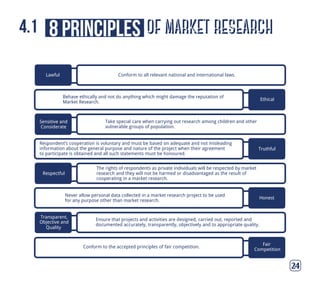
Behave ethically and not do anything which might damage the reputation of
Market Research.
Take special care when carrying out research among children and other
vulnerable groups of population.
Respondent’s cooperation is voluntary and must be based on adequate and not misleading
information about the general purpose and nature of the project when their agreement
to participate is obtained and all such statements must be honoured.
The rights of respondents as private individuals will be respected by market
research and they will not be harmed or disadvantaged as the result of
cooperating in a market research.
Never allow personal data collected in a market research project to be used
for any purpose other than market research.
Ensure that projects and activities are designed, carried out, reported and
documented accurately, transparently, objectively and to appropriate quality.
Conform to the accepted principles of fair competition.
Conform to all relevant national and international laws.Lawful
Ethical
Sensitive and
Considerate
Truthful
Respectful
Honest
Transparent,
Objective and
Quality
Fair
Competition
Glossary.
5 0
glossary of terms. 26
of termsglossary5.1
26
attitude research (a.k.a attitude survey)
A research study to obtain information on how people feel about certain products, ideas or companies.
Awareness
A measure of respondents’ knowledge of an object or an idea. There are two main measures of awareness:
spontaneous (or unaided) and prompted (or aided) awareness.
blind testing
The testing of products with potential consumers where brand names, packaging and other identifying items
have been removed.
capi (computer-aided personal interviewing)
Responses in a personal interview are keyed directly into a computer and the administration of the interview is
managed by a specifically designed programme. The programme checks for invalid responses and will not accept
responses outside prescribed limits, hence subsequent editing and keying in of data is avoided.
cati (computer-aided telephone interviewing)
Responses are keyed directly into a computer and administration of the interview is managed by a specifically
designed programme. The programme checks for invalid responses and will not accept responses outside
prescribed limits, hence subsequent editing and keying in of data is avoided.
census
The collection of data from all available units in a population of interest.
central location interviewing
When face-to-face interviews are conducted at one or more specified locations (eg mall intercept interviewing).
of termsglossary5.1
27
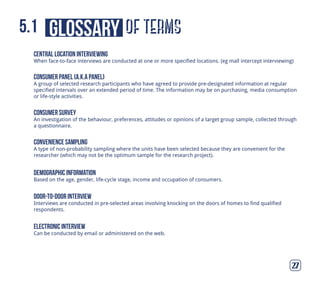
central location interviewing
When face-to-face interviews are conducted at one or more specified locations. (eg mall intercept interviewing)
consumer panel (a.k.a panel)
A group of selected research participants who have agreed to provide pre-designated information at regular
specified intervals over an extended period of time. The information may be on purchasing, media consumption
or life-style activities.
consumer survey
An investigation of the behaviour, preferences, attitudes or opinions of a target group sample, collected through
a questionnaire.
convenience sampling
A type of non-probability sampling where the units have been selected because they are convenient for the
researcher (which may not be the optimum sample for the research project).
demographic information
Based on the age, gender, life-cycle stage, income and occupation of consumers.
door-to-door interview
Interviews are conducted in pre-selected areas involving knocking on the doors of homes to find qualified
respondents.
electronic interview
Can be conducted by email or administered on the web.
of termsglossary5.1
28
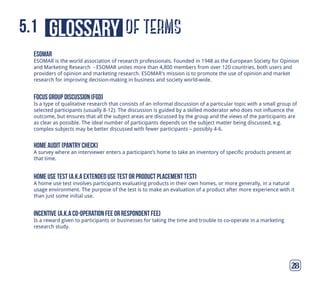
esomar
ESOMAR is the world association of research professionals. Founded in 1948 as the European Society for Opinion
focus group discussion (fgd)
home audit (pantry check)
home use test (a.k.a extended use test or product placement test)
incentive (a.k.a co-operation fee or respondent fee)
research study.
of termsglossary5.1
29
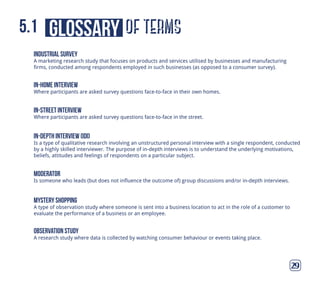
industrial survey
A marketing research study that focuses on products and services utilised by businesses and manufacturing
firms, conducted among respondents employed in such businesses (as opposed to a consumer survey).
in-home interview
Where participants are asked survey questions face-to-face in their own homes.
in-street interview
Where participants are asked survey questions face-to-face in the street.
moderator
Is someone who leads (but does not influence the outcome of) group discussions and/or in-depth interviews.
mystery shopping
A type of observation study where someone is sent into a business location to act in the role of a customer to
evaluate the performance of a business or an employee.
in-depth interview (idi)
Is a type of qualitative research involving an unstructured personal interview with a single respondent, conducted
by a highly skilled interviewer. The purpose of in-depth interviews is to understand the underlying motivations,
beliefs, attitudes and feelings of respondents on a particular subject.
observation study
A research study where data is collected by watching consumer behaviour or events taking place.
of termsglossary5.1
30
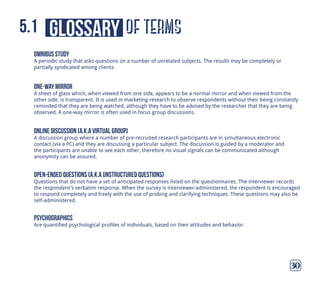
omnibus study
A periodic study that asks questions on a number of unrelated subjects. The results may be completely or
partially syndicated among clients.
online discussion (a.k.a virtual group)
A discussion group where a number of pre-recruited research participants are in simultaneous electronic
contact (via a PC) and they are discussing a particular subject. The discussion is guided by a moderator and
the participants are unable to see each other, therefore no visual signals can be communicated although
anonymity can be assured.
one-way mirror
A sheet of glass which, when viewed from one side, appears to be a normal mirror and when viewed from the
other side, is transparent. It is used in marketing research to observe respondents without their being constantly
reminded that they are being watched, although they have to be advised by the researcher that they are being
observed. A one-way mirror is often used in focus group discussions.
open-ended questions (a.k.a unstructured questions)
Questions that do not have a set of anticipated responses listed on the questionnaires. The interviewer records
the respondent's verbatim response. When the survey is interviewer-administered, the respondent is encouraged
to respond completely and freely with the use of probing and clarifying techniques. These questions may also be
self-administered.
psychographics
Are quantified psychological profiles of individuals, based on their attitudes and behavior.
of termsglossary5.1
31
qualitative research
Involves the use of unstructured exploratory techniques (such as group discussions and in-depth interviews) that
are based on statically small samples in order to understand a problem further.
quantitative research
Involves the collection of (statically) large samples of quantitative data using a questionnaire allowing for some
form of statistical analysis. Quantitative Research is usually used to substantiate the findings from a qualitative
research.
random digit dialing (rdd)
Random selecting telephone numbers to overcome bias of unpublished and recent telephone numbers.
respondent
Is the person who is interviewed by a researcher.
sample size
Is the number of sample units to be included in the sample.
retail audit
Gathering information on a brand’s sales volume, sales trends, stock levels, effectiveness of in-store display and
promotion efforts and other associated aspects based on data compiled from retail outlets on applying marketing
research methodology for analysis.
of termsglossary5.1
32
socio-economic groups (a.k.a social grades or social class)
A method of dividing a population of interest into groups usually based on income and occupation of the head of
household, although other variables can also be used. The ESOMAR social grades (A, B, C1, C2, D, E1, E2 & E3)
are based on the terminal education age and occupation of the main income earner.
topic guide
Is an outline of the subjects to be discussed during group discussions and/or in-depth interviews.
usage & attitude surveys (u&a)
Research projects that aim to describe users (and non-users) of a product, together with their attitudes towards
the product.
social media research
In applying market research methodology to analyse collected social media data from social media platform.
Acknowledgement.
6 0
Acknowledgement. 34
ledgement
6.1.1 Acknowledgement.
34
acknow6.1
1. Marketing Research Society Malaysia, MRSM
2. About.com. 2011. Market Research.
3. http://marketresearch.about.com/od/market.research.com.
social.media/g/Social-MediaResearch.html(accessed August 17, 2011)
4. Business Dictionary.com. http://www.businessdictionary.com/
definition/retail-audit.html(accessed August 17, 2011)
5. Esomar. 2011. http://www.esomar.org/index.php/glossary-a.html
(accessed August 17, 2011)
6. Naresh K. Malhotra. 2010. Marketing Research: An Applied
Orientation. Sixth Edition. Prentice Hall
7. Esomar Glossary
8. About.com
9. dissertationhelponline.blogspot.com
10. quantitativeresearchmethods.org
11. http://www.focusgrouptips.com/social-media-marketing.html
12. masternewmedia.org
13. mysteryshopperuk.org
14. socialresearchmethods.net
15. saiasiagroup.net
16. Answers to Contemporary Market Research question - ESOMAR
17. Market Research Handbook - Fifth Edition - ESOMAR
About Metrix Research Sdn. Bhd.
7 0
about metrix research sdn. bhd. 36
metrix research
7.1.1 Promoting research for better business decision.
36
about7.1
You could always gather a bunch of
colleagues, friends, family, uncles, aunties,
the neighbour’s family, the postman’s
grandmother, and conduct your own
research, couldn’t you?
That’s what some companies do to save
cost. But to be perfectly honest with you,
at the end of the day, not having research
done by professionals could cost
you more.
A truly effective research process is
complex because we are dealing with humans
with complex emotions and their own sense of
logic.
We are dealing with that 96% of the brain that its
owner has very little or no awareness of! Besides
that, every step of the process has potential
problems and need to be managed and
monitored well.
Accurate research results lead to better business
decisions that lead to more business, more job
satisfaction for employees, and ultimately, more
profits and more delighted shareholders.
Accurate research can create a ‘happy circle’ as
opposed to a vicious one.
What’s the
BIG DEAL
Metrix
Research?
about
We help you make informed decisions based on
quality findings and actionable insights, through a
process that leads to ‘winnable’ solution.
All of which will enable you to act and achieve success.
metrix research
7.1.2 A Malaysian homegrown company.
37
about7.1
Metrix Research was established with us
having a dream to build something with
passion and drive that will make a difference
to businesses. From our humble beginning
in 2004 when we started as a subsidiary of
METRIX Associates Consultancy Sdn. Bhd. to
the present, our goal has always been to
provide better focus to clients and to
redefine how research is to be approached.
We believe that a research agency should
never function like a factory with robots
that monotonously churn out mindless
data. Instead we believe, as a research
specialist, it is our mission to see beyond
data and unearth great insights.
These insights should then act as a spring-
board to ideas and ooportunities that will
become actionable plans. At METRIX
Research, we don’t let research remain at
the grey data stage. Instead, we take it
further by transforming it into colourful
solutions.
In short, we make research come alive.
So, why do more people use blue
toothbrushes than red ones? Give us a call to
discuss the psychological implications, and
perhaps we’ll be able to apply some of it to
help grow your business!
Rozina Mat Rawi
(Managing Director)
Tel : +603 2782 7722
Email : general@metrix.com.my
Metrix has been a member
of ESOMAR since 2003
and is a founding member
of the Marketing
Research Society of
Malaysia (MRSM).
Notes
Notes
Notes

Revised eBook (complete layout)

  • 1.
    ContentTable of 1.0 introduction1.1what is market research (mr)? 1.2 The role of mr in marketing decision making. 1.3 Who uses mr? 1.4 why use mr? 1.5 how mr is conducted. 2 3 4 5 6 2.0 type of market research (mr)2.1 common mr types. 2.2 social media research. 2.3 mystery shopping. 2.4 sampling. 8 16 18 19
  • 2.
    ContentTable of 3.0 marketresearch today22 4.0 8 principles of market research24 5.0 glossary 26 6.0 acknowledgement 34 7.0 about metrix research sdn. bhd.36
  • 3.
    Introduction.1.1 what ismarket research (mr)? 1.2 The role of mr in marketing decision making. 1.3 Who uses mr? 1.4 why use mr? 1.5 how mr is conducted. 2 3 4 5 6 1 0
  • 4.
    ductionintro which includes socialand opinion research, is the systematic gathering and interpretation of infor- mation about individuals or organisation using statistical and analytical methods and techniques of the applied social sciences to gain insights and support decision making. Market Research 1.1.1 What is Market Research? It also helps identify a company’s strengths, weaknesses, threats and business opportu- nities so that better business decisions can be made. 1.1 2
  • 5.
    1.2.1 The roleof Market Research in Marketing Decision Making. Consumer behaviour and the market environment are so much more sophisticated than before, hence it is important that information is intelligently applied and research methods are updated constantly. Truly effective market research that packs a punch involves highly complex processes, because, well, people are highly complex beings even though most are not aware of it. 3 Product Place Price Promotion Consumer Convenience Cost Communication Marketing in the 80’s 4Ps Target Market Consumer 21st Century Marketing 4Cs market researchrole of1.2
  • 6.
    4 In the past,MR was used by large organisations or businesses that want to gain competitive advantage by having a better understanding of their business landscape. Nowadays, MR services are em- ployed by all types of businesses as well as NGOs, government agencies and political parties that need to make informed decisions in their business or operation management. MR has become a necessity rather than a luxury. Everybody needs MR, whether it’s to grow a multi-billion corporation in Paris or to set up a nasi lemak stall in Parit. market researchwho uses1.3
  • 7.
    market research 1.4.1 Whyconduct Market Research? 5 Have you been in a situation where you had to make a decision with nothing to go by? No facts, no parameters, no list of criteria that define what a good decision is. All you had was ‘gut feel’ and the sun shining on you. Admittedly, MR does not guarantee that your dream will come true, but it can get you there a lot faster and with less risk! Scary isn’t it? Benefits of adopting Market Research services. why conduct1.4 Mitigating Risk Understand Industry of Market Trends Understand Competitors Understand Product’s Weakesses & Strength Listen & Understand Stakeholders
  • 8.
    is conducted 6 IdentifytheProblem ResearchDesign Identify theroot cause of the problem, with clear objectives as to what is to be achieved by research. A blueprint or framework that defines scope of the study and how the market research project is to be administered. DataCollection Analysis&Reporting DataAnalysis Arguably the most important step of the Market Research process . Essentially data can be collected via secondary resources or primary research. This gives meaning to the data collected. All the data in the world is not going to be of any use if it doesn’t undergo proper analysis so that accurate conclusions can be formed. This generates insights and actionable results for the client to act on – thus fulfilling the initial set of research objectives. 1 2 3 4 5 HOW market research1.5
  • 9.
    Types of MarketResearch. 2 0 2.1 common mr types. 2.2 social media research. 2.3 mystery shopping. 2.4 sampling. 8 16 18 19

  • 10.
    research types 2.1.1 Whatis Qualitative Market Research. 8 common market2.1 One of the most common way of clarifying types of market research is to describe work as Qualitative research is to understand why individuals behave the way they do, and why they say, think and believe certain things. It is concerned with meaning rather than quantification. Qualitative research goes beyond what people say in order to uncover the tension and contradiction between what people say, think, and do. Qualitative or Quantitative Research Methodology used in qualitative research. Qualitative Research Focus Group Discussion Focus Group Interview Depth Interview Pair Interview Ethno- graphy Online Discussion In-
  • 11.
    Focus Group Discussion. FocusGroup Interview. In-depth Interview. Friendship Pair Interview. (a.k.a Paired Depth of Triad) 9 Similar to a focus group discussion, this technique focuses more on individual conversation between the moderator and the respondent in a group environment. Respondents will share their viewpoints only to the moderator and less among group members. This is a short one-to-one conversation between a researcher and a respondent. This technique allows researcher to uncover deeper understanding towards brands or product from the respondent through personal and non-structured conversation. It is suitable for topics that are deemed to be sensitive or embarrassing to the respondent. This is a type of depth interview where there are two respondents (instead of the usual one). Friendship pair interviewing is often used for research with children and young people. This is because when the respondents are familiar and comfortable with each other, they are more open and spontaneous. Each group consists of about 8-10 respondents with one moderator. The moderator will facilitate the discussion guided by a topic guide, and he/she will involve the respondents by encouraging them to share their experiences, attitudes, interests, and feelings towards certain products or services. A typical discussion can last up to 3 hours depending on the dynamic of the discussion group. research typescommon market2.1
  • 12.
    Ethnography / Observation. OnlineGroup. 10 This technique requires the researcher to engage with the society under study by being part of it as an individual. Through this technique, the researcher will be able to understand the underlying motives of the consumer when buying or selecting products through close observation and direct questioning. This is like Focus Group Discussions and Focus Group Interviews, except it is conducted online. However, due to limitations at the respondents’ end such as slow connection speed and lack of devices like microphone or video camera, this type of research is confined to communicating via text messaging. The disadvantage is that it does not allow the researcher to understand their respondents’ emotional expressions, which can only be understood through verbal interaction or body language. research typescommon market2.1

  • 13.
    2.1.2 What isQuantitative Market Research. Methodology Used in Marketing Research. 11 Quantitative market research is the process of measuring things in order to describe, monitor, explain or predict market phenomena. Quantitative research can range from simple measure- ment, like counting canned beans, to more complex question, like the strength of association between services satisfaction and repeat purchase. A scientifically calculated sample of people from a population is asked a set of question to measure their response. Quantitative Electronic TV Ratings Retail Audit Omnibus Telephones Personal MailCATI Door to Door Street Intercept Central Location Test E-Panel CAPI Mail Mail Panel Online Survey research typescommon market2.1
  • 14.
    Computer Aided TelephoneInterview.(CATI) Door to Door. Intercept. Central Test Location. 12 A survey that involves knocking on the doors of homes to find qualified respondents. The respondents are then asked survey questions face-to-face in their own homes. Phew! No armed guards or vicious dogs here. A recruitment method in which an interviewer asks survey questions face-to-face in the street, mall or other public location, and administers survey. A type of central location interviewing where respondents are approached (or intercepted) in high traffic locations such as grocery stores or shopping malls. The main part of the interview can take place either on the mall floor or in another location (usually nearby). Responses are keyed directly into a computer and the administration of the interview is managed by a specifically designed programme. It is suitable for places where in-home interviewing is difficult, for example in high income residential areas where security guards and vicious dogs see the poor researcher as their latest toy. research typescommon market2.1
  • 15.
    Computer Aided PersonalInterview.(CAPI) Mail. Mail Panel. Online Survey. 13 A type of consumer panel where respondents have agreed to complete a limited number of mail surveys each year. The household classification data of the respondents is known in advance, which allows a client to select a sample of respondents with whom to conduct a survey. Mail panels can be local or national in scope. A survey where respondents are asked to complete a questionnaire (unaided) and to return it to the sender either by post or e-mail. The respondents may or may not be recruited in advance of the survey. A technique that uses web or email via internet as a medium to complete the survey. Normally this has a fast turnaround in generating results. It is fully computer assisted, is short and takes about less than 15 minutes to complete. The advantage is that it enables the researcher to ask personal or sensitive questions and it also has graphics, video and sound. Responses in a personal interview are keyed directly into a computer, and the administration of the interview is managed by a specifically designed programme. This programme checks for invalid responses and will not accept responses outside prescribed limits, hence there is no need for subsequent editing and keying in of data. research typescommon market2.1
  • 16.
    E - Panel. Omnibus. RetailAudit. 14 A syndicated study by different clients ask their questions of the same sample of people. The survey cost is shared – cost effective way of collecting data and the data run at regular times depending on agencies; e.g. monthly, quarterly. A continuous study to monitor sales data, especially for fast moving consumer good products. Participation is from selected retail outlets. The following information is usually obtained - market volume, purchases stocks, averages (stock, monthly sales, monthly supply, price) and sales movement by brands. A custom online panel is a group of pre-screened respondents who have expressed a willingness to participate in surveys and/or sessions. The custom online panel is also known as a customer advisory panel, proprietary panel or an online research panel. Respondents become "panellists" by completing a profiling questionnaire. The data collected includes demographics, lifestyle characteristics and media habits, which provides a basis for future survey participation. research typescommon market2.1
  • 17.
    A survey thatinvolves a group of respondents (recruited via panel) that agree to have a meter device connected to their TV/Cable to measure penetration of TV programmes. Information gathered over a period of time from groups of people on a specific product. TV Ratings. Consumer Panel. 15 research typescommon market2.1
  • 18.
    When watching AmericanIdol, how many times have you thought, “What? He can’t even sing, and he’s the winner? Are you kidding me?” Well, welcome to a brand new world of citizen judges, writers, journalists, bloggers, commentators, raters, editors, publisers, networkers, and aggregators. These are the new influencers, whereby the advantage is that they can be more influential and convincing than the professionals. They are consumers who talk with each other on a large scale, using the new media tools of the Internet. People who connect, converse, and create communities to share knowledge and opinions. And they talk about brands, products and B2B conversations too. research 2.2.1 Introduction. 16 social media2.2 Yes, it’s a double-edged sword. They could lift you or drop you. Which is not a bad thing, as corporations have to be on their toes and not allow themselves to get complacent. Tough, but that’s how the world has evolved. “Tough, but that’s how the world has evolved”
  • 19.
    research 2.2.2 So whatexactly is Social Media Marketing Research? 17 social media2.2 Do you want the technical definition, or the juicy version? Well, technically, it is marketing research. Juicily, it’s voyeurism. You use data obtained from naturally occuring conversation on social media websites for the purpose of market research. Social network like Facebook, microblogs like Twitter, blog hostings sites like WordPress, video sites like YouTube and photo sites like Instagram can most commonly used ‘platform’ for social media research. You lurk and listen to what they’re saying just about anything, really. Behind the computer screen, people have no inhibitions. Like naked people they willingly display everything for all to see - their behaviours, attitudes, perceptions, opinions, beliefs, and emotions. Yes, you get to see all that, and also how they relate to your brand/product, and what they’re saying about them. You get to know about trends and hot topics. Then comes the analysis of the information gathered to optimise brands, products, and media marketing campaigns, and to influence your target markets. For some, the term social media research encompasses techniques such as conducting online focus groups, sampling from social media websites, conducting polls from social media websites, and utilizing communities within social media. While others, however prefer a more narrow definition which focuses on the collection and analysis of naturally occuring comments, opinions and messages in social media, and using that data to report on brand trends, satisfaction and other common market research measures. There are a few definition of social media research within the MR community
  • 20.
    shopping 2.3.1 What’s this?2.3.2 How it is applied. 2.3.3 Why is it important? 18 mystery2.3 Mystery shopping is a covert operation that measures the quality of service or compliance to regulation, or to gather specific information about products and services whereby the establishment that’s being evaluated does not know the identity of the researcher. People hired as mystery shoppers perform specific tasks such as purchasing a product, asking questions, registering complaints and being a pain, or behaving in a certain way, and then provide detailed reports or feedback about their experiences. Mystery shopping is a tool that can be used externally by market research companies or watchdog organisations or internally by the companies themselves. It’s a lazy sale person’s nightmare come true. 1. Preparation for new competition. 2. Monitoring competitors. 3. Employee recognition/ incentive programs. 4. Measuring training. Mystery shopping can be used in any industry, with the most common venues being retail stores, hotels, movie theatres, restaurants, fast food chains, banks, petrol stations, car dealerships, apartments, health clubs and health care facilities. Since 2010, mystery shopping has become abun- dant in the medical tourism industry, with health- care providers and medical facilities using the tool to assess and improve the customer service experience.
  • 21.
    pling 2.4.1 What’s this? 2.4.2What is the purpose? 2.4.3 Advantages of Sampling. 19 sam2.4 To draw conclusions about populations from samples, we must use inferential statistics, to enable us to determine a population’s characteristics by directly observing only a portion (or sample) of the population. 1. It involves a smaller amount of subjects, which reduces investment in time and money. 2. Sampling can actually be more accurate than studying an entire population, because it affords researchers a lot more control over the subjects. Large studies can bury interesting correlations amongst the ‘noise.’ 3. Statistical manipulations are much easier with smaller data sets, and it is easier to avoid human error when inputting and analysing the data. Sampling is the survey of a small part of a population to gain information about the whole. People who are selecting from a particular population are assumed to represent the population, whether it’s a group of individuals, objects, or items. These respondents provide knowledge about the whole population, especially for the purposes of making predictions based on statistical inference.
  • 22.
    pling 2.4.4 Disadvantages ofSampling. 2.4.5 Sampling Variability. 20 sam2.4 There is room for potential bias in the selection of suitable subjects for the research. This may be because the researcher selects subjects that are more likely to give the desired results, or that the subjects tend to select themselves. We cannot expect any given sample to be exactly representative of the population from which it was drawn. Nor do we expect two samples, independently drawn from the same population, to be exactly alike. So each time we draw a sample from the same population, we must expect to get a different answer, and we must expect each of them to be “wrong” to a certain degree. This is called sampling variability or sampling error. With larger samples, the error is reduced. This works on the principle of the probability, where the probability of getting extreme outcome decreases with the increase of number of incidences, hence increases the number of the “true” outcome. 0.00% 2.00% 4.00% 6.00% 8.00% 10.00% 12.00% 0 1000 2000 3000 4000 5000 6000 Sample Size VS Standard Error Standard Error
  • 23.
    Market Research Today. 30 Market research today. 22
  • 24.
    today 3.1.1 It ain’twhat it was before. 3.1.2 Moving forward. market research3.1 22 Name one thing that the internet has not affected. Even ascetics are often seen tapping on their smart phones while walking barefoot from village to village. Internet has changed everyone and the way we live. It has also changed how market research agencies and researchers collect and analyse data. Today, collecting data in market research requires researchers to look into video blogs, online portals, emotional measurement, data mining, analysis of comments in online forums, social media and other private online communities. Market researchers are expected to play a more important role in client business decisions, providing key actionable insights – rather than just data. Understanding the role of emotions and mindset of consumer will become more critical in decision processes as well as in planning on consumer behaviour. Moving forward, there will still be strong demand for market research services but the importance lies with providing insights and giving meanings to data so that clients can act on them. The changes and improvements in technology enhancements has also provided greater opportunities for market research today to encourage creativity and innovation in designing more effective research for clients.
  • 25.
    8 Principles ofMarket Research. 4 0 Market research today. 24
  • 26.
    of market research8principles4.1 24 Behave ethically and not do anything which might damage the reputation of Market Research. Take special care when carrying out research among children and other vulnerable groups of population. Respondent’s cooperation is voluntary and must be based on adequate and not misleading information about the general purpose and nature of the project when their agreement to participate is obtained and all such statements must be honoured. The rights of respondents as private individuals will be respected by market research and they will not be harmed or disadvantaged as the result of cooperating in a market research. Never allow personal data collected in a market research project to be used for any purpose other than market research. Ensure that projects and activities are designed, carried out, reported and documented accurately, transparently, objectively and to appropriate quality. Conform to the accepted principles of fair competition. Conform to all relevant national and international laws.Lawful Ethical Sensitive and Considerate Truthful Respectful Honest Transparent, Objective and Quality Fair Competition
  • 27.
  • 28.
    of termsglossary5.1 26 attitude research(a.k.a attitude survey) A research study to obtain information on how people feel about certain products, ideas or companies. Awareness A measure of respondents’ knowledge of an object or an idea. There are two main measures of awareness: spontaneous (or unaided) and prompted (or aided) awareness. blind testing The testing of products with potential consumers where brand names, packaging and other identifying items have been removed. capi (computer-aided personal interviewing) Responses in a personal interview are keyed directly into a computer and the administration of the interview is managed by a specifically designed programme. The programme checks for invalid responses and will not accept responses outside prescribed limits, hence subsequent editing and keying in of data is avoided. cati (computer-aided telephone interviewing) Responses are keyed directly into a computer and administration of the interview is managed by a specifically designed programme. The programme checks for invalid responses and will not accept responses outside prescribed limits, hence subsequent editing and keying in of data is avoided. census The collection of data from all available units in a population of interest. central location interviewing When face-to-face interviews are conducted at one or more specified locations (eg mall intercept interviewing).
  • 29.
    of termsglossary5.1 27 central locationinterviewing When face-to-face interviews are conducted at one or more specified locations. (eg mall intercept interviewing) consumer panel (a.k.a panel) A group of selected research participants who have agreed to provide pre-designated information at regular specified intervals over an extended period of time. The information may be on purchasing, media consumption or life-style activities. consumer survey An investigation of the behaviour, preferences, attitudes or opinions of a target group sample, collected through a questionnaire. convenience sampling A type of non-probability sampling where the units have been selected because they are convenient for the researcher (which may not be the optimum sample for the research project). demographic information Based on the age, gender, life-cycle stage, income and occupation of consumers. door-to-door interview Interviews are conducted in pre-selected areas involving knocking on the doors of homes to find qualified respondents. electronic interview Can be conducted by email or administered on the web.
  • 30.
    of termsglossary5.1 28 esomar ESOMAR isthe world association of research professionals. Founded in 1948 as the European Society for Opinion focus group discussion (fgd) home audit (pantry check) home use test (a.k.a extended use test or product placement test) incentive (a.k.a co-operation fee or respondent fee) research study.
  • 31.
    of termsglossary5.1 29 industrial survey Amarketing research study that focuses on products and services utilised by businesses and manufacturing firms, conducted among respondents employed in such businesses (as opposed to a consumer survey). in-home interview Where participants are asked survey questions face-to-face in their own homes. in-street interview Where participants are asked survey questions face-to-face in the street. moderator Is someone who leads (but does not influence the outcome of) group discussions and/or in-depth interviews. mystery shopping A type of observation study where someone is sent into a business location to act in the role of a customer to evaluate the performance of a business or an employee. in-depth interview (idi) Is a type of qualitative research involving an unstructured personal interview with a single respondent, conducted by a highly skilled interviewer. The purpose of in-depth interviews is to understand the underlying motivations, beliefs, attitudes and feelings of respondents on a particular subject. observation study A research study where data is collected by watching consumer behaviour or events taking place.
  • 32.
    of termsglossary5.1 30 omnibus study Aperiodic study that asks questions on a number of unrelated subjects. The results may be completely or partially syndicated among clients. online discussion (a.k.a virtual group) A discussion group where a number of pre-recruited research participants are in simultaneous electronic contact (via a PC) and they are discussing a particular subject. The discussion is guided by a moderator and the participants are unable to see each other, therefore no visual signals can be communicated although anonymity can be assured. one-way mirror A sheet of glass which, when viewed from one side, appears to be a normal mirror and when viewed from the other side, is transparent. It is used in marketing research to observe respondents without their being constantly reminded that they are being watched, although they have to be advised by the researcher that they are being observed. A one-way mirror is often used in focus group discussions. open-ended questions (a.k.a unstructured questions) Questions that do not have a set of anticipated responses listed on the questionnaires. The interviewer records the respondent's verbatim response. When the survey is interviewer-administered, the respondent is encouraged to respond completely and freely with the use of probing and clarifying techniques. These questions may also be self-administered. psychographics Are quantified psychological profiles of individuals, based on their attitudes and behavior.
  • 33.
    of termsglossary5.1 31 qualitative research Involvesthe use of unstructured exploratory techniques (such as group discussions and in-depth interviews) that are based on statically small samples in order to understand a problem further. quantitative research Involves the collection of (statically) large samples of quantitative data using a questionnaire allowing for some form of statistical analysis. Quantitative Research is usually used to substantiate the findings from a qualitative research. random digit dialing (rdd) Random selecting telephone numbers to overcome bias of unpublished and recent telephone numbers. respondent Is the person who is interviewed by a researcher. sample size Is the number of sample units to be included in the sample. retail audit Gathering information on a brand’s sales volume, sales trends, stock levels, effectiveness of in-store display and promotion efforts and other associated aspects based on data compiled from retail outlets on applying marketing research methodology for analysis.
  • 34.
    of termsglossary5.1 32 socio-economic groups(a.k.a social grades or social class) A method of dividing a population of interest into groups usually based on income and occupation of the head of household, although other variables can also be used. The ESOMAR social grades (A, B, C1, C2, D, E1, E2 & E3) are based on the terminal education age and occupation of the main income earner. topic guide Is an outline of the subjects to be discussed during group discussions and/or in-depth interviews. usage & attitude surveys (u&a) Research projects that aim to describe users (and non-users) of a product, together with their attitudes towards the product. social media research In applying market research methodology to analyse collected social media data from social media platform.
  • 35.
  • 36.
    ledgement 6.1.1 Acknowledgement. 34 acknow6.1 1. MarketingResearch Society Malaysia, MRSM 2. About.com. 2011. Market Research. 3. http://marketresearch.about.com/od/market.research.com. social.media/g/Social-MediaResearch.html(accessed August 17, 2011) 4. Business Dictionary.com. http://www.businessdictionary.com/ definition/retail-audit.html(accessed August 17, 2011) 5. Esomar. 2011. http://www.esomar.org/index.php/glossary-a.html (accessed August 17, 2011) 6. Naresh K. Malhotra. 2010. Marketing Research: An Applied Orientation. Sixth Edition. Prentice Hall 7. Esomar Glossary 8. About.com 9. dissertationhelponline.blogspot.com 10. quantitativeresearchmethods.org 11. http://www.focusgrouptips.com/social-media-marketing.html 12. masternewmedia.org 13. mysteryshopperuk.org 14. socialresearchmethods.net 15. saiasiagroup.net 16. Answers to Contemporary Market Research question - ESOMAR 17. Market Research Handbook - Fifth Edition - ESOMAR
  • 37.
    About Metrix ResearchSdn. Bhd. 7 0 about metrix research sdn. bhd. 36
  • 38.
    metrix research 7.1.1 Promotingresearch for better business decision. 36 about7.1 You could always gather a bunch of colleagues, friends, family, uncles, aunties, the neighbour’s family, the postman’s grandmother, and conduct your own research, couldn’t you? That’s what some companies do to save cost. But to be perfectly honest with you, at the end of the day, not having research done by professionals could cost you more. A truly effective research process is complex because we are dealing with humans with complex emotions and their own sense of logic. We are dealing with that 96% of the brain that its owner has very little or no awareness of! Besides that, every step of the process has potential problems and need to be managed and monitored well. Accurate research results lead to better business decisions that lead to more business, more job satisfaction for employees, and ultimately, more profits and more delighted shareholders. Accurate research can create a ‘happy circle’ as opposed to a vicious one. What’s the BIG DEAL Metrix Research? about We help you make informed decisions based on quality findings and actionable insights, through a process that leads to ‘winnable’ solution. All of which will enable you to act and achieve success.
  • 39.
    metrix research 7.1.2 AMalaysian homegrown company. 37 about7.1 Metrix Research was established with us having a dream to build something with passion and drive that will make a difference to businesses. From our humble beginning in 2004 when we started as a subsidiary of METRIX Associates Consultancy Sdn. Bhd. to the present, our goal has always been to provide better focus to clients and to redefine how research is to be approached. We believe that a research agency should never function like a factory with robots that monotonously churn out mindless data. Instead we believe, as a research specialist, it is our mission to see beyond data and unearth great insights. These insights should then act as a spring- board to ideas and ooportunities that will become actionable plans. At METRIX Research, we don’t let research remain at the grey data stage. Instead, we take it further by transforming it into colourful solutions. In short, we make research come alive. So, why do more people use blue toothbrushes than red ones? Give us a call to discuss the psychological implications, and perhaps we’ll be able to apply some of it to help grow your business! Rozina Mat Rawi (Managing Director) Tel : +603 2782 7722 Email : general@metrix.com.my Metrix has been a member of ESOMAR since 2003 and is a founding member of the Marketing Research Society of Malaysia (MRSM).
  • 40.
  • 41.
  • 42.