BLUE OCEAN
STRATEGY
The ´How to´ book
No. 2,3 & 7 in Amazon.de (Foreign language books)
No. 1,1 & 8 in Amazon.com
(relevant categories)
Peter Berends
W.Chan Kim Renée Mauborgne
Introduction
• What is Blue Ocean Strategy?
• Background?
• What are the steps prescribed?
• How does it relate to practice?
• Difficulties and appraisal
Background
• Based on a study of 150 strategic moves spanning more than 100 years and 30
industries.
• BOS is the simultaneous pursuit of differentiation and low cost.
• The aim of BOS is not to out-perform the competition in the existing industry, but
to create new market space or a blue ocean, thereby making the competition
irrelevant.
• BOS claims to offer systematic and reproducible methodologies and processes in
pursuit of value innovation by both new and existing firms.
What is Blue Ocean Strategy?
• Blue Ocean Strategy is a preconceived way to maximise the chances to open new
competition-free markets that boost firm income (and thus survival).
• Red oceans are competition intensive markets where firms ´struggle´ to survive
(the oceans are red from the blood of fish biting each other)
Red Ocean Strategy Blue Ocean Strategy
Compete in existing market space Create uncontested market space
Beat the competition Make the competition irrelevant
Exploit existing demand Create and capture new demand
Make the value-cost trade off Break the value-cost trade off
Focus on ´normal´ strategic choices Focus on ´both-and´ choices
Value innovation as cornerstone
• Value innovation places equal emphasis on value and innovation.
• Value innovation is a new way of thinking about and executing strategy
that results in the creation of a blue ocean.
• The creation of blue oceans is about driving costs down while
simultaneously driving value up for buyers.
The 6 Principles of a Blue Ocean Strategy
Formulation principles:
• Reconstruct market boundaries
• Focus on the big picture
• Reach beyond existing demand
• Get the strategic sequence right
Execution principles:
• Overcome the four key organizational hurdles
• Build execution into strategy
Analytical tools and frameworks
• The strategy canvas
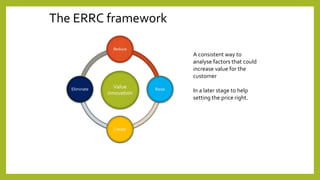
• The four actions framework and grid (Eliminate, Reduce, Raise, Create)
• The three characterisics of a good strategy
The strategy canvas: Benefits
Industry profile by
showing the factors
that affect
competition among
the players.
Shows the strategic profile for
incumbents, identifying which
factors they invest in.
Shows the
company´s strategic
profile and how it
invests in the
competitive factors,
and possible future
factors to create a
BOS.
The Strategy Canvas: Components
Component Graphical depiction Description
Key competive factors Horizontal axis 1. Factors the industry
invests in (red), and
2. Factors that are added
(to create a blue ocean
strategy)
Level of
investment/Value
Vertical axis Captures the offering
levels buyers receive
across all the competitive
facors
Strategic profile Value curve Visualises the strategic
position vis à vis the
competition
The power of visualization: perceptual
bandwith:
• taste: 1.000 b/s
• smell: 100 kb/s
• hearing: 100 kb/s
• touch: 1Mb/s
• sight: 10 Mb/s
(That´s why a picture tells more than a thousand words.)
Value
innovation
Reduce
Raise
Create
Eliminate
The ERRC framework
A consistent way to
analyse factors that could
increase value for the
customer
In a later stage to help
setting the price right.
1. Reconstructing Market Boundaries:
The 6 Paths
• Path 1. Look across alternative
industries
• Path 2. Look across strategic groups
within industries
• Path 3. Look across the chain of
buyers
• Path 4. Look across complementary
product and service offerings
• Path 5. Look across functional or
emotional appeal to buyers
• Path 6. Look across time
Path Head to head
Competition
BlueOcean
Creation
1 Industry Focuses on rivals within the industry Looks across alternative industries
2 Strategic Group Focuses on competitive position within
strategic groups
Across strategic groups
3 Buyer Group Focuses on better serving the buyer
group
Redefines the buyer group
4 Product-Service
Scope
Maximizing the value of product and
service offerings within the bounds of
the industry
Complementary product and service
offerings
5 Functional-
emotional
orientation
Improving price-performance within the
functional-emotional orientation of its
industry
Rethinks
6 Time Adapting to trends Co-creates trends over time
2. Focus on the big picture, not the numbers
(aligning the strategy process)
• Visualize
• Awakening
• Exploration
• Strategy fair
• Communication
3. Reach beyond existing demand
Three groups (tiers) of non-customers
1. Soon to be customers
2. Refusing customers
3. unexplored customers
Expansion instead of
segmentation.
4. Get the strategic sequence right
Decision tree:
1. Buyer utility? (Buyer utility map)
then
2. Price? (Price corridor)
then
3. Cost? (target costing)
then
4. Adoption hurdles? (educating the fearful)
Viable Blue
Ocean Strategy
Characteristics of a BOS
• Focus
• Divergence
• CatchingTagline
EXECUTING BLUE
OCEAN STRATEGY
5. Overcoming key organization hurdles
• Tipping point leadership
• Hurdles:
• cognitive
• resource
• motivational
• political
6. Build execution into strategy
• Take the process in consideration
• Procedural fairness:
• Engagement
• Explanation
• Expectation clarity
• Take the people you´re working with seriously
Examples
1. Philips Senseo
2. Nestlé Nespresso
THT Constant
taste
Brand
loyalty
Price Ease of use Disposal Variety `espresso
feel´
Senseo Coffee
Senseo Coffee Nespresso
Central ideas
• Value for customers
• The customer doesn`t know
what he wants
• Visualise
• Dialogue
• looking for leverage points
• Challenge conventional
wisdom
Challenge
business/firm
paradigms
The main challenge is thus
more entrepreneurial in
nature.
Appraisal
• Puts forward the focus of value innovation: what can we do to increase customer
value in a divergent way (not only cost or diversification).
• Blue Ocean Strategy is a well written account of what creative entrepreneurs and
value innovation can accomplish.
• It offers templates and procedures of which the strategy canvas and the ERRC grid
are an addition to the literature.
Difficulties
• They describe cases and promise success (success bias). From descriptive theory
to prescriptive (pretty common in economic sciences).
• Little is known of firms that consciously addapted BOS –AND were successful.
• Finding and appraising the strategic values is the hard work that asks for out of the
box thinking. Mostly market entrants shake up the industry rules, not the
incumbents.
• For the execution of strategy and accompanying change, better books are
available.
Conclusion
• The strategy canvas and ERRC Grid are valuable tools for analysis, visualisation
and communication.
• It´s difficult to see what we cannot see (paradigms and mental models)
• The customer doesn´t know on forehand what he wants –what is it that we
envision?
• The customer is the central focus: how to increase value.
+49 176 99 129 615

Blue ocean strategy

  • 1.
    BLUE OCEAN STRATEGY The ´Howto´ book No. 2,3 & 7 in Amazon.de (Foreign language books) No. 1,1 & 8 in Amazon.com (relevant categories) Peter Berends W.Chan Kim Renée Mauborgne
  • 2.
    Introduction • What isBlue Ocean Strategy? • Background? • What are the steps prescribed? • How does it relate to practice? • Difficulties and appraisal
  • 3.
    Background • Based ona study of 150 strategic moves spanning more than 100 years and 30 industries. • BOS is the simultaneous pursuit of differentiation and low cost. • The aim of BOS is not to out-perform the competition in the existing industry, but to create new market space or a blue ocean, thereby making the competition irrelevant. • BOS claims to offer systematic and reproducible methodologies and processes in pursuit of value innovation by both new and existing firms.
  • 4.
    What is BlueOcean Strategy? • Blue Ocean Strategy is a preconceived way to maximise the chances to open new competition-free markets that boost firm income (and thus survival). • Red oceans are competition intensive markets where firms ´struggle´ to survive (the oceans are red from the blood of fish biting each other)
  • 5.
    Red Ocean StrategyBlue Ocean Strategy Compete in existing market space Create uncontested market space Beat the competition Make the competition irrelevant Exploit existing demand Create and capture new demand Make the value-cost trade off Break the value-cost trade off Focus on ´normal´ strategic choices Focus on ´both-and´ choices
  • 6.
    Value innovation ascornerstone • Value innovation places equal emphasis on value and innovation. • Value innovation is a new way of thinking about and executing strategy that results in the creation of a blue ocean. • The creation of blue oceans is about driving costs down while simultaneously driving value up for buyers.
  • 7.
    The 6 Principlesof a Blue Ocean Strategy Formulation principles: • Reconstruct market boundaries • Focus on the big picture • Reach beyond existing demand • Get the strategic sequence right Execution principles: • Overcome the four key organizational hurdles • Build execution into strategy
  • 8.
    Analytical tools andframeworks • The strategy canvas • The four actions framework and grid (Eliminate, Reduce, Raise, Create) • The three characterisics of a good strategy
  • 9.
    The strategy canvas:Benefits Industry profile by showing the factors that affect competition among the players. Shows the strategic profile for incumbents, identifying which factors they invest in. Shows the company´s strategic profile and how it invests in the competitive factors, and possible future factors to create a BOS.
  • 10.
    The Strategy Canvas:Components Component Graphical depiction Description Key competive factors Horizontal axis 1. Factors the industry invests in (red), and 2. Factors that are added (to create a blue ocean strategy) Level of investment/Value Vertical axis Captures the offering levels buyers receive across all the competitive facors Strategic profile Value curve Visualises the strategic position vis à vis the competition
  • 11.
    The power ofvisualization: perceptual bandwith: • taste: 1.000 b/s • smell: 100 kb/s • hearing: 100 kb/s • touch: 1Mb/s • sight: 10 Mb/s (That´s why a picture tells more than a thousand words.)
  • 14.
    Value innovation Reduce Raise Create Eliminate The ERRC framework Aconsistent way to analyse factors that could increase value for the customer In a later stage to help setting the price right.
  • 15.
    1. Reconstructing MarketBoundaries: The 6 Paths • Path 1. Look across alternative industries • Path 2. Look across strategic groups within industries • Path 3. Look across the chain of buyers • Path 4. Look across complementary product and service offerings • Path 5. Look across functional or emotional appeal to buyers • Path 6. Look across time
  • 16.
    Path Head tohead Competition BlueOcean Creation 1 Industry Focuses on rivals within the industry Looks across alternative industries 2 Strategic Group Focuses on competitive position within strategic groups Across strategic groups 3 Buyer Group Focuses on better serving the buyer group Redefines the buyer group 4 Product-Service Scope Maximizing the value of product and service offerings within the bounds of the industry Complementary product and service offerings 5 Functional- emotional orientation Improving price-performance within the functional-emotional orientation of its industry Rethinks 6 Time Adapting to trends Co-creates trends over time
  • 18.
    2. Focus onthe big picture, not the numbers (aligning the strategy process) • Visualize • Awakening • Exploration • Strategy fair • Communication
  • 19.
    3. Reach beyondexisting demand Three groups (tiers) of non-customers 1. Soon to be customers 2. Refusing customers 3. unexplored customers Expansion instead of segmentation.
  • 20.
    4. Get thestrategic sequence right Decision tree: 1. Buyer utility? (Buyer utility map) then 2. Price? (Price corridor) then 3. Cost? (target costing) then 4. Adoption hurdles? (educating the fearful) Viable Blue Ocean Strategy
  • 21.
    Characteristics of aBOS • Focus • Divergence • CatchingTagline
  • 22.
  • 23.
    5. Overcoming keyorganization hurdles • Tipping point leadership • Hurdles: • cognitive • resource • motivational • political
  • 24.
    6. Build executioninto strategy • Take the process in consideration • Procedural fairness: • Engagement • Explanation • Expectation clarity • Take the people you´re working with seriously
  • 25.
  • 26.
    THT Constant taste Brand loyalty Price Easeof use Disposal Variety `espresso feel´ Senseo Coffee Senseo Coffee Nespresso
  • 27.
    Central ideas • Valuefor customers • The customer doesn`t know what he wants • Visualise • Dialogue • looking for leverage points • Challenge conventional wisdom Challenge business/firm paradigms The main challenge is thus more entrepreneurial in nature.
  • 28.
    Appraisal • Puts forwardthe focus of value innovation: what can we do to increase customer value in a divergent way (not only cost or diversification). • Blue Ocean Strategy is a well written account of what creative entrepreneurs and value innovation can accomplish. • It offers templates and procedures of which the strategy canvas and the ERRC grid are an addition to the literature.
  • 29.
    Difficulties • They describecases and promise success (success bias). From descriptive theory to prescriptive (pretty common in economic sciences). • Little is known of firms that consciously addapted BOS –AND were successful. • Finding and appraising the strategic values is the hard work that asks for out of the box thinking. Mostly market entrants shake up the industry rules, not the incumbents. • For the execution of strategy and accompanying change, better books are available.
  • 30.
    Conclusion • The strategycanvas and ERRC Grid are valuable tools for analysis, visualisation and communication. • It´s difficult to see what we cannot see (paradigms and mental models) • The customer doesn´t know on forehand what he wants –what is it that we envision? • The customer is the central focus: how to increase value. +49 176 99 129 615