
Achieving Quality
Production
B
U
S
I
N
E
S
S
S
T
U
D
I
E
S
7115
This chapter will explain:
What quality means and why it is important for all businesses
The concept of quality control and how businesses implement quality control
The concept of quality assurance and how this can be implemented.
7
1
1
5
B
u
s
i
n
e
s
s
S
t
u
d
i
e
s
B
U
S
I
N
E
S
S
S
T
U
D
I
E
S
What Quality Means and Why
It Is Important For All
Businesses?
Quality Quality means to
produce a good or a
service which meets
customer
expectations.
Quality products help businesses:
Establish brand image
Build brand loyalty
Maintain a good reputation
Increase Sales
Attract new customers
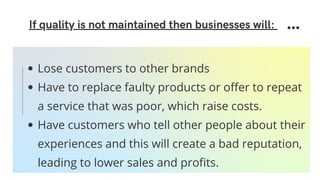
If quality is not maintained then businesses will:
Lose customers to other brands
Have to replace faulty products or offer to repeat
a service that was poor, which raise costs.
Have customers who tell other people about their
experiences and this will create a bad reputation,
leading to lower sales and profits.
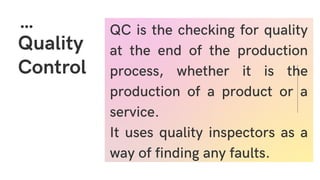
Quality
Control
QC is the checking for quality
at the end of the production
process, whether it is the
production of a product or a
service.
It uses quality inspectors as a
way of finding any faults.
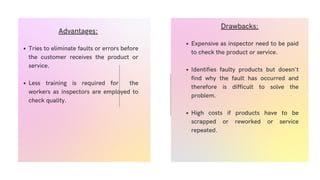
Tries to eliminate faults or errors before
the customer receives the product or
service.
Less training is required for the
workers as inspectors are employed to
check quality.
Advantages:
Expensive as inspector need to be paid
to check the product or service.
Identifies faulty products but doesn't
find why the fault has occurred and
therefore is difficult to solve the
problem.
High costs if products have to be
scrapped or reworked or service
repeated.
Drawbacks:
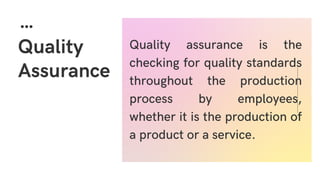
Quality
Assurance
Quality assurance is the
checking for quality standards
throughout the production
process by employees,
whether it is the production of
a product or a service.
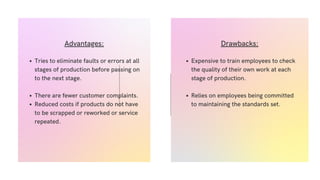
Tries to eliminate faults or errors at all
stages of production before passing on
to the next stage.
There are fewer customer complaints.
Reduced costs if products do not have
to be scrapped or reworked or service
repeated.
Advantages:
Expensive to train employees to check
the quality of their own work at each
stage of production.
Relies on employees being committed
to maintaining the standards set.
Drawbacks:
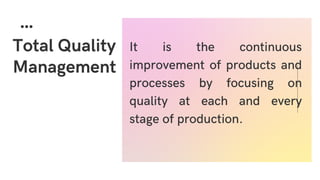
Total Quality
Management
It is the continuous
improvement of products and
processes by focusing on
quality at each and every
stage of production.
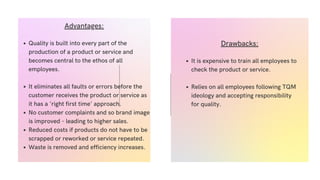
Quality is built into every part of the
production of a product or service and
becomes central to the ethos of all
employees.
It eliminates all faults or errors before the
customer receives the product or service as
it has a 'right first time' approach.
No customer complaints and so brand image
is improved - leading to higher sales.
Reduced costs if products do not have to be
scrapped or reworked or service repeated.
Waste is removed and efficiency increases.
Advantages:
It is expensive to train all employees to
check the product or service.
Relies on all employees following TQM
ideology and accepting responsibility
for quality.
Drawbacks:
How can a customer be assured
of a quality product or service?
Thank you!

Achieving Quality Production

  • 1.
  • 2.
    This chapter willexplain: What quality means and why it is important for all businesses The concept of quality control and how businesses implement quality control The concept of quality assurance and how this can be implemented. 7 1 1 5 B u s i n e s s S t u d i e s
  • 3.
    B U S I N E S S S T U D I E S What Quality Meansand Why It Is Important For All Businesses?
  • 4.
    Quality Quality meansto produce a good or a service which meets customer expectations.
  • 5.
    Quality products helpbusinesses: Establish brand image Build brand loyalty Maintain a good reputation Increase Sales Attract new customers
  • 6.
    If quality isnot maintained then businesses will: Lose customers to other brands Have to replace faulty products or offer to repeat a service that was poor, which raise costs. Have customers who tell other people about their experiences and this will create a bad reputation, leading to lower sales and profits.
  • 7.
    Quality Control QC is thechecking for quality at the end of the production process, whether it is the production of a product or a service. It uses quality inspectors as a way of finding any faults.
  • 8.
    Tries to eliminatefaults or errors before the customer receives the product or service. Less training is required for the workers as inspectors are employed to check quality. Advantages: Expensive as inspector need to be paid to check the product or service. Identifies faulty products but doesn't find why the fault has occurred and therefore is difficult to solve the problem. High costs if products have to be scrapped or reworked or service repeated. Drawbacks:
  • 9.
    Quality Assurance Quality assurance isthe checking for quality standards throughout the production process by employees, whether it is the production of a product or a service.
  • 10.
    Tries to eliminatefaults or errors at all stages of production before passing on to the next stage. There are fewer customer complaints. Reduced costs if products do not have to be scrapped or reworked or service repeated. Advantages: Expensive to train employees to check the quality of their own work at each stage of production. Relies on employees being committed to maintaining the standards set. Drawbacks:
  • 11.
    Total Quality Management It isthe continuous improvement of products and processes by focusing on quality at each and every stage of production.
  • 12.
    Quality is builtinto every part of the production of a product or service and becomes central to the ethos of all employees. It eliminates all faults or errors before the customer receives the product or service as it has a 'right first time' approach. No customer complaints and so brand image is improved - leading to higher sales. Reduced costs if products do not have to be scrapped or reworked or service repeated. Waste is removed and efficiency increases. Advantages: It is expensive to train all employees to check the product or service. Relies on all employees following TQM ideology and accepting responsibility for quality. Drawbacks:
  • 13.
    How can acustomer be assured of a quality product or service?
  • 14.