Total Quality Management
• Encompasses entire organization, from
supplier to customer
• Stresses a commitment by management to
have a continuing, companywide drive
toward excellence in all aspects of products
and services that are important to the
customer
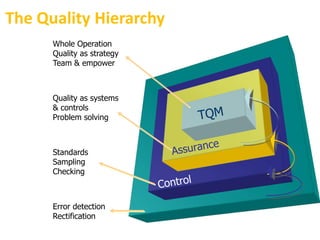
The Quality Hierarchy
Whole Operation
Quality as strategy
Team & empower
Quality as systems
& controls
Problem solving
Standards
Sampling
Checking
Error detection
Rectification
The Quality Hierarchy
Inspection
• The ad – hoc physical check of products or
goods or services to establish their
compliance to specification
• “Quality” introduced after the production
of the goods or services
• Does not examine cause and effect of
poor quality
• Done by remote third party
– Does not empower or make quality
part of the producers responsibility
• Requires physical intervention
• Limited to checking and proving that item
only
– Defects are easily missed unless
100% checking or sampling
techniques applied
• Often limited to the sensitivity of the
testing process or ‘testability’ of the
characteristics under examination
Quality control
• The systematic checking of outputs from
or during a productive process
• “Quality” introduced after the production
of the goods or services
– More systematic
• Still done by remote third party
• Requires physical intervention
• Limited to checking and proving that item
only
– Defects are easily missed unless
100% checking or sampling
techniques applied
• Often limited to the sensitivity of the
testing process or ‘testability’ of the
characteristics under examination
The Quality Hierarchy
Assurance
• A practical implementation of a total
quality approach
– Requires total company commitment
• Strategic quality principle
– Requires total company commitment
• Quality introduced at the outset and
throughout the process
– Builds quality in
• Quality becoming the responsibility of the
producer
• Quality as part of the process
• Administered and policed by remote third
party
Total Quality Management (TQM)
• A total company approach to quality
• Strategic top down strategy
– Used when quality is a key
competitive advantage
• As much a philosophy as a technique
– Customer is king
– Build in rather than inspect in
– Empowerment of the producer
• Demming as pioneer
• Japanese as exemplars of approach
Total Quality Management Concepts
1. Continuous improvement
2. Six Sigma
3. Employee empowerment
4. Benchmarking
5. Just-in-time (JIT)
6. Taguchi concepts
7. Knowledge of TQM tools
Total Quality Management Concepts
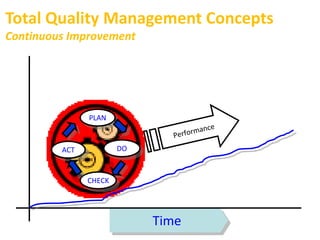
Continuous Improvement
 Represents continual improvement of all
processes
 Involves all operations and work centers
including suppliers and customers
 People, Equipment, Materials, Procedures
Total Quality Management Concepts
Continuous Improvement
Time
PLAN
DO
CHECK
ACT
Total Quality Management Concepts
Six Sigma
 Two meanings
 Statistical definition of a process that is
99.9997% capable, 3.4 defects per million
opportunities (DPMO)
 A program designed to reduce defects, lower
costs, and improve customer satisfaction
Mean
3.4 defects/million
±6
2,700 defects/million
±3
Total Quality Management Concepts
Six Sigma
Total Quality Management Concepts
Six Sigma
• Black Belt
– project leader
• Master Black Belt
– a teacher and mentor
for Black Belts
• Green Belts
– project team members
Total Quality Management Concepts
Six Sigma
Total Quality Management Concepts
Employee Empowerment
 Getting employees involved in product and
process improvements
 85% of quality problems are due
to process and material
 Techniques
 Build communication networks
that include employees
 Develop open, supportive supervisors
 Move responsibility to employees
 Build a high-morale organization
 Create formal team structures
Total Quality Management Concepts
Benchmarking
Selecting best practices to use as a standard
for performance
1. Determine what to
benchmark
2. Form a benchmark team
3. Identify benchmarking partners
4. Collect and analyze benchmarking
information
5. Take action to match or exceed the
benchmark
Total Quality Management Concepts
Just In Time (JIT)
Relationship to quality:
 JIT cuts the cost of quality
 JIT improves quality
 Better quality means less inventory
and better, easier-to-employ JIT
system
Total Quality Management Concepts
Just In Time (JIT)
 ‘Pull’ system of production scheduling including
supply management
 Allows reduced inventory levels
 Inventory costs money and hides process and material problems
 Encourages improved process and product
quality
Total Quality Management Concepts
Just In Time (JIT)
Scrap
Unreliable
Vendors
Capacity Imbalances
Work in process
inventory level
(hides problems)
Total Quality Management Concepts
Just In Time (JIT)
Reducing inventory reveals
problems so they can be solved
Scrap
Unreliable
Vendors
Capacity Imbalances
Total Quality Management Concepts
Taguchi Concepts
 Engineering and experimental design
methods to improve product and process
design
 Identify key component and process variables
affecting product variation
 Taguchi Concepts
 Quality robustness
 Quality loss function
 Target-oriented quality
Total Quality Management Concepts
Quality Robustness
 Ability to produce products uniformly in
adverse manufacturing and
environmental conditions
 Remove the effects of adverse conditions
 Small variations in materials and process
do not destroy product quality
Total Quality Management Concepts
Quality Loss Function
 Shows that costs increase as the
product moves away from what the
customer wants
 Costs include customer dissatisfaction,
warranty and service, internal
scrap and repair, and costs to society
 Traditional conformance specifications
are too simplistic
Total Quality Management Tools
 Tools for Generating Ideas
 Check sheets
 Scatter diagrams
 Cause-and-effect diagrams
 Tools to Organize the Data
 Pareto charts
 Flowcharts
Total Quality Management Tools
Printers
Run
Out of
Toner
Machinery People
Materials Methods Money
Staff don’t
report poor
print
Managers
budgets too
tightly
controlled
Too many
forms to
fill in
Low capacity
toner refills
Using non
branded
toner to
save
money
Total Quality Management Tools
Number of
occurrences
Room svc Check-in Pool hours Minibar Misc.
72% 16% 5% 4% 3%
12
4 3 2
54
– 100
– 93
– 88
– 72
70 –
60 –
50 –
40 –
30 –
20 –
10 –
0 –
Frequency(number)
Causes and percent of the total
Cumulativepercent
Data for October
Pareto Charts
Total Quality Management Tools
Flow Chart
MRI Flowchart
1. Physician schedules MRI
2. Patient taken to MRI
3. Patient signs in
4. Patient is prepped
5. Technician carries out MRI
6. Technician inspects film
7. If unsatisfactory, repeat
8. Patient taken back to room
9. MRI read by radiologist
10. MRI report transferred to
physician
11. Patient and physician discuss
Total Quality Management Tools
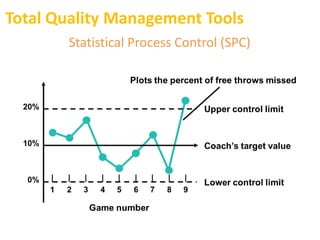
Statistical Process Control (SPC)
 Uses statistics and control charts to tell when
to take corrective action
 Drives process improvement
 Four key steps
 Measure the process
 When a change is indicated, find the assignable cause
 Eliminate or incorporate the cause
 Restart the revised process
Total Quality Management Tools
Statistical Process Control (SPC)
Total Quality Management Tools
Inspection
 Involves examining items to see if an
item is good or defective
 Detect a defective product
 Does not correct deficiencies in process
or product
 It is expensive
 Issues
 When to inspect
 Where in process to inspect
Total Quality Management Tools
When and where to inspect?
1. At the supplier’s plant while the supplier is
producing
2. At your facility upon receipt of goods from the
supplier
3. Before costly or irreversible processes
4. During the step-by-step production process
5. When production or service is complete
6. Before delivery to your customer
7. At the point of customer contact
Total Quality Management Tools
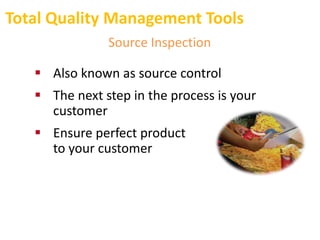
Source Inspection
 Also known as source control
 The next step in the process is your
customer
 Ensure perfect product
to your customer
Total Quality Management Tools
Service Industry Inspection
Organization
What is
Inspected
Standard
Arnold Palmer
Hospital
Billing
Pharmacy
Lab
Nurses
Admissions
Accurate, timely, and
correct format
Prescription accuracy,
inventory accuracy
Audit for lab-test accuracy
Charts immediately
updated
Data entered correctly and
completely
Total Quality Management Tools
Service Industry Inspection
Organization
What is
Inspected
Standard
Nordstrom
Department
Store
Display areas
Stockrooms
Salesclerks
Attractive, well-organized,
stocked, good lighting
Rotation of goods,
organized, clean
Neat, courteous, very
knowledgeable
Total Quality Management Tools
Service Industry Inspection
Organization
What is
Inspected
Standard
Hard Rock Hotel Reception
desk
Doorman
Room
Minibar
Use customer’s name
Greet guest in less than 30
seconds
All lights working, spotless
bathroom
Restocked and charges
accurately posted to bill
Total Quality Management Tools
Service Industry Inspection
Organization
What is
Inspected
Standard
Arnold Palmer
Hospital
Billing
Pharmacy
Lab
Nurses
Admissions
Accurate, timely, and
correct format
Prescription accuracy,
inventory accuracy
Audit for lab-test accuracy
Charts immediately
updated
Data entered correctly and
completely
Total Quality Management Tools
Service Industry Inspection
Organization
What is
Inspected
Standard
Olive Garden
Restaurant
Busboy
Busboy
Waiter
Serves water and bread
within 1 minute
Clears all entrée items and
crumbs prior to dessert
Knows and suggest
specials, desserts
Total Quality Management Tools
Attributes Vs. Variables
 Attributes
 Items are either good or bad, acceptable or
unacceptable
 Does not address degree of failure
 Variables
 Measures dimensions such as weight, speed,
height, or strength
 Falls within an acceptable range
 Use different statistical techniques
Total Quality Management in Service
 Service quality is more difficult to
measure than the quality of goods
 Service quality perceptions depend on
 Intangible differences between products
 Intangible expectations customers have of
those products
Total Quality Management in Service
The Operations Manager must
recognize:
1. The tangible component of services is
important
2. The service process is important
3. The service is judged against the
customer’s expectations
4. Exceptions will occur
Total Quality Management in Service
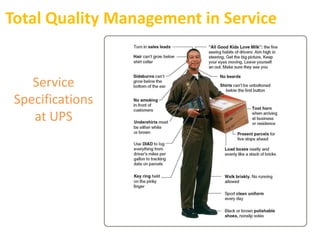
Service
Specifications
at UPS
Total Quality Management in Service
Determinants of Service Quality
Reliability Consistency of performance and dependability
Responsiveness Willingness or readiness of employees
Competence Required skills and knowledge
Access Approachability and ease of contact
Courtesy Politeness, respect, consideration, friendliness
Communication Keeping customers informed
Credibility Trustworthiness, believability, honesty
Security Freedom from danger, risk, or doubt
Understanding/
knowing the customer
Understand the customer’s needs
Tangibles Physical evidence of the service
Total Quality Management in Service
Service Recovery Strategy
 Managers should have a plan for when
services fail
 Marriott’s LEARN routine
 Listen
 Empathize
 Apologize
 React
 Notify

Quality managemnt day 2 material

  • 1.
    Total Quality Management •Encompasses entire organization, from supplier to customer • Stresses a commitment by management to have a continuing, companywide drive toward excellence in all aspects of products and services that are important to the customer
  • 2.
    The Quality Hierarchy WholeOperation Quality as strategy Team & empower Quality as systems & controls Problem solving Standards Sampling Checking Error detection Rectification
  • 3.
    The Quality Hierarchy Inspection •The ad – hoc physical check of products or goods or services to establish their compliance to specification • “Quality” introduced after the production of the goods or services • Does not examine cause and effect of poor quality • Done by remote third party – Does not empower or make quality part of the producers responsibility • Requires physical intervention • Limited to checking and proving that item only – Defects are easily missed unless 100% checking or sampling techniques applied • Often limited to the sensitivity of the testing process or ‘testability’ of the characteristics under examination Quality control • The systematic checking of outputs from or during a productive process • “Quality” introduced after the production of the goods or services – More systematic • Still done by remote third party • Requires physical intervention • Limited to checking and proving that item only – Defects are easily missed unless 100% checking or sampling techniques applied • Often limited to the sensitivity of the testing process or ‘testability’ of the characteristics under examination
  • 4.
    The Quality Hierarchy Assurance •A practical implementation of a total quality approach – Requires total company commitment • Strategic quality principle – Requires total company commitment • Quality introduced at the outset and throughout the process – Builds quality in • Quality becoming the responsibility of the producer • Quality as part of the process • Administered and policed by remote third party Total Quality Management (TQM) • A total company approach to quality • Strategic top down strategy – Used when quality is a key competitive advantage • As much a philosophy as a technique – Customer is king – Build in rather than inspect in – Empowerment of the producer • Demming as pioneer • Japanese as exemplars of approach
  • 5.
    Total Quality ManagementConcepts 1. Continuous improvement 2. Six Sigma 3. Employee empowerment 4. Benchmarking 5. Just-in-time (JIT) 6. Taguchi concepts 7. Knowledge of TQM tools
  • 6.
    Total Quality ManagementConcepts Continuous Improvement  Represents continual improvement of all processes  Involves all operations and work centers including suppliers and customers  People, Equipment, Materials, Procedures
  • 7.
    Total Quality ManagementConcepts Continuous Improvement Time PLAN DO CHECK ACT
  • 8.
    Total Quality ManagementConcepts Six Sigma  Two meanings  Statistical definition of a process that is 99.9997% capable, 3.4 defects per million opportunities (DPMO)  A program designed to reduce defects, lower costs, and improve customer satisfaction
  • 9.
  • 10.
    Total Quality ManagementConcepts Six Sigma • Black Belt – project leader • Master Black Belt – a teacher and mentor for Black Belts • Green Belts – project team members
  • 11.
    Total Quality ManagementConcepts Six Sigma
  • 12.
    Total Quality ManagementConcepts Employee Empowerment  Getting employees involved in product and process improvements  85% of quality problems are due to process and material  Techniques  Build communication networks that include employees  Develop open, supportive supervisors  Move responsibility to employees  Build a high-morale organization  Create formal team structures
  • 13.
    Total Quality ManagementConcepts Benchmarking Selecting best practices to use as a standard for performance 1. Determine what to benchmark 2. Form a benchmark team 3. Identify benchmarking partners 4. Collect and analyze benchmarking information 5. Take action to match or exceed the benchmark
  • 14.
    Total Quality ManagementConcepts Just In Time (JIT) Relationship to quality:  JIT cuts the cost of quality  JIT improves quality  Better quality means less inventory and better, easier-to-employ JIT system
  • 15.
    Total Quality ManagementConcepts Just In Time (JIT)  ‘Pull’ system of production scheduling including supply management  Allows reduced inventory levels  Inventory costs money and hides process and material problems  Encourages improved process and product quality
  • 16.
    Total Quality ManagementConcepts Just In Time (JIT) Scrap Unreliable Vendors Capacity Imbalances Work in process inventory level (hides problems)
  • 17.
    Total Quality ManagementConcepts Just In Time (JIT) Reducing inventory reveals problems so they can be solved Scrap Unreliable Vendors Capacity Imbalances
  • 18.
    Total Quality ManagementConcepts Taguchi Concepts  Engineering and experimental design methods to improve product and process design  Identify key component and process variables affecting product variation  Taguchi Concepts  Quality robustness  Quality loss function  Target-oriented quality
  • 19.
    Total Quality ManagementConcepts Quality Robustness  Ability to produce products uniformly in adverse manufacturing and environmental conditions  Remove the effects of adverse conditions  Small variations in materials and process do not destroy product quality
  • 20.
    Total Quality ManagementConcepts Quality Loss Function  Shows that costs increase as the product moves away from what the customer wants  Costs include customer dissatisfaction, warranty and service, internal scrap and repair, and costs to society  Traditional conformance specifications are too simplistic
  • 21.
    Total Quality ManagementTools  Tools for Generating Ideas  Check sheets  Scatter diagrams  Cause-and-effect diagrams  Tools to Organize the Data  Pareto charts  Flowcharts
  • 22.
  • 23.
  • 24.
  • 25.
    Total Quality ManagementTools Printers Run Out of Toner Machinery People Materials Methods Money Staff don’t report poor print Managers budgets too tightly controlled Too many forms to fill in Low capacity toner refills Using non branded toner to save money
  • 26.
  • 27.
  • 28.
  • 29.
  • 30.
    Total Quality ManagementTools Number of occurrences Room svc Check-in Pool hours Minibar Misc. 72% 16% 5% 4% 3% 12 4 3 2 54 – 100 – 93 – 88 – 72 70 – 60 – 50 – 40 – 30 – 20 – 10 – 0 – Frequency(number) Causes and percent of the total Cumulativepercent Data for October Pareto Charts
  • 31.
    Total Quality ManagementTools Flow Chart MRI Flowchart 1. Physician schedules MRI 2. Patient taken to MRI 3. Patient signs in 4. Patient is prepped 5. Technician carries out MRI 6. Technician inspects film 7. If unsatisfactory, repeat 8. Patient taken back to room 9. MRI read by radiologist 10. MRI report transferred to physician 11. Patient and physician discuss
  • 32.
    Total Quality ManagementTools Statistical Process Control (SPC)  Uses statistics and control charts to tell when to take corrective action  Drives process improvement  Four key steps  Measure the process  When a change is indicated, find the assignable cause  Eliminate or incorporate the cause  Restart the revised process
  • 33.
    Total Quality ManagementTools Statistical Process Control (SPC)
  • 34.
    Total Quality ManagementTools Inspection  Involves examining items to see if an item is good or defective  Detect a defective product  Does not correct deficiencies in process or product  It is expensive  Issues  When to inspect  Where in process to inspect
  • 35.
    Total Quality ManagementTools When and where to inspect? 1. At the supplier’s plant while the supplier is producing 2. At your facility upon receipt of goods from the supplier 3. Before costly or irreversible processes 4. During the step-by-step production process 5. When production or service is complete 6. Before delivery to your customer 7. At the point of customer contact
  • 36.
    Total Quality ManagementTools Source Inspection  Also known as source control  The next step in the process is your customer  Ensure perfect product to your customer
  • 37.
    Total Quality ManagementTools Service Industry Inspection Organization What is Inspected Standard Arnold Palmer Hospital Billing Pharmacy Lab Nurses Admissions Accurate, timely, and correct format Prescription accuracy, inventory accuracy Audit for lab-test accuracy Charts immediately updated Data entered correctly and completely
  • 38.
    Total Quality ManagementTools Service Industry Inspection Organization What is Inspected Standard Nordstrom Department Store Display areas Stockrooms Salesclerks Attractive, well-organized, stocked, good lighting Rotation of goods, organized, clean Neat, courteous, very knowledgeable
  • 39.
    Total Quality ManagementTools Service Industry Inspection Organization What is Inspected Standard Hard Rock Hotel Reception desk Doorman Room Minibar Use customer’s name Greet guest in less than 30 seconds All lights working, spotless bathroom Restocked and charges accurately posted to bill
  • 40.
    Total Quality ManagementTools Service Industry Inspection Organization What is Inspected Standard Arnold Palmer Hospital Billing Pharmacy Lab Nurses Admissions Accurate, timely, and correct format Prescription accuracy, inventory accuracy Audit for lab-test accuracy Charts immediately updated Data entered correctly and completely
  • 41.
    Total Quality ManagementTools Service Industry Inspection Organization What is Inspected Standard Olive Garden Restaurant Busboy Busboy Waiter Serves water and bread within 1 minute Clears all entrée items and crumbs prior to dessert Knows and suggest specials, desserts
  • 42.
    Total Quality ManagementTools Attributes Vs. Variables  Attributes  Items are either good or bad, acceptable or unacceptable  Does not address degree of failure  Variables  Measures dimensions such as weight, speed, height, or strength  Falls within an acceptable range  Use different statistical techniques
  • 43.
    Total Quality Managementin Service  Service quality is more difficult to measure than the quality of goods  Service quality perceptions depend on  Intangible differences between products  Intangible expectations customers have of those products
  • 44.
    Total Quality Managementin Service The Operations Manager must recognize: 1. The tangible component of services is important 2. The service process is important 3. The service is judged against the customer’s expectations 4. Exceptions will occur
  • 45.
    Total Quality Managementin Service Service Specifications at UPS
  • 46.
    Total Quality Managementin Service Determinants of Service Quality Reliability Consistency of performance and dependability Responsiveness Willingness or readiness of employees Competence Required skills and knowledge Access Approachability and ease of contact Courtesy Politeness, respect, consideration, friendliness Communication Keeping customers informed Credibility Trustworthiness, believability, honesty Security Freedom from danger, risk, or doubt Understanding/ knowing the customer Understand the customer’s needs Tangibles Physical evidence of the service
  • 47.
    Total Quality Managementin Service Service Recovery Strategy  Managers should have a plan for when services fail  Marriott’s LEARN routine  Listen  Empathize  Apologize  React  Notify