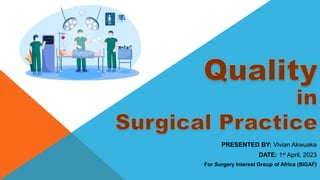
PRESENTED BY: Vivian Akwuaka
DATE: 1st April, 2023
For Surgery Interest Group of Africa (SIGAF)
OUTLINE
Overview of
Quality and
Patient Safety
Surgical Safety
Measuring and
Sustaining
Improvement
Conclusion
P r e s e n t e d B y : V i v i a n
A k w u a k a
D a t e : 1 s t A p r i l , 2 0 2 3
OVERVIEW OF
QUALITY AND
PATIENT SAFETY
Quality in Healthcare
•Safe
•Delivering health care that
minimizes risks and harm to service
users, including avoiding preventable
injuries and reducing medical errors.
•Timely
•Reducing delays in providing and
receiving health care.
•Effective
•Providing services based on
scientific knowledge and evidence-
based guidelines.
•Efficient
•Delivering health care in a manner
that maximizes resource use and
avoids waste.
•Equitable
•Delivering health care that does not
differ in quality according to personal
characteristics such as gender, race,
ethnicity, geographical location or
socioeconomic status.
•Patient-centered
•Providing care that takes into
account the preferences and
aspirations of individual service
users and the culture of their
community.
P r e s e n t e d B y : V i v i a n
A k w u a k a
D a t e : 1 s t A p r i l 2 0 2 3
P r e s e n t e d B y : V i v i a n
A k w u a k a
D a t e : 1 s t A p r i l 2 0 2 3
CLIENT, FAMILY AND PUBLIC INVOLVEMENT
Patient and family involvement includes the feedback and
experiences from patients and their family members and
caregivers.
Why?
• Increasing complexity in patient care and needs
• Increasing risk/potential for errors and patient harm
• They have experience, expertise, insights and valuable
perspectives that are useful in bringing about changes in
health care regardless of whether their own experience
was positive or negative.
P r e s e n t e d B y : V i v i a n
A k w u a k a
D a t e : 1 s t A p r i l 2 0 2 3
CLIENT, FAMILY AND PUBLIC INVOLVEMENT cont’d
Patient and family involvement in patient care can be achieved
through any/all of the following;
 Information sharing/ Education (individualized)
 Providing the opportunity for patients/family to communicate
their knowledge, fears, anxieties, suggestions, complaints
etc.
 Patient satisfaction surveys
 Interviews and focus group sessions
 Support groups
 Others?
P r e s e n t e d B y : V i v i a n
A k w u a k a
D a t e : 1 s t A p r i l 2 0 2 3
P r e s e n t e d B y : V i v i a n
A k w u a k a
D a t e : 1 s t A p r i l 2 0 2 3
REMEMBER
The patient is a partnerin
his/her care management.
CLINICAL EFFECTIVENESS
The extent to which specific clinical interventions
do what they are intended to do.
 Are we applying ‘best practice’ based on
evidence of effectiveness?
 Are we moving with the times and adapting to
new ways of doing things?
 Do we and our staff have access to
appropriate knowledge resources?
 Is there a wide understanding of up-to-date
guidelines, policies, SOPs in your
organisation?
P r e s e n t e d B y : V i v i a n
A k w u a k a
D a t e : 1 s t A p r i l 2 0 2 3
Best practices are sets of tasks and procedures that
are proven to lead to optimal efficiency and results.
CONTINUOUS QUALITY IMPROVEMENT
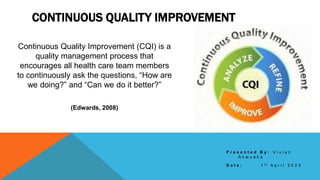
Continuous Quality Improvement (CQI) is a
quality management process that
encourages all health care team members
to continuously ask the questions, “How are
we doing?” and “Can we do it better?”
(Edwards, 2008)
P r e s e n t e d B y : V i v i a n
A k w u a k a
D a t e : 1 s t A p r i l 2 0 2 3
Donabedian’s
Triad
P r e s e n t e d B y : V i v i a n
A k w u a k a
D a t e : 1 s t A p r i l 2 0 2 3
Image by Denadai and Lo, 2021.
SURGICAL
SAFETY
SURGICAL SAFETY why?
 Annual volume of major surgery globally was 187 – 281 million in 2004 (Public health concern)
 In industrialized countries, major complications occur in 3 – 22% of inpatient surgical
procedures with a death rate of 0.4 – 0.8%. Nearly half of these adverse events are
preventable
 In developing countries, Death rate after major surgery is as high as 10%
 Published series showing avoidable anaesthesia mortality rates of 1:3000 in Zimbabwe,
1:1900 in Zambia, 1:500 in Malawi and 1:150 in Togo
 A 2019 study conducted in 79 Nigerian hospitals showed an 18.5% postoperative
complications rate.
 Mortality from general anaesthesia alone is reported to be as high as one in 150 in some parts
of sub-Saharan Africa.
 According to the Guardian Newspaper UK (2013), three of the 5 worst medical nightmares
patients face are; wrong site surgery, wrong patient surgery and retained instruments/swabs
P r e s e n t e d B y : V i v i a n
A k w u a k a
D a t e : 1 s t A p r i l 2 0 2 3
SURGICAL SAFETY IN PRACTICE
Doing no harm
through all the
phases of
surgical care.
P r e s e n t e d B y : V i v i a n
A k w u a k a
D a t e : 1 s t A p r i l 2 0 2 3
Doing no harm
through all the
phases of
surgical care.
WHO PATIENT SAFETY SAFE SURGERY SAVES LIVES
CHALLENGE
P r e s e n t e d B y : V i v i a n
A k w u a k a
D a t e : 1 s t A p r i l 2 0 2 3
 Focused on identifying the basic components of surgical care to be provided
and by standardizing routines with tools to ensure consistency – WHO
Surgical Safety Checklist, published in 2008
 Pre/post checklist implementation study
 Reduced mortality by nearly half – 1.5% to 0.8%
 Reduced complications by a third – 11% to 7%
P r e s e n t e d B y : V i v i a n
A k w u a k a
D a t e : 1 s t A p r i l 2 0 2 3
 Responsible Person: Usually
the circulating nurse but can be
done by any other member of
the surgical team.
 Nearly all the steps will be
checked verbally with the
appropriate personnel to ensure
that the key actions have been
performed
 The checklist is broken down
into three phases:
Sign In
Time Out
Sign Out
SIGN IN Before Induction Of Anaesthesia
 Confirm patient identity, site, procedure and consent
 Confirm surgical site marking
 Anaesthesia safety check – machines working, medicines, anaesthetic risks if any?
 A – Airway equipment
 B – Breathing system (oxygen, inhalational agents, suction etc.)
 C – Circulation (monitoring devices)
 D – Drugs and devices
 E – Emergency medications, equipment and assistance
 Allergy check
 Airway and pulse oximeter if general anaesthesia
 Assess risk of >500mls of blood loss. If yes, large bore IV lines or central line should be
inserted before skin incision. Fluids and relevant blood products should also be made available.
 Prosthesis and other surgical needs
P r e s e n t e d B y : V i v i a n
A k w u a k a
D a t e : 1 s t A p r i l 2 0 2 3
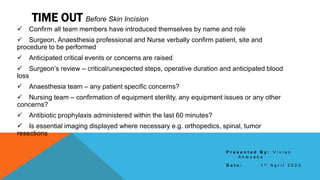
TIME OUT Before Skin Incision
 Confirm all team members have introduced themselves by name and role
 Surgeon, Anaesthesia professional and Nurse verbally confirm patient, site and
procedure to be performed
 Anticipated critical events or concerns are raised
 Surgeon’s review – critical/unexpected steps, operative duration and anticipated blood
loss
 Anaesthesia team – any patient specific concerns?
 Nursing team – confirmation of equipment sterility, any equipment issues or any other
concerns?
 Antibiotic prophylaxis administered within the last 60 minutes?
 Is essential imaging displayed where necessary e.g. orthopedics, spinal, tumor
resections
P r e s e n t e d B y : V i v i a n
A k w u a k a
D a t e : 1 s t A p r i l 2 0 2 3
SIGN OUT Before removing Patient from the OR
 Nurse verbally confirms with the team the name of the procedure recorded
 Instrument, sponge and needle counts are correct or not applicable.
 Specimen labelled including patient’s name
 Equipment problems to be addressed
 Surgeon, Anaesthesia Personnel and Nurse review the key concerns for recovery
and postoperative management of the patient. This ensures transfer of critical
information to the entire team
P r e s e n t e d B y : V i v i a n
A k w u a k a
D a t e : 1 s t A p r i l 2 0 2 3
IMPORTANT NOTES
 The safety steps should inspire effective change that will foster compliance
 The checklist can be modified to reflect differences among facilities but removing
safety steps because they cannot be accomplished in the existing environment or
circumstance is strongly discouraged
 An open culture that promotes respect for the value that each team member
brings is essential for continuous quality improvement and patient safety in surgical
practice.
P r e s e n t e d B y : V i v i a n
A k w u a k a
D a t e : 1 s t A p r i l 2 0 2 3
MEASURING
AND SUSTAINING
IMPROVEMENT
CLINICAL AUDITS AND MONITORING
Healthcare organisations must ensure that
clinicians participate in regular clinical audit and
reviews of clinical services
Clinicians are involved in prioritising, conducting,
reporting and acting on clinical audits.
Clinicians participate in reviewing the effectiveness
of clinical services through evaluation, audit or
research.
P r e s e n t e d B y : V i v i a n
A k w u a k a
D a t e : 1 s t A p r i l 2 0 2 3
Audit is different from Research
PRINCIPLES TO FOLLOW FOR AUDITS
 Objectivity
 Honesty
 Accurate and use of standards forms
 Confodentiality and patient privacy
 Relevance to common clinical problems
 Clear standards set by peer assessment
 Education and learning rather that blame or punishment
 Complete medical records
 All that happened to the patient
 Result of investigations
 Post-Op notes
 Follow-up information
 Autopsy findings if applicable
 Audit should lead to appropriate action
P r e s e n t e d B y : V i v i a n
A k w u a k a
D a t e : 1 s t A p r i l 2 0 2 3
A good surgeon must never
hide his/her faults, but should
learn from them in order to
better serve the patients and
improve his/her practice
Akinbode, 2015.
SURGICAL AUDIT PARAMETERS
 Time utilization
 Cost effectiveness
 Mortality and morbidity assessment
 Quality of diagnostic services - discrepancies
 Performance monitoring
 Assessment of newer technologies
 Surgical outcomes and complication rates
 Patient satisfaction
P r e s e n t e d B y : V i v i a n
A k w u a k a
D a t e : 1 s t A p r i l 2 0 2 3
Structure
•Amount and type of
available resources
e.g. beds, staff,
doctor/nures to
patient ratios,
equipment, wards
Process
•Time and flow of
processes carried
out e.g. surgery
times, down times,
knife on skin time
Outcomes
•Mortality
•SSI rates
•Complication rates
•Unplanned Return
to OR or
readmission
•Quality of life
•Long term survival
CONCLUSION
P r e s e n t e d B y : V i v i a n
A k w u a k a
D a t e : 1 s t A p r i l 2 0 2 3
Surgical care is one of the very essential
aspects of general clinical care.
Prepare and
Prevent
instead of
Repair and Repent
REFERENCES
Denadai, R., & Lo, L. J. (2021). Adapting Donabedian's structure-process-outcome triad for quality improvement activities in surgical cleft-craniofacial care. Journal of Plastic, Reconstructive & Aesthetic
Surgery, 74(1), 223-243.Britain, G. (2007). Available at: https://www.jprasurg.com/article/S1748-6815(20)30251-5/fulltext
Benjamin Schwartz (2017) Do No Harm Image. Available at: https://kenan.ethics.duke.edu/doing-no-harm/.
Lowery, J. (2013). Patient-Centered Care Methods and Practices Leading to Health Outcomes and Financial Benefits in Hospital Care. Available at: https://www.semanticscholar.org/paper/Patient-
Centered-Care-Methods-and-Practices-Leading-Lowery/284be4c937e59824f8adcbd5e040e9d43850eb24
WHO Guidelines for Safe Surgery 2009: Safe Surgery Saves Lives. Geneva: World Health Organization; 2009. Section I, Introduction. Available from: https://www.ncbi.nlm.nih.gov/books/NBK143229/
Edwards PJ, et al. Maximizing your investment in EHR: Utilizing EHRs to inform continuous quality improvement. JHIM 2008;22(1):32-7.
Osinaike, B., Ayandipo, O., Onyeka, T., Alagbe-Briggs, O., Mohammed, A., Oyedepo, O., Nuhu, A., Asudo, F., Akanmu, O., Nwokorie, C., Mohammed, A., Edubio,
M., Izuora, K., Mohammed, R., Nweze, O., Efu, M., Eguma, S., Jasper, A., Ewah, R., Akhideno, I., … Nigerian Surgical Outcomes Study Investigators (2019).
Nigerian surgical outcomes - Report of a 7-day prospective cohort study and external validation of the African surgical outcomes study surgical risk
calculator. International journal of surgery (London, England), 68, 148–156. https://doi.org/10.1016/j.ijsu.2019.06.003
Meara, J. G., Leather, A. J., Hagander, L., Alkire, B. C., Alonso, N., Ameh, E. A., ... & Yip, W. (2015). Global Surgery 2030: evidence and solutions for achieving health, welfare, and economic development.
The lancet, 386(9993), 569-624. Available at: https://www.thelancet.com/journals/lancet/article/PIIS0140-6736(15)60160-X/fulltext?dgcid=recommender_referral_trendmd
Akinbode, O. (2015) Surgical Audit. Available at: https://www.slideshare.net/akinbodeog/surgical-audit-55109683
Wikipedia contributors. (2022, September 11). Clinical governance. In Wikipedia, The Free Encyclopedia. Retrieved 06:28, December 4, 2022, from
https://en.wikipedia.org/w/index.php?title=Clinical_governance&oldid=1109684353
P r e s e n t e d B y : V i v i a n
A k w u a k a
D a t e : 1 s t A p r i l 2 0 2 3
P r e s e n t e d B y : V i v i a n
A k w u a k a
D a t e : 1 s t A p r i l 2 0 2 3

Quality in Surgical Practice presentation

  • 1.
    PRESENTED BY: VivianAkwuaka DATE: 1st April, 2023 For Surgery Interest Group of Africa (SIGAF)
  • 2.
    OUTLINE Overview of Quality and PatientSafety Surgical Safety Measuring and Sustaining Improvement Conclusion P r e s e n t e d B y : V i v i a n A k w u a k a D a t e : 1 s t A p r i l , 2 0 2 3
  • 3.
  • 4.
    Quality in Healthcare •Safe •Deliveringhealth care that minimizes risks and harm to service users, including avoiding preventable injuries and reducing medical errors. •Timely •Reducing delays in providing and receiving health care. •Effective •Providing services based on scientific knowledge and evidence- based guidelines. •Efficient •Delivering health care in a manner that maximizes resource use and avoids waste. •Equitable •Delivering health care that does not differ in quality according to personal characteristics such as gender, race, ethnicity, geographical location or socioeconomic status. •Patient-centered •Providing care that takes into account the preferences and aspirations of individual service users and the culture of their community. P r e s e n t e d B y : V i v i a n A k w u a k a D a t e : 1 s t A p r i l 2 0 2 3
  • 5.
    P r es e n t e d B y : V i v i a n A k w u a k a D a t e : 1 s t A p r i l 2 0 2 3
  • 6.
    CLIENT, FAMILY ANDPUBLIC INVOLVEMENT Patient and family involvement includes the feedback and experiences from patients and their family members and caregivers. Why? • Increasing complexity in patient care and needs • Increasing risk/potential for errors and patient harm • They have experience, expertise, insights and valuable perspectives that are useful in bringing about changes in health care regardless of whether their own experience was positive or negative. P r e s e n t e d B y : V i v i a n A k w u a k a D a t e : 1 s t A p r i l 2 0 2 3
  • 7.
    CLIENT, FAMILY ANDPUBLIC INVOLVEMENT cont’d Patient and family involvement in patient care can be achieved through any/all of the following;  Information sharing/ Education (individualized)  Providing the opportunity for patients/family to communicate their knowledge, fears, anxieties, suggestions, complaints etc.  Patient satisfaction surveys  Interviews and focus group sessions  Support groups  Others? P r e s e n t e d B y : V i v i a n A k w u a k a D a t e : 1 s t A p r i l 2 0 2 3
  • 8.
    P r es e n t e d B y : V i v i a n A k w u a k a D a t e : 1 s t A p r i l 2 0 2 3 REMEMBER The patient is a partnerin his/her care management.
  • 9.
    CLINICAL EFFECTIVENESS The extentto which specific clinical interventions do what they are intended to do.  Are we applying ‘best practice’ based on evidence of effectiveness?  Are we moving with the times and adapting to new ways of doing things?  Do we and our staff have access to appropriate knowledge resources?  Is there a wide understanding of up-to-date guidelines, policies, SOPs in your organisation? P r e s e n t e d B y : V i v i a n A k w u a k a D a t e : 1 s t A p r i l 2 0 2 3 Best practices are sets of tasks and procedures that are proven to lead to optimal efficiency and results.
  • 10.
    CONTINUOUS QUALITY IMPROVEMENT ContinuousQuality Improvement (CQI) is a quality management process that encourages all health care team members to continuously ask the questions, “How are we doing?” and “Can we do it better?” (Edwards, 2008) P r e s e n t e d B y : V i v i a n A k w u a k a D a t e : 1 s t A p r i l 2 0 2 3
  • 11.
    Donabedian’s Triad P r es e n t e d B y : V i v i a n A k w u a k a D a t e : 1 s t A p r i l 2 0 2 3 Image by Denadai and Lo, 2021.
  • 12.
  • 13.
    SURGICAL SAFETY why? Annual volume of major surgery globally was 187 – 281 million in 2004 (Public health concern)  In industrialized countries, major complications occur in 3 – 22% of inpatient surgical procedures with a death rate of 0.4 – 0.8%. Nearly half of these adverse events are preventable  In developing countries, Death rate after major surgery is as high as 10%  Published series showing avoidable anaesthesia mortality rates of 1:3000 in Zimbabwe, 1:1900 in Zambia, 1:500 in Malawi and 1:150 in Togo  A 2019 study conducted in 79 Nigerian hospitals showed an 18.5% postoperative complications rate.  Mortality from general anaesthesia alone is reported to be as high as one in 150 in some parts of sub-Saharan Africa.  According to the Guardian Newspaper UK (2013), three of the 5 worst medical nightmares patients face are; wrong site surgery, wrong patient surgery and retained instruments/swabs P r e s e n t e d B y : V i v i a n A k w u a k a D a t e : 1 s t A p r i l 2 0 2 3
  • 14.
    SURGICAL SAFETY INPRACTICE Doing no harm through all the phases of surgical care. P r e s e n t e d B y : V i v i a n A k w u a k a D a t e : 1 s t A p r i l 2 0 2 3
  • 15.
    Doing no harm throughall the phases of surgical care.
  • 16.
    WHO PATIENT SAFETYSAFE SURGERY SAVES LIVES CHALLENGE P r e s e n t e d B y : V i v i a n A k w u a k a D a t e : 1 s t A p r i l 2 0 2 3  Focused on identifying the basic components of surgical care to be provided and by standardizing routines with tools to ensure consistency – WHO Surgical Safety Checklist, published in 2008  Pre/post checklist implementation study  Reduced mortality by nearly half – 1.5% to 0.8%  Reduced complications by a third – 11% to 7%
  • 17.
    P r es e n t e d B y : V i v i a n A k w u a k a D a t e : 1 s t A p r i l 2 0 2 3  Responsible Person: Usually the circulating nurse but can be done by any other member of the surgical team.  Nearly all the steps will be checked verbally with the appropriate personnel to ensure that the key actions have been performed  The checklist is broken down into three phases: Sign In Time Out Sign Out
  • 18.
    SIGN IN BeforeInduction Of Anaesthesia  Confirm patient identity, site, procedure and consent  Confirm surgical site marking  Anaesthesia safety check – machines working, medicines, anaesthetic risks if any?  A – Airway equipment  B – Breathing system (oxygen, inhalational agents, suction etc.)  C – Circulation (monitoring devices)  D – Drugs and devices  E – Emergency medications, equipment and assistance  Allergy check  Airway and pulse oximeter if general anaesthesia  Assess risk of >500mls of blood loss. If yes, large bore IV lines or central line should be inserted before skin incision. Fluids and relevant blood products should also be made available.  Prosthesis and other surgical needs P r e s e n t e d B y : V i v i a n A k w u a k a D a t e : 1 s t A p r i l 2 0 2 3
  • 19.
    TIME OUT BeforeSkin Incision  Confirm all team members have introduced themselves by name and role  Surgeon, Anaesthesia professional and Nurse verbally confirm patient, site and procedure to be performed  Anticipated critical events or concerns are raised  Surgeon’s review – critical/unexpected steps, operative duration and anticipated blood loss  Anaesthesia team – any patient specific concerns?  Nursing team – confirmation of equipment sterility, any equipment issues or any other concerns?  Antibiotic prophylaxis administered within the last 60 minutes?  Is essential imaging displayed where necessary e.g. orthopedics, spinal, tumor resections P r e s e n t e d B y : V i v i a n A k w u a k a D a t e : 1 s t A p r i l 2 0 2 3
  • 20.
    SIGN OUT Beforeremoving Patient from the OR  Nurse verbally confirms with the team the name of the procedure recorded  Instrument, sponge and needle counts are correct or not applicable.  Specimen labelled including patient’s name  Equipment problems to be addressed  Surgeon, Anaesthesia Personnel and Nurse review the key concerns for recovery and postoperative management of the patient. This ensures transfer of critical information to the entire team P r e s e n t e d B y : V i v i a n A k w u a k a D a t e : 1 s t A p r i l 2 0 2 3
  • 21.
    IMPORTANT NOTES  Thesafety steps should inspire effective change that will foster compliance  The checklist can be modified to reflect differences among facilities but removing safety steps because they cannot be accomplished in the existing environment or circumstance is strongly discouraged  An open culture that promotes respect for the value that each team member brings is essential for continuous quality improvement and patient safety in surgical practice. P r e s e n t e d B y : V i v i a n A k w u a k a D a t e : 1 s t A p r i l 2 0 2 3
  • 22.
  • 23.
    CLINICAL AUDITS ANDMONITORING Healthcare organisations must ensure that clinicians participate in regular clinical audit and reviews of clinical services Clinicians are involved in prioritising, conducting, reporting and acting on clinical audits. Clinicians participate in reviewing the effectiveness of clinical services through evaluation, audit or research. P r e s e n t e d B y : V i v i a n A k w u a k a D a t e : 1 s t A p r i l 2 0 2 3 Audit is different from Research
  • 24.
    PRINCIPLES TO FOLLOWFOR AUDITS  Objectivity  Honesty  Accurate and use of standards forms  Confodentiality and patient privacy  Relevance to common clinical problems  Clear standards set by peer assessment  Education and learning rather that blame or punishment  Complete medical records  All that happened to the patient  Result of investigations  Post-Op notes  Follow-up information  Autopsy findings if applicable  Audit should lead to appropriate action P r e s e n t e d B y : V i v i a n A k w u a k a D a t e : 1 s t A p r i l 2 0 2 3 A good surgeon must never hide his/her faults, but should learn from them in order to better serve the patients and improve his/her practice Akinbode, 2015.
  • 25.
    SURGICAL AUDIT PARAMETERS Time utilization  Cost effectiveness  Mortality and morbidity assessment  Quality of diagnostic services - discrepancies  Performance monitoring  Assessment of newer technologies  Surgical outcomes and complication rates  Patient satisfaction P r e s e n t e d B y : V i v i a n A k w u a k a D a t e : 1 s t A p r i l 2 0 2 3 Structure •Amount and type of available resources e.g. beds, staff, doctor/nures to patient ratios, equipment, wards Process •Time and flow of processes carried out e.g. surgery times, down times, knife on skin time Outcomes •Mortality •SSI rates •Complication rates •Unplanned Return to OR or readmission •Quality of life •Long term survival
  • 26.
    CONCLUSION P r es e n t e d B y : V i v i a n A k w u a k a D a t e : 1 s t A p r i l 2 0 2 3 Surgical care is one of the very essential aspects of general clinical care. Prepare and Prevent instead of Repair and Repent
  • 27.
    REFERENCES Denadai, R., &Lo, L. J. (2021). Adapting Donabedian's structure-process-outcome triad for quality improvement activities in surgical cleft-craniofacial care. Journal of Plastic, Reconstructive & Aesthetic Surgery, 74(1), 223-243.Britain, G. (2007). Available at: https://www.jprasurg.com/article/S1748-6815(20)30251-5/fulltext Benjamin Schwartz (2017) Do No Harm Image. Available at: https://kenan.ethics.duke.edu/doing-no-harm/. Lowery, J. (2013). Patient-Centered Care Methods and Practices Leading to Health Outcomes and Financial Benefits in Hospital Care. Available at: https://www.semanticscholar.org/paper/Patient- Centered-Care-Methods-and-Practices-Leading-Lowery/284be4c937e59824f8adcbd5e040e9d43850eb24 WHO Guidelines for Safe Surgery 2009: Safe Surgery Saves Lives. Geneva: World Health Organization; 2009. Section I, Introduction. Available from: https://www.ncbi.nlm.nih.gov/books/NBK143229/ Edwards PJ, et al. Maximizing your investment in EHR: Utilizing EHRs to inform continuous quality improvement. JHIM 2008;22(1):32-7. Osinaike, B., Ayandipo, O., Onyeka, T., Alagbe-Briggs, O., Mohammed, A., Oyedepo, O., Nuhu, A., Asudo, F., Akanmu, O., Nwokorie, C., Mohammed, A., Edubio, M., Izuora, K., Mohammed, R., Nweze, O., Efu, M., Eguma, S., Jasper, A., Ewah, R., Akhideno, I., … Nigerian Surgical Outcomes Study Investigators (2019). Nigerian surgical outcomes - Report of a 7-day prospective cohort study and external validation of the African surgical outcomes study surgical risk calculator. International journal of surgery (London, England), 68, 148–156. https://doi.org/10.1016/j.ijsu.2019.06.003 Meara, J. G., Leather, A. J., Hagander, L., Alkire, B. C., Alonso, N., Ameh, E. A., ... & Yip, W. (2015). Global Surgery 2030: evidence and solutions for achieving health, welfare, and economic development. The lancet, 386(9993), 569-624. Available at: https://www.thelancet.com/journals/lancet/article/PIIS0140-6736(15)60160-X/fulltext?dgcid=recommender_referral_trendmd Akinbode, O. (2015) Surgical Audit. Available at: https://www.slideshare.net/akinbodeog/surgical-audit-55109683 Wikipedia contributors. (2022, September 11). Clinical governance. In Wikipedia, The Free Encyclopedia. Retrieved 06:28, December 4, 2022, from https://en.wikipedia.org/w/index.php?title=Clinical_governance&oldid=1109684353 P r e s e n t e d B y : V i v i a n A k w u a k a D a t e : 1 s t A p r i l 2 0 2 3
  • 28.
    P r es e n t e d B y : V i v i a n A k w u a k a D a t e : 1 s t A p r i l 2 0 2 3

Editor's Notes

  • #5 The IOM defines healthcare quality as, “the degree to which health services for individuals and populations increase the likelihood of desired health outcomes and are consistent with current professional knowledge”.5 Similar is the World Health Organization's (WHO) definition: “the extent to which health care services provided to individuals and populations improve desired health outcomes”
  • #10 i.e. maintain and improve the health of patients securing the greatest possible health gain from the available resources (NHS Quality Improvement Scotland (NHS QIS 2005) Clinical effectiveness is thinking critically about what you do, questioning whether it is having the desired result, making a change to practice. It is based on evidence of what is effective in order to improve patient care and experience.
  • #16 In the preoperative phase, obtaining informed consent, confirming patient identity and operative site and the procedure to be undertaken, checking the integrity of the anaesthetic machine and the availability of emergency medications, and adequate preparation for intraoperative events are all amenable to intervention. During the operation, appropriate and judicious use of antibiotics, availability of essential imaging, appropriate patient monitoring, efficient teamwork, competent anaesthetic and surgical judgements, meticulous surgical technique and good communication among surgeons, anaesthetists and nurses are all necessary to ensure a good outcome. After the operation, a clear plan of care, an understanding of intraoperative events and a commitment to high-quality monitoring may all improve the surgical system, thereby promoting patient safety and improving outcomes. There is also a recognized need for trained personnel and functioning resources, such as adequate lighting and sterilization equipment. Finally, safe surgery requires ongoing quality assurance and monitoring.
  • #19 To make it simple, an audit wants to make sure that the current practice is up to date, and that the way things are currently being done meets the expected standards. This is different from research, where you are looking for new knowledge to add to already established knowledge.
  • #21 To make it simple, an audit wants to make sure that the current practice is up to date, and that the way things are currently being done meets the expected standards. This is different from research, where you are looking for new knowledge to add to already established knowledge.
  • #22 Staff must feel comfortable and empowered to speak up.
  • #24 To make it simple, an audit wants to make sure that the current practice is up to date, and that the way things are currently being done meets the expected standards. This is different from research, where you are looking for new knowledge to add to already established knowledge.