1
The Saskatchewan
Surgical Initiative:
Lessons Learned
Health Quality Summit, Saskatoon, May 7th 2014
Presenters: Donna Davis, Dr. Peter Barrett, Terry Blackmore
(Patient & Family Advisor) (Physician Leader) (A/Exec. Director, Saskatchewan Health)
2
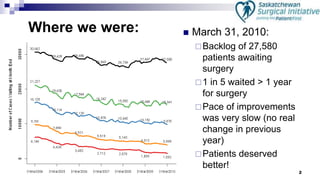
Where we were:  March 31, 2010:
Backlog of 27,580
patients awaiting
surgery
1 in 5 waited > 1 year
for surgery
Pace of improvements
was very slow (no real
change in previous
year)
Patients deserved
better!
3
The Environment
 Sept. 2008 – “Releasing Time to Care” work
leads health leaders to Britain’s National
Health Service; see the 18-week wait time
work first-hand.
 May 2009 – Best Brains exchange on
Managing Wait Times.
 Change management principles.
 IHI model for improvement.
4
The Environment
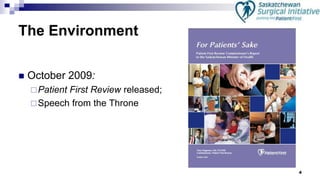
 October 2009:
Patient First Review released;
Speech from the Throne
5
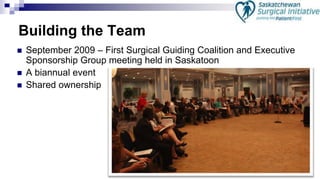
 September 2009 – First Surgical Guiding Coalition and Executive
Sponsorship Group meeting held in Saskatoon
 A biannual event
 Shared ownership
Building the Team
6
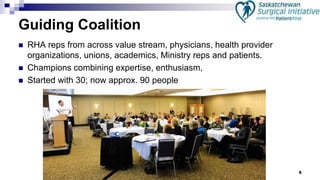
Guiding Coalition
 RHA reps from across value stream, physicians, health provider
organizations, unions, academics, Ministry reps and patients.
 Champions combining expertise, enthusiasm,
 Started with 30; now approx. 90 people
7
Executive Sponsorship Group
 Leaders from Ministry, RHAs, HQC, provider orgs (SMA, SRNA,
SUN), physician leaders, patients
 20-25 participants
 Established the broad vision and objectives
 Ongoing role included:
 Breaking down barriers
 Win hearts and minds in system – highly visible
 Make it uncomfortable to maintain status quo
 Demonstrate courage and commitment – stay the course
 Create incentives; remove disincentives
 Establish mandates and directives
 Support physician leadership and engagement
 Bring resources to the table; investments and disinvestments
8
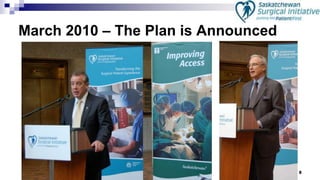
March 2010 – The Plan is Announced
9
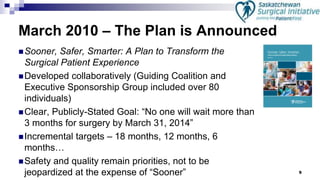
March 2010 – The Plan is Announced
Sooner, Safer, Smarter: A Plan to Transform the
Surgical Patient Experience
Developed collaboratively (Guiding Coalition and
Executive Sponsorship Group included over 80
individuals)
Clear, Publicly-Stated Goal: “No one will wait more than
3 months for surgery by March 31, 2014”
Incremental targets – 18 months, 12 months, 6
months…
Safety and quality remain priorities, not to be
jeopardized at the expense of “Sooner”
10
11
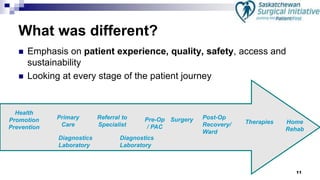
What was different?
 Emphasis on patient experience, quality, safety, access and
sustainability
 Looking at every stage of the patient journey
Diagnostics
Laboratory
Diagnostics
Laboratory
Referral to
Specialist Home
Rehab
Health
Promotion
Prevention
Post-Op
Recovery/
Ward
Therapies
Primary
Care
Pre-Op
/ PAC
Surgery
12
“Listening doesn’t mean you
have heard, and looking
doesn’t mean you have seen.”
Involving Patients and Families
13
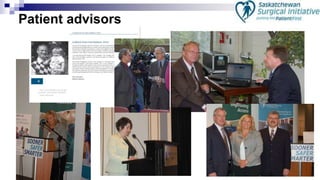
Patient advisors
14
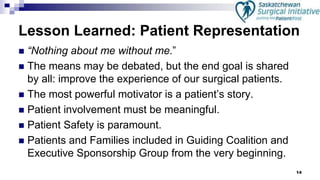
Lesson Learned: Patient Representation
 “Nothing about me without me.”
 The means may be debated, but the end goal is shared
by all: improve the experience of our surgical patients.
 The most powerful motivator is a patient’s story.
 Patient involvement must be meaningful.
 Patient Safety is paramount.
 Patients and Families included in Guiding Coalition and
Executive Sponsorship Group from the very beginning.
15
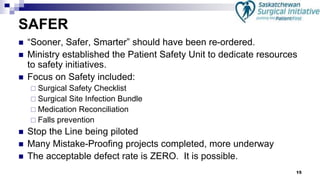
SAFER
 “Sooner, Safer, Smarter” should have been re-ordered.
 Ministry established the Patient Safety Unit to dedicate resources
to safety initiatives.
 Focus on Safety included:
 Surgical Safety Checklist
 Surgical Site Infection Bundle
 Medication Reconciliation
 Falls prevention
 Stop the Line being piloted
 Many Mistake-Proofing projects completed, more underway
 The acceptable defect rate is ZERO. It is possible.
16
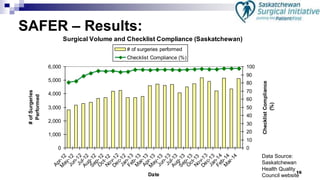
SAFER – Results:
Surgical Volume and Checklist Compliance (Saskatchewan)
0
1,000
2,000
3,000
4,000
5,000
6,000
Apr-12
M
ay-12Jun-12Jul-12Aug-12Sep-12O
ct-12Nov-12
Dec-12Jan-13Feb-13M
ar-13Apr-13
M
ay-13Jun-13Jul-13Aug-13Sep-13O
ct-13Nov-13
Dec-13Jan-14Feb-14M
ar-14
Date
#ofSurgeries
Performed
0
10
20
30
40
50
60
70
80
90
100
ChecklistCompliance
(%)
# of surgeries performed
Checklist Compliance (%)
Data Source:
Saskatchewan
Health Quality
Council website
17
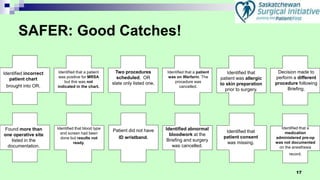
SAFER: Good Catches!
Decision made to
perform a different
procedure following
Briefing.
Identified that a patient
was on Warfarin. The
procedure was
cancelled.
Identified abnormal
bloodwork at the
Briefing and surgery
was cancelled.
Identified that a
medication
administered pre-op
was not documented
on the anesthesia
record.
Identified incorrect
patient chart
brought into OR.
Found more than
one operative site
listed in the
documentation.
Identified that a patient
was positive for MRSA
but this was not
indicated in the chart.
Identified that
patient consent
was missing.
Identified that blood type
and screen had been
done but results not
ready.
Two procedures
scheduled; OR
slate only listed one.
Patient did not have
ID wristband.
Identified that
patient was allergic
to skin preparation
prior to surgery.
18
“Insanity is doing the same
thing over and over again and
expecting different results”
– Albert Einstein
The Surgical Initiative asked “How can we work differently?”
19
Don't ask “What's the matter”;
ask “What matters to you?”
- IHI Conference
20
SMARTER – Continuous Improvement
 Surgical Initiative the first system-wide project to benefit
from Lean methodology:
Standardized process
Visible targets and results
Replicating results
21
SMARTER - Appropriateness
 Appropriateness work is underway.
 Appropriateness is conceptually tied to “clinical variation”.
 Unexplained variation implies a quality problem.
 Working to understand variation and reduce clinical variation in 4
clinical groups (Variation and Appropriateness Working Groups)
“Variation is the breeding ground for error.”
Dr. Richard Shannon
Quality Summit, April 2011
22
Dr. Brent James – Intermountain, Utah
1. Well-documented, massive, variation in practices
(beyond the level where it is even remotely possible that all patients are receiving good care)
2. High rates of inappropriate care (2 - 32% of all care delivered, depending on specific
condition examined)
3. Unacceptable rates of preventable care-associated patient injury and death
4. A striking inability to "do what we know works"
5. Huge amounts of waste ( >50%, by best recent measures), spiraling prices, and limited
access
SMARTER - Appropriateness
23
SMARTER – Clinical Pathways
 Pathways promote timely and appropriate care aligned with the
patient’s preference.
 Clinical pathways implemented:
1. Hip/knee
2. Spine
3. Pelvic floor
4. Prostate
5. Bariatric Surgery
 Acute Stroke Care and Lower Extremity Wound Care pathways
are in development
24
“Only those that provide the
care can improve the care.”
- Don Berwick, IHI, Orlando; Dec 7, 2011
25
Lesson Learned – Physician Engagement
 Critical to engage physicians in improvement work.
 We’re learning how to do a better job of physician
engagement.
 Accurate, meaningful data is persuasive.
26
27
Laurel Trujillo, M.D., Medical Director of Quality
Palo Alto Medical Foundation
 Create a dataset about costs for common problem
 Present data to MDs with goal of triggering conversation
 Allow group to define their own practice standard
 Communicate standard to all
 Provide follow-up data to track changes
Lesson Learned – Physician Engagement
28
Lesson Learned – Shared Vision
 Committed, consistent leadership:
Drive it
No other option
Provide the tools and resources
 But, those closest to the work must fix it
Own it
Drive it
Celebrate the successes
Learn from the failures
29
0100002000030000
Saskatchewan: All Specialties: Number Waiting by Time Already Waited
Month End Dates (Data Source: 30Mar2014 refresh of the SK Surgical Patient Registry)
NumberofCasesWaitingatMonthEnd
28Feb2005 28Feb2006 28Feb2007 29Feb2008 28Feb2009 28Feb2010 28Feb2011 29Feb2012 28Feb2013 28Feb2014
28,679 28,923
27,229
26,671
27,756 27,799
25,345
21,843
19,544
15,776
18,852
18,012
16,793
15,766 15,978 16,003
12,950
9,291
7,868
4,380
13,570
12,420
11,103
10,456 10,387 10,075
7,686
4,645
3,920
1,691
8,092
6,874
5,599
5,051 4,678
4,150
2,763
1,060 947
319
4,558
3,852
2,823 2,526
2,002 1,706
872
275 165 80
Wait Time Colour Key (% change from: 28Feb2010 to 28Feb2014, 31Mar2010 to 28Feb2014)
All (-43%, -43%) > 3 mth (-73%, -71%) > 6 mth (-83%, -83%) > 12 mth (-92%, -92%) > 18 mth (-95%, -95%)
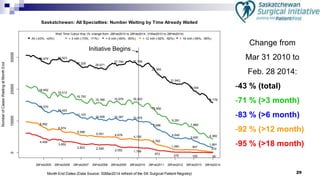
Change from
Mar 31 2010 to
Feb. 28 2014:
-43 % (total)
-71 % (>3 month)
-83 % (>6 month)
-92 % (>12 month)
-95 % (>18 month)
Initiative Begins
30
31
SOONER
 RHAs implemented many improvements – OR allocation, case
cart standardization, better patient flow, better communication,
better relationships.
 Pooled referrals and the Specialist Directory have helped level the
workload amongst specialists, allowing patients to accept the first
available appointment if they choose.
 Third party service delivery offered additional surgical capacity.
 Mid size regions are offering surgery as close to home as
possible.
 Additional perioperative nurse training.
32
Lesson Learned: Importance of Leadership
 Executive Sponsorship Group & Guiding Coalition
 Committed leadership – senior leaders, physicians
and front-line
 Common vision – Think and Act as One
 Patient and family involvement in decision-making
 Bold, clear goals
 Transparent results, shared widely
33
Lesson Learned: Transition Planning
 Keep it Visible
 Consultations across the system on:
 Design of future governance;
 Ensuring continuous improvement; and
 How to engagement system partners.
 Provincial Surgical Oversight Team established
 Patients, physician leaders and system administration involved
 Will monitor results and report to Provincial Leadership Team
34
Results for the Health System
More than shortening wait times
System wide culture shift to patient-centred care and
continuous improvement
Simultaneously improved quality, safety and efficiency
Serve the patient as a whole person – consider the entire
patient journey
Visible incremental targets and measures
35
Results for the Health System
 Strengthened partnerships and relationships
 Patient advisors have become the norm
 Province wide approach to safety and continuous
improvement
 Willingness to share results and learn from each other as well
as high performing organizations
Questions?
Contact Me:
Terry Blackmore
A/Executive Director, Saskatchewan Health
Terry.Blackmore@health.gov.sk.ca
www.qualitysummit.ca
#QS14

The Saskatchewan Surgical Initiative: Lessons Learned

  • 1.
    1 The Saskatchewan Surgical Initiative: LessonsLearned Health Quality Summit, Saskatoon, May 7th 2014 Presenters: Donna Davis, Dr. Peter Barrett, Terry Blackmore (Patient & Family Advisor) (Physician Leader) (A/Exec. Director, Saskatchewan Health)
  • 2.
    2 Where we were: March 31, 2010: Backlog of 27,580 patients awaiting surgery 1 in 5 waited > 1 year for surgery Pace of improvements was very slow (no real change in previous year) Patients deserved better!
  • 3.
    3 The Environment  Sept.2008 – “Releasing Time to Care” work leads health leaders to Britain’s National Health Service; see the 18-week wait time work first-hand.  May 2009 – Best Brains exchange on Managing Wait Times.  Change management principles.  IHI model for improvement.
  • 4.
    4 The Environment  October2009: Patient First Review released; Speech from the Throne
  • 5.
    5  September 2009– First Surgical Guiding Coalition and Executive Sponsorship Group meeting held in Saskatoon  A biannual event  Shared ownership Building the Team
  • 6.
    6 Guiding Coalition  RHAreps from across value stream, physicians, health provider organizations, unions, academics, Ministry reps and patients.  Champions combining expertise, enthusiasm,  Started with 30; now approx. 90 people
  • 7.
    7 Executive Sponsorship Group Leaders from Ministry, RHAs, HQC, provider orgs (SMA, SRNA, SUN), physician leaders, patients  20-25 participants  Established the broad vision and objectives  Ongoing role included:  Breaking down barriers  Win hearts and minds in system – highly visible  Make it uncomfortable to maintain status quo  Demonstrate courage and commitment – stay the course  Create incentives; remove disincentives  Establish mandates and directives  Support physician leadership and engagement  Bring resources to the table; investments and disinvestments
  • 8.
    8 March 2010 –The Plan is Announced
  • 9.
    9 March 2010 –The Plan is Announced Sooner, Safer, Smarter: A Plan to Transform the Surgical Patient Experience Developed collaboratively (Guiding Coalition and Executive Sponsorship Group included over 80 individuals) Clear, Publicly-Stated Goal: “No one will wait more than 3 months for surgery by March 31, 2014” Incremental targets – 18 months, 12 months, 6 months… Safety and quality remain priorities, not to be jeopardized at the expense of “Sooner”
  • 10.
  • 11.
    11 What was different? Emphasis on patient experience, quality, safety, access and sustainability  Looking at every stage of the patient journey Diagnostics Laboratory Diagnostics Laboratory Referral to Specialist Home Rehab Health Promotion Prevention Post-Op Recovery/ Ward Therapies Primary Care Pre-Op / PAC Surgery
  • 12.
    12 “Listening doesn’t meanyou have heard, and looking doesn’t mean you have seen.” Involving Patients and Families
  • 13.
  • 14.
    14 Lesson Learned: PatientRepresentation  “Nothing about me without me.”  The means may be debated, but the end goal is shared by all: improve the experience of our surgical patients.  The most powerful motivator is a patient’s story.  Patient involvement must be meaningful.  Patient Safety is paramount.  Patients and Families included in Guiding Coalition and Executive Sponsorship Group from the very beginning.
  • 15.
    15 SAFER  “Sooner, Safer,Smarter” should have been re-ordered.  Ministry established the Patient Safety Unit to dedicate resources to safety initiatives.  Focus on Safety included:  Surgical Safety Checklist  Surgical Site Infection Bundle  Medication Reconciliation  Falls prevention  Stop the Line being piloted  Many Mistake-Proofing projects completed, more underway  The acceptable defect rate is ZERO. It is possible.
  • 16.
    16 SAFER – Results: SurgicalVolume and Checklist Compliance (Saskatchewan) 0 1,000 2,000 3,000 4,000 5,000 6,000 Apr-12 M ay-12Jun-12Jul-12Aug-12Sep-12O ct-12Nov-12 Dec-12Jan-13Feb-13M ar-13Apr-13 M ay-13Jun-13Jul-13Aug-13Sep-13O ct-13Nov-13 Dec-13Jan-14Feb-14M ar-14 Date #ofSurgeries Performed 0 10 20 30 40 50 60 70 80 90 100 ChecklistCompliance (%) # of surgeries performed Checklist Compliance (%) Data Source: Saskatchewan Health Quality Council website
  • 17.
    17 SAFER: Good Catches! Decisionmade to perform a different procedure following Briefing. Identified that a patient was on Warfarin. The procedure was cancelled. Identified abnormal bloodwork at the Briefing and surgery was cancelled. Identified that a medication administered pre-op was not documented on the anesthesia record. Identified incorrect patient chart brought into OR. Found more than one operative site listed in the documentation. Identified that a patient was positive for MRSA but this was not indicated in the chart. Identified that patient consent was missing. Identified that blood type and screen had been done but results not ready. Two procedures scheduled; OR slate only listed one. Patient did not have ID wristband. Identified that patient was allergic to skin preparation prior to surgery.
  • 18.
    18 “Insanity is doingthe same thing over and over again and expecting different results” – Albert Einstein The Surgical Initiative asked “How can we work differently?”
  • 19.
    19 Don't ask “What'sthe matter”; ask “What matters to you?” - IHI Conference
  • 20.
    20 SMARTER – ContinuousImprovement  Surgical Initiative the first system-wide project to benefit from Lean methodology: Standardized process Visible targets and results Replicating results
  • 21.
    21 SMARTER - Appropriateness Appropriateness work is underway.  Appropriateness is conceptually tied to “clinical variation”.  Unexplained variation implies a quality problem.  Working to understand variation and reduce clinical variation in 4 clinical groups (Variation and Appropriateness Working Groups) “Variation is the breeding ground for error.” Dr. Richard Shannon Quality Summit, April 2011
  • 22.
    22 Dr. Brent James– Intermountain, Utah 1. Well-documented, massive, variation in practices (beyond the level where it is even remotely possible that all patients are receiving good care) 2. High rates of inappropriate care (2 - 32% of all care delivered, depending on specific condition examined) 3. Unacceptable rates of preventable care-associated patient injury and death 4. A striking inability to "do what we know works" 5. Huge amounts of waste ( >50%, by best recent measures), spiraling prices, and limited access SMARTER - Appropriateness
  • 23.
    23 SMARTER – ClinicalPathways  Pathways promote timely and appropriate care aligned with the patient’s preference.  Clinical pathways implemented: 1. Hip/knee 2. Spine 3. Pelvic floor 4. Prostate 5. Bariatric Surgery  Acute Stroke Care and Lower Extremity Wound Care pathways are in development
  • 24.
    24 “Only those thatprovide the care can improve the care.” - Don Berwick, IHI, Orlando; Dec 7, 2011
  • 25.
    25 Lesson Learned –Physician Engagement  Critical to engage physicians in improvement work.  We’re learning how to do a better job of physician engagement.  Accurate, meaningful data is persuasive.
  • 26.
  • 27.
    27 Laurel Trujillo, M.D.,Medical Director of Quality Palo Alto Medical Foundation  Create a dataset about costs for common problem  Present data to MDs with goal of triggering conversation  Allow group to define their own practice standard  Communicate standard to all  Provide follow-up data to track changes Lesson Learned – Physician Engagement
  • 28.
    28 Lesson Learned –Shared Vision  Committed, consistent leadership: Drive it No other option Provide the tools and resources  But, those closest to the work must fix it Own it Drive it Celebrate the successes Learn from the failures
  • 29.
    29 0100002000030000 Saskatchewan: All Specialties:Number Waiting by Time Already Waited Month End Dates (Data Source: 30Mar2014 refresh of the SK Surgical Patient Registry) NumberofCasesWaitingatMonthEnd 28Feb2005 28Feb2006 28Feb2007 29Feb2008 28Feb2009 28Feb2010 28Feb2011 29Feb2012 28Feb2013 28Feb2014 28,679 28,923 27,229 26,671 27,756 27,799 25,345 21,843 19,544 15,776 18,852 18,012 16,793 15,766 15,978 16,003 12,950 9,291 7,868 4,380 13,570 12,420 11,103 10,456 10,387 10,075 7,686 4,645 3,920 1,691 8,092 6,874 5,599 5,051 4,678 4,150 2,763 1,060 947 319 4,558 3,852 2,823 2,526 2,002 1,706 872 275 165 80 Wait Time Colour Key (% change from: 28Feb2010 to 28Feb2014, 31Mar2010 to 28Feb2014) All (-43%, -43%) > 3 mth (-73%, -71%) > 6 mth (-83%, -83%) > 12 mth (-92%, -92%) > 18 mth (-95%, -95%) Change from Mar 31 2010 to Feb. 28 2014: -43 % (total) -71 % (>3 month) -83 % (>6 month) -92 % (>12 month) -95 % (>18 month) Initiative Begins
  • 30.
  • 31.
    31 SOONER  RHAs implementedmany improvements – OR allocation, case cart standardization, better patient flow, better communication, better relationships.  Pooled referrals and the Specialist Directory have helped level the workload amongst specialists, allowing patients to accept the first available appointment if they choose.  Third party service delivery offered additional surgical capacity.  Mid size regions are offering surgery as close to home as possible.  Additional perioperative nurse training.
  • 32.
    32 Lesson Learned: Importanceof Leadership  Executive Sponsorship Group & Guiding Coalition  Committed leadership – senior leaders, physicians and front-line  Common vision – Think and Act as One  Patient and family involvement in decision-making  Bold, clear goals  Transparent results, shared widely
  • 33.
    33 Lesson Learned: TransitionPlanning  Keep it Visible  Consultations across the system on:  Design of future governance;  Ensuring continuous improvement; and  How to engagement system partners.  Provincial Surgical Oversight Team established  Patients, physician leaders and system administration involved  Will monitor results and report to Provincial Leadership Team
  • 34.
    34 Results for theHealth System More than shortening wait times System wide culture shift to patient-centred care and continuous improvement Simultaneously improved quality, safety and efficiency Serve the patient as a whole person – consider the entire patient journey Visible incremental targets and measures
  • 35.
    35 Results for theHealth System  Strengthened partnerships and relationships  Patient advisors have become the norm  Province wide approach to safety and continuous improvement  Willingness to share results and learn from each other as well as high performing organizations
  • 36.
    Questions? Contact Me: Terry Blackmore A/ExecutiveDirector, Saskatchewan Health Terry.Blackmore@health.gov.sk.ca www.qualitysummit.ca #QS14

Editor's Notes

  • #2 Introduction of speakers Outline: Context and background Governance structure The Plan Impact of Patient Advisors Necessity of engaging physicians Results Lessons learned throughout the four year initiative.
  • #3 TERRY… With any large scale change initiative there must be a sense of urgency Our burning platform: Create a better system for our patients. Despite efforts, there had been no real change in previous 6 years.
  • #4 TERRY…
  • #5 TERRY…
  • #9 Minister Don McMorris announced the plan, with Dr. Peter Barrett participating in the announcement as the physician lead. Objectives: Shorten wait time for surgery Better patient experience Safer, higher quality of care Support for good health Patient and family-centred providers.
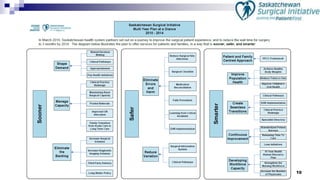
  • #10 TERRY… Looked at entire patient journey
  • #11 TERRY… The “Driver Diagram” was a useful tool because it showed visually how the work fit together Should have led out with SAFER.
  • #12 DONNA…
  • #13 DONNA…
  • #14 DONNA…
  • #15 DONNA…
  • #16 DONNA… Safety initiatives grouped together within the Ministry for the first time. Four examples of safety initiatives under the Surgical Initiative Other work includes Stop the Line (which requires cultural change to enforce that it’s everyone’s responsiblity to speak up if there’s a safety issue. Senior Leaders are being trained in how to conduct Mistake Proofing Projects. It’s important to first identify where mistakes can happen, and then work to fix the processes that allow mistakes to occur. Blame is never placed on an individual – it’s the process that needs to be fixed. The system shouldn’t tolerate any rate of defects greater than zero. - Share your story. What is at stake? Safety is paramount.
  • #17 DONNA… In the 24 months shown, surgical volumes increased fairly steadily, nearly doubling (from 2,822 in April 2012 to 5,118 in March 2014). At the same time, Surgical Checklist Compliance increased from 80% to 97% today. Goal is 100%, so there is still room for improvement.
  • #18 DONNA… Real Saskatchewan examples of how the Surgical Safety Checklist has protected patients from harm. From patient’s perspective, safety is the most important factor.
  • #19 PETER…
  • #20 PETER…
  • #21 PETER…
  • #22 PETER…
  • #24 PETER…
  • #26 PETER…
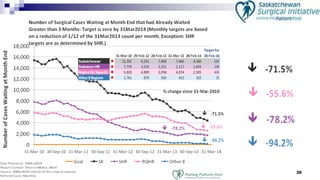
  • #30 TERRY… 4,380 patients waiting >3 months for surgery compared to 15,353 when the initiative began.
  • #31 TERRY…
  • #32 TERRY…
  • #33 TERRY…
  • #34 TERRY…
  • #35 TERRY…
  • #36 TERRY…