1
2
Quality Awareness
Programme
BLACK CAT ENGINEERING &
CONSTRUCTION COMPANY
Prepared by : Amitkumar Vasavada
Sr.QA Engineer
Supported by : Mohamed A.Mansour
QA/QC Manager
3
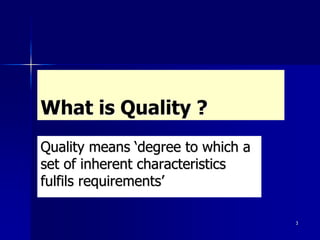
What is Quality ?
Quality means ‘degree to which a
set of inherent characteristics
fulfils requirements’
4
Difference between Quality
Control & Quality Assurance
Quality Assurance Quality Control
 Focused on providing Focused on fulfilling
confidence that quality quality requirements.
requirements will be
fulfilled.
 Process oriented Product Oriented
 Defect prevention Defect detection
 New concept on Traditional on
prevention correction
5
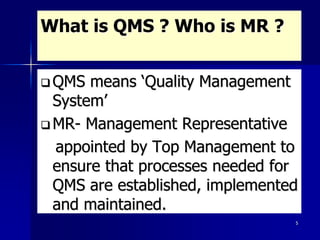
What is QMS ? Who is MR ?
 QMS means ‘Quality Management
System’
 MR- Management Representative
appointed by Top Management to
ensure that processes needed for
QMS are established, implemented
and maintained.
6
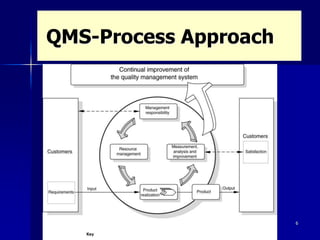
QMS-Process Approach
7
What are the QMS
documentations?
Statement of Quality Policy & Quality
Objectives
 Quality Management
Procedure/Quality Control Procedure
 ITPs /Method Statement(MS)
 Records/Registers
8
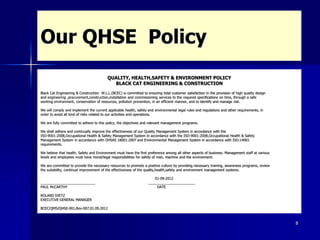
Our QHSE Policy
QUALITY, HEALTH,SAFETY & ENVIRONMENT POLICY
BLACK CAT ENGINEERING & CONSTRUCTION
Black Cat Engineering & Construction W.L.L.(BCEC) is committed to ensuring total customer satisfaction in the provision of high quality design
and engineering ,procurement,construction,installation and commissioning services to the required specifications on time, through a safe
working environment, conservation of resources, pollution prevention, in an efficient manner, and to identify and manage risk.
We will comply and implement the current applicable health, safety and environmental legal rules and regulations and other requirements, in
order to avoid all kind of risks related to our activities and operations.
We are fully committed to adhere to this policy, the objectives and relevant management programs.
We shall adhere and continually improve the effectiveness of our Quality Management System in accordance with the
ISO-9001:2008,Occupational Health & Safety Management System in accordance with the ISO-9001:2008,Occupational Health & Safety
Management System in accordance with OHSAS 18001:2007 and Environmental Management System in accordance with ISO:14001
requirements.
We believe that health, Safety and Environment must have the first preference among all other aspects of business. Management staff at various
levels and employees must have moral/legal responsibilities for safety of man, machine and the environment.
We are committed to provide the necessary resources to promote a positive culture by providing necessary training, awareness programs, review
the suitability, continual improvement of the effectiveness of the quality,health,safety and environment management systems.
01-09-2012
____________________________ ________________________
PAUL McCARTHY DATE
ROLAND DIETZ
EXECUTIVE GENERAL MANAGER
BCEC/QMS/QHSE-001,Rev-007,01.09.2012
9
ITP- Basis & content
 Basis of ITP :
 Project Specification
 Drawing
 Quality Control Procedure
 Content of ITP:
 Chief Quality related activities
10
ITP Content
 Reference documents to be used.
 All characteristics/parameters to be
verified.
 Verifying documents where test results
recorded.
 Person/Party to be present during activities.
11
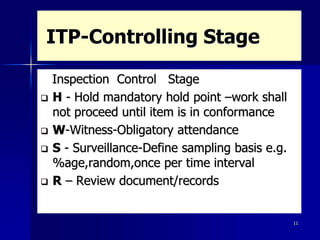
ITP-Controlling Stage
Inspection Control Stage
 H - Hold mandatory hold point –work shall
not proceed until item is in conformance
 W-Witness-Obligatory attendance
 S - Surveillance-Define sampling basis e.g.
%age,random,once per time interval
 R – Review document/records
12
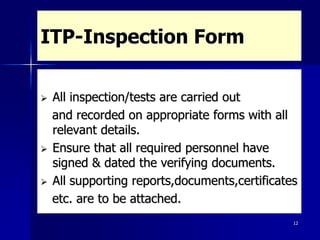
ITP-Inspection Form
 All inspection/tests are carried out
and recorded on appropriate forms with all
relevant details.
 Ensure that all required personnel have
signed & dated the verifying documents.
 All supporting reports,documents,certificates
etc. are to be attached.
13
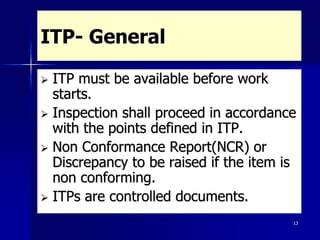
ITP- General
 ITP must be available before work
starts.
 Inspection shall proceed in accordance
with the points defined in ITP.
 Non Conformance Report(NCR) or
Discrepancy to be raised if the item is
non conforming.
 ITPs are controlled documents.
14
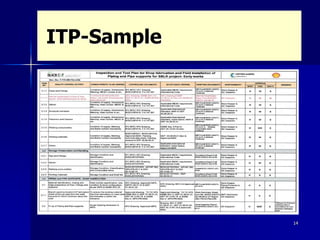
ITP-Sample
15
Quality Management
Principles used by BCEC
Our company BCEC used eight quality management
principles in order to lead and operate an
organization successfully.
 Customer Focus
 Leadership
 Involvement of people
 Process approach
 System approach to management
 Continual improvement
 Factual approach to decision making
 Mutually beneficial supplier relationships
16
Why Quality records are
required ?
Quality Records are the evidence of
any planned activity carried out and
provide evidence of conformity to
requirements and of the effective
operation of the Quality Management
System.
17
What is ‘Non Conformity’
 Non conformity is defined as ‘Non
fulfillment of a requirements’
 This requirements can be project
specification, drawing etc.
 Identify & store non conforming material
seperately .
 Take appropriate corrective and preventive
actions.
18
Difference between Corrective
and preventive action
 Corrective action- Action taken to eliminate
the cause of a detected non conformity to
prevent recurrence or other undesirable
situation. Correction is also a part of
corrective action.
 Preventive action-Action to eliminate the
cause of a potential nonconformity in order
to prevent occurrence.
19
Cost of Poor Quality
Cost of Quality associated with conformance
cost and non conformance cost.
General quality cost models are based on :
(i) Prevention cost i.e. Design & development
cost,training,supplier’s evaluation
(ii) Appraisal cost i.e. Measurement of
product, calibration cost etc.
(iii)Failure cost (Internal + External)
20
Continue
 Quality defect is a cost. Indeed it is more
costly to correct defect or errors than to ‘do
it right’ from the beginning.
 The cost of a quality defect is greater the
later it is detected. e.g. cost involved during
production is lesser than to client’s
end(shipment,handling etc)
21
How will you satisfy your
customer?
Fulfilling Customer’s requirements by :
 Effective implementation of Quality
Management System , Project procedures,
Quality Control Procedures, Inspection &
test Plan, Method statement etc.
 Project Specification
 Maintaining Associated records.
22
Involvement of people
 People are like asset of the Organisation and their
involvement and support can be encouraged by
following;
 Providing on going training and career planning.
 Defining their role & responsibilities
 Establishing individual & team objectives
 Recognizing and rewarding
 Maintaining openness & two way communication
 Ensuring effective team work
 Communicating suggestions and opinions.
23
Ways of communicating
quality requirements
 Site meeting, team briefing, training
 Notice boards,inhouse
journals/magazines
 Audio visual and electronic media,such
as e-mail, websites etc.
 Employee surveys and suggestion
schemes
24
About your monitoring &
measuring equipments-
 Check and verify calibration status
from the stickers or marking on the
equipment .
 Don’t proceed unless until you are
clear about calibration status.
 It is everyone’s responsibility to ensure
that equipments/instruments are fit for
use and maintained to suitable
accuracy and their status identified.
25
Any Questions ?
THANK YOU

Quality Awareness Program.ppt

  • 1.
  • 2.
    2 Quality Awareness Programme BLACK CATENGINEERING & CONSTRUCTION COMPANY Prepared by : Amitkumar Vasavada Sr.QA Engineer Supported by : Mohamed A.Mansour QA/QC Manager
  • 3.
    3 What is Quality? Quality means ‘degree to which a set of inherent characteristics fulfils requirements’
  • 4.
    4 Difference between Quality Control& Quality Assurance Quality Assurance Quality Control  Focused on providing Focused on fulfilling confidence that quality quality requirements. requirements will be fulfilled.  Process oriented Product Oriented  Defect prevention Defect detection  New concept on Traditional on prevention correction
  • 5.
    5 What is QMS? Who is MR ?  QMS means ‘Quality Management System’  MR- Management Representative appointed by Top Management to ensure that processes needed for QMS are established, implemented and maintained.
  • 6.
  • 7.
    7 What are theQMS documentations? Statement of Quality Policy & Quality Objectives  Quality Management Procedure/Quality Control Procedure  ITPs /Method Statement(MS)  Records/Registers
  • 8.
    8 Our QHSE Policy QUALITY,HEALTH,SAFETY & ENVIRONMENT POLICY BLACK CAT ENGINEERING & CONSTRUCTION Black Cat Engineering & Construction W.L.L.(BCEC) is committed to ensuring total customer satisfaction in the provision of high quality design and engineering ,procurement,construction,installation and commissioning services to the required specifications on time, through a safe working environment, conservation of resources, pollution prevention, in an efficient manner, and to identify and manage risk. We will comply and implement the current applicable health, safety and environmental legal rules and regulations and other requirements, in order to avoid all kind of risks related to our activities and operations. We are fully committed to adhere to this policy, the objectives and relevant management programs. We shall adhere and continually improve the effectiveness of our Quality Management System in accordance with the ISO-9001:2008,Occupational Health & Safety Management System in accordance with the ISO-9001:2008,Occupational Health & Safety Management System in accordance with OHSAS 18001:2007 and Environmental Management System in accordance with ISO:14001 requirements. We believe that health, Safety and Environment must have the first preference among all other aspects of business. Management staff at various levels and employees must have moral/legal responsibilities for safety of man, machine and the environment. We are committed to provide the necessary resources to promote a positive culture by providing necessary training, awareness programs, review the suitability, continual improvement of the effectiveness of the quality,health,safety and environment management systems. 01-09-2012 ____________________________ ________________________ PAUL McCARTHY DATE ROLAND DIETZ EXECUTIVE GENERAL MANAGER BCEC/QMS/QHSE-001,Rev-007,01.09.2012
  • 9.
    9 ITP- Basis &content  Basis of ITP :  Project Specification  Drawing  Quality Control Procedure  Content of ITP:  Chief Quality related activities
  • 10.
    10 ITP Content  Referencedocuments to be used.  All characteristics/parameters to be verified.  Verifying documents where test results recorded.  Person/Party to be present during activities.
  • 11.
    11 ITP-Controlling Stage Inspection ControlStage  H - Hold mandatory hold point –work shall not proceed until item is in conformance  W-Witness-Obligatory attendance  S - Surveillance-Define sampling basis e.g. %age,random,once per time interval  R – Review document/records
  • 12.
    12 ITP-Inspection Form  Allinspection/tests are carried out and recorded on appropriate forms with all relevant details.  Ensure that all required personnel have signed & dated the verifying documents.  All supporting reports,documents,certificates etc. are to be attached.
  • 13.
    13 ITP- General  ITPmust be available before work starts.  Inspection shall proceed in accordance with the points defined in ITP.  Non Conformance Report(NCR) or Discrepancy to be raised if the item is non conforming.  ITPs are controlled documents.
  • 14.
  • 15.
    15 Quality Management Principles usedby BCEC Our company BCEC used eight quality management principles in order to lead and operate an organization successfully.  Customer Focus  Leadership  Involvement of people  Process approach  System approach to management  Continual improvement  Factual approach to decision making  Mutually beneficial supplier relationships
  • 16.
    16 Why Quality recordsare required ? Quality Records are the evidence of any planned activity carried out and provide evidence of conformity to requirements and of the effective operation of the Quality Management System.
  • 17.
    17 What is ‘NonConformity’  Non conformity is defined as ‘Non fulfillment of a requirements’  This requirements can be project specification, drawing etc.  Identify & store non conforming material seperately .  Take appropriate corrective and preventive actions.
  • 18.
    18 Difference between Corrective andpreventive action  Corrective action- Action taken to eliminate the cause of a detected non conformity to prevent recurrence or other undesirable situation. Correction is also a part of corrective action.  Preventive action-Action to eliminate the cause of a potential nonconformity in order to prevent occurrence.
  • 19.
    19 Cost of PoorQuality Cost of Quality associated with conformance cost and non conformance cost. General quality cost models are based on : (i) Prevention cost i.e. Design & development cost,training,supplier’s evaluation (ii) Appraisal cost i.e. Measurement of product, calibration cost etc. (iii)Failure cost (Internal + External)
  • 20.
    20 Continue  Quality defectis a cost. Indeed it is more costly to correct defect or errors than to ‘do it right’ from the beginning.  The cost of a quality defect is greater the later it is detected. e.g. cost involved during production is lesser than to client’s end(shipment,handling etc)
  • 21.
    21 How will yousatisfy your customer? Fulfilling Customer’s requirements by :  Effective implementation of Quality Management System , Project procedures, Quality Control Procedures, Inspection & test Plan, Method statement etc.  Project Specification  Maintaining Associated records.
  • 22.
    22 Involvement of people People are like asset of the Organisation and their involvement and support can be encouraged by following;  Providing on going training and career planning.  Defining their role & responsibilities  Establishing individual & team objectives  Recognizing and rewarding  Maintaining openness & two way communication  Ensuring effective team work  Communicating suggestions and opinions.
  • 23.
    23 Ways of communicating qualityrequirements  Site meeting, team briefing, training  Notice boards,inhouse journals/magazines  Audio visual and electronic media,such as e-mail, websites etc.  Employee surveys and suggestion schemes
  • 24.
    24 About your monitoring& measuring equipments-  Check and verify calibration status from the stickers or marking on the equipment .  Don’t proceed unless until you are clear about calibration status.  It is everyone’s responsibility to ensure that equipments/instruments are fit for use and maintained to suitable accuracy and their status identified.
  • 25.