Prof.C.P.Prakasam: Qualitative Research Designs: Types and approaches, prakasamcp60@gmal
1
Qualitative Research Designs: Types and approaches
By
Prof. C.P.Prakasam
prakasamcp60@gmail.com
Former Professor, International Institute for Population Sciences, Mumbai
Paper presented in
“Workshop on Research Design in Health Sciences:
Construct Critique and conduct”
Organized by
PSG College of Nursing
Avinashi Road, Peelamedu,
Coimbatore-641004, Tamil Nadu, India
Dates: 25th to 27th June 2009
Prof.C.P.Prakasam: Qualitative Research Designs: Types and approaches, prakasamcp60@gmal
2
Qualitative Research Designs: Types and approaches
By
Prof. C.P.Prakasam
prakasamcp60@gmail.com
Introduction:
Qualitative research was one of the first forms of social studies was restricted as a discipline of
anthropology or sociology in the past. During the 1970s and 1980s qualitative research began to
be used in other disciplines, and became a significant type of research in the fields of education
studies, social work studies, women's studies, disability studies, information studies, management
studies, nursing service studies, human service studies, psychology, communication studies, and
other. Qualitative research occurred in the consumer products industry also in the recent times.
Qualitative researchers aim to gather an in-depth understanding of human behavior and the reasons
that govern such behavior.
Social Scientist defines Qualitative research in many ways. Leininger,(1985), defines qualitative
research as “methods and techniques of observing, documenting, analyzing and interpreting
attributes, patterns, characteristics and meanings of specific, contextual features of phenomena
under study”, and Minichiello et al., 1995 explains qualitative research as “which seek to uncover
the thoughts, perceptions and feelings experienced by informants”. The first focuses primarily on
methods or techniques. The second emphasizes a paradigmatic approach, involves understanding
the world through theoretical approach.
By research design may be understood as entire process of research from conceptualizing a
problem writing research questions, and on to data collection, analysis, interpretation, and report
writing. Other researcher (Yin, 2003) explains that “the design is the logical sequence that connects
the empirical data to a study’s initial research questions and ultimately to its conclusions”. The
discipline (qualitative research) investigates the why and how of decision making, not just what,
where, when. Hence, smaller but focused samples are more often needed rather than large random
samples. This document discusses the designs in qualitative research.
When to use qualitative Research:
• We conduct qualitative research when a problem or issue needs to be explored.
• We conduct qualitative research when we need a complex, detailed understanding of the issue.
• We conduct qualitative research when we want to empower individuals to share their stories, hear
their voices.
Prof.C.P.Prakasam: Qualitative Research Designs: Types and approaches, prakasamcp60@gmal
3
Main types of Qualitative Research:
• Narrative Research, Phenomenology, Grounded theory, Ethnography, Case study are the
main types of qualitative approaches. Others types are memory work, evaluation and action
research.
I. Narrative research:
The narrative research is understood as “a spoken or written text giving an account of an event or
action or series of events or actions, chronologically connected”. The procedures for implementing
this research consist of focusing on studying one or two individuals, gathering data through the
collection of their stories, reporting individual experiences, and chronologically ordering the
meaning of these experiences.
• A biographical study is a form of narrative study in which the researcher writes and
records the experiences of another person’s life.
• Autobiography is another form of narrative study in which information of an individual
written and recorded by the individuals who are the subject of the study.
• A Life history is another form of narrative study which portrays an individual’s entire
life, by a researcher.
II. Phenomenology:
Phenomenology describes the structures of experience as they present themselves to
consciousness, without recourse to theory, deduction, or assumptions from other disciplines.
Phenomenological study describes the meaning for the several individuals of their lived
experiences of a concept or a phenomenon. It focuses on describing what all participants have in
common as they experience a phenomenon.
Ex: Stigma towards Person Living with HIV/AIDS (PLHA), Barrier for Girl child attaining higher
education etc.
III. Grounded theory:
Theory is developed inductively from a corpus of data acquired by a participant-observer.
Though a phenomenology emphasizes the meaning of an experience for a number of individuals,
the intent of a grounded theory study is to generate or discover a theory. Participants in the study
would all have experienced the process, and the development of the theory might help explain
practice or provide a framework for further research. Grounded theory is a qualitative research
design in which the inquirer “generates” explanation (a theory) of a process, action, or interaction
shaped by the views of a large number of participants.
Prof.C.P.Prakasam: Qualitative Research Designs: Types and approaches, prakasamcp60@gmal
4
It is a research method that operates almost in a reverse fashion from traditional research and at
first may appear to be in contradiction of the scientific method. Rather than beginning by
researching and developing a hypothesis, the first step is data collection, through a variety of
methods. From the data collected, the key points are marked with a series of codes, which are
extracted from the text. The codes are grouped into similar concepts in order to make them more
workable. From these concepts, categories are formed, which are the basis for the creation of a
theory, or a reverse engineered hypothesis. This contradicts the traditional model of research,
where the researcher chooses a theoretical framework, and only then applies this model to the
studied phenomenon.
IV. Ethnographic Research:
Ethnography come from the anthropological tradition and is concerned with the study of culture.
Longitudinal observations are undertaken within particular contexts. These observations seek the
participants’’ views of reality through interviews and other sources recorded by camera, videotape
and audiotape. In the recent period ethnographic research is also carried out by health personals,
called mini-ethnographies, characterized by an eclectic use of techniques. An ethnographic study
of risk management among illicit drug injectors, a study of sex selective abortion among rural
women etc are few among many ethnographic studies.
Ethnography is a qualitative design in which the researcher describes and interprets the shared and
learned patterns of values, behaviours, beliefs and language of a cultural-sharing group. As a
process, ethnography involves extended observations of the group, most often through participant
observation, in which the researcher is immersed in the day to day lives of the people and observes
and interviews the group participants. The researcher studies the meaning of the behavior, the
language, and the interaction among members of the culture-sharing group.
Procedures for conducting Ethnography:
• Identify and locate a culture-sharing group to study.
• Identify a gatekeeper or key informants who will give information about the group.
• Conduct one –to-group and one-to-one interviews or focus group discussion or use
projective technique such as story telling/visual charts, diagrams, picture and capture the
information
• Gather information.
V. Case Study Research:
Case study research is a qualitative approach in which the investigator explores a bounded system
(a case) or multiple bounded systems (cases) over time, through detailed in-depth data collection
Prof.C.P.Prakasam: Qualitative Research Designs: Types and approaches, prakasamcp60@gmal
5
involving multiple sources of information( viz: observation, interviews, audiovisual material, and
documents and reports), and reports a case description and case-based themes.
Several procedures are available for conducting case studies. Selected steps are given here:
• Identify the case or cases. These cases may involve an individual, several individuals, a
program, an event, or activity .Case/cases may be selected through “purposive sample”.
Sample size would be small depending on “ordinary cases”, “accessible cases” or “unusual
cases”.
• The data collection in case study research is typically extensive, drawing on multiple
sources of information, such as observations, interviews, documentation, and audiovisual
material.
• Analysis involves “holistic or embedded analysis”.
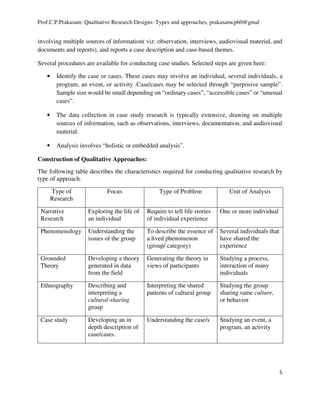
Construction of Qualitative Approaches:
The following table describes the characteristics required for conducting qualitative research by
type of approach.
Type of
Research
Focus Type of Problem Unit of Analysis
Narrative
Research
Exploring the life of
an individual
Require to tell life stories
of individual experience
One or more individual
Phenomenology Understanding the
issues of the group
To describe the essence of
a lived phenomenon
(group/ category)
Several individuals that
have shared the
experience
Grounded
Theory
Developing a theory
generated in data
from the field
Generating the theory in
views of participants
Studying a process,
interaction of many
individuals
Ethnography Describing and
interpreting a
cultural-sharing
group
Interpreting the shared
patterns of cultural group
Studying the group
sharing same culture,
or behavior
Case study Developing an in
depth description of
case/cases.
Understanding the case/s Studying an event, a
program, an activity
Prof.C.P.Prakasam: Qualitative Research Designs: Types and approaches, prakasamcp60@gmal
6
Illustrations:
I. Narrative-Biographical Study
Example: Life experience of an eminent person or specific personality.
• The author describes the story of a single individual as central focus for the study.
• Data collection consisted of “conversation” or stories
• Author projects the specific qualities of the individual.
II. A Phenomenological study:
Example: A group of women (Commercial Sex worker) diagnosis of AIDS – to identify
the emotional response, risk behavior and awareness to health care.
Method adopted: Identifying the location of CSW through key informant, conducting in-
depth interview by following ethics, collection of information through projective technique
(Story telling), response listing and grouping to categories, developing frequency and
describing the categories.
Computer package suitable for the study: Atlas-ti
Structure of preparing Qualitative research report:
1. Introduction: Statement of problem, Purpose of study, the research question, delimitations
and limitations.
2. Review of literature
3. Procedures: Description of characteristics of individual/group. Site or population selection.
Instruments/tools for data collection. Area Mapping, selection of procedure for collection
of data (one-to-one, one-to-group) viz: in-depth interview or focus group discussion,
sensitization of group by street play, exhibition and collection of information on the basis
of procedure adopted.
4. Analysis and interpretation.
Computer packages for qualitative data analysis:
• AQUAD
• ATLAS-ti ,
• Epi-info,
• Hypersoft (Mac), Zyindex
Prof.C.P.Prakasam: Qualitative Research Designs: Types and approaches, prakasamcp60@gmal
7
Bibliography:
Carol Grbich (2003): “Qualitative Research in Health: An introduction”, Sage Publications, New Delhi
Creswell W.J (2007): “Qualitative Inquiry & Research Design”, Sage Publications, New Delhi
Yin, R.K. (2003): “Case Study Research: Design and methods”, Sage Publications, New Delhi
**************************

Qualitative research design Types and Approaches

  • 1.
    Prof.C.P.Prakasam: Qualitative ResearchDesigns: Types and approaches, prakasamcp60@gmal 1 Qualitative Research Designs: Types and approaches By Prof. C.P.Prakasam prakasamcp60@gmail.com Former Professor, International Institute for Population Sciences, Mumbai Paper presented in “Workshop on Research Design in Health Sciences: Construct Critique and conduct” Organized by PSG College of Nursing Avinashi Road, Peelamedu, Coimbatore-641004, Tamil Nadu, India Dates: 25th to 27th June 2009
  • 2.
    Prof.C.P.Prakasam: Qualitative ResearchDesigns: Types and approaches, prakasamcp60@gmal 2 Qualitative Research Designs: Types and approaches By Prof. C.P.Prakasam prakasamcp60@gmail.com Introduction: Qualitative research was one of the first forms of social studies was restricted as a discipline of anthropology or sociology in the past. During the 1970s and 1980s qualitative research began to be used in other disciplines, and became a significant type of research in the fields of education studies, social work studies, women's studies, disability studies, information studies, management studies, nursing service studies, human service studies, psychology, communication studies, and other. Qualitative research occurred in the consumer products industry also in the recent times. Qualitative researchers aim to gather an in-depth understanding of human behavior and the reasons that govern such behavior. Social Scientist defines Qualitative research in many ways. Leininger,(1985), defines qualitative research as “methods and techniques of observing, documenting, analyzing and interpreting attributes, patterns, characteristics and meanings of specific, contextual features of phenomena under study”, and Minichiello et al., 1995 explains qualitative research as “which seek to uncover the thoughts, perceptions and feelings experienced by informants”. The first focuses primarily on methods or techniques. The second emphasizes a paradigmatic approach, involves understanding the world through theoretical approach. By research design may be understood as entire process of research from conceptualizing a problem writing research questions, and on to data collection, analysis, interpretation, and report writing. Other researcher (Yin, 2003) explains that “the design is the logical sequence that connects the empirical data to a study’s initial research questions and ultimately to its conclusions”. The discipline (qualitative research) investigates the why and how of decision making, not just what, where, when. Hence, smaller but focused samples are more often needed rather than large random samples. This document discusses the designs in qualitative research. When to use qualitative Research: • We conduct qualitative research when a problem or issue needs to be explored. • We conduct qualitative research when we need a complex, detailed understanding of the issue. • We conduct qualitative research when we want to empower individuals to share their stories, hear their voices.
  • 3.
    Prof.C.P.Prakasam: Qualitative ResearchDesigns: Types and approaches, prakasamcp60@gmal 3 Main types of Qualitative Research: • Narrative Research, Phenomenology, Grounded theory, Ethnography, Case study are the main types of qualitative approaches. Others types are memory work, evaluation and action research. I. Narrative research: The narrative research is understood as “a spoken or written text giving an account of an event or action or series of events or actions, chronologically connected”. The procedures for implementing this research consist of focusing on studying one or two individuals, gathering data through the collection of their stories, reporting individual experiences, and chronologically ordering the meaning of these experiences. • A biographical study is a form of narrative study in which the researcher writes and records the experiences of another person’s life. • Autobiography is another form of narrative study in which information of an individual written and recorded by the individuals who are the subject of the study. • A Life history is another form of narrative study which portrays an individual’s entire life, by a researcher. II. Phenomenology: Phenomenology describes the structures of experience as they present themselves to consciousness, without recourse to theory, deduction, or assumptions from other disciplines. Phenomenological study describes the meaning for the several individuals of their lived experiences of a concept or a phenomenon. It focuses on describing what all participants have in common as they experience a phenomenon. Ex: Stigma towards Person Living with HIV/AIDS (PLHA), Barrier for Girl child attaining higher education etc. III. Grounded theory: Theory is developed inductively from a corpus of data acquired by a participant-observer. Though a phenomenology emphasizes the meaning of an experience for a number of individuals, the intent of a grounded theory study is to generate or discover a theory. Participants in the study would all have experienced the process, and the development of the theory might help explain practice or provide a framework for further research. Grounded theory is a qualitative research design in which the inquirer “generates” explanation (a theory) of a process, action, or interaction shaped by the views of a large number of participants.
  • 4.
    Prof.C.P.Prakasam: Qualitative ResearchDesigns: Types and approaches, prakasamcp60@gmal 4 It is a research method that operates almost in a reverse fashion from traditional research and at first may appear to be in contradiction of the scientific method. Rather than beginning by researching and developing a hypothesis, the first step is data collection, through a variety of methods. From the data collected, the key points are marked with a series of codes, which are extracted from the text. The codes are grouped into similar concepts in order to make them more workable. From these concepts, categories are formed, which are the basis for the creation of a theory, or a reverse engineered hypothesis. This contradicts the traditional model of research, where the researcher chooses a theoretical framework, and only then applies this model to the studied phenomenon. IV. Ethnographic Research: Ethnography come from the anthropological tradition and is concerned with the study of culture. Longitudinal observations are undertaken within particular contexts. These observations seek the participants’’ views of reality through interviews and other sources recorded by camera, videotape and audiotape. In the recent period ethnographic research is also carried out by health personals, called mini-ethnographies, characterized by an eclectic use of techniques. An ethnographic study of risk management among illicit drug injectors, a study of sex selective abortion among rural women etc are few among many ethnographic studies. Ethnography is a qualitative design in which the researcher describes and interprets the shared and learned patterns of values, behaviours, beliefs and language of a cultural-sharing group. As a process, ethnography involves extended observations of the group, most often through participant observation, in which the researcher is immersed in the day to day lives of the people and observes and interviews the group participants. The researcher studies the meaning of the behavior, the language, and the interaction among members of the culture-sharing group. Procedures for conducting Ethnography: • Identify and locate a culture-sharing group to study. • Identify a gatekeeper or key informants who will give information about the group. • Conduct one –to-group and one-to-one interviews or focus group discussion or use projective technique such as story telling/visual charts, diagrams, picture and capture the information • Gather information. V. Case Study Research: Case study research is a qualitative approach in which the investigator explores a bounded system (a case) or multiple bounded systems (cases) over time, through detailed in-depth data collection
  • 5.
    Prof.C.P.Prakasam: Qualitative ResearchDesigns: Types and approaches, prakasamcp60@gmal 5 involving multiple sources of information( viz: observation, interviews, audiovisual material, and documents and reports), and reports a case description and case-based themes. Several procedures are available for conducting case studies. Selected steps are given here: • Identify the case or cases. These cases may involve an individual, several individuals, a program, an event, or activity .Case/cases may be selected through “purposive sample”. Sample size would be small depending on “ordinary cases”, “accessible cases” or “unusual cases”. • The data collection in case study research is typically extensive, drawing on multiple sources of information, such as observations, interviews, documentation, and audiovisual material. • Analysis involves “holistic or embedded analysis”. Construction of Qualitative Approaches: The following table describes the characteristics required for conducting qualitative research by type of approach. Type of Research Focus Type of Problem Unit of Analysis Narrative Research Exploring the life of an individual Require to tell life stories of individual experience One or more individual Phenomenology Understanding the issues of the group To describe the essence of a lived phenomenon (group/ category) Several individuals that have shared the experience Grounded Theory Developing a theory generated in data from the field Generating the theory in views of participants Studying a process, interaction of many individuals Ethnography Describing and interpreting a cultural-sharing group Interpreting the shared patterns of cultural group Studying the group sharing same culture, or behavior Case study Developing an in depth description of case/cases. Understanding the case/s Studying an event, a program, an activity
  • 6.
    Prof.C.P.Prakasam: Qualitative ResearchDesigns: Types and approaches, prakasamcp60@gmal 6 Illustrations: I. Narrative-Biographical Study Example: Life experience of an eminent person or specific personality. • The author describes the story of a single individual as central focus for the study. • Data collection consisted of “conversation” or stories • Author projects the specific qualities of the individual. II. A Phenomenological study: Example: A group of women (Commercial Sex worker) diagnosis of AIDS – to identify the emotional response, risk behavior and awareness to health care. Method adopted: Identifying the location of CSW through key informant, conducting in- depth interview by following ethics, collection of information through projective technique (Story telling), response listing and grouping to categories, developing frequency and describing the categories. Computer package suitable for the study: Atlas-ti Structure of preparing Qualitative research report: 1. Introduction: Statement of problem, Purpose of study, the research question, delimitations and limitations. 2. Review of literature 3. Procedures: Description of characteristics of individual/group. Site or population selection. Instruments/tools for data collection. Area Mapping, selection of procedure for collection of data (one-to-one, one-to-group) viz: in-depth interview or focus group discussion, sensitization of group by street play, exhibition and collection of information on the basis of procedure adopted. 4. Analysis and interpretation. Computer packages for qualitative data analysis: • AQUAD • ATLAS-ti , • Epi-info, • Hypersoft (Mac), Zyindex
  • 7.
    Prof.C.P.Prakasam: Qualitative ResearchDesigns: Types and approaches, prakasamcp60@gmal 7 Bibliography: Carol Grbich (2003): “Qualitative Research in Health: An introduction”, Sage Publications, New Delhi Creswell W.J (2007): “Qualitative Inquiry & Research Design”, Sage Publications, New Delhi Yin, R.K. (2003): “Case Study Research: Design and methods”, Sage Publications, New Delhi **************************