Qualitative research designs
GROUP 19
GROUP MEMBERS
NAME REG NUMBER
EDWARD SAIDI BScNM/21/O3O
ROSE CHITSEKO BScNM/21/026
BECKFORD JAMES BScNM/21/039
WYSON MBEWE BScNM/21/090
CHIKUMBUTSO NKHOMA BScNM/21/125
AUSTIN MSUKWA BScNM/20/097
LYNESS CHISI BScNM/21/025
MEDITH MSOWOYA BScNM/21/108
GROUP 19
Broad objective
By the end of this lesson learners should
acquire knowledge on qualitative research
designs
Specific objective
By the end of the lesson students should be able
to:
Define qualitative research
State factors to consider when using
qualitative research
Describe when qualitative approach is applied
Describe the different research methods used
in qualitative research
Definition
Qualitative research is a type of research that
focusses on explaining the reality of the world
through the perspectives of the participants.
The results of the research tend to be subjective
since it is affected by perceptive and the opinions
of the respondents based on their experiences
Qualitative research focuses on words, perceptions,
ideas and concepts.
Factors to consider when using qualitative
research
Given the possibility of qualitative, quantitative, or
mixed methods approaches, there are factors that
affect a choice of one approach over another for the
design of a proposal which include the research
problem, the personal experiences of the researcher,
and the audience(s) for whom the report will be
written
1. The research problem
If phenomenon needs to be explored and understood because little
research has been done on it or because it involves an understudied
sample, then it merits a qualitative approach.
Qualitative research is especially useful when the researcher does not
know the important variables to examine. This type of approach may
be needed because the topic is new, the subject has never been
addressed with a certain sample or group of people, and existing
theories do not apply with the particular sample or group under study
(morse, 1991)
2.Personal experience
individuals who enjoy writing in a literary way or
conducting personal interviews or making up-
close observations may gravitate to the
qualitative approach.
For those researchers undertaking social justice
or community involvement, a qualitative
approach is typically best
3. Audience
Finally, researchers write for audiences that will
accept their research. These audiences may be
journal editors and readers, faculty committees,
conference attendees, or colleagues in the field.
Some audiences will choose qualitative design as
the best design to befit their research
WHEN IS QUALITATIVE RESEARCH APPLIED
Having looked at the introduction to
qualitative research and the factors to consider
we can therefore look at when this kind of
research can be applied
Problem statement or research question.
Only use a qualitative research design when your
problem statement or research question calls for
a qualitative design. This will guide a researcher to
use a qualitative design.
It is not about what methodology approach we
prefer, its about what approach is required by the
research question or problem statement which has
to be exploratory inductive if using qualitative
design. In short use qualitative design if your
research is exploratory.
Sector preference.
This comes in situations where a funding
agency comes up with a problem
statement so that researchers can start
from there. Problem statements provide
a guiding tool for researchers to go for a
qualitative approach
Will be applied when the research is to be done on
human behavior, attitudes, cultures and experiences on
the basis of observations and interpretations
When trying to Identify motives, desires through
interviews
Done when we want to gather broader knowledge
through open ended questions which will help in
hypothesis or theory development.
Done when we want to generate some hypothesis or
theories through a conversation such as in inductive
approach eg exploring factors customers consider
when deciding which laundry soap to buy, this will
include interaction with participants which will enable
participators to uncover attitudes, motivations, and
feelings
Done When investigating, exploring or understanding
peoples ideas, perceptions, feelings
Done when trying to get a deeper understanding of
the complexity of a situation so as to draw a big
picture under the hood eg such as in ethnography
Consider a qualitative design if you are not a
good at statistics
Depending on the audience, what they require
of you. Either quantitative or qualitative.
Done when you have a small sample size…eg
three people
Phenomenology
Definition
It is the process of examining human experience
through descriptions provided by people involved.
Description…
These experiences are called lived experiences.
The goal is to describe the meaning that
experience hold for each subject.
This type of study is used to study areas in
which there is a little knowledge [ donalek,
2004]
Its respondents are asked to asked to describe
their experiences as the perceive
The may write about their experience , but
information is obtained through interviews, it
uses open ended questions.
The researcher must first identify what she or he
expects to discover and then deliberately put
aside these ideas, this process is called bracketing
The question could be, what is it like for mothers to
live with a teenage child who is dying of cancer,
the researcher might perceive that she, herself wound
feel very hopeless and frightened.
This feelings would need to be identified and then put
aside to listen to what to the mother will say about
how she is living through this experience.
It is possible that this mother has discovered
an important reason for living, where as
previously she had no experiences
Characteristics
It is a descriptive research design aimed to
describe as accurately as possible the structure of
the phenomenon
It aimed to uncover what a particular experience
means to the group of people and how they
experienced it.
It requires a researcher to set aside their
prejudices and prior assumptions and focus
mainly on immediate experience
Characteristics continuing…
It requires a researcher to first describe the
lived experience objectively and then reflect
on the descriptive with reference to the
existing theories about a phenomenon
Steps in phenomenological research
1.Bracketing
This is the process of setting aside personal
experiences, biases , preconceived notions
about the research topic.
The researcher has a colleague interview in
order to determine their experience with the
phenomenon to uncover researcher’s bias.
Continuing…
2.Intuition
The researchers hold themselves to open
multiple meaning of different experiences.
3.Analysing
After gathering the interview data from the
multiple sources, the researcher will search for
partners of commonalities in their reports
4.Describing
The researcher understands and defines a phenomenon
in a conceptual way.
Strengths of phenomenological research
approach
The results emerge from the data instead of
being imposed by structured statistical analysis.
It offers a rich and detailed view of human
experience
It helps to create awareness about phenomenon
It helps to contribute in developing new theories
Weaknesses of phenomenological research
approach
It requires the researcher interpretation
Researcher induced bias can affect the
outcome of the study
Maintaining pure bracketing can be very
challenging for the researcher
It could be difficult to establish validity and
reliability
ETHNOGRAPHY
• ETHNO means “human culture” & GRAPH means
description of.
• ETHNOGRAPHY is the description of culture OR
• ETHNOGRAPHY is the systematic study of people and
culture
• It is designed to explore cultural phenomena
• the researcher observes society from the point of
view of the subject of study.
CONTINUED…
It is conducted to obtain emic perspective and
holistic view of the community being studied.
The goal of Ethnography is to grasp the natives point
of view.
Ethnography is the type of qualitative research that
allows the researcher to immerse himself or herself in
a particular community or organization to observe
their behaviors and interactions up close.
ADVANTAGES OF ETHNOGRAPHY
It gives the researcher direct access to the cultural
and practices of the group.
It gives the researcher access to more authentic
information, therefore, worthy of trust.
It also gives a chance to observe dynamics that the
researcher could not have found out simply by
asking.
It is also open and flexible method allowing
researcher to explore many different aspects of the
group and setting.
DISADVANTAGES OF ETHNOGRAPHY
It is time consuming; it takes time for a researcher to
embed in the setting and gather enough
observations.
There are ethical considerations to take into account
because it requires invasion of privacy. For example,
by observing and reporting sensitive information.
Observe bias, because it involves subjective
interpretation of data.
Grounded theory
 It refers to the set of systematic inductive
methods for conducting qualitative
research aimed toward theory
development .
 It is set out to discover or construct
theory from data, systematically obtained
and analysed using comparative analysis.
Factors to consider when using grounded
theory
 Identify the area of interest
 Avoid preconceived theories and focus on the data
only
 Use theoretical sensitivity- an awareness of subtle
messages and meanings in data
NB- research stops when you have reached theoretical
saturation. This is the point where you have to sampled
and analysed data until all the theories and data have
been uncovered.
Data collection methods in grounded theory
Interviewing participants with open
ended questions
Participant observation{field work} or
focus groups
Study of artifacts and texts
Parts of grounded theory
A. Methods
This involves:
Coding{labelling and categorizing} from collected
data instead of relying on theories not grounded in
the data.
Social processes are discovered in the data
Abstract categories are constructed inductively
Categories are refined using theoretical sampling
The gap between coding and writing is bridged with
analytical methods
B. Products
This involves:
 Data collection
 Open coding: this involves line by line coding where
concepts and key phrases are being identified and
highlighted and moved into sub categories then
categories.
 Axial coding: at this stage, relationships are identified
between the categories and connections are identified.
Selective coding: this involves identifying the
core category and method relating it to other
categories. The relationships must be
authenticated and categories refined.
Categories are then integrated together and a
grounded theory is identified .
Case study
It is an in depth exploration from multiple perspectives of
complexity and uniqueness of a particular project ,policy,
institution or a system in real life.
Are bounded time and activity and researchers collect detailed
information using a variety of data collection procedures, like
questionaries, interviews, observations and written accounts by
the subjects
For case study to be considered qualitative, the researcher must
be interested in the meaning of the experiences to the subjects
themselves rather than generalizing results to the other groups
of people
cnt
For example in nursing, the case study approach
must be used to answer questions such as;
How do the nurse manage nausea associated with
chemotherapy?
STEPS WHEN CONDUCTING A CASE STUDY
Selecting a subject of the case study
Preparing a checklist which consists of set of
questions
Data collection through interviews
Processing and organizing data
Types of case studies
1. Intrinsic
 One that is done to learn about a particular case itself
2. Instrumental
 We choose a case to gain insight into a particular issue
 i.e the case is instrumental to understanding something else
3. Collective
 It is an extension of instrumental case to several other cases
.
4. Theory led or theory generated
The first the person starts from specific theory and then
secondly constructs a theory through interpretation of the data
generated in the case and thus one ends rather than starts with
a theory.
5. Evaluation
Has three essential features
o To determine the value of the case
o To include and balance different interests and values
o To report findings to range of stake holders in the way that
they can use
Disadvantages
Time consuming
Costly
Subject may drop out
Action research
 Action research is a philosophy and methodology of research
generally applied in the social sciences. It seeks transformative
change through the simultaneous process of taking action and
doing research, which are linked together by critical reflection.
 Action research is based on action, evaluation and critical
analysis of practices based on collected data in order to
introduce improvements in relevant practices. This type of
research is facilitated by participation and collaboration of
number of individuals with a common purpose.
 Its reflection is based on interpretations made by the
participants.
Characteristics of action research
 The project is undertaken collaboratively by the
participants in the situation
 The action proceeds through a spiral of cycles of
planning, acting, observing reflecting and evaluating
 It raises awareness and understanding of practice
leading to change and improvement
 It is dynamic and systematic process
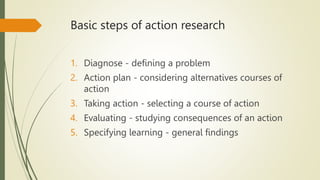
Basic steps of action research
1. Diagnose - defining a problem
2. Action plan - considering alternatives courses of
action
3. Taking action - selecting a course of action
4. Evaluating - studying consequences of an action
5. Specifying learning - general findings
The purpose of action research
 To integrate teaching with research
 To improve the effectiveness of practice
 To bring the expectation and performance gap
 To continuously develop the personal and
professional self
 To routine reflective teaching
 To realize educational values
Summary
Qualitative research is characterized by involvement
of the opinions, ideas, beliefs and perspectives of
selected participants as a result of their meaningful
experiences.
 When deciding to write a qualitative research it is
necessary that researchers become familiar with how
each qualitative research design is different in order
to determine which is most suitable for their research
goals.
Reference
Bliss.L (2016) Phenomenological research: inquiry to understand the
meaning of people’s experience international journal of adult vocation,
education and technology
Polit F.D and Beck C.T[2010] essentials of Nursing research; appraising
evidence for nursing practice[7th Edition] Lippincott Company.
Taylor, B.J.,& Francis,K.(2013). Qualitative research in the health
sciences: methodologies, methods and processes, Routeledge
https://guides.temple.edu
https://www.ncbi.nih.gov

Group 19.pptx

  • 1.
  • 2.
    GROUP MEMBERS NAME REGNUMBER EDWARD SAIDI BScNM/21/O3O ROSE CHITSEKO BScNM/21/026 BECKFORD JAMES BScNM/21/039 WYSON MBEWE BScNM/21/090 CHIKUMBUTSO NKHOMA BScNM/21/125 AUSTIN MSUKWA BScNM/20/097 LYNESS CHISI BScNM/21/025 MEDITH MSOWOYA BScNM/21/108 GROUP 19
  • 3.
    Broad objective By theend of this lesson learners should acquire knowledge on qualitative research designs
  • 4.
    Specific objective By theend of the lesson students should be able to: Define qualitative research State factors to consider when using qualitative research Describe when qualitative approach is applied Describe the different research methods used in qualitative research
  • 5.
    Definition Qualitative research isa type of research that focusses on explaining the reality of the world through the perspectives of the participants. The results of the research tend to be subjective since it is affected by perceptive and the opinions of the respondents based on their experiences Qualitative research focuses on words, perceptions, ideas and concepts.
  • 6.
    Factors to considerwhen using qualitative research Given the possibility of qualitative, quantitative, or mixed methods approaches, there are factors that affect a choice of one approach over another for the design of a proposal which include the research problem, the personal experiences of the researcher, and the audience(s) for whom the report will be written
  • 7.
    1. The researchproblem If phenomenon needs to be explored and understood because little research has been done on it or because it involves an understudied sample, then it merits a qualitative approach. Qualitative research is especially useful when the researcher does not know the important variables to examine. This type of approach may be needed because the topic is new, the subject has never been addressed with a certain sample or group of people, and existing theories do not apply with the particular sample or group under study (morse, 1991)
  • 8.
    2.Personal experience individuals whoenjoy writing in a literary way or conducting personal interviews or making up- close observations may gravitate to the qualitative approach. For those researchers undertaking social justice or community involvement, a qualitative approach is typically best
  • 9.
    3. Audience Finally, researcherswrite for audiences that will accept their research. These audiences may be journal editors and readers, faculty committees, conference attendees, or colleagues in the field. Some audiences will choose qualitative design as the best design to befit their research
  • 10.
    WHEN IS QUALITATIVERESEARCH APPLIED Having looked at the introduction to qualitative research and the factors to consider we can therefore look at when this kind of research can be applied
  • 11.
    Problem statement orresearch question. Only use a qualitative research design when your problem statement or research question calls for a qualitative design. This will guide a researcher to use a qualitative design. It is not about what methodology approach we prefer, its about what approach is required by the research question or problem statement which has to be exploratory inductive if using qualitative design. In short use qualitative design if your research is exploratory.
  • 12.
    Sector preference. This comesin situations where a funding agency comes up with a problem statement so that researchers can start from there. Problem statements provide a guiding tool for researchers to go for a qualitative approach
  • 13.
    Will be appliedwhen the research is to be done on human behavior, attitudes, cultures and experiences on the basis of observations and interpretations When trying to Identify motives, desires through interviews Done when we want to gather broader knowledge through open ended questions which will help in hypothesis or theory development.
  • 14.
    Done when wewant to generate some hypothesis or theories through a conversation such as in inductive approach eg exploring factors customers consider when deciding which laundry soap to buy, this will include interaction with participants which will enable participators to uncover attitudes, motivations, and feelings Done When investigating, exploring or understanding peoples ideas, perceptions, feelings Done when trying to get a deeper understanding of the complexity of a situation so as to draw a big picture under the hood eg such as in ethnography
  • 15.
    Consider a qualitativedesign if you are not a good at statistics Depending on the audience, what they require of you. Either quantitative or qualitative. Done when you have a small sample size…eg three people
  • 16.
    Phenomenology Definition It is theprocess of examining human experience through descriptions provided by people involved.
  • 17.
    Description… These experiences arecalled lived experiences. The goal is to describe the meaning that experience hold for each subject.
  • 18.
    This type ofstudy is used to study areas in which there is a little knowledge [ donalek, 2004] Its respondents are asked to asked to describe their experiences as the perceive
  • 19.
    The may writeabout their experience , but information is obtained through interviews, it uses open ended questions. The researcher must first identify what she or he expects to discover and then deliberately put aside these ideas, this process is called bracketing
  • 20.
    The question couldbe, what is it like for mothers to live with a teenage child who is dying of cancer, the researcher might perceive that she, herself wound feel very hopeless and frightened. This feelings would need to be identified and then put aside to listen to what to the mother will say about how she is living through this experience.
  • 21.
    It is possiblethat this mother has discovered an important reason for living, where as previously she had no experiences
  • 22.
    Characteristics It is adescriptive research design aimed to describe as accurately as possible the structure of the phenomenon It aimed to uncover what a particular experience means to the group of people and how they experienced it. It requires a researcher to set aside their prejudices and prior assumptions and focus mainly on immediate experience
  • 23.
    Characteristics continuing… It requiresa researcher to first describe the lived experience objectively and then reflect on the descriptive with reference to the existing theories about a phenomenon
  • 24.
    Steps in phenomenologicalresearch 1.Bracketing This is the process of setting aside personal experiences, biases , preconceived notions about the research topic. The researcher has a colleague interview in order to determine their experience with the phenomenon to uncover researcher’s bias.
  • 25.
    Continuing… 2.Intuition The researchers holdthemselves to open multiple meaning of different experiences.
  • 26.
    3.Analysing After gathering theinterview data from the multiple sources, the researcher will search for partners of commonalities in their reports
  • 27.
    4.Describing The researcher understandsand defines a phenomenon in a conceptual way.
  • 28.
    Strengths of phenomenologicalresearch approach The results emerge from the data instead of being imposed by structured statistical analysis. It offers a rich and detailed view of human experience It helps to create awareness about phenomenon It helps to contribute in developing new theories
  • 29.
    Weaknesses of phenomenologicalresearch approach It requires the researcher interpretation Researcher induced bias can affect the outcome of the study Maintaining pure bracketing can be very challenging for the researcher It could be difficult to establish validity and reliability
  • 30.
    ETHNOGRAPHY • ETHNO means“human culture” & GRAPH means description of. • ETHNOGRAPHY is the description of culture OR • ETHNOGRAPHY is the systematic study of people and culture • It is designed to explore cultural phenomena • the researcher observes society from the point of view of the subject of study.
  • 31.
    CONTINUED… It is conductedto obtain emic perspective and holistic view of the community being studied. The goal of Ethnography is to grasp the natives point of view. Ethnography is the type of qualitative research that allows the researcher to immerse himself or herself in a particular community or organization to observe their behaviors and interactions up close.
  • 32.
    ADVANTAGES OF ETHNOGRAPHY Itgives the researcher direct access to the cultural and practices of the group. It gives the researcher access to more authentic information, therefore, worthy of trust. It also gives a chance to observe dynamics that the researcher could not have found out simply by asking. It is also open and flexible method allowing researcher to explore many different aspects of the group and setting.
  • 33.
    DISADVANTAGES OF ETHNOGRAPHY Itis time consuming; it takes time for a researcher to embed in the setting and gather enough observations. There are ethical considerations to take into account because it requires invasion of privacy. For example, by observing and reporting sensitive information. Observe bias, because it involves subjective interpretation of data.
  • 34.
    Grounded theory  Itrefers to the set of systematic inductive methods for conducting qualitative research aimed toward theory development .  It is set out to discover or construct theory from data, systematically obtained and analysed using comparative analysis.
  • 35.
    Factors to considerwhen using grounded theory  Identify the area of interest  Avoid preconceived theories and focus on the data only  Use theoretical sensitivity- an awareness of subtle messages and meanings in data NB- research stops when you have reached theoretical saturation. This is the point where you have to sampled and analysed data until all the theories and data have been uncovered.
  • 36.
    Data collection methodsin grounded theory Interviewing participants with open ended questions Participant observation{field work} or focus groups Study of artifacts and texts
  • 37.
    Parts of groundedtheory A. Methods This involves: Coding{labelling and categorizing} from collected data instead of relying on theories not grounded in the data. Social processes are discovered in the data Abstract categories are constructed inductively Categories are refined using theoretical sampling The gap between coding and writing is bridged with analytical methods
  • 38.
    B. Products This involves: Data collection  Open coding: this involves line by line coding where concepts and key phrases are being identified and highlighted and moved into sub categories then categories.  Axial coding: at this stage, relationships are identified between the categories and connections are identified.
  • 39.
    Selective coding: thisinvolves identifying the core category and method relating it to other categories. The relationships must be authenticated and categories refined. Categories are then integrated together and a grounded theory is identified .
  • 40.
    Case study It isan in depth exploration from multiple perspectives of complexity and uniqueness of a particular project ,policy, institution or a system in real life. Are bounded time and activity and researchers collect detailed information using a variety of data collection procedures, like questionaries, interviews, observations and written accounts by the subjects For case study to be considered qualitative, the researcher must be interested in the meaning of the experiences to the subjects themselves rather than generalizing results to the other groups of people
  • 41.
    cnt For example innursing, the case study approach must be used to answer questions such as; How do the nurse manage nausea associated with chemotherapy?
  • 42.
    STEPS WHEN CONDUCTINGA CASE STUDY Selecting a subject of the case study Preparing a checklist which consists of set of questions Data collection through interviews Processing and organizing data
  • 43.
    Types of casestudies 1. Intrinsic  One that is done to learn about a particular case itself 2. Instrumental  We choose a case to gain insight into a particular issue  i.e the case is instrumental to understanding something else 3. Collective  It is an extension of instrumental case to several other cases
  • 44.
    . 4. Theory ledor theory generated The first the person starts from specific theory and then secondly constructs a theory through interpretation of the data generated in the case and thus one ends rather than starts with a theory. 5. Evaluation Has three essential features o To determine the value of the case o To include and balance different interests and values o To report findings to range of stake holders in the way that they can use
  • 45.
  • 46.
    Action research  Actionresearch is a philosophy and methodology of research generally applied in the social sciences. It seeks transformative change through the simultaneous process of taking action and doing research, which are linked together by critical reflection.  Action research is based on action, evaluation and critical analysis of practices based on collected data in order to introduce improvements in relevant practices. This type of research is facilitated by participation and collaboration of number of individuals with a common purpose.  Its reflection is based on interpretations made by the participants.
  • 47.
    Characteristics of actionresearch  The project is undertaken collaboratively by the participants in the situation  The action proceeds through a spiral of cycles of planning, acting, observing reflecting and evaluating  It raises awareness and understanding of practice leading to change and improvement  It is dynamic and systematic process
  • 48.
    Basic steps ofaction research 1. Diagnose - defining a problem 2. Action plan - considering alternatives courses of action 3. Taking action - selecting a course of action 4. Evaluating - studying consequences of an action 5. Specifying learning - general findings
  • 49.
    The purpose ofaction research  To integrate teaching with research  To improve the effectiveness of practice  To bring the expectation and performance gap  To continuously develop the personal and professional self  To routine reflective teaching  To realize educational values
  • 50.
    Summary Qualitative research ischaracterized by involvement of the opinions, ideas, beliefs and perspectives of selected participants as a result of their meaningful experiences.  When deciding to write a qualitative research it is necessary that researchers become familiar with how each qualitative research design is different in order to determine which is most suitable for their research goals.
  • 51.
    Reference Bliss.L (2016) Phenomenologicalresearch: inquiry to understand the meaning of people’s experience international journal of adult vocation, education and technology Polit F.D and Beck C.T[2010] essentials of Nursing research; appraising evidence for nursing practice[7th Edition] Lippincott Company. Taylor, B.J.,& Francis,K.(2013). Qualitative research in the health sciences: methodologies, methods and processes, Routeledge https://guides.temple.edu https://www.ncbi.nih.gov