

Qualitative Research 
      Methods 
     Debora A. Paterniti, Ph.D. 
Center for Health Services Research in 
            Primary Care 
Departments of Internal Medicine & Sociology
Departments of Internal Medicine & Sociology 
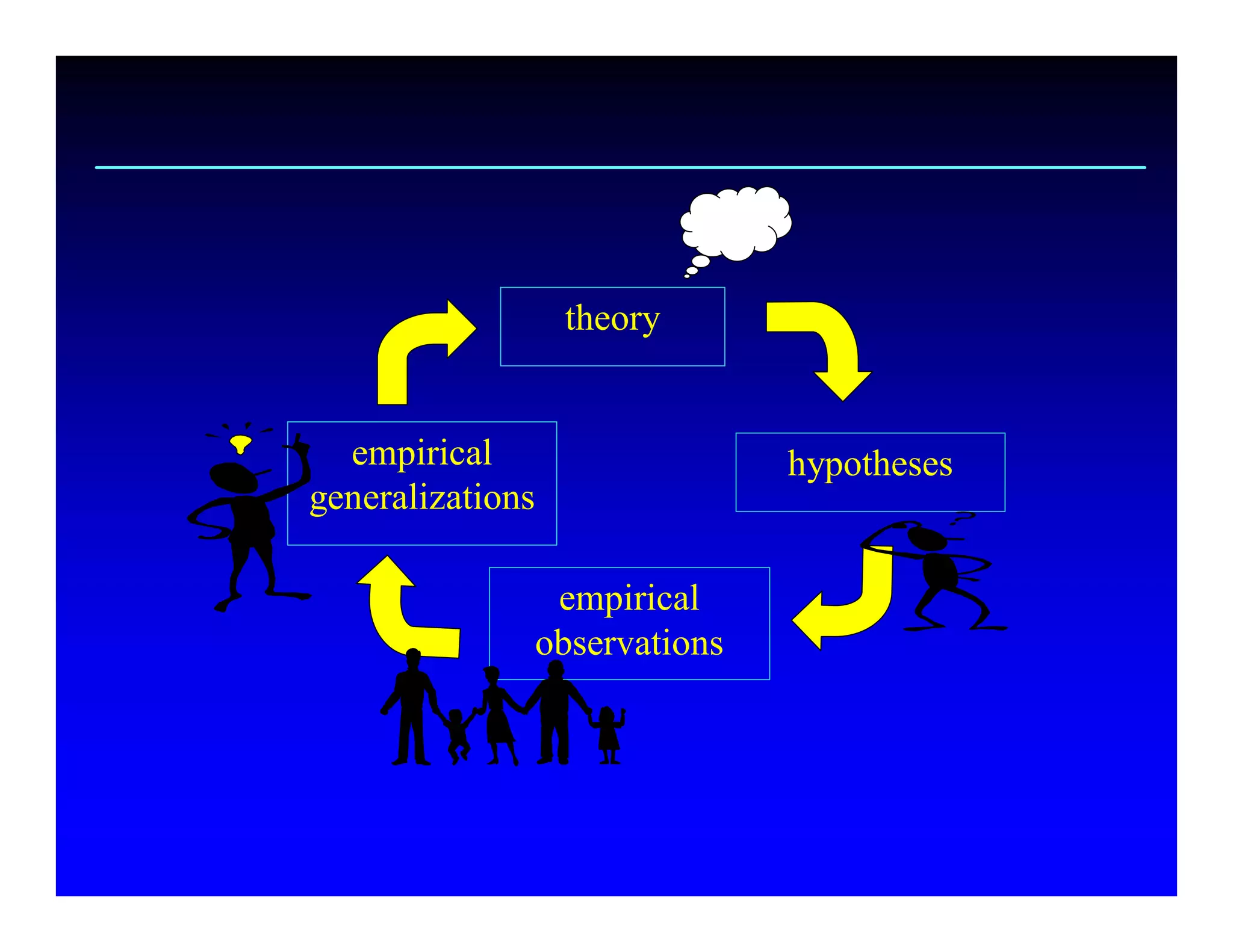
theory 


  empirical                       hypotheses 
generalizations

                   empirical 
                  observations 
Part I: Research Design
Part I: Research Design 
purpose of qualitative methods 

§  to provide an open­ended, in­depth exploration 
   of an aspect of life 

§  to focus attention on a particular experience 

§  to gain a specific person’s or group’s insights 
   about an experience
purpose of qualitative methods 

§  to elicit subjective world views of an 
   experience 

§  to gain an in­depth understanding of the nature 
   of social settings and behaviors from the 
   “native” standpoint
modes of data collection 

¯ 
¯    intensive interviewing 
¯ 
¯    focus groups interviews 
¯ 
¯    field research 
¯ 
¯    case studies 
¯ 
¯    discourse/conversational analysis
     discourse/conversational analysis 
intensive interviewing 
§  an open­ended, directed conversation that 
   explores a participant’s deep, first­hand 
   knowledge 
§  focuses on “lived experience” 
§  emphasizes “sense­making” 
§  an in­depth and intimate discussion beyond 
   what ordinary conversational conventions and 
   etiquette permit
focus groups 
§  a small group discussion 
§
§  guided by a set of research questions that 
§
   explore attitudes, values, and behaviors 
§  emphasizing a particular topic or event 
§
§  homogenous yet diverse group 
§
§  lead by a trained discussion leader
§ lead by a trained discussion leader 
field research 

§  prolonged observation involving specific 
   contexts, persons, or behaviors 

§  entry into the “worlds” of persons and 
   behaviors of interest 
§  an attempt to understand a particular aspect of 
   the “lived experience” from the perspective of 
   those who live it
non probability sampling strategies 
§  convenience sampling­ ease of availability 
§  snowball sampling­ selection of additional 
      people for interviewing based on previous 
      interviews 
§  purposeful sampling­ judgment about which 
     might be the most useful or representative 
§  quota sampling­ specified characteristics 
     known to be representative of the 
     population
finding participants 
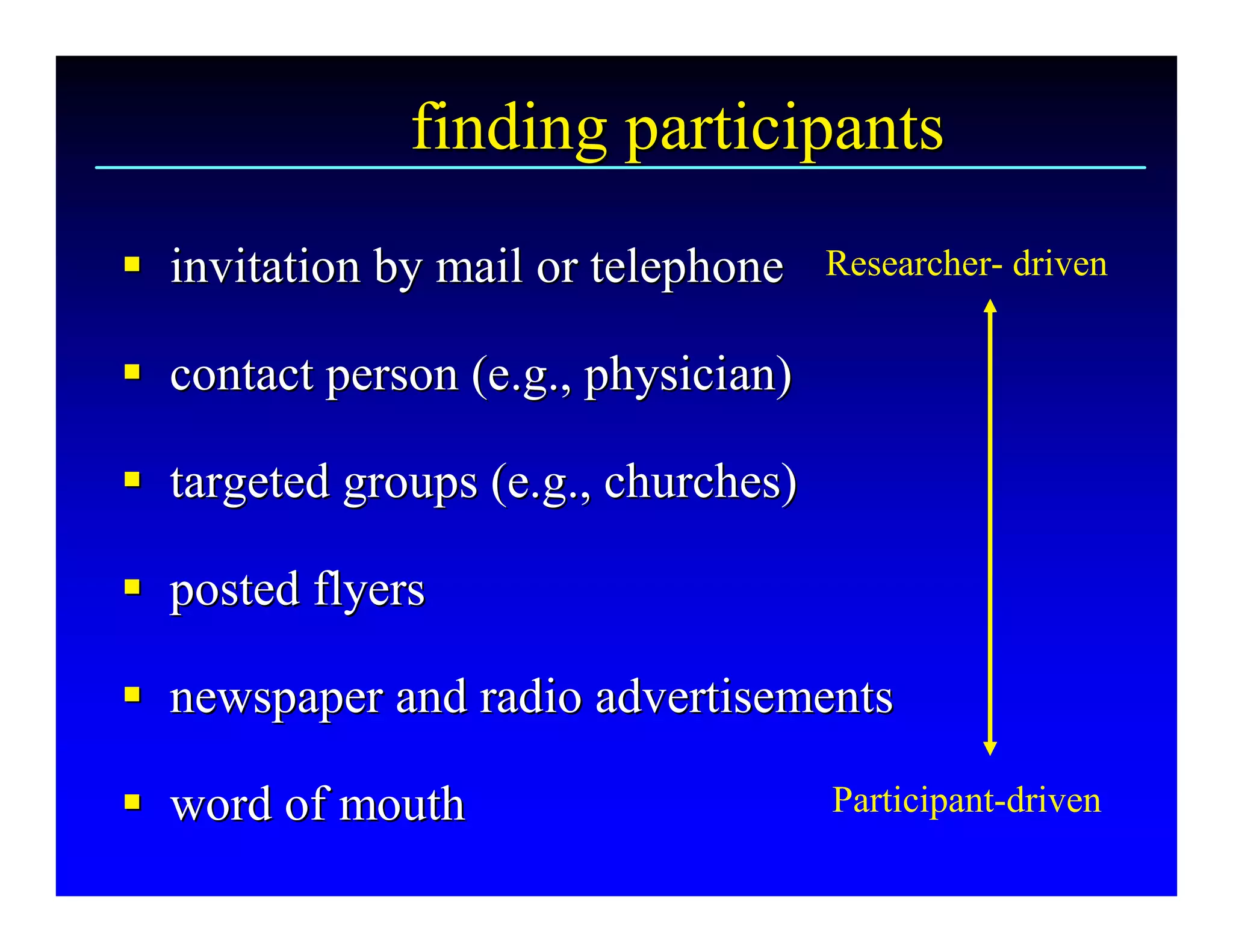
§  invitation by mail or telephone 
§                                      Researcher­ driven 


§  contact person (e.g., physician) 
§

§  targeted groups (e.g., churches) 
§

§  posted flyers 
§

§  newspaper and radio advertisements 
§

§  word of mouth 
§                                      Participant­driven
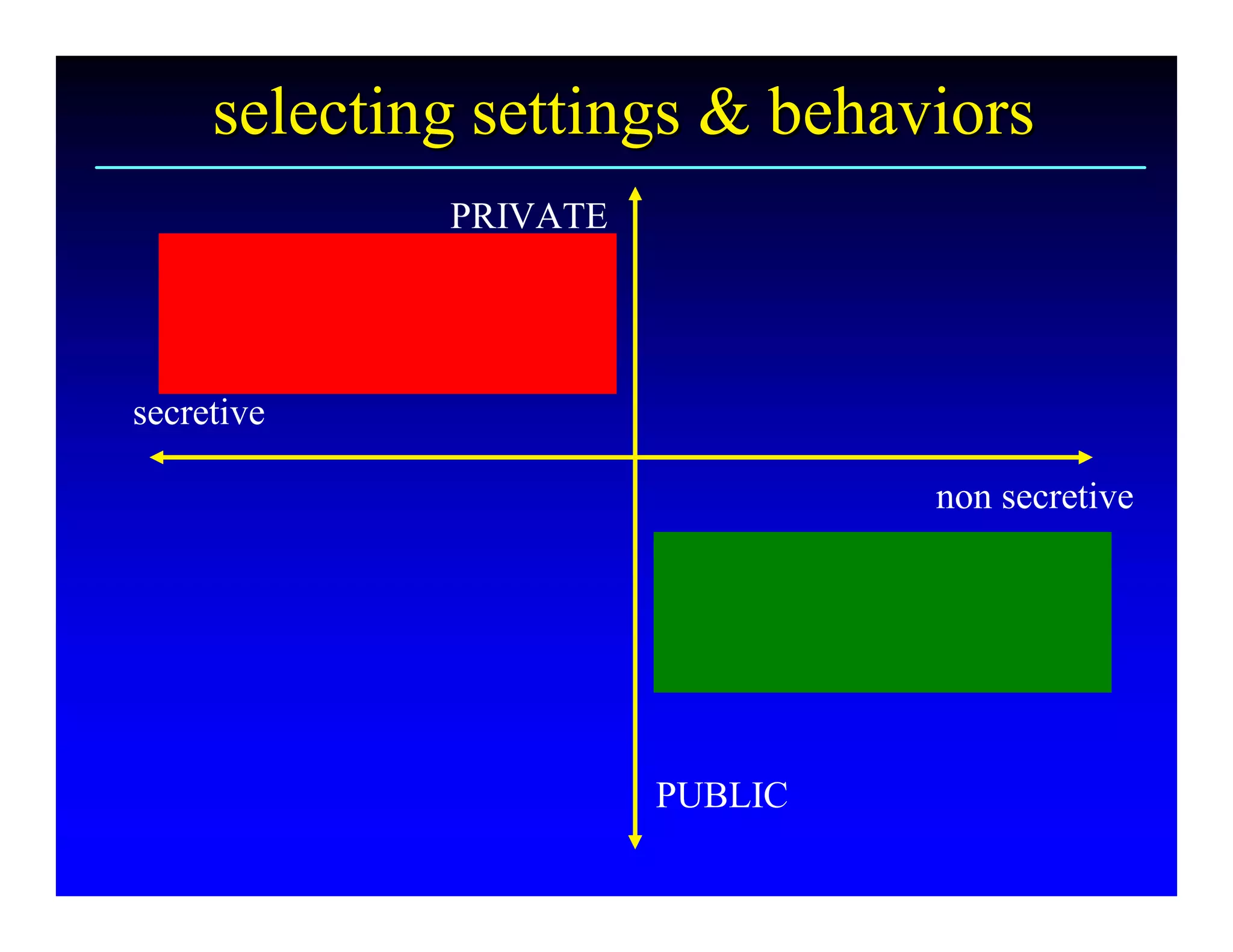
selecting settings & behaviors 
             PRIVATE 


secretive 

                                  non secretive


                        PUBLIC 
barriers to subject participation 
§  travel to the research site 
§
§  opinions of family, friends, or “experts” 
§                                  “ 
                                    experts 
§  timing of interview or observations 
§
§  setting­related constraints (gatekeepers) 
§ setting ­ 
§  Hawthorne effect 
§
§  researcher knowledge & status
§ researcher knowledge & status 
Part II: Data Collection
Part II: Data Collection 
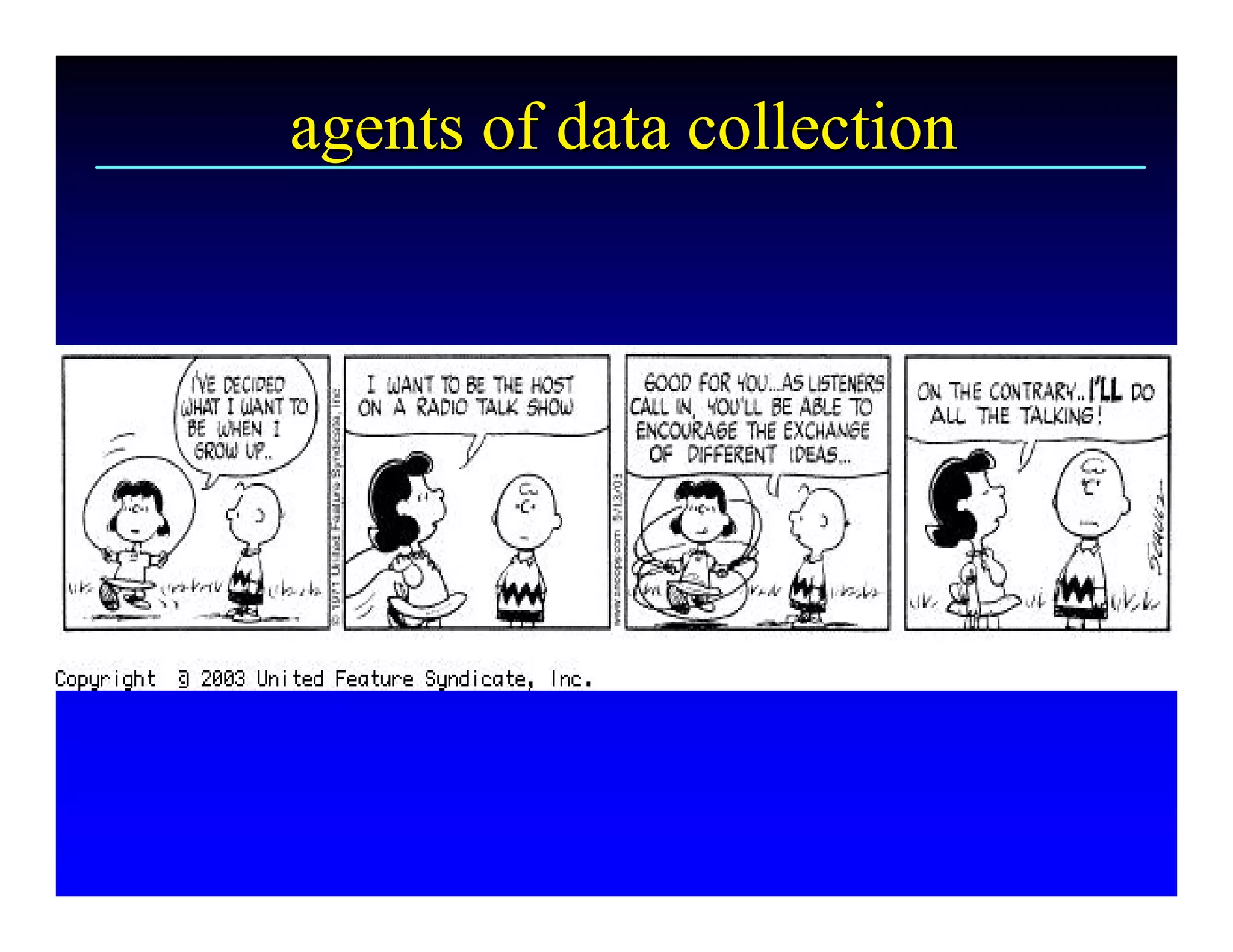
agents of data collection
agents of data collection 
general guiding questions 
§  types and meanings 
§
   §  what is this?  what does this mean? 
   §

§  structures 
§
   §  what are the contexts that give this meaning? 
   §

§  processes 
§
   §  how does this come to have meaning?
   § how does this come to have meaning? 
data collection strategies 

§  asking questions 
§
   § 
   §    phrasing questions 
   § 
   §    open­ended questions 
        open ­ 
   § 
   §    ask participants to think back 
   § 
   §    avoid asking “why” 
                      “ 
                       why 
   § 
   §    keep questions simple 
   § 
   §    be cautious about giving examples
        be cautious about giving examples 
strategies for collecting data 
§  interactional style 
§
   § 
   §    be conversational 
   § 
   §    be clear 
   § 
   §    allow sufficient time for responses 
   § 
   §    use what works 
   § 
   §    recognize the limits 


§  observing behavior 
§
   §  take notes on the group or setting dynamic 
   §
   §  note limitations of recording devices
   § note limitations of recording devices 
types of interview questions 
§  opening & introductory questions 
§
   §  tell us about…. 
   § tell us about … 
   §  when you hear…. 
   § when you hear  … 
§  transition questions 
§
   §  what have you done…. 
   § what have you done … 
   §  how did you come to…. 
   § how did you come to … 
§  key questions 
§
   §  what were the most important…. 
   § what were the most important … 
§  ending questions 
§
   §  of all of the things that you described….
   § of all of the things that you described  . 
                                             … 
forms of qualitative data 
§  transcripts of interviews 
§
§  audio­recorded conversations 
§ audio  ­ 
§  notated observations made during interviews or 
§
   in a specific setting 
§  pictures or videos of social group dynamics or 
§
   behaviors in context
   behaviors in context 
examples: interview & focus group data 

§  what does this mean? 
§
§  how does it come to have meaning? 
§

§  meaning 
§
   §  what does having a diagnosis mean? 
   §


§  processes 
§
   §  how does the diagnosis come to have meaning?
   § how does the diagnosis come to have meaning? 
interview transcript excerpt 
…when I was first diagnosed, my physician, she 
… 
 uh, ‘Mr. [X], you have…cancer…on one side 
      ‘ 
       Mr. [X], you have  cancer 
                            …              … 
 of your prostate, no…two sides.  It take me for 
 of your prostate, no  … 
 a shock at that moment.  I’m a firm believer 
 a shock at that moment.  I       ’ 
 that you don’t worry about anything that you 
 that you don  ’ 
 can’t do anything about. {cough} 
 can ’ 
…then I went down and picked up some literature 
… 
 ‘cause I really wasn’t educated on prostate 
 ‘ cause I really wasn ’ 
 cancer, and uh…it was very limited anyway.  I 
 cancer, and uh   … 
 started readin’ it, and went home and discussed 
         readin 
 it with my wife…and I have a son­in­law, he’s 
 it with my wife  and I have a son  in  law, he 
                  …                            ­  ­  ’ 
 a doctor, and they made me make the 
 decision…. (Cancer Decision­­ making Project, ACS)
 decision  (Cancer Decision  making Project, ACS) 
           … 
focus group transcript excerpt 
P1:  …ya know, I was lookin’ for the side effects, ya 
  know, ‘cause like I told y’all in the beginning, I was, 
  ‘I don’t know about this medication’ it’s…is it gonna 
  make me worse?  But…I mean, it helped me… 
P2:  …Let, let me ask a question [of] e’rybody: did the 
  diagnosis scare y’all?” 
P3: ..yeah… 
P4: …it scared the shit—it scared me. 
P1: it did me…cause I had known that I had some risky 
  behaviors…I have known there was a chance of this 
  [P2: yeah], so I didn’t ‘freak out’…but of course, you 
  face a death sentence, it’s gonna scare anybody. 
  (Combo­Antiretroviral Adherence Project, VA focus group)
examples: field research data 

§  what is the “nature” of this place? 
§              “ 
                nature 

§  structures 
§
   §  what are the contexts that give institutional life 
   §
      meaning?
      meaning? 
field note excerpt 
Colorless paint and faded wallpaper provided the backdrop for 
   dozens of bodies seated in the open entryway.  An older man 
   with dark skin sat tied in his wheelchair with a three­inch 
   webbed belt surrounding him; he had wet his pants.  The sight 
   of his pants intensified the smell of urine. 
The man attempted to move himself down one of the many 
   corridors with his right leg, casting it out in front of him and 
   pulling back as he leaned forward in a feeble effort to move his 
   body with the aid of a chair, stopping his chair next to the post 
   where I stood.  As I tried to get my bearings, he tried to 
   maintain his balance.  He took a couple of deep breaths, then 
   loudly cleared his throat, spitting at the post as I moved past 
   him. 
A woman screamed, and I looked around at others who seemed 
   deaf or accustomed to the noise.  I heard the man behind me 
   begin to clear his throat again as I disappeared behind the 
   heavy wooden door marked “Staff Only.” (J Cont Ethn 2000)
assessing data collection 
§  describe context and structure of the situation 

§  record observations of participants 

§  assess quality of the data 

§  evaluate relative usefulness of guiding 
   questions 

§  acknowledge areas of difficulty
Part III: Data Analysis
Part III: Data Analysis 
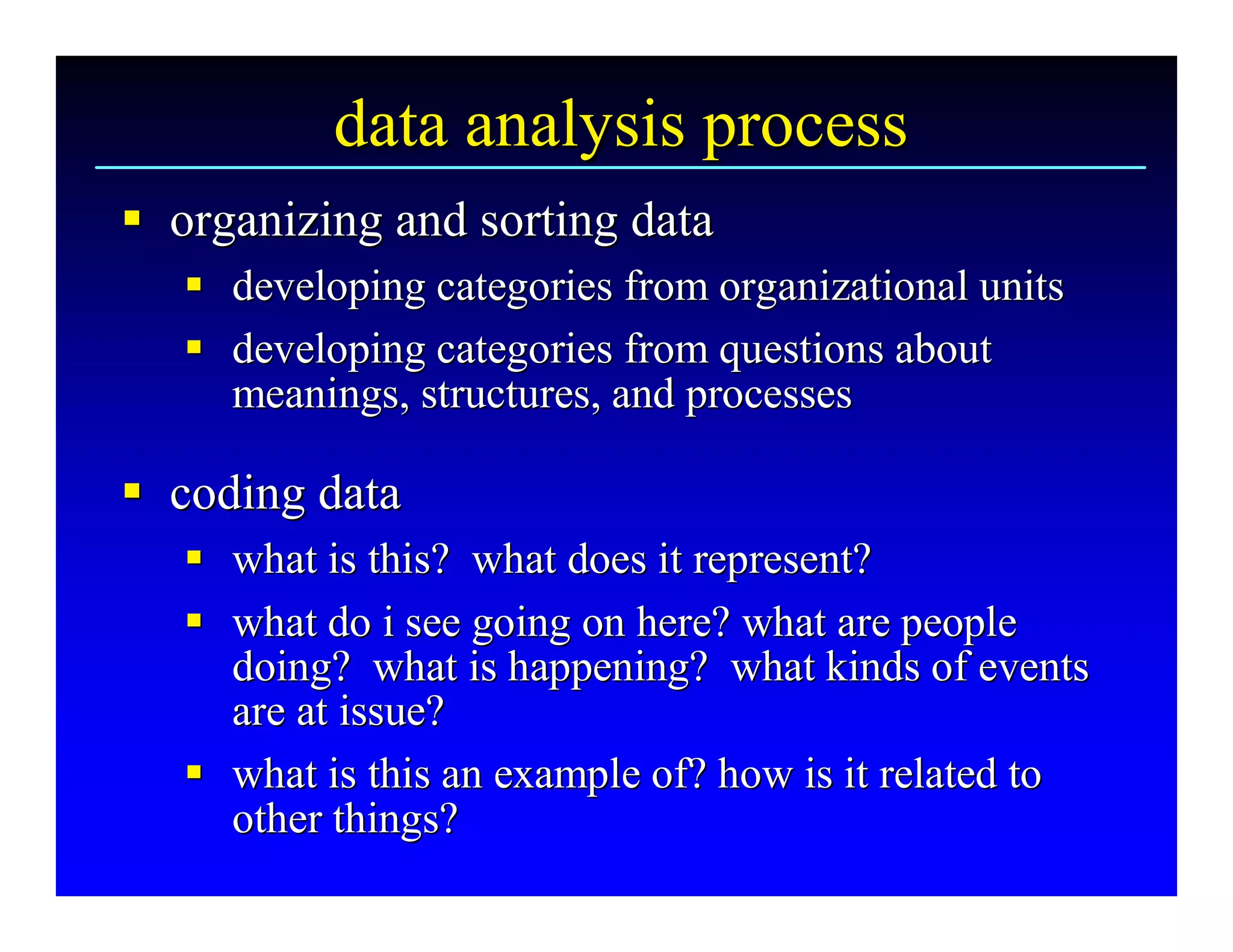
data analysis process 
§  organizing and sorting data 
§
   §  developing categories from organizational units 
   §
   §  developing categories from questions about 
   §
      meanings, structures, and processes 

§  coding data 
§
   §  what is this?  what does it represent? 
   §
   §  what do i see going on here? what are people 
   §
      doing?  what is happening?  what kinds of events 
      are at issue? 
   §  what is this an example of? how is it related to 
   §
      other things?
      other things? 
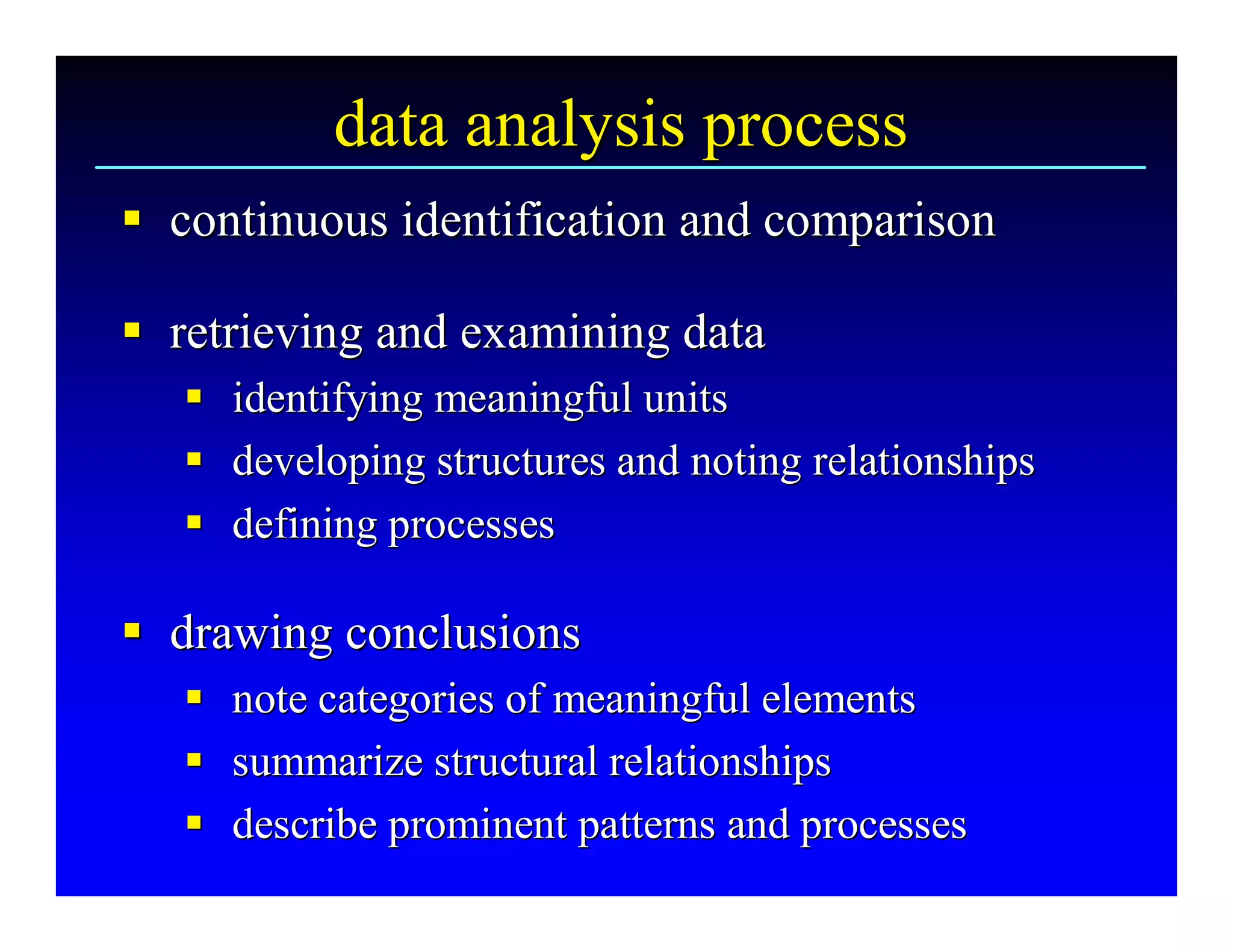
data analysis process 
§  continuous identification and comparison 
§

§  retrieving and examining data 
§
   §  identifying meaningful units 
   §
   §  developing structures and noting relationships 
   §
   §  defining processes 
   §

§  drawing conclusions 
§
   §  note categories of meaningful elements 
   §
   §  summarize structural relationships 
   §
   §  describe prominent patterns and processes
   § describe prominent patterns and processes 
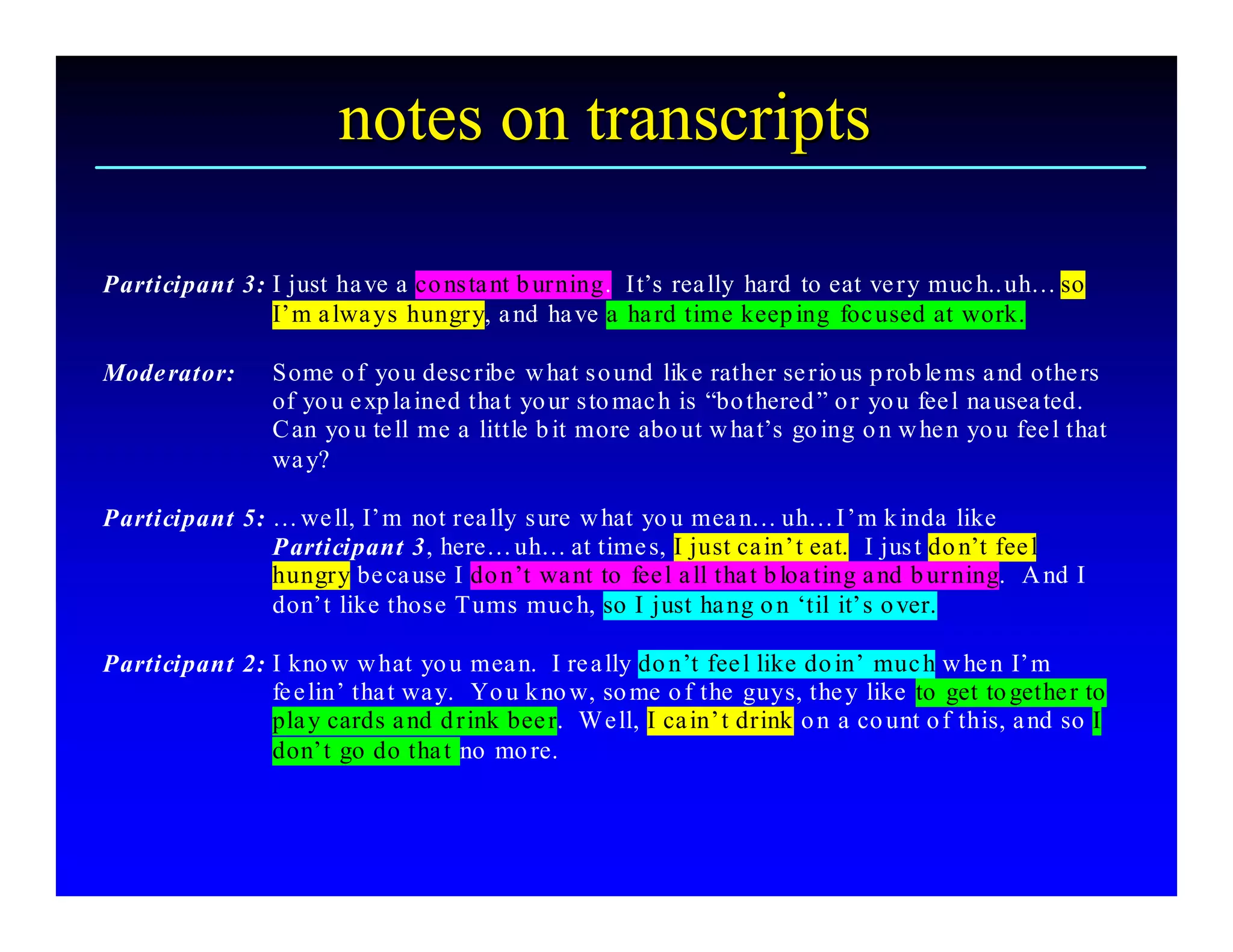
notes on transcripts 

Participant 3: I just  ha ve a co ns ta nt b urning.  It’s rea lly hard  to eat ve ry muc h.. uh… so 
               I’m a lwa ys  hungry, a nd ha ve a  ha rd time keep ing  foc used at work. 

Mode rator:       Some o f  yo u desc ribe  w hat s o und  lik e rather se rio us p rob le ms a nd othe rs 
                  of  yo u e xp la ined tha t  yo ur s to mac h is “bo thered ” o r  yo u  fee l na usea ted. 
                  C an  yo u te ll  me a  little b it more abo ut w ha t’s  go ing o n w he n yo u  fee l that 
                  wa y? 

Participant 5: … we ll, I’m  not rea lly s ure w hat  yo u mea n… uh… I’m k inda  like 
               P articipant 3, here… uh… at time s, I just ca in’t eat.  I jus t do n’t  fee l 
               hungry be ca use I do n’t  wa nt  to  fee l a ll tha t b loa ting a nd b urning.   A nd I 
               don’t  like thos e Tums muc h, so I just  ha ng o n ‘til  it’s o ver. 

Participant 2: I kno w w hat  yo u  mea n.  I re a lly do n’t  fee l like do in’  muc h w he n  I’m 
               fe e lin’ tha t wa y.   Yo u k no w, so me o f the  guys, the y  like  to  get to gethe r to 
               pla y cards a nd d rink bee r.  W e ll, I ca in’t drink o n  a co unt o f  this, a nd so I 
               don’t  go do tha t  no mo re.
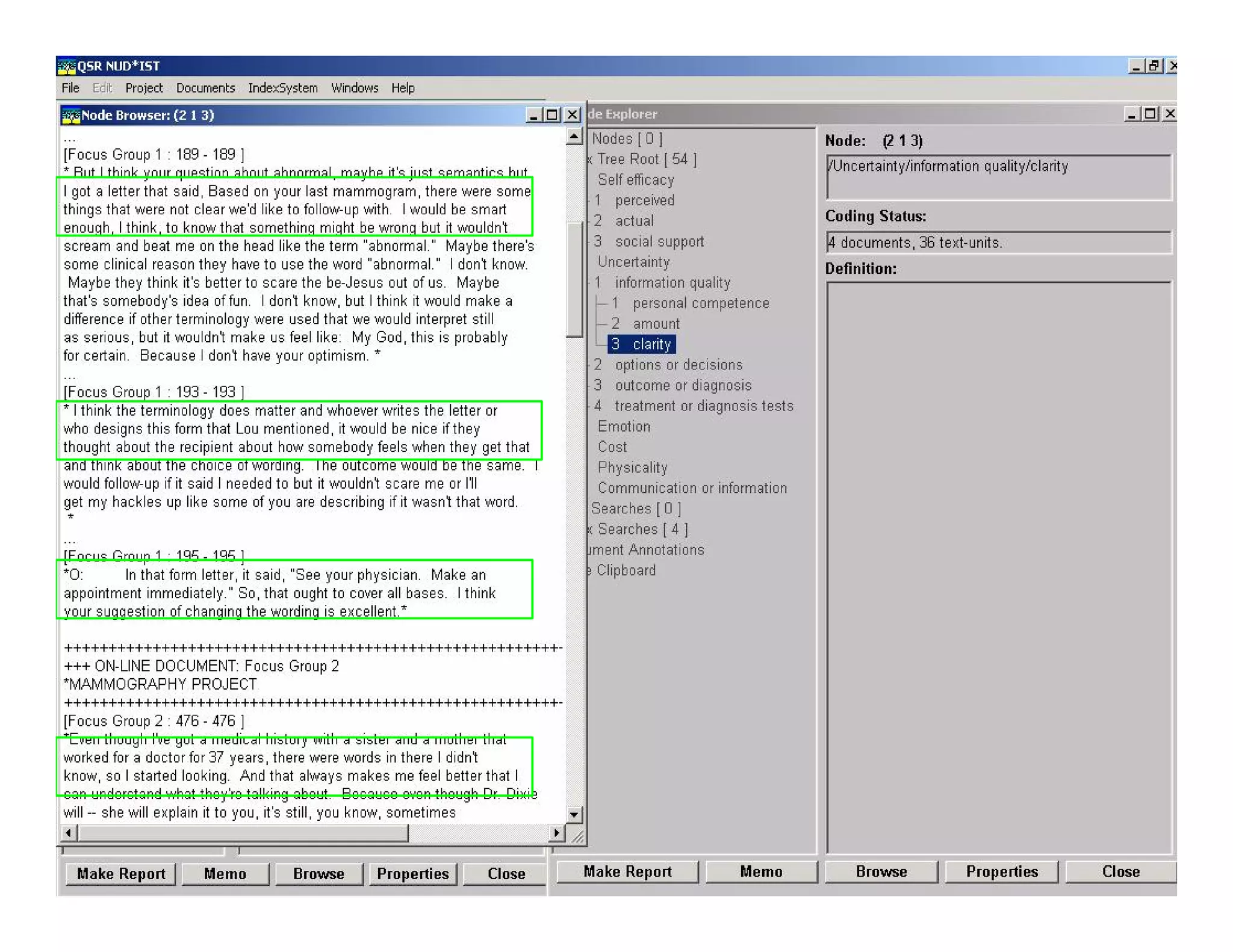
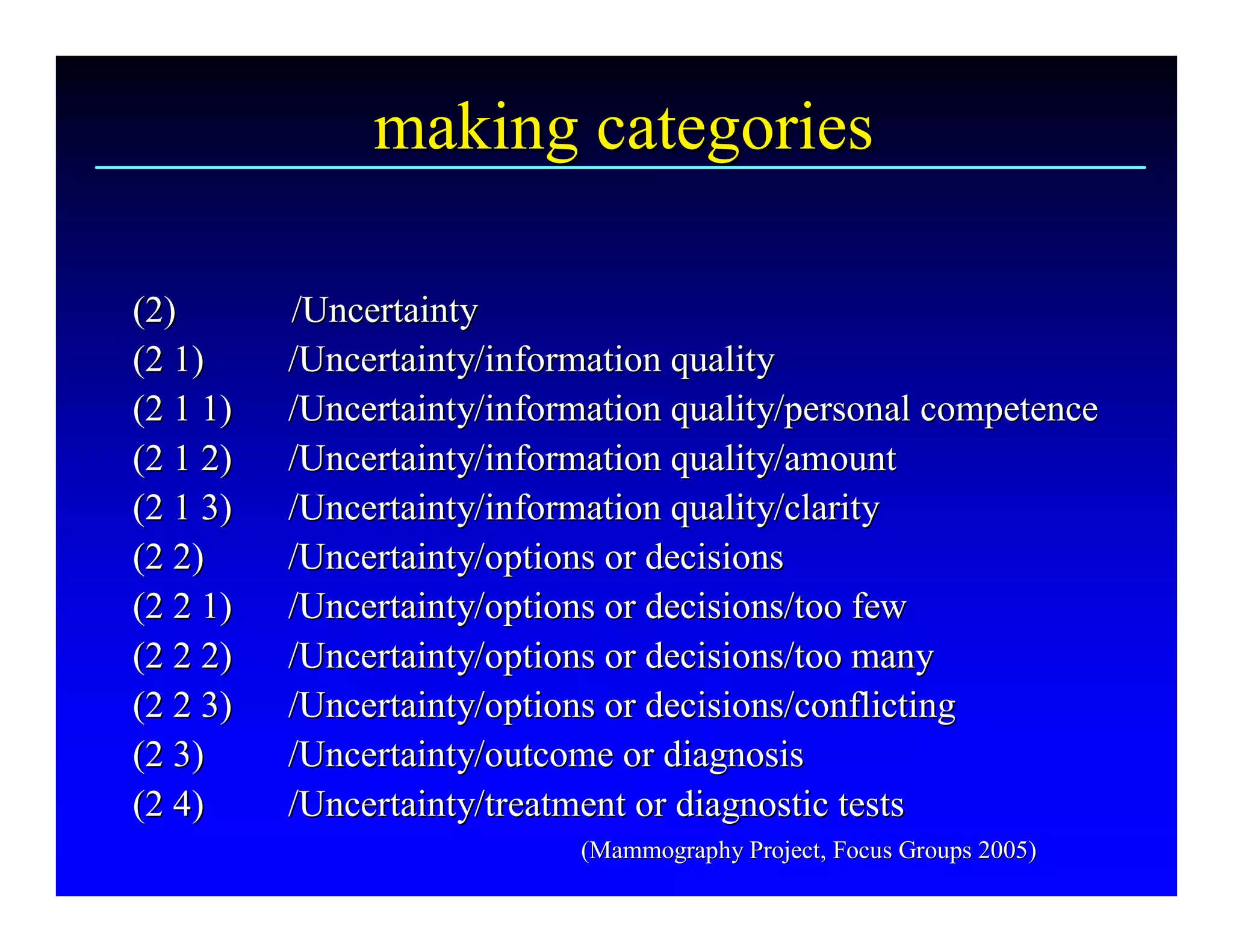
making categories 

(2)           /Uncertainty 
(2 1)         /Uncertainty/information quality 
(2 1 1)      /Uncertainty/information quality/personal competence 
(2 1 1)      /Uncertainty/information quality/personal competenc 
(2 1 2)      /Uncertainty/information quality/amount 
(2 1 3)      /Uncertainty/information quality/clarity 
(2 2)         /Uncertainty/options or decisions 
(2 2 1)      /Uncertainty/options or decisions/too few 
(2 2 2)      /Uncertainty/options or decisions/too many 
(2 2 3)      /Uncertainty/options or decisions/conflicting 
(2 3)         /Uncertainty/outcome or diagnosis 
(2 4)         /Uncertainty/treatment or diagnostic tests 
                              (Mammography Project, Focus Groups 2005)
                              (Mammography Project, Focus Groups 2005) 
presenting results 
§  chart formats 
§
§  tables with summary data 
§
§  tables that present similarities and contrasts 
§
§  long text passages
§ long text passages 
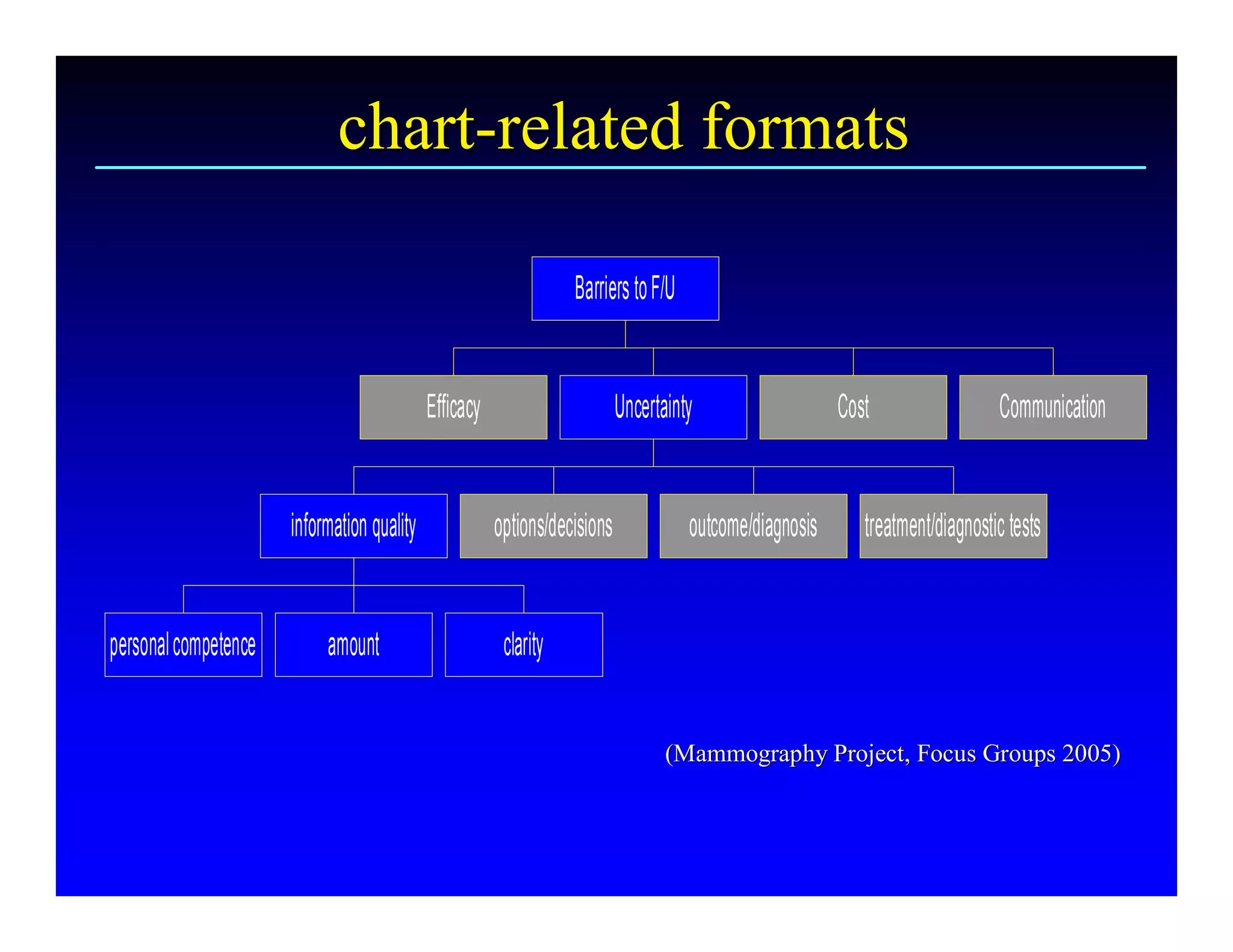
chart­related formats 
                              chart 
                                   ­ 

                                                                      Barriers to F/U 


                                              Efficacy                      Uncertainty                       Cost                   Communication 


                       information quality                options/decisions              outcome/diagnosis       treatment/diagnostic tests 


personal competence         amount                         clarity 


                                                                                   (Mammography Project, Focus Groups 2005)
                                                                                   (Mammography Project, Focus Groups 2005) 
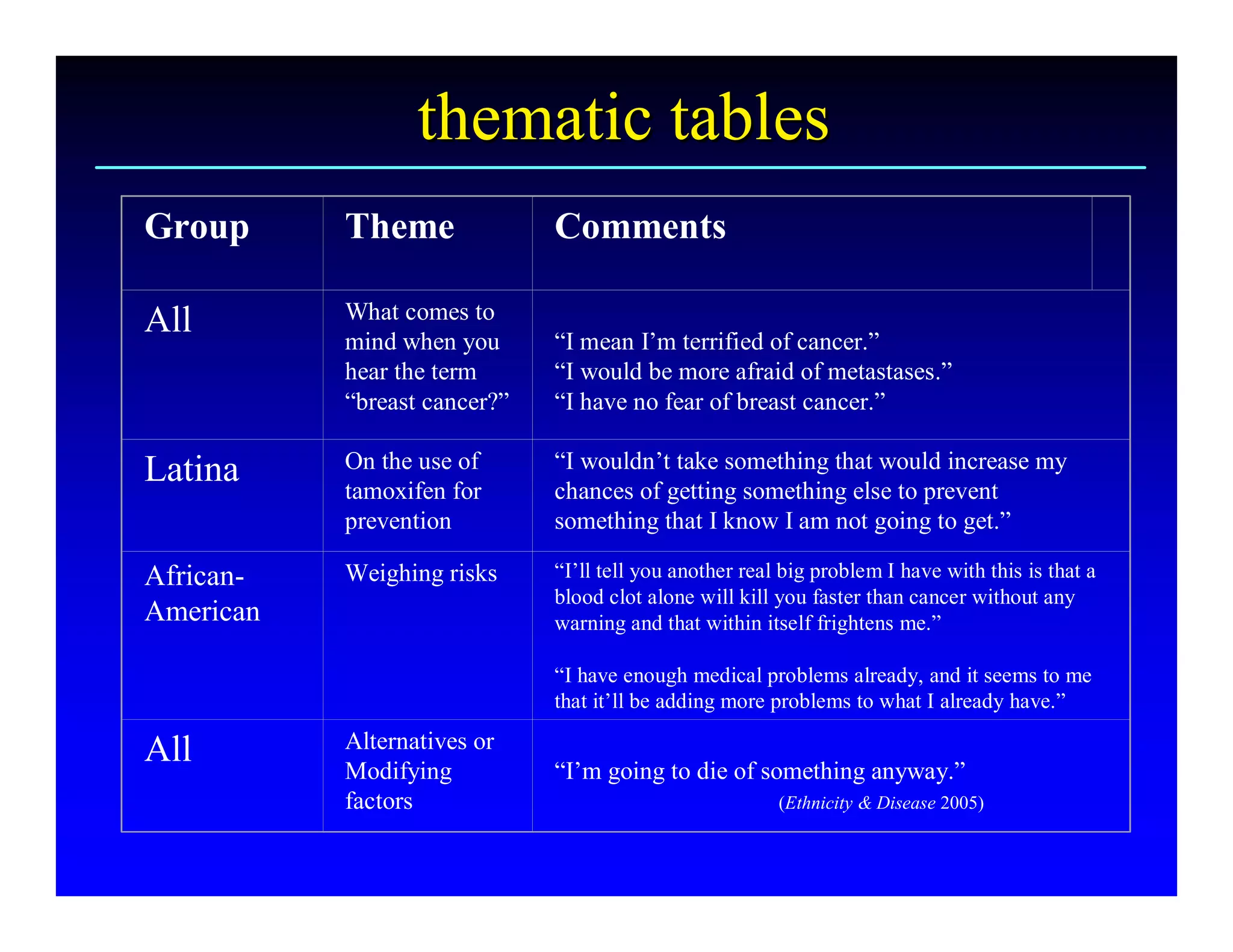
thematic tables 
Group       Theme               Comments 

All         What comes to 
            mind when you       “I mean I’m terrified of cancer.” 
            hear the term       “I would be more afraid of metastases.” 
            “breast cancer?”    “I have no fear of breast cancer.” 

Latina      On the use of       “I wouldn’t take something that would increase my 
            tamoxifen for       chances of getting something else to prevent 
            prevention          something that I know I am not going to get.” 

African­    Weighing risks      “I’ll tell you another real big problem I have with this is that a 
                                blood clot alone will kill you faster than cancer without any 
American                        warning and that within itself frightens me.” 

                                “I have enough medical problems already, and it seems to me 
                                that it’ll be adding more problems to what I already have.” 

All         Alternatives or 
            Modifying           “I’m going to die of something anyway.” 
            factors                                        (Ethnicity & Disease 2005)
Part IV: Using Results
Part IV: Using Results 
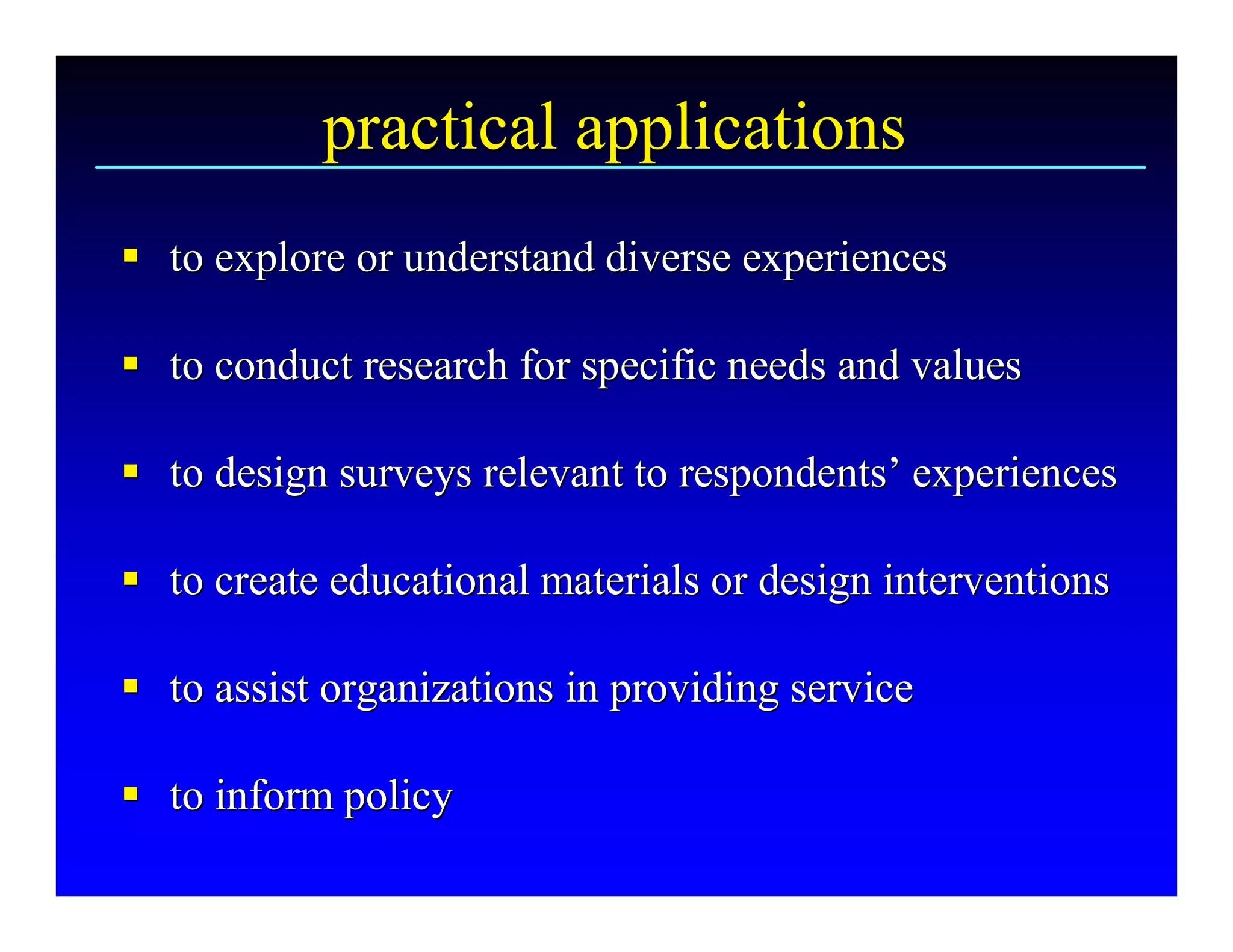
practical applications 
§  to explore or understand diverse experiences 
§

§  to conduct research for specific needs and values 
§

§  to design surveys relevant to respondents’ experiences 
§ to design surveys relevant to respondents 

§  to create educational materials or design interventions 
§

§  to assist organizations in providing service 
§

§  to inform policy
§ to inform policy 
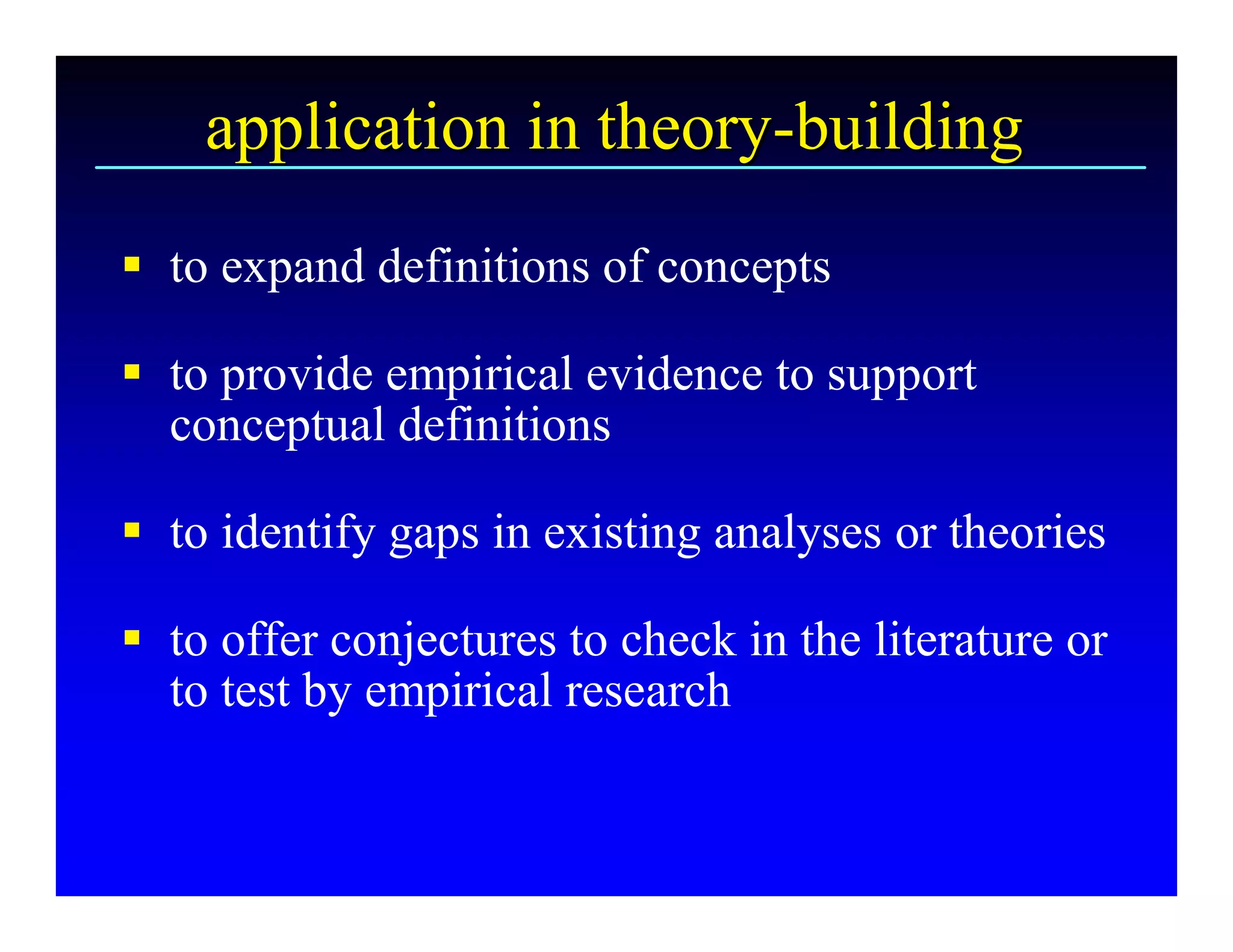
application in theory­building 
    application in theory 
                         ­ 
§  to expand definitions of concepts 

§  to provide empirical evidence to support 
   conceptual definitions 

§  to identify gaps in existing analyses or theories 

§  to offer conjectures to check in the literature or 
   to test by empirical research
Part V: Ethics & Conduct
Part V: Ethics & Conduct 
obligations to research subjects 
§  how much do we hold onto our agenda? 

§  how much do we reveal about ourselves? 
§  how far do we probe into sensitive areas? 
§  how tightly do we hold onto the traditional 
   roles of researcher and subject? 
§  what role do these decisions have in 
   influencing our analysis and write­up of the 
   “data”?
In Summary…
In Summary 
          … 
“Doing” qualitative research involves… 
 “ 
  Doing  qualitative research involves 
§  inductive logic 
§
§  non probability sampling 
§
§  understanding perspectives of participants 
§
§  using open­ended questions & observation 
§ using open  ­ 
§  exploring types & meanings, structures, and 
§
   processes 
§  obtaining feedback from participants 
§
§  theory­building and hypotheses development 
§ theory  ­ 
§  assessing the researcher­participant 
§ assessing the researcher ­ 
   relationship
   relationship 

qualitative research

  • 1.
    Qualitative Research  Methods  Debora A. Paterniti, Ph.D.  Center for Health Services Research in  Primary Care  Departments of Internal Medicine & Sociology Departments of Internal Medicine & Sociology 
  • 3.
    theory  empirical  hypotheses  generalizations empirical  observations 
  • 4.
  • 5.
    purpose of qualitative methods  §  to provide an open­ended, in­depth exploration  of an aspect of life  §  to focus attention on a particular experience  §  to gain a specific person’s or group’s insights  about an experience
  • 6.
    purpose of qualitative methods  §  to elicit subjective world views of an  experience  §  to gain an in­depth understanding of the nature  of social settings and behaviors from the  “native” standpoint
  • 7.
    modes of data collection  ¯  ¯ intensive interviewing  ¯  ¯ focus groups interviews  ¯  ¯ field research  ¯  ¯ case studies  ¯  ¯ discourse/conversational analysis discourse/conversational analysis 
  • 8.
    intensive interviewing  §  an open­ended, directed conversation that  explores a participant’s deep, first­hand  knowledge  §  focuses on “lived experience”  §  emphasizes “sense­making”  §  an in­depth and intimate discussion beyond  what ordinary conversational conventions and  etiquette permit
  • 9.
    focus groups  §  a small group discussion  § §  guided by a set of research questions that  § explore attitudes, values, and behaviors  §  emphasizing a particular topic or event  § §  homogenous yet diverse group  § §  lead by a trained discussion leader § lead by a trained discussion leader 
  • 10.
    field research  §  prolonged observation involving specific  contexts, persons, or behaviors  §  entry into the “worlds” of persons and  behaviors of interest  §  an attempt to understand a particular aspect of  the “lived experience” from the perspective of  those who live it
  • 11.
    non probability sampling strategies  §  convenience sampling­ ease of availability  §  snowball sampling­ selection of additional  people for interviewing based on previous  interviews  §  purposeful sampling­ judgment about which  might be the most useful or representative  §  quota sampling­ specified characteristics  known to be representative of the  population
  • 12.
    finding participants  §  invitation by mail or telephone  § Researcher­ driven  §  contact person (e.g., physician)  § §  targeted groups (e.g., churches)  § §  posted flyers  § §  newspaper and radio advertisements  § §  word of mouth  § Participant­driven
  • 13.
    selecting settings & behaviors  PRIVATE  secretive  non secretive PUBLIC 
  • 14.
    barriers to subject participation  §  travel to the research site  § §  opinions of family, friends, or “experts”  § “  experts  §  timing of interview or observations  § §  setting­related constraints (gatekeepers)  § setting ­  §  Hawthorne effect  § §  researcher knowledge & status § researcher knowledge & status 
  • 15.
  • 16.
  • 17.
    general guiding questions  §  types and meanings  § §  what is this?  what does this mean?  § §  structures  § §  what are the contexts that give this meaning?  § §  processes  § §  how does this come to have meaning? § how does this come to have meaning? 
  • 18.
    data collection strategies  §  asking questions  § §  § phrasing questions  §  § open­ended questions  open ­  §  § ask participants to think back  §  § avoid asking “why”  “  why  §  § keep questions simple  §  § be cautious about giving examples be cautious about giving examples 
  • 19.
    strategies for collecting data  §  interactional style  § §  § be conversational  §  § be clear  §  § allow sufficient time for responses  §  § use what works  §  § recognize the limits  §  observing behavior  § §  take notes on the group or setting dynamic  § §  note limitations of recording devices § note limitations of recording devices 
  • 20.
    types of interview questions  §  opening & introductory questions  § §  tell us about….  § tell us about …  §  when you hear….  § when you hear  …  §  transition questions  § §  what have you done….  § what have you done …  §  how did you come to….  § how did you come to …  §  key questions  § §  what were the most important….  § what were the most important …  §  ending questions  § §  of all of the things that you described…. § of all of the things that you described  .  … 
  • 21.
    forms of qualitative data  §  transcripts of interviews  § §  audio­recorded conversations  §audio  ­  §  notated observations made during interviews or  § in a specific setting  §  pictures or videos of social group dynamics or  § behaviors in context behaviors in context 
  • 22.
    examples: interview & focus group data  §  what does this mean?  § §  how does it come to have meaning?  § § meaning  § §  what does having a diagnosis mean?  § §  processes  § §  how does the diagnosis come to have meaning? § how does the diagnosis come to have meaning? 
  • 23.
    interview transcript excerpt  …when I was first diagnosed, my physician, she  …  uh, ‘Mr. [X], you have…cancer…on one side  ‘  Mr. [X], you have  cancer  …  …  of your prostate, no…two sides.  It take me for  of your prostate, no  …  a shock at that moment.  I’m a firm believer  a shock at that moment.  I  ’  that you don’t worry about anything that you  that you don  ’  can’t do anything about. {cough}  can ’  …then I went down and picked up some literature  …  ‘cause I really wasn’t educated on prostate  ‘ cause I really wasn ’  cancer, and uh…it was very limited anyway.  I  cancer, and uh  …  started readin’ it, and went home and discussed  readin  it with my wife…and I have a son­in­law, he’s  it with my wife  and I have a son  in  law, he  …  ­  ­  ’  a doctor, and they made me make the  decision…. (Cancer Decision­­ making Project, ACS) decision  (Cancer Decision  making Project, ACS)  … 
  • 24.
    focus group transcript excerpt  P1:  …ya know, I waslookin’ for the side effects, ya  know, ‘cause like I told y’all in the beginning, I was,  ‘I don’t know about this medication’ it’s…is it gonna  make me worse?  But…I mean, it helped me…  P2:  …Let, let me ask a question [of] e’rybody: did the  diagnosis scare y’all?”  P3: ..yeah…  P4: …it scared the shit—it scared me.  P1: it did me…cause I had known that I had some risky  behaviors…I have known there was a chance of this  [P2: yeah], so I didn’t ‘freak out’…but of course, you  face a death sentence, it’s gonna scare anybody.  (Combo­Antiretroviral Adherence Project, VA focus group)
  • 25.
    examples: field research data  §  what is the “nature” of this place?  § “  nature  §  structures  § §  what are the contexts that give institutional life  § meaning? meaning? 
  • 26.
    field note excerpt  Colorless paint and faded wallpaper provided the backdrop for  dozens of bodies seated in the open entryway.  An older man  with dark skin sat tied in his wheelchair with a three­inch  webbed belt surrounding him; he had wet his pants.  The sight  of his pants intensified the smell of urine.  The man attempted to move himself down one of the many  corridors with his right leg, casting it out in front of him and  pulling back as he leaned forward in a feeble effort to move his  body with the aid of a chair, stopping his chair next to the post  where I stood.  As I tried to get my bearings, he tried to  maintain his balance.  He took a couple of deep breaths, then  loudly cleared his throat, spitting at the post as I moved past  him.  A woman screamed, and I looked around at others who seemed  deaf or accustomed to the noise.  I heard the man behind me  begin to clear his throat again as I disappeared behind the  heavy wooden door marked “Staff Only.” (J Cont Ethn 2000)
  • 27.
    assessing data collection  §  describe context and structure of the situation  §  record observations of participants  § assess quality of the data  §  evaluate relative usefulness of guiding  questions  §  acknowledge areas of difficulty
  • 28.
  • 29.
    data analysis process  §  organizing and sorting data  § §  developing categories from organizational units  § §  developing categories from questions about  § meanings, structures, and processes  §  coding data  § §  what is this?  what does it represent?  § §  what do i see going on here? what are people  § doing?  what is happening?  what kinds of events  are at issue?  §  what is this an example of? how is it related to  § other things? other things? 
  • 30.
    data analysis process  §  continuous identification and comparison  § §  retrieving and examining data  § §  identifying meaningful units  § §  developing structures and noting relationships  § §  defining processes  § §  drawing conclusions  § §  note categories of meaningful elements  § §  summarize structural relationships  § §  describe prominent patterns and processes § describe prominent patterns and processes 
  • 31.
    notes on transcripts  Participant 3: I just  ha ve a cons ta nt b urning.  It’s rea lly hard  to eat ve ry muc h.. uh… so  I’m a lwa ys  hungry, a nd ha ve a  ha rd time keep ing  foc used at work.  Mode rator:  Some o f  yo u desc ribe  w hat s o und  lik e rather se rio us p rob le ms a nd othe rs  of  yo u e xp la ined tha t  yo ur s to mac h is “bo thered ” o r  yo u  fee l na usea ted.  C an  yo u te ll  me a  little b it more abo ut w ha t’s  go ing o n w he n yo u  fee l that  wa y?  Participant 5: … we ll, I’m  not rea lly s ure w hat  yo u mea n… uh… I’m k inda  like  P articipant 3, here… uh… at time s, I just ca in’t eat.  I jus t do n’t  fee l  hungry be ca use I do n’t  wa nt  to  fee l a ll tha t b loa ting a nd b urning.   A nd I  don’t  like thos e Tums muc h, so I just  ha ng o n ‘til  it’s o ver.  Participant 2: I kno w w hat  yo u  mea n.  I re a lly do n’t  fee l like do in’  muc h w he n  I’m  fe e lin’ tha t wa y.   Yo u k no w, so me o f the  guys, the y  like  to  get to gethe r to  pla y cards a nd d rink bee r.  W e ll, I ca in’t drink o n  a co unt o f  this, a nd so I  don’t  go do tha t  no mo re.
  • 33.
    making categories  (2)  /Uncertainty  (2 1)         /Uncertainty/information quality  (2 1 1)      /Uncertainty/information quality/personal competence  (2 1 1)      /Uncertainty/information quality/personal competenc  (2 1 2)      /Uncertainty/information quality/amount  (2 1 3)      /Uncertainty/information quality/clarity  (2 2)         /Uncertainty/options or decisions  (2 2 1)      /Uncertainty/options or decisions/too few  (2 2 2)      /Uncertainty/options or decisions/too many  (2 2 3)      /Uncertainty/options or decisions/conflicting  (2 3)         /Uncertainty/outcome or diagnosis  (2 4)         /Uncertainty/treatment or diagnostic tests  (Mammography Project, Focus Groups 2005) (Mammography Project, Focus Groups 2005) 
  • 34.
    presenting results  §  chart formats  § §  tables with summary data  § § tables that present similarities and contrasts  § §  long text passages § long text passages 
  • 35.
    chart­related formats  chart  ­  Barriers to F/U  Efficacy  Uncertainty  Cost  Communication  information quality  options/decisions  outcome/diagnosis  treatment/diagnostic tests  personal competence  amount  clarity  (Mammography Project, Focus Groups 2005) (Mammography Project, Focus Groups 2005) 
  • 36.
    thematic tables  Group  Theme  Comments  All  What comes to  mind when you  “I mean I’m terrified of cancer.”  hear the term  “I would be more afraid of metastases.”  “breast cancer?”  “I have no fear of breast cancer.”  Latina  On the use of  “I wouldn’t take something that would increase my  tamoxifen for  chances of getting something else to prevent  prevention  something that I know I am not going to get.”  African­  Weighing risks  “I’ll tell you another real big problem I have with this is that a  blood clot alone will kill you faster than cancer without any  American  warning and that within itself frightens me.”  “I have enough medical problems already, and it seems to me  that it’ll be adding more problems to what I already have.”  All  Alternatives or  Modifying  “I’m going to die of something anyway.”  factors  (Ethnicity & Disease 2005)
  • 37.
  • 38.
    practical applications  §  to explore or understand diverse experiences  § §  to conduct research for specific needs and values  § § to design surveys relevant to respondents’ experiences  § to design surveys relevant to respondents  §  to create educational materials or design interventions  § §  to assist organizations in providing service  § §  to inform policy § to inform policy 
  • 39.
    application in theory­building  application in theory  ­  §  to expand definitions of concepts  §  to provide empirical evidence to support  conceptual definitions  §  to identify gaps in existing analyses or theories  §  to offer conjectures to check in the literature or  to test by empirical research
  • 40.
  • 41.
    obligations to research subjects  §  how much do we hold onto our agenda?  §  how much do we reveal about ourselves?  § how far do we probe into sensitive areas?  §  how tightly do we hold onto the traditional  roles of researcher and subject?  §  what role do these decisions have in  influencing our analysis and write­up of the  “data”?
  • 42.
  • 43.
    “Doing” qualitative research involves…  “  Doing  qualitative research involves  §  inductive logic  § §  non probability sampling  § §  understanding perspectives of participants  § §  using open­ended questions & observation  § using open  ­  §  exploring types & meanings, structures, and  § processes  §  obtaining feedback from participants  § §  theory­building and hypotheses development  § theory  ­  §  assessing the researcher­participant  § assessing the researcher ­  relationship relationship