Bonus Feature
         Kids Eyewear


                                                    BINOCULAR VISION DYSFUNCTION:


                                   Why
                                                      20/20     is not good enough
     B
              inocular vision (BV)
              dysfunction, a term
              generally     used     to
              describe problems with                                                             By Dr. Patrick Quaid, OD, FCOVD, PhD
     teaming and co-ordination of
     one’s eyes, is often a significant
     challenge to detect and treat in
                                                   with strabismus in the U.S.1 Indeed, published                               If you don’t think +1.25DS is a big deal, try
     the eyecare arena. BV disorders
                                                   research has indicated that “correctable vision                              over-minusing yourself by 1.25 dioptres for a
     are more frequently encountered
                                                   impairment” is the most common “treatable                                    day and get back to me. While we do not doubt
     than glaucoma, macular degen-
                                                   chronic condition in childhood”2,3. Building                                 that other factors are involved in reading ability,
     eration and diabetic retinopathy
                                                   a Comprehensive Child Vision Care System,                                    +1.25DS or higher on cycloplegic should also
     combined. Surely a condition
                                                   published by the National Commission on                                      prompt other BV specific tests, such as fusional
     that occurs 8.5 – 9.7 times more
                                                   Vision and Health4, has useful statistics for                                and accommodative facility and reserve
     often than all ocular disease
                                                   interested readers.                                                          measurement.
     in children aged six months to
     18 years1 combined deserves                   There is also growing research indicating an                                 Interestingly, published literature shows a
     greater attention.                            association between academic performance                                     three-times-higher incidence of convergence
                                                   and vision. One such study5 looked at 782                                    insufficiency (CI) in ADHD-diagnosed
     Using U.S. Census Bureau
                                                   first- to fifth-graders and found an association                             children compared to the general population6.
     estimates of the prevalence of
                                                   between lower academic achievement and                                       Given that five of the nine DSM-IV criteria
     amblyopia (2-3 percent) and
                                                   hyperopia of +1.25DS and higher. We looked                                   symptoms for ADHD overlap with CI, the
     strabismus (3-4 percent) in the
                                                   at this issue in our practice recently and                                   authors advised that any child with suspected
     general population, in 2010 there
                                                   found that students with a reading-based IEP                                 ADHD have CI specifically ruled out. CI is
     were approximately 9.3 million
                                                   (Individual Educational Plan) had significantly                              important to detect when we consider that the
     amblyopes and 18 million people
                                                   greater hyperopia compared to controls, with                                 Convergence Insufficiency Treatment Trial7
                                                   the median value being close to +1.25DS.                                     (a randomized controlled trial) showed that CI
                                                   Cycloplegic refractive error was used (i.e. drops)                           can be effectively treated using vision therapy.
                                                   as children often mask significant amounts of                                Interestingly, patients with known BV issues
                                                   hyperopia by virtue of their accommodation.                                  also score significantly worse on behavioural
                                                   Indeed, over 80 percent of IEP children in                                   test batteries (i.e. Connors scale)8, re-enforcing
                                                   this study saw 20/20 without glasses despite                                 the need to detect BV conditions in
                                                   significantly greater levels of hyperopia.                                   “behaviourally challenged” children. In short,
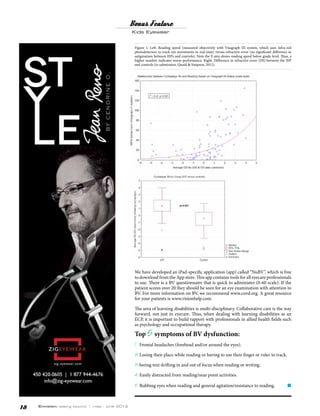
                                                   A worsening trend of reading speed is also                                   20/20 really is “not good enough”.
     Dr. Quaid practiced in the UK hospital
                                                   observed using the Visagraph III system with
     eyecare system, specifically dealing with     increasing levels of uncorrected hyperopia
     glaucoma co-management and pre- and           (Figure 1).
     post-operative care of binocular vision
     patients (Bradford Royal Infirmary).
     He attained his PhD in 2005 from the
     University of Waterloo School of              References:
     Optometry and started his practice in         1. MAINO, Dm (2010). The Binocular Vision Dysfuntional Pandemic (Ed). Optometry & Vision Development, 41(1), 6-13.
                                                   2. KEMPER et al (2004). Patterns of Vision Care Among Medicaid-Enrolled Children. Pediatrics, 113, 190-196.
     Guelph with IRIS The Visual Group (a          3. KEMPER et al (2004). Prevalence and Distribution of Corrective Lenses Among School-Aged Children. Optometry & Vision Science, 81(1), 7-10.
     collaborative care model) with specific       4. National Commission on Vision & Health (June 2009). Building a Comprehensive Child Vision Care System. Prepared by ABT Associated Inc., 55 Wheeler
     emphasis on binocular vision. Dr. Quaid          St., Cambridge, MA.
     serves on the Editorial Board for Optometry   5. Rosner J & Rosner J (1997). The Relationship Between Moderate Hyperopia and Academic Achievement. How Much Plus Is Enough? Journal of the American
     & Vision Development, is Adjunct Clinic          Optometric Association, 68, 648-650.
                                                   6. GRANET et al. (2005). The Relationship Between Convergence Insufficiency and ADHD. Strabismus, 13, 163-168.
     Faculty at UWSO and serves on the Quality     7. CITT Study Group (2005). Convergence Insufficiency Treatment Trial.
     Assurance Committee for the Ontario           8. BORSTING et al (2005). Measuring ADHD Behaviours in Children With Symptomatic Accommodative Dysfunction or Convergence Insufficiency:
     College of Optometrists.                         A Preliminary Study. Optometry, Vol. 76, Issue 10, 588 - 592


16   Envision: seeing beyond | may - june 2012
Bonus Feature
                                                 Kids Eyewear


                                                  Figure 1: Left: Reading speed (measured objectively with Visagraph III system, which uses infra-red
                                                  photodetectors to track eye movements in real time) versus refractive error (no significant difference in
                                                  astigmatism between IEPs and controls). Note the Y-axis shows reading speed below grade level. Thus, a
                                                  higher number indicates worse performance. Right: Difference in refractive error (DS) between the IEP
                                                  and controls (in submission, Quaid & Simpson, 2012).


                                                  We have developed an iPad-specific application (app) called “NuBV”, which is free
                                                  to download from the App store. This app contains tools for all eyecare professionals
                                                  to use. There is a BV questionnaire that is quick to administer (0-60 scale). If the
                                                  patient scores over 20 they should be seen for an eye examination with attention to
                                                  BV. For more information on BV, we recommend www.covd.org. A great resource
                                                  for your patients is www.visionhelp.com.

                                                  The area of learning disabilities is multi-disciplinary. Collaborative care is the way
                                                  forward, not just in eyecare. Thus, when dealing with learning disabilities as an
                                                  ECP, it is important to build rapport with professionals in allied health fields such
                                                  as psychology and occupational therapy.

                                                  Top     5 symptoms of BV dysfunction:
                                                  1.   Frontal headaches (forehead and/or around the eyes).

                                                  2. Losing their place while reading or having to use their finger or ruler to track.
                                                  3.Seeing text drifting in and out of focus when reading or writing.
                                                  4. Easily distracted from reading/near point activities.
                                                  5. Rubbing eyes when reading and general agitation/resistance to reading.

18   Envision: seeing beyond | may - june 2012

Quaid 20/20 is Not Enough

  • 1.
    Bonus Feature Kids Eyewear BINOCULAR VISION DYSFUNCTION: Why 20/20 is not good enough B inocular vision (BV) dysfunction, a term generally used to describe problems with By Dr. Patrick Quaid, OD, FCOVD, PhD teaming and co-ordination of one’s eyes, is often a significant challenge to detect and treat in with strabismus in the U.S.1 Indeed, published If you don’t think +1.25DS is a big deal, try the eyecare arena. BV disorders research has indicated that “correctable vision over-minusing yourself by 1.25 dioptres for a are more frequently encountered impairment” is the most common “treatable day and get back to me. While we do not doubt than glaucoma, macular degen- chronic condition in childhood”2,3. Building that other factors are involved in reading ability, eration and diabetic retinopathy a Comprehensive Child Vision Care System, +1.25DS or higher on cycloplegic should also combined. Surely a condition published by the National Commission on prompt other BV specific tests, such as fusional that occurs 8.5 – 9.7 times more Vision and Health4, has useful statistics for and accommodative facility and reserve often than all ocular disease interested readers. measurement. in children aged six months to 18 years1 combined deserves There is also growing research indicating an Interestingly, published literature shows a greater attention. association between academic performance three-times-higher incidence of convergence and vision. One such study5 looked at 782 insufficiency (CI) in ADHD-diagnosed Using U.S. Census Bureau first- to fifth-graders and found an association children compared to the general population6. estimates of the prevalence of between lower academic achievement and Given that five of the nine DSM-IV criteria amblyopia (2-3 percent) and hyperopia of +1.25DS and higher. We looked symptoms for ADHD overlap with CI, the strabismus (3-4 percent) in the at this issue in our practice recently and authors advised that any child with suspected general population, in 2010 there found that students with a reading-based IEP ADHD have CI specifically ruled out. CI is were approximately 9.3 million (Individual Educational Plan) had significantly important to detect when we consider that the amblyopes and 18 million people greater hyperopia compared to controls, with Convergence Insufficiency Treatment Trial7 the median value being close to +1.25DS. (a randomized controlled trial) showed that CI Cycloplegic refractive error was used (i.e. drops) can be effectively treated using vision therapy. as children often mask significant amounts of Interestingly, patients with known BV issues hyperopia by virtue of their accommodation. also score significantly worse on behavioural Indeed, over 80 percent of IEP children in test batteries (i.e. Connors scale)8, re-enforcing this study saw 20/20 without glasses despite the need to detect BV conditions in significantly greater levels of hyperopia. “behaviourally challenged” children. In short, A worsening trend of reading speed is also 20/20 really is “not good enough”. Dr. Quaid practiced in the UK hospital observed using the Visagraph III system with eyecare system, specifically dealing with increasing levels of uncorrected hyperopia glaucoma co-management and pre- and (Figure 1). post-operative care of binocular vision patients (Bradford Royal Infirmary). He attained his PhD in 2005 from the University of Waterloo School of References: Optometry and started his practice in 1. MAINO, Dm (2010). The Binocular Vision Dysfuntional Pandemic (Ed). Optometry & Vision Development, 41(1), 6-13. 2. KEMPER et al (2004). Patterns of Vision Care Among Medicaid-Enrolled Children. Pediatrics, 113, 190-196. Guelph with IRIS The Visual Group (a 3. KEMPER et al (2004). Prevalence and Distribution of Corrective Lenses Among School-Aged Children. Optometry & Vision Science, 81(1), 7-10. collaborative care model) with specific 4. National Commission on Vision & Health (June 2009). Building a Comprehensive Child Vision Care System. Prepared by ABT Associated Inc., 55 Wheeler emphasis on binocular vision. Dr. Quaid St., Cambridge, MA. serves on the Editorial Board for Optometry 5. Rosner J & Rosner J (1997). The Relationship Between Moderate Hyperopia and Academic Achievement. How Much Plus Is Enough? Journal of the American & Vision Development, is Adjunct Clinic Optometric Association, 68, 648-650. 6. GRANET et al. (2005). The Relationship Between Convergence Insufficiency and ADHD. Strabismus, 13, 163-168. Faculty at UWSO and serves on the Quality 7. CITT Study Group (2005). Convergence Insufficiency Treatment Trial. Assurance Committee for the Ontario 8. BORSTING et al (2005). Measuring ADHD Behaviours in Children With Symptomatic Accommodative Dysfunction or Convergence Insufficiency: College of Optometrists. A Preliminary Study. Optometry, Vol. 76, Issue 10, 588 - 592 16 Envision: seeing beyond | may - june 2012
  • 2.
    Bonus Feature Kids Eyewear Figure 1: Left: Reading speed (measured objectively with Visagraph III system, which uses infra-red photodetectors to track eye movements in real time) versus refractive error (no significant difference in astigmatism between IEPs and controls). Note the Y-axis shows reading speed below grade level. Thus, a higher number indicates worse performance. Right: Difference in refractive error (DS) between the IEP and controls (in submission, Quaid & Simpson, 2012). We have developed an iPad-specific application (app) called “NuBV”, which is free to download from the App store. This app contains tools for all eyecare professionals to use. There is a BV questionnaire that is quick to administer (0-60 scale). If the patient scores over 20 they should be seen for an eye examination with attention to BV. For more information on BV, we recommend www.covd.org. A great resource for your patients is www.visionhelp.com. The area of learning disabilities is multi-disciplinary. Collaborative care is the way forward, not just in eyecare. Thus, when dealing with learning disabilities as an ECP, it is important to build rapport with professionals in allied health fields such as psychology and occupational therapy. Top 5 symptoms of BV dysfunction: 1. Frontal headaches (forehead and/or around the eyes). 2. Losing their place while reading or having to use their finger or ruler to track. 3.Seeing text drifting in and out of focus when reading or writing. 4. Easily distracted from reading/near point activities. 5. Rubbing eyes when reading and general agitation/resistance to reading. 18 Envision: seeing beyond | may - june 2012